
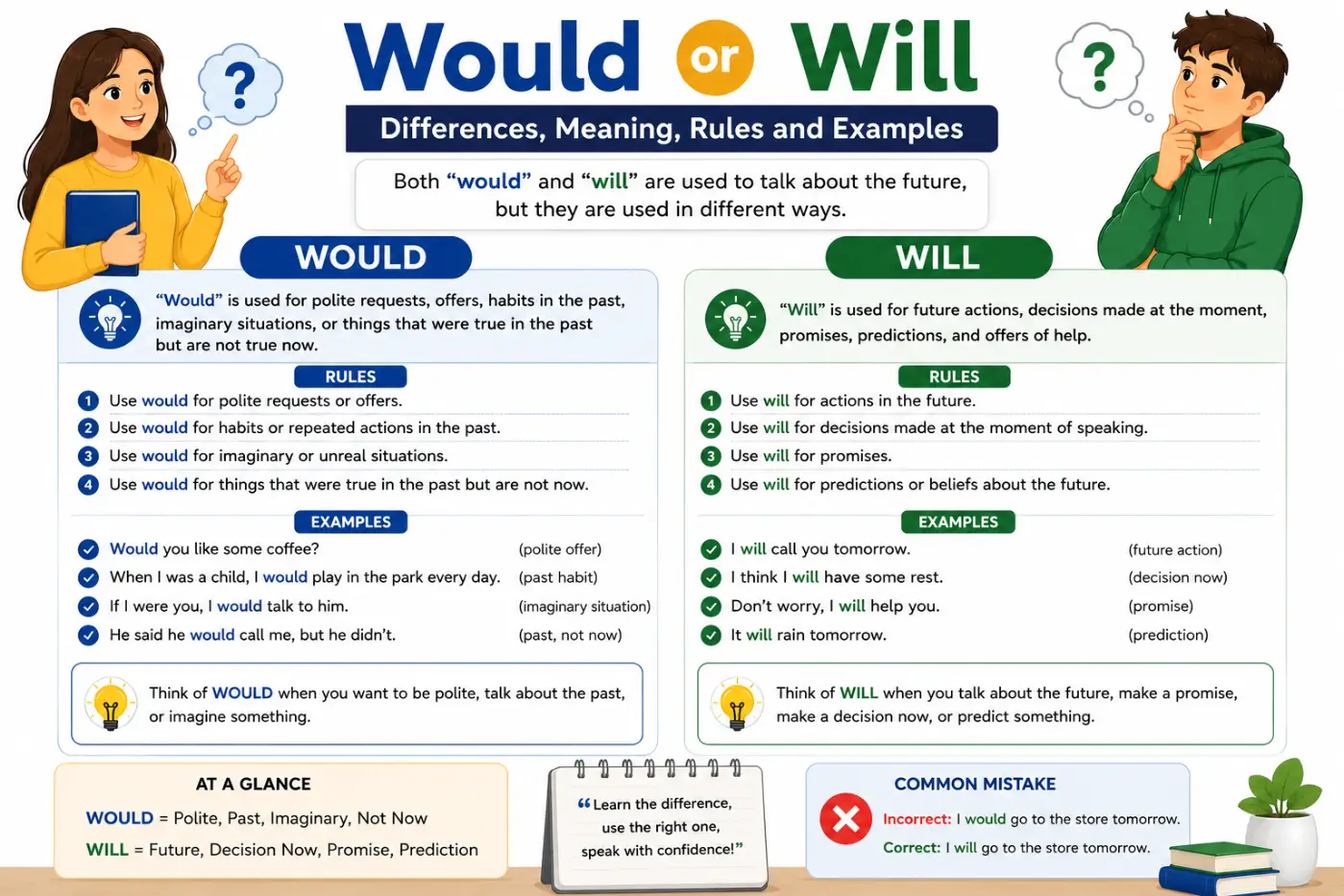
Would or Will is one of the most common grammar questions for English learners. Since both words are modal verbs and often appear in similar sentences, it’s easy to wonder which one is correct. The confusion becomes even greater because would can sometimes seem like the past form of will, while in other situations it has an entirely different meaning.
The good news is that the difference is straightforward once you understand the purpose of each word. Will usually talks about real future events, intentions, promises, predictions, and instant decisions. Would, on the other hand, often expresses imagined situations, polite language, preferences, repeated actions in the past, or reported speech.
This guide explains everything you need to know about Would or Will. You’ll learn the meanings, grammar rules, key differences, common mistakes, and practical examples so you can choose the correct modal verb with confidence.
Short Answer
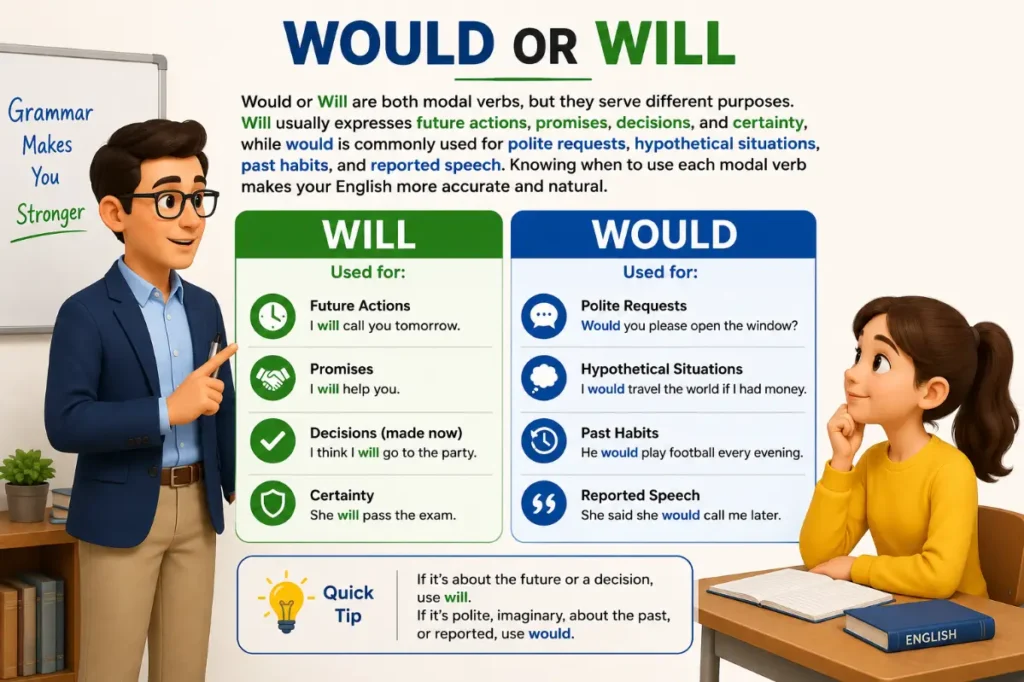
Would or Will are both modal verbs, but they serve different purposes. Will usually expresses future actions, promises, decisions, and certainty, while would is commonly used for polite requests, hypothetical situations, past habits, and reported speech. Knowing when to use each modal verb makes your English more accurate and natural.
Table of Contents
- What Does Will Mean
- What Does Would Mean
- Would or Will Quick Comparison
- The Main Difference Between Will and Would
- When to Use Will
- When to Use Would
- Future Actions
- Hypothetical Situations
- Polite Requests
- Reported Speech
- Past Habits
- Common Grammar Rules
- Everyday Examples
- Common Mistakes
- Memory Tips
What Does Will Mean
Will is a modal verb that mainly expresses future actions, predictions, promises, willingness, and decisions made at the moment of speaking.
Examples:
- I will call you tonight.
- She will arrive tomorrow.
- We will help you.
Each sentence refers to something expected to happen in the future.
Like all modal verbs, will does not change its form.
Correct:
- He will come later.
- They will join us.
Incorrect:
- He wills come later.
- They wills join us.
What Does Would Mean
Would is also a modal verb. It has several important uses, including polite requests, hypothetical situations, preferences, repeated actions in the past, and reported speech.
Examples:
- Would you help me?
- I would travel more if I had time.
- My grandfather would tell stories every evening.
Although would originally developed as the past form of will, modern English uses it in many additional ways.
Would or Will Quick Comparison
| Feature | Will | Would |
|---|---|---|
| Future actions | ✔ | |
| Predictions | ✔ | Sometimes |
| Promises | ✔ | |
| Instant decisions | ✔ | |
| Polite requests | ✔ | |
| Hypothetical situations | ✔ | |
| Past habits | ✔ | |
| Reported speech | ✔ | |
| Preferences | ✔ |
This comparison provides a quick overview before we examine each use in detail.
The Main Difference Between Will and Would
The biggest difference between Would or Will is certainty.
Will usually describes something the speaker expects to happen.
Would often describes something imagined, conditional, polite, or less certain.
Compare these examples.
Future Event
- I will visit Boston next month.
The speaker expects the trip to happen.
Imagined Situation
- I would visit Boston if I had enough vacation time.
The visit depends on another condition.
The first sentence talks about a real future plan.
The second talks about an imaginary possibility.
When to Use Will
To Talk About the Future
This is the most common use of will.
Examples:
- I will finish the report tomorrow.
- She will arrive at noon.
- They will move next year.
Each sentence describes a future event.
To Make Predictions
Examples:
- It will rain tonight.
- The economy will improve.
- You will enjoy this movie.
These predictions express confidence about the future.
To Make Promises
Examples:
- I will always support you.
- We will keep our promise.
- She will never forget your kindness.
The speaker commits to an action.
To Make Instant Decisions
Sometimes people decide something while speaking.
Examples:
- I’ll answer the phone.
- I’ll carry your bag.
- We’ll order pizza tonight.
The decision happens at that moment.
When to Use Would
To Make Polite Requests
One of the most common uses of would is making requests sound more polite.
Examples:
- Would you open the window?
- Would you mind waiting?
- Would you please help me?
These requests sound softer than using will.
Compare these.
- Will you help me?
Polite.
- Would you help me?
Even more polite.
To Describe Hypothetical Situations
Examples:
- I would buy that house if I had enough money.
- She would travel the world if she won the lottery.
- We would stay longer if we could.
These situations are imaginary or depend on another condition.
To Express Preferences
Examples:
- I would rather stay home.
- We’d prefer to leave early.
- I would love another cup of coffee.
These expressions describe personal preferences politely.
Future Actions
Understanding future actions helps explain the difference between Would or Will.
Will for Real Future Events
Examples:
- The meeting will begin at ten.
- We will visit our grandparents next weekend.
- She will graduate next year.
The speaker believes these events will happen.
Would for Imagined Future Events
Examples:
- I would move to Canada if I found the right job.
- He would start a business if he had more money.
- They would travel more if they retired.
Each sentence depends on another condition.
Polite Requests
Both modal verbs can ask someone to do something, but they create different tones.
Using Will
Examples:
- Will you close the door?
- Will you call me later?
- Will you help us?
These questions are polite but direct.
Using Would
Examples:
- Would you close the door?
- Would you call me later?
- Would you help us?
These questions sound more respectful and formal.
This is why customer service representatives often use would.
Hypothetical Situations
One of the clearest differences between Would or Will appears in conditional sentences.
Real Situation
- I will help you tomorrow.
The speaker plans to help.
Imaginary Situation
- I would help you if I were available.
Helping depends on another condition.
Notice that would often appears with if clauses.
Examples:
- I would buy it if it were cheaper.
- We’d visit if we had time.
- She would agree if you asked.
Reported Speech
Another important use of would is reported speech.
Direct speech:
- She said, “I will call you.”
Reported speech:
- She said she would call me.
Here, will changes to would because the reporting verb is in the past.
More examples.
Direct:
- He said, “I will finish it.”
Reported:
- He said he would finish it.
Direct:
- They said, “We will arrive early.”
Reported:
- They said they would arrive early.
This grammar rule is one of the most common uses of would.
Past Habits
Would can also describe repeated actions in the past.
Examples:
- Every summer, we would visit our grandparents.
- My father would read stories every night.
- She would always smile when she saw us.
These sentences describe habits that happened regularly in the past.
Notice that would cannot describe past states.
Correct:
- My grandfather would tell jokes.
Incorrect:
- My grandfather would be tall.
For past states, use used to or the simple past instead.
Correct:
- My grandfather was tall.
- My grandfather used to be tall.
Would vs Will in Conditional Sentences
Conditional sentences are another area where learners often struggle.
First Conditional
- If it rains, we will stay inside.
This describes a real future possibility.
Second Conditional
- If it rained tomorrow, we would stay inside.
This describes an unlikely or imaginary situation.
Third Conditional
- If we had left earlier, we would have caught the train.
This talks about an unreal past situation.
Learning these patterns makes choosing between would and will much easier.
Grammar Rules for Would and Will
Following a few simple rules will prevent most mistakes.
Rule 1
Always use the base form of the verb.
Correct:
- She will come.
- He would help.
Incorrect:
- She will comes.
- He would helps.
Rule 2
Never use to after these modal verbs.
Correct:
- I will go.
- We would stay.
Incorrect:
- I will to go.
- We would to stay.
Rule 3
Negative forms are simple.
- will not
- won’t
- would not
- wouldn’t
Examples:
- I won’t forget.
- She wouldn’t agree.
Rule 4
Questions begin with the modal verb.
Examples:
- Will you join us?
- Would you like some coffee?
- Will they arrive today?
- Would he accept the offer?
Pronunciation
| Word | IPA | Simple Pronunciation |
|---|---|---|
| Will | /wɪl/ | sounds like will |
| Would | /wʊd/ | sounds like wood |
Although they look similar, their vowel sounds are different.
Word Origin
The word will comes from the Old English willan, meaning “to wish” or “to want.”
The word would developed as the past form of will, but over time it gained several independent grammatical functions, including expressing politeness, hypothetical situations, and repeated past actions. Understanding this history explains why would appears in so many different types of sentences.
Would or Will in American and British English
The grammar rules for Would or Will are the same in both American and British English. The main differences involve style and word choice rather than grammar.
American English often uses contractions in both speech and writing.
Examples:
- I’ll call you tomorrow.
- We’d love to help.
- She’ll arrive soon.
British English also uses these contractions, especially in conversation.
In formal writing, both varieties may avoid contractions.
Examples:
- We will contact you shortly.
- I would appreciate your response.
Regardless of the variety of English, the meanings of will and would remain the same.
Comparison Table
| Situation | Will | Would |
|---|---|---|
| Future plans | ✔ | |
| Predictions | ✔ | Sometimes |
| Promises | ✔ | |
| Instant decisions | ✔ | |
| Polite requests | Sometimes | ✔ |
| Invitations | ✔ | |
| Preferences | ✔ | |
| Conditional sentences | ✔ | |
| Reported speech | ✔ | |
| Past habits | ✔ |
This table summarizes the most common uses of each modal verb.
Real Life Examples
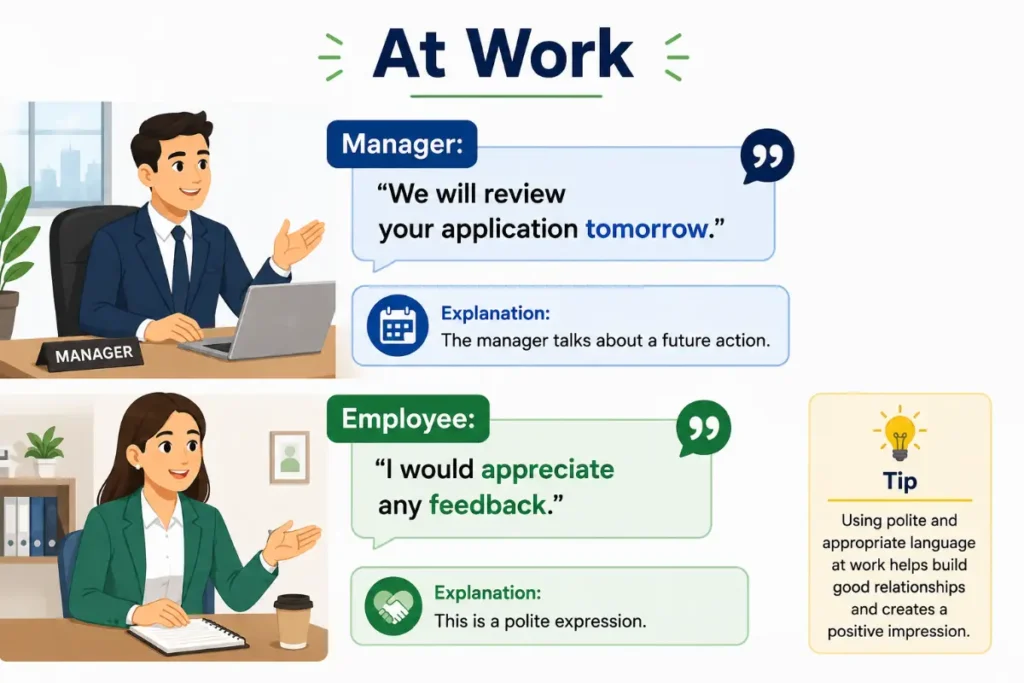
At Work
Manager:
“We will review your application tomorrow.”
Explanation: The manager talks about a future action.
Employee:
“I would appreciate any feedback.”
Explanation: This is a polite expression.
At School
Teacher:
“We will start the test in five minutes.”
Explanation: A scheduled future event.
Student:
“Would you explain question number three again?”
Explanation: A polite request.
At Home
Mother:
“We will have dinner at six.”
Explanation: A future plan.
Child:
“I would like more juice, please.”
Explanation: A polite request or preference.
While Shopping
Customer:
“I would like to return this item.”
Explanation: This is the standard polite expression used in stores.
Cashier:
“We will process your refund today.”
Explanation: A future action.
Everyday Conversation Examples
These examples show how native speakers naturally use Would or Will.
Example 1
Friend:
“Will you come to my birthday party?”
Reply:
“I will.”
The speaker agrees to a future action.
Example 2
Neighbor:
“Would you help me move this table?”
Reply:
“Of course.”
The request sounds polite.
Example 3
Family Conversation
“We will leave after breakfast.”
A future plan.
Example 4
Restaurant
“I would like a cup of coffee.”
This is the most natural way to order politely.
Example 5
Phone Conversation
“I’ll call you after work.”
A spontaneous promise about the future.
Common Mistakes
Many learners confuse Would or Will because both relate to future ideas.
Mistake 1
Using would for a definite future event.
Incorrect:
- I would see you tomorrow.
Correct:
- I will see you tomorrow.
Explanation: The meeting is planned, so will is correct.
Mistake 2
Using will in an imaginary condition.
Incorrect:
- If I had more money, I will buy a new car.
Correct:
- If I had more money, I would buy a new car.
Explanation: The situation is hypothetical.
Mistake 3
Using will in reported speech.
Incorrect:
- She said she will call me.
Correct:
- She said she would call me.
Explanation: The reporting verb is in the past.
Mistake 4
Using the wrong verb form.
Incorrect:
- She will goes.
- He would helps.
Correct:
- She will go.
- He would help.
Mistake 5
Adding to after the modal verb.
Incorrect:
- I will to leave.
- She would to help.
Correct:
- I will leave.
- She would help.
Memory Tips
These simple tricks make it much easier to remember the difference.
Think About Reality
Will talks about real future events.
Would talks about imagined situations or polite language.
Remember the Letter P
Would = Polite
When asking politely, would is often the best choice.
Remember the Letter F
Will = Future
When talking about definite future plans or promises, think of will.
Remember Conditional Sentences
If the sentence begins with an imaginary if clause, would is usually the correct choice.
Example:
- If I won the lottery, I would travel the world.
Use This Formula
Will + base verb
Would + base verb
Examples:
- I will call.
- I would call.
Never change the main verb after a modal verb.
Professional Writing Tips
Choosing the correct modal verb improves clarity and professionalism.
Business Emails
Professional:
- We will review your request within two business days.
Polite:
- We would appreciate your feedback.
Notice that will promises an action, while would softens a request.
Academic Writing
Researchers often use would when discussing hypothetical outcomes.
Example:
- A larger sample would improve the reliability of the results.
This avoids making absolute claims.
Customer Service
Customer service representatives frequently use would.
Examples:
- Would you mind holding for a moment?
- We would be happy to assist you.
These expressions sound respectful and welcoming.
Related Grammar and Usage Notes
Understanding related modal verbs strengthens your grammar skills.
Will vs Shall
Traditionally, shall was used with I and we for future actions.
Modern English usually prefers will.
Example:
- I will call tomorrow.
Would vs Could
Would often expresses willingness, preference, or hypothetical situations.
Could often expresses possibility or ability.
Examples:
- I would help if I had time.
- I could help if I finished early.
Would vs Might
Both describe hypothetical situations.
Examples:
- I would buy the house if I had enough money.
- I might buy the house next year.
The first depends on a condition.
The second expresses possibility.
Will vs Going To
Both describe future events.
Examples:
- I will answer the phone.
This is an instant decision.
- I am going to visit my parents this weekend.
This describes a planned action.
Understanding this difference makes your English sound more natural.
Key Takeaways
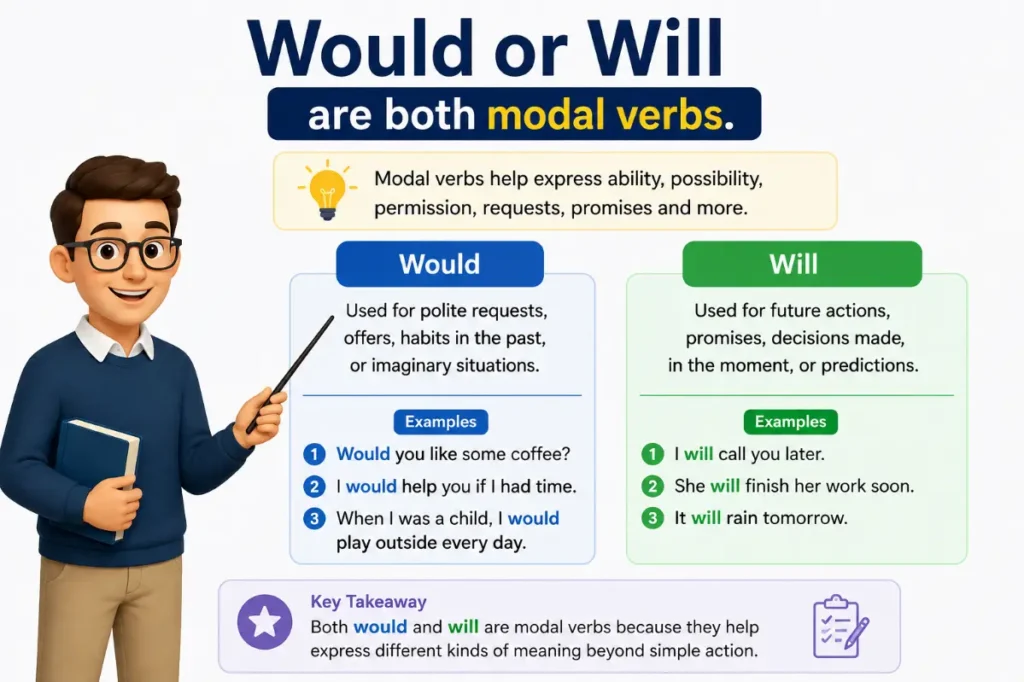
- Would or Will are both modal verbs.
- Will expresses future actions, predictions, promises, and instant decisions.
- Would expresses polite requests, hypothetical situations, reported speech, preferences, and past habits.
- Use will when talking about real future events.
- Use would in second and third conditional sentences.
- Would is more polite than will when making requests.
- Both modal verbs are followed by the base form of the main verb.
- Never use to after will or would.
- Context is the key to choosing the correct modal verb.
Conclusion
Understanding Would or Will helps you communicate more clearly in both spoken and written English. Although these modal verbs are closely related, they perform different grammatical functions. Will is the standard choice for future actions, promises, predictions, and instant decisions, while would is used for polite requests, hypothetical situations, conditional sentences, reported speech, preferences, and repeated actions in the past.
The easiest way to choose between them is to ask yourself what you want to express. If you’re talking about a real future event, will is usually the correct choice. If you’re describing an imagined situation, making a polite request, or reporting what someone said, would is generally the better option. By practicing these grammar rules and studying real-life examples, you’ll use Would or Will naturally and confidently in every situation.
Frequently Asked Questions
What is the difference between Would or Will?
Will is mainly used for future actions, promises, and predictions. Would is used for polite requests, hypothetical situations, reported speech, preferences, and repeated past actions.
Is would the past tense of will?
Historically, yes. In modern English, would also has several independent uses beyond reported speech.
When should I use will?
Use will for future plans, predictions, promises, offers, and decisions made at the moment of speaking.
When should I use would?
Use would for polite requests, hypothetical situations, conditional sentences, reported speech, and expressing preferences.
Which is more polite, will or would?
Would is generally more polite.
Compare:
- Will you help me?
- Would you help me?
The second sounds softer and more respectful.
Can would describe past habits?
Yes.
Example:
- Every Sunday, my grandmother would bake fresh bread.
This describes a repeated action in the past.
Can will be used in conditional sentences?
Yes, but mainly in first conditional sentences.
Example:
- If it rains, we will stay inside.
For imaginary situations, use would.
Is “I would like” more polite than “I want”?
Yes.
- I would like a coffee.
This sounds much more polite than:
- I want a coffee.
Can both words be used in business writing?
Yes. Will is used for commitments and future actions, while would is used to make requests and statements more polite.
What is the easiest way to remember Would or Will?
Remember this simple rule:
Will = Real future
Would = Imagined, polite, or conditional

English Grammar & Usage
Nathan Holloway is an American grammar writer and language researcher who specializes in English grammar, sentence structure, verb usage, and common writing mistakes. He enjoys breaking down confusing grammar rules into practical explanations with clear examples, making English easier for students, professionals, and everyday writers.