
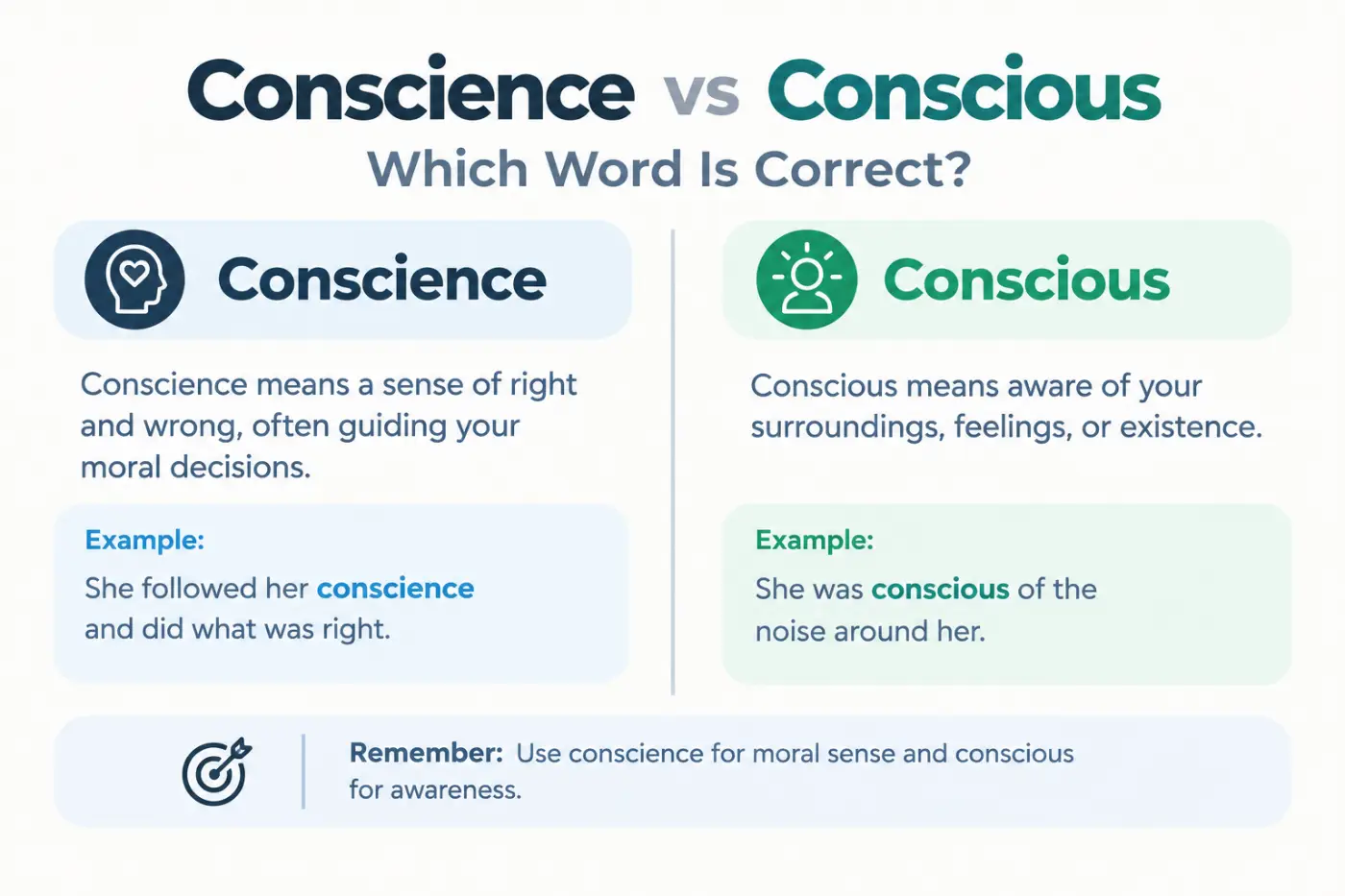
Conscience vs conscious can be confusing because these two words look similar, share the same Latin root, and relate to the mind. However, they serve different purposes in English. Conscience is a noun that describes your inner moral sense, while conscious is an adjective that describes your awareness or state of being awake.
The difference becomes easier to understand when you think about how each word works in everyday life. Your conscience may tell you that you should apologize after hurting someone’s feelings. You remain conscious of the other person’s pain when you recognize how your actions affected them. One word concerns moral judgment, while the other concerns awareness.
Learning the distinction helps you write more clearly at school, at work, in personal messages, and in formal documents. It also helps you avoid common spelling mistakes, choose the right word in a sentence, and recognize related expressions such as conscientious, consciously, and unconscious. Once you understand their meanings and grammatical roles, choosing the correct word becomes much easier.
Short Answer
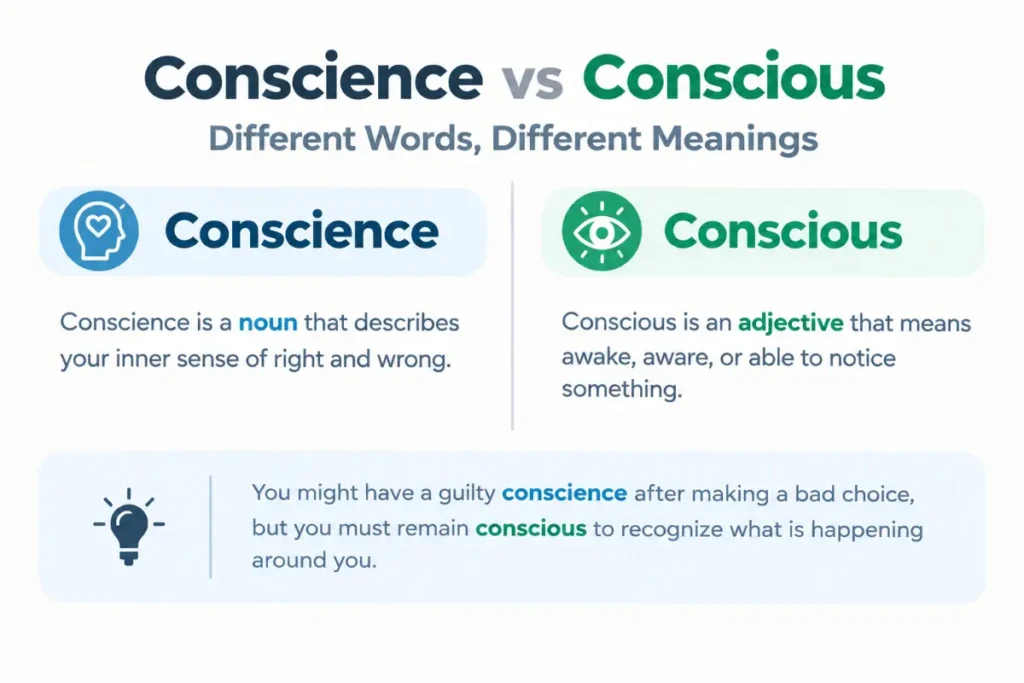
Conscience vs conscious comes down to the difference between a person’s sense of right and wrong and their awareness of something. Conscience is the inner sense that helps you judge your actions as right or wrong. Conscious is an adjective that means awake, aware, or mentally alert. For example, your conscience may bother you after you lie, but you must be conscious to recognize what happened.
Table of Contents
- What Conscience Means.
- What Conscious Means.
- The Main Difference Between the Two Words.
- Comparison Table.
- How to Use Conscience Correctly.
- How to Use Conscious Correctly.
- Pronunciation and Spelling Differences.
- Word Origins and Related Words.
- Real Life Examples.
- Common Mistakes to Avoid.
- Easy Memory Tips.
- Related Grammar and Usage Notes.
- Frequently Asked Questions.
- Key Takeaways.
- Conclusion.
What Conscience Means
Conscience is a noun that refers to your inner sense of right and wrong. It helps you judge your behavior and recognize when your actions agree with or violate your moral beliefs.
Your conscience can influence how you treat people, make decisions, accept responsibility, and respond after making a mistake. It may create feelings of guilt when you do something you believe is wrong or give you peace of mind when you act honestly.
For example, imagine that a cashier accidentally gives you too much change. You notice the mistake and return the extra money because you know keeping it would be dishonest. Your conscience helps you recognize the right thing to do.
The Basic Meaning of Conscience
The word usually refers to a person’s moral judgment rather than general awareness. It can influence your decisions before you act and your feelings after you act.
Consider these examples.
- My conscience told me to admit the mistake. This means the speaker felt a moral responsibility to be honest.
- She has a clear conscience. This means she feels she has done nothing that violates her moral standards.
- He felt guilty because his conscience bothered him. This means he experienced moral discomfort because of something he had done.
- I cannot do that in good conscience. This means the speaker believes the action would violate their moral principles.
- Her conscience would not let her keep the money. This means her moral beliefs prevented her from keeping something that did not belong to her.
Each example connects conscience with moral responsibility, honesty, guilt, or a person’s sense of right and wrong.
Conscience in Everyday Life
Your conscience can affect ordinary decisions as much as major moral choices. It may remind you to tell the truth, return a borrowed item, give credit to someone who helped you, or admit that you made an error.
For instance, a student who realizes that a classmate did most of a group project may feel that taking all the credit would be unfair. The student’s conscience encourages them to acknowledge the classmate’s contribution.
Likewise, an employee might refuse to hide a mistake from a customer because doing so would violate their personal standards. In both cases, conscience influences behavior by helping a person judge what is right.
However, conscience does not guarantee that a person’s judgment will always be correct. People develop moral beliefs through family, culture, education, religion, personal experience, and reflection. Two people can sometimes reach different moral conclusions about the same situation.
Common Expressions With Conscience
Several familiar expressions use this noun.
- A clear conscience. Feeling free from guilt because you believe you have acted honestly or responsibly.
- A guilty conscience. Feeling troubled because you believe you have done something wrong.
- In good conscience. Acting in a way that agrees with your moral principles.
- On your conscience. Feeling personally responsible for something, especially a troubling outcome.
- A matter of conscience. A decision that depends on a person’s moral beliefs.
For example, I could not recommend the product in good conscience means the speaker could not honestly recommend it without violating their moral standards.
These expressions appear in conversations, novels, news reports, workplace discussions, and formal writing. Learning them helps you understand the word beyond its basic dictionary definition.
What Conscious Means
Conscious is an adjective that describes a person who is awake, aware, or able to notice and understand something. It can also describe deliberate thoughts, decisions, or actions.
Unlike conscience, which concerns moral judgment, conscious focuses on awareness. You can be conscious of a sound, a problem, your surroundings, your emotions, or the consequences of a decision.
For example, if you hear someone calling your name and recognize the voice, you are conscious of that sound. If you carefully choose your words because you want to avoid offending someone, you are conscious of how your language may affect them.
The Basic Meaning of Conscious
The adjective has several related meanings. The correct interpretation depends on the sentence.
- Awake and responsive. A conscious person is awake and aware of their surroundings.
- Aware of something. A person who is conscious of a problem recognizes that it exists.
- Deliberate or intentional. A conscious decision is made intentionally rather than by accident.
- Aware of your own thoughts or feelings. A conscious person may recognize their emotions, habits, or reactions.
Consider these examples.
- The patient was conscious after the accident. This means the patient was awake and aware rather than unconscious.
- She is conscious of her responsibilities. This means she understands and recognizes her responsibilities.
- He made a conscious effort to listen carefully. This means he deliberately tried to listen.
- I am conscious of the time. This means I am aware of how much time has passed or how much time remains.
- They made a conscious choice to save money. This means they chose to save money intentionally.
These examples show that conscious describes awareness or intentional action rather than an inner moral judgment.
Conscious in Everyday Life
You use this adjective whenever you talk about noticing, recognizing, or deliberately responding to something.
A driver who sees a pedestrian crossing the road is conscious of the pedestrian’s presence. A manager who recognizes that an employee feels overlooked is conscious of the employee’s concerns. A person who deliberately reduces unnecessary spending makes a conscious effort to manage money.
The word also appears in health and medical contexts. Someone who is conscious after an injury can generally be described as awake and aware, although the precise level of awareness and responsiveness may vary. In medical situations, professionals use more specific assessments when needed.
Common Expressions With Conscious
English includes many expressions that use conscious.
- Conscious of. Aware of something. For example, She is conscious of the risks means she recognizes the possible dangers.
- Conscious effort. A deliberate attempt to do something. For example, He made a conscious effort to stay calm means he intentionally tried to remain calm.
- Conscious decision. A choice made intentionally. For example, Moving closer to work was a conscious decision means the person made the choice deliberately.
- Socially conscious. Aware of social problems and their effects on people. For example, The company promotes socially conscious business practices means it considers social effects in its decisions.
- Self conscious. Nervous or uncomfortable because you think other people are noticing or judging you. For example, She felt self conscious about speaking in front of the class means she felt uneasy about how others might perceive her.
- Conscious mind. The part of mental activity associated with thoughts and experiences you are currently aware of. For example, The memory came into his conscious mind means he became aware of the memory.
These expressions cover awareness, deliberate action, social responsibility, and personal feelings. Their shared feature is awareness rather than moral judgment.
The Main Difference Between the Two Words
The simplest way to remember the difference is to connect conscience with morality and conscious with awareness. Both words relate to the mind, but they describe different things.
Your conscience helps you judge your behavior. Being conscious means you are awake or aware of something. A person can be conscious of a mistake without feeling guilty about it, and a person can feel guilty about a mistake they remember making earlier.
Conscience Is About Right and Wrong
Conscience often appears when someone considers honesty, fairness, responsibility, or personal values. It helps people evaluate their behavior according to their moral beliefs.
For example, consider this sentence.
He could not ignore his conscience after taking credit for his coworker’s work.
The sentence means the man felt troubled because he believed he had acted unfairly. His moral judgment caused him discomfort.
Now consider another example.
Her conscience was clear because she had told the truth.
This sentence connects conscience with honesty. The person feels at peace because her actions agree with her moral standards.
Conscious Is About Awareness
Conscious describes a state of awareness or an intentional action. It does not automatically suggest that someone feels guilty, behaves ethically, or makes a morally correct decision.
For example.
He was conscious of the mistake but chose not to correct it.
This sentence means the man knew about the mistake. It does not tell us that he felt guilty or that his conscience troubled him.
Consider another example.
She made a conscious decision to speak up during the meeting.
This means she deliberately decided to express her opinion. The word describes the intentional nature of her choice, not her moral feelings.
Can Both Words Appear in the Same Sentence
Yes. Using both words in one sentence is an excellent way to see the difference.
She was conscious of her mistake, and her conscience urged her to apologize.
The first part means she recognized that she had made a mistake. The second part means her moral sense encouraged her to make things right.
Here is another example.
He remained conscious of the damage he had caused, but his conscience did not seem to bother him.
The sentence describes awareness and moral feeling separately. He understood the consequences of his actions, but he apparently did not feel guilty about them.
These examples show why the two words cannot replace each other. Awareness and moral judgment can occur together, but they are not the same thing.
Comparison Table
The following table summarizes the main differences between conscience and conscious.
| Feature | Conscience | Conscious |
|---|---|---|
| Part of speech | Noun | Adjective |
| Main meaning | Inner sense of right and wrong | Awake or aware |
| Main purpose | Expresses moral judgment | Describes awareness or intention |
| Common context | Guilt, honesty, responsibility, ethics | Awareness, attention, deliberate choices |
| Common expressions | Clear conscience, guilty conscience | Conscious effort, conscious decision |
| Related word | Conscientious | Consciously |
| Opposite or contrast | No single direct opposite in every context | Unconscious |
| Example | My conscience bothered me. | I was conscious of the noise. |
The most useful distinction is grammatical as well as semantic. Conscience names something, so it is a noun. Conscious describes a person, state, or action, so it is an adjective.
How to Use Conscience Correctly
Use conscience when you mean a person’s moral sense or the inner judgment that influences their behavior. The word commonly appears in sentences about guilt, honesty, responsibility, and ethical decisions.
Use Conscience as a Noun
A noun can serve as the subject or object of a sentence. Conscience can also appear after a possessive word such as my, your, his, her, or their.
Examples include the following.
- My conscience would not let me lie. Conscience is the subject of the sentence’s second clause and represents the speaker’s moral judgment.
- She listened to her conscience. Conscience is the object of the verb listened to and refers to her inner moral sense.
- His conscience troubled him all night. Conscience is the subject that causes him to feel morally uneasy.
- They acted according to their conscience. The sentence means they made a decision that agreed with their moral beliefs.
- A guilty conscience can make it difficult to relax. The phrase describes the discomfort a person may feel after doing something they consider wrong.
Each sentence uses conscience as a thing or concept rather than as a description of someone’s awareness.
Use Conscience in Moral Decisions
This noun works especially well when a sentence explains why someone chooses to act honestly or refuses to do something they consider wrong.
For example, The accountant refused to falsify the records because of her conscience.
This sentence means the accountant’s moral beliefs prevented her from changing the records dishonestly. Her decision came from a sense of right and wrong.
You can also use conscience when discussing professional ethics. A journalist might refuse to publish information that could unfairly harm an innocent person. A teacher might acknowledge a grading mistake because fairness matters to them.
In each case, conscience refers to the moral judgment behind the decision.
Understand the Difference Between Conscience and Consciousness
Conscience is sometimes confused with consciousness, but the two nouns have different meanings.
Consciousness generally refers to the state of being aware and able to experience thoughts, sensations, or surroundings. Conscience refers to moral judgment.
For example, The injured cyclist regained consciousness means the cyclist became awake and aware again. By contrast, The cyclist’s conscience troubled him after he blamed another person for the accident means he felt moral discomfort about his behavior.
This distinction matters in both everyday writing and medical or psychological discussions. Consciousness concerns awareness, while conscience concerns morality.
How to Use Conscious Correctly
Use conscious when describing someone who is awake, aware, or deliberately doing something. As an adjective, it usually modifies a noun or follows a linking verb such as be, seem, remain, or become.
Use Conscious to Describe Awareness
Conscious often appears with the preposition of when you want to explain what someone recognizes or notices.
Examples include the following.
- I am conscious of the noise outside. The speaker is aware of the noise.
- She became conscious of her breathing. She started noticing her breathing.
- They were conscious of the risks involved. They understood that the situation involved risks.
- He is conscious of how his words affect others. He recognizes that his language can influence people’s feelings.
- We are conscious of the time remaining. We know how much time is left.
The phrase conscious of is especially useful because it connects awareness with a specific person, event, feeling, or situation.
Use Conscious to Describe Intentional Actions
Conscious can also describe an action that someone performs deliberately.
For example, She made a conscious effort to improve her writing.
This means she intentionally worked to improve her writing instead of expecting improvement to happen by itself.
Here are more examples.
- He made a conscious choice to tell the truth. He deliberately chose honesty.
- The company took conscious steps to reduce waste. The company intentionally acted to reduce the amount of waste it produced.
- I am trying to be more conscious of my spending. I am making an effort to pay closer attention to how I use money.
- They made a conscious decision to arrive early. They deliberately decided to arrive before the scheduled time.
These examples describe awareness and intention. They do not automatically tell us anything about guilt or moral judgment.
Understand Conscious and Unconscious
The adjective unconscious usually describes someone who is not awake or aware, or an activity that happens without deliberate awareness.
For example, The patient was unconscious after the fall means the patient was not awake or responsive in the ordinary sense.
In another context, He made an unconscious gesture while thinking means the gesture happened without deliberate intention.
The precise meaning depends on the situation. In medical contexts, unconsciousness can involve different levels of impaired responsiveness, so the word alone does not establish a diagnosis or explain the cause.
Use Conscious in Formal and Informal Writing
Conscious works in casual conversations, academic papers, business writing, and formal reports.
In casual speech, you might say, I’m conscious of how much time we have left. In a professional report, you might write, The team remained conscious of the budget limitations throughout the project.
Both sentences are correct. The surrounding language determines the tone.
Conscience also works in formal and informal settings, especially when discussing ethical decisions, personal responsibility, or moral beliefs.
Pronunciation and Spelling Differences
Although the two words look similar, their spelling and pronunciation differ. Paying attention to the middle letters can help you recognize each word and avoid typing the wrong one.
How to Pronounce Conscience
In American English, conscience is commonly pronounced /ˈkɑːn.ʃəns/. The first syllable receives the stress, and the word has two spoken syllables.
The ending sounds like shuns. The spelling may look complicated at first, but the pronunciation becomes easier when you recognize the familiar sound pattern.
Example: My conscience told me to return the wallet.
When speaking, emphasize the first syllable rather than giving equal weight to every part of the word.
How to Pronounce Conscious
In American English, conscious is commonly pronounced /ˈkɑːn.ʃəs/. Like conscience, it has two spoken syllables, with stress on the first syllable.
The ending sounds like shus, which differs slightly from the ending of conscience. Both words begin with a similar sound, so listening for the final syllable can help you distinguish them.
Example: She remained conscious throughout the conversation.
The pronunciation difference is subtle, especially in fast speech. For spelling, however, the final letters offer a clear clue.
Why the Spellings Are Different
The noun conscience ends in ence, while the adjective conscious ends in ous.
The spelling reflects their different word forms and historical development. English has many words with these endings, but neither ending provides a universal rule for predicting a word’s meaning.
Compare these related examples.
- Conscience. A noun that refers to moral judgment.
- Conscious. An adjective that refers to awareness.
- Conscientious. An adjective that describes someone who is careful, responsible, and attentive to duties.
- Consciously. An adverb that means knowingly or deliberately.
- Consciousness. A noun that refers to awareness or the state of being conscious.
Notice that conscientious shares the spelling pattern of conscience but describes a person or action rather than the inner moral sense itself. Learning these related forms helps you spell them correctly and understand their grammatical roles.
Word Origins and Related Words
Both conscience and conscious ultimately come from Latin words associated with knowing or being aware. Their shared history helps explain why their spellings resemble each other.
The English noun conscience developed through Old French from Latin conscientia, a term associated with knowledge, awareness, and moral knowledge. Over time, its English meaning became strongly connected with a person’s inner sense of right and wrong.
The adjective conscious entered English through French and Latin forms related to knowing or being aware. Its modern meanings include being awake, recognizing something, and acting deliberately.
Their shared roots explain the connection between the words, but they do not make the words interchangeable. Modern English assigns each word its own grammatical role and common meanings.
Conscience and Conscientious
The word conscientious is an adjective that describes someone who takes their responsibilities seriously and works carefully.
For example, Maya is a conscientious employee who checks every report before submitting it.
This means Maya is careful, thorough, and responsible. The sentence does not simply say that she has a conscience. It describes the way she approaches her duties.
Compare these examples.
- He followed his conscience. He acted according to his moral judgment.
- He is a conscientious worker. He performs his work carefully and responsibly.
A conscientious person may be guided by a strong moral sense, but the adjective also emphasizes diligence and attention to duty.
Conscious and Consciously
Consciously is the adverb form of conscious. It describes an action performed with awareness or intention.
For example, She consciously avoided interrupting her colleague.
This means she deliberately chose not to interrupt. The adverb modifies the verb avoided by explaining how she acted.
Compare these sentences.
- She was conscious of the problem. The adjective describes her awareness.
- She consciously addressed the problem. The adverb describes her deliberate action.
The grammatical difference is simple. Use conscious to describe a person or state and consciously to describe how someone acts.
Conscious and Consciousness
Consciousness is a noun that refers to the state of being aware or the experience of thoughts and sensations.
For example, The patient slowly regained consciousness after the procedure.
This means the patient became aware again after being unconscious or less responsive.
Consciousness also appears in discussions of psychology, philosophy, and neuroscience. In these fields, it can refer to subjective experience, awareness, or the state of being mentally aware.
Conscience and consciousness are both nouns, but they do not share the same meaning. One concerns moral judgment, and the other concerns awareness.
Real Life Examples
Everyday situations often make the difference easier to remember than dictionary definitions. The following examples show how these words work in school, at work, in relationships, and in ordinary decisions.
Examples From School
Example one. The student felt guilty because her conscience told her to admit that she had copied the answer.
The sentence uses conscience because the student is experiencing moral pressure to be honest. The word describes her inner judgment about her behavior.
Example two. The student was conscious of the teacher watching her.
Here, conscious means aware. The sentence says nothing about guilt or honesty. It simply explains what the student noticed.
Examples From the Workplace
Example one. The manager’s conscience would not allow him to take credit for an employee’s idea.
The manager’s moral sense tells him that claiming someone else’s work would be wrong. Conscience explains the moral conflict behind his decision.
Example two. The manager was conscious of the team’s limited budget.
The manager understood the financial restriction. Conscious describes his awareness of the budget rather than his moral beliefs.
Examples From Relationships
Example one. Her conscience bothered her after she broke her promise.
The sentence explains her guilt or moral discomfort after failing to keep a commitment.
Example two. He became conscious of how upset his friend looked.
The person noticed his friend’s emotional state. Conscious describes recognition rather than guilt.
Examples From Daily Life
Example one. I could not buy the expensive item in good conscience because I knew I could not afford it.
The expression in good conscience means the purchase would conflict with the speaker’s sense of what is responsible or right.
Example two. I made a conscious decision to leave my phone in another room while studying.
The word conscious means the decision was deliberate. It does not suggest that leaving the phone elsewhere was a moral obligation.
Examples Using Both Words Together
These sentences show how the two words can work naturally in the same context.
- She was conscious of the damage she had caused, and her conscience encouraged her to make amends. Conscious describes her awareness of the damage, while conscience describes her moral response.
- He knew he had made a conscious choice, but his conscience still troubled him afterward. Conscious describes his intentional decision, while conscience describes his moral discomfort.
- The driver was conscious of the danger, and his conscience urged him to help the injured pedestrian. Conscious refers to recognizing the danger, while conscience refers to the moral urge to help.
- I consciously chose to tell the truth because my conscience would not let me lie. Consciously describes the deliberate choice, while conscience refers to the speaker’s moral standards.
The key is to ask what the sentence needs to express. If it concerns awareness or intention, use conscious or a related form. If it concerns moral judgment, conscience is usually the right choice.
Common Mistakes to Avoid
Even experienced writers sometimes confuse these words because they share several letters and sound similar. Recognizing the grammatical role of each word can prevent most mistakes.
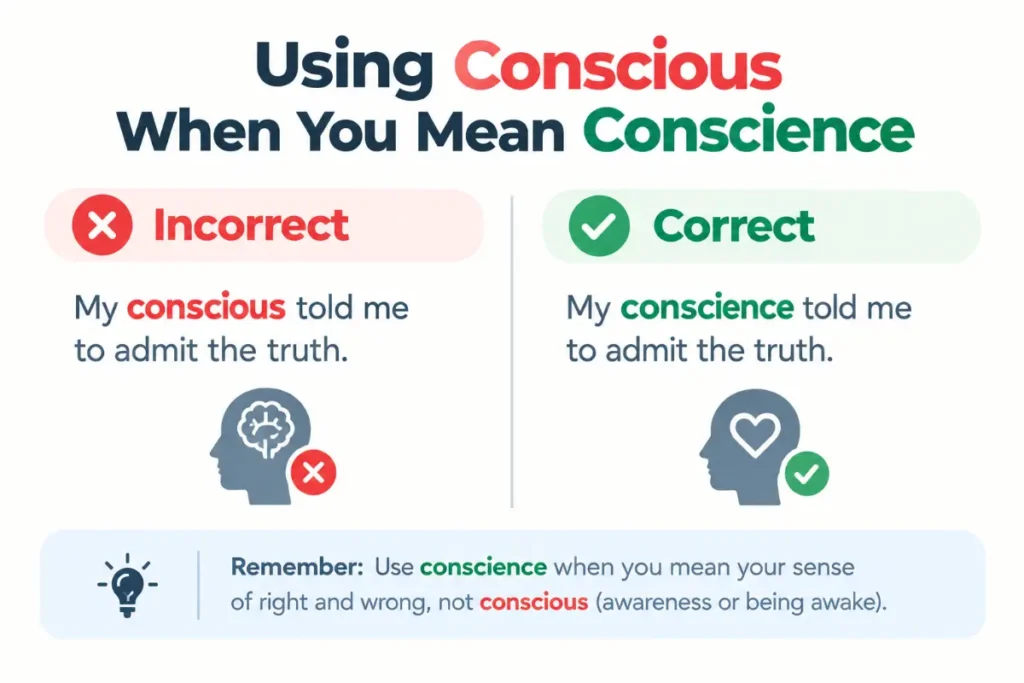
Using Conscious When You Mean Conscience
Incorrect: My conscious told me to apologize.
Correct: My conscience told me to apologize.
The sentence refers to an inner sense of right and wrong, so it needs the noun conscience. Conscious is an adjective and cannot perform the same role here.
Using Conscience When You Mean Conscious
Incorrect: She was conscience of the danger.
Correct: She was conscious of the danger.
The sentence describes awareness of a risk. The adjective conscious fits after the linking verb was and works naturally with of.
Confusing Conscience With Consciousness
Incorrect: The patient regained conscience after the accident.
Correct: The patient regained consciousness after the accident.
The sentence refers to becoming awake and aware again. Consciousness is the appropriate noun in this context.
However, conscience can appear in a different sentence about the same person. For example, The patient later struggled with a guilty conscience over a decision made before the accident. That sentence concerns moral judgment, not awareness.
Confusing Conscience With Conscientious
Incorrect: She is a conscience employee.
Correct: She is a conscientious employee.
The adjective conscientious describes someone who works carefully and responsibly. Conscience is a noun and cannot directly modify employee in this way.
Using Conscious Instead of Consciously
Incorrect: He conscious ignored the warning.
Correct: He consciously ignored the warning.
The sentence needs an adverb to describe how he ignored the warning. Consciously explains that he did so knowingly or deliberately.
Assuming Conscious Always Means Awake
Conscious often means awake and responsive, but it also means aware of something or deliberate. For example, She made a conscious effort to speak slowly does not mean she made an effort to stay awake.
Always consider the context before choosing a definition.
Assuming Conscience Always Means Guilt
Conscience does not only create guilt. It can also encourage someone to do the right thing, help them resist pressure, or give them peace of mind after an honest decision.
For example, He followed his conscience and returned the lost wallet. The sentence describes moral guidance rather than guilt.
Easy Memory Tips
A simple memory trick can help you choose the correct word without stopping to think about spelling rules.
Connect Conscience With Morality
Think of conscience as your inner moral compass. A compass helps you find direction, while your conscience helps you judge right and wrong.
For example, if you return a wallet you found on the sidewalk because you believe keeping it would be dishonest, your conscience guides your decision.
Remember this phrase.
Conscience means your sense of right and wrong.
Connect Conscious With Awareness
Think of conscious as noticing what is happening around you. If you are conscious of a sound, a risk, a feeling, or a decision, you are aware of it.
For example, if you notice that your friend seems upset, you are conscious of your friend’s feelings.
Remember this phrase.
Conscious means awake or aware.
Use the Noun and Adjective Test
Grammar offers another reliable way to remember the difference.
Conscience is a noun. You can say my conscience, her conscience, or a clear conscience.
Conscious is an adjective. You can say a conscious person, remain conscious, or be conscious of a problem.
If you are unsure which spelling to use, look at the other words in the sentence. A sentence describing a person’s state of awareness usually needs the adjective conscious. A sentence naming a person’s moral sense usually needs the noun conscience.
Try the Sentence Substitution Test
Replace the word you are considering with a simple explanation of its meaning.
- My conscience bothered me. Replace conscience with sense of right and wrong. The sentence still makes sense.
- I was conscious of the noise. Replace conscious with aware of. The sentence still makes sense.
- She regained consciousness. Replace consciousness with awareness. The sentence still makes sense.
- He is a conscientious student. Replace conscientious with careful and responsible. The sentence still makes sense.
This method helps you distinguish the related words without memorizing a long list of spelling rules.
Related Grammar and Usage Notes
Understanding related words makes your writing more accurate and helps you express your meaning with greater precision.
Conscience Versus Consciousness
These two nouns can be especially confusing because both end in letters associated with noun forms and both relate to the mind.
Conscience refers to moral judgment. Consciousness refers to awareness or the state of being conscious.
For example, Her conscience troubled her after the argument means she felt morally uneasy about her behavior. Her consciousness returned after the fainting episode means she became aware again.
The words are related historically, but their modern meanings are different.
Conscious Versus Aware
The adjective aware is a close synonym of conscious in many situations. Both can describe someone who recognizes a fact, situation, or feeling.
For example, She was aware of the deadline and She was conscious of the deadline express similar ideas.
However, the two words do not fit every expression equally well. English speakers commonly say a conscious effort, a conscious decision, and a conscious person. The phrase an aware effort would sound unnatural in ordinary English.
Choose the word that fits the expression and the meaning you intend.
Conscience Versus Ethics
Conscience and ethics are related, but they are not identical.
Conscience is a person’s inner sense of right and wrong. Ethics refers to principles or standards used to judge behavior, especially within a profession, institution, or field of study.
For example, Her conscience made her question the decision describes an individual’s moral response. The organization revised its ethics policy refers to formal standards that guide behavior.
A person may use their conscience when applying ethical principles to a difficult situation.
Conscious Versus Intentional
Conscious can describe deliberate action, while intentional directly emphasizes that something was done on purpose.
For example, He made a conscious decision to change careers and He made an intentional decision to change careers are both understandable, although the first sounds more natural in many contexts.
However, conscious has meanings that intentional does not. A person can be conscious of a problem without intentionally causing it or taking action to address it.
Conscientious Versus Conscious
These adjectives have different meanings despite their similar spelling.
Conscientious describes someone who is careful, thorough, and responsible. Conscious describes someone who is awake, aware, or acting deliberately.
For example, She is a conscientious nurse who checks every detail praises her care and responsibility. She remained conscious during the examination describes her state of awareness.
Use conscientious when you want to emphasize diligence and responsibility. Use conscious when you want to describe awareness or deliberate action.
American and British English Usage
The distinction between conscience and conscious remains the same in standard American and British English. Their meanings and grammatical roles do not change across these varieties of English.
Pronunciation can vary slightly by accent, particularly in vowel sounds. However, the spelling distinction remains consistent in ordinary writing.
For American English readers, use conscience for moral judgment and conscious for awareness. The same guidance works for British English readers.
Formal and Informal Usage
Both words are suitable for formal and informal communication.
In everyday conversation, you might say, My conscience won’t let me do that. In a formal report, you might write, The employee’s conscience influenced the ethical decision.
Similarly, I’m conscious of the time works in conversation, while The committee remained conscious of the potential risks fits a more formal setting.
Neither word is inherently formal or informal. The sentence structure and surrounding language determine the tone.
Professional Writing Tips
When editing an article, essay, email, or report, check the word’s intended meaning and grammatical role.
- Use conscience for moral judgment, guilt, honesty, or ethical responsibility.
- Use conscious for awareness, wakefulness, or deliberate action.
- Use consciousness for the state of awareness.
- Use conscientious to describe careful and responsible behavior.
- Use consciously to describe an action performed deliberately.
These distinctions are useful in academic writing, journalism, business communication, and everyday correspondence. A quick grammar check can prevent a small spelling mistake from changing the meaning of an entire sentence.
Expert Editor Insight
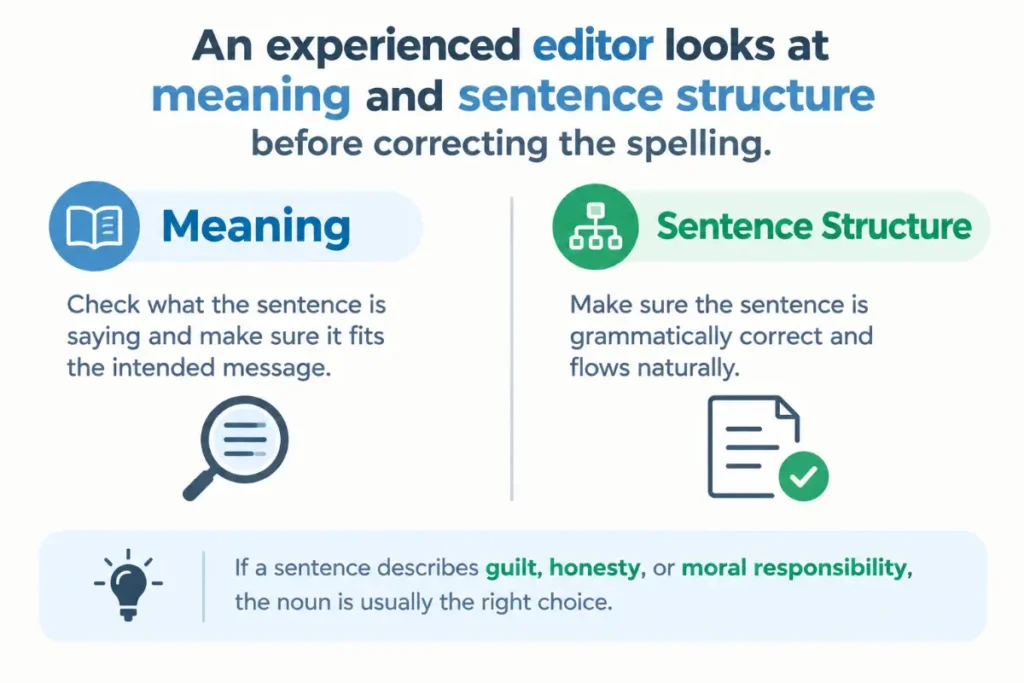
An experienced editor looks at meaning and sentence structure before correcting the spelling. If a sentence describes guilt, honesty, or moral responsibility, the noun is usually the right choice. If it describes awareness or an intentional action, the adjective is the better fit. Spelling tools may catch some mistakes, but they can miss a correctly spelled word used in the wrong context. A quick meaning check is often more useful than relying on automatic correction alone.
Key Takeaways
- Conscience is a noun. It refers to your inner sense of right and wrong.
- Conscious is an adjective. It describes being awake, aware, or deliberate.
- Consciousness is a noun. It refers to awareness or the state of being conscious.
- Conscientious is an adjective. It describes someone who is careful, responsible, and thorough.
- Consciously is an adverb. It describes an action performed knowingly or deliberately.
- Conscience and conscious are not interchangeable. Their meanings and grammatical roles differ.
- The spelling clue is useful. Conscience ends in ence, while conscious ends in ous.
- Context matters. Check if the sentence describes moral judgment, awareness, or deliberate action before choosing the word.
Conclusion
Conscience vs conscious becomes easy to understand when you remember that one word relates to morality and the other relates to awareness. Conscience is your inner sense of right and wrong, while conscious describes being awake, aware, or deliberate. Your conscience may encourage you to tell the truth, while being conscious means recognizing what is happening around you.
To use these words correctly, pay attention to their meanings and grammatical roles. Use conscience when discussing guilt, honesty, moral choices, or personal responsibility. Use conscious when describing awareness, wakefulness, or intentional actions. Remember the related forms too, including consciousness, conscientious, and consciously, because each serves a different purpose.
With a little practice, you’ll recognize the difference naturally. Think of conscience as your moral compass and conscious as your ability to notice and understand what’s happening. This simple distinction will help you write clearer sentences, avoid common spelling mistakes, and communicate your ideas with confidence.
Frequently Asked Questions
What Is the Difference Between Conscience and Conscious?
Conscience is a noun that refers to your inner sense of right and wrong. Conscious is an adjective that means awake, aware, or deliberate. Your conscience may encourage you to apologize, while being conscious of someone’s feelings means recognizing how they feel.
How Do You Remember Conscience vs Conscious?
Connect conscience with moral choices and conscious with awareness. Your conscience acts like an inner moral compass, while being conscious means noticing or understanding something. You can also remember that conscience is a noun and conscious is an adjective.
Is Conscience a Noun or an Adjective?
Conscience is a noun. It names a person’s inner sense of right and wrong. For example, My conscience bothered me after I lied uses conscience as a noun because it identifies the source of the speaker’s moral discomfort.
Is Conscious a Noun or an Adjective?
Conscious is an adjective. It describes someone who is awake or aware, or an action performed deliberately. For example, She was conscious of the risk uses conscious to describe her awareness of a possible danger.
What Is the Difference Between Conscience and Consciousness?
Conscience refers to moral judgment, while consciousness refers to awareness or the state of being conscious. A guilty conscience concerns feelings about an action, whereas regaining consciousness means becoming awake or aware again.
Can You Use Conscience and Conscious in the Same Sentence?
Yes. For example, He was conscious of his mistake, and his conscience urged him to correct it. Conscious describes his awareness of the mistake, while conscience describes his moral sense telling him to make things right.
What Is the Difference Between Conscious and Conscientious?
Conscious means awake, aware, or deliberate. Conscientious means careful, responsible, and attentive to duties. A conscious worker understands what is happening, while a conscientious worker takes care to perform tasks properly.
What Does It Mean to Have a Clear Conscience?
Having a clear conscience means feeling free from guilt because you believe your actions were honest or morally acceptable. For example, someone who returns lost property to its owner may feel at peace because they did the right thing.
Is It Correct to Say I Am Conscious of Something?
Yes. The expression conscious of is grammatically correct and means aware of something. For example, I am conscious of the deadline means I know the deadline is approaching and recognize its importance.
What Is the Opposite of Conscious?
The usual opposite of conscious is unconscious. In ordinary contexts, unconscious can mean not awake or not aware. In other contexts, it can describe an action or response that occurs without deliberate awareness.
Why Do Conscience and Conscious Have Similar Spellings?
Both words developed from Latin forms associated with knowing or awareness. Their shared history explains their similar appearance, but their modern meanings differ. Conscience concerns moral judgment, while conscious describes awareness or wakefulness.

Confusing Words, Spelling & Word Choice
Claire Whitmore is a U.S.-based English editor who writes about commonly confused words, spelling differences, and word choice. Her work helps readers understand subtle distinctions between similar-looking words through simple definitions, practical examples, and modern usage guidance in both American and British English.