
Shown vs Showed is one of the most common grammar questions in English. The confusion starts because both words belong to the same verb. They look similar. They describe something that happened in the past. Yet they do completely different jobs in a sentence.
Many people write sentences like I have showed you because it sounds natural. Others write I shown him the report because they know shown exists but are not sure where it belongs. Both mistakes appear every day in emails school assignments business writing and social media.
The good news is that the rule is surprisingly simple once you understand how English verbs work. By the end of this guide you will know exactly when to use showed and when to use shown. You will also learn why people confuse them so often how professional editors spot mistakes in seconds and how to remember the correct form for life.
Short Answer
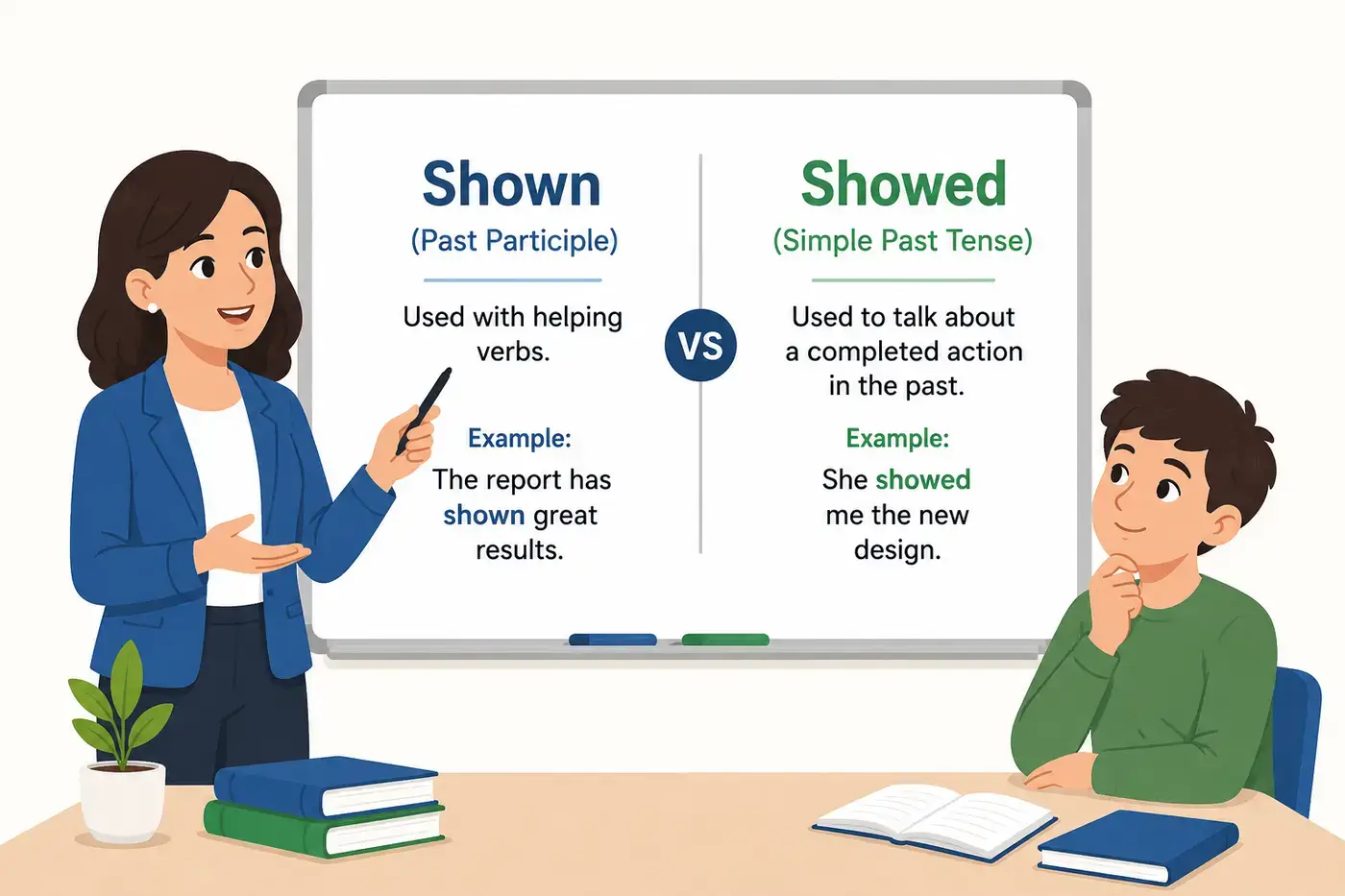
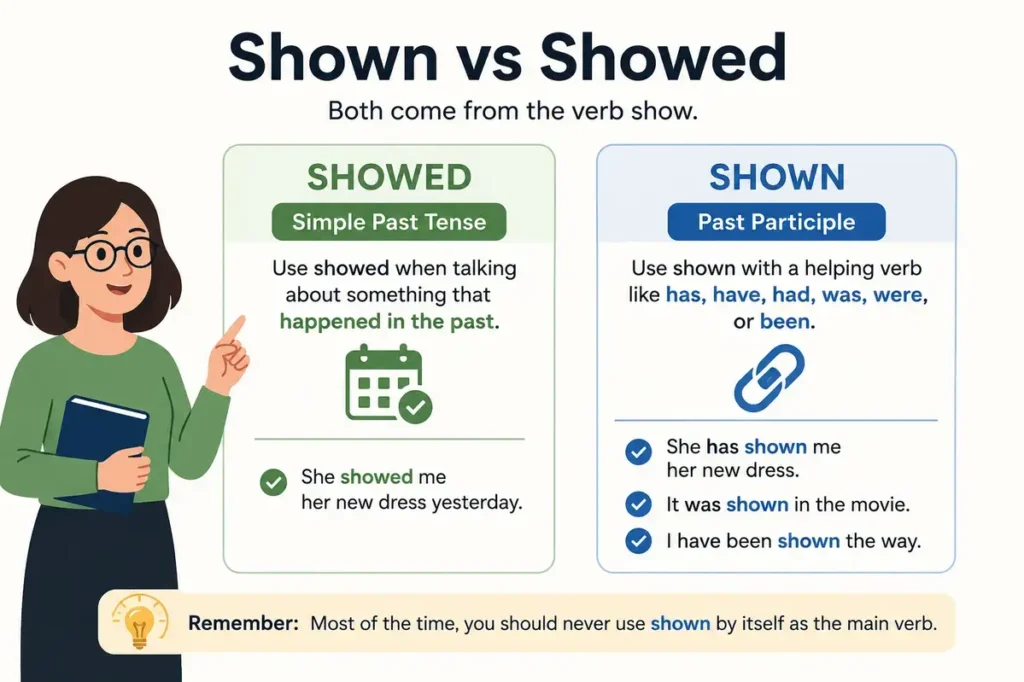
Shown vs Showed confuses many English learners because both come from the verb show. The simple answer is this. Showed is the simple past tense. Shown is the past participle and needs a helping verb like has have had was were or been. Most of the time you should never use shown by itself as the main verb.
Table Of Contents
- What Is The Difference Between Shown And Showed.
- Quick Comparison Table.
- What Does Show Mean.
- When To Use Showed.
- When To Use Shown.
- Why People Mix Them Up.
- Grammar Rule Behind Shown And Showed.
- Real World Examples.
- Common Mistakes.
- Memory Tricks.
- Professional Writing Tips.
- Frequently Asked Questions.
- Key Takeaways.
- Conclusion.
What Is The Difference Between Shown And Showed
The biggest difference is grammatical function.
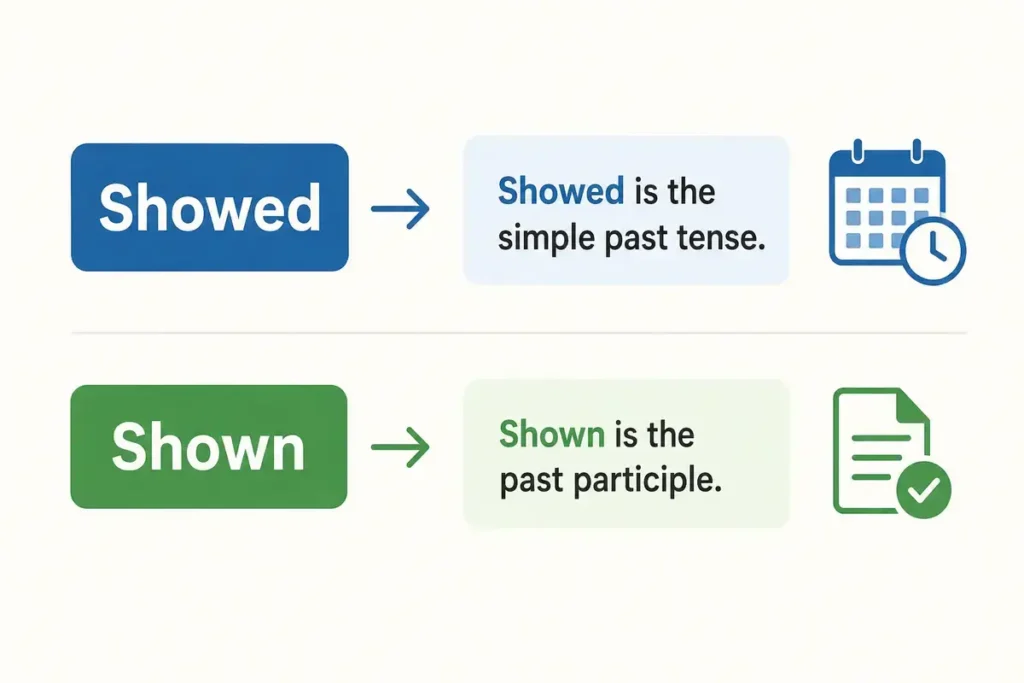
- Showed is the simple past tense.
- Shown is the past participle.
That sounds technical, but the idea is easy.
- Use showed when talking about an action that happened in the past.
- Use shown after a helping verb.
Look at these examples.
Correct
- She showed me her passport.
- They showed the house yesterday.
- The teacher showed us the answer.
Correct
- She has shown me her passport.
- They had shown the house before the buyers arrived.
- The answer was shown on the screen.
- Notice something important. Every sentence with shown includes another verb before it.
- That small detail makes all the difference.
Quick Comparison Table
| Feature | Showed | Shown |
|---|---|---|
| Verb form | Simple past | Past participle |
| Can stand alone | Yes | No |
| Needs a helping verb | No | Yes |
| Used after has, have, or had | No | Yes |
| Used after was, were, or been | No | Yes |
| Used in the passive voice | No | Yes |
| Example | She showed me the file. | She has shown me the file. |
- This single table answers most questions about shown vs showed.
What Does Show Mean
The verb show means to let someone see something. It can also mean to explain, prove, demonstrate, guide, or reveal.
Examples Include
- Showing a friend your vacation photos.
- Explaining a math problem to students.
Although the meaning stays almost the same, the verb changes form depending on the grammar of the sentence.
Verb Forms
Present tense
- I show.
- You show.
- They show.
Simple past
- I showed.
- You showed.
- They showed.
Past participle
- Shown.
Present participle
- Showing.
- Learning these four forms removes most confusion.
When To Use Showed
Use showed for completed actions in the past.
- No helping verb is needed.
- Think of it as the action that simply happened.
Examples
- She showed me her new apartment.
- The doctor showed the patient the X-rays.
- My father showed me how to ride a bicycle.
- The manager showed us the new office.
- Our guide showed us around the museum.
- Each sentence describes one completed action.
- Nothing else is required.
Now compare these.
Incorrect
- She has showed me the apartment.
- The doctor has showed the patient the results.
Correct
- She has shown me the apartment.
- The doctor has shown the patient the results.
- Professional editors catch this mistake immediately because has always expects the past participle.
When To Use Shown
Use shown only after a helping verb.
- The helping verb changes depending on the tense.
Present Perfect
- I have shown.
- You have shown.
- She has shown.
Past Perfect
- They had shown.
Future Perfect
- We will have shown.
Passive Voice
- The results were shown yesterday.
- The document has been shown to the committee.
- The evidence was shown during the trial.
- Notice that shown never works alone.
Incorrect
- I shown him my ticket.
Correct
- I showed him my ticket.
- I have shown him my ticket.
- That tiny helping verb completely changes the grammar.
Why People Mix Them Up
English has many irregular verbs.
- Some follow predictable patterns.
- Others do not.
Think about these examples.
- Write → Wrote → Written.
- Break → Broke → Broken.
- Speak → Spoke → Spoken.
- Show → Showed → Shown.
Because English has so many different verb patterns, people often assume any past form should work anywhere.
- It does not.
Another reason is everyday conversation.
- Native speakers sometimes speak quickly.
- Helping verbs become shorter.
For example:
- I’ve shown.
- He’s shown.
- They’ve shown.
When learners hear these contractions, they sometimes remember only the word shown and forget that another verb came before it.
That creates sentences like:
- I shown him.
- She shown us.
- They shown everyone.
- These forms are not correct in standard English.
The Grammar Rule Behind Shown And Showed
Every English verb has principal parts.
- These parts allow the language to create different tenses.
For show, the forms are:
- Show.
- Showed.
- Shown.
- Showing.
- Simple past uses the second form.
- Past participles use the third form.
Examples
- Yesterday I showed my teacher my project.
- I have shown my teacher my project.
- They had shown remarkable progress.
- The results were shown during the meeting.
- Professional writers rarely think about this rule consciously.
- Years of reading and writing make it automatic.
- Still, the underlying grammar never changes.
- Once you recognize the pattern, you can apply it to hundreds of English verbs.
Compare:
- Drive → Drove → Driven.
- Eat → Ate → Eaten.
- See → Saw → Seen.
- Choose → Chose → Chosen.
- Show → Showed → Shown.
- The pattern becomes easier each time you notice it.
Why Professional Editors Rarely Make This Mistake
Editors rarely stop to think about shown vs showed because they read sentences as complete grammatical units instead of isolated words.
- When an editor sees has, the brain instantly expects a past participle.
- When an editor sees a completed action with no helping verb, the brain automatically expects the simple past tense.
- That habit develops after reading thousands of books, articles, legal documents, business reports, and academic papers.
- Instead of asking which word looks right, experienced writers ask which verb form fits the sentence.
- That small shift in thinking prevents countless grammar mistakes.
Real Life Examples Of Shown Vs Showed
Reading grammar rules helps. Seeing them in real sentences helps even more. The more examples you read the more natural the correct form becomes.
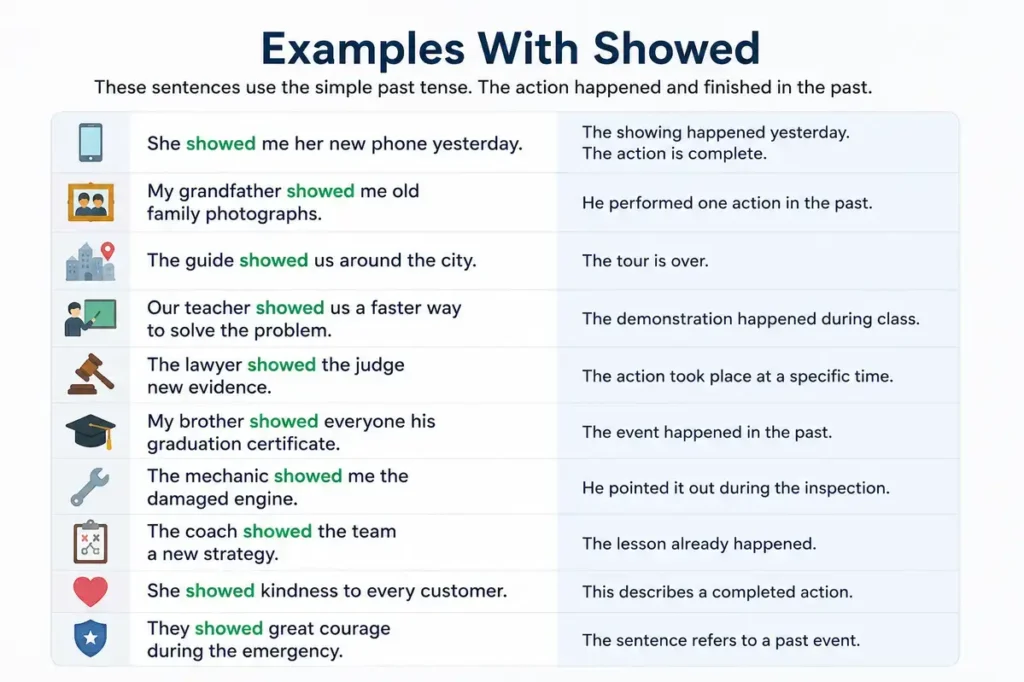
Examples With Showed
These sentences use the simple past tense. The action happened and finished in the past.
- She showed me her new phone yesterday.
The showing happened yesterday. The action is complete.
- My grandfather showed me old family photographs.
He performed one action in the past.
- The guide showed us around the city.
The tour is over.
- Our teacher showed us a faster way to solve the problem.
The demonstration happened during class.
- The lawyer showed the judge new evidence.
The action took place at a specific time.
- My brother showed everyone his graduation certificate.
The event happened in the past.
- The mechanic showed me the damaged engine.
He pointed it out during the inspection.
- The coach showed the team a new strategy.
The lesson already happened.
- She showed kindness to every customer.
This describes a completed action.
- They showed great courage during the emergency.
The sentence refers to a past event.
Examples With Shown
Now notice the helping verbs before shown.
- She has shown remarkable improvement this year.
Has creates the present perfect tense.
- They have shown great patience.
Have requires the past participle.
- The report was shown to the committee.
Was creates the passive voice.
- The evidence has been shown to be reliable.
Has been works with the past participle.
- Our results had already been shown before the meeting started.
Had been also requires the past participle.
- The presentation has shown clear progress.
The action connects the past with the present.
- Your application has been shown to the manager.
Passive construction.
- His artwork was shown at a local exhibition.
The artwork received the action.
- Scientists have shown that regular exercise improves health.
The finding remains true today.
- The document had been shown several times before the trial.
Past perfect passive construction.
After reading enough examples you begin to recognize the pattern almost automatically.
Common Mistakes
Many grammar mistakes happen because people remember the meaning of a word but forget its grammatical role.
Here are the errors editors see most often.
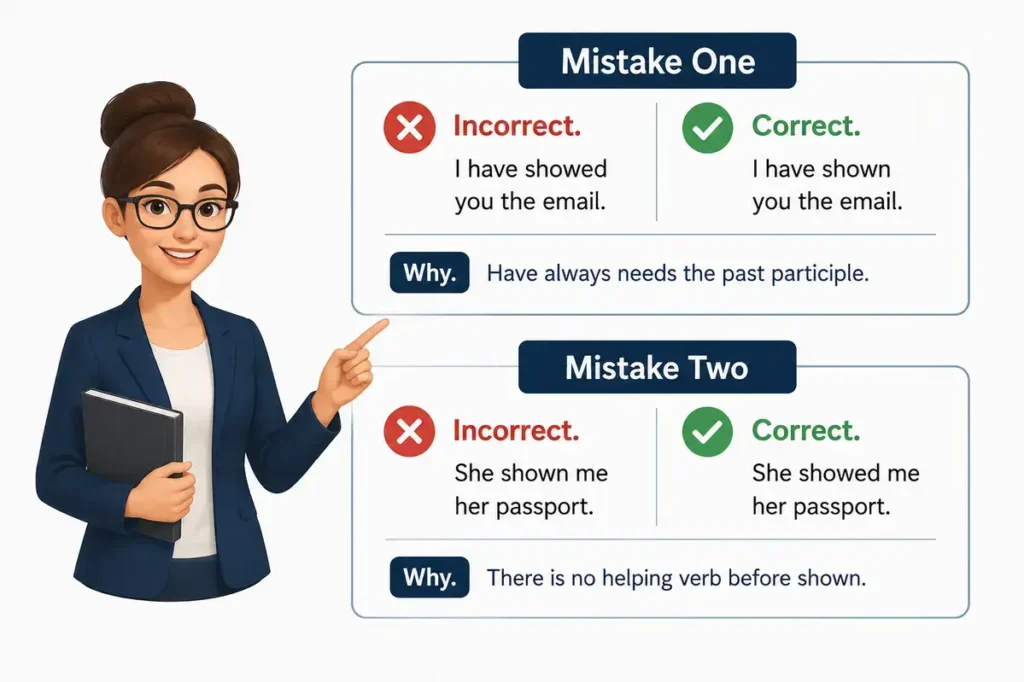
Mistake One
Incorrect
- I have showed you the email.
Correct
- I have shown you the email.
Why
- Have always needs the past participle.
Mistake Two
Incorrect
- She shown me her passport.
Correct
- She showed me her passport.
Why
- There is no helping verb before shown.
Mistake Three
Incorrect
- The results have showed improvement.
Correct
- The results have shown improvement.
Why
- The present perfect requires shown.
Mistake Four
Incorrect
- He was showed the instructions.
Correct
- He was shown the instructions.
Why
- The passive voice uses the past participle.
Mistake Five
Incorrect
- We had showed the client the proposal.
Correct
- We had shown the client the proposal.
Why
- Had always takes the past participle.
Why Native Speakers Still Make This Mistake
Even native English speakers occasionally confuse these forms.
The reason is simple.
- English contains many irregular verbs.
- People often rely on what sounds familiar instead of checking the grammar.
- Fast typing creates another problem.
- A writer may know the correct form but accidentally type showed after has because the fingers move faster than the brain notices.
- Professional proofreading catches these slips before publication.
Memory Trick That Actually Works
Forget complicated grammar terms for a moment.
Remember one simple sentence:
- Showed works alone.
- Shown needs a helper.
That helper can be:
- Has.
- Have.
- Had.
- Was.
- Were.
- Been.
- Being.
- Will have.
- Could have.
- Should have.
- Would have.
- If you see one of those helping verbs, your brain should immediately think of shown.
- If there is no helping verb, the answer is usually showed.
This trick works for many other irregular verbs too.
- Broken needs has.
- Written needs has.
- Chosen needs has.
- Seen needs has.
- Shown follows the same pattern.
Easy Way To Check Yourself
Before finishing a sentence, ask one quick question:
- Is there a helping verb before the main verb?
- If the answer is yes, use shown.
- If the answer is no, use showed.
Examples
- She showed me the receipt.
- No helping verb. Correct.
- She has shown me the receipt.
- Helping verb present. Correct.
- The receipt was shown to the customer.
- Helping verb present. Correct.
- This simple habit eliminates most mistakes.
Professional Writing Tips
Editors look beyond individual words.
- They read the entire sentence.
- That approach makes grammar mistakes easier to spot.
When proofreading:
- Find the main verb.
- Look for a helping verb.
- Match the verb form to the grammar.
- This method works far better than guessing.
- It also improves accuracy in business writing, academic papers, legal documents, and professional emails.
- Strong writing depends on consistency.
- Readers may not consciously notice correct grammar.
- They do notice awkward sentences.
- Using the correct verb form helps your writing sound polished and trustworthy.
Shown Vs Showed In American And British English
This question surprises many writers.
- There is no meaningful difference between American English and British English.
- Both varieties follow exactly the same grammar.
American English
- She showed me the report.
- She has shown me the report.
British English
- She showed me the report.
- She has shown me the report.
- Neither variety accepts I have showed in standard writing.
- This is one grammar rule shared across the English-speaking world.
Shown Vs Showed In Formal And Informal Writing
The grammar stays the same in every situation.
Formal Writing
- The results have shown consistent improvement.
Business Writing
- The manager showed the revised proposal during the meeting.
Academic Writing
- Researchers have shown a strong connection between sleep and memory.
Casual Conversation
- She showed me her vacation pictures.
- He has shown me that movie already.
- Changing the level of formality never changes the verb forms.
Related Verb Patterns
Learning one irregular verb makes others easier.
| Base Verb | Simple Past | Past Participle |
|---|---|---|
| Show | Showed | Shown |
| Write | Wrote | Written |
| Speak | Spoke | Spoken |
| Break | Broke | Broken |
| Drive | Drove | Driven |
| See | Saw | Seen |
| Choose | Chose | Chosen |
| Eat | Ate | Eaten |
| Take | Took | Taken |
| Give | Gave | Given |
Notice the pattern.
Once you understand this idea, many grammar questions become much easier. The past participle often changes more than the simple past.
Quick Practice
Choose the correct word.
- She has shown us the final design.
- The teacher showed the class a science experiment.
- The report was shown during the meeting.
- My father showed me how to change a tire.
- Scientists have shown that practice improves performance.
- The evidence had been shown before the hearing began.
If those answers feel natural you have already mastered the rule.
Why This Rule Matters
Grammar is not about memorizing endless rules. It is about making your message clear. Using the wrong verb form can distract readers. It can also make professional writing appear less polished. Correct grammar builds confidence.
It helps readers focus on your ideas instead of your mistakes. That is why experienced writers editors teachers and publishers pay close attention to verb forms. Once you understand Shown vs Showed you are unlikely to confuse them again.
Key Takeaways
- Showed is the simple past tense.
- Shown is the past participle.
- Showed can stand alone as the main verb.
- Shown always needs a helping verb.
- Present perfect uses has shown or have shown.
- Past perfect uses had shown.
- Passive voice uses shown.
- American English and British English follow the same rule.
- Professional writers choose the verb form based on grammar not appearance.
- Remember the easiest rule. Showed works alone. Shown needs a helper.
Conclusion
The answer to Shown vs Showed is much simpler than it first appears.
Use showed for a completed action in the past.
Use shown after a helping verb such as has have had was were or been.
That single rule solves almost every question about these two verb forms. Professional editors do not choose between shown and showed by guessing. They look at the structure of the sentence. If the sentence needs the simple past they use showed. If the sentence requires a past participle they use shown.
Keep one sentence in mind whenever you write. Showed works alone. Shown needs a helper. Once that pattern becomes familiar you will recognize the correct form instantly. It will improve your grammar, make your writing sound more polished, and help you communicate with confidence in everyday conversations, academic work, and professional writing.
Frequently Asked Questions
Is Showed Ever Correct?
Yes. Showed is completely correct when it is the simple past tense.
Examples
- She showed me the contract.
- The teacher showed the students a new method.
- Both sentences describe completed actions in the past.
Is Shown Ever Used Without A Helping Verb?
No. In standard English, shown is a past participle. It needs a helping verb.
Correct
- He has shown great leadership.
- The results were shown yesterday.
Incorrect
- He shown great leadership.
Why Do People Say I Have Showed?
Many people apply the regular verb pattern by mistake. Since showed is the simple past form, they assume it also works after have or has.
- Standard English does not follow that pattern.
- The correct form is have shown.
Is Have Shown Correct?
Yes. This is the correct present perfect form.
Examples
- I have shown you the receipt.
- They have shown remarkable progress.
Is Had Shown Correct?
Yes. Had shown is the past perfect tense.
Example
- She had shown everyone the new design before the meeting started.
- The action happened before another event in the past.
Is Was Shown Correct?
Yes. Was shown is the passive voice.
Example
- The evidence was shown during the trial.
- The subject receives the action instead of performing it.
Is Showed Used In American English?
Yes. American English uses showed as the simple past tense and shown as the past participle.
Examples
- She showed me the report.
- She has shown me the report.
- The grammar is the same in American English and British English.
Is I Shown Correct?
No.
Correct
- I showed him the document.
- I have shown him the document.
- The sentence needs either the simple past or a helping verb before shown.
Why Is Shown Called A Past Participle?
A past participle is a verb form used with helping verbs to create perfect tenses and the passive voice.
Examples
- They have shown excellent teamwork.
- The results were shown on the screen.
- It cannot normally stand alone as the main verb.
How Can I Remember The Difference Between Shown And Showed?
Remember this simple rule:
- Showed stands alone.
- Shown needs a helper.
- If you see words like has, have, had, was, were, or been, the correct choice is almost always shown.

English Grammar & Usage
Nathan Holloway is an American grammar writer and language researcher who specializes in English grammar, sentence structure, verb usage, and common writing mistakes. He enjoys breaking down confusing grammar rules into practical explanations with clear examples, making English easier for students, professionals, and everyday writers.