
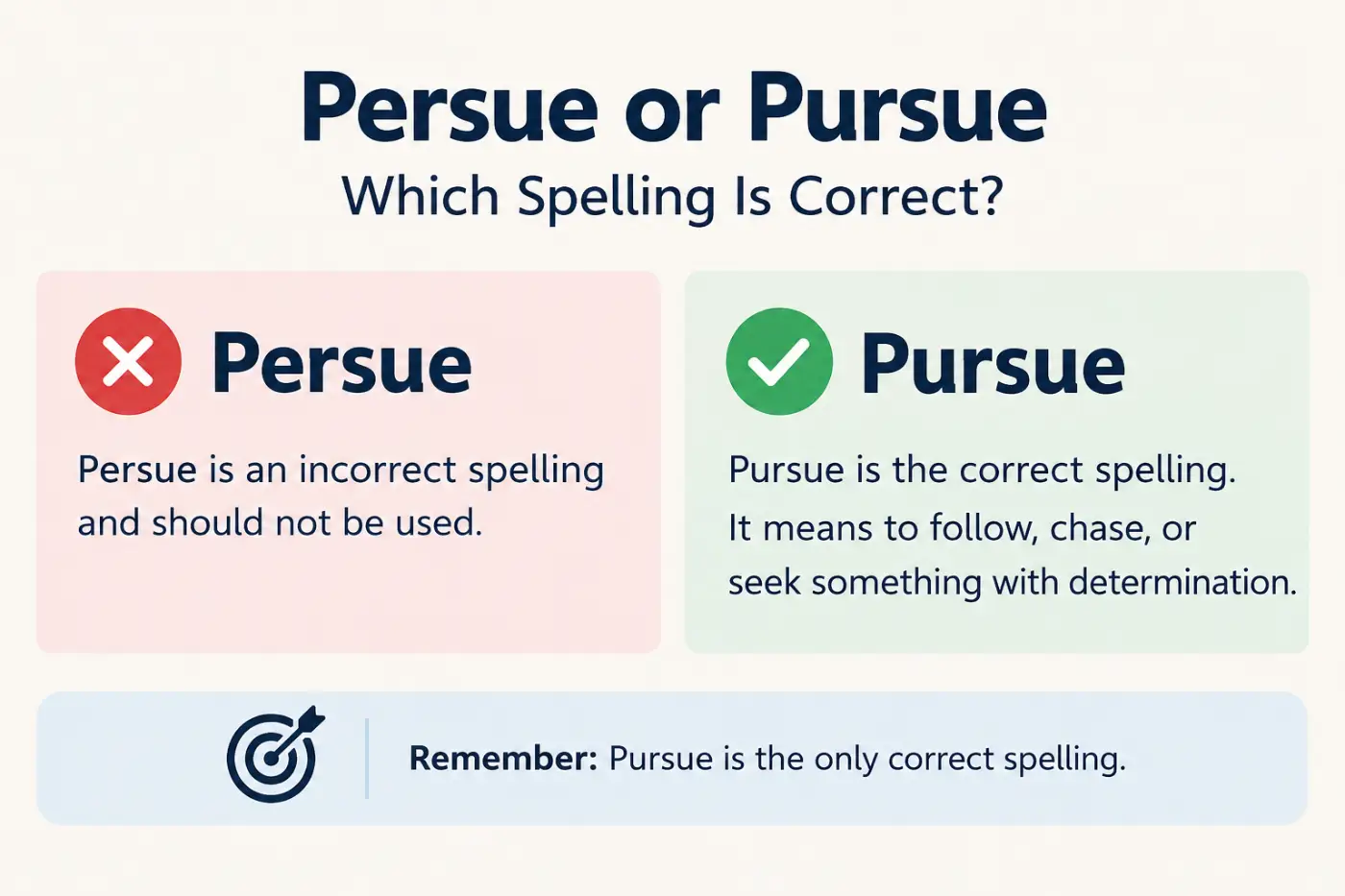
The exact keyword persue or pursue can confuse writers who are unsure about the correct spelling. The correct form is pursue, with a u after the initial p and another u before the final e. Persue is a misspelling in standard English.
The confusion often happens because English spelling doesn’t always match pronunciation. The vowel sounds in pursue can make the word seem as if it should contain an e. People may also remember the beginning of the word but forget the exact order of its letters. A quick spell check can catch the error, but understanding the correct spelling makes it easier to avoid next time.
The verb pursue has several useful meanings. You can pursue a professional goal, pursue further education, pursue a romantic relationship, pursue a question, or pursue someone who is running away. These uses share a central idea: following something or continuing to work toward it. Learning the spelling alongside the meaning and common sentence patterns will help you use the word confidently in everyday American English.
Quick Answer
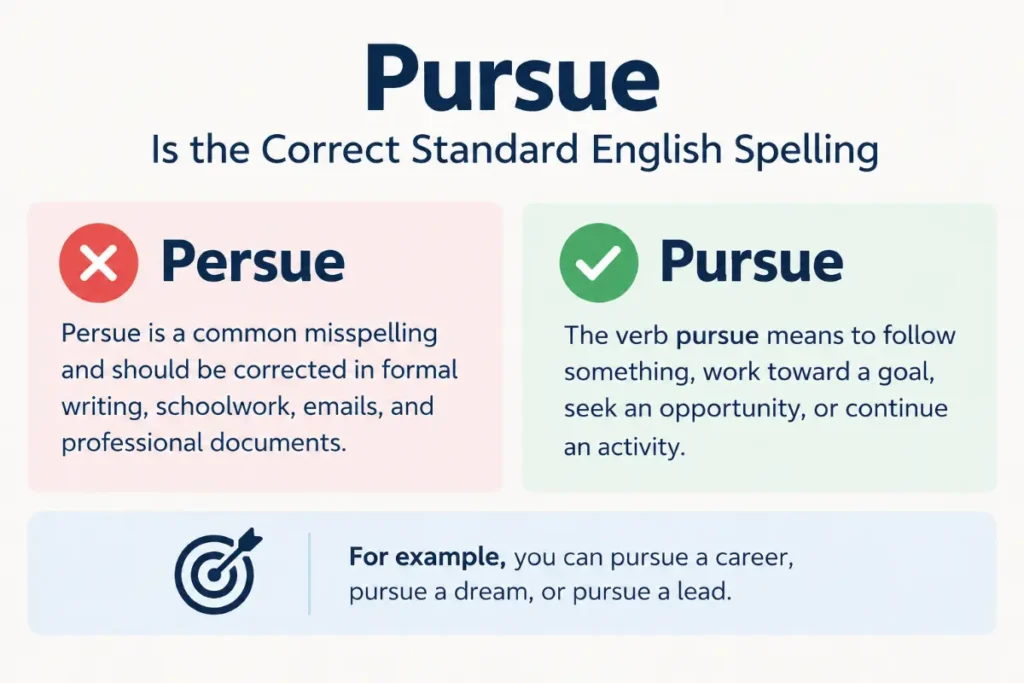
Pursue is the correct standard English spelling. Persue is a common misspelling and should be corrected in formal writing, schoolwork, emails, and professional documents. The verb pursue means to follow something, work toward a goal, seek an opportunity, or continue an activity. For example, you can pursue a career, pursue a dream, or pursue a lead.
Meaning and Definition
Pursue is a verb that means to follow, seek, continue, or work toward something. The exact meaning depends on the situation, but the central idea stays the same. You keep moving toward a person, goal, opportunity, or activity instead of leaving it behind.
For example, a student might pursue a degree, a job seeker might pursue a new position, and a detective might pursue a suspect. Each situation involves following a particular direction or trying to achieve a result.
What Pursue Means in Different Contexts
The word has several common meanings.
1. To work toward a goal. You make an effort to achieve something you want. For example, Maya decided to pursue her dream of becoming a doctor.
2. To follow someone or something. You move after a person, animal, or object. For example, the police pursued the driver who fled the scene.
3. To seek an opportunity. You try to obtain something that interests you. For example, the company plans to pursue new business opportunities.
4. To continue an activity. You keep doing something over time. For example, he chose to pursue his studies after taking a year off.
5. To seek an answer or solution. You investigate an issue or try to resolve a problem. For example, the researcher pursued the question until she found a reasonable explanation.
These meanings are connected. In every case, someone follows a direction, seeks a result, or continues an effort.
Meaning of the Incorrect Form
Persue is not the standard spelling of this verb in modern English. It is generally a spelling mistake caused by the word’s pronunciation or by confusion about the order of its vowels.
If you see this spelling in a draft, replace it with pursue when the intended meaning is to follow, seek, or work toward something.
For example.
Incorrect: She wants to persue a career in law.
Correct: She wants to pursue a career in law.
The corrected sentence uses the standard spelling and communicates the intended meaning clearly.
The incorrect form does not have a separate, widely accepted meaning in standard English. It should not be treated as an alternative spelling of the verb.
Comparison Table for Persue or Pursue
| Feature | Persue | Pursue |
|---|---|---|
| Standard spelling | Incorrect | Correct |
| Meaning | No standard meaning as this verb | To follow or work toward something |
| Part of speech | Misspelling | Verb |
| Pronunciation | Intended reading of the misspelling | /pərˈsuː/ in American English |
| Formality | Not appropriate as a spelling of the verb | Suitable for formal and informal writing |
| Common contexts | Typing and spelling errors | Careers goals investigations and relationships |
| Example | Incorrect: I will persue my goal. | Correct: I will pursue my goal. |
The difference is spelling rather than meaning. When you intend the common English verb, use pursue.
Which Form Is Correct
Pursue is the correct spelling because it is the established form used in standard English dictionaries and conventional writing. Persue leaves out the correct letter sequence and is not an accepted alternative spelling of the verb.
English contains many words whose spellings are difficult to predict from their sounds. That is why remembering the complete written form matters. The spelling of pursue stays the same in American English and British English.
You should write pursue in school assignments, job applications, reports, business emails, articles, and personal messages. The word is suitable for both casual and formal communication.
Consider these examples.
1. I plan to pursue a degree in engineering.
2. She decided to pursue a different career.
3. The journalist continued to pursue the story.
All three sentences use the same standard spelling. The word changes meaning slightly with the context, but its spelling does not change.
Ten Natural Example Sentences
These examples show how to use pursue in everyday conversation, education, work, and formal writing.
1. Everyday conversation: I want to pursue my passion for photography.
The speaker wants to spend time developing an interest and possibly turn it into a larger part of life.
2. Text message: I finally decided to pursue the opportunity we talked about.
The speaker plans to take action instead of letting an opportunity pass.
3. School: Daniel hopes to pursue a degree in computer science.
The student intends to continue his education in a specific field.
4. Career planning: She left her old job to pursue a career in teaching.
Pursue describes the effort to enter and develop a new profession.
5. Workplace communication: Our team will pursue new clients in the coming months.
The team plans to seek business opportunities and build relationships with potential customers.
6. Academic writing: The study aims to pursue further evidence about the causes of the problem.
The sentence describes an effort to investigate a subject. Depending on the intended meaning, seek further evidence may sound more natural in formal academic writing.
7. Formal communication: We intend to pursue all available options before making a final decision.
The organization plans to examine its choices rather than settle on one too quickly.
8. Relationships: He decided to pursue a relationship with someone he had known for years.
The person wants to develop a romantic connection.
9. News reporting: Investigators continued to pursue several leads in the case.
The investigators kept examining possible sources of information.
10. Storytelling: The young explorer pursued the mysterious trail through the forest.
Pursue creates a sense of movement and determination as the character follows the trail.
Notice how the verb works with different objects. You can pursue a goal, a degree, a career, an opportunity, a relationship, or an investigation. The noun after the verb helps readers understand what someone is trying to achieve or follow.
Common Spelling Mistakes
Pursue can be tricky because its vowels do not make the spelling immediately obvious to every writer. Here are five errors to watch for.
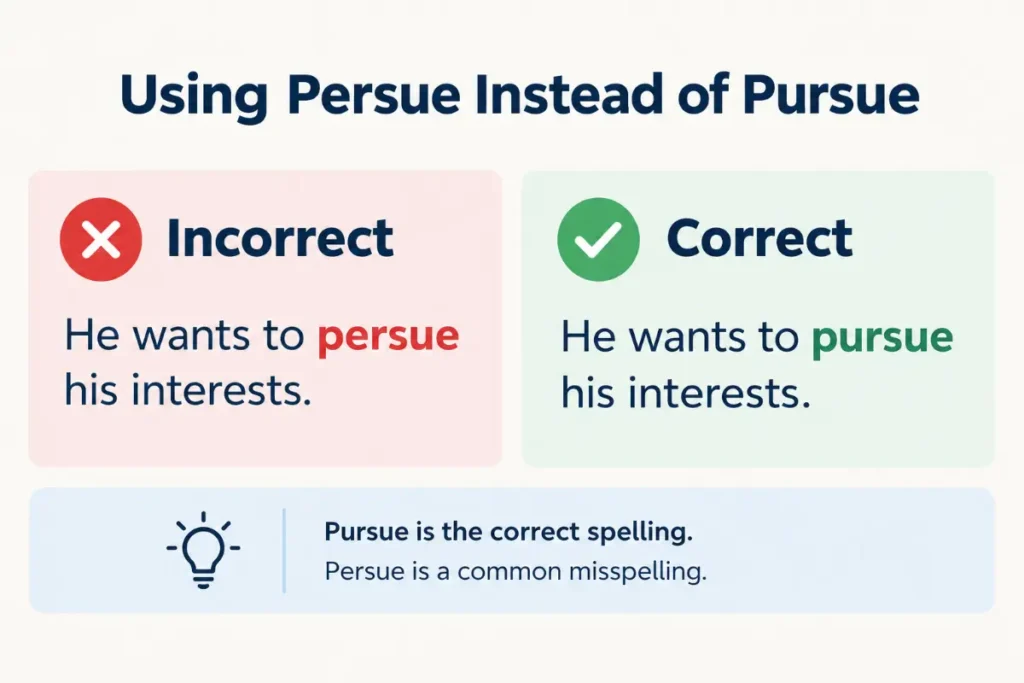
Using Persue Instead of Pursue
Incorrect: He wants to persue his interests.
Correct: He wants to pursue his interests.
The incorrect form changes the letter sequence. Remember that the standard spelling begins with pur, not per.
Leaving Out the Second U
Incorrect: She plans to pursu a career in medicine.
Correct: She plans to pursue a career in medicine.
The final e belongs at the end of the word. The complete spelling is p, u, r, s, u, e.
Adding an Extra Letter
Incorrect: They will pursuue the matter.
Correct: They will pursue the matter.
This error can happen when someone types too quickly or tries to remember the vowel sequence. Check the word letter by letter if it looks unfamiliar.
Confusing Pursue With Pursuit
Incorrect: She will pursuit a new opportunity.
Correct: She will pursue a new opportunity.
Pursue is a verb, while pursuit is a noun. The first describes an action. The second names the act of seeking or following something.
You can write, She will pursue a new opportunity, or Her pursuit of a new opportunity took several months.
Confusing Pursue With Persuade
Incorrect: I want to persuade a career in medicine.
Correct: I want to pursue a career in medicine.
Persuade means to convince someone to do or believe something. Pursue means to follow, seek, or work toward something. The words look and sound somewhat alike, but their meanings differ.
Pronunciation Guide
Pursue has two syllables in standard American English. Its pronunciation is commonly represented by the International Phonetic Alphabet as /pərˈsuː/.
An easy pronunciation guide is per SOO. This is an approximation to help readers, not a replacement for the standard spelling.
The main stress falls on the second syllable. The final sound is a long oo sound, as in blue or food.
How to Pronounce It Clearly
1. Start with the first syllable. Say it lightly, without giving it the strongest stress.
2. Move to the second syllable and say it more strongly.
3. Keep the vowel in the final syllable long enough to sound like the vowel in blue.
A common mistake is to stress the first syllable too strongly. Another is to pronounce the final vowel as a short sound. In standard American English, the second syllable receives the main stress.
Pronunciation alone may not help you remember the spelling because the sound does not clearly reveal every letter. Pair the spoken form with the written form when learning the word.
Etymology and Word Origin
Pursue has a long history in English. It entered English through Anglo French and Old French forms related to the idea of following or chasing. Its history can ultimately be traced to a Latin verb associated with following up or pursuing.
Over time, the word developed beyond the literal act of chasing someone. English speakers began using it for goals, activities, interests, plans, and investigations.
That development explains why pursue works in both physical and abstract situations. A police officer may pursue a suspect, while a student may pursue an education. In the first example, the meaning involves following someone. In the second, it involves working toward a goal.
The spelling has become established through its historical development. Modern writers should learn the accepted form rather than try to rebuild the word’s spelling from its sound.
Regional Usage
American English
Pursue is the standard spelling in the United States. It works in conversation, business writing, education, journalism, and formal documents.
American writers commonly use expressions such as pursue a career, pursue a degree, pursue an opportunity, and pursue legal action.
For example, a college application might say, I hope to pursue a degree in biology.
British English
Pursue is also the standard spelling in British English. There is no regional spelling difference that makes persue correct in the United Kingdom.
British writers use the word in much the same way as American writers. For example, She plans to pursue a career in journalism is standard in both varieties.
Australian English
Australian English also uses pursue as the correct spelling. The main meanings and grammatical patterns remain the same.
A student might pursue further education, or a business might pursue a new contract.
Canadian English
Canadian English follows the same spelling. Writers in Canada use pursue for goals, careers, investigations, and other activities.
The important point is that this is not a case of American and British spelling differences. Pursue is standard across these major English varieties.
Grammar Rules and Part of Speech
Pursue is a verb. It describes an action, effort, or continuing process. It can take a direct object, meaning that it often comes before the person or thing being followed or sought.
For example, in They pursued the opportunity, the verb is pursued and the direct object is the opportunity.
Common Verb Forms
| Form | Example |
|---|---|
| Base form | pursue |
| Third person singular | pursues |
| Simple past | pursued |
| Past participle | pursued |
| Present participle | pursuing |
These forms follow the normal pattern for a regular verb ending in e.
1. I pursue new challenges.
2. She pursues a career in science.
3. They pursued the case for several months.
4. He has pursued this goal since childhood.
5. We are pursuing several options.
Notice that the final e disappears before the ing ending. The correct form is pursuing, not pursueing.
Pursue With an Object
The verb commonly takes an object.
You can pursue a goal, pursue a dream, pursue a career, pursue a suspect, or pursue a claim.
For example, She pursued the scholarship means she took steps to obtain it.
Pursue Without an Object
The verb can also appear without a stated object when the context makes the meaning clear.
For example, He had a clear goal and was determined to pursue sounds incomplete in most ordinary contexts because the reader expects to know what he planned to follow or achieve.
A more natural version is He had a clear goal and was determined to pursue it.
In some contexts, the object may be understood from an earlier sentence. Still, naming the object often makes the writing clearer.
Pursue in Formal Writing
The word is appropriate in formal writing, but it should fit the meaning. In a business report, pursue new markets may sound natural. In a simple message, try to find new customers might be more direct.
Choose the verb based on the tone and meaning you want. A formal word does not automatically make a sentence better.
Real Life Usage Examples
Daily Conversation
People use pursue when discussing personal goals, interests, and plans.
1. I want to pursue music more seriously this year.
2. She decided to pursue her interest in gardening.
The first sentence describes a plan to give music more time and effort. The second describes a decision to develop an interest.
Workplace Communication
In professional settings, the word often describes business plans and career development.
1. The company plans to pursue a partnership with a local supplier.
2. I hope to pursue a management position next year.
The first sentence describes a business goal. The second describes a career goal.
Academic Writing
Students and researchers use the word when discussing education or investigation.
1. He plans to pursue graduate studies after college.
2. The research team pursued additional evidence to test its idea.
The first sentence refers to continued education. The second describes an investigation.
News and Journalism
Journalists may use pursue to describe investigations, legal matters, and people being followed.
1. Detectives continued to pursue leads in the investigation.
2. The company said it would pursue legal action against the contractor.
The first sentence refers to gathering information. The second describes an intention to take a legal step.
Literature and Storytelling
In stories, the verb can describe physical action or a character’s ambition.
1. The knight pursued the thief across the valley.
2. The main character pursued the truth despite strong opposition.
The first sentence describes a chase. The second describes a determined effort to discover facts.
Related Words and Expressions
Several words are closely connected to pursue. Learning their meanings can help you choose the most precise verb.
Pursuit
Pursuit is the noun form. It refers to the act of following or trying to achieve something.
Example: Her pursuit of knowledge continued throughout her life.
Use pursue for the action and pursuit for the activity or effort.
Follow
Follow means to go after someone or something, or to pay attention to instructions or events.
Example: Follow the marked path to reach the cabin.
Follow is often more literal or general than pursue.
Seek
Seek means to look for or try to obtain something.
Example: The family sought help from a local charity.
Seek is useful when the emphasis is on searching for something.
Chase
Chase means to run after someone or something in an effort to catch it. It can also describe working hard to obtain something.
Example: The dog chased the ball across the yard.
Chase often suggests physical movement or an urgent effort.
Aim For
Aim for means to set something as a goal.
Example: She aims for a leadership role in her department.
This phrase is often more direct when describing a specific target.
Strive
Strive means to make a strong effort to achieve something.
Example: The team strives to improve its service.
Strive emphasizes effort and determination rather than following or seeking something.
Chase After
Chase after can describe physically following someone or trying hard to obtain something.
Example: He spent years chasing after success.
The phrase can sound more emotional or informal than pursue.
Work Toward
Work toward means to make steady progress toward a goal.
Example: They are working toward a new agreement.
This phrase is especially useful when the focus is on gradual effort and progress.
Synonyms and Choosing the Right Word
Pursue has several synonyms, but they do not all fit every sentence. The best choice depends on the kind of action you want to describe.
| Word or phrase | Main emphasis | Example |
|---|---|---|
| Follow | Going after or keeping to a path | Follow the instructions. |
| Seek | Looking for something | Seek professional advice. |
| Chase | Trying to catch or obtain something | Chase the ball. |
| Strive | Making a strong effort | Strive for excellence. |
| Aim for | Setting a target | Aim for a higher score. |
| Work toward | Making gradual progress | Work toward a degree. |
| Investigate | Examining facts or a problem | Investigate the complaint. |
| Continue | Keeping an activity going | Continue the discussion. |
These words overlap with pursue, but they are not perfect substitutes. You pursue a career, for example, but you would not usually say you investigate a career when you mean that you are trying to build one.
A good editor looks at the intended action before replacing a word with a synonym.
Expert Editor Insight
An experienced editor treats pursue as the standard spelling and checks the surrounding sentence to confirm the intended meaning. Spelling tools often flag the misspelled form, but they may not catch every problem if a word resembles a valid name or appears in an unusual context. Read the entire sentence after correcting the spelling. Check that the verb fits its object and that its tense matches the rest of the sentence. For example, pursue a goal, pursued a goal, and pursuing a goal are all correct forms in the right grammatical setting.
How to Remember the Correct Spelling
The easiest method is to learn the word as a complete unit instead of trying to guess its spelling from pronunciation.
Remember these six letters in order: P U R S U E.
You can also connect the spelling to a familiar phrase such as pursue your purpose. Both words begin with the same three letters, which can help you recall the correct opening.
Another useful approach is to remember the related noun pursuit. Both words share the sequence pursu. If you can spell pursuit correctly, you have a strong clue for spelling pursue.
When writing quickly, pause for a second before submitting a sentence that contains this verb. That small check can prevent an avoidable mistake.
Conclusion
The correct spelling is pursue, not persue. The verb means to follow, seek, or work toward something, and it appears in common expressions such as pursue a career, pursue a dream, and pursue an opportunity. Its spelling is the same in American, British, Australian, and Canadian English.
To remember it, focus on the six letters in order: P U R S U E. You can also connect it with the noun pursuit, which shares the same spelling pattern. Before sending an important message or submitting an assignment, check the word and the sentence around it. A quick review helps keep your writing accurate and clear.
FAQs
Is persue a real English word?
Persue is not the standard spelling of the common English verb meaning to follow or work toward something. In ordinary writing, it should be treated as a misspelling of pursue. Use pursue in school assignments, workplace messages, articles, and formal documents. If a particular name or specialized term uses the other spelling, check that specific context before changing it.
What does pursue mean?
Pursue means to follow someone or something, seek an opportunity, or work toward a goal. You can pursue a career, pursue an education, pursue a relationship, or pursue an investigation. The meaning depends on the object and context. The central idea is making an effort to follow, find, or achieve something rather than giving up on it.
Which spelling is correct for a career?
Pursue is the correct spelling when talking about a career. For example, She wants to pursue a career in nursing means she wants to enter and develop a profession in that field. Persue is a misspelling and should not appear in standard writing when you mean this verb.
How do you pronounce pursue?
In standard American English, pursue is pronounced /pərˈsuː/. It has two syllables, and the main stress falls on the second syllable. An easy guide is per SOO. The final vowel sounds like the vowel in blue. Learning the stress pattern can help you recognize the word, but you should still memorize its written form.
Can pursue start a sentence?
Yes. Pursue can start a sentence when it is used as a command or an instruction. For example, Pursue your goals with patience and care is grammatically correct. The verb can also start an introductory phrase in some sentence structures, although writers should make sure the sentence remains clear and complete.
What is a synonym for pursue?
Useful synonyms include seek, follow, chase, strive for, and work toward. The best choice depends on the context. Seek emphasizes looking for something, chase often suggests following or trying to catch something, and strive emphasizes effort. Pursue works well for goals, careers, opportunities, investigations, and other continuing efforts.
Why do people misspell pursue?
People may write the wrong form because English vowel sounds do not always make spelling obvious. The word’s pronunciation can lead writers to remember an incorrect vowel sequence. Fast typing and weak familiarity with the written form can also contribute. Repeated exposure to the correct spelling and a quick proofreading check can help prevent the error.
Is pursue suitable for formal writing?
Yes. Pursue is standard in formal and informal English. It is common in academic writing, professional reports, legal discussions, and business communication. Phrases such as pursue a degree, pursue an opportunity, and pursue legal action are well established. Choose a simpler alternative if it communicates your meaning more clearly in a casual message.

Confusing Words, Spelling & Word Choice
Claire Whitmore is a U.S.-based English editor who writes about commonly confused words, spelling differences, and word choice. Her work helps readers understand subtle distinctions between similar-looking words through simple definitions, practical examples, and modern usage guidance in both American and British English.