
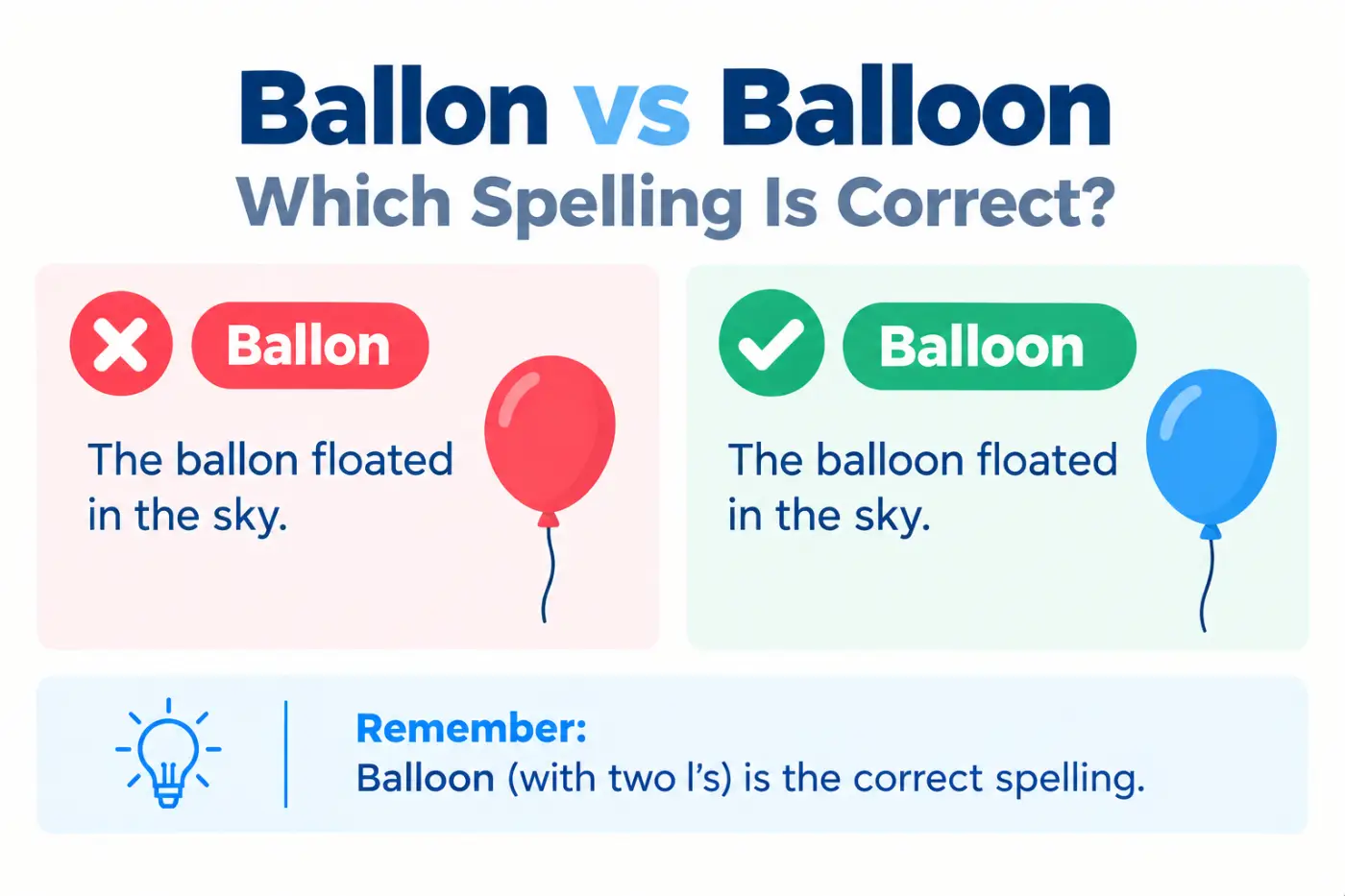
Ballon vs balloon is a common spelling confusion because both forms look similar, but only balloon is the standard spelling of the everyday English word for an inflatable object. You might see this word when shopping for party supplies, writing a birthday invitation, describing a child’s toy, or talking about a hot air balloon. Adding or leaving out one letter can make the difference between a correctly written word and a spelling error.
The correct spelling is balloon. It contains two Ls followed by two Os before the final N. The incorrect form ballon often appears when someone types quickly, forgets a repeated letter, or assumes that the word follows a simpler spelling pattern. Spellcheckers may catch this mistake, but knowing the spelling yourself helps you write with greater confidence.
Learning this distinction is straightforward once you understand the word’s structure and see it in everyday sentences. This guide explains the correct spelling, meaning, pronunciation, word origin, grammar, common mistakes, and practical memory tricks. You’ll also find examples and answers to common questions so you can use the word correctly in schoolwork, emails, professional writing, and everyday conversation.
Short Answer
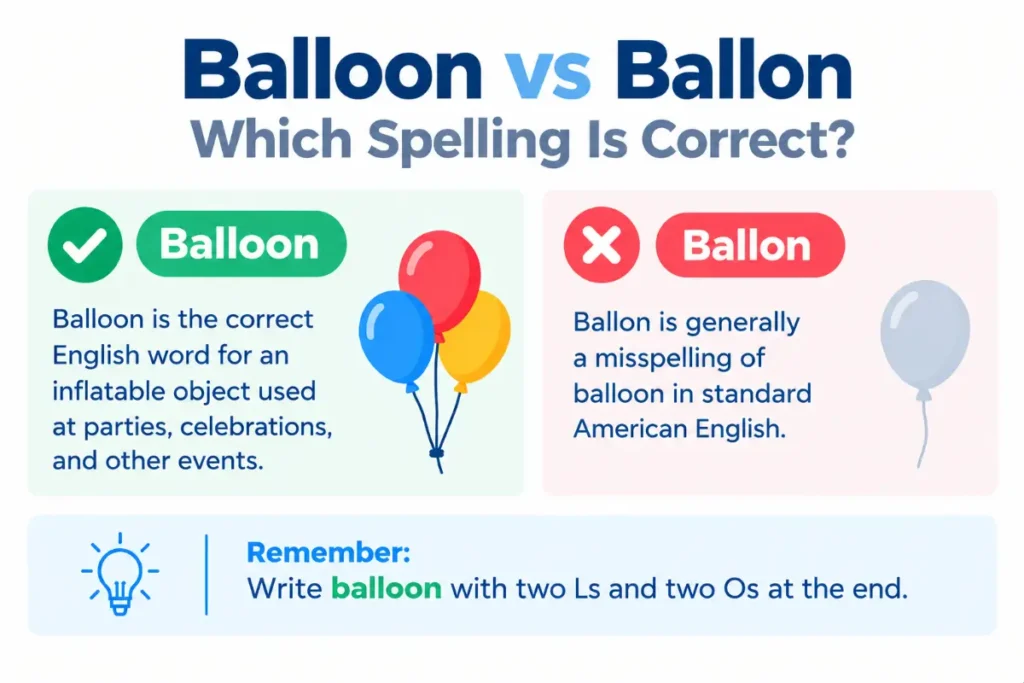
Ballon vs balloon is a spelling comparison in which balloon is the correct English word for an inflatable object used at parties, celebrations, and other events. Ballon is generally a misspelling of balloon in standard American English. The easiest way to remember the correct spelling is to write balloon with two Ls and two Os at the end.
Table of Contents
- The Correct Spelling.
- The Meaning of Balloon.
- Why Ballon Is Usually Incorrect.
- Balloon Pronunciation.
- The Origin of the Word Balloon.
- American and British English Usage.
- Balloon vs Ballon Comparison.
- How to Use Balloon in a Sentence.
- Singular and Plural Forms.
- Common Balloon Spelling Mistakes.
- Easy Ways to Remember the Spelling.
- Related Words and Expressions.
- Writing Tips for Everyday and Professional Use.
- Frequently Asked Questions.
- Key Takeaways.
- Conclusion.
The Correct Spelling
The correct spelling of the common English noun is balloon.
It has seven letters: B, A, L, L, O, O, and N. The two repeated letters are the key to remembering the word.
The spelling ballon is not the standard spelling for the ordinary English word. If you’re referring to an inflatable toy, a decorative object, or an aircraft that floats through the air, write balloon.
Why Balloon Is the Standard Form
English spelling often preserves historical patterns that aren’t always obvious from pronunciation alone. In this case, balloon has a double L and a double O. Both pairs belong in the word, so leaving out one L or one O creates a spelling error.
Consider these examples.
- Correct: We bought ten balloons for the birthday party. The word uses the standard spelling and refers to inflatable decorations.
- Incorrect: We bought ten ballons for the birthday party. The spelling is wrong because it omits one O.
- Correct: The balloon floated toward the ceiling. The noun is spelled with two Ls and two Os.
- Incorrect: The ballon floated toward the ceiling. The sentence needs the standard spelling balloon.
The meaning of the sentence may remain clear even when you misspell the word. However, correct spelling makes your writing easier to read and more professional.
Is Ballon Ever Correct
In ordinary American English, ballon is a misspelling when you intend to write the word balloon. However, a similar spelling may appear in a proper name, a brand name, a surname, or a word borrowed from another language.
For example, ballon is a French word associated with a ball or balloon, depending on the context. That foreign language usage doesn’t make ballon the correct English spelling of the everyday noun.
When writing in English, use the standard spelling that matches your intended meaning. If you’re copying a person’s name, a business name, or a foreign language expression, preserve its original spelling.
The Meaning of Balloon
A balloon is a flexible object that expands when filled with air or another gas. Many balloons are made from latex, rubber, or thin plastic film. People use them for decoration, entertainment, scientific research, and transportation.
The word can refer to several different objects, depending on the context.
1. A Party Balloon
A party balloon is an inflatable decoration often used at birthdays, weddings, graduations, and other celebrations. It may be filled with ordinary air or helium.
Example: We decorated the living room with blue and silver balloons.
This sentence uses balloons as a plural noun because it refers to several decorative objects.
2. A Hot Air Balloon
A hot air balloon is an aircraft that rises when heated air inside its envelope becomes less dense than the surrounding air. A burner usually heats the air, allowing the balloon to ascend.
Example: We watched a hot air balloon rise above the hills.
Here, balloon refers to an aircraft rather than a small party decoration. The word retains the same spelling.
3. A Weather Balloon
A weather balloon carries instruments into the atmosphere to collect information such as temperature, air pressure, humidity, and wind conditions. These measurements help scientists study the atmosphere and improve weather forecasts.
Example: The weather balloon carried instruments high into the atmosphere.
The term weather balloon is a compound noun made from weather and balloon.
In medicine, a balloon may be an inflatable component used during certain procedures. For example, a balloon catheter can help open a narrowed blood vessel during angioplasty.
Example: The medical team used a balloon catheter during the procedure.
In this context, balloon describes a specialized medical device. Its spelling remains unchanged.
5. A Balloon in Writing and Art
The word also appears in comics and illustrations. A speech balloon contains a character’s spoken words, while a thought balloon shows what a character is thinking.
Example: The artist placed the character’s response inside a speech balloon.
This meaning is figurative because the shape resembles an inflated balloon.
Understanding these meanings helps you recognize the word in different settings. The context changes, but the standard spelling does not.
Balloon Pronunciation
The word balloon is pronounced /bəˈluːn/ in standard American English. It has two syllables, and the stress falls on the second syllable.
The first syllable has a weak vowel sound, similar to the first sound in about. The second syllable contains the long oo sound heard in moon and spoon.
You can remember the pronunciation by listening for the strong ending. The word begins softly and finishes with a stressed sound.
How to Say Balloon Correctly
Break the word into two spoken parts.
- First syllable: /bə/.
- Second syllable: /ˈluːn/.
The written word contains seven letters, but its pronunciation follows two syllables. The repeated letters don’t create extra syllables.
Example: The balloon burst when it touched a sharp branch.
In this sentence, balloon is pronounced with the stress on the second syllable. The sentence also shows the word’s common meaning as an inflatable object.
Does Ballon Have a Different Pronunciation
When ballon appears as a spelling error in English, it doesn’t represent a separate standard pronunciation of balloon. Readers will usually understand the intended word from context, but the spelling remains incorrect.
In French, ballon has its own pronunciation and meaning. The pronunciation depends on the language, so don’t assume that a word spelled similarly in two languages sounds the same.
For English writing, focus on the standard form balloon and its familiar pronunciation.
The Origin of the Word Balloon
The English word balloon came through French from Italian ballone, a word related to a large ball. Its history reflects the way languages borrow words and adapt their spelling over time.
The modern English form developed with two Ls and two Os. This historical background can help explain the spelling, although you don’t need to memorize the entire word history to use it correctly.
English contains many borrowed words whose spellings preserve features of their origins. Some words become simpler over time, while others retain repeated letters or unfamiliar letter patterns. Balloon belongs to the second group.
How Word History Helps With Spelling
Learning a word’s origin can make its spelling more memorable. In this case, the connection to a ball provides a useful mental association. A balloon is often round when inflated, so linking the word to the shape may help you recall it.
However, word origin isn’t a substitute for checking the modern spelling. Historical forms can change, and similar words don’t always follow the same spelling rules.
For everyday writing, remember the current English form rather than trying to recreate its historical spelling.
American and British English Usage
American and British English use the same standard spelling: balloon. There is no regional spelling difference for this word.
You should write balloon in an American school assignment, a British newspaper, a business email, or an English language examination. The spelling doesn’t change based on the country.
Pronunciation can vary slightly across speakers and accents, but those differences don’t affect the written form.
Does British English Use Ballon
No. British English uses balloon for the common English noun, just as American English does. Ballon isn’t a standard British alternative.
Example: The children released their balloons into the air.
This sentence is correctly spelled in both American and British English.
What About Other English Speaking Countries
The same spelling is standard in other major varieties of English, including Australian and Canadian English. The word’s meaning may depend on the setting, but the spelling remains balloon.
When writing for an international audience, you don’t need to change this word to suit a regional style guide.
Balloon vs Ballon Comparison
The distinction is simple. Balloon is the standard English spelling, while ballon is generally an error when used to mean an inflatable object.
| Feature | Balloon | Ballon |
|---|---|---|
| Standard English spelling | Yes | No for the ordinary English noun |
| Letter count | Seven | Six |
| Double L | Yes | Yes |
| Double O | Yes | No |
| Common English meaning | An inflatable object | Usually a spelling error |
| Used in American English | Yes | Not as the standard noun |
| Used in British English | Yes | Not as the standard noun |
| Correct plural | Balloons | Not standard for this meaning |
| Appropriate in formal writing | Yes | No, unless part of a proper name or foreign expression |
The Main Difference
The key difference is the second O. Balloon contains two Os after the two Ls, while ballon contains only one O after the Ls.
That small difference matters because English spelling relies on the complete letter sequence, not just a word’s general appearance.
Example: She tied a ribbon to each balloon.
The word balloon is correct because it contains both Os. If you wrote ballon in the same sentence, you would introduce a spelling mistake.
Why the Error Happens
Many spelling mistakes occur because people remember a word’s sound but not every letter. Balloon can be especially easy to mistype because the double letters appear close together.
Some people also remove repeated letters when typing quickly. Others may have seen the French word ballon and assume the same spelling works in English.
A quick proofreading habit can prevent the problem. Look closely at the middle and ending of the word instead of relying only on how familiar it looks.
How to Use Balloon in a Sentence
Balloon works as a noun in most everyday situations. It can describe a party decoration, an aircraft, a scientific instrument, or a shape used in a comic. It can also appear as a verb when something expands or increases rapidly.
The following examples show how the word works in different contexts.
Everyday Examples
- The little girl carried a pink balloon around the park. The word is a singular noun because the sentence refers to one inflatable object.
- We filled the room with balloons before the guests arrived. Balloons is the plural noun used for several decorations.
- A red balloon became stuck in the branches of a tree. Balloon identifies one object, while the rest of the sentence describes where it ended up.
- Please tie the balloon securely so it doesn’t float away. The noun is the object being tied, and the sentence gives a practical instruction.
- The children laughed when the balloon squeaked as the air escaped. Balloon refers to the inflatable object, and the sentence describes a sound it made.
These examples reflect the word’s most familiar use. In each case, balloon has two Ls and two Os.
Examples in School and Work
- The science teacher explained how a weather balloon collects atmospheric data. Balloon is part of a compound noun describing a scientific instrument.
- The designer added a speech balloon to the comic strip. The term identifies a shape that contains dialogue.
- The event planner ordered three hundred balloons for the school celebration. Balloons is a plural noun used in a professional planning context.
- The report described how costs began to balloon during the second quarter. Here, balloon is a verb meaning to grow or increase rapidly.
- The research team launched a balloon to measure conditions high above the ground. Balloon refers to equipment used for scientific research.
These sentences show why spelling matters beyond casual conversation. A correctly spelled word makes instructions, reports, and descriptions easier to understand.
Examples Using Balloon as a Verb
Although balloon is best known as a noun, English also uses it as a verb. The verb can mean to swell, expand, or increase sharply.
- The company’s expenses ballooned after the unexpected repairs. Ballooned means that the expenses grew quickly.
- The fabric ballooned in the strong wind. The verb describes the fabric swelling outward.
- Public interest in the event began to balloon. The sentence uses balloon figuratively to describe a rapid increase in interest.
The verb follows regular spelling rules in these examples. The past tense is ballooned, and the present participle is ballooning.
Singular and Plural Forms
Balloon is a countable noun. You can refer to one balloon or several balloons, and the plural is formed by adding S.
| Form | Example | Explanation |
|---|---|---|
| Singular | One balloon | Refers to a single object |
| Plural | Five balloons | Adds S to show more than one |
| Indefinite article | A balloon | Used before a singular noun beginning with a consonant sound |
| Definite article | The balloon | Refers to a specific balloon |
| Past tense verb | The costs ballooned | Describes a rapid increase in the past |
| Present participle | Costs are ballooning | Describes an increase in progress |
Why the Plural Is Balloons
To make balloon plural, simply add S to the end. You don’t remove either of the repeated letter pairs.
Correct: The shop sells balloons in many colors.
Incorrect: The shop sells ballon in many colors.
The incorrect example has two problems if it intends to refer to multiple inflatable objects. It uses the nonstandard spelling and fails to form the usual plural noun.
When Balloon Is Used Without a Plural Ending
Balloon can also appear in compound terms or general statements where the noun’s role depends on the sentence.
Example: Balloon design requires attention to color and shape.
Here, balloon modifies design. It describes a type of design rather than identifying a specific number of objects.
Example: The balloon industry supplies decorations for celebrations.
In this sentence, balloon modifies industry. The noun doesn’t need a plural ending because it describes the type of industry.
These constructions are common in English. A noun can sometimes act as a modifier without changing to its plural form.
Common Balloon Spelling Mistakes
Even familiar words can cause trouble when they contain repeated letters. The best way to avoid errors is to learn the correct letter pattern and recognize the situations that commonly lead to mistakes.
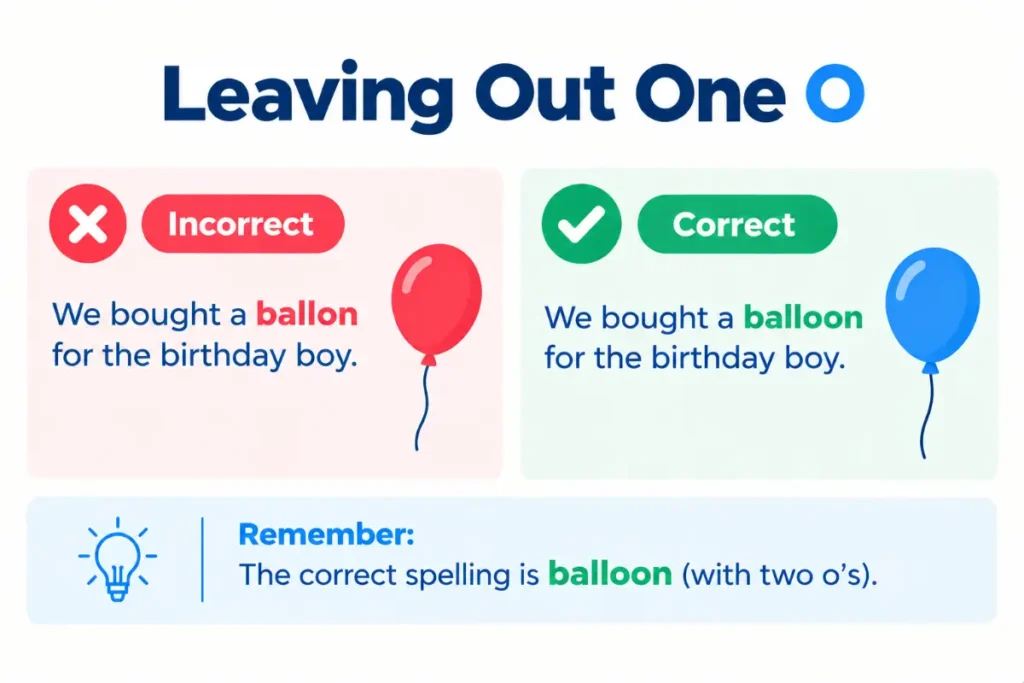
Leaving Out One O
Incorrect: We bought a ballon for the birthday boy.
Correct: We bought a balloon for the birthday boy.
The incorrect version omits one O. Since the standard spelling contains two Os at the end, the correct form is balloon.
Leaving Out One L
Incorrect: The baloon floated above the crowd.
Correct: The balloon floated above the crowd.
The incorrect version has only one L. Remember that balloon has a double L followed by a double O.
Using the Wrong Plural
Incorrect: The children played with several ballon.
Correct: The children played with several balloons.
The correct plural adds S to the complete word balloon. Don’t remove a repeated letter when changing a singular noun into its plural form.
Confusing Spelling With Pronunciation
A word can sound familiar even when its spelling isn’t correct. You may recognize what someone means when they write ballon, but that doesn’t make the spelling standard in English.
Reading aloud can help you catch awkward wording, but it won’t always reveal a missing letter. That’s why visual proofreading matters.
Trusting Autocorrect Too Much
Spellcheckers and autocorrect tools can catch many errors, but they aren’t perfect. A tool may overlook a mistake, fail to understand your intended meaning, or accept a spelling that belongs to another language or a proper name.
For important writing, check the word yourself. If you’re preparing a school assignment, public announcement, or professional document, a final spelling review is worth the effort.
Easy Ways to Remember the Spelling
You don’t need a complicated grammar rule to remember balloon. A few simple memory techniques can help you write it correctly every time.
Remember the Double Letters
Think of balloon as two pairs of repeated letters followed by one final letter.
B A L L O O N
The pattern is simple: two Ls, two Os, and one N.
When you write the word, picture both pairs together. This visual trick is especially useful when you’re typing quickly.
Think of Two Loops
Imagine the two Os as two round balloons tied together. The image gives you a quick reminder that the word needs two Os, not one.
You can also picture the two Ls as strings holding the imaginary balloons in place. It isn’t a formal spelling rule, but a memorable picture can make the letter pattern easier to recall.
Say the Word and Write It
Read the word slowly, then write it from memory. Repeat the process a few times without looking at the correct form.
This practice helps build familiarity with the letter sequence. It works best when you use the word in a complete sentence rather than memorizing isolated letters alone.
Use a Simple Memory Sentence
Try this sentence.
Two Ls and two Os make a balloon.
The sentence highlights the two letter pairs that people often forget. You can repeat it before writing the word if you tend to leave out a letter.
Practice With Related Sentences
Write three short sentences using balloon in different ways.
- I received a balloon at the fair.
- The balloons decorated the room.
- The company’s expenses began to balloon.
The first sentence uses the singular noun. The second uses the plural noun. The third uses balloon as a verb.
Practicing different forms helps you remember the spelling in real situations instead of only in a spelling test.
Related Words and Expressions
Learning related vocabulary can improve your spelling and help you express ideas more precisely. Several English words connect to balloons, their uses, or their shapes.
Words Related to Balloon
| Word | Meaning | Example |
|---|---|---|
| Inflate | To fill something with air or gas | Please inflate the balloon carefully. |
| Deflate | To release air or gas from something | The balloon began to deflate. |
| Helium | A light chemical element used to fill some balloons | The shop filled the balloon with helium. |
| Latex | A material used to make many flexible balloons | The balloon was made from latex. |
| Envelope | The outer part of a balloon that contains the gas | The hot air balloon’s envelope expanded as it filled with hot air. |
| Airship | A powered aircraft that uses a lighter than air gas for lift | The airship moved slowly across the sky. |
| Blimp | A type of nonrigid airship | A blimp circled above the stadium. |
These words describe different materials, actions, and types of aircraft. They aren’t alternative spellings of balloon, so choose the word that matches the intended meaning.
Balloon Related Expressions
English speakers also use balloon in figurative expressions.
Balloon in size. This phrase describes something that grows larger.
Example: The stain ballooned after the fabric became wet.
The verb ballooned means that the stain expanded.
Balloon in cost. This expression describes a sharp increase in expenses.
Example: Renovation costs ballooned after the contractor discovered structural damage.
The word suggests that the costs grew much more than expected.
Speech balloon. This term describes a shape in a comic or illustration that contains spoken words.
Example: The speech balloon showed what the character said.
Hot air balloon. This is an aircraft that rises when the air inside its envelope is heated.
Example: They took a hot air balloon ride at sunrise.
These expressions demonstrate that balloon can appear in both literal and figurative contexts. The spelling remains the same in each one.
Writing Tips for Everyday and Professional Use
Correct spelling is one part of clear writing. The other part is choosing words that fit the situation and making sentences easy to understand.
Proofread Repeated Letters
When reviewing your writing, pay extra attention to words with double letters. Common examples include balloon, address, occasion, necessary, and successful.
Repeated letters are easy to overlook because the eye often recognizes the general shape of a word rather than checking each letter. Reading your text slowly can help you spot errors.
Use the Word That Matches Your Meaning
Balloon can refer to a physical object or describe rapid growth. The surrounding sentence usually makes the intended meaning clear.
Example: The balloon rose above the rooftops.
Here, balloon is a physical object.
Example: The budget continued to balloon.
Here, balloon is a verb that describes an increase in the budget.
Using the word correctly helps readers understand your point without needing extra explanation.
Be Careful With Foreign Language Words
A similar looking word may be correct in another language. That doesn’t mean you should use it in an English sentence when the standard English spelling is different.
For instance, French uses ballon in contexts where English uses balloon. If you’re writing in English, follow English spelling conventions. If you’re quoting a foreign language expression or using a proper name, preserve the original form.
Don’t Rely Only on Sound
Pronunciation can help you remember a word, but it can’t always tell you how many letters to write. English has many words with silent letters, repeated letters, and spellings inherited from older forms.
Use pronunciation as one memory aid, then confirm the written form when accuracy matters.
Keep a Personal Spelling List
If you repeatedly misspell certain words, keep a short list of them. Write the correct spelling, add a sentence, and review the list occasionally.
For example, you might record balloon with the reminder two Ls and two Os. A small habit like this can prevent the same error from appearing in emails, assignments, and published content.
Key Takeaways
- Balloon is the standard English spelling for an inflatable object.
- Ballon is generally a spelling mistake in ordinary English writing.
- Balloon contains seven letters, including two Ls and two Os.
- The word is pronounced with two syllables and stress on the second syllable.
- American and British English use the same spelling.
- The plural form is balloons.
- Balloon can function as both a noun and a verb.
- A simple memory trick is to remember two Ls and two Os.
- Similar spellings in other languages don’t change the standard English form.
- Proofreading repeated letters helps prevent common spelling errors.
Conclusion
Ballon vs balloon comes down to one simple rule. Balloon is the correct spelling in standard English when you mean an inflatable object or use the word to describe something that grows rapidly. Ballon is generally incorrect for this meaning, although it can appear in French and in proper names. Remember the two Ls and two Os, and you’ll have the spelling right.
The word balloon appears in many everyday situations, from birthday parties and school projects to scientific research and professional reports. It can function as a noun or a verb, and its spelling stays consistent in American and British English. Understanding these uses will help you recognize the word and choose the correct form when writing.
When you’re unsure, pause for a moment and check the letters. Balloon has seven letters, with two Ls followed by two Os. That small memory trick can save you from a common spelling mistake and help you write with greater confidence.
Frequently Asked Questions
Is Ballon or Balloon Correct?
Balloon is the correct spelling of the common English word for an inflatable object. Ballon is generally a misspelling in standard English. Remember to include two Ls and two Os.
Why Do People Spell Balloon as Ballon?
People often leave out one O when typing quickly or recalling the word from memory. The two spellings look similar, so the mistake can go unnoticed during casual writing. Checking the letter pattern helps prevent it.
How Do You Spell Balloon Correctly?
Spell it B A L L O O N. The word has seven letters, including two consecutive Ls and two consecutive Os. Writing it a few times can help you remember the pattern.
What Is the Plural of Balloon?
The plural of balloon is balloons. Add S to the end without changing the spelling of the singular noun.
Example: We ordered twelve balloons for the celebration.
The word balloons refers to more than one inflatable object.
How Many Letters Are in Balloon?
Balloon contains seven letters. These are B, A, L, L, O, O, and N.
The two pairs of repeated letters are useful clues when checking your spelling.
Is Balloon Spelled the Same Way in American and British English?
Yes. American and British English both use balloon. There is no standard regional spelling difference for this word.
How Do You Pronounce Balloon?
Balloon is pronounced /bəˈluːn/ in standard American English. It has two syllables, with the main stress on the second syllable.
The ending sounds like the word moon.
Can Balloon Be Used as a Verb?
Yes. Balloon can mean to swell, expand, or increase rapidly.
Example: The project’s costs ballooned after the unexpected delay.
In this sentence, ballooned describes a sharp increase in costs.
What Is the Difference Between Ballon and Balloon?
The main difference is spelling. Balloon is the standard English word, with two Ls and two Os. Ballon is usually a misspelling when someone intends to write the English word for an inflatable object.
Is Ballon Ever a Real Word?
Yes, in certain contexts. Ballon is a French word and may also appear in surnames, brand names, or other proper names. However, it isn’t the standard English spelling of balloon.
What Is the Easiest Way to Remember Balloon?
Remember the phrase two Ls and two Os. You can also picture two round balloons side by side to remind yourself to include both Os.
Is Balloon One Word or Two?
Balloon is one word. It is written without a space or hyphen. In expressions such as hot air balloon and weather balloon, the full expression contains multiple words, but balloon itself remains a single word.

Confusing Words, Spelling & Word Choice
Claire Whitmore is a U.S.-based English editor who writes about commonly confused words, spelling differences, and word choice. Her work helps readers understand subtle distinctions between similar-looking words through simple definitions, practical examples, and modern usage guidance in both American and British English.