
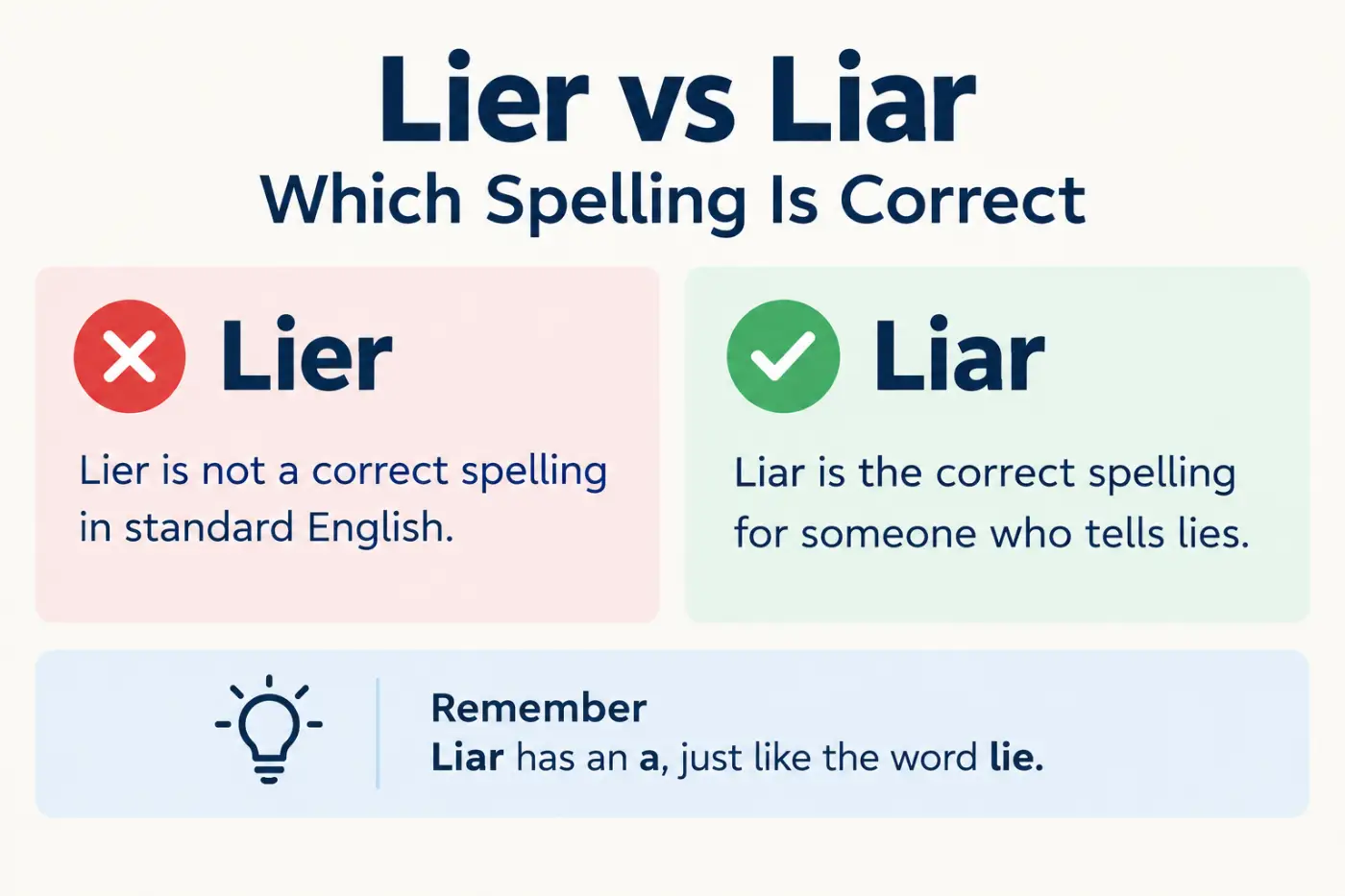
Lier vs liar is a common spelling confusion because both words look almost identical and sound the same in ordinary American English. However, they don’t have the same meaning. The difference comes down to how each word is used and the meaning you want to express.
The word liar describes a person who knowingly tells lies. You might call someone a liar if they deliberately make a false statement to deceive another person. For example, if someone promises to return borrowed money but falsely claims they already paid it back, you might describe that person as a liar.
The spelling lier exists, but it’s uncommon in modern everyday English. It can refer to someone or something that lies down or occupies a particular position. Most writers rarely need this word. For ordinary conversations, school assignments, emails, articles, and professional writing, liar is the correct choice when talking about dishonesty.
Short Answer
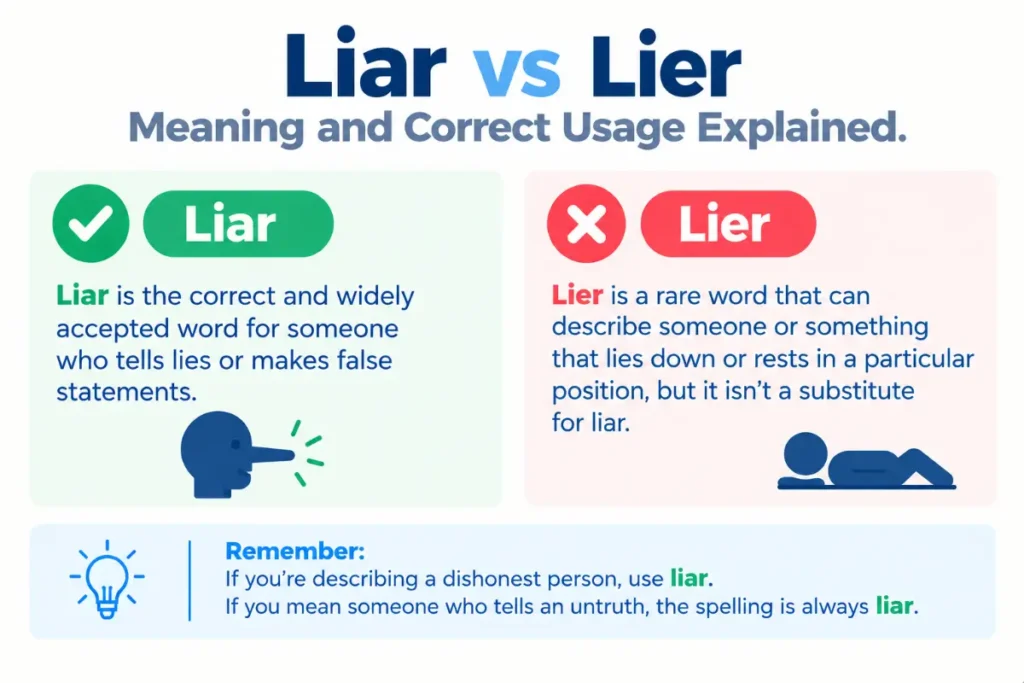
Liar is the correct and widely accepted word for someone who tells lies or makes false statements. Lier is a rare word that can describe someone or something that lies down or rests in a particular position, but it isn’t a substitute for liar. If you’re describing a dishonest person, use liar. If you mean someone who tells an untruth, the spelling is always liar.
Table of Contents
- The Difference Between Lier and Liar.
- What Liar Means.
- What Lier Means.
- Why People Confuse These Words.
- How to Use Liar Correctly.
- When Lier May Be Appropriate.
- Lier vs Liar Comparison Table.
- Real Life Examples.
- Common Spelling Mistakes.
- Pronunciation and Word Origins.
- Memory Tips.
- Related Words and Expressions.
- Frequently Asked Questions.
- Key Takeaways.
- Conclusion.
The Difference Between Lier and Liar
The main difference is meaning. Liar is the standard word for a person who tells lies, while lier is a rare term associated with lying down or occupying a position.
Both spellings may look reasonable to an English learner. After all, English has many words that end in er, such as teacher, writer, and speaker. However, English spelling doesn’t always follow one simple pattern. You need to learn the established spelling of each word and understand its meaning.
Consider these examples.
1. Correct: The liar denied taking the money.
The word liar identifies a person who tells lies or is accused of dishonesty. It fits the sentence because the subject is being described as dishonest.
2. Incorrect for this meaning: The lier denied taking the money.
This spelling doesn’t express the ordinary meaning of a dishonest person. Use liar instead.
3. Rare usage: The lier rested quietly on the grass.
In a context that specifically uses lier to mean someone who lies down, the word may be understood. However, most modern writers would choose a clearer expression, such as the person lying on the grass.
The safest rule is simple. Use liar when you mean a dishonest person. Avoid lier in ordinary writing unless you have a specific reason to use its rare positional meaning.
What Liar Means
A liar is a person who tells lies. A lie is a statement that someone knows is false and presents as true. The word usually suggests dishonesty or an attempt to mislead another person.
Liar is a countable noun. You can talk about one liar, two liars, or several liars. The plural form is liars, which follows the usual English rule of adding s to many nouns.
Definition of Liar
The word liar refers to someone who tells a lie. It can describe a person who lies once or someone who has developed a pattern of dishonesty.
For example, a child might tell a lie about breaking a vase because they fear getting into trouble. An employee might lie about finishing a task to avoid criticism. A public figure might make a false claim to protect a reputation. In each case, liar can describe the person who deliberately misleads others.
However, the word carries a strong negative meaning. Calling someone a liar can sound angry, insulting, or accusatory. It’s best to use it when the facts support the claim or when you clearly intend to express a strong judgment.
Example Sentences With Liar
1. The liar finally admitted that he had taken the wallet.
The sentence describes someone who told a lie and later confessed. Liar emphasizes the person’s dishonesty.
2. Nobody believed the liar after his story changed three times.
This example shows how repeated false statements can damage trust. The word liar presents the person as untrustworthy.
3. She felt hurt when her friend called her a liar.
Here, liar is an accusation. The sentence shows how the word can damage a personal relationship.
4. A good witness tells the truth instead of acting like a liar.
This sentence contrasts honesty with dishonesty. It uses liar to describe someone who fails to tell the truth.
5. He isn’t a liar just because he made one honest mistake.
This example highlights an important distinction. A person who makes an incorrect statement by mistake hasn’t necessarily lied.
Does Liar Always Mean a Bad Person
Not necessarily. The word describes dishonesty, but it doesn’t tell you everything about someone’s character.
A person may lie out of fear, embarrassment, selfishness, or a desire to protect someone. Some lies can cause serious harm, while others may seem minor. The circumstances matter when you judge someone’s behavior.
It’s also important to distinguish a lie from a mistake. If someone gives you the wrong date because they remember it incorrectly, that doesn’t automatically make them a liar. A lie generally involves knowingly presenting something false as true.
In everyday conversation, people sometimes use liar loosely when they’re angry or disappointed. In careful writing, however, it’s better to distinguish deliberate dishonesty from an honest error.
What Lier Means
Lier is a rare English word related to the verb lie in the sense of lying down or occupying a position. It may describe a person or thing that lies in a particular place or position.
This meaning differs from the dishonesty associated with liar. The two words belong to different uses of the verb lie, which explains why their spellings differ.
Definition of Lier
The noun lier is uncommon in present day American English. Most readers are more familiar with liar and may assume lier is a spelling mistake.
In rare or specialized contexts, lier can refer to someone or something that lies down. It may also appear in older writing or in technical discussions involving objects that rest in a particular position.
For example, a writer discussing a person resting in a field might encounter a use of lier in an older text. In modern writing, the phrase person lying in a field would usually communicate the idea more naturally.
Because the word is rare, its precise interpretation depends on context. Don’t assume that every appearance of lier is an error, but don’t choose it as a replacement for liar when describing dishonesty.
Example Sentences With Lier
The following examples illustrate the possible positional meaning of the rare noun. They aren’t recommendations for everyday American writing.
1. The old text referred to a lier resting beside the road.
In this constructed example, lier refers to a person lying down. Modern readers would probably find the wording unusual.
2. The description used the term lier for an object placed flat on the ground.
Here, the word is being used in a positional sense. A modern writer would usually describe the object directly.
3. The historian explained how the unusual word lier appeared in the original document.
This example discusses the spelling itself rather than recommending it for ordinary use.
These sentences demonstrate why context matters. The word can have a rare meaning that differs from the standard noun liar, but most readers won’t expect that unusual usage.
Should You Use Lier in Everyday Writing
In most cases, no. If you want to say that someone tells lies, write liar. If you want to describe a person resting on a surface, write person lying down, person lying on the floor, or another natural phrase.
These alternatives help readers understand your meaning without stopping to interpret an uncommon noun.
For example, write The child was lying on the couch instead of trying to turn the verb into the rare noun lier. The sentence is natural, clear, and easy to understand.
Why People Confuse These Words
The confusion between lier and liar comes from their similar appearance, similar pronunciation, and connection to the verb lie. The difference becomes easier to understand once you recognize that English uses lie in two distinct senses.
The Two Meanings of Lie
English has two important verbs spelled lie.
The first means to say something false or dishonest. The second means to rest, recline, or occupy a position. Both verbs have forms that learners need to recognize.
| Word form | Meaning | Example |
|---|---|---|
| Lie | Tell something untrue | Don’t lie to your parents. |
| Lies | Tells something untrue | He lies about his age. |
| Lied | Told something untrue | She lied about the meeting. |
| Lying | Telling something untrue | He is lying to his teacher. |
| Lie | Rest or recline | I need to lie down. |
| Lies | Rests or is located | The town lies near the river. |
| Lay | Rested or placed something down | She lay on the sofa. |
| Lain | Rested in a position | He had lain there for hours. |
| Lying | Resting in a position | The book is lying on the desk. |
The table shows that one spelling can represent two meanings. Context tells you which meaning applies.
The noun liar comes from the dishonesty sense of lie. The rare noun lier relates to the positional sense. That distinction explains the spelling difference.
Why the Ending Matters
English nouns often use endings such as er or or to identify people who perform an action. A teacher teaches, a reader reads, and a speaker speaks. This pattern may lead someone to assume that lier must be the correct noun for a person who tells lies.
However, the established English spelling for a dishonest person is liar. It isn’t enough to apply a general spelling pattern. You also need to recognize the standard form of the individual word.
Think of spelling as a set of patterns with some exceptions. Patterns help you make educated guesses, but familiar words still need to be learned in their accepted forms.
Why Spell Check May Not Catch the Error
A spelling checker might accept both lier and liar because both forms exist in English. A grammar tool may also miss the problem if the sentence is grammatically structured.
For example, a sentence such as He is a lier has a subject, a linking verb, and a noun phrase. Its grammar looks normal, but the noun doesn’t express the intended meaning.
This is a meaning error rather than a simple typing error. Automated tools may not recognize it without enough context.
To catch the problem, read the sentence and ask what you want the word to mean. If you’re describing someone who tells lies, replace lier with liar.
How to Use Liar Correctly
Use liar when you need a noun for a person who tells lies. The word works in casual conversation, storytelling, news commentary, academic discussion, and other types of writing. The tone may vary, but the spelling stays the same.
Use Liar for a Dishonest Person
The most common use is to describe someone who deliberately tells falsehoods.
1. My brother called the salesman a liar.
The sentence reports an accusation of dishonesty. It doesn’t automatically prove that the salesman lied.
2. The detective discovered that the suspect was a liar.
The word describes a person whose statements were dishonest. The surrounding context should support this characterization.
3. She didn’t want to be known as a liar.
This sentence shows concern about reputation. It uses liar in the ordinary sense of someone who tells lies.
Use Liar When Discussing Trust
The word can describe the effect dishonesty has on relationships. Trust depends on people believing that others are being truthful.
1. Once people see him as a liar, they may question his future claims.
The sentence explains how dishonesty can weaken credibility.
2. She forgave her friend but struggled to trust someone she considered a liar.
This example shows that forgiveness and restored trust aren’t always the same thing.
3. The company lost customers after its owner was exposed as a liar.
Here, the word connects dishonesty with a loss of public confidence.
Use Liar Carefully in Formal Writing
Liar is a standard English word, but it’s emotionally charged. In professional or academic writing, a more precise description may be more useful.
For example, instead of writing The manager is a liar, you could write The manager knowingly gave false information about the results. The second sentence describes the behavior rather than relying on a personal label.
This approach is especially useful in workplace reports, research papers, legal discussions, and news writing. It lets readers evaluate the evidence without being pushed toward a conclusion by an insult.
That doesn’t mean you can never use liar in formal writing. The word may be appropriate in a quotation, a literary analysis, or a discussion of someone’s established pattern of dishonesty. The key is to make sure the wording fits the purpose and evidence.
Use the Plural Form Liars Correctly
The plural of liar is liars. Simply add s to the singular noun.
1. The liars were caught changing their stories.
Liars refers to more than one person who told lies.
2. People often struggle to trust habitual liars.
The sentence describes people who repeatedly engage in dishonest behavior.
3. The novel features two liars who deceive each other.
The plural form identifies two characters who tell lies.
Don’t write liar’s when you mean more than one dishonest person. The apostrophe changes the grammatical meaning.
For example, The liars left the room refers to multiple people. The liar’s story changed uses the possessive form to show that the story belongs to one liar.
When Lier May Be Appropriate
Although most writers should choose alternatives, lier can appear in rare contexts where its positional meaning is intended. Knowing that the word exists can help you read older texts and understand unusual vocabulary.
Older Texts and Uncommon Vocabulary
English has changed over time. Some words that once appeared in writing have become uncommon, while others have developed more familiar alternatives.
Lier may appear in historical material or specialized discussions. If you encounter it, look at the surrounding sentence and determine which meaning the author intended.
Don’t automatically change every occurrence to liar. Doing so could alter the meaning of a historical passage. At the same time, don’t assume that an unusual spelling is suitable for modern everyday prose.
Technical or Specialized Contexts
A rare noun may occasionally appear in a specialized field or in a description of an object that lies in a particular position. In these cases, the writer should define the term if readers may not know it.
A technical word earns its place when it communicates something more precisely than ordinary language. If it adds confusion instead, a familiar phrase is usually better.
For most American readers, object resting on a surface is clearer than a rare noun. Choose the wording that communicates the idea with the least effort.
Better Alternatives to Lier
If you mean someone or something is in a resting position, use a phrase that states the action directly.
1. Person lying down. Use this phrase for someone resting horizontally.
2. Object lying on the floor. Use this when an item rests on a floor or another flat surface.
3. Person reclining. Use this when someone leans back or rests in a relaxed position.
4. Object resting in place. Use this when an item remains in a particular location.
5. Something located nearby. Use this when you mean that a place or object lies in a certain geographical position.
These expressions are easier to understand than the rare noun. They also help you avoid a spelling choice that readers might mistake for an error.
Lier vs Liar Comparison Table
The following table summarizes the difference between the two words.
| Feature | Liar | Lier |
|---|---|---|
| Main meaning | A person who tells lies | A rare term associated with lying down or occupying a position |
| Common in modern American English | Yes | No |
| Standard spelling for a dishonest person | Yes | No |
| Part of speech | Noun | Rare noun |
| Typical context | Dishonesty and false statements | Uncommon positional usage |
| Plural form | Liars | Liers in contexts that use the noun |
| Best choice for everyday writing | Yes when describing dishonesty | Usually avoid it |
| Common reader expectation | A dishonest person | An unusual or possibly mistaken spelling |
The practical difference is straightforward. Liar is the normal word for a dishonest person. Lier is rare and usually unnecessary in everyday writing.
Real Life Examples
Seeing the words in context makes their meanings easier to remember. The examples below cover common situations in conversation, school, work, and storytelling.
Examples From Everyday Conversation
1. My friend said I was a liar, but I had told the truth.
Liar is the correct noun because the sentence describes an accusation of dishonesty. It also shows that calling someone a liar doesn’t prove the accusation is true.
2. Don’t call your sister a liar without knowing what happened.
The sentence advises someone to avoid making an unfair accusation. Liar is appropriate because it refers to a person accused of telling lies.
3. He became known as a liar after repeatedly breaking his promises.
The word describes a reputation built around dishonesty. The context suggests a repeated pattern rather than one isolated mistake.
4. The little boy feared that his parents would think he was a liar.
Liar describes the child’s concern about how his parents might judge him. It doesn’t mean that every false statement automatically makes someone dishonest.
Examples From School and Work
1. The teacher asked the student to explain why he had lied.
The sentence uses the verb lied rather than the noun liar. It focuses on the act of telling a falsehood.
2. The report showed that the witness had knowingly provided false information.
This wording is more formal than calling the witness a liar. It identifies the behavior clearly and avoids an emotionally charged label.
3. The editor removed the word lier and replaced it with liar.
The correction is appropriate if the original sentence referred to a dishonest person. The change fixes the word choice rather than the overall sentence structure.
4. A reliable employee admits mistakes instead of making false claims.
This sentence avoids both nouns and expresses the idea directly. It may suit professional writing better than a personal accusation.
Examples From Stories and Fiction
1. The king trusted the liar until the truth reached the palace.
Liar describes a character who deceives the king. The sentence creates a conflict between trust and dishonesty.
2. Every liar in the village feared the arrival of the honest judge.
The plural noun liars describes several dishonest characters. The contrast with the judge helps establish the story’s moral conflict.
3. The detective wondered if the suspect was a liar or simply confused.
This sentence separates deliberate dishonesty from an honest mistake. The distinction makes the investigation more thoughtful.
4. The narrator called himself a liar because he had hidden the truth.
Liar describes the narrator’s judgment of his own behavior. The example shows that people can use the word when reflecting on their actions.
Examples Showing the Rare Word
The next examples illustrate unusual uses of lier. In ordinary American writing, the alternatives are generally more natural.
1. The old passage described a lier beside the river.
The intended meaning is someone lying down near the river. A modern writer would usually say a person lying beside the river.
2. The researcher examined an old definition of lier.
This sentence discusses the word as a vocabulary item. The unusual spelling is the subject of the discussion rather than a label for a dishonest person.
3. The author chose the rare term lier to preserve the language of the historical setting.
The example explains why a writer might retain an uncommon word. Historical accuracy can justify unusual vocabulary when the meaning is clear.
These examples reinforce a useful habit. Choose the word that matches the intended meaning, not the spelling that looks familiar.
Common Mistakes
Even confident English writers can confuse similar words. The best way to avoid errors is to check both spelling and meaning.
Using Lier for a Dishonest Person
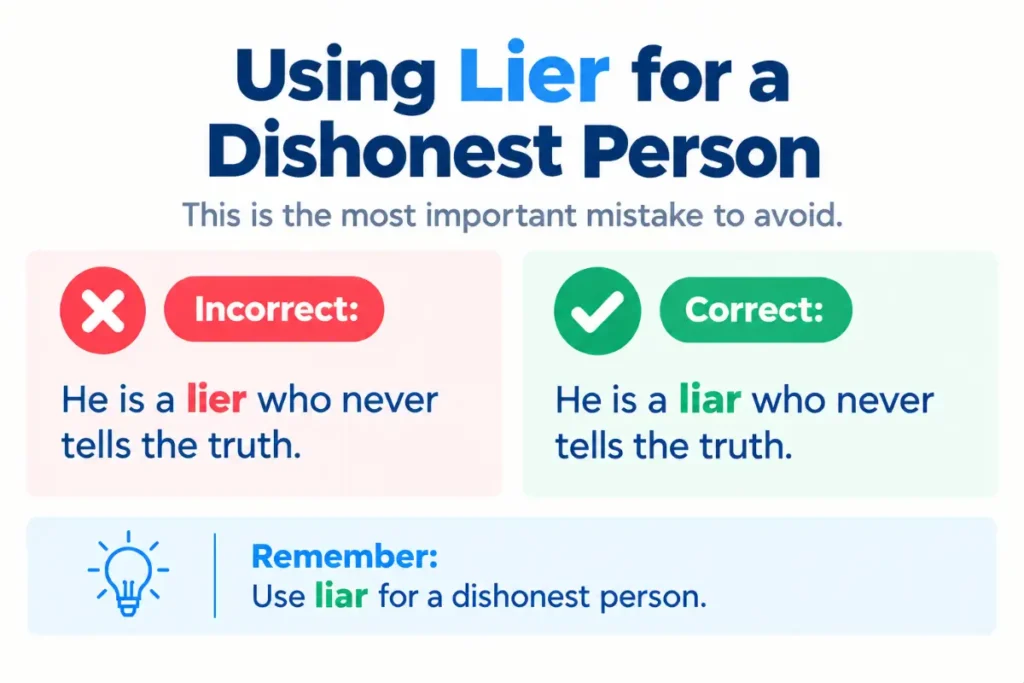
This is the most important mistake to avoid.
Incorrect: He is a lier who never tells the truth.
Correct: He is a liar who never tells the truth.
The corrected sentence uses the standard noun for someone who tells lies. Remember that the rare spelling lier doesn’t replace liar in this context.
Assuming Both Words Are Interchangeable
The words aren’t interchangeable just because they look similar. Their meanings differ, and only liar is the normal choice for describing a dishonest person.
For example, She called him a liar is correct when she accuses him of dishonesty. Replacing liar with lier changes the intended meaning and makes the sentence sound incorrect to most readers.
Confusing Liar With Lying
Liar is a noun, while lying is a form of the verb lie. Both can refer to dishonesty, but they serve different grammatical roles.
1. Correct: He is a liar.
Liar identifies the person.
2. Correct: He is lying.
Lying describes what the person is doing.
3. Incorrect: He is a lying.
The sentence doesn’t work in standard English because lying is already the verb form needed here.
You can also use lying as an adjective, as in a lying witness. In that phrase, lying describes the witness’s dishonest behavior.
Confusing Liar With Liar’s
An apostrophe changes the meaning of the word. Liar refers to one dishonest person, while liar’s usually shows possession or appears in a contraction.
1. The liar spoke first.
The noun identifies one person.
2. The liar’s story changed.
The possessive form shows that the story belongs to the liar.
3. The liar’s been caught.
In this sentence, liar’s is a contraction of liar has. The apostrophe doesn’t make the noun plural.
If you mean more than one dishonest person, write liars without an apostrophe.
Calling Someone a Liar Without Evidence
This mistake involves meaning and judgment rather than spelling. A person can give incorrect information without deliberately lying.
For example, someone might tell you that a meeting starts at 10 a.m. because they read an outdated schedule. If the meeting actually starts at 11 a.m., the information is wrong, but the person may not have intended to deceive you.
In careful writing, describe the facts first. Use liar only when the context supports the claim of deliberate dishonesty.
Pronunciation and Word Origins
Pronunciation can help you recognize the words, but it won’t always help you spell them. In standard American English, liar and lier are generally pronounced alike or very similarly. Both are commonly said as one syllable, with the vowel sound found in words such as fire in accents that pronounce it as one syllable.
Because the words sound alike, you need to rely on meaning and spelling knowledge rather than pronunciation alone.
How to Pronounce Liar
In American English, liar is commonly pronounced as one syllable, though some speakers may produce a slight second vowel sound. The exact realization can vary by accent and speaking style.
Say the word naturally rather than forcing it into separate syllables. In ordinary conversation, its pronunciation is familiar to most native speakers.
How to Pronounce Lier
Lier is usually pronounced similarly to liar. That similarity is one reason the spellings can be confusing.
Don’t assume that the spelling difference always creates a clear difference in sound. In many accents, listeners can’t reliably distinguish the words by pronunciation alone.
Where the Word Liar Comes From
Liar developed from the English verb lie, meaning to tell something untrue, combined with a noun forming ending. English has long used related forms to describe people who perform actions.
The word belongs to the same family as lie, lies, lied, and lying when those forms refer to dishonesty. Their grammatical roles differ, but they share the same central idea.
The rare positional noun lier relates to the other meaning of lie, which describes resting or being situated in a place. English has several words that look similar because they come from different meanings or historical word patterns.
The most useful point isn’t the full history of either word. It’s the connection between meaning and spelling. Liar is the established spelling for a dishonest person, while lier remains unusual in everyday writing.
Memory Tips
A simple memory trick can help you choose the correct spelling quickly.
Connect Liar With a Lie
The word liar contains the letters lia in the same order as lie begins. Think of a liar as someone who tells a lie.
You can remember the relationship with this sentence.
A liar tells a lie.
The connection is short and direct. When you need a noun for a dishonest person, think about the word lie and remember the standard spelling liar.
Remember That Liar Names a Person
Liar is a noun. It labels a person rather than describing an action.
Compare these examples.
1. He lied to his friend.
Lied is the past tense verb.
2. He is lying to his friend.
Lying is the verb form used for an ongoing action.
3. He is a liar.
Liar is the noun that identifies the person.
Remembering the grammatical role can help you avoid mixing the forms.
Use a Meaning Check
Before choosing a spelling, ask yourself one question: Am I talking about dishonesty or about someone resting in a position?
If the answer is dishonesty, use liar. If you are reading a rare use related to lying down, examine the context and consider a more familiar phrase.
This method works better than trying to memorize every unusual word in English. Meaning gives you a practical way to check your choice.
Try a Quick Practice Test
Choose the correct word for each sentence.
1. The witness was exposed as a lier or liar.
2. My dog is lying or lieing on the rug.
3. The lier or liar admitted that he had made up the story.
4. The liars or liar’s were caught changing their statements.
The correct answers are liar, lying, liar, and liars.
In the second sentence, lying is the correct form of lie when it means resting. In the fourth sentence, liars is plural because the sentence refers to more than one person. These related forms help reinforce the difference between spelling, grammar, and meaning.
Related Grammar and Usage Notes
Understanding the related forms of lie will make your writing more accurate. English uses the same spelling for two different verbs, and each has its own pattern.
Lie and Lay
Lie means to rest or recline. Lay means to put something down and usually takes an object.
1. I need to lie down.
The subject rests without placing a separate object somewhere.
2. I need to lay the book on the table.
The subject places the book on the table. The noun book is the object of lay.
3. She lay on the bed yesterday.
Lay is the past tense of lie when it means to rest.
4. She laid the blanket on the bed yesterday.
Laid is the past tense of lay when it means to place something down.
These verbs are often confused because their forms overlap. Paying attention to the action can help you choose the correct one.
Lie and Lied
When lie means to tell something untrue, its past tense is lied.
1. He lied about his age.
Lied describes a false statement made in the past.
2. She has lied to her parents before.
The present perfect form connects an earlier act of dishonesty with the present.
3. They were lying about the results.
Lying describes the dishonest action in progress.
Don’t use lay as the past tense of lie when you mean to tell an untruth. The standard form is lied.
Lying and Lieing
The correct spelling is lying, not lieing. When the verb lie takes the ending ing, the final ie changes to y.
For example, write He is lying about the money. The same spelling rule appears in other English words, such as dying from die and tying from tie.
This spelling pattern is worth remembering because it applies to several common verbs. It also shows why the noun liar shouldn’t be created by simply adding an ending without considering established usage.
Liar and Deceiver
A deceiver is someone who tricks or misleads another person. A liar is someone who tells lies.
The meanings overlap, but they aren’t identical. A person can deceive someone through actions, misleading behavior, or carefully chosen omissions without making a direct false statement.
For example, someone who tells a customer that a product is new when they know it’s used may be a liar. Someone who hides important details to create a false impression may be a deceiver, even if every sentence they say is technically true.
Choose the word that best describes the behavior. This makes your writing more precise.
Liar and Fibber
A fibber is someone who tells fibs, which are usually understood as small or relatively harmless lies. Liar is a broader word and can carry a stronger negative tone.
For example, a parent might call a child a fibber after a minor lie about eating a cookie. Calling the child a liar may sound more severe, depending on the situation.
Both words are standard English. Their difference lies mainly in tone and the kind of dishonesty being described.
Liar and Dishonest Person
Dishonest person is a more neutral phrase than liar in some situations. It can describe a broader pattern of behavior without focusing on a single statement.
For example, a report might say that an employee acted dishonestly by changing records. This phrasing describes the conduct directly and may sound more professional than labeling the employee a liar.
The best choice depends on the purpose of the sentence. Everyday conversation may favor liar, while formal writing may benefit from specific and evidence based wording.
Lier vs Liar in American English
In modern American English, liar is the standard and familiar word for a person who tells lies. The spelling is widely understood across everyday, academic, and professional settings.
Lier is not a common alternative spelling for a dishonest person in the United States. Readers are likely to interpret it as a typo or pause to work out what the writer means.
There isn’t a meaningful American versus British spelling difference for the ordinary noun liar. Writers in both varieties of English use liar to describe someone who tells lies.
The rare positional use of lier doesn’t make it a regional replacement for liar. If you’re writing for a US audience, choose liar for dishonesty and use a clear phrase such as lying down for a resting position.
Professional Writing Tips
Choosing accurate words helps readers trust your writing. It also prevents a small spelling issue from distracting them from your message.
Check Meaning Before Correcting Spelling
When you review a draft, don’t rely on a spelling checker alone. Read each sentence in context and make sure the word communicates the intended idea.
If you see lier, ask what the writer means. If the sentence describes someone who tells lies, correct it to liar.
Prefer Specific Descriptions Over Labels
Calling someone a liar makes a strong claim about that person’s honesty. In reports, news articles, and professional communication, it can be more useful to describe the specific statement or action.
For example, The manager knowingly gave the team an incorrect sales figure offers more detail than The manager is a liar. The first sentence explains what happened and gives readers a clearer basis for judgment.
This approach doesn’t weaken your writing. It makes your point easier to assess and helps you avoid claims that go beyond the available evidence.
Read the Sentence Aloud
Reading a sentence aloud can help you catch awkward phrasing, missing words, and unclear meaning. However, it won’t reliably distinguish liar from lier because the two spellings may sound the same.
Use sound to check the flow of a sentence and context to check the spelling. Both steps are useful, but they solve different problems.
Keep a Personal List of Confusing Words
If you often mix up similar spellings, keep a short reference list. Include the word, its meaning, and one clear example.
For example, write liar means a person who tells lies. Add the sentence He is a liar because he knowingly made a false claim. A short, memorable example can be more useful than a long definition.
Reviewing common errors helps build confidence and makes future editing faster.
Key Takeaways
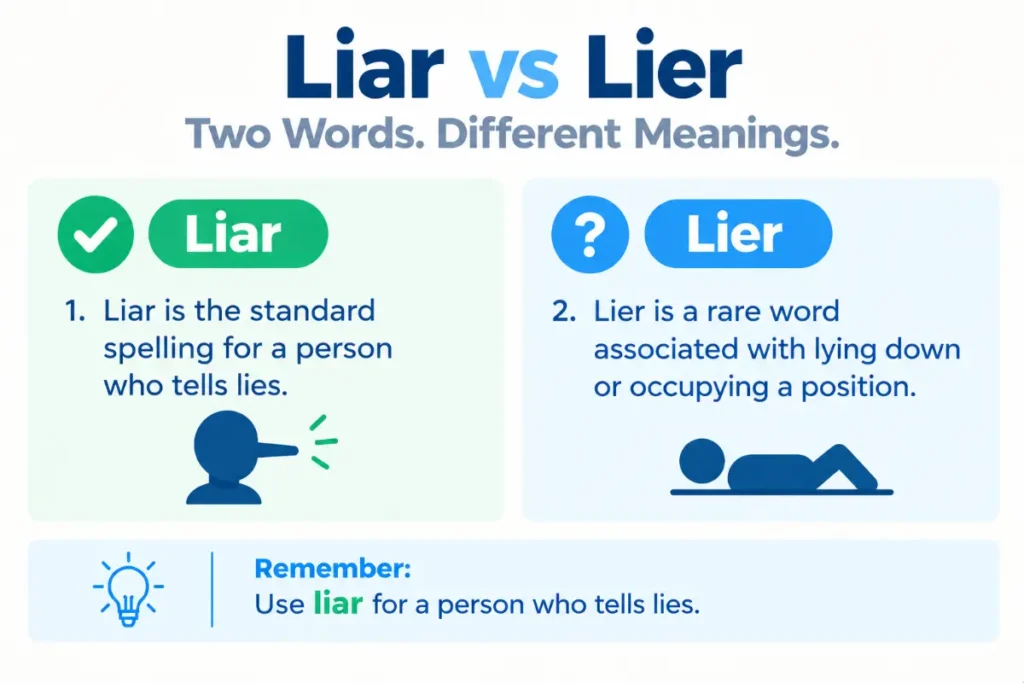
1. Liar is the standard spelling for a person who tells lies.
2. Lier is a rare word associated with lying down or occupying a position.
3. Liar and lier may sound the same in American English, so pronunciation alone may not help you choose the correct spelling.
4. The plural of liar is liars. The possessive form is liar’s.
5. Liar is used in both American and British English for someone who tells lies.
6. A person who makes an honest mistake isn’t automatically a liar. The word usually suggests deliberate dishonesty.
7. In professional writing, describe the specific behavior when a direct accusation would be too strong or unsupported.
8. When in doubt, use liar for dishonesty and choose a clear phrase such as lying down for a resting position.
Conclusion
Lier vs liar comes down to a simple spelling and meaning distinction. Liar is the correct standard word for someone who tells lies, while lier is a rare term associated with lying down or occupying a position. If you’re writing about dishonesty, liar is the word you need.
The easiest way to remember the difference is to connect liar with lie. A liar tells a lie, and several dishonest people are called liars. These familiar forms appear in everyday conversation, schoolwork, professional writing, and published English.
Before you finish a sentence, check the meaning you want to express. Use liar for a dishonest person, and choose a clearer phrase when you mean someone is resting or lying in a particular place. This simple habit will help you avoid a common spelling mistake and make your writing more precise.
Frequently Asked Questions
Is Lier or Liar Correct?
Liar is correct when you mean a person who tells lies. Lier is a rare word associated with lying down or occupying a position. For everyday American English, use liar when describing dishonesty.
What Is the Difference Between Lier vs Liar?
The difference is meaning and usage. Liar describes someone who tells lies, while lier has a rare positional meaning. The two words can sound alike, but they aren’t interchangeable.
Is Lier a Real Word?
Yes. Lier exists as a rare English word associated with lying down or occupying a position. However, it’s uncommon in modern everyday writing and isn’t the standard spelling for a dishonest person.
Why Do People Spell Liar as Lier?
People may choose lier because it looks like a logical spelling based on the verb lie and common English word endings. However, the accepted spelling for someone who tells lies is liar. Familiarity with the standard form helps prevent this mistake.
How Do You Spell Someone Who Tells Lies?
The correct spelling is liar. For example, you can write, He is a liar because he knowingly gave false information. The plural form is liars.
Is Liar Correct in American and British English?
Yes. Liar is the standard spelling in both American and British English when describing someone who tells lies. There isn’t a standard regional spelling difference for this word.
Are Liar and Lying the Same Word?
No. Liar is a noun that identifies a person who tells lies. Lying is a verb form that describes the act of telling something untrue or, in another sense, resting in a position.
For example, She is a liar identifies a person, while She is lying describes an action.
What Is the Plural of Liar?
The plural is liars. Add the letter s without an apostrophe.
For example, The liars were exposed after their stories contradicted each other. Use liar’s for possession or as a contraction, not as the ordinary plural form.
Can I Use Lier in a Formal Essay?
You generally shouldn’t use lier to mean a dishonest person. Use liar instead. If you’re analyzing a historical text that contains lier, you can retain the spelling when discussing the original wording or explaining its rare meaning.
How Can I Remember the Correct Spelling?
Remember this sentence: A liar tells a lie. The connection between liar and lie makes the correct spelling easier to recall. If the sentence describes dishonesty, choose liar.

Confusing Words, Spelling & Word Choice
Claire Whitmore is a U.S.-based English editor who writes about commonly confused words, spelling differences, and word choice. Her work helps readers understand subtle distinctions between similar-looking words through simple definitions, practical examples, and modern usage guidance in both American and British English.