
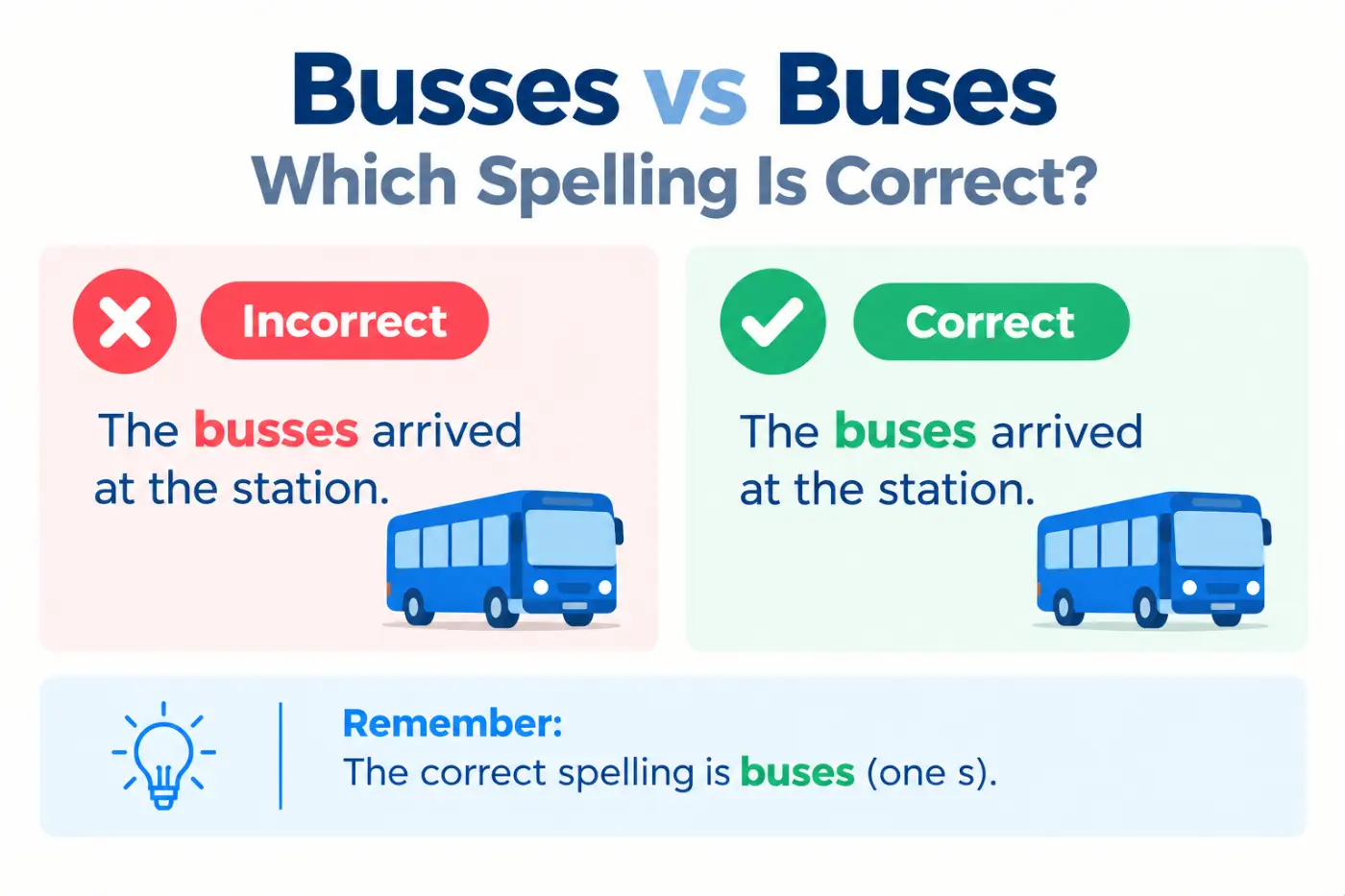
Busses vs buses is a common spelling question because both forms appear in English writing. If you’re talking about public transportation or school transportation, buses is the spelling you should normally use. It is the standard choice in American English and the form most readers expect to see in everyday writing.
The confusion comes from a familiar spelling pattern. Many English nouns ending in s form their plurals by adding es. For example, class becomes classes and glass becomes glasses. However, bus usually forms its plural as buses, even though busses is also recorded in dictionaries as an alternative.
The good news is that you don’t need to memorize a long list of exceptions to get this one right. Once you understand the standard plural of bus and the separate meaning of buss, you’ll know which spelling fits a school report, a business email, a travel schedule, or an everyday conversation.
Short Answer
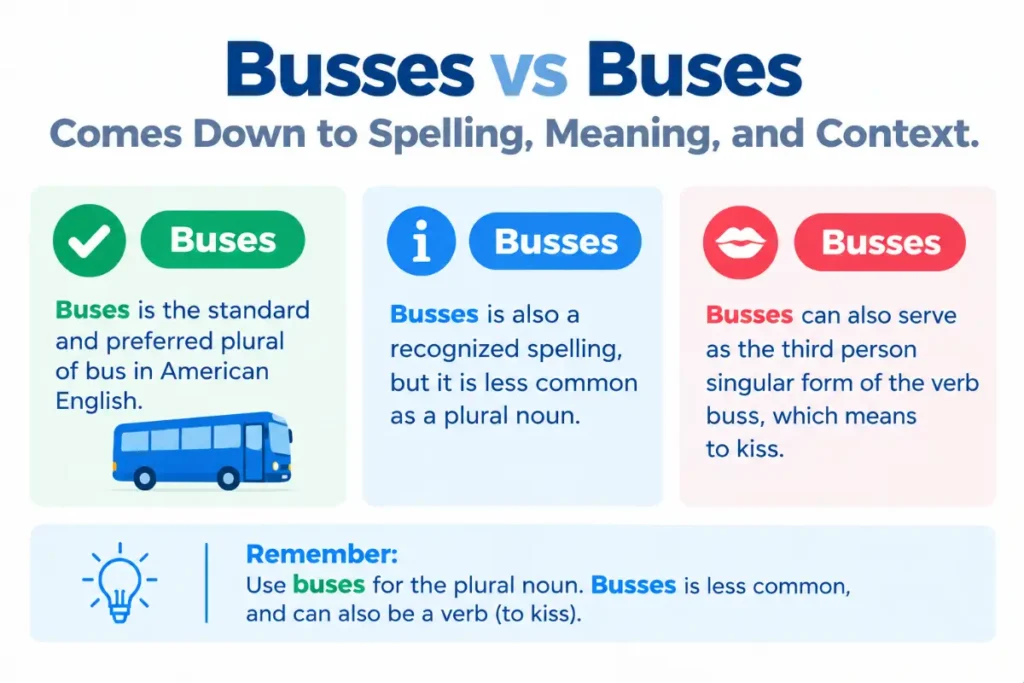
Busses vs buses comes down to spelling, meaning, and context. Buses is the standard and preferred plural of bus in American English. Busses is also a recognized spelling, but it is less common as a plural noun. The word busses can also serve as the third person singular form of the verb buss, which means to kiss.
Table of Contents
- The Difference Between Busses and Buses.
- What Buses Means.
- What Busses Means.
- Why Buses Is the Preferred Spelling.
- The Grammar Rule for Pluralizing Bus.
- Busses vs Buses in American and British English.
- Pronunciation and Word Origin.
- Comparison Table.
- Real Life Examples.
- Common Spelling Mistakes.
- Memory Tips.
- Related Grammar and Usage Notes.
- Frequently Asked Questions.
- Key Takeaways.
- Conclusion.
The Difference Between Busses and Buses
The main difference is frequency and standard usage. Buses is the preferred plural spelling of bus when referring to vehicles. Busses is a less common alternative plural, and it can also be a verb form connected to the word buss, meaning a kiss.
For most American English writing, choosing buses is the safest option. It follows established usage and helps readers recognize the intended meaning without pausing over an unusual spelling.
Consider these examples.
- The buses arrive at the station every fifteen minutes.This sentence uses buses as the plural noun for transportation vehicles. It is the normal spelling for this meaning.
- The school purchased three new buses for its students.The word buses refers to multiple school vehicles. This is the preferred spelling in American English.
- In the old poem, the characters exchange affectionate busses.Here, busses is used as a plural noun meaning kisses. The spelling is associated with the less common word buss, not the usual word for a transportation vehicle.
The context tells you which meaning the writer intends. Still, when the subject is transportation, use buses unless you’re quoting a source or following a specific publication’s spelling convention.
What Buses Means
Buses is the plural form of the noun bus. A bus is a road vehicle designed to carry multiple passengers, usually along a set route or for a particular transportation service.
The word can describe several kinds of vehicles. These include city buses, school buses, shuttle buses, tour buses, and intercity buses.
How to Use Buses Correctly
Use buses when referring to more than one bus. The word works in everyday conversation, formal writing, news reports, academic assignments, transportation notices, and business documents.
Examples include the following.
- The buses were parked outside the stadium.The sentence describes more than one vehicle. Buses is the correct plural noun.
- Two buses connect the airport with downtown.The word identifies two transportation vehicles serving a route. The spelling follows standard American usage.
- Our city plans to replace its oldest buses next year.The sentence refers to multiple vehicles owned or operated by the city. The plural is buses.
- Several buses were delayed because of heavy traffic.This example uses buses in a transportation report. It is clear, conventional, and suitable for professional writing.
- The museum offers free buses to the exhibition center.Here, buses describes vehicles that transport visitors. The spelling remains the same regardless of the service they provide.
Buses in Different Contexts
The word buses isn’t limited to public transit. Its meaning depends on the noun bus in the surrounding context.
- Public transportation. The city added more buses to its busiest routes.
- School transportation. The school buses leave at three o’clock.
- Tourism. Tour buses carry visitors between popular attractions.
- Airport transportation. Shuttle buses take passengers to the rental car center.
- Long distance travel. Overnight buses provide transportation between major cities.
In all these examples, buses is the standard plural spelling. The type of vehicle doesn’t change the rule.
Is Buses Singular or Plural
Buses is plural. The singular form is bus.
Use bus for one vehicle and buses for two or more. This distinction also affects the verb in a sentence.
- The bus stops near the library.The singular noun bus takes the singular verb stops.
- The buses stop near the library.The plural noun buses takes the plural verb stop.
Keeping the noun and verb in agreement makes your sentence grammatically correct and easy to understand.
What Busses Means
Busses has more than one possible use in English. It can be an alternative plural spelling of the transportation noun bus. It can also be the plural of buss, a less common noun meaning a kiss, or the third person singular present tense of the verb buss.
Although dictionaries recognize busses as a possible plural of bus, it is much less common than buses in standard modern American writing. For that reason, writers generally choose buses when discussing transportation.
Busses as a Plural Noun for Vehicles
Some dictionaries list busses as an alternative plural of bus. This means the spelling isn’t simply a random typo in every context. However, it isn’t the usual choice in contemporary American English.
For example.
- The busses lined up outside the terminal.The intended meaning is that several transportation vehicles lined up outside the terminal. The spelling is a recognized but less common alternative. In ordinary American writing, buses would be preferable.
- The company operates a fleet of busses.The writer means multiple vehicles operated by a transportation company. The standard modern spelling is buses.
If you’re writing for a general American audience, use buses to avoid distracting readers with an uncommon variant.
Busses as a Word Meaning Kisses
The noun buss means a kiss, often an affectionate or playful one. Its plural is busses.
This meaning is uncommon in everyday modern English. You’re more likely to encounter it in older literature, historical writing, poetry, or deliberately playful language.
Examples include the following.
- The child gave her grandmother two busses on the cheek.Here, busses means kisses. It has nothing to do with transportation.
- The old story described a farewell filled with busses and embraces.The word refers to kisses exchanged during a goodbye. Its tone may sound old fashioned or literary to modern readers.
- She greeted the children with warm busses.In this sentence, busses means affectionate kisses. The wording is unusual today, so kisses would be clearer for most readers.
Busses as a Verb
Busses can also be the third person singular present form of the verb buss. The verb means to kiss.
For example.
- He busses his grandmother on the cheek whenever he visits.The word busses describes an action performed by he. It is the present tense form of the verb buss.
- She busses the baby gently before bedtime.Here, busses means that she kisses the baby. The word functions as a verb rather than a plural noun.
This verb use is uncommon in contemporary American English. Most people would write kisses instead. Still, understanding the form helps explain why busses appears in dictionaries and older texts.
Why Buses Is the Preferred Spelling
English spelling isn’t always perfectly predictable. Some words ending in s add es to form their plurals, while others have more established spellings that writers need to learn.
The noun bus is one of those words. Although busses is recognized as an alternative plural, buses has become the conventional form in modern standard English.
Frequency and Reader Expectations
Readers who encounter the word buses immediately understand that the writer means multiple vehicles. The spelling is familiar in transportation schedules, school notices, traffic reports, newspapers, and everyday messages.
By comparison, busses may look like a typo to readers who don’t know it is an accepted variant. Even when a spelling is technically possible, the most familiar form is usually the better choice for clear communication.
For example.
- The district ordered twelve new buses.This sentence uses the spelling most American readers expect. It works well in school announcements and official reports.
- The district ordered twelve new busses.The intended meaning is understandable, but the spelling may distract readers. Unless a style guide or source requires it, use buses.
Dictionaries and Standard Usage
English dictionaries may record multiple spellings for a word without treating them as equally common. A dictionary entry can include a variant because it appears in real usage, not because it is the preferred form for every situation.
For bus, the plural buses is the normal modern choice for transportation. The alternative busses is recognized but less common. This distinction matters when you’re writing for school, work, publication, or a broad American audience.
Professional Writing Recommendations
In professional writing, consistency and reader familiarity matter. Choose buses in transportation reports, company documents, school policies, travel guides, news stories, and website content.
If you’re editing a document that uses busses for vehicles, consider changing it to buses. If the spelling appears in a historical quotation, a title, or a source that must remain unchanged, preserve the original wording when appropriate.
The goal isn’t to claim that every occurrence of busses is wrong. The goal is to choose the spelling that communicates your intended meaning clearly and follows standard current usage.
The Grammar Rule for Pluralizing Bus
The usual plural of bus is formed by adding es to the singular form. The result is buses.
The pattern is straightforward.
- Singular: bus.
- Plural: buses.
The spelling adds es rather than simply adding s. This creates the familiar plural form used throughout standard American English.
Why Bus Becomes Buses
Many English nouns form their plurals by adding s. For example, car becomes cars, and book becomes books. Nouns that end in certain sibilant sounds often take es instead.
Examples include the following.
- Class becomes classes.The noun ends in ss, so the plural adds es.
- Box becomes boxes.The noun ends in x, so the plural adds es.
- Watch becomes watches.The noun ends in ch, so the plural adds es.
- Bus becomes buses.The plural takes es, producing the standard spelling buses.
This pattern helps explain the spelling, although English has enough exceptions that it’s wise to check unfamiliar words rather than assume every noun follows the same rule.
Does the Rule Always Produce Only One Accepted Spelling
No. English sometimes preserves spelling variants that developed through historical use. Busses is an example of a less common alternative plural for bus.
The existence of a variant doesn’t mean you should use it interchangeably in every setting. Standard spelling depends on current usage, the intended meaning, and the expectations of your audience.
For most writing in the United States, buses is the best choice.
The Plural Rule in Sentences
Compare the following examples.
- One bus is waiting outside.The sentence refers to a single vehicle, so it uses the singular form bus.
- Four buses are waiting outside.The sentence refers to four vehicles, so it uses the standard plural buses.
- Every bus has a safety inspection.The word every refers to individual members of a group, so the singular noun bus is correct.
- All buses have safety inspections.The word all refers to multiple vehicles, so the plural noun buses is correct.
These examples show that number and sentence structure determine the form you need.
Busses vs Buses in American and British English
The standard plural buses is used in both American and British English. The spelling doesn’t normally change across these varieties of English when the word refers to transportation vehicles.
The less common form busses may appear in either variety as a variant, but it isn’t the usual spelling to choose for everyday writing in either country.
American English
In the United States, buses is the standard spelling in school communications, transit announcements, business writing, and general publications.
Examples include the following.
- The city is adding electric buses to its fleet.The sentence follows conventional American spelling.
- The school buses were inspected before classes began.The spelling is standard in an educational context.
- Passengers should wait until the buses come to a complete stop.The word buses is used in a safety instruction, where clear and familiar wording is especially helpful.
British English
British English also uses buses as the standard plural of bus. A writer in the United Kingdom can use the same spelling when describing public transportation, school transportation, or coach services.
For example.
- The buses run every ten minutes during peak hours.The plural follows standard British usage.
- Several buses connect the town with nearby villages.The sentence uses the same conventional plural spelling found in American English.
- The council plans to introduce more electric buses.The spelling remains buses despite the regional variety of English.
Is Busses More British Than Buses
No. You shouldn’t treat busses as the standard British spelling or buses as an exclusively American form. Both American and British English generally prefer buses for transportation vehicles.
When writing for an international audience, buses is the clearest choice because it is familiar and conventional across both varieties.
Pronunciation and Word Origin
The difference between buses and busses is primarily a spelling issue when both words refer to multiple transportation vehicles. They are generally pronounced the same in that context.
The noun buss, meaning a kiss, has the same spelling as the alternative plural form of bus, but it belongs to a different word family. Context helps readers distinguish the meanings.
How to Pronounce Buses
In standard American English, buses is pronounced with two syllables. The first syllable sounds like the word bus, and the second has an unstressed sound similar to the ending in roses.
The final syllable is important because the plural adds a syllable to the singular word. When you say bus, you pronounce one syllable. When you say buses, you pronounce two.
How to Pronounce Busses
When busses is an alternative plural of the transportation noun bus, it is generally pronounced the same as buses. The spelling difference doesn’t usually create a difference in pronunciation.
When busses comes from the verb buss, meaning to kiss, it is also normally pronounced like buses in modern English. The surrounding sentence supplies the meaning.
The Origin of Bus
The modern transportation word bus is a shortened form of omnibus, a word historically associated with transportation for everyone. The shortened form became established as the vehicle name, and bus developed the conventional plural buses.
The spelling busses reflects a variant plural pattern that has appeared in English usage. It remains less common than buses in contemporary standard writing.
The Origin of Buss
The separate word buss means a kiss. It has a long history in English and is now much less common than kiss in everyday language.
This distinction explains why the same spelling can appear in different contexts. A writer discussing a fleet of vehicles is using the noun bus. A writer describing affectionate kisses may be using the noun buss.
Comparison Table
| Feature | Buses | Busses |
|---|---|---|
| Standard plural of the transportation noun | Yes | Recognized but less common |
| Preferred in modern American English | Yes | Usually avoid for vehicles |
| Used in British English | Yes | Possible as a less common variant |
| Can mean multiple transportation vehicles | Yes | Yes |
| Can mean multiple kisses | No in the ordinary transportation sense | Yes when pluralizing buss |
| Can function as a verb | No in ordinary usage | Yes as the form of buss used with he, she, or it |
| Best choice for school and business writing | Yes | Only when the context specifically calls for it |
The table shows why buses is the practical choice for transportation writing. Busses has legitimate uses, but they are less common and depend more heavily on context.
Real Life Examples
Examples are one of the easiest ways to remember a spelling rule. The sentences below show how buses works in ordinary situations and when busses may appear for a different reason.
Examples With Buses
- The buses were late because of a traffic accident.Buses is the plural noun for transportation vehicles. The sentence describes a delay affecting multiple vehicles.
- We took two buses to reach the airport.The word buses refers to two separate vehicles used during the trip.
- The school bought five new buses this year.The sentence uses the standard plural spelling in an educational context.
- Electric buses produce no tailpipe emissions while operating.The word buses identifies a category of transportation vehicles. The sentence discusses a feature of those vehicles.
- The buses stop outside the shopping center.The plural noun buses takes the plural verb stop.
- Our tour guide arranged buses for the entire group.The sentence describes multiple vehicles arranged for a tour. The standard plural spelling is appropriate.
- The city needs more buses during rush hour.The word refers to public transportation vehicles needed at a busy time of day.
- Several buses were parked beside the stadium.The sentence describes multiple vehicles in a specific location.
- The transit agency operates buses throughout the county.The word buses refers to vehicles that provide transportation services across a region.
- Passengers should board the buses in the order shown on their tickets.The plural noun identifies the vehicles passengers must enter. The sentence uses the conventional spelling.
Examples With Busses as an Alternative Vehicle Plural
- The busses were lined up outside the station.The writer means transportation vehicles. The spelling is a less common variant, so buses would be the better choice in standard American writing.
- The company maintains a fleet of busses for local travel.The intended meaning is clear, but buses is the conventional plural in modern usage.
- Several busses arrived at the terminal before sunrise.The word refers to multiple vehicles. For clarity and consistency, most editors would change it to buses.
These examples demonstrate that busses can appear as a vehicle plural without being the preferred choice. Recognizing a variant and choosing the best spelling are two different tasks.
Examples With Busses Meaning Kisses
- The novel describes a child receiving busses from her relatives.Here, busses means kisses. The word has a literary or old fashioned feel.
- He busses his daughter on the forehead before she leaves.The word functions as a verb meaning that he kisses his daughter. Most modern writers would use kisses.
- The characters exchange affectionate busses at the end of the story.The noun refers to kisses exchanged between characters. It doesn’t refer to transportation.
- She busses the baby goodnight.The word describes the action of kissing the baby. The verb form is valid but uncommon in contemporary American English.
The context in these examples makes the meaning clear. If the intended meaning is transportation, buses is usually the right choice. If the intended meaning is kisses, busses may be correct because it comes from the separate word buss.
Common Spelling Mistakes
Even a simple plural can cause confusion when two spellings look plausible. These mistakes are easy to avoid once you know the standard form and the difference between a noun and a verb.
Using Busses in Every Situation
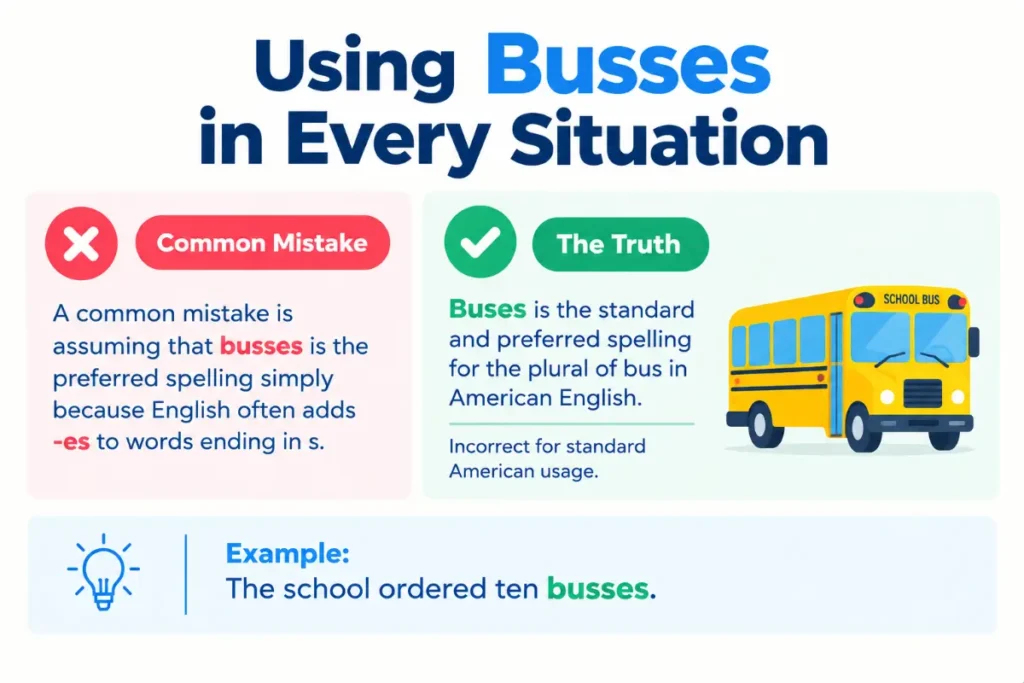
A common mistake is assuming that busses is the preferred spelling simply because English often adds es to words ending in s.
Incorrect for standard American usage.
The school ordered ten busses.
Preferred.
The school ordered ten buses.
The second sentence uses the conventional plural of bus. The first sentence uses a recognized but uncommon variant.
Assuming Busses Is Always Wrong
The opposite mistake is claiming that busses is never a real English word. That isn’t accurate. Dictionaries recognize it as an alternative plural of bus, and it is also a valid form associated with buss, meaning a kiss.
The better rule is to choose the spelling that fits the meaning and audience. For ordinary transportation writing, use buses.
Confusing Bus With Buss
The words bus and buss are different words despite their similar appearance.
- The bus stopped at the corner.Bus is a transportation vehicle.
- He gave her a buss on the cheek.Buss means a kiss.
Understanding this distinction helps explain why busses sometimes appears in a sentence that has nothing to do with vehicles.
Using the Wrong Verb With Buses
Another mistake involves subject verb agreement. A plural noun normally takes a plural verb in the present tense.
Incorrect.
The buses arrives at noon.
Correct.
The buses arrive at noon.
The word buses is plural, so the verb should be arrive, not arrives.
Treating Every Dictionary Variant as Equally Common
A word can have more than one accepted spelling without both forms being equally suitable for everyday writing. A dictionary records usage, while a style guide or editor may recommend one form for consistency.
For modern American English, buses is the sensible default. This choice reduces confusion and matches what readers generally expect.
Memory Tips
A simple memory trick can help you remember the correct spelling without looking it up each time.
Remember the Standard Pair
Think of the singular and plural together.
- One bus.
- Two buses.
Practice the pair aloud or write it once or twice. Seeing the words side by side reinforces the standard spelling.
Connect Buses With Transportation
Picture a row of school buses or city buses. When you write about vehicles, think of the familiar phrase school buses. This common expression helps reinforce the conventional spelling.
Use Busses Only When the Context Calls for It
Think of busses as the less common spelling that deserves a second look. If you’re writing about public transportation, change it to buses unless you have a specific reason to preserve the alternative form.
If you’re reading an older poem or story about kisses, remember that buss is a separate word. That connection explains why busses can be correct in a different context.
Ask One Simple Question
Before choosing a spelling, ask yourself what the word means.
- Are you talking about vehicles.Use buses.
- Are you using the uncommon word buss to mean a kiss.Busses may be correct as a plural noun or verb form.
- Are you copying an original source that spells the vehicle plural busses.Preserve the spelling if accuracy to the source requires it. Otherwise, use the standard modern form.
This quick check makes the choice easier and prevents unnecessary spelling errors.
Related Grammar and Usage Notes
Understanding a few related words and rules can help you use buses confidently in different kinds of writing.
Bus and Buses
Bus is singular, while buses is plural. Use the singular when referring to one vehicle and the plural when referring to more than one.
Examples.
- The bus is full.The sentence describes one vehicle, so bus is singular.
- The buses are full.The sentence describes multiple vehicles, so buses is plural.
Bus’s and Buses
The forms bus’s and buses have different grammatical jobs. Bus’s is usually the singular possessive form, while buses is the plural form.
Examples.
- The bus’s door wouldn’t open.The apostrophe and s show that the door belongs to or is associated with one bus.
- The buses stopped outside the school.The word buses means more than one vehicle. It isn’t possessive.
- The buses’ doors were checked before departure.The apostrophe after the plural s shows that the doors belong to multiple buses.
These distinctions matter in formal writing because a misplaced apostrophe can change the meaning of a sentence.
Bus Stop and Bus Stops
The same plural rule applies to common expressions built around bus.
- The bus stop is across the street.Bus stop refers to one location.
- The bus stops near the library.In this sentence, bus is a noun and stops is a verb.
- The buses stop at different locations.Buses is plural, and stop is the matching verb.
- The city added more bus stops.The expression refers to multiple places where passengers can board or leave a bus.
Pay attention to the role each word plays in the sentence. A word ending in s isn’t always plural. It may be a verb or part of a possessive form.
Busload and Busloads
A busload is the number of people or things that a bus can carry, or the people or things carried by one bus. Its plural is busloads.
For example.
The organizers expected several busloads of visitors.
The word busloads refers to multiple groups of passengers or quantities that fill buses. It follows a different compound word pattern, but it still uses the standard spelling of bus.
Busing and Bussing
The forms busing and bussing can also cause confusion. In American English, busing commonly refers to transporting people by bus, particularly students between schools or neighborhoods. Bussing can be used as a variant spelling in some contexts and also appears in restaurant work to describe clearing and resetting tables.
The preferred spelling depends on the intended meaning and the style guide being followed. This variation doesn’t change the standard plural of the transportation noun bus, which is buses.
How to Edit Transportation Content
If you’re editing a report, website, travel guide, school announcement, or public notice, use a consistent approach.
- Search for every occurrence of busses that refers to transportation vehicles.
- Replace it with buses when the text follows standard modern American English.
- Keep busses when it is deliberately used as a form of buss, meaning a kiss, or when an original quotation must remain unchanged.
- Check related forms such as bus’s, buses’, and bus stops to make sure the grammar matches the intended meaning.
- Read the revised sentences aloud to confirm that the meaning remains clear.
These steps help maintain consistent spelling and polished writing without changing the intended message.
Key Takeaways
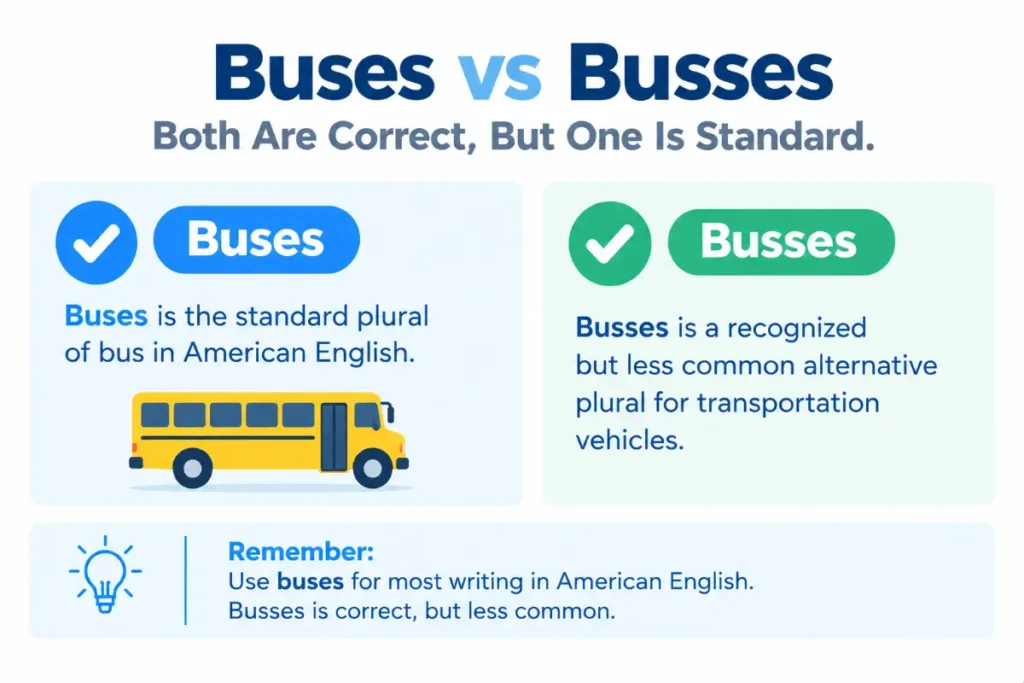
- Buses is the standard plural of bus in American English.
- Busses is a recognized but less common alternative plural for transportation vehicles.
- Busses can also refer to kisses when it comes from the separate word buss.
- American and British English both generally prefer buses for transportation.
- Use bus for one vehicle and buses for multiple vehicles.
- Use bus’s for singular possession and buses’ for plural possession.
- In schoolwork, professional documents, and everyday writing, buses is the safest and clearest choice.
Conclusion
Busses vs buses is a spelling question with a straightforward answer for most writers. Buses is the standard plural of bus and the preferred spelling when you’re talking about public transportation, school transportation, or any other type of bus. Although busses is recognized as a less common alternative, buses is the form most readers expect in modern American English.
The difference becomes clearer when you remember that buss is also a separate word meaning a kiss. Its plural is busses, and the same spelling can function as a verb meaning kisses. That usage is much less common today, but it explains why the spelling appears in dictionaries and older writing.
For everyday writing, keep the rule simple. Write one bus, two buses. This choice is clear, conventional, and suitable for school assignments, professional documents, travel information, and general communication. When transportation is the subject, buses is the spelling to trust.
Frequently Asked Questions
1. Which Is Correct Busses or Buses?
Buses is the standard and preferred plural spelling of bus in American English. Busses is a recognized but less common alternative when referring to transportation vehicles. For schoolwork, professional documents, and everyday writing, choose buses.
2. Is Busses Ever Correct?
Yes. Busses is recorded as an alternative plural of the transportation noun bus. It can also be the plural of buss, meaning a kiss, or the verb form used with he, she, or it. Its correctness depends on context.
3. Why Do People Spell Buses as Busses?
Some writers apply a familiar plural spelling pattern or follow an older or less common variant. English preserves several spelling variations, so a form can exist without being the most widely preferred choice. In modern American writing, buses is standard.
4. Is Busses a British Spelling?
No. Busses isn’t the standard British plural spelling of bus. British English normally uses buses, just as American English does. The less common variant may appear, but it isn’t the usual regional preference.
5. What Is the Plural of Bus in American English?
The plural of bus is buses. For example, you can write, The buses arrive every twenty minutes. The form is standard in American English and is also conventional in British English.
6. How Do You Remember the Correct Spelling?
Remember the simple pair one bus, two buses. If the word refers to transportation, choose buses. Treat busses as a less common alternative that you should use only when the context or source specifically calls for it.
7. Does Busses Mean Kisses?
It can. Busses is the plural of buss, a less common word for a kiss. It can also function as a verb meaning kisses, as in She busses the baby goodnight. In modern everyday American English, kisses is much more common.
8. Are Buses and Busses Pronounced the Same?
When both spellings refer to transportation vehicles, they’re generally pronounced the same. The difference is in spelling and usage rather than pronunciation. Context also helps distinguish busses when it comes from the separate word buss.
9. Should I Use Busses in a School Essay?
Use buses when you’re referring to transportation vehicles. It is the standard spelling expected in American English school assignments. Use busses only if you’re discussing the word buss, quoting a source, or following a specific spelling convention.
10. Is Buses Singular or Plural?
Buses is plural. The singular form is bus. Write the bus arrives for one vehicle and the buses arrive for multiple vehicles. The verb should agree with the noun.
11. What Is the Difference Between Bus’s and Buses?
Bus’s is usually the singular possessive form, as in the bus’s engine. Buses is the plural form, as in three buses. For plural possession, write buses’ as in the buses’ engines.
12. Can I Use Busses in Formal Writing?
You can encounter busses as a recognized variant, but buses is the better choice for most formal American writing about transportation. It is more familiar to readers and aligns with standard modern usage.

Confusing Words, Spelling & Word Choice
Claire Whitmore is a U.S.-based English editor who writes about commonly confused words, spelling differences, and word choice. Her work helps readers understand subtle distinctions between similar-looking words through simple definitions, practical examples, and modern usage guidance in both American and British English.