
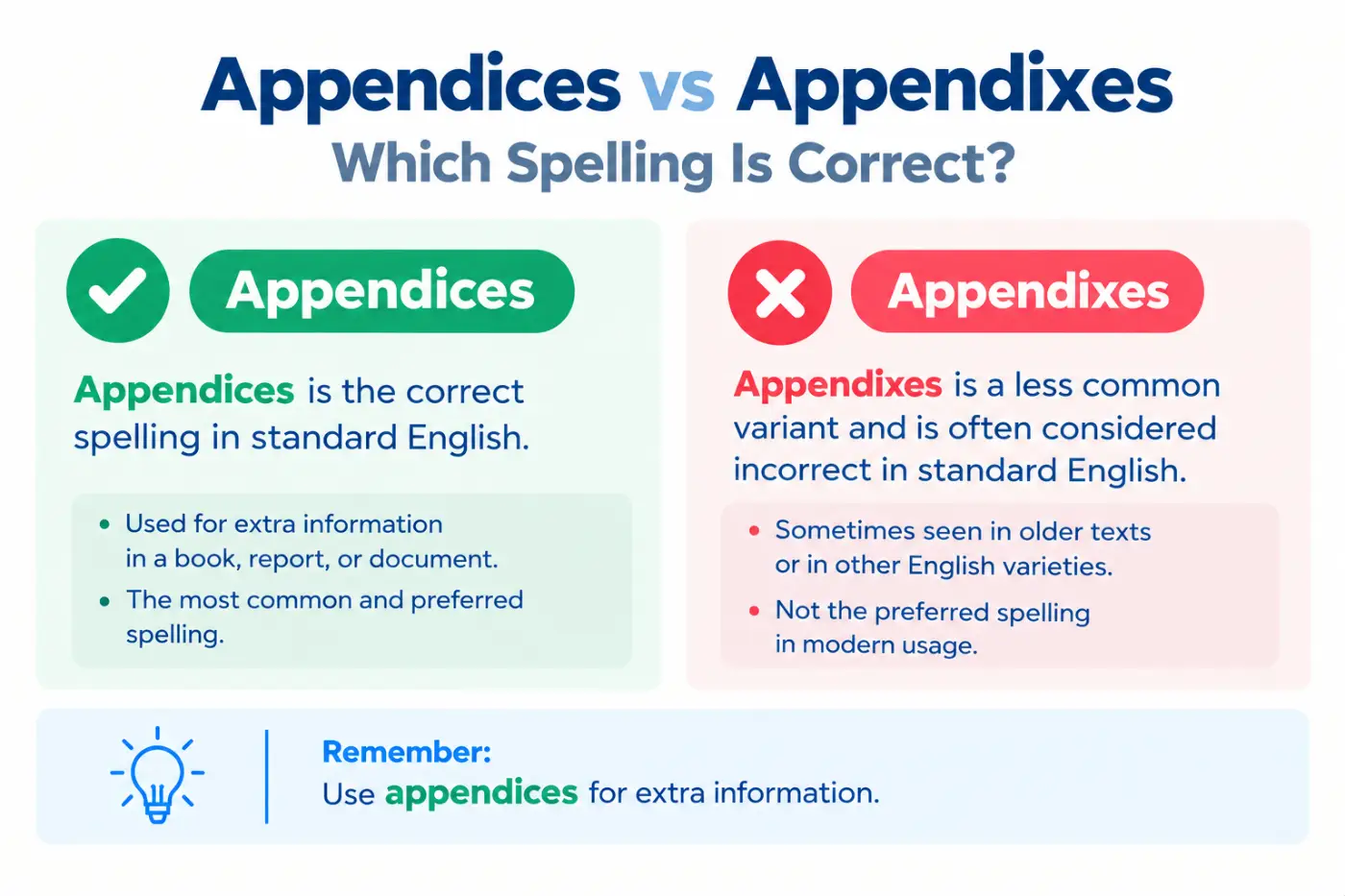
Appendices vs appendixes is a common spelling question for students, researchers, editors, and professionals preparing formal documents. Both spellings are correct, and neither is automatically a grammatical mistake. The difference comes down to how English forms the plural of a word borrowed from Latin and how writers choose to use that plural in modern English.
The singular word is appendix. It usually refers to supplementary material placed at the end of a book, research paper, report, or other document. Its plural can be appendices or appendixes. Although the two forms share the same basic meaning, appendices often appears in academic and scientific writing, while appendixes follows the familiar English pattern for forming plurals.
The easiest approach is to choose the form that suits your document and audience, then use it consistently. If your university, publisher, employer, or style guide specifies one spelling, follow that preference. Otherwise, either form is acceptable. The sections below explain the grammar, meaning, pronunciation, regional usage, and practical examples so you can make the right choice with confidence.
Short Answer
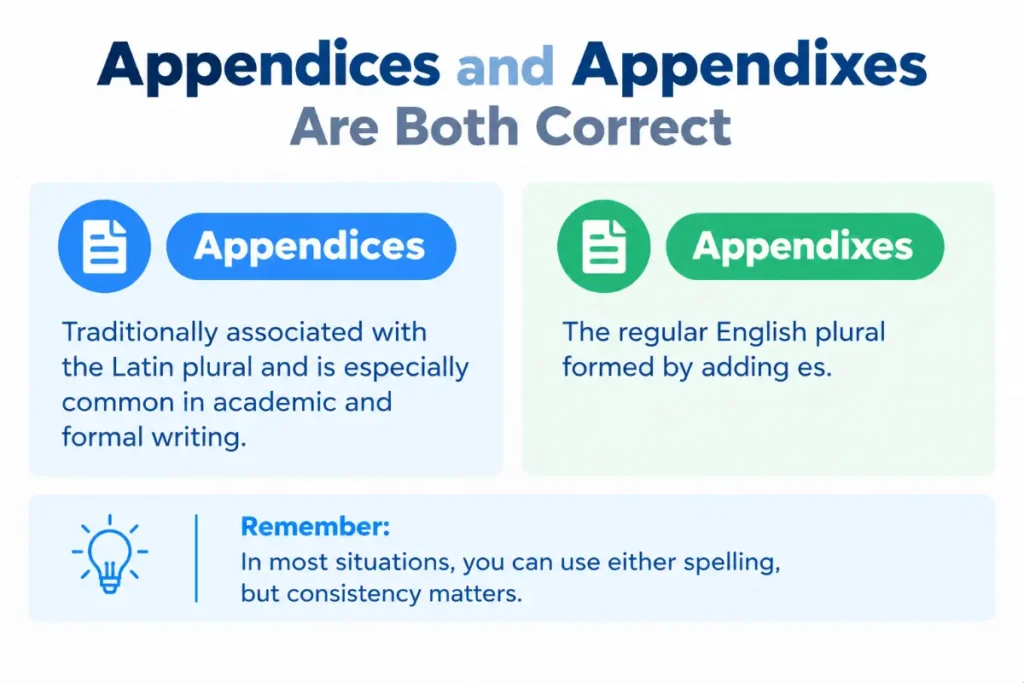
Appendices and appendixes are both correct plural forms of appendix. Both refer to supplementary sections at the end of a book, report, thesis, or other document. Appendices is traditionally associated with the Latin plural and is especially common in academic and formal writing. Appendixes is the regular English plural formed by adding es. In most situations, you can use either spelling, but consistency matters.
Table of Contents
- The Difference Between Appendices and Appendixes.
- What Appendix Means.
- Why Appendix Has Two Plural Forms.
- Grammar Rules for Appendix.
- American and British English Usage.
- Pronunciation and Word Forms.
- Comparison Table.
- Real Life Examples.
- How to Use the Words in Academic Writing.
- Common Spelling and Grammar Mistakes.
- Memory Tips.
- Related Grammar and Usage Notes.
- Frequently Asked Questions.
- Key Takeaways.
- Conclusion.
The Difference Between Appendices and Appendixes
The main difference between appendices and appendixes is their form, not their meaning. Both are accepted plurals of appendix, so both can describe two or more supplementary sections attached to a document.
Appendices is the traditional plural
Appendices follows the Latin plural pattern. English has retained this form in many words borrowed from Latin, particularly in academic, scientific, medical, and technical contexts.
For example, a research paper may include three appendices containing survey questions, additional calculations, and supporting data. The word appendices sounds natural in this formal context because it is widely used in scholarly writing.
This spelling is a good choice for dissertations, journal articles, research reports, and technical documents. However, it isn’t restricted to those settings. You can also use it in ordinary professional writing.
Appendixes is the regular English plural
Appendixes follows the standard English pattern of adding es to a noun ending in x. This pattern appears in words such as boxes, foxes, and taxes.
For example, a business report may contain two appendixes with budget details and supporting charts. The spelling is grammatically correct and communicates exactly the same idea as appendices.
Some writers prefer appendixes because it follows a familiar English rule. Others prefer appendices because it is traditional in formal publications. Neither choice changes the meaning of the sentence.
Which spelling should you choose
Choose appendices if you’re writing an academic paper, dissertation, scientific report, or formal publication and want to follow a traditional convention. Choose appendixes if your organization uses regular English plurals or prefers that form in its documents.
If you don’t have a specific style requirement, either spelling works. The most important rule is consistency. Don’t switch between the two forms in the same document without a clear reason.
What Appendix Means
An appendix is supplementary material placed at the end of a book, report, research paper, or similar document. It provides extra information that supports the main discussion but may be too detailed or lengthy to include in the body of the text.
An appendix can contain raw data, questionnaires, technical explanations, legal documents, calculations, interview questions, charts, or additional reference material. Its purpose is to help readers examine supporting details without interrupting the main argument.
For example, a student writing a research paper about consumer behavior might place the survey questionnaire in an appendix. Readers can consult the questionnaire to understand how the researcher collected the information.
When a document contains more than one such section, the writer can call them appendices or appendixes.
Appendix as a document section
In academic and professional writing, an appendix usually appears after the main text and before the references or after the references, depending on the required format. A style guide or publisher’s instructions determine the exact placement.
Suppose a research report includes a questionnaire, a statistical table, and a detailed calculation. The writer might organize these materials into three separate appendices, each with its own heading or label.
This structure keeps the main report readable while preserving the evidence readers may need to check the findings.
Appendix as a medical term
The word appendix also refers to a small, narrow pouch attached to the large intestine. In this context, the singular term describes an anatomical structure rather than a document section.
For instance, a medical textbook might discuss inflammation of the appendix. When referring to multiple anatomical appendixes, writers may use appendixes or, in some specialized contexts, appendices. Medical terminology and the specific anatomical context can influence the preferred wording.
Don’t confuse this meaning with the supplementary section at the end of a document. The surrounding sentence makes the intended meaning clear.
Why Appendix Has Two Plural Forms
English has borrowed thousands of words from Latin and Greek. Over time, many of these words developed both traditional plural forms and regular English plurals. Appendix is one example of this pattern.
The Latin plural pattern
In Latin, nouns ending in x can form plurals in different ways depending on their grammatical class and ending. The plural appendices reflects the traditional Latin form associated with appendix.
English has preserved this form in formal vocabulary. Similar patterns appear in words such as index and indices, matrix and matrices, and vertex and vertices. These pairs demonstrate how Latin plural forms remain part of modern English.
However, not every word ending in x follows the same pattern. The correct plural depends on the individual word and its accepted forms.
The regular English plural pattern
English also allows many borrowed words to take familiar English plural endings. For appendix, this produces appendixes.
This pattern makes the word easier to handle for readers who aren’t familiar with Latin grammar. Instead of learning a special plural ending, they can follow the ordinary English spelling rule.
Both forms have become established in modern English. You don’t need to know Latin to use either one correctly.
Why both forms survive
Language changes as people use words in different settings. Traditional forms often remain popular in academic fields, while regular forms may appeal to writers who prefer familiar English spelling patterns.
Neither form needs to disappear for the other to remain correct. English already contains many nouns with more than one accepted plural. The choice often reflects convention, audience, and editorial preference rather than a difference in meaning.
For writers, this means there’s no need to correct appendixes to appendices simply because the latter looks more formal. First check the document’s style requirements. If no rule applies, choose the form that reads naturally and stick with it.
Grammar Rules for Appendix
The plural of appendix follows two accepted patterns. Understanding the singular and plural forms helps you avoid spelling and agreement errors.
Rule One: Use appendix for one item
Use appendix when you mean a single supplementary section or anatomical structure.
Example: The report includes an appendix with the complete survey questionnaire.
The sentence refers to one section at the end of the report, so the singular noun is correct. The article an also fits because appendix begins with a vowel sound.
Rule Two: Use appendices or appendixes for multiple items
Use either plural form when you mean two or more appendices.
Example: The dissertation contains four appendices with additional research findings.
The noun is plural because the dissertation contains four separate sections. The form appendices is traditional and works well in formal academic writing.
You could also write, “The dissertation contains four appendixes with additional research findings.” The meaning would remain the same.
Rule Three: Match the verb to the noun
A singular appendix takes a singular verb when it serves as the subject of a sentence. The plural forms appendices and appendixes take plural verbs.
| Singular form | Plural form |
|---|---|
| The appendix contains the data. | The appendices contain the data. |
| An appendix is included. | Two appendixes are included. |
| This appendix explains the method. | These appendices explain the method. |
In the first example, contains agrees with the singular subject appendix. In the plural sentence, contain agrees with appendices. The same agreement rule applies to appendixes.
Rule Four: Use plural demonstratives correctly
Use this and that with a singular noun. Use these and those with a plural noun.
Correct: These appendices provide additional evidence.
Incorrect: This appendices provide additional evidence.
The first sentence uses the plural demonstrative these with the plural noun appendices. The second sentence mismatches the singular word this with a plural noun.
Rule Five: Keep the spelling consistent
A document can use either plural form, but readers may notice unnecessary switching.
For example, using appendices in one chapter and appendixes in another can make a carefully edited report appear inconsistent. This doesn’t necessarily create a grammatical error, but it can weaken the document’s editorial quality.
Choose one form before you begin editing. Apply that choice to headings, the table of contents, cross references, captions, and the main text.
American and British English Usage
Writers often wonder if American English prefers appendixes and British English prefers appendices, or the other way around. The distinction isn’t that simple.
Both spellings are used in American and British English. Appendices is well established in formal academic and technical writing in both varieties. Appendixes is also recognized and can appear in general and professional writing.
Usage in American English
American writers frequently encounter appendices in research papers, dissertations, scientific publications, and technical reports. It is a familiar choice when a document includes supporting material at the end.
Appendixes is also correct in American English. A writer or editor may choose it to follow a publication’s house style or to maintain a regular English plural pattern.
For example, an American university might ask a student to label supporting sections as Appendix A, Appendix B, and Appendix C. In a sentence describing the complete set, the student could refer to these sections as appendices.
The labels remain singular because each label identifies one section. The plural noun describes the sections collectively.
Usage in British English
British English also accepts both forms. Formal and scholarly publications commonly use appendices, while appendixes remains a valid alternative.
Local publishing preferences can influence the choice, but the spelling alone doesn’t establish that a document was written in Britain or the United States.
For example, a British researcher might write, “The appendices contain the complete interview transcripts.” An American researcher could use the same sentence without changing the spelling.
Which form is more formal
Many readers associate appendices with formal writing because it preserves the traditional Latin plural. That association makes it a sensible default for academic work.
However, appendixes isn’t informal or unprofessional. It is a recognized English plural that can appear in formal documents as well.
If you are preparing a journal submission, dissertation, legal report, or technical manual, check the relevant style guide. Some institutions and publishers may specify a preferred form. Following their instructions is more useful than trying to infer a strict regional rule that doesn’t apply universally.
Pronunciation and Word Forms
Spelling is only part of the question. Understanding the pronunciation and related forms of appendix can also help you use the word correctly.
How to pronounce appendix
In standard American English, appendix is commonly pronounced uh PEN diks, with the main stress on the second syllable.
The first syllable is unstressed, the second receives the strongest emphasis, and the final syllable sounds like dिक्स without a separate extra vowel. In phonetic notation, a common American pronunciation is /əˈpɛndɪks/.
How to pronounce appendices
Appendices is commonly pronounced uh PEN duh seez in American English. The main stress remains on the second syllable.
Its ending sounds like seez, not sis. The word has four syllables in its usual pronunciation.
How to pronounce appendixes
Appendixes is commonly pronounced uh PEN dik siz in American English. It also has four syllables, with the stress on the second.
The two plural spellings have different endings and pronunciations, but their meanings are the same. You don’t need to change the sentence structure or meaning when switching between them.
Singular and plural forms at a glance
| Form | Grammatical number | Meaning |
|---|---|---|
| Appendix | Singular | One supplementary section or anatomical structure |
| Appendices | Plural | Two or more supplementary sections or structures |
| Appendixes | Plural | Two or more supplementary sections or structures |
Is appendices the only traditional plural
No. English has preserved different Latin plurals across many fields, but the pattern depends on the word. Appendices is one established plural of appendix, while appendixes is an established English alternative.
Don’t assume that every noun ending in x should take ices. For example, the usual plural of box is boxes, not bocies. Learn the accepted forms of each word instead of applying one pattern to every noun.
Comparison Table
The following table summarizes the most useful distinctions between the two plural forms.
| Feature | Appendices | Appendixes |
|---|---|---|
| Correct spelling | Yes | Yes |
| Grammatical number | Plural | Plural |
| Singular form | Appendix | Appendix |
| Meaning | Two or more supplementary sections | Two or more supplementary sections |
| Word formation | Traditional Latin plural | Regular English plural |
| American English | Accepted | Accepted |
| British English | Accepted | Accepted |
| Academic writing | Commonly used | Also acceptable |
| Professional writing | Correct | Correct |
| Main advantage | Follows a traditional convention | Follows a familiar English pattern |
The key point is that neither spelling is inherently wrong. The decision depends on the writing context and any relevant editorial requirements.
Real Life Examples
Examples make the distinction easier to understand. In each sentence below, the plural form refers to the same basic concept.
Examples from academic writing
1. The thesis includes three appendices containing interview transcripts, survey questions, and additional statistical results.
This sentence uses appendices to refer to three supplementary sections. The spelling suits a formal academic document and clearly identifies material placed outside the main chapters.
2. The professor asked the students to review the appendixes before submitting their final papers.
Here, appendixes refers to multiple supporting sections. The spelling is correct, and the sentence remains suitable for an educational setting.
3. The appendices provide details that support the study’s main conclusions.
The plural noun is the subject of the sentence, so it takes the plural verb provide. The sentence explains how supplementary information strengthens the main research discussion.
4. Each appendix contains a separate set of research materials.
This sentence uses the singular form because it describes each section individually. The word each emphasizes the individual items, even though the sentence may refer to several sections collectively.
Examples from business writing
1. The annual report includes two appendices with detailed financial statements and supporting calculations.
The sentence describes additional information attached to a business report. Appendices is a natural choice in formal corporate and financial writing.
2. Please review the appendixes before approving the project proposal.
The plural noun refers to several supplementary sections that the reader needs to examine. Appendixes is correct and communicates the instruction clearly.
3. Appendix B contains the complete project budget.
The singular form is correct because the sentence refers to one specific section. The letter B distinguishes that section from other appendices in the document.
4. The three appendices are available in the final version of the report.
The plural subject appendices agrees with the plural verb are. This example also shows how writers can refer to supporting sections without listing their individual contents.
Examples from scientific writing
1. The appendices contain laboratory procedures and additional experimental data.
The sentence uses the traditional plural to describe supporting research information. Such details can help other researchers understand or reproduce the work.
2. The authors added two appendixes to explain their statistical methods.
The regular English plural is correct here. It refers to two supplementary sections that explain technical details omitted from the main discussion.
3. Appendix A lists the equipment used in the experiment.
The singular form identifies one section by its label. This format makes it easy for readers to find specific supporting information.
4. Readers can consult the appendices for the full data set.
The plural noun directs readers to several supporting sections. The sentence also demonstrates a useful writing technique: refer readers to supplementary material when the main text doesn’t need every detail.
Examples from medical writing
1. The textbook includes appendices with reference tables and clinical terminology.
Here, appendices describes supplementary sections in a medical textbook. It doesn’t refer to organs or anatomical structures.
2. The medical report discusses conditions that affect the appendix.
This sentence uses the singular anatomical meaning of appendix. It isn’t describing a section at the end of a document.
3. The physician explained the findings in two appendixes attached to the report.
In this example, appendixes refers to two supporting sections. The context makes the document related meaning clear.
4. The appendix is a small pouch connected to the large intestine.
The noun is singular because it refers to one anatomical structure. This is a separate meaning of the same word and should not be confused with a document appendix.
Examples from everyday professional communication
1. I’ve included two appendices with the information you requested.
The sentence works well in an email accompanying a report. The contraction I’ve keeps the tone natural without making the message unprofessional.
2. Both appendixes contain information about the proposed changes.
The regular plural is correct and sounds natural in a business setting. The word both makes it clear that exactly two supplementary sections are being discussed.
3. Please see Appendix C for the complete list of requirements.
This sentence directs the reader to one labeled section. It is direct, easy to follow, and suitable for professional communication.
4. The report’s appendices are organized by topic.
The plural noun agrees with are. The sentence also illustrates how supplementary sections can be arranged to make a lengthy document easier to use.
How to Use the Words in Academic Writing
Academic writing benefits from precise terminology and consistent formatting. Although both plural forms are correct, the surrounding document’s conventions should guide your choice.
Follow your university’s style guide
Universities often provide detailed instructions for theses, dissertations, research papers, and capstone projects. These instructions may cover appendix placement, headings, labels, page numbering, and the treatment of supplementary materials.
If your university specifies appendices, use that form throughout the document. If it explicitly permits appendixes, that spelling is also suitable. When the instructions don’t address the issue, consult your department’s preferred format or follow a recognized style guide consistently.
Label each appendix clearly
When a document contains several supplementary sections, use a consistent labeling system. Depending on the required format, you might use letters such as Appendix A and Appendix B or numbered labels such as Appendix 1 and Appendix 2.
Each label identifies an individual section, so the heading normally uses the singular Appendix. In the main text, however, you can refer to all the sections collectively as appendices or appendixes.
For example, write, “See Appendices A and B for the supporting data.” This sentence directs readers to two separate sections while using the traditional plural form.
Use cross references carefully
Cross references help readers locate supporting information without searching through the entire document. Make sure each reference matches the label used in the relevant section.
For example, if your report labels a questionnaire as Appendix A, refer to it as Appendix A everywhere in the document. Don’t call it Appendix One in another section unless your formatting system supports that alternative.
Also check that every appendix mentioned in the main text actually appears in the final document. This simple review prevents broken references and helps readers find the information they need.
Keep the main text focused
An appendix should support the main discussion rather than replace it. Include information that readers may need to verify a claim, review a method, or explore a technical detail, but keep the central argument in the main body.
For example, a research paper can summarize its survey findings in the main text and place the full questionnaire in an appendix. Readers get the essential results first and can inspect the original questions when needed.
This approach improves readability without sacrificing transparency or useful evidence.
Check the required placement
Appendix placement varies by document type and style guide. Some academic formats place appendices after the references, while others place them before the reference list or follow different instructions for specific materials.
Don’t assume one arrangement applies to every institution. Follow the requirements for your assignment, publication, or organization.
The same principle applies to appendix titles, captions, page breaks, and numbering. Consistent formatting makes the document easier to read and reflects careful editing.
Common Spelling and Grammar Mistakes
Even though both plurals are correct, writers can still make errors when using them. The most common problems involve spelling, subject verb agreement, singular and plural forms, and inconsistent formatting.
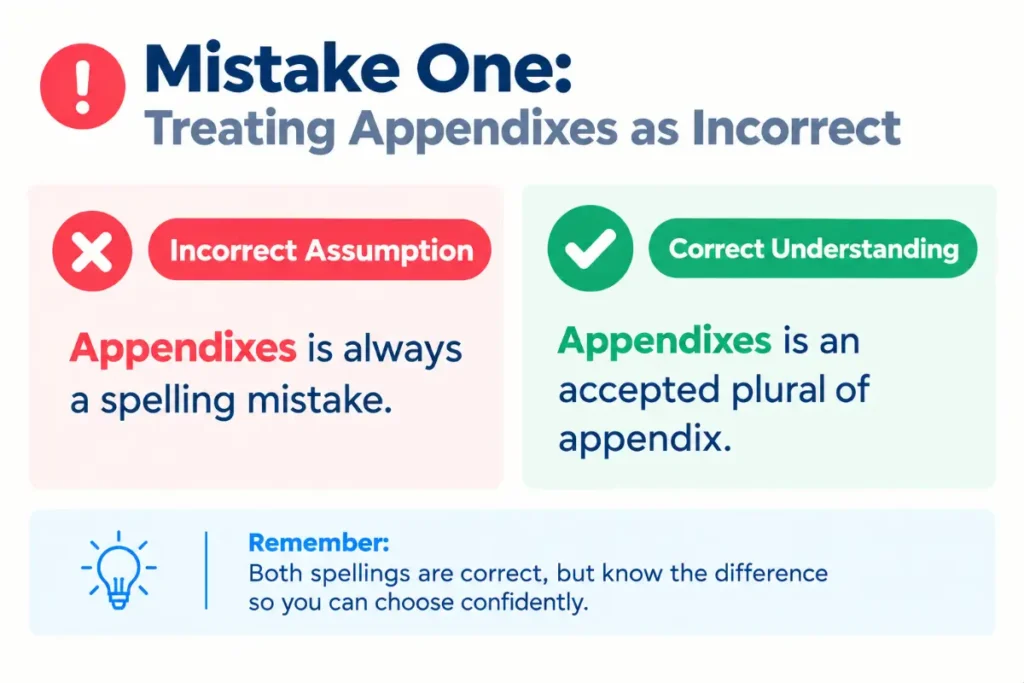
Mistake One: Treating appendixes as incorrect
Incorrect assumption: Appendixes is always a spelling mistake.
Correct understanding: Appendixes is an accepted plural of appendix.
The error lies in rejecting a valid form, not in using the spelling itself. Although appendices may be preferred in many formal settings, the alternative remains correct.
Mistake Two: Writing appendicies
Incorrect: The report contains three appendicies.
Correct: The report contains three appendices.
The correct spelling is appendices, without an extra i before the final e. If you prefer the regular English plural, use appendixes instead.
Mistake Three: Using a singular verb with a plural noun
Incorrect: The appendices contains the raw data.
Correct: The appendices contain the raw data.
The subject is plural, so the verb must also be plural. Changing the verb to contain fixes the agreement error.
Mistake Four: Using a plural noun for one section
Incorrect: Appendix are attached to the report.
Correct: An appendix is attached to the report.
The sentence refers to one section, so it needs a singular noun and singular verb. If the report contains several sections, you could write, “Appendices are attached to the report.”
Mistake Five: Confusing a heading with a plural reference
Incorrect heading: Appendices A.
Correct heading: Appendix A.
The heading identifies one section, so the singular form is appropriate. In the main text, you can refer to several labeled sections collectively as appendices.
Mistake Six: Switching between the two forms without a reason
Inconsistent: The report includes three appendices. The appendixes provide more detail.
Better: The report includes three appendices. The appendices provide more detail.
The first version uses both accepted forms, but the shift may distract readers. The revised version follows one convention throughout.
Mistake Seven: Assuming the word always refers to a document
The word appendix can also refer to an anatomical structure. Writers should use the context to establish which meaning applies.
For example, “The appendix contains a table of results” refers to a document section. “The appendix became inflamed” refers to the anatomical structure.
Both sentences are grammatically correct, but they use different meanings of the same word.
Memory Tips
A simple memory trick can help you remember the difference between the two plural forms without memorizing a complicated grammar rule.
Remember the traditional Latin ending
Think of appendices as the traditional plural. Its ending resembles the plural forms of other words such as indices and matrices.
This association can help if you regularly write academic papers, scientific reports, or technical documents. You don’t need to know the full Latin rules to remember the accepted spelling.
Remember the regular English ending
Think of appendixes as the familiar English plural. It follows the same general spelling pattern as boxes and foxes.
This makes the spelling easy to recall when you want to apply a regular English plural pattern. It is a valid alternative, not a shortcut or an inferior form.
Use the one document rule
If you have one supplementary section, write appendix. If you have two or more, write appendices or appendixes.
For example, one section is Appendix A. Three sections may be called appendices A, B, and C in a sentence, although the exact labeling format depends on your style guide.
Remember that the section heading identifies an individual item, while the plural noun describes multiple items. This distinction prevents many common errors.
Related Grammar and Usage Notes
Understanding a few related terms can help you write about supplementary material more accurately.
Appendix vs Attachment
An appendix is generally a supplementary section included within a larger document. An attachment is a separate file or document supplied with another document, often in an email.
For example, a report may contain an appendix with additional calculations. An email delivering that report may also include an attachment containing a spreadsheet.
The two terms can overlap in some contexts, but they aren’t always interchangeable.
Appendix vs Addendum
An appendix usually provides supporting information that complements the main text. An addendum adds material to a document, often after the original document has been completed or issued.
For example, a research report may include an appendix containing the original survey questions. A later addendum might provide a correction or an additional finding that became available after publication.
The exact distinction can vary by document type, so follow the terminology used by your organization or publisher.
Appendix vs Annex
An annex is another term for supplementary material attached to a document. The distinction between an annex and an appendix depends on the publication, institution, or field.
Some organizations use annex for separate or substantial supporting documents and appendix for supplementary sections within a report. Other organizations use the terms more loosely.
Don’t assume they have a universal difference. Check the relevant document standards before choosing one.
Appendix vs Index
An appendix provides additional information related to the main text. An index helps readers locate specific subjects, names, or terms within a publication.
For example, a textbook might include an appendix with a formula sheet and an index listing the pages where particular concepts appear.
The two sections serve different purposes. An appendix adds information, while an index points readers toward information already included in the work.
Appendix vs Footnote
An appendix is a supplementary section usually placed at the end of a document. A footnote is a note that appears at the bottom of a page and provides a citation, clarification, or additional comment.
For example, a researcher may explain a minor point in a footnote while placing a lengthy questionnaire in an appendix.
Use footnotes for brief supporting comments when appropriate. Use appendices for larger collections of supplementary material.
Key Takeaways
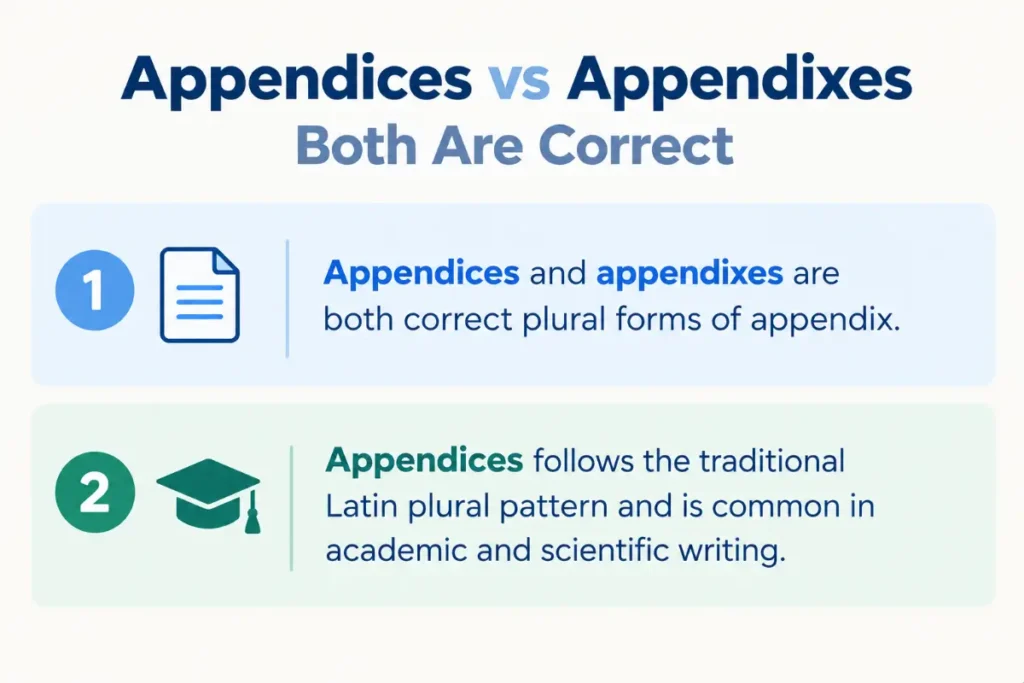
1. Appendices and appendixes are both correct plural forms of appendix.
2. Appendices follows the traditional Latin plural pattern and is common in academic and scientific writing.
3. Appendixes follows a regular English plural pattern and is also accepted in formal and informal contexts.
4. American and British English recognize both spellings.
5. Use appendix for one section and either plural form for two or more sections.
6. Match plural nouns with plural verbs. For example, write “The appendices contain the results.”
7. Follow your university’s style guide, publisher’s requirements, or workplace conventions when they specify a preferred form.
8. Keep your spelling consistent throughout the document, including headings, captions, cross references, and the table of contents.
Conclusion
Appendices vs appendixes comes down to two accepted plural forms with the same meaning. Appendices follows the traditional Latin pattern and is widely used in academic and scientific writing. Appendixes follows the regular English plural pattern and is equally valid. Neither spelling is inherently incorrect.
For most writers, the simplest approach is to choose one form and use it consistently. If you’re preparing a dissertation, research paper, technical report, or professional document, check the relevant style guide before making your decision. When no specific rule applies, either spelling will work.
Ultimately, good writing depends on accuracy, clarity, and consistency. Once you understand why both forms exist, you can use appendices or appendixes confidently without second guessing your choice.
Frequently Asked Questions
1. Which is correct appendices or appendixes?
Both are correct. Appendices is the traditional Latin plural, while appendixes follows the regular English plural pattern. Choose the form that matches your style guide or use the one you prefer consistently.
2. Is appendices more correct than appendixes?
No. Appendices is often preferred in formal academic and scientific writing, but appendixes is also an accepted plural. One spelling isn’t universally more correct than the other.
3. Is appendixes grammatically correct in American English?
Yes. American English accepts appendixes as a plural of appendix. Writers can use it in professional and academic contexts, provided it follows any applicable style requirements.
4. Do British writers use appendices or appendixes?
British English recognizes both forms. Appendices is common in formal writing, but appendixes is also acceptable. Individual publishers and institutions may prefer one spelling.
5. What is the singular of appendices?
The singular form is appendix. For example, “The appendix contains the additional survey results” refers to one supplementary section.
6. What is the plural of appendix in academic writing?
Both appendices and appendixes are correct. Many academic writers choose appendices because it is traditional and widely used in scholarly publications. Follow your university or publisher’s instructions if they specify a form.
7. Can I use appendices and appendixes in the same document?
You can, but it’s usually better to choose one form and use it consistently. Switching between the two spellings without a clear reason may make the document look poorly edited.
8. How do you pronounce appendices?
In standard American English, appendices is commonly pronounced uh PEN duh seez. The main stress falls on the second syllable.
9. How do you pronounce appendixes?
In standard American English, appendixes is commonly pronounced uh PEN dik siz. It has four syllables, with the main stress on the second syllable.
10. Is appendix a Latin word?
Yes. Appendix comes from Latin appendix, meaning something attached or added. English retained the word and its traditional plural form appendices, while also developing the regular English plural appendixes.
11. Should I write Appendix A or Appendices A?
Use Appendix A when identifying one section. When referring to multiple sections collectively, use appendices or appendixes. For example, “See Appendices A and B for further details” is a correct plural reference.
12. What is the difference between appendices and appendixes in a report?
There is no difference in meaning. Both refer to multiple supplementary sections. The choice is stylistic rather than grammatical, so follow the report’s established conventions and keep the spelling consistent.

Confusing Words, Spelling & Word Choice
Claire Whitmore is a U.S.-based English editor who writes about commonly confused words, spelling differences, and word choice. Her work helps readers understand subtle distinctions between similar-looking words through simple definitions, practical examples, and modern usage guidance in both American and British English.