
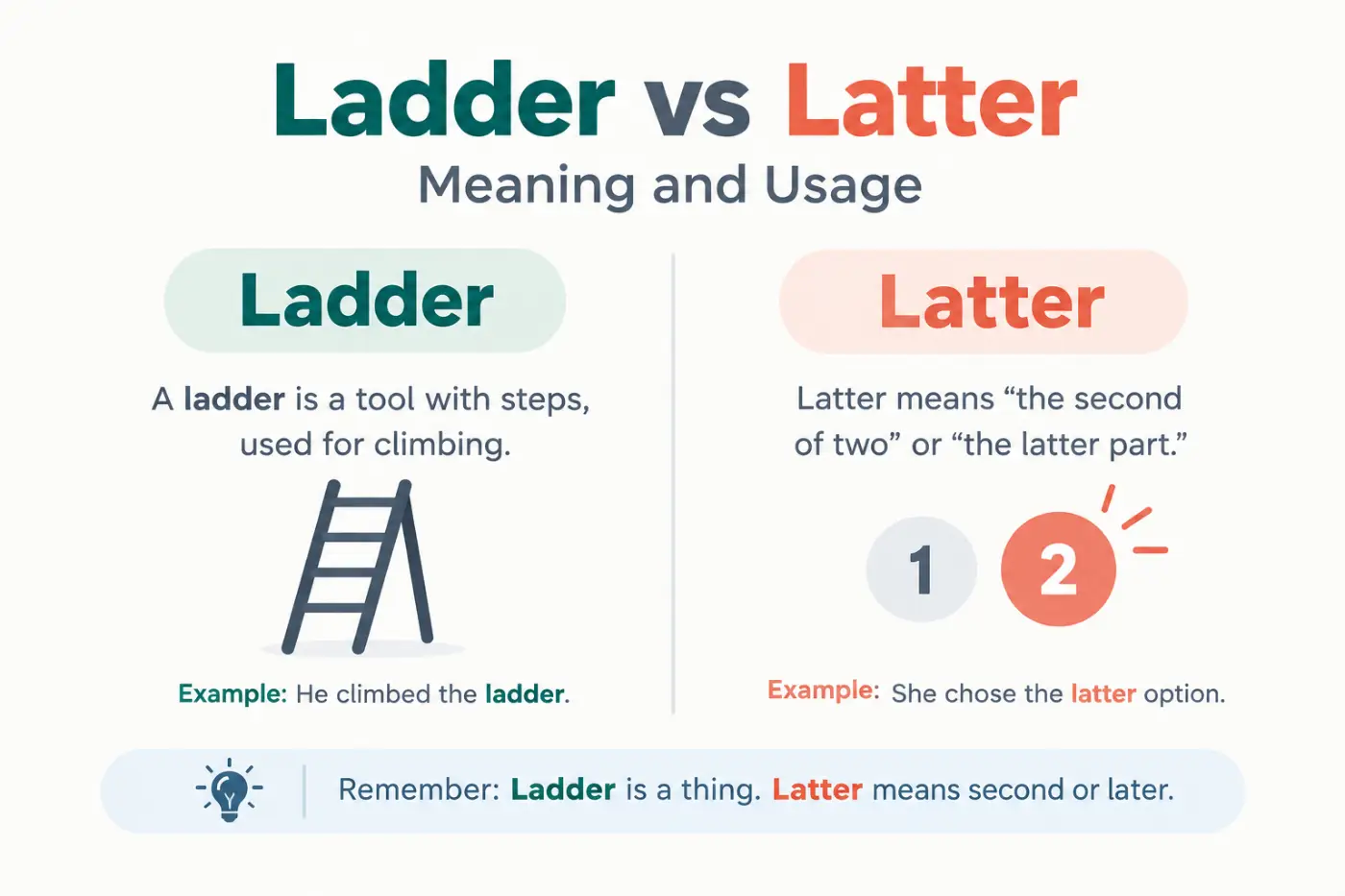
Latter vs ladder is a common source of confusion because the two words sound alike in American English but have very different meanings. Latter helps readers identify the second of two things already mentioned. Ladder names a physical object used for climbing. One word belongs mainly to written comparisons while the other describes a tool or a figurative path to success.
The easiest way to choose the correct word is to look at the meaning of your sentence. If you are comparing two options and want to refer to the second one, use latter. If you are describing a step ladder in a garage or talking about climbing the career ladder, use ladder. This simple distinction works in everyday conversation, school assignments, business writing, and professional communication.
Learning these words also helps you avoid spelling mistakes that can change the meaning of a sentence. Although context often helps readers understand your point, choosing the correct spelling makes your writing clearer and more professional. The examples and memory tips below will help you recognize the difference quickly and use both words with confidence.
Quick Answer
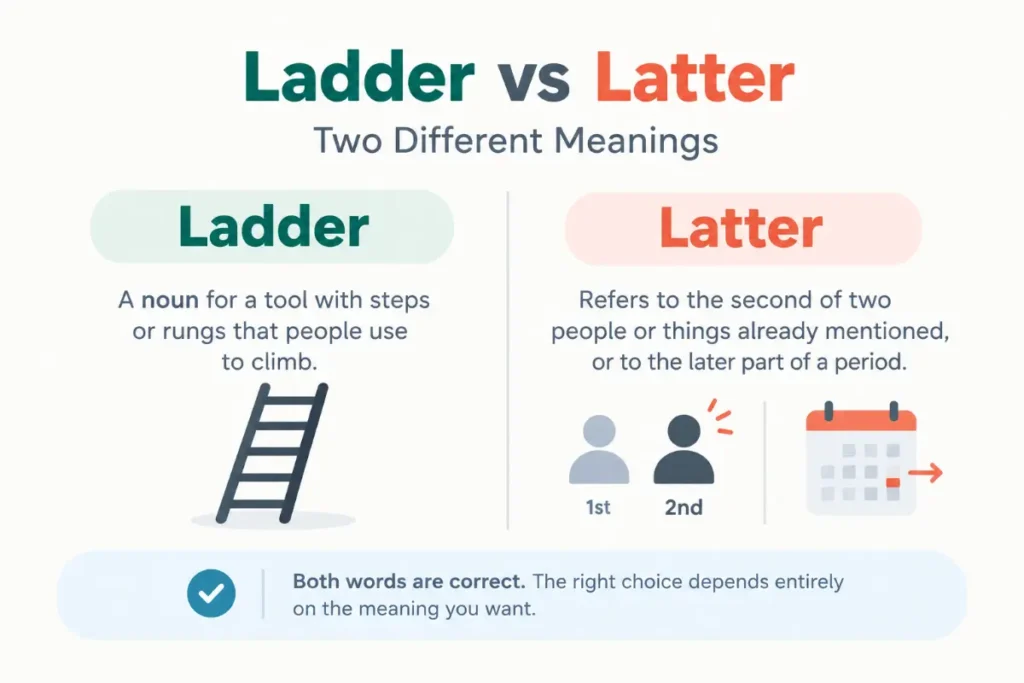
Latter vs ladder comes down to meaning and spelling. Latter refers to the second of two people or things mentioned earlier. Ladder is a piece of equipment with rungs that people climb to reach a higher place. Both words sound similar in American English, but they serve different purposes. Use latter when discussing two choices and ladder when talking about something you climb.
Table of Contents
- What Latter Means.
- What Ladder Means.
- Latter vs Ladder Comparison Table.
- How to Use Latter Correctly.
- How to Use Ladder Correctly.
- Pronunciation and Spelling Differences.
- Real Life Examples.
- Common Mistakes to Avoid.
- Easy Memory Tips.
- Word Origins and Related Terms.
- Professional Writing Tips.
- Frequently Asked Questions.
- Key Takeaways.
- Conclusion.
What Latter Means
Latter refers to the second of two people, things, choices, or ideas mentioned earlier in a sentence or passage. It helps writers avoid repeating a name or description when the reader can identify the second item from the surrounding context.
For example, consider this sentence.
I can travel by train or by bus. I prefer the latter.
The word latter refers to the bus because the bus appears second in the list. The sentence communicates the choice without repeating the full phrase.
Latter often appears in formal writing, academic discussions, reports, essays, and professional communication. However, it can also work in everyday writing when two options are clearly identified.
The Main Rule for Latter
Use latter when you mean the second of two previously mentioned items.
For example.
Emma considered a morning class and an evening class. She chose the latter.
The latter refers to the evening class because it was mentioned second.
The company considered hiring a new employee or training its current staff. Management selected the latter.
Here, latter refers to training the current staff. The word points back to the second option.
We discussed the budget and the timeline. The latter needs more attention.
In this example, the latter refers to the timeline. The reader can identify the intended meaning from the order of the two subjects.
Can Latter Refer to a Period Near the End?
Yes. Latter can also describe the later part of a period, process, or historical era.
For example.
Sales increased during the latter half of the year.
The phrase latter half means the second half of the year.
She became more confident in the latter stages of the competition.
The phrase latter stages refers to the later parts of the competition.
This use differs slightly from referring to the second of two choices. In both cases, latter points to something that comes later in an established sequence.
Is Latter Formal or Informal?
Latter is generally more common in formal or carefully edited writing than in casual conversation. People often say the second one or the second option when speaking.
For example.
Formal: Between the two proposals, I favor the latter.
Conversational: Between the two proposals, I prefer the second one.
Both sentences communicate the same choice. The first sounds more formal, while the second feels more natural in everyday conversation.
For clear writing, use latter when the two options are easy to identify and the word makes your sentence shorter without making it harder to understand.
What Ladder Means
Ladder is a noun that describes a structure with two long sides connected by horizontal rungs or steps. People climb it to reach roofs, shelves, trees, and other elevated places. Ladders come in different sizes and designs, including folding ladders, extension ladders, and step ladders.
For example.
The painter placed a ladder against the wall.
The word ladder names the equipment the painter uses to reach a higher part of the wall.
Please put the ladder back in the garage after you finish.
Here, ladder refers to a physical object that needs to be stored.
The Different Types of Ladders
A ladder can take several forms depending on its purpose.
1. Step ladder. A step ladder usually folds open and supports itself. People commonly use it for household tasks such as changing a light bulb or reaching a high cabinet.
2. Extension ladder. An extension ladder has sections that slide to increase its length. Workers often use this type to reach elevated areas around buildings.
3. Straight ladder. A straight ladder has a fixed length and leans against a stable support. Users must position it correctly before climbing.
4. Attic ladder. An attic ladder provides access to an attic or loft. Some models fold or retract when they are not in use.
The word ladder stays the same regardless of its design. It refers to the equipment rather than the action of climbing it.
Ladder Can Have a Figurative Meaning
Ladder also appears in expressions that describe progress, achievement, status, or advancement. In these expressions, the word represents a series of steps toward a goal rather than a physical climbing tool.
For example.
She worked hard to climb the corporate ladder.
The corporate ladder represents the levels of responsibility and authority within a company. The sentence means she worked to advance her career.
The scholarship gave him a chance to move up the social ladder.
The social ladder represents levels of social status. Moving up means gaining a higher position or greater standing.
The team climbed the rankings ladder throughout the season.
The ladder represents a sequence of rankings. The team improved its position over time.
These expressions show that ladder can be literal or figurative. Its meaning depends on the situation, but it always connects to the idea of steps or levels.
Latter vs Ladder Comparison Table
The main difference between latter and ladder is their meaning. One points to the second item in a previously mentioned pair, while the other names climbing equipment or a figurative series of steps.
| Feature | Latter | Ladder |
|---|---|---|
| Part of speech | Pronoun or adjective | Noun |
| Main meaning | The second of two items mentioned | A structure used for climbing |
| Figurative meaning | The later part of a period | A sequence of levels or stages |
| Typical context | Comparisons and choices | Tools, careers, rankings, and progress |
| Example | I prefer the latter. | The ladder is in the shed. |
| Memory clue | Think of the second choice | Think of climbing rungs |
| Common phrase | The latter option | The career ladder |
The Difference in One Sentence
Consider these two sentences.
I chose the latter after comparing both options.
I used a ladder to reach the top shelf.
The first sentence identifies a choice that was mentioned second. The second describes a tool used to reach a higher place.
The words may sound alike, but their meanings make them easy to distinguish once you understand the context.
How to Use Latter Correctly
Using latter correctly requires one essential skill. You must know which two items the word refers to.
Mention Both Options First
Latter usually works best after you introduce two clearly identified people, things, or ideas.
For example.
We could watch a comedy or a documentary. The latter sounds more interesting.
The word latter refers to the documentary because it appears second.
Daniel considered moving to Denver or Seattle. He eventually chose the latter.
The latter refers to Seattle. The sentence works because the reader can follow the order of the two cities.
Avoid using latter before introducing the relevant options. Without that earlier information, readers may struggle to understand what you mean.
Keep the Order Clear
Latter depends on the order in which you mention the options. It always points to the second item in the relevant pair, not the item you like best or the one that appears more important.
For example.
The restaurant offers pasta and seafood. The latter is popular with customers.
The latter refers to seafood.
If you reverse the order, the reference changes.
The restaurant offers seafood and pasta. The latter is popular with customers.
Now latter refers to pasta.
This is why careful sentence structure matters. A reader should never need to guess which option you intended.
Use Latter for Two Main Choices
Latter is most reliable when a sentence presents exactly two options.
For example.
The manager compared quality and price. The latter influenced the final decision.
The latter refers to price.
The course covers grammar and vocabulary. The latter receives more attention in the final unit.
The latter refers to vocabulary.
When you list three or more items, latter can create confusion because readers may disagree about which item it identifies. In most cases, name the specific item or use a clear phrase such as the second option.
For example.
Unclear: We considered tea, coffee, and juice. I preferred the latter.
Clear: We considered tea, coffee, and juice. I preferred juice.
The second sentence names the choice directly. This small change makes the meaning precise.
Understand Latter and Former
Former and latter often appear together. Former refers to the first of two items, while latter refers to the second.
For example.
The store sells handmade furniture and imported furniture. The former costs more.
The former refers to handmade furniture because it was mentioned first.
The store sells handmade furniture and imported furniture. The latter costs more.
The latter refers to imported furniture because it was mentioned second.
Remember this distinction when writing comparisons. Former points backward to the first item, while latter points backward to the second.
Avoid Ambiguous References
A sentence can become difficult to follow when it contains several pairs of ideas. In that situation, repeating the exact noun often works better than using latter.
For example.
Unclear: Mia discussed the schedule with Noah after reviewing the budget. The latter needed changes.
The reader may not know if latter refers to Noah or the budget.
Clear: Mia discussed the schedule with Noah after reviewing the budget. The budget needed changes.
The second version removes the uncertainty.
Although latter can make writing concise, clarity should always come first. A few extra words are worth using when they prevent confusion.
How to Use Ladder Correctly
Ladder is easier to use because it names an object or represents a series of levels. You do not need to introduce two choices before using it.
Use Ladder for Physical Equipment
Use ladder when you mean a structure that someone can climb.
For example.
The firefighter carried a ladder to the building.
The ladder is a physical tool used to reach elevated areas.
We bought a new ladder for painting the second floor.
The sentence refers to equipment purchased for a practical task.
The gardener used a ladder to trim the tall tree.
The ladder helps the gardener reach branches that would otherwise be difficult to access.
In each example, the word names the same kind of object. The surrounding sentence explains how someone uses it.
Use Ladder in Career and Business Writing
In professional English, ladder often describes a path through different levels of responsibility or achievement.
For example.
She hopes to climb the management ladder.
This means she wants to advance into higher management positions.
He started as an assistant and slowly moved up the career ladder.
The career ladder represents the stages of professional advancement.
The company created a clear promotion ladder for new employees.
The promotion ladder describes the levels an employee can progress through.
These expressions appear in workplace conversations, career advice, and business articles. They are familiar to American readers and work well in both formal and conversational writing.
Use Ladder for Rankings and Progress
Ladder can also describe a sequence in which people or teams move up or down based on performance.
For example.
The team climbed the league ladder after winning five games.
The league ladder represents the team’s position relative to other teams.
The player dropped several places on the rankings ladder.
The rankings ladder represents the order of competitors.
The tournament uses a ladder system to rank participants.
A ladder system organizes participants into levels or positions. Their results can change their place in the ranking.
Know the Plural and Related Forms
The plural form of ladder is ladders.
For example.
The warehouse stores several ladders of different sizes.
The sentence refers to multiple pieces of climbing equipment.
The word also appears in compounds and common expressions.
1. Ladder safety. This refers to practices that reduce the risk of falls and other injuries while using a ladder.
2. Ladder rack. This describes a rack designed to carry or store ladders.
3. Career ladder. This describes a sequence of professional roles or levels.
4. Ladder system. This describes an arrangement that ranks participants or organizes progress through levels.
The word keeps its spelling in these expressions. Its meaning changes according to the phrase, but the core idea of climbing or moving through levels remains.
Pronunciation and Spelling Differences
Latter and ladder have different spellings but usually sound the same in standard American English. Both are commonly pronounced with a short vowel sound followed by a sound similar to the quick middle consonant in the word water when spoken by many American speakers.
This makes them homophones in American English. Homophones are words that sound alike but have different meanings and spellings.
Why the Words Sound So Similar
Both words contain two syllables and share a similar sound pattern. In American English, the letter combination tt in latter and the double letter d in ladder can produce a similar middle sound because of a pronunciation feature called a flap.
A flap occurs when the tongue briefly taps the area behind the upper front teeth. This sound makes the middle consonants in many American English words sound alike.
For example, many Americans pronounce the middle consonant in latter and ladder almost identically. Regional accents and individual speaking habits can affect the exact sound.
How the Spellings Differ
The spelling difference is small but meaningful.
1. Latter contains tt in the middle and refers to the second of two items or the later part of a period.
2. Ladder contains dd in the middle and refers to climbing equipment or a sequence of levels.
Both words end with er. The middle consonants provide the clearest spelling distinction, while the meaning of the sentence tells you which word to choose.
Is Latter vs Ladder a Homophone Confusion?
Yes. In American English, the two words are generally homophones because they share the same pronunciation but have different meanings.
However, pronunciation can vary by region. Some speakers may produce slightly different vowel or consonant sounds. The safest approach is to learn the meaning and spelling of each word instead of relying on sound alone.
Real Life Examples
Seeing the words in realistic sentences makes the difference easier to remember. The examples below cover everyday conversation, schoolwork, professional writing, and figurative language.
Everyday Examples With Latter
1. I can meet on Tuesday or Thursday. The latter works better for me. The latter refers to Thursday because it appears second in the pair.
2. My brother enjoys reading and gaming, but he spends more time on the latter. The latter refers to gaming because gaming is the second activity mentioned.
3. We can order pizza or sandwiches. I would prefer the latter. The latter refers to sandwiches.
4. The shop sells fresh flowers and artificial flowers. The latter last longer without water. The latter refers to artificial flowers.
5. She considered taking a taxi or walking home. She chose the latter. The latter refers to walking home.
Each sentence identifies two options before using latter. That order gives readers enough information to understand the reference.
Everyday Examples With Ladder
1. Dad left the ladder beside the garage. Ladder refers to a physical object used for climbing.
2. I need a ladder to reach the top shelf. The ladder helps the speaker reach something high.
3. The workers carried their ladders into the building. The plural form ladders refers to multiple pieces of equipment.
4. Please check the ladder before climbing it. The sentence refers to equipment that should be inspected for safety.
5. She used a folding ladder to hang the curtains. Ladder names the tool used to complete the task.
These examples connect ladder to a physical object, so the correct spelling is easy to identify.
Professional Examples
1. The company offers technical training and leadership training. The latter prepares employees for management roles. The latter refers to leadership training.
2. He began as a junior analyst and climbed the corporate ladder over ten years. The corporate ladder represents career advancement.
3. The report compares two marketing plans. The latter requires a smaller budget. The latter refers to the second marketing plan.
4. The team improved its position on the rankings ladder after the final match. The rankings ladder represents the team’s position among competitors.
5. The department must choose between hiring contractors and training existing employees. The latter may offer better long term value. The latter refers to training existing employees.
These examples show how the words work in business communication. Latter helps identify an option, while ladder describes levels of advancement or ranking.
Common Mistakes to Avoid
The most common mistake is choosing a word because it sounds right rather than checking its meaning. Since latter and ladder sound alike in American English, spelling errors can slip into emails, essays, reports, and social media posts.
Mistake One Using Ladder for a Second Choice
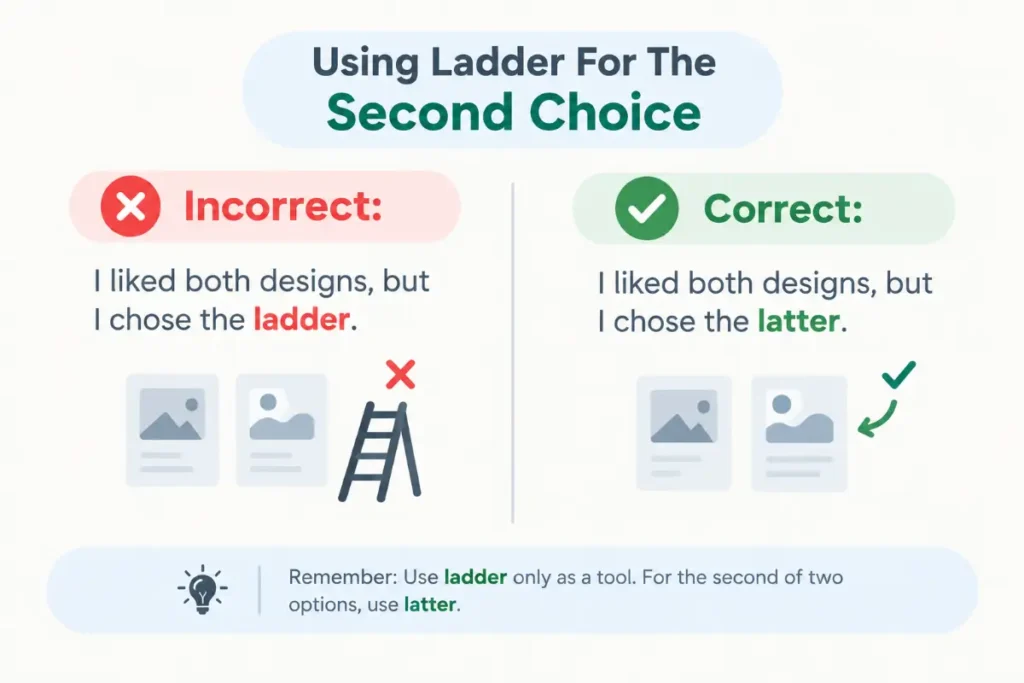
Incorrect: I compared the two phones and chose the ladder.
Correct: I compared the two phones and chose the latter.
The correct sentence refers to the second phone. Ladder would suggest a climbing tool, which does not fit the intended meaning.
Mistake Two Using Latter for Climbing Equipment
Incorrect: She placed the latter against the wall to reach the roof.
Correct: She placed the ladder against the wall to reach the roof.
The sentence describes a physical object, so ladder is the correct word.
Mistake Three Using Latter Without Clear Context
Unclear: The latter was much better.
Clear: The blue jacket and the black jacket were both on sale. The latter was much better.
In the clearer version, the latter refers to the black jacket. Without the earlier pair, readers cannot identify the intended item.
Mistake Four Using Latter for Three or More Choices
Unclear: I considered tea, coffee, and lemonade. The latter was my favorite.
Clear: I considered tea, coffee, and lemonade. Lemonade was my favorite.
Latter works most clearly when you refer to the second of two items. Naming the third item avoids confusion.
Mistake Five Confusing Latter With Later
Latter and later are different words.
Latter refers to the second of two items or the later part of a period. Later means at a time after the present or after another event.
For example.
I prefer the latter option. The sentence identifies the second option.
I will call you later. The sentence refers to a future time.
The two words can both relate to something that comes second or afterward, but they do not serve the same grammatical purpose.
Mistake Six Assuming Latter Always Means the Last Item
Latter usually identifies the second item in a pair. It does not automatically mean the last item in any list, regardless of length.
For example.
We discussed marketing, sales, and customer service. The latter department needs more staff.
This sentence is less precise because the list has three items. A reader may interpret latter as customer service because it comes last, but using the exact department name makes the meaning clearer.
Mistake Seven Overusing Latter in Professional Writing
Repeating latter throughout a long paragraph can make your writing stiff and difficult to follow. Use the word when the reference is obvious, but repeat the noun when clarity requires it.
For example.
Less clear: The company reviewed its sales and service departments. The latter received a new manager. The latter also changed its schedule.
Clearer: The company reviewed its sales and service departments. The service department received a new manager and changed its schedule.
The revised version reduces repetition and makes the meaning easier to follow.
Easy Memory Tips
A simple memory trick can help you select the right spelling without stopping to think for too long.
Remember the Second Choice
Think of latter as the word for the second option. If you mention coffee first and tea second, the latter refers to tea.
Example.
I can study at home or at the library. I prefer the latter.
The library comes second, so latter is correct.
Picture a Ladder
When you think about ladder, picture a physical ladder leaning against a wall. Imagine its rungs and the act of climbing them.
Example.
He climbed the ladder to reach the roof.
The image of someone climbing makes the correct spelling easy to remember.
Use a Quick Question
Ask yourself what the sentence describes.
1. If it refers to the second of two choices, use latter.
2. If it refers to climbing equipment or a series of levels, use ladder.
3. If it refers to a time after another event, consider later instead.
This quick test helps distinguish three commonly confused words.
Try a Short Practice Test
Choose the correct word for each sentence.
1. The worker carried a latter or ladder to the roof.
2. We could drive or take the train. I prefer the latter or ladder.
3. She wants to climb the career latter or ladder.
4. The latter or ladder half of the movie was more exciting.
Answers.
1. Ladder. The sentence describes climbing equipment.
2. Latter. The word identifies the second travel option, which is the train.
3. Ladder. The career ladder represents professional advancement.
4. Latter. The phrase latter half means the second half of a period or event.
The practice sentences reinforce the central rule. Think about meaning first and spelling second.
Word Origins and Related Terms
Understanding the background of a word can make its meaning easier to remember. Latter and ladder have different histories, even though their modern American pronunciations are similar.
Where Latter Comes From
Latter developed from Old English forms connected to the idea of being later or coming after something. Its modern meaning preserves that connection. It can identify the second of two items or describe the later part of a period.
For example, the phrase the latter half of the century refers to the later portion of that century. In a comparison between two books, the latter identifies the second book mentioned.
Where Ladder Comes From
Ladder also has Old English roots. Its history connects to the idea of a structure used for climbing. The modern word retains that concrete meaning and extends it to figurative expressions about career advancement, rankings, and progress.
For example, a physical ladder helps someone climb to a higher place. A career ladder describes the stages someone moves through while advancing professionally.
Related Words Worth Knowing
Several related words can help you express these ideas more precisely.
| Word | Meaning | Example |
|---|---|---|
| Former | The first of two items mentioned | I prefer the former option. |
| Later | At a time after another event | We will talk later. |
| Latest | The most recent | She read the latest report. |
| Last | The final item or event in a sequence | He finished last. |
| Step | A single level or part of a process | She took the next step in her career. |
| Rung | A horizontal bar on a ladder | He held the ladder’s top rung. |
These words overlap in certain situations, but they are not interchangeable. Choose the one that expresses the exact relationship you want to describe.
Professional Writing Tips
The right word matters, but the structure of your sentence matters just as much. Good writing makes references clear without forcing readers to work out your meaning.
Choose Clarity Over Shortness
Latter can shorten a sentence, but it does not always improve it. If the reader has to search through a paragraph to identify the second option, repeat the noun instead.
For example.
Less clear: The proposal includes a training plan and a hiring plan. The latter needs approval.
Clearer: The proposal includes a training plan and a hiring plan. The hiring plan needs approval.
The second version repeats the noun, but it gives readers a direct and unmistakable reference.
Use Latter Carefully in Long Paragraphs
In an essay or report, readers may forget the order of two items if several sentences separate them from the word latter. Keep the reference close to the original pair whenever possible.
For example.
The survey compared online classes with in person classes. The latter received higher satisfaction scores.
This works because the reference appears immediately after the two options.
Make Figurative Expressions Specific
Ladder often appears in figurative expressions, but the surrounding words should explain the kind of progress involved.
For example.
She climbed the corporate ladder by developing her skills and taking on more responsibility.
The phrase corporate ladder communicates professional advancement. The rest of the sentence shows how she achieved it.
The team climbed the rankings ladder after winning several matches.
The phrase rankings ladder communicates progress in a competitive order. The example explains the improvement that led to the team’s higher position.
Edit for American English
In American English, latter and ladder usually sound alike. Spell checking software may not catch a mistake when the wrong word is still a valid English word.
For example, a spell checker may accept I climbed the latter because latter is spelled correctly as a word. However, the sentence is incorrect if you mean a physical ladder.
During proofreading, check the meaning of each sentence instead of relying only on automatic spelling corrections. Reading your work aloud can help you spot awkward phrasing, but context remains the best way to choose between these words.
Key Takeaways
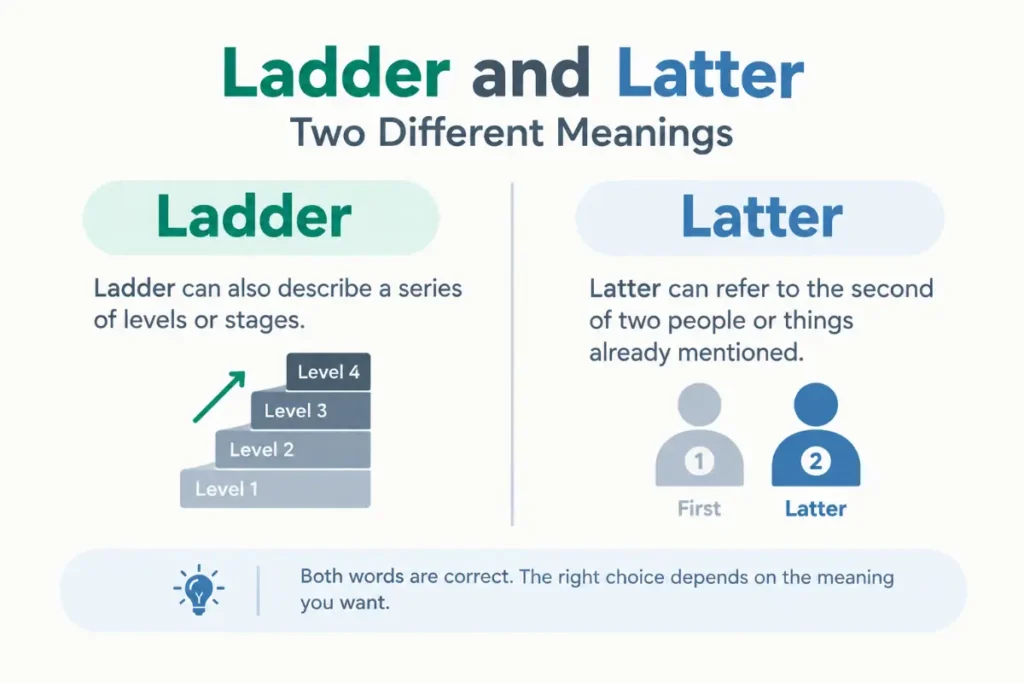
1. Latter refers to the second of two previously mentioned items or the later part of a period.
2. Ladder refers to climbing equipment or a series of levels that represent progress.
3. Both words usually sound alike in American English, so pronunciation alone may not help you choose the correct spelling.
4. Former identifies the first of two items, while latter identifies the second.
5. Later refers to a future time or a time after another event. It does not replace latter in comparisons.
6. When a sentence contains several options or a confusing reference, name the specific item instead of relying on latter.
7. Always choose the word that matches your intended meaning. A spell checker may accept both words even when only one fits the sentence.
Conclusion
Latter vs ladder becomes easy to understand once you focus on meaning instead of sound. Latter identifies the second of two things mentioned earlier or describes the later part of a period. Ladder refers to a physical structure used for climbing or a figurative path through levels of progress and achievement.
Remember the simple rule. If you’re talking about the second choice between two options, use latter. If you’re talking about climbing equipment, career advancement, or a sequence of rankings, use ladder. When you need to describe something that happens at a later time, use later instead.
With this distinction in mind, you’ll be able to choose the correct word in emails, essays, reports, and everyday conversations. Check the context, keep your references clear, and let the meaning guide your spelling.
Frequently Asked Questions
What is the difference between latter and ladder?
Latter refers to the second of two items mentioned earlier. Ladder refers to climbing equipment or a figurative series of levels. For example, I chose the latter identifies the second choice, while I climbed the ladder describes climbing equipment or making progress.
Is latter vs ladder a spelling mistake or a grammar mistake?
It can be either. Choosing the wrong spelling is a word usage error, and it can also create a grammatical or semantic problem if the word does not fit the sentence. The best correction depends on the intended meaning.
Do latter and ladder sound the same?
Yes. In standard American English, latter and ladder usually sound the same because their middle consonants are pronounced similarly. They have different spellings and meanings, so context helps distinguish them.
When should I use latter in a sentence?
Use latter when referring to the second of two people, things, or ideas already mentioned. For example, We can meet Monday or Friday. I prefer the latter. The word latter refers to Friday.
When should I use ladder in a sentence?
Use ladder when referring to climbing equipment or a figurative sequence of levels. For example, The worker placed the ladder against the wall. You can also say She climbed the career ladder to describe professional advancement.
Can latter refer to the second half of something?
Yes. Latter can describe the later part of a period, event, or process. For example, The latter half of the game was more exciting means the second half of the game was more exciting.
Is latter the same as later?
No. Latter usually identifies the second of two items or the later part of a period. Later refers to a time after another time or event. For example, I prefer the latter option identifies a choice, while I will arrive later refers to a future time.
What is the opposite of latter?
Former is the usual counterpart of latter when comparing two items. Former identifies the first item mentioned, while latter identifies the second. For example, in tea and coffee, I prefer the former, former refers to tea.
Can I use latter for three or more options?
It’s better to avoid it. Latter works most clearly when you refer to the second of two items. If you mention three or more options, name the intended choice directly to prevent confusion.
What does climb the ladder mean?
Climb the ladder can describe moving upward on a physical ladder or advancing through levels of success, authority, or achievement. For example, He climbed the corporate ladder means he progressed to higher positions within a company.
How can I remember the difference between latter and ladder?
Remember that latter identifies the second choice, while ladder is something you climb. Picture two options when you think of latter and a ladder leaning against a wall when you think of ladder.

Confusing Words, Spelling & Word Choice
Claire Whitmore is a U.S.-based English editor who writes about commonly confused words, spelling differences, and word choice. Her work helps readers understand subtle distinctions between similar-looking words through simple definitions, practical examples, and modern usage guidance in both American and British English.