
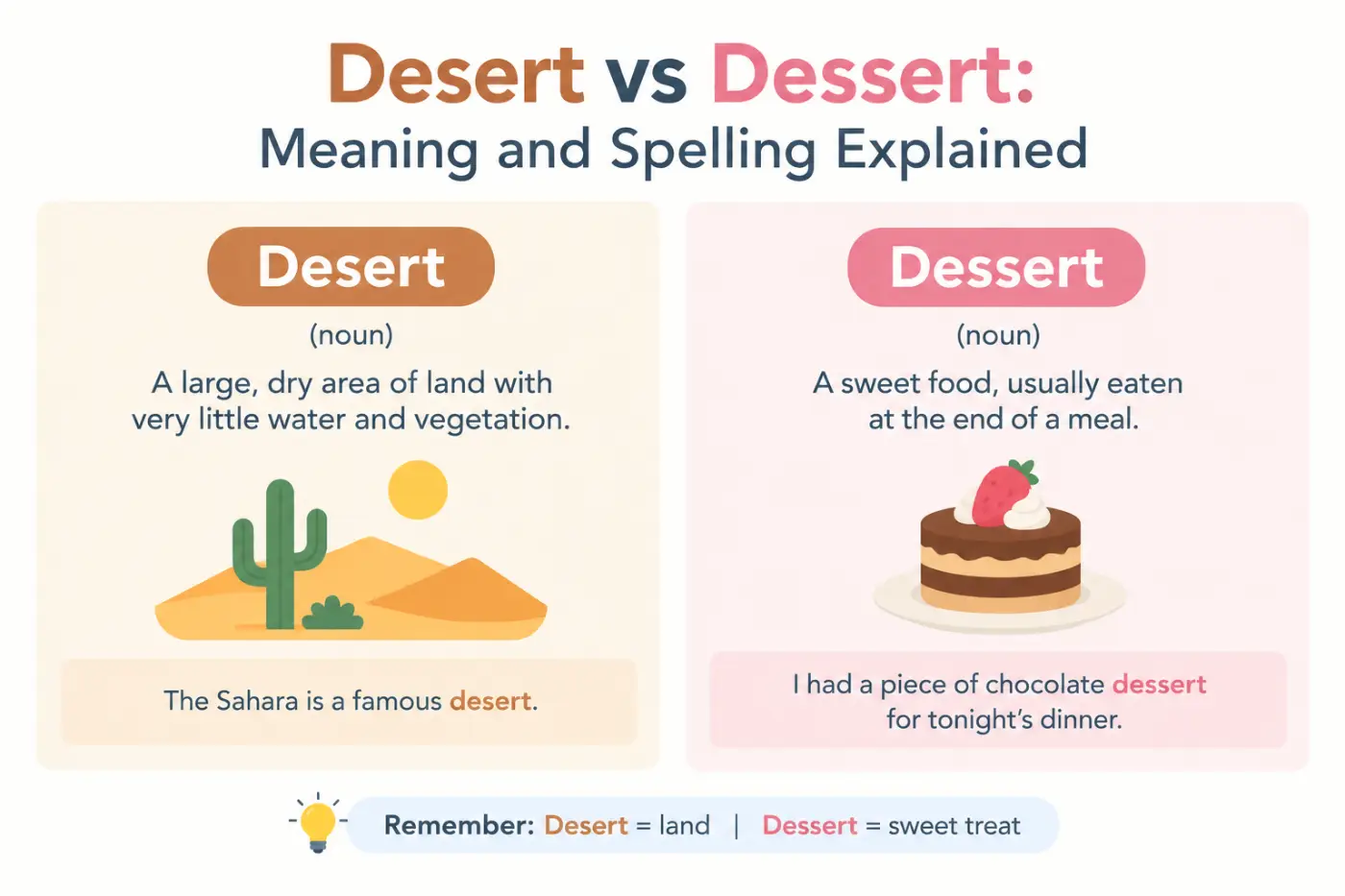
Desert vs dessert is a common spelling challenge because the two words look and sound similar in some contexts. However, they have different meanings and different pronunciations when you use desert as a noun for a dry region or dessert as a sweet course. One word describes a landscape or the act of leaving someone behind. The other brings to mind cake, ice cream, cookies, and other sweet treats.
The easiest way to tell them apart is to connect each word with a familiar idea. A desert has one s in the middle, just like the single stretch of land you might picture across a dry landscape. A dessert has two s letters because most people would happily ask for a second helping. This simple spelling trick can help you avoid mistakes in school assignments, emails, restaurant menus, and everyday writing.
Although the spelling difference looks small, the meaning can change completely when you choose the wrong word. Writing that you crossed a dessert instead of a desert can turn an ordinary travel story into an amusing mistake. Once you understand the definitions, pronunciation patterns, grammar, and examples, choosing the right word becomes much easier.
Short Answer
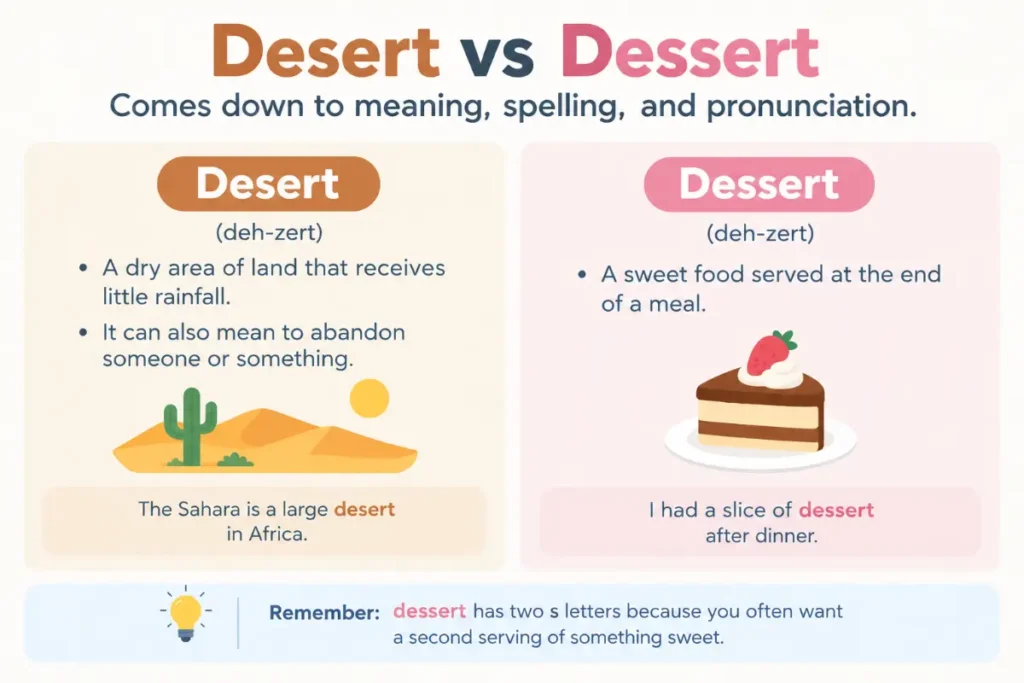
Desert vs dessert comes down to meaning, spelling, and pronunciation. A desert is a dry area of land that receives little rainfall. It can also mean to abandon someone or something. A dessert is a sweet food served at the end of a meal. Remember that dessert has two s letters because you often want a second serving of something sweet.
Table of Contents
- What Desert Means.
- What Dessert Means.
- Desert vs Dessert at a Glance.
- How to Pronounce Desert and Dessert.
- How to Remember the Correct Spelling.
- Desert as a Verb.
- Real Life Examples.
- Common Mistakes to Avoid.
- Related Words and Expressions.
- American and British English Usage.
- Writing Tips for Students and Professionals.
- Frequently Asked Questions.
- Key Takeaways.
- Conclusion.
What Desert Means
The word desert has several meanings. It most commonly refers to a dry region with little rainfall. It can also function as a verb meaning to abandon someone or something. In formal English, the related noun desert can refer to what someone deserves, although this use appears most often in the expression just deserts.
Desert as a dry region
A desert is an area that receives very little precipitation compared with the amount of water that could evaporate. Many deserts have sparse vegetation and limited surface water, but they do not all look the same. Some contain sand dunes, while others have rocky ground, gravel plains, or cold, icy terrain.
For example, the Sahara is a hot desert in northern Africa. The Mojave Desert lies in the southwestern United States, and Antarctica is classified as a polar desert because it receives very little precipitation.
Example sentence: The travelers carried extra water as they crossed the desert.
This sentence uses desert as a noun because it names a geographical region. The single s in the spelling distinguishes it from dessert, which refers to food.
Example sentence: Few plants can survive in the driest parts of the desert.
Here, desert describes a natural environment where water is scarce. The sentence does not refer to a meal or anything sweet.
Desert as a verb meaning to abandon
Desert can also mean to leave a person, place, responsibility, or cause when support or loyalty is expected. This meaning often carries a negative tone because it suggests that someone has walked away from an obligation.
Example sentence: He refused to desert his friends during a difficult time.
In this sentence, desert is a verb. It means to abandon his friends when they need him.
Example sentence: The soldiers were ordered not to desert their posts.
Here, desert means to leave an assigned position without permission. This use often appears in military, historical, and legal contexts.
Example sentence: The village seemed deserted after the storm.
Deserted is the past participle and adjective form associated with the verb desert. In this sentence, it means that the village appeared empty or abandoned. The word does not refer to a dry geographical region.
Desert in the expression just deserts
The phrase just deserts means the reward or punishment someone deserves. It often appears when a person receives a fair result because of their actions.
Example sentence: After years of dishonest behavior, the corrupt official finally got his just deserts.
The phrase means that the official received the consequences he deserved. Although deserts looks like the name of a dry landscape, this expression has a different history and meaning.
The spelling surprises many readers because they expect the word to contain two s letters. However, just deserts is the established expression. It is not written as just desserts.
What Dessert Means
A dessert is a sweet food usually served at the end of a meal. Common examples include cake, pie, ice cream, pudding, cookies, fruit tarts, and pastries.
Example sentence: We ordered chocolate cake for dessert.
Dessert is a noun in this sentence because it names the sweet course served after the main meal. Its spelling contains two s letters.
Example sentence: My favorite dessert is homemade apple pie.
Here, dessert refers to a particular kind of sweet food. The word can describe the course in general or a specific item served at the end of a meal.
Common types of dessert
Desserts come in many forms and vary across cultures. Some are baked, while others are chilled, frozen, fried, or prepared without cooking.
- Cakes and cupcakes. These sweet baked foods often appear at birthdays, celebrations, and family gatherings.
- Pies and tarts. These desserts usually combine a pastry crust with fruit, chocolate, custard, or another filling.
- Ice cream and frozen treats. These include ice cream, sorbet, gelato, and frozen yogurt.
- Cookies and brownies. These are popular small sweets that people often serve with coffee, milk, or tea.
- Puddings and custards. These desserts generally have a soft texture and may use milk, eggs, sugar, or starch.
- Fruit based desserts. These include fruit salad, baked apples, poached pears, and fruit crumbles.
Example sentence: The restaurant offers three desserts on its dinner menu.
The plural noun desserts refers to several sweet dishes available to customers. The double s remains in the spelling.
Can dessert include fruit or cheese?
Yes. Dessert does not have to contain chocolate or a large amount of sugar. Fresh fruit, fruit based dishes, and some cheese courses can serve as the final course of a meal, depending on the menu and dining tradition.
Example sentence: She chose fresh berries for dessert instead of cake.
This sentence shows that dessert describes the role of the food in the meal, not just a particular recipe or texture.
Dessert as a noun in everyday English
In ordinary American English, dessert is usually a noun. People ask about dessert, order dessert, make dessert, or skip dessert after a large meal.
Examples include the following.
- Would you like dessert after dinner? The speaker asks if someone wants a sweet course.
- I made dessert for the family. The speaker prepared a sweet dish.
- We skipped dessert because we were full. The diners chose not to eat a final course.
- The dessert menu includes cheesecake and brownies. The menu lists sweet food options.
The two s letters remain a reliable clue whenever the word refers to the sweet course.
Desert vs Dessert at a Glance
The spelling difference is only one letter, but the meanings are far apart. Use the following comparison to check the correct word quickly.
| Feature | Desert | Dessert |
|---|---|---|
| Main meaning | A dry region with little rainfall | A sweet course after a meal |
| Part of speech | Noun or verb | Usually a noun |
| Spelling | One s in the middle | Two s letters in the middle |
| Noun pronunciation | DEZ ert | dih ZERT |
| Verb pronunciation | dih ZERT | Not normally used as a verb |
| Example | The desert was hot and dry. | We shared a dessert. |
| Memory clue | One s for a dry stretch of land | Two s letters for a second serving |
A quick way to choose
Ask yourself what the sentence describes.
- If it describes a dry landscape, choose desert.
- If it describes leaving someone or something behind, choose desert.
- If it describes a sweet course after a meal, choose dessert.
- If it uses the phrase meaning a deserved consequence, write just deserts.
These rules cover the most common uses and the expression that often causes spelling confusion.
How to Pronounce Desert and Dessert
Pronunciation provides another helpful clue. When desert refers to a dry region, the stress falls on the first syllable. When dessert refers to sweet food, the stress falls on the second syllable.
Pronouncing desert as a noun
The geographical noun desert is pronounced DEZ ert. Its first syllable receives the stress, and the second syllable sounds weaker.
Example sentence: The desert stretched for miles beyond the highway.
The stress falls on the first syllable of desert because the word describes a dry region.
Pronouncing desert as a verb
The verb desert is pronounced dih ZERT. The second syllable receives the stress, making it sound like dessert.
Example sentence: A loyal friend would never desert you.
In this sentence, desert means to abandon someone. The stress pattern helps distinguish the verb from the geographical noun when speaking.
Pronouncing dessert
The word dessert is pronounced dih ZERT. The second syllable receives the stress, just as it does in the verb desert.
Example sentence: We saved room for dessert.
The final syllable receives the strongest emphasis. This pronunciation is a useful clue when you hear the word spoken aloud, although context still matters because the verb desert sounds the same.
Why stress matters
English sometimes uses stress to distinguish words that share the same spelling. Desert is a clear example because the noun and verb have different stress patterns.
When someone says DEZ ert, they usually mean a dry region. When someone says dih ZERT, they may mean a sweet course or the act of abandoning someone. The sentence tells you which meaning the speaker intends.
For example, The troops did not desert the camp uses the verb desert. The camp stood near the desert uses the geographical noun. The spelling stays the same, but the pronunciation and grammatical role change.
How to Remember the Correct Spelling
A strong memory trick connects spelling with meaning. Instead of memorizing two definitions separately, picture something familiar whenever you write either word.
Remember dessert with two s letters
The most popular trick is simple. Dessert has two s letters because you may want seconds.
Imagine finishing dinner and asking for another slice of cake. You want a second serving, so dessert gets two s letters.
Example sentence: Everyone wanted seconds of the strawberry dessert.
The sentence reinforces the connection between dessert, sweet food, and the desire for another serving.
Remember desert with one s
A desert has one s in the middle. You can connect this spelling with the single dry stretch of land in a simple picture of a desert landscape.
Example sentence: The hikers crossed a desert with very little water.
Think of the wide, dry landscape rather than a plate of food. This mental image helps you select the single s spelling.
Use the dinner test
If the sentence mentions dinner, cake, ice cream, or a sweet course, dessert is probably the right choice.
Example sentence: We ate dessert after dinner.
Both words describe food related events, and dessert clearly names the sweet course.
However, context matters. A sentence about someone deserting a dinner party uses desert as a verb because it means leaving unexpectedly.
Example sentence: He decided to desert the dinner party before the speeches began.
The verb describes leaving the event, not eating a sweet dish.
Use a visual spelling trick
Write the two words next to each other and attach a mental image to each.
- Desert. Picture a dry landscape with sand, rocks, and little water.
- Dessert. Picture two scoops of ice cream or two slices of cake.
The double s in dessert becomes a visual reminder of an extra serving. The single s in desert keeps the spelling shorter.
Say the words aloud
Pronouncing the words correctly can strengthen your memory. Say DEZ ert when you mean a dry region. Say dih ZERT when you mean a sweet course.
Example sentence: The traveler left the desert and enjoyed dessert at a nearby restaurant.
Read this sentence aloud and pay attention to the different stress patterns. The first word has stress on its first syllable, while the second has stress on its second syllable.
Desert as a Verb
Many spelling guides focus on the geographical noun and the sweet food noun. However, the verb desert is also worth learning because it appears in everyday speech, literature, news reports, and formal writing.
What does it mean to desert someone?
To desert someone means to abandon that person or stop providing support when the person expects you to remain. The word often suggests disloyalty or failure to meet a responsibility.
Example sentence: She promised not to desert her brother when he needed help.
The verb describes the act of abandoning someone during a difficult time. It carries more emotional weight than simply leaving a room.
Example sentence: The community refused to desert families affected by the flood.
Here, desert means to stop supporting people who need help. The sentence presents the word in a figurative and social context.
What does it mean to desert a place?
The verb can also mean to leave a place that someone is expected to occupy or maintain.
Example sentence: The guards were punished for deserting their posts.
The word deserting is the present participle form of the verb. It refers to leaving an assigned position without authorization.
Example sentence: Residents deserted the town after repeated attacks.
In this sentence, deserted means that residents abandoned the town. It does not describe the town’s climate or physical landscape.
Desert versus leave
The words leave and desert can overlap, but they do not always carry the same tone.
Leave is neutral. It can describe an ordinary departure without suggesting wrongdoing.
Example sentence: She left the office at five.
The sentence simply reports when she departed.
Desert often suggests abandonment, disloyalty, or the failure to fulfill a duty.
Example sentence: He deserted his team during the championship match.
This sentence suggests that he abandoned his teammates when they depended on him. The choice of verb gives the action a stronger negative meaning.
Common forms of the verb desert
The verb follows the regular pattern used by many English verbs.
| Form | Example |
|---|---|
| Base form | desert |
| Third person singular | deserts |
| Past tense | deserted |
| Present participle | deserting |
| Past participle | deserted |
Example sentence: The captain deserted his post.
Deserted is the simple past tense in this sentence. It tells the reader that the abandonment happened in the past.
Example sentence: The captain is deserting his post.
Deserting follows the auxiliary verb is and forms the present progressive tense. It describes an action in progress.
Real Life Examples
Seeing the words in natural sentences makes the distinction easier to remember. These examples cover travel, food, school, relationships, and formal writing.
Examples using desert as a noun
- The family drove across the desert during their vacation. Desert refers to a dry geographical region.
- Cacti can survive in some harsh desert environments. Desert describes an environment with little water.
- The scientists studied wildlife in the Mojave Desert. The word appears as part of a geographical name.
- Nighttime temperatures in the desert can fall sharply. Desert identifies the location where the temperature changes.
- The plane flew over a vast desert before reaching the city. Desert refers to a large dry area.
Examples using dessert as a noun
- We ordered cheesecake for dessert. Dessert names the sweet course after a meal.
- My grandmother makes the best apple pie dessert. Dessert refers to a sweet dish, although a more natural version is often simply My grandmother makes the best apple pie.
- The children shared a bowl of ice cream for dessert. Dessert identifies the food served at the end of the meal.
- Would you like dessert or coffee? Dessert refers to the final course offered at a restaurant.
- The bakery added a new chocolate dessert to its menu. Dessert describes a sweet food item available for customers.
These examples show why checking the meaning of each word matters more than relying on the appearance of the letters alone.
Common Mistakes to Avoid
The most frequent errors involve adding an extra s to desert, leaving an s out of dessert, or confusing the geographical noun with the verb.
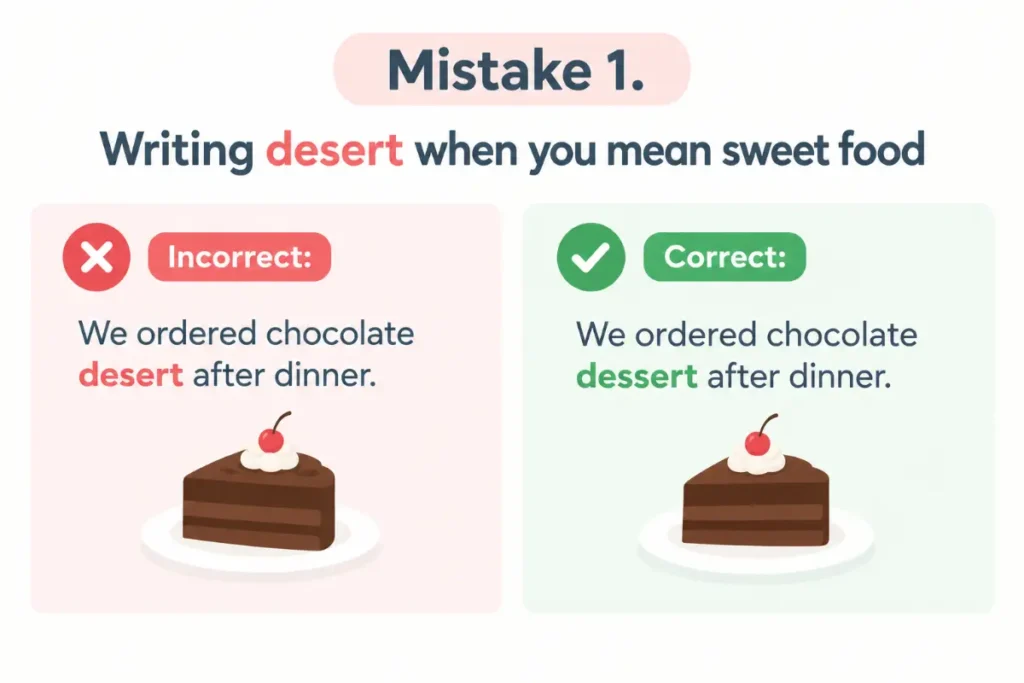
Mistake 1. Writing desert when you mean sweet food
Incorrect: We ordered chocolate desert after dinner.
Correct: We ordered chocolate dessert after dinner.
Dessert needs two s letters because it names the sweet course. The incorrect version uses the spelling associated with a dry region or the verb meaning to abandon.
Mistake 2. Writing dessert when you mean a dry region
Incorrect: The travelers crossed the dessert.
Correct: The travelers crossed the desert.
Desert is the correct word because the sentence describes a geographical area. Dessert would make the sentence sound as if the travelers crossed a giant sweet dish.
Mistake 3. Using dessert instead of the verb desert
Incorrect: He would never dessert his friends.
Correct: He would never desert his friends.
The sentence describes abandoning friends, so it needs the verb desert. Dessert is a noun for sweet food.
Mistake 4. Misspelling just deserts
Incorrect: He finally got his just desserts.
Correct: He finally got his just deserts.
The established expression is just deserts. It means that someone received the consequences or treatment they deserved.
Mistake 5. Assuming every desert is hot and sandy
Incorrect assumption: A cold place cannot be a desert.
Correct understanding: A desert is defined mainly by low precipitation, not by high temperatures.
Antarctica is a polar desert because it receives very little precipitation. Deserts can be hot, cold, sandy, rocky, or covered in ice.
Mistake 6. Ignoring pronunciation
Incorrect assumption: Desert and dessert always sound the same.
Correct understanding: The geographical noun desert usually stresses the first syllable, while dessert stresses the second.
The verb desert also stresses the second syllable. Listening to the stress can help you understand the intended meaning.
Mistake 7. Treating deserted as a food word
Incorrect: The deserted was delicious.
Correct: The dessert was delicious.
Dessert names the sweet dish. Deserted describes something abandoned or empty, so it cannot replace dessert in this sentence.
Related Words and Expressions
Understanding related words helps you use both spellings accurately in different situations.
Deserted
Deserted usually functions as an adjective or as a past participle of the verb desert. It often means empty, abandoned, or no longer occupied.
Example sentence: They walked along a deserted beach.
Deserted describes the beach as empty or lacking people. It does not mean that the beach is dry or that someone is eating a sweet dish.
Desertion
Desertion is a noun formed from the verb desert. It refers to the act of abandoning a person, responsibility, post, or organization.
Example sentence: The officer faced charges of desertion.
The word describes the act of leaving a required military position or duty. It commonly appears in formal and legal contexts.
Dessert menu
A dessert menu lists the sweet dishes available at a restaurant. It may include cakes, pies, ice cream, fruit dishes, and other treats.
Example sentence: The waiter brought us the dessert menu after dinner.
The double s spelling remains correct because the menu lists sweet food.
Dessert fork
A dessert fork is a smaller fork designed for eating certain sweet dishes. Its size and shape may vary by dining tradition and table setting.
Example sentence: She used a dessert fork to eat the pastry.
The word dessert identifies the purpose of the fork.
Desert island
A desert island usually refers to an uninhabited island. The expression appears in adventure stories and in the popular idea of choosing a few items to take to an isolated island.
Example sentence: The novel tells the story of a sailor stranded on a desert island.
In this expression, desert is linked to the idea of being deserted or uninhabited. It does not mean that the island must be a dry, sandy landscape.
Just deserts
Just deserts refers to a result that someone deserves because of their behavior. The result may be good or bad, although the expression often appears in situations involving punishment or consequences.
Example sentence: The dishonest manager received his just deserts.
The expression means that the manager got what he deserved. The correct spelling uses one s in deserts.
Desertification
Desertification is the process through which land in dry regions becomes less productive. It can result from several interacting factors, including climate variation, prolonged drought, and unsustainable land use.
Example sentence: Researchers studied desertification in areas affected by prolonged drought.
The word shares its spelling family with desert as a geographical noun. It does not refer to dessert or food.
American and British English Usage
American and British English use desert and dessert with the same core spellings and meanings. The distinction does not change across these varieties of English.
In the United States, people commonly say dessert when referring to the sweet course served after dinner. British English uses the same word, although terms such as pudding and sweets can also appear in everyday conversation depending on the region and context.
Dessert in American English
American restaurants often use dessert on menus that list cheesecake, brownies, pies, ice cream, and similar dishes.
Example sentence: The restaurant offers dessert with its holiday dinner.
The word follows the same spelling and meaning used in standard American English.
Dessert in British English
British speakers also use dessert, particularly in formal dining and restaurant settings. In casual conversation, pudding can refer to a sweet course or a particular sweet dish.
Example sentence: We had dessert after the Sunday roast.
This sentence is correct in both American and British English. The choice of dessert does not create a regional spelling difference.
Desert across English varieties
Desert has the same spelling in American and British English when it names a dry region or means to abandon someone or something.
Example sentence: The travelers crossed the desert before sunset.
The spelling and meaning remain the same in both varieties.
Writing Tips for Students and Professionals
Choosing the correct word helps make your writing precise. A single letter can change a sentence from a clear statement into an obvious spelling error.
Check the meaning before checking the spelling
Before writing desert or dessert, identify the idea you want to express. Ask yourself if you are describing a dry region, abandoning someone, or naming a sweet course.
Example sentence: The guide explained the dangers of the desert before the group ate dessert.
The context makes both words clear. The guide discusses a dry region, then the group eats a sweet course.
Read the sentence aloud
Reading aloud can reveal the intended stress pattern. It also helps you catch sentences that sound odd because you selected the wrong word.
Example sentence: The family explored the desert and enjoyed dessert at the hotel.
The different stress patterns help distinguish the geographical noun from the food noun.
Use spelling tools carefully
Spell checkers can catch some mistakes, but they may not recognize the wrong word if it is spelled correctly. A document containing desert instead of dessert may pass a basic spelling check because both are valid English words.
For example, We ate desert after lunch contains a real word but uses it incorrectly. A spelling tool may not flag the error because desert is spelled correctly on its own.
Proofreading for meaning is just as important as proofreading for spelling. Read each sentence in context and confirm that the word expresses the intended idea.
Be precise in formal writing
In academic work, business documents, travel writing, and journalism, choose the word that matches the meaning exactly. Avoid relying on readers to infer what you meant from context when a clear word is available.
Example sentence: The research team examined water availability in the desert.
Desert is precise because the sentence concerns a dry environment.
Example sentence: The hotel provided dessert after the conference dinner.
Dessert is precise because the sentence refers to a sweet course.
Use the correct word in headlines and menus
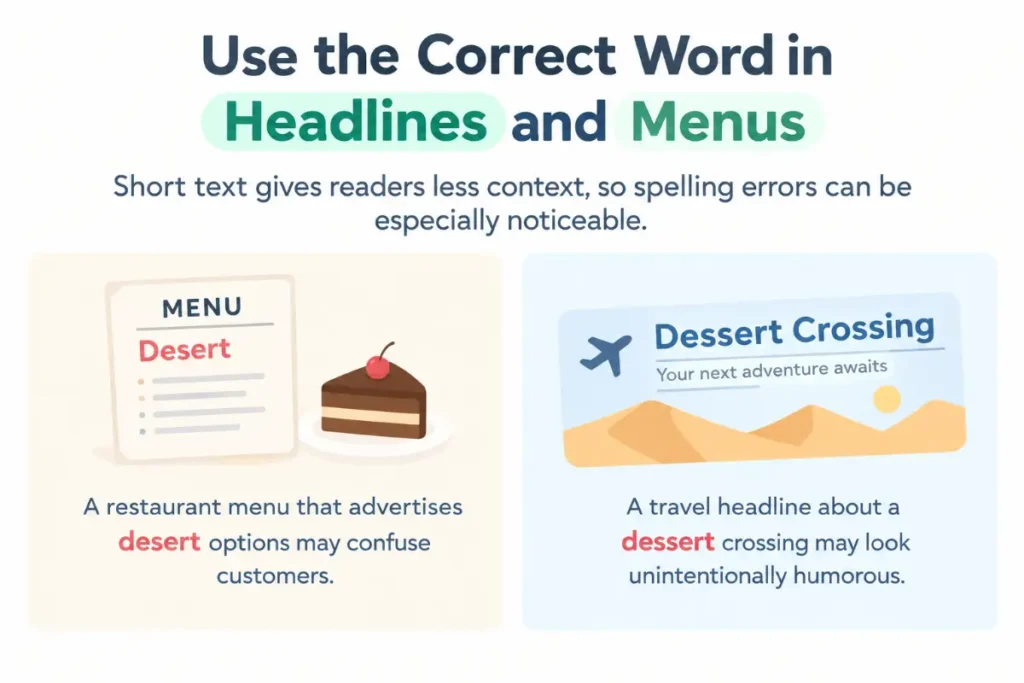
Short text gives readers less context, so spelling errors can be especially noticeable. A restaurant menu that advertises desert options may confuse customers, while a travel headline about a dessert crossing may look unintentionally humorous.
For menus, recipes, travel articles, and educational materials, check the intended meaning before publication. A quick review can prevent an avoidable error.
Conclusion
In conclusion, desert and dessert have different meanings, even though their spellings look similar. A desert is a dry region that receives very little rainfall, while a dessert is a sweet dish served after a meal. Understanding this difference helps you choose the right word in your writing.
The easiest way to remember the difference is that dessert has two s letters, just like you may want a second serving of something sweet. In contrast, desert has only one s when referring to a dry landscape. By remembering this simple trick, you can avoid common spelling mistakes and use both words correctly in everyday conversations, school assignments, and professional writing.
Frequently Asked Questions
1. What is the difference between desert vs dessert?
Desert usually means a dry region with little rainfall. It can also mean to abandon someone or something. Dessert means a sweet food served at the end of a meal. The simplest memory trick is that dessert has two s letters because you might want seconds.
2. How do you spell dessert correctly?
Spell the sweet course dessert, with two s letters in the middle. For example, you might write, We had ice cream for dessert. The spelling desert refers to a dry region or the act of abandoning someone.
3. Why does dessert have two s letters?
A useful memory trick connects the two s letters in dessert with the idea of seconds. You may want a second serving of cake or ice cream. This is a memory aid rather than the historical origin of the spelling.
4. Is desert pronounced the same as dessert?
Not always. The geographical noun desert is pronounced with stress on the first syllable. Dessert is pronounced with stress on the second syllable. The verb desert, meaning to abandon, also stresses the second syllable and sounds like dessert.
5. Can desert be used as a verb?
Yes. Desert means to abandon someone, leave a responsibility, or leave an assigned position without permission. For example, He refused to desert his teammates means that he refused to abandon them.
6. What does just deserts mean?
Just deserts means the result or treatment someone deserves. The expression often describes the consequences of a person’s actions. The correct spelling is just deserts, with one s in the middle of deserts.
7. Is a desert always hot?
No. A desert is defined mainly by its low precipitation, not its temperature. Some deserts are hot and sandy, while others are cold or covered in ice. Antarctica is an example of a polar desert.
8. What is the plural of dessert?
The plural of dessert is desserts. Add an s to the end of the word. For example, The bakery sells several desserts, means that the bakery offers several sweet dishes.
9. Is dessert the same as pudding?
Not exactly. Dessert is a broad term for a sweet course served after a meal. Pudding can refer to a specific sweet dish and, especially in British English, can also refer to the dessert course in general.
10. How can I remember desert vs dessert?
Remember that dessert has two s letters because you might want seconds. Desert has one s and refers to a dry region. If the word means abandoning someone, use desert as a verb.
11. Is dessert spelled differently in American and British English?
No. Both American and British English spell the sweet course dessert. The word desert also keeps the same spelling in both varieties when it refers to a dry region or the act of abandoning someone.
12. Why does my spell checker miss desert and dessert mistakes?
Both words are correctly spelled English words. A spell checker may accept a sentence that uses the wrong word because it often checks spelling rather than meaning. Read the sentence in context to make sure the word fits.

Confusing Words, Spelling & Word Choice
Claire Whitmore is a U.S.-based English editor who writes about commonly confused words, spelling differences, and word choice. Her work helps readers understand subtle distinctions between similar-looking words through simple definitions, practical examples, and modern usage guidance in both American and British English.