
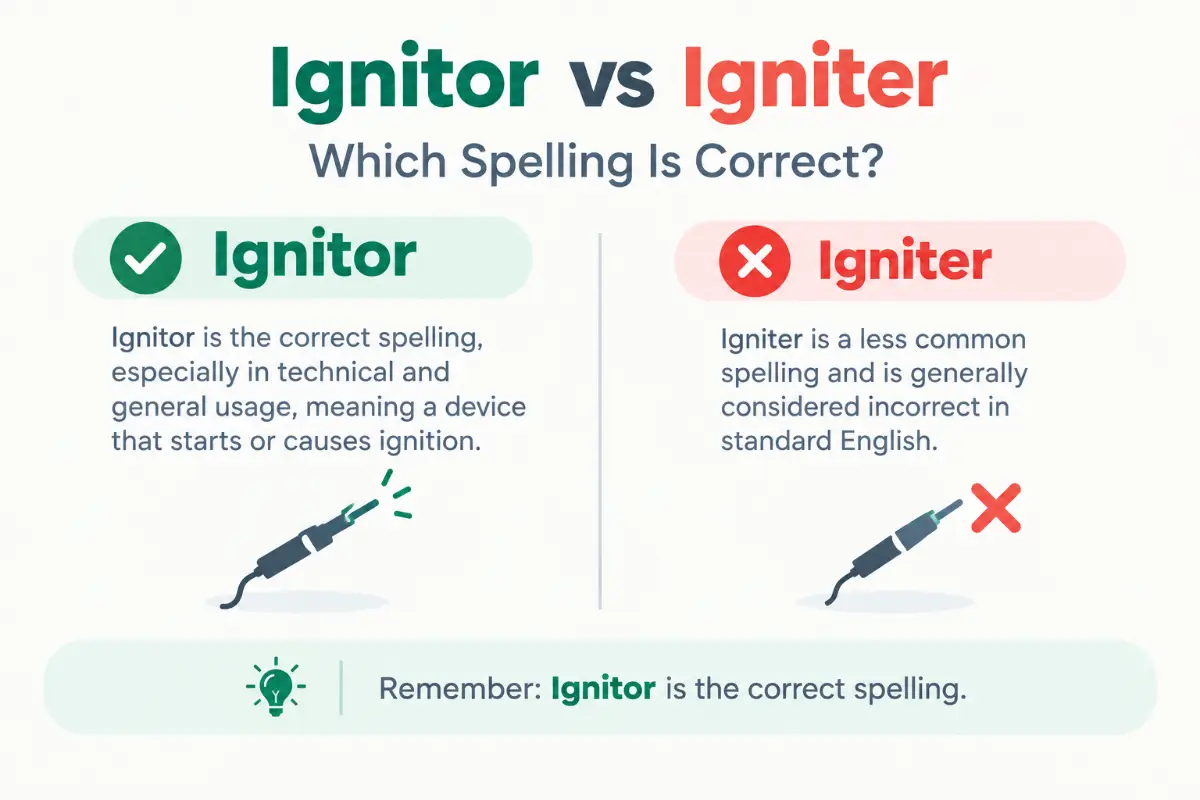
Ignitor vs igniter is a spelling question that often catches people off guard because both forms appear in real English. You may see an igniter listed as a furnace part in one place and an ignitor listed in another. That can make a simple spelling choice feel more complicated than it really is.
The key point is simple. Both words refer to something that ignites or starts combustion. Dictionaries recognize both forms, and major dictionary sources list igniter as a noun formed from ignite while also recognizing ignitor as a variant.
For general American English writing, I recommend igniter. It looks natural to most readers and works well in everyday writing, technical explanations, product descriptions, repair instructions, and professional documents. You don’t need to treat ignitor as a spelling error. It has a legitimate place in English.
Short Answer
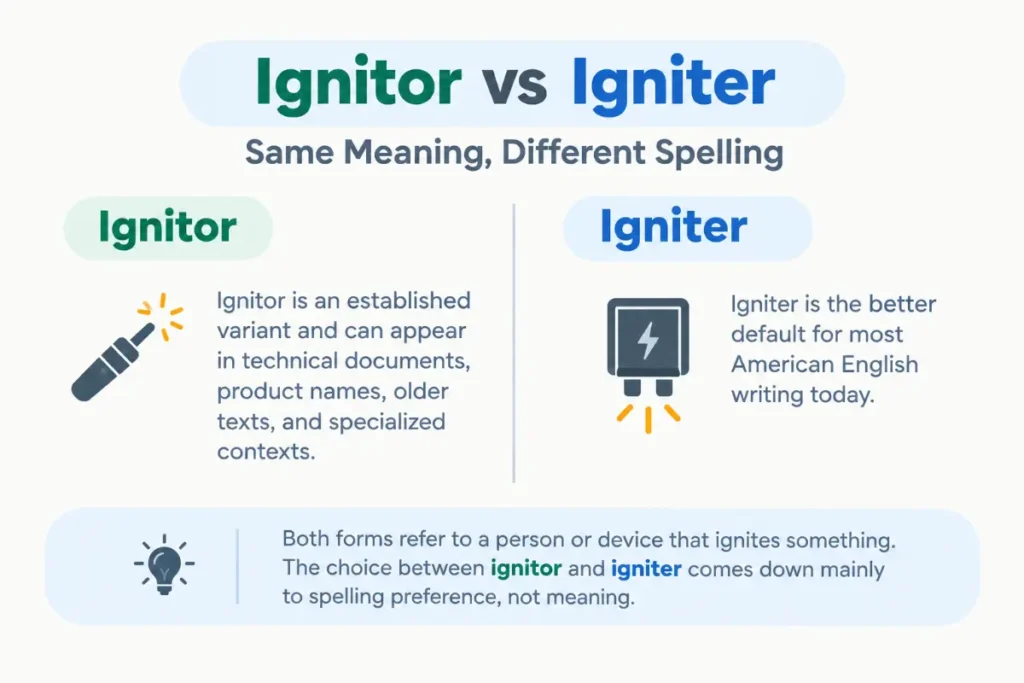
Ignitor vs igniter comes down mainly to spelling preference rather than meaning. Both forms refer to a person or device that ignites something. For most American English writing today, igniter is the better default. Ignitor is also an established variant and can appear in technical documents, product names, older texts, and specialized contexts.
Table of Contents
- The correct spelling in American English.
- What igniter means.
- What ignitor means.
- The difference between the two spellings.
- Why two spellings exist.
- How to use the word correctly.
- Pronunciation and word forms.
- American English and British English usage.
- Technical and professional usage.
- Real life examples.
- Common spelling mistakes.
- Memory tips.
- Related words and expressions.
- Frequently asked questions.
- Key takeaways.
- Conclusion.
The Correct Spelling In American English
If you’re writing for an American audience and need one spelling to use consistently, choose igniter.
That doesn’t make ignitor wrong. Instead, it means igniter is usually the safer modern choice for general writing. Dictionary.com lists igniter as an American noun meaning a person or thing that ignites something. Collins also lists both igniter and ignitor as noun forms derived from ignite.
The distinction matters most when you’re editing formal material. A technical writer may need to choose one form and use it throughout a manual. A teacher may want the spelling that readers are most likely to recognize. A website writer may want the form that sounds most natural to an American audience.
In all of those situations, igniter is a strong default.
You can think of the two forms as members of the same family. They perform the same basic job linguistically. The spelling changes but the central meaning stays the same.
What Igniter Means
An igniter is a person, device, or substance that causes something to ignite.
The verb ignite means to start burning or to cause something to burn. The noun igniter names the thing that performs that action.
For example:
The stove igniter produced a spark.
This sentence identifies the igniter as a part of the stove. Its job is to create the spark needed to light the burner.
The furnace igniter stopped working.
Here the word refers to a furnace component responsible for starting the combustion process.
The rocket engine uses an igniter to begin combustion.
In this example, the igniter has a specialized technical function. It initiates the process that allows the engine to begin producing thrust.
The word can also have a broader meaning. An igniter doesn’t always have to be a mechanical part. It can refer to something that starts a fire or initiates a reaction.
That broader meaning explains why dictionaries define the word as a person or thing that ignites something.
What Ignitor Means
Ignitor carries essentially the same basic meaning.
It can refer to a device that produces a spark or otherwise starts combustion. It can also refer to a substance used to start a fire or initiate burning. Dictionary sources list ignitor as an alternative spelling of igniter.
For example:
The technician replaced the ignitor.
The sentence describes a replacement part. The word tells the reader that the component helps initiate ignition.
The old ignitor failed during testing.
Here the spelling with or describes the same general type of device.
An older manual may use ignitor throughout its instructions.
That doesn’t automatically mean the manual contains a spelling mistake. Language changes over time and technical terminology can remain stable inside a particular industry or organization.
This point is worth remembering. Seeing ignitor in a manual or product description doesn’t mean you need to correct it automatically.
The Difference Between The Two Spellings
The practical difference between ignitor vs igniter is mostly spelling and usage preference.
| Feature | Igniter | Ignitor |
|---|---|---|
| Basic meaning | Something that ignites | Something that ignites |
| Part of speech | Noun | Noun |
| General American usage | Preferred default | Accepted variant |
| Technical usage | Common | Also used |
| Meaning difference | No major difference | No major difference |
| Derived from | Ignite | Ignite |
| Plural | Igniters | Ignitors |
| Best general choice | Yes | Usually not the first choice |
Both forms come from the same underlying idea. The word ignite provides the base. The ending changes the word into a noun that identifies an agent or device.
Collins explicitly lists igniter and ignitor as derived noun forms of ignite. Dictionary.com also identifies igniter as a noun meaning a person or thing that ignites.
So you don’t need to search for a hidden difference in meaning. There isn’t a major one in ordinary usage.
Why Two Spellings Exist
English often allows more than one spelling for the same word.
That happens because English has developed from several linguistic traditions and has borrowed vocabulary from many sources. It also uses more than one productive pattern for forming nouns.
The spelling igniter follows a familiar English pattern. Words such as writer, starter, fighter, and heater use er to identify a person or thing that performs an action or serves a function.
Ignitor follows another productive pattern. The ending or also appears in words such as creator, operator, generator, and accelerator.
Neither pattern is strange to English.
The interesting part is that English speakers can build related nouns in different ways. Over time, one form may become more common while another remains in use.
The history of ignite also reaches back to Latin. Collins traces the verb to Latin roots associated with fire. The English noun forms developed from the verb rather than representing two unrelated words.
That history helps explain why both forms look plausible.
How To Use The Word Correctly
The easiest way to use igniter correctly is to remember its grammatical role.
Igniter is a noun.
Ignite is a verb.
Ignition is another noun that describes the process or event of starting combustion.
These three words belong together but they don’t perform the same grammatical job.
Consider this sentence:
The igniter ignites the fuel during ignition.
The first word names the device. The second word describes the action. The third word names the process.
That distinction becomes especially useful in technical writing.
For example:
The igniter creates the spark.
The verb creates tells us what the component does.
The system uses an electronic igniter.
Here the word describes a component.
The ignition system failed during testing.
Now we’re talking about the broader system or process rather than the individual component.
A common writing mistake happens when people treat ignite and igniter as interchangeable. They aren’t.
You wouldn’t normally write:
The mechanic replaced the ignite.
You’d write:
The mechanic replaced the igniter.
Likewise, you wouldn’t normally use ignition when you mean a physical component.
The technician inspected the ignition.
This sentence can make sense if the technician inspected the ignition process or system. It doesn’t specifically identify a device.
The technician inspected the igniter.
This sentence clearly identifies the component.
Pronunciation And Word Forms
Both forms are pronounced in essentially the same way.
The word begins with the sound found in ignite. The main stress falls on the second syllable.
The pronunciation is commonly represented as /ɪɡˈnaɪtər/ in American English. Dictionary.com gives this pronunciation for American English igniter.
The spelling difference doesn’t create a major pronunciation difference.
That makes this pair different from some English word pairs where a spelling change creates a completely different pronunciation.
The common singular forms are:
Igniter.
Ignitor.
The common plural forms are:
Igniters.
Ignitors.
The verb form is:
Ignite.
The related process noun is:
Ignition.
The adjective form can be:
Ignitable.
These forms are connected by meaning but each has a specific grammatical role.
American English And British English Usage
It would be too simple to say that one spelling belongs exclusively to American English and the other belongs exclusively to British English.
Real usage doesn’t follow such a neat dividing line.
Dictionary.com identifies igniter as an American form and also gives British usage information for the same word. Collins lists both igniter and ignitor in American English.
That evidence makes one point clear. You shouldn’t treat the pair as a strict American versus British spelling contrast like color and colour.
Instead, think of igniter as the stronger general choice for modern American writing while recognizing ignitor as an established variant.
British technical writing can contain specialized terminology that differs by industry, company, or historical source. The same thing happens in American technical writing.
For that reason, a professional writer should pay attention to the terminology used by the organization or industry involved.
If a manufacturer consistently uses ignitor in its official documentation, changing every instance to igniter may create an unnecessary terminology mismatch.
If you’re writing a fresh article for a general American audience, igniter is usually the cleaner choice.
Technical And Professional Usage
Technical writing creates an interesting situation because consistency can matter more than personal spelling preference.
Imagine you’re writing a furnace repair manual. The manufacturer calls a particular replacement component an ignitor. You should normally preserve the manufacturer’s terminology when identifying that exact part.
Now imagine you’re writing a general educational article about furnace components. In that situation, igniter is a natural choice for a broad American audience.
The same principle applies to automotive writing.
A repair guide may use a particular manufacturer’s preferred term. A general article can use the more familiar spelling and explain the component in plain language.
This is an important professional writing habit. Don’t change established product terminology simply because another spelling looks more familiar.
Names and technical labels can function as identifiers. Consistency helps readers match the written information with the physical part or official documentation they have in front of them.
The rule is simple.
Use the terminology required by the source when you’re describing a specific product or system.
Use the preferred general form when you’re writing independent educational content.
That approach supports both accuracy and clarity.
Real Life Examples
Real examples make the spelling difference easier to understand.
The grill igniter stopped producing a spark.
The word identifies the component that starts the grill.
The furnace igniter needs to be replaced.
The word refers to the part that starts the heating process.
The technician tested the electronic igniter.
The adjective electronic describes the type of igniter.
The engine igniter failed during the inspection.
The sentence identifies a component associated with engine ignition.
The old equipment manual calls the component an ignitor.
Here the spelling with or appears as part of the manual’s established terminology.
The replacement igniter arrived this morning.
This sentence uses the modern preferred spelling in ordinary American English.
The igniter creates a spark that lights the fuel.
This example shows the relationship between the device and the action it performs.
The ignition system includes several components.
This sentence uses ignition correctly because it refers to the broader system rather than one specific device.
The technician checked the igniter before starting the furnace.
The word clearly identifies the component being inspected.
The damaged ignitor was replaced with a new part.
The alternative spelling works naturally here because the context doesn’t create a meaning difference.
Common Mistakes
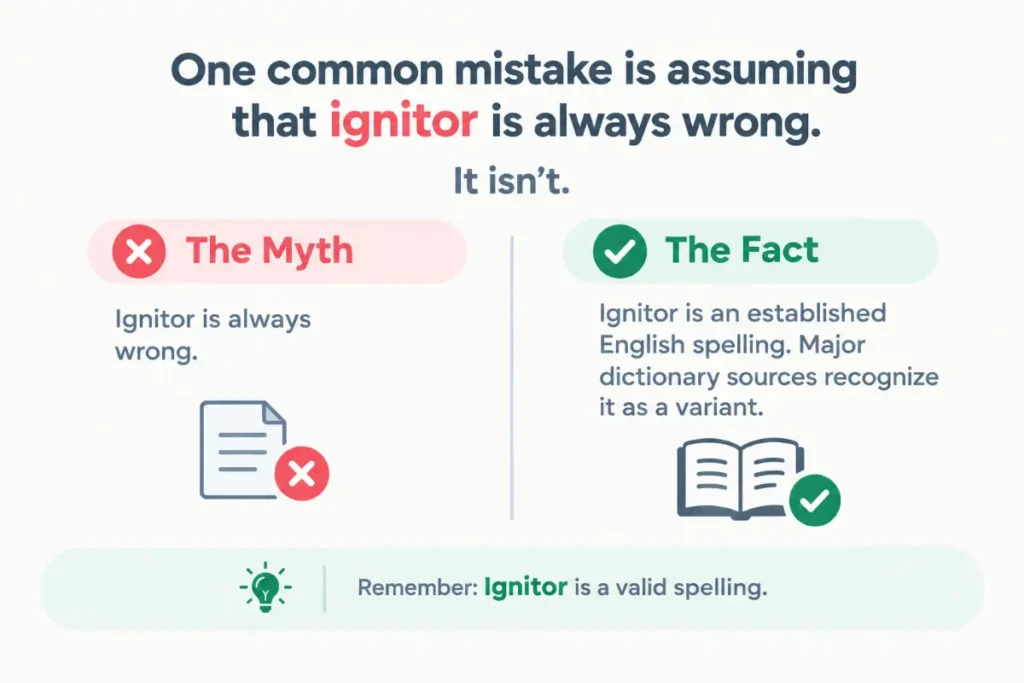
One common mistake is assuming that ignitor is always wrong.
It isn’t.
Ignitor is an established English spelling. Major dictionary sources recognize it as a variant.
Another mistake is assuming that the two forms have completely different meanings.
They generally don’t.
Another mistake is confusing igniter with ignition.
Igniter names the thing that causes ignition. Ignition names the act or process of starting combustion.
Another mistake is confusing igniter with lighter.
A lighter is a broader everyday term for a device that produces a flame. An igniter can refer specifically to a component designed to initiate combustion inside a machine or system.
Another mistake is changing technical terminology without checking the source.
Suppose a manufacturer calls a replacement part an ignitor. Rewriting the product name as igniter may make your article less precise.
Another mistake is treating spelling preference as a grammar rule.
This isn’t really a grammar problem. Both forms function as nouns. The main issue is spelling preference and terminology.
Memory Tips
If you want one simple spelling for American English, remember igniter.
Connect it with words such as starter and heater. These familiar words use the er ending to name something that performs a function.
You can also connect igniter directly with ignite.
Ignite is the action.
Igniter is the thing that performs the action.
Ignition is the process.
That three word relationship gives you a useful mental map.
For example:
The igniter ignites the fuel.
The ignition begins.
This pattern makes the roles easy to remember.
If you encounter ignitor in a technical manual, don’t panic. Treat it as a recognized variant rather than assuming you’ve discovered a typo.
Related Words And Usage Notes
Ignite is the central verb in this word family.
It means to set something on fire, cause something to burn, or begin burning. It can also have a figurative meaning. For example, a speech can ignite public interest. Collins lists both literal and figurative meanings for ignite.
Ignition is the noun connected with the process.
You might talk about an ignition system, an ignition switch, or the moment of ignition.
Ignitable is an adjective describing something that can be ignited.
For example:
The material is highly ignitable.
That sentence describes a property of the material.
Igniter is the noun for the person or thing that performs the ignition.
The word can appear in many technical settings.
You may encounter a furnace igniter, stove igniter, grill igniter, engine igniter, or rocket igniter.
The exact engineering design can vary dramatically, but the linguistic role stays consistent.
Is Igniter More Professional Than Ignitor
Not necessarily.
Igniter is generally the better default for new American English content, but professional quality doesn’t depend on choosing er simply because it looks more modern.
Professional writing depends on accuracy, consistency, audience awareness, and terminology.
If a company uses ignitor in its official documentation, following that terminology can be the more professional choice.
If you’re writing an independent article for American readers, igniter will usually feel more familiar.
The best professional habit is to choose deliberately instead of switching randomly between the two forms.
For example, don’t write one paragraph with igniter and another paragraph with ignitor unless you have a reason for the change.
Consistency makes technical writing easier to follow.
Is Igniter The Safer Choice For General Writing
Yes.
For most general American English content, igniter is the safer default.
It works well in educational writing, consumer content, repair articles, product explanations, and general technical material.
You can also use it when speaking to a broad audience that may not know specialized industry terminology.
That doesn’t make ignitor unusable.
It simply means that igniter is often the more straightforward choice when you have no specific terminology requirement to follow.
Think of it as choosing the familiar road when both roads reach the same destination.
When You Should Keep Ignitor
There are several situations where keeping ignitor makes sense.
First, preserve the spelling in an official product name.
Second, preserve it when you’re quoting a source.
Third, keep it when a technical standard or internal style guide requires it.
Fourth, maintain it when consistency with an existing manual or database matters.
Fifth, keep it when the spelling is part of a recognized industry term.
You don’t gain anything by changing an established technical label just to match your personal preference.
Good editing isn’t about changing every unfamiliar word. It’s about making the text accurate and useful.
Key Takeaways
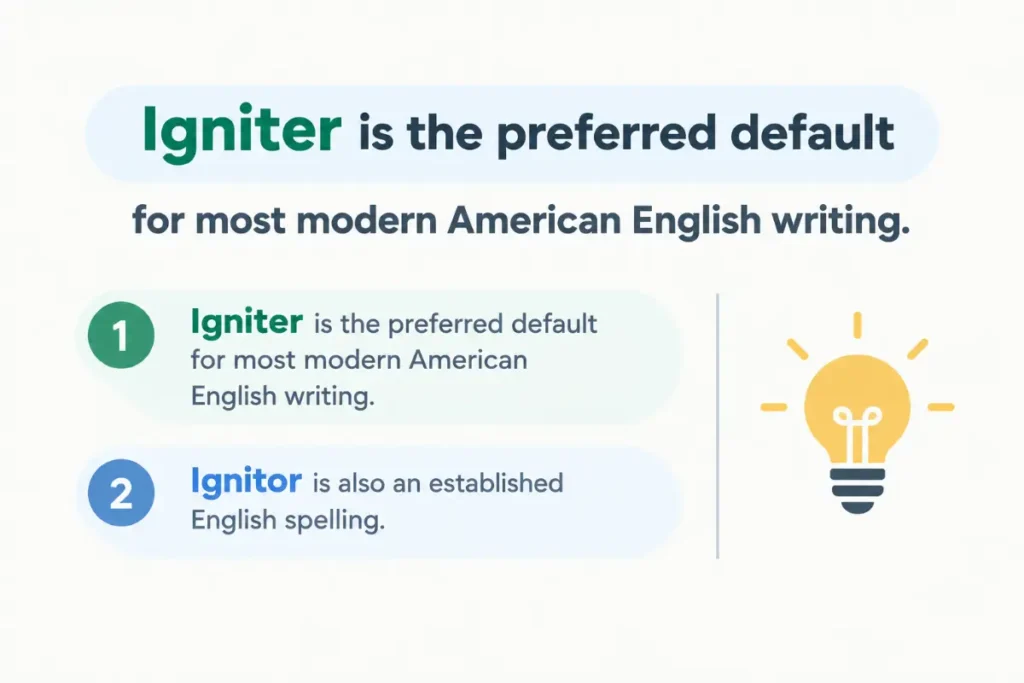
- Igniter is the preferred default for most modern American English writing.
- Ignitor is also an established English spelling.
- The two forms generally have the same basic meaning.
- Igniter is a noun that names something that causes ignition.
- Ignite is the related verb.
- Ignition names the process or act of starting combustion.
- The spelling difference doesn’t normally create a difference in meaning.
- Don’t automatically label ignitor as a spelling error.
- Follow official terminology when you’re writing about a specific product or technical system.
- For general US content, choose igniter and use it consistently.
Conclusion
Ignitor vs igniter is mostly a question of spelling preference rather than meaning. Both forms describe something that ignites or helps start combustion. Major dictionary sources recognize both forms, so calling ignitor simply wrong would be inaccurate.
For most American readers, igniter is the better default. It fits naturally into general writing and works well in educational articles, repair guides, consumer content, and many technical explanations. At the same time, ignitor still has a legitimate place when a manufacturer, industry, manual, or established source uses that form.
The simplest rule is this. Choose igniter for fresh general American English writing. Keep ignitor when a specific terminology choice calls for it. Once you understand that distinction, this spelling question becomes much easier to handle with confidence.
Frequently Asked Questions
Is ignitor vs igniter a spelling difference or a meaning difference?
It is mainly a spelling difference. Both forms can refer to something that ignites fuel or another combustible material. Dictionaries recognize both forms and treat ignitor as a variant of igniter.
Is igniter the correct spelling in American English?
Yes. Igniter is a strong standard choice for American English. Dictionary.com identifies it as an American noun and Collins lists it as a noun derived from ignite.
Is ignitor a wrong spelling?
No. Ignitor is an established variant. You may see it in technical writing, older material, product terminology, and other specialized contexts.
Which spelling should I use in a US article?
Use igniter as your default. It is clear, familiar, and appropriate for general American English writing.
Does igniter mean the same thing as ignition?
No. Igniter refers to a person, device, or substance that causes ignition. Ignition refers to the act or process of starting combustion.
Is an igniter a noun or a verb?
Igniter is a noun. Ignite is the related verb.
How do you pronounce igniter?
The common American pronunciation is represented as /ɪɡˈnaɪtər/. The stress falls on the second syllable.
How do you spell the plural of igniter?
The plural is igniters.
How do you spell the plural of ignitor?
The plural is ignitors.
Can I use ignitor in formal writing?
Yes. You can use it when it matches established terminology or a source you need to follow. For fresh general American English writing, igniter is usually the stronger default.
Are igniter and ignitor different in technical contexts?
They can refer to the same general type of component, but a particular manufacturer or industry may use one spelling as its preferred technical term. Always follow official terminology when identifying a specific product or component.
Should I change ignitor to igniter when editing?
Not automatically. First check the context. If the text is general American English content, changing it to igniter may improve consistency with common usage. If the spelling belongs to a product name, technical label, quotation, or established terminology, keep it.

Confusing Words, Spelling & Word Choice
Claire Whitmore is a U.S.-based English editor who writes about commonly confused words, spelling differences, and word choice. Her work helps readers understand subtle distinctions between similar-looking words through simple definitions, practical examples, and modern usage guidance in both American and British English.