
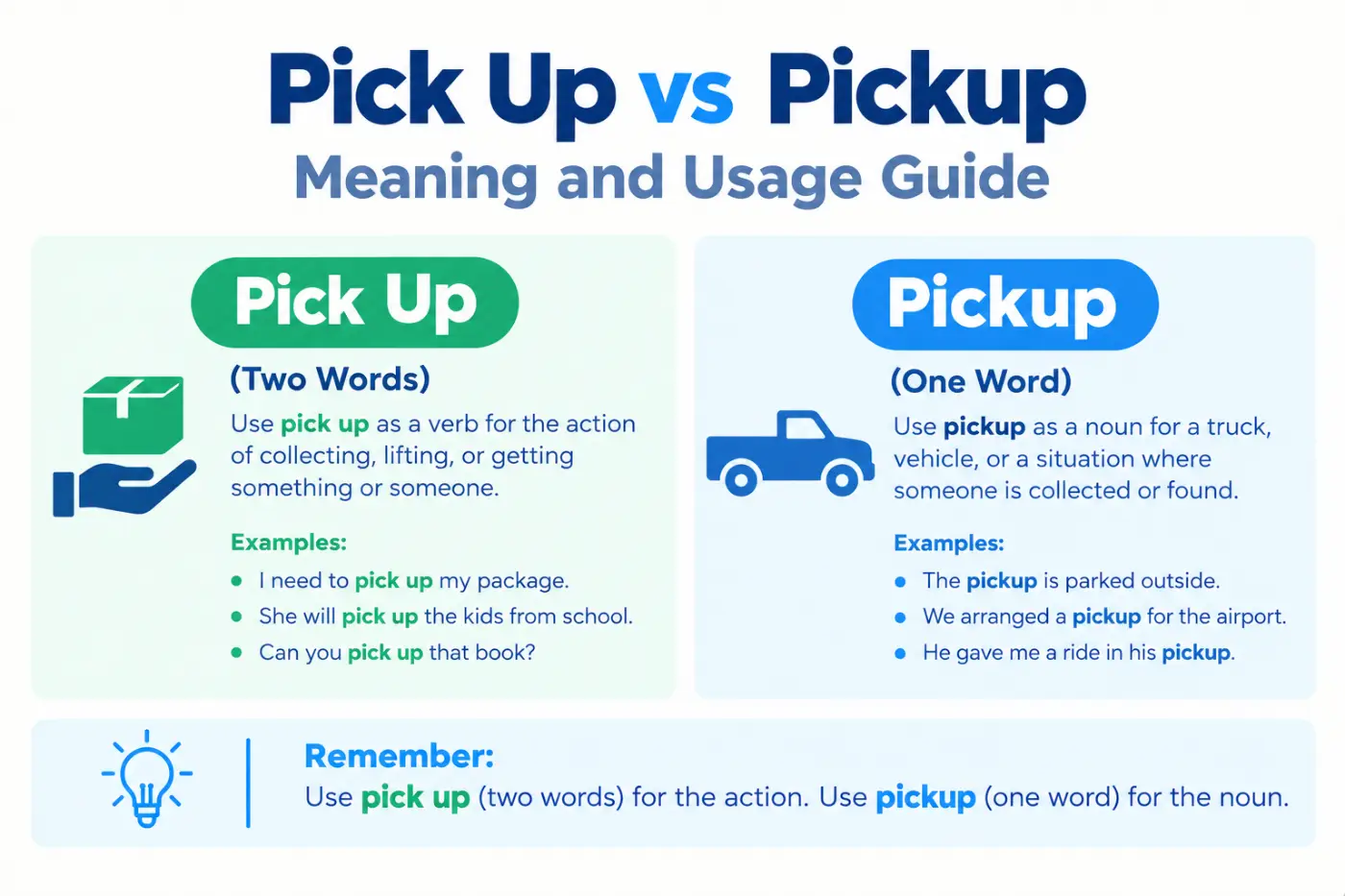
Pick up vs pickup can confuse even experienced English writers because the two forms look almost identical and share related meanings. The difference becomes simple once you identify the role each form plays in a sentence. Use pick up when someone performs an action and pickup when you name a thing, event, or instance of collection.
For example, you might say, “I will pick up my order at noon.” In this sentence, pick up describes what the speaker plans to do. You might also say, “The pickup is scheduled for noon.” Here, pickup names the scheduled collection. Both sentences are correct because each spelling serves a different grammatical purpose.
This distinction matters in everyday American English, especially in text messages, business emails, delivery instructions, online shopping, transportation, and workplace communication. Once you learn to recognize verbs and nouns, you can choose the right form quickly and write with greater confidence.
Short Answer
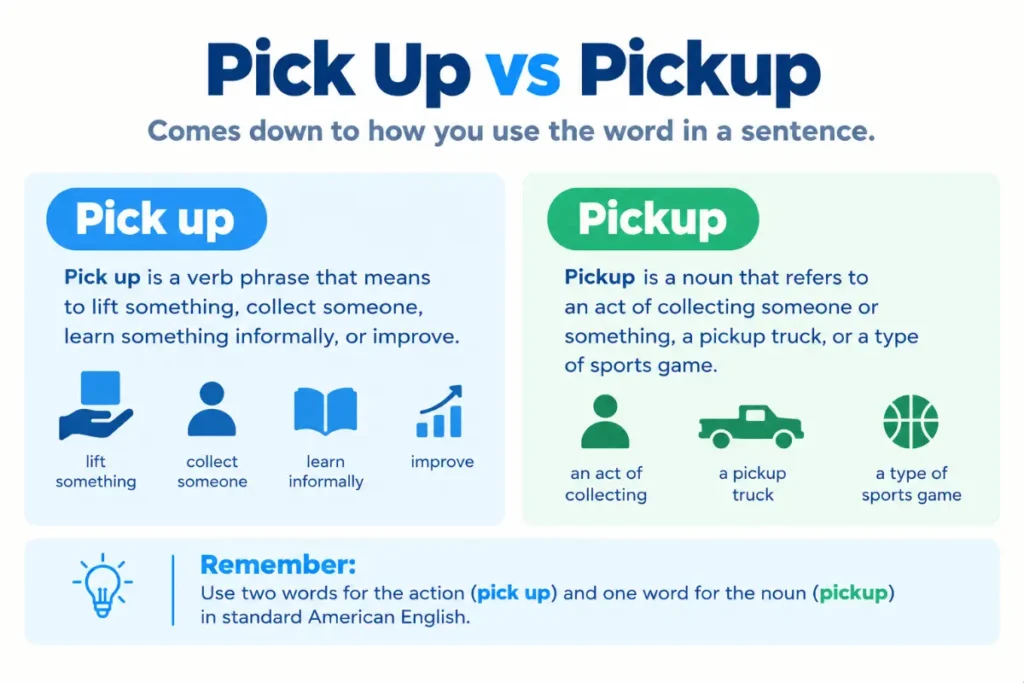
Pick up vs pickup comes down to how you use the word in a sentence. Pick up is a verb phrase that means to lift something, collect someone, learn something informally, or improve. Pickup is a noun that refers to an act of collecting someone or something, a pickup truck, or a type of sports game. Use two words for the action and one word for the noun in standard American English.
Table of Contents
- The Main Difference Between Pick Up and Pickup.
- What Pick Up Means.
- What Pickup Means.
- Grammar Rules for Pick Up and Pickup.
- Pick Up vs Pickup Comparison Table.
- Real Life Examples.
- Common Mistakes to Avoid.
- Easy Memory Tips.
- Related Words and Expressions.
- American and British English Usage.
- Professional Writing Tips.
- Frequently Asked Questions.
- Key Takeaways.
- Conclusion.
The Main Difference Between Pick Up and Pickup
The main difference is grammatical. Pick up functions as a verb phrase, while pickup generally functions as a noun or an adjective that describes another noun.
Consider these two examples.
- “Please pick up the package before 5 p.m.” The words pick up describe the action of collecting the package.
- “Package pickup closes at 5 p.m.” The word pickup identifies the collection service or process.
The meaning stays closely related, but the grammar changes. In the first sentence, the reader needs to know what action someone should perform. In the second, the reader needs to know what service or event the sentence describes.
You can apply the same distinction to transportation.
- “I will pick up my friend at the airport.” The speaker will collect the friend.
- “My friend needs an airport pickup.” The speaker is talking about the transportation arrangement.
In both examples, the context makes the meaning clear. The spelling tells the reader how the word functions in the sentence.
Why the Two Forms Look So Similar
English often turns verb phrases into nouns over time. Writers may use a familiar action as the name of an event, service, object, or activity. The spelling can change as the expression develops a separate grammatical role.
The verb phrase pick up describes actions such as lifting, collecting, learning, or improving. The noun pickup can name a collection, a transportation arrangement, a vehicle, or a particular type of informal game.
This pattern also appears in other English expressions. For example, set up is a verb phrase, while setup is a noun. Likewise, log in is a verb phrase, while login is commonly used as a noun or adjective in computing.
The key is to check the sentence rather than rely on how familiar a spelling looks.
What Pick Up Means
Pick up is a two word verb phrase with several common meanings. Its exact meaning depends on the situation, but it usually describes an action or a change.
1. To Lift Something
The most literal meaning of pick up is to lift something from a surface or the ground.
Examples.
- “Please pick up your keys.” The speaker asks someone to lift the keys and take them.
- “She picked up the book from the floor.” The sentence describes the physical action of lifting the book.
- “He bent down to pick up the coin.” The phrase explains what he did after bending down.
In each example, pick up describes an action performed by a person.
2. To Collect Someone or Something
In American English, pick up often means to collect a person from a location or retrieve an item.
Examples.
- “I need to pick up my daughter from school.” The speaker plans to collect a child and bring her away from school.
- “Can you pick up my prescription?” The speaker asks someone to collect medication on their behalf.
- “We will pick up the groceries after work.” The sentence describes a planned shopping collection.
This meaning appears frequently in everyday conversation. You might use it when arranging rides, collecting takeout, retrieving packages, or running errands.
3. To Learn Something Informally
Pick up can also mean to learn a skill or acquire knowledge through practice and experience rather than formal instruction.
Examples.
- “He picked up Spanish while living in Miami.” He learned some Spanish through exposure and everyday use.
- “Children often pick up new words quickly.” The sentence describes how children acquire vocabulary.
- “I picked up a few cooking tips from my grandmother.” The speaker learned practical skills through observation or conversation.
This meaning often suggests that learning happened naturally. The person may not have followed a formal course or studied a textbook.
4. To Improve or Become Stronger
When a situation improves in speed, activity, strength, or intensity, English speakers often use pick up.
Examples.
- “Business started to pick up in the spring.” The company experienced more activity or sales.
- “The wind picked up during the afternoon.” The wind became stronger.
- “Traffic usually picks up around 5 p.m.” More vehicles begin using the roads during that time.
Here, pick up describes a change. It does not mean lifting or collecting anything.
5. To Answer a Phone Call
In casual American English, pick up can mean answering a ringing phone.
Examples.
- “Please pick up the phone.” The speaker wants someone to answer the call.
- “She did not pick up when I called.” The person did not answer the phone.
- “He picked up after the third ring.” The person answered the call after the phone rang three times.
This usage is common in conversations about missed calls and everyday communication.
6. To Buy or Get Something Along the Way
The phrase can also describe buying or obtaining something during a trip or another activity.
Examples.
- “I will pick up some milk on my way home.” The speaker plans to buy milk during the trip home.
- “She picked up a sandwich before the meeting.” She bought or obtained food before attending the meeting.
- “Can you pick up a birthday card for Mom?” The speaker asks someone to purchase a card.
The phrase often implies that the purchase is one task among several.
7. To Resume an Activity
Pick up can mean returning to something after a pause or continuing from a previous point.
Examples.
- “We will pick up the discussion tomorrow.” The group will continue the discussion the next day.
- “She picked up where she left off.” She resumed an activity at the point where she stopped.
- “Let us pick up the story after lunch.” The speaker suggests continuing the story later.
This use works well in meetings, classes, conversations, and creative work.
8. To Establish Contact With Someone
In informal conversation, pick someone up can mean attracting a romantic or sexual partner or approaching someone to start a conversation with that goal.
Example.
“He tried to pick someone up at the bar.”
The sentence suggests that he tried to meet someone for romantic or sexual interest. This meaning differs from collecting a person from a location, so context matters.
What Pickup Means
Pickup is generally a noun. It names a thing, event, arrangement, or type of activity rather than expressing the action itself.
1. A Collection or Transportation Arrangement
One common meaning is the act or arrangement of collecting a person or item.
Examples.
- “The package pickup is scheduled for Tuesday.” The sentence identifies a planned collection.
- “Your pickup is ready at the front desk.” The sentence refers to an item or order waiting to be collected.
- “We arranged a pickup from the airport.” The sentence describes a transportation arrangement.
In these examples, pickup names the event or service. It does not tell someone to perform the action.
2. A Pickup Truck
In the United States, pickup commonly refers to a pickup truck. This is a motor vehicle with an enclosed passenger cabin and an open cargo bed.
Examples.
- “My neighbor drives a red pickup.” The noun identifies a type of vehicle.
- “They bought a used pickup last weekend.” The sentence describes the purchase of a truck.
- “The pickup has enough room for the tools.” The sentence refers to the vehicle’s cargo capacity.
American speakers sometimes shorten pickup truck to pickup. The meaning remains clear in a vehicle related context.
3. A Casual Sports Game
A pickup game is an informal game arranged by players without the full organization of a formal league or scheduled competition.
Examples.
- “We played a pickup basketball game after work.” The group played basketball informally.
- “The park hosts pickup soccer on weekends.” The sentence refers to casual soccer games at the park.
- “He joined a pickup game with some neighbors.” The player joined an informal game.
In this usage, pickup acts as an adjective that describes the kind of game. It still uses the one word spelling.
4. An Increase in Activity
The noun pickup can name an increase in activity, demand, speed, or strength.
Examples.
- “The store reported a pickup in holiday sales.” The sentence describes an increase in sales.
- “There was a noticeable pickup in wind speed.” The noun identifies an increase in the wind’s strength.
- “The company expects a pickup in demand next quarter.” The sentence refers to an anticipated rise in customer demand.
This use often appears in business reports, news writing, and discussions of economic activity.
5. A Musical Device
In music, a pickup can refer to a device that converts string vibrations into an electrical signal. Electric guitars commonly use pickups for this purpose.
Example.
“The guitarist replaced the pickup in his electric guitar.”
The noun identifies a component of the instrument. This technical meaning has no connection to collecting a person or lifting an object.
6. A Brief Introduction or Romantic Encounter
The noun pickup also appears in expressions such as pickup line. A pickup line is a remark intended to start a romantic or flirtatious conversation.
Example.
“He used a funny pickup line to start a conversation.”
The word names a type of remark rather than the act of approaching someone.
Grammar Rules for Pick Up and Pickup
The easiest way to choose the correct form is to identify the grammatical job the word performs.
Rule One for Actions
Use pick up when the expression functions as a verb.
Examples.
- “Please pick up the documents.” The phrase expresses an instruction.
- “I pick up my coffee every morning.” The phrase describes a repeated action.
- “They picked up the equipment yesterday.” The phrase describes an action completed in the past.
Notice that the verb changes tense, but the two word spelling stays the same.
Rule Two for Nouns
Use pickup when the word names an event, arrangement, object, or increase.
Examples.
- “The pickup takes place at noon.” The noun identifies a scheduled collection.
- “Our pickup arrived early.” The noun refers to a truck or collection vehicle depending on the context.
- “There was a pickup in customer interest.” The noun describes an increase.
A useful test is to place the, a, or your before the word. If the sentence works naturally with a noun, pickup may be the correct form.
For example, “The pickup is delayed” uses a noun. By contrast, “Please pick up the order” uses a verb phrase.
Rule Three for Phrasal Verbs
Pick up is a phrasal verb. It combines the verb pick with the particle up to create meanings that go beyond the individual words.
Some phrasal verbs allow an object between the verb and the particle.
Both of these sentences are correct.
- “Pick up the bag.”
- “Pick the bag up.”
The object the bag can appear after up or between pick and up.
However, when the object is a personal pronoun, you normally place it between the two parts.
- “Pick it up.”
- “Pick them up.”
- “Pick her up.”
In standard usage, avoid “Pick up it” or “Pick up them” when the pronoun is the object of this phrasal verb.
Rule Four for Adjectives
Use pickup as one word when it describes a noun in established compounds such as pickup truck, pickup game, and pickup line.
Examples.
- “They bought a pickup truck.” The word describes the type of truck.
- “We joined a pickup game.” The word describes the informal nature of the game.
- “She laughed at his pickup line.” The word identifies the type of line.
English compounds can vary in spelling, so a dictionary is useful when a less familiar expression appears in professional writing.
Rule Five for Verb Tenses
The spelling pick up stays separate across common verb tenses.
| Tense | Correct example |
|---|---|
| Present | I pick up the mail. |
| Present continuous | I am picking up the mail. |
| Simple past | I picked up the mail. |
| Present perfect | I have picked up the mail. |
| Future | I will pick up the mail. |
| Infinitive | I need to pick up the mail. |
The phrase remains two words because it still functions as a verb.
The noun pickup does not change to show verb tense because nouns do not carry tense in the same way.
Pick Up vs Pickup Comparison Table
The following table summarizes the most useful differences between the two forms.
| Feature | Pick up | Pickup |
|---|---|---|
| Main grammatical role | Verb phrase | Noun |
| Main purpose | Describes an action | Names a thing or event |
| Collection example | I will pick up the package. | The package pickup is tomorrow. |
| Transportation example | She will pick up her friend. | Her friend needs a pickup. |
| Vehicle example | He will pick up the truck later. | He owns a pickup. |
| Increase example | Sales began to pick up. | There was a pickup in sales. |
| Informal sports example | We will pick up a game later. | We joined a pickup game. |
| Standard spelling | Two words | One word |
The most important distinction is the grammatical role. If the sentence describes someone doing something, use the verb phrase. If it names an event, object, or type of activity, use the noun or compound form.
Real Life Examples
Everyday situations make the spelling difference easier to remember. These examples show how both forms work in natural American English.
At a Restaurant
- “I will pick up our takeout order at 6 p.m.” The speaker will collect the food at the stated time.
- “Our takeout pickup is scheduled for 6 p.m.” The sentence identifies the collection arrangement.
The first sentence describes an action. The second names an event or arrangement.
At Work
- “Please pick up the printed reports before the meeting.” The sentence gives someone an instruction to collect the reports.
- “The report pickup is scheduled for the afternoon.” The sentence identifies the planned collection.
Both forms suit workplace communication. Choose the form that matches the sentence’s meaning.
While Driving
- “I need to pick up my coworker at the station.” The speaker plans to collect a person.
- “My coworker needs a pickup from the station.” The sentence describes the transportation need.
The difference is small on the page but clear in grammar.
In Business Reports
- “Sales began to pick up after the new product launched.” The sentence describes an increase in sales activity.
- “The company saw a pickup in sales after the new product launched.” The noun identifies that increase.
Both sentences communicate a similar idea. The first emphasizes the change as an action or development, while the second presents the increase as a noun.
In Sports
- “We plan to pick up a basketball game after dinner.” The group plans to arrange or start an informal game.
- “We plan to join a pickup basketball game after dinner.” The sentence describes the type of game the group intends to join.
The second example uses pickup to modify basketball game.
In Everyday Conversation
- “I picked up a few new phrases during my trip.” The speaker learned expressions informally.
- “There was a pickup in tourist activity during the summer.” The sentence describes an increase in activity.
The context determines the meaning. In the first example, picked up describes learning. In the second, pickup names an increase.
Common Mistakes to Avoid
Even when you understand the basic rule, a few common mistakes can slip into emails, assignments, and everyday writing.
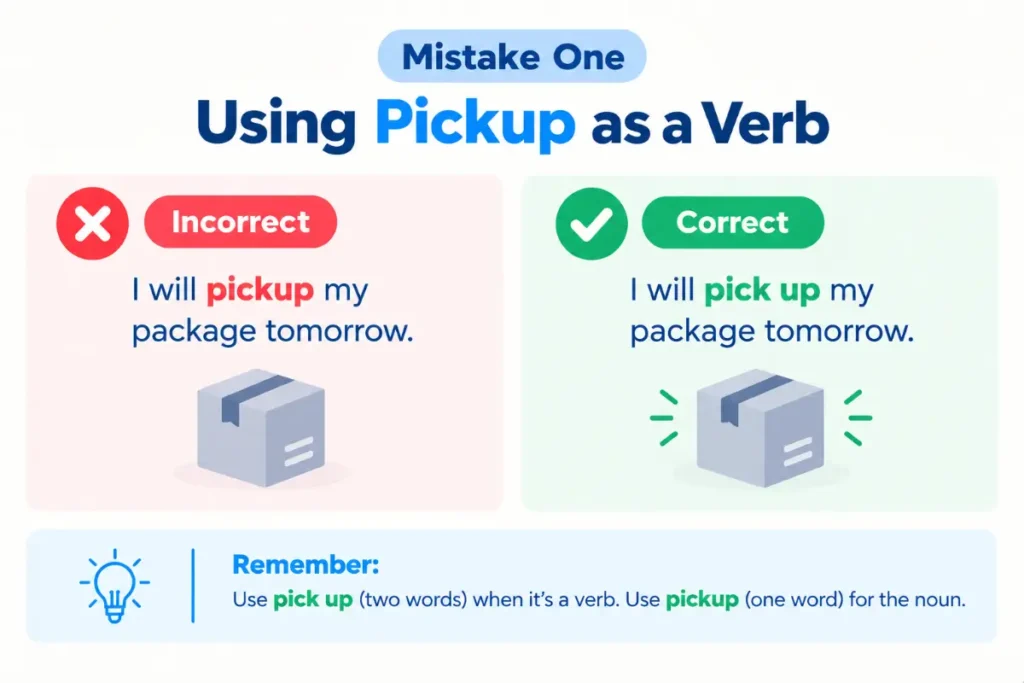
Mistake One Using Pickup as a Verb
Incorrect: “I will pickup my package tomorrow.”
Correct: “I will pick up my package tomorrow.”
The sentence describes an action, so the verb phrase needs two words.
Mistake Two Using Pick Up as a Noun
Incorrect: “Your pick up is ready at the counter.”
Correct: “Your pickup is ready at the counter.”
The sentence names an order collection. Use the one word noun.
Mistake Three Confusing a Pickup With Picking Something Up
Incorrect: “The driver will pickup the passengers at noon.”
Correct: “The driver will pick up the passengers at noon.”
The driver performs an action, so the phrase stays separate.
However, this sentence is correct: “The passenger pickup is at noon.” Here, pickup identifies the scheduled collection.
Mistake Four Using the Wrong Form in Compound Words
Incorrect: “He bought a pick up truck.”
Correct: “He bought a pickup truck.”
In standard American English, pickup truck is written as two words for the complete compound, with pickup itself written as one word.
Mistake Five Placing Pronouns Incorrectly
Incorrect: “Please pick up it.”
Correct: “Please pick it up.”
When a personal pronoun serves as the object of this phrasal verb, place it between pick and up.
Mistake Six Adding a Hyphen Without a Reason
In standard American usage, write pick up for the verb phrase and pickup for the noun. Do not add a hyphen to either form in ordinary sentences.
For example, write “I will pick up the order” and “The pickup is delayed.”
Some style guides handle compound expressions differently, so follow the relevant house style for specialized publications. For everyday American writing, the two standard forms are sufficient.
Easy Memory Tips
You do not need to memorize every definition to choose the correct spelling. A few simple checks can help you make the right decision.
Think of an Action
If someone is doing something, write pick up.
- Pick up the phone.
- Pick up the groceries.
- Pick up your friend.
- Pick up a new skill.
Each sentence describes an action. The two word spelling is correct.
Think of a Thing or Event
If you are naming something, write pickup.
- The pickup is delayed.
- The store offers curbside pickup.
- He drives a pickup.
- We joined a pickup game.
Each sentence uses the word as a noun or as part of a noun phrase.
Try the Article Test
Place the or a before the word.
“The pickup is late” sounds natural because pickup is a noun. “The pick up is late” does not fit standard spelling for that meaning.
Now try an instruction: “Please pick up the box.” The words describe an action, so the separate spelling works.
Replace the Phrase With a Simple Verb
Try replacing pick up with a single verb such as collect, lift, learn, or answer.
- “Pick up the package” becomes “Collect the package.”
- “Pick up the coin” becomes “Lift the coin.”
- “Pick up some Italian” becomes “Learn some Italian.”
- “Pick up the phone” becomes “Answer the phone.”
If the replacement preserves the intended meaning, you are likely using the verb phrase. This test is a guide rather than an absolute rule because pick up has several meanings.
Related Words and Expressions
Understanding similar word pairs can strengthen your spelling and grammar skills. English often combines verbs and particles to create phrasal verbs, then uses related forms as nouns.
Set Up vs Setup
Set up is a verb phrase. Setup is a noun.
- “We need to set up the equipment.” The sentence describes an action.
- “The setup took an hour.” The noun names the arrangement or preparation.
This pair follows the same basic pattern as pick up and pickup.
Log In vs Login
Log in is a verb phrase used when someone accesses an account or system. Login commonly appears as a noun or adjective.
- “Please log in to your account.” The sentence describes an action.
- “I forgot my login details.” The noun refers to information used to access an account.
Usage can vary by organization and style guide, especially in technical writing.
Check In vs Check In as a Noun
The verb phrase check in describes registering or reporting arrival.
- “We need to check in at the hotel.” The sentence describes an action.
- “Hotel check in begins at 3 p.m.” The noun identifies a process or event.
The noun is often written as check in in general usage, though check in and check in process may be styled differently by particular organizations. Some compounds use a closed or hyphenated form depending on the dictionary and context.
Takeout vs Take Out
Take out is a verb phrase. Takeout is a noun or adjective in American English.
- “We will take out the trash.” The phrase describes an action.
- “We ordered takeout for dinner.” The noun refers to prepared food bought from a restaurant to eat elsewhere.
This pair is especially useful because it appears in the same restaurant context as food pickup.
Backup vs Back Up
Back up is a verb phrase that can mean to make a copy of data or move backward. Backup is a noun or adjective.
- “Please back up your files.” The sentence describes an action.
- “Keep a backup of your files.” The noun names a copy.
The grammatical role helps determine the spelling in all these pairs.
American and British English Usage
The basic distinction between the verb phrase and the noun remains useful in both American and British English. However, some related expressions and preferences can vary by region.
In American English, pickup is common in expressions such as pickup truck, curbside pickup, and pickup game. Americans also regularly use pick up to mean collecting a person or order.
British English also uses pick up as a verb phrase. For the noun referring to the collection of goods or passengers, British writers may use pick up in some contexts or prefer other expressions such as collection. The best choice depends on the publication and the intended meaning.
For American audiences, these examples are natural.
- “I will pick up the groceries after work.”
- “The store offers curbside pickup.”
- “He drives a pickup truck.”
- “We played a pickup basketball game.”
If you are writing for a US audience, these standard spellings will work well in most everyday and professional contexts.
Professional Writing Tips
Correct spelling makes instructions easier to follow. It also helps prevent confusion in schedules, order confirmations, workplace messages, and customer service communication.
Write Clear Collection Instructions
When writing a delivery or collection message, use the verb phrase to tell the reader what to do.
Example.
“Please pick up your order at the front desk before 5 p.m.”
The instruction clearly identifies the action and the deadline.
Use the Noun for Scheduled Events
When describing the event itself, use the noun.
Example.
“Your order pickup is scheduled for Friday afternoon.”
This wording identifies the collection arrangement rather than instructing someone to collect the order.
Check Compound Terms
Business writing often includes established compounds such as pickup location, pickup time, and pickup truck. Keep the spelling consistent throughout the document.
For example, “Please confirm your pickup time” uses pickup as a noun modifying time. The wording is concise and appropriate for a customer notification.
Edit for Grammar Rather Than Sound
Both forms sound the same in ordinary speech. You cannot reliably distinguish them by pronunciation alone. Instead, look at the word’s function.
Read the sentence and ask yourself one question. Am I describing an action or naming something?
That quick check will resolve most spelling doubts.
Key Takeaways
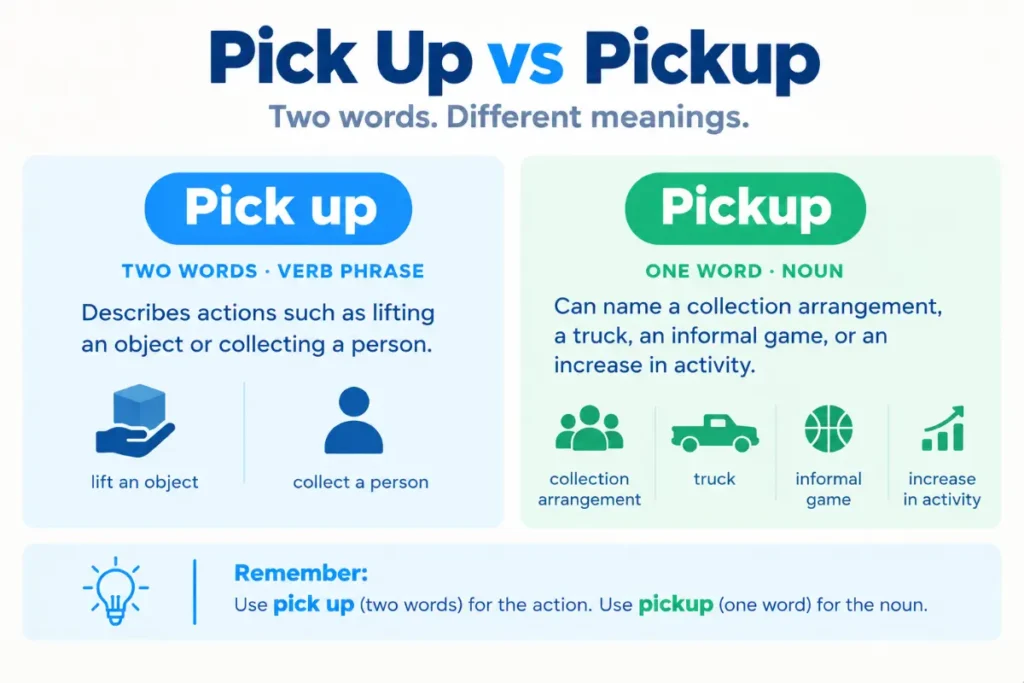
- Pick up is a two word verb phrase that describes actions such as lifting an object or collecting a person.
- Pickup is a one word noun that can name a collection arrangement, a truck, an informal game, or an increase in activity.
- Use pick up in instructions such as “Pick up your order.”
- Use pickup in expressions such as “Your order pickup is ready.”
- Both forms usually sound the same, so grammar determines the correct spelling.
- In standard American English, write pickup truck, pickup game, and curbside pickup without a hyphen.
- When using a personal pronoun as the object, write “Pick it up” rather than “Pick up it.”
Conclusion
Pick up vs pickup becomes easy to understand once you focus on grammar rather than pronunciation. Use pick up when you describe an action such as lifting a bag, collecting a friend, answering a phone, or learning a new skill. Use pickup when you name a collection arrangement, a vehicle, a casual game, or an increase in activity.
The simplest way to remember the distinction is to check the word’s role in the sentence. If someone needs to do something, the two word verb phrase is usually correct. If you are naming an event or object, the one word form is often the right choice.
With this rule in mind, you can write clearer emails, more accurate delivery instructions, and natural American English sentences. A quick grammar check is all you need to choose the correct spelling with confidence.
Frequently Asked Questions
1. Is pick up vs pickup the main difference between a verb and a noun?
Yes. In standard American English, pick up is a verb phrase that describes an action, while pickup is generally a noun or an adjective in a compound. For example, “I will pick up the order” describes an action, while “The order pickup is ready” names a collection arrangement.
2. Is pickup one word or two words?
Pickup is one word when it functions as a noun or appears in compounds such as pickup truck and pickup game. Use two words when it functions as a verb phrase, as in “Please pick up the package.”
3. Is pick up one word when used as a verb?
No. Write pick up as two words when it describes an action. For example, “I need to pick up my prescription” uses the correct spelling because the phrase functions as a verb.
4. Is pickup truck one word or two words?
Pickup truck is written as two words in standard American English. Within that compound, pickup is one word and truck is the second word.
5. Is it pickup order or pick up order?
Use pickup order when you mean an order arranged for collection. For example, “Your pickup order is ready.” Use pick up the order when describing the action, as in “I will pick up the order after work.”
6. Is it curbside pickup or curbside pick up?
In standard American English, curbside pickup is the usual spelling. It names a service that lets customers collect purchases from a designated location outside a store.
7. Is pickup hyphenated?
In standard American usage, pickup is one word as a noun and pick up is two words as a verb phrase. Neither form normally requires a hyphen in everyday writing.
8. Do pick up and pickup sound the same?
Yes. They usually have the same pronunciation in American English. Since sound alone does not reveal the correct spelling, use the sentence’s grammar to decide.
9. Can pickup mean an increase in sales?
Yes. The noun pickup can describe an increase in sales or activity. For example, “The store saw a pickup in sales” means sales increased.
10. Can pick up mean learning a language?
Yes. Pick up can mean learning something informally through exposure or experience. For example, “She picked up some French during her trip” means she learned some French while traveling.
11. Is pickup formal enough for business writing?
Yes. Pickup is standard American English and works well in business writing. Expressions such as pickup time, pickup location, and curbside pickup are common in customer instructions and service communications.
12. How can I remember the correct spelling?
Think of the grammatical role. Use pick up for an action and pickup for a thing or event. For example, “Pick up the package” gives an instruction, while “The package pickup is delayed” names the collection event.

Confusing Words, Spelling & Word Choice
Claire Whitmore is a U.S.-based English editor who writes about commonly confused words, spelling differences, and word choice. Her work helps readers understand subtle distinctions between similar-looking words through simple definitions, practical examples, and modern usage guidance in both American and British English.