
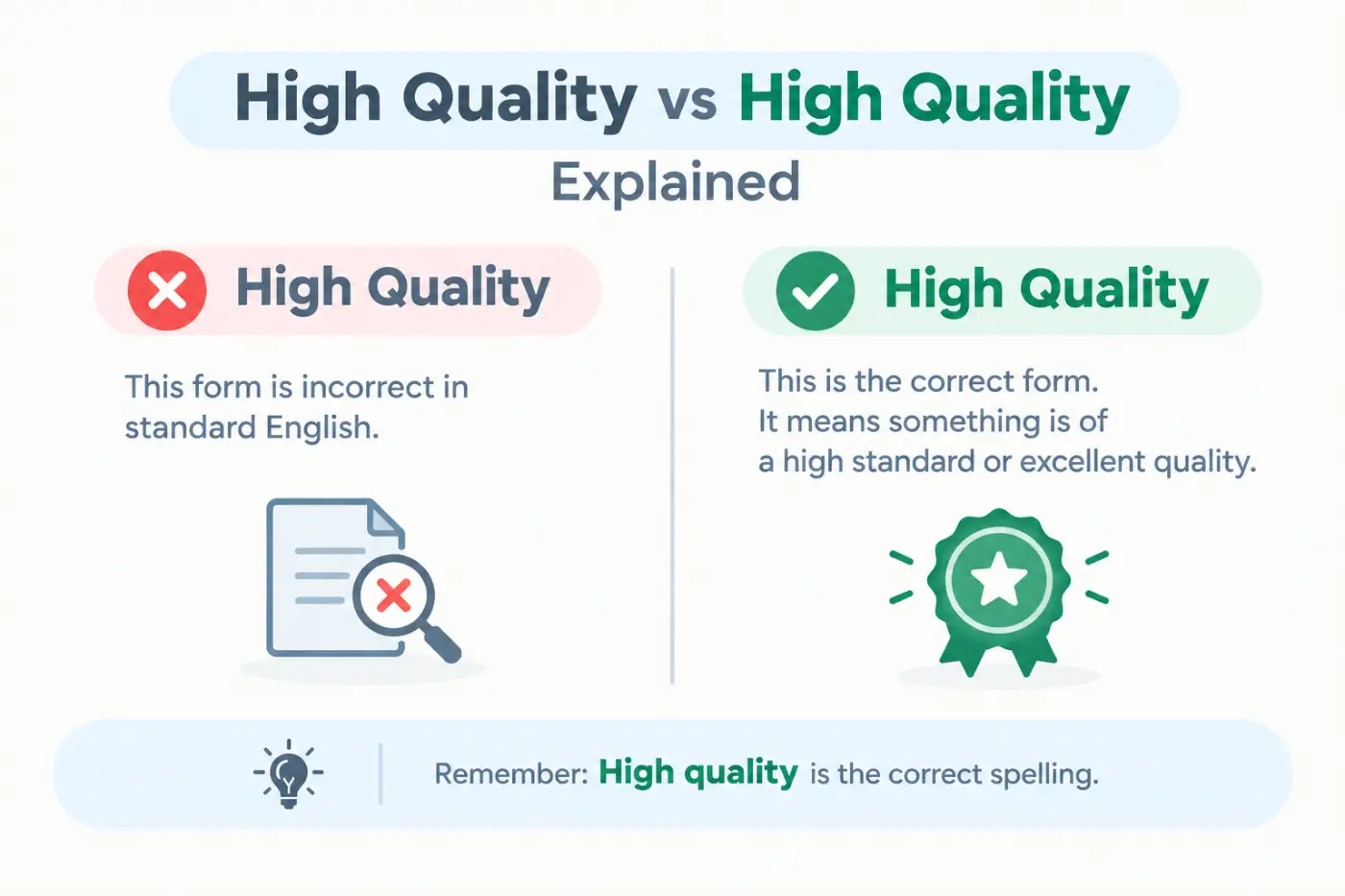
The question of high quality vs high-quality usually comes down to one simple grammar point. The words have the same meaning but they do different jobs in a sentence. The form without a hyphen works as a noun phrase. The hyphenated form works as a compound adjective before a noun.
This distinction matters because English uses hyphens to connect words that work together to modify another word. A phrase such as high-quality service makes it clear that high and quality form one descriptive unit. In a sentence such as The service is high quality the phrase comes after the linking verb and does not need that connection.
Many writers hesitate because both forms look natural. That confusion is understandable. English compound modifiers can be tricky because the need for a hyphen often depends on the position of the phrase in the sentence. Once you identify the grammatical role of the phrase you can choose the correct form quickly.
Short Answer
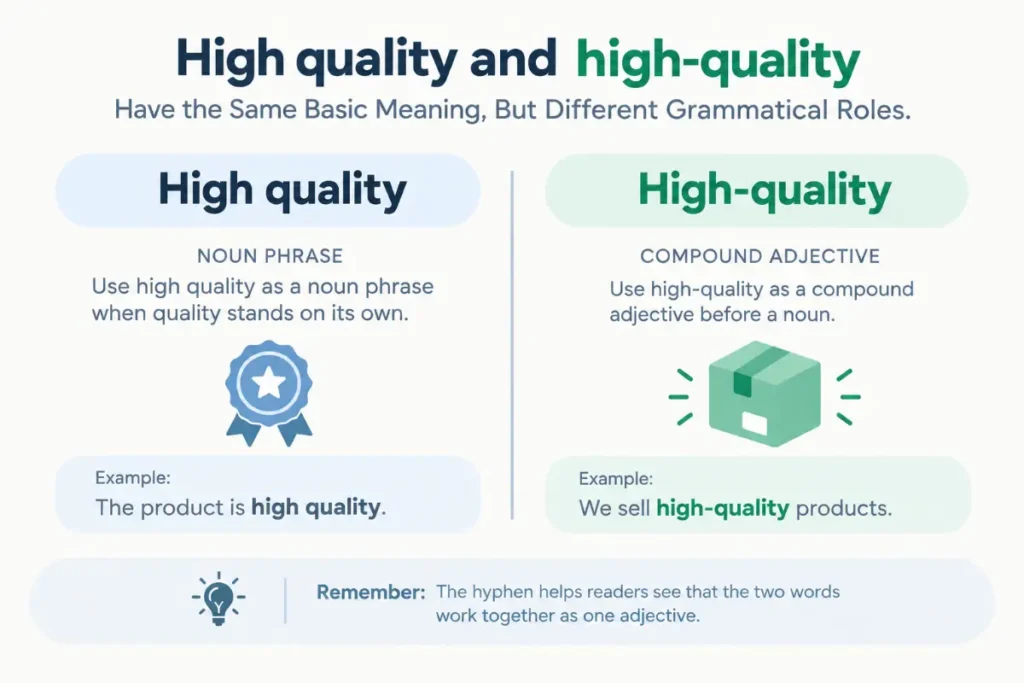
High quality and high-quality have the same basic meaning but different grammatical roles. Use high quality as a noun phrase when quality stands on its own. Use high-quality as a compound adjective before a noun. For example, The product is high quality. You can also write, We sell high-quality products. The hyphen helps readers see that the two words work together as one adjective.
Table of Contents
- The basic difference.
- When to use high quality.
- When to use high-quality.
- Why the hyphen matters.
- High quality after linking verbs.
- High-quality before nouns.
- High quality vs high-quality in professional writing.
- Examples in everyday English.
- Common mistakes.
- Similar expressions.
- American English usage.
- Pronunciation and meaning.
- Memory tips.
- Grammar notes about compound adjectives.
- Frequently asked questions.
- Key takeaways.
- Conclusion.
The Basic Difference
The easiest way to understand high quality vs high-quality is to look at the word that follows the phrase.
Use high quality when the phrase functions as a noun phrase or appears after a linking verb.
Example.
The restaurant serves food of high quality.
The food is high quality.
In both sentences the phrase describes the standard or level of the food. It does not directly sit before a noun as a combined modifier.
Use high-quality when the phrase comes directly before a noun and acts as one adjective.
Example.
The restaurant serves high-quality food.
Here high-quality describes food. The two words work together as a single modifier. The hyphen shows that connection.
The difference is grammatical rather than semantic. Both forms communicate the idea of excellent or superior quality. The sentence structure determines the correct form.
When To Use High Quality
Use high quality when quality functions as a noun.
The phrase often appears after verbs such as be, seem, remain, become, look, and feel. These verbs can connect the subject with a description.
Consider these examples.
The fabric is high quality.
The phrase high quality describes the fabric after the linking verb is.
The furniture looks high quality.
Here the phrase describes the furniture after looks.
The materials seem high quality.
The phrase describes the materials after seem.
You can also use high quality after a noun with a preposition.
We need products of high quality.
She produces work of high quality.
They are known for their high quality.
In these examples quality remains a noun. The surrounding grammar makes the role clear.
The form can also appear when quality is the main subject of discussion.
The high quality of the materials impressed the buyer.
In this sentence high quality is a noun phrase. It is followed by of the materials which explains what has the high quality.
Another useful pattern is in phrases such as quality of life.
The phrase quality of life does not need a hyphen because quality and life are not functioning as one adjective before another noun.
The quality of the service has improved.
Here quality is clearly a noun.
When To Use High Quality
Use high-quality when the phrase directly modifies a noun.
Examples include high-quality products, high-quality materials, high-quality content, high-quality services, high-quality education, and high-quality images.
The hyphen joins high and quality into one compound modifier.
Look at this sentence.
We bought high-quality furniture.
Without the hyphen the reader can still understand the meaning. However, standard edited English uses the hyphen because high and quality work together to describe furniture.
The same pattern appears in many professional expressions.
The company provides high-quality training.
She submitted a high-quality report.
The website contains high-quality information.
The photographer delivered high-quality images.
The store sells high-quality clothing.
The manufacturer uses high-quality materials.
The hyphenated form is especially useful in headings and marketing copy because it keeps the grammatical relationship clear.
Why The Hyphen Matters
A hyphen can connect two or more words that function together as a compound modifier.
Consider the phrase high-quality product.
High modifies quality.
Together they describe product.
The reader sees the phrase as one descriptive unit.
Without the hyphen the words high and quality may still be understood correctly. Yet formal writing benefits from showing the relationship clearly.
Compare these structures.
The product is high quality.
This product is high-quality.
The first sentence uses high quality as a complement after is.
The second uses high-quality directly before product.
This principle applies to many similar expressions.
The company offers long-term support.
The support is long term.
The team developed a user-friendly design.
The design is user friendly.
They provide cost-effective solutions.
The solutions are cost effective.
Compound adjectives often lose the hyphen when they appear after a linking verb. That pattern is not absolute in every style guide or expression but it provides a reliable rule for ordinary writing.
High Quality After Linking Verbs
A linking verb connects the subject with information that describes or identifies it.
Common linking verbs include be, seem, become, appear, look, feel, remain, and stay.
When high quality follows one of these verbs as a subject complement you normally leave the phrase open.
Examples.
The camera is high quality.
The camera looks high quality.
The video appears high quality.
The service remains high quality.
The final result feels high quality.
The material seems high quality.
In each example high quality comes after the verb. It describes the subject rather than directly modifying a following noun.
This distinction makes editing much easier.
Ask yourself one question. Is the phrase directly before the noun it describes?
If the answer is yes, use high-quality.
If the phrase comes after a linking verb, high quality is normally the better choice.
High Quality Before Nouns
When the phrase comes immediately before a noun it usually acts as a compound adjective.
Examples.
High-quality content attracts readers.
High-quality ingredients can improve a recipe.
The noun does not have to appear immediately after the compound adjective in every possible sentence. The important point is that the phrase functions together as a modifier.
You can also use high-quality after determiners and possessives.
A high-quality product can cost more.
This high-quality material feels durable.
Our high-quality service attracts repeat customers.
Her high-quality work earned praise.
The hyphen remains because high-quality still works as one modifier.
High Quality Vs High-Quality In Professional Writing
Professional writing often uses both forms.
The correct choice depends on sentence structure rather than personal preference.
Consider a product description.
Our company sells high-quality office furniture.
Here high-quality modifies office furniture.
Now change the sentence.
Our office furniture is high quality.
Here high quality follows the linking verb is.
Both sentences are correct.
The same principle works in business communication.
The company provides high-quality training.
The training is high quality.
The agency creates high-quality content.
The content is high quality.
The manufacturer produces high-quality components.
The components are high quality.
The consultant delivers high-quality advice.
The advice is high quality.
Using the right form gives professional writing a polished feel. It also prevents unnecessary ambiguity.
Real Life Examples
The difference becomes easier to remember when you see it in ordinary situations.
Products
This store sells high-quality shoes.
The shoes are high quality.
The first sentence places the compound adjective before shoes. The second uses the phrase after are.
Food
We bought high-quality coffee.
The coffee is high quality.
The first sentence describes coffee directly. The second describes the coffee after a linking verb.
Education
The school offers high-quality instruction.
The instruction is high quality.
The grammar changes because the phrase changes position.
Technology
She bought a high-quality laptop.
The laptop is high quality.
Again the noun comes after the hyphenated modifier in the first sentence.
Writing
He submitted a high-quality article.
His article is high quality.
The meaning stays almost identical while the grammar changes.
Services
They provide high-quality support.
Their support is high quality.
Both forms are useful in professional communication.
Common Mistakes
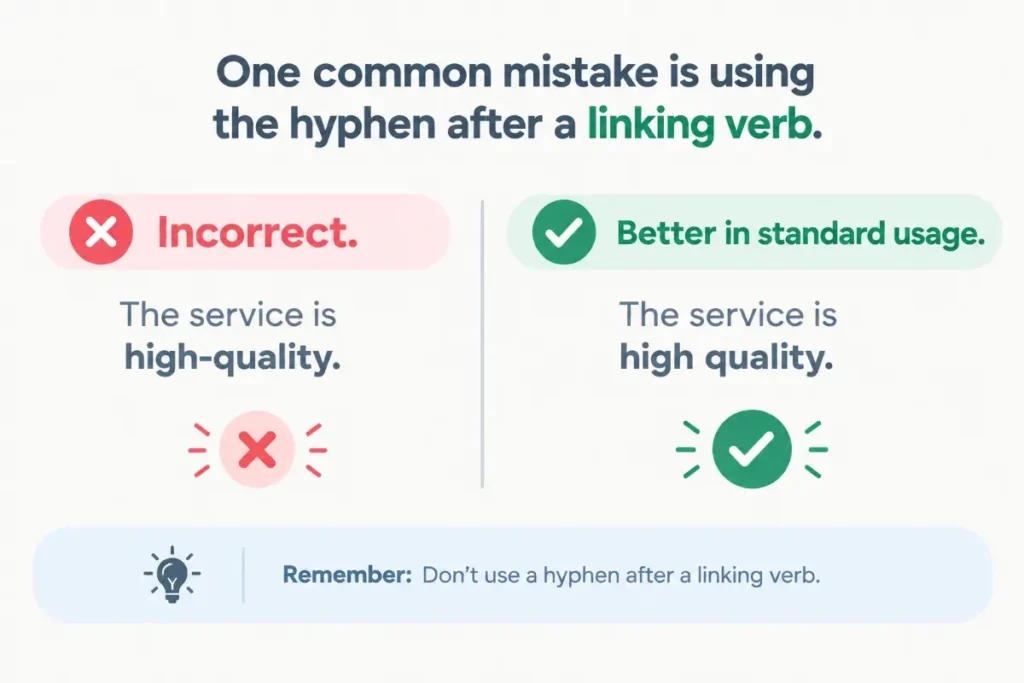
One common mistake is using the hyphen after a linking verb.
Incorrect.
The service is high-quality.
Better in standard usage.
The service is high quality.
The phrase follows is and describes the subject.
Another common mistake is removing the hyphen before a noun.
Less polished.
We provide high quality services.
Better.
We provide high-quality services.
The hyphen makes the compound modifier clear.
A third mistake is adding a hyphen every time the words appear together.
English does not require a hyphen simply because two words have a close relationship.
For example.
The quality is high.
This sentence needs no hyphen because high is a normal adjective describing quality.
Another example is.
The product has high quality.
Many editors prefer a more natural construction such as The product is high quality or The product has excellent quality. The important point is that high and quality are not acting as a compound adjective before another noun.
High Quality Vs High-Quality In Titles
Headings require special care because writers often shorten phrases in titles.
Suppose your heading is.
High-Quality Content Writing Tips.
Here high-quality modifies content writing.
Now consider.
How To Maintain High Quality.
Here high quality functions as a noun phrase.
The same grammatical rule still applies in headings.
Do not add a hyphen simply because the phrase appears in a title. Look at its role.
This approach also helps with SEO content. Search engines can understand both forms, but good writing should follow standard grammar rather than forcing a keyword into every possible structure.
Similar Expressions
The same grammar pattern appears in many compound adjectives.
High-quality product.
Low-quality product.
Top-quality service.
Poor-quality material.
First-rate service.
Long-term plan.
Short-term goal.
User-friendly interface.
Cost-effective solution.
These expressions show how English combines words to create compact descriptions.
Notice what happens after a linking verb.
The product is low quality.
The service is top quality.
The plan is long term.
The interface is user friendly.
The solution is cost effective.
This pattern gives you a practical way to edit similar expressions.
American English Usage
American English commonly uses hyphens in compound modifiers before nouns when the connection could be unclear without them.
For example.
A high-quality product.
A long-term contract.
A well-known author.
A full-time employee.
After a linking verb the hyphen often disappears.
The product is high quality.
The contract is long term.
The author is well known.
The employee works full time.
Style guides can differ on specific compounds. Some expressions become established as open words over time. Dictionaries and major style guides can also record variations.
For ordinary professional writing you can rely on the basic position rule. Use the hyphen when the combined words act as a modifier before a noun. Leave the phrase open when it functions as a complement after a linking verb.
Pronunciation And Meaning
The pronunciation of high quality and high-quality does not normally change because of the hyphen.
The hyphen is mainly a written punctuation mark. It shows that the words belong together grammatically.
Both forms communicate a strong positive assessment of quality.
The phrase can describe physical goods.
This is a high-quality jacket.
It can describe services.
They offer high-quality customer support.
It can describe work.
She produces high-quality research.
It can describe digital material.
The website contains high-quality images.
The meaning depends on the noun being described.
Formal And Informal Usage
Both forms can appear in formal and informal English.
The hyphenated form is especially common before nouns in edited writing.
High-quality research supports the claim.
The open form is common after linking verbs.
The research is high quality.
In casual speech people do not hear the hyphen. They simply hear the words. The distinction becomes visible when you write the sentence.
That is why the issue matters more for writing than conversation.
Memory Tips
A simple memory trick can help.
Think of the hyphen as a small bridge.
When high and quality need to cross over together to describe a noun they use the bridge.
High-quality product.
When the phrase stands after a linking verb the bridge usually disappears.
The product is high quality.
Another trick is to look right.
If a noun comes directly after the phrase and the phrase describes that noun use high-quality.
High-quality service.
If the phrase comes after is, seems, looks, feels, or another linking verb use high quality.
The service is high quality.
This rule works for most everyday examples.
Related Grammar And Usage Notes
The word quality is a noun.
The word high is an adjective.
When high describes quality directly the phrase high quality functions as a noun phrase.
When high-quality modifies another noun the entire expression works as an adjective.
That difference explains the punctuation.
Consider this sentence.
We need high-quality materials.
Materials is the noun.
High-quality describes materials.
Now consider this sentence.
The materials are high quality.
Materials is the subject.
Are connects the subject with the description high quality.
The grammar has changed even though the basic meaning has not.
You can also replace high quality with other adjective and noun combinations.
The material is excellent.
The material is premium quality.
Some of these alternatives have their own grammar patterns. That is another reason to avoid treating hyphens as decoration. They reflect how words function together.
Why Writers Often Get This Wrong
The confusion comes from the fact that English does not pronounce the hyphen.
A speaker can say the same words in both sentences.
The product is high quality.
It is a high-quality product.
When writers move from speech to text they have to show the grammatical relationship visually.
Another source of confusion is the common belief that compound phrases should always be hyphenated. That rule is too broad.
Hyphens are not required every time two words appear together.
Their purpose is to clarify a compound relationship.
That is why sentence position matters so much.
How To Edit Your Own Sentence
When you are unsure about the form check the phrase before changing anything.
First find the noun being described.
Then see where high quality appears.
If it directly modifies a noun use high-quality.
If it follows a linking verb and describes the subject use high quality.
Then read the complete sentence aloud.
Finally check the surrounding phrase for other compound modifiers.
For example.
We hired a high-quality editor.
The editor is high quality.
These sentences make the rule visible immediately.
This method is faster than memorizing dozens of isolated examples.
Professional Writing Tips
Writers often use high-quality to describe products services research content and work. The phrase is useful but it can become vague if you use it without evidence.
For stronger professional writing explain what makes the quality high.
Instead of saying that a report is high-quality you can describe its clear structure accurate data careful research and useful conclusions.
Instead of calling a product high-quality you can explain its materials construction durability and performance.
This approach supports credibility because readers can see the basis for the claim.
The grammar still matters. The stronger point is that precise language works best when it accompanies precise evidence.
Search And Voice Query Answers
People often search for direct answers such as Is high quality hyphenated or Should I write high-quality product.
The short answer is simple.
Use high-quality before a noun.
Use high quality after a linking verb.
For example.
This is a high-quality product.
This product is high quality.
That answer is easy to remember and works well in ordinary American English.
Key Takeaways
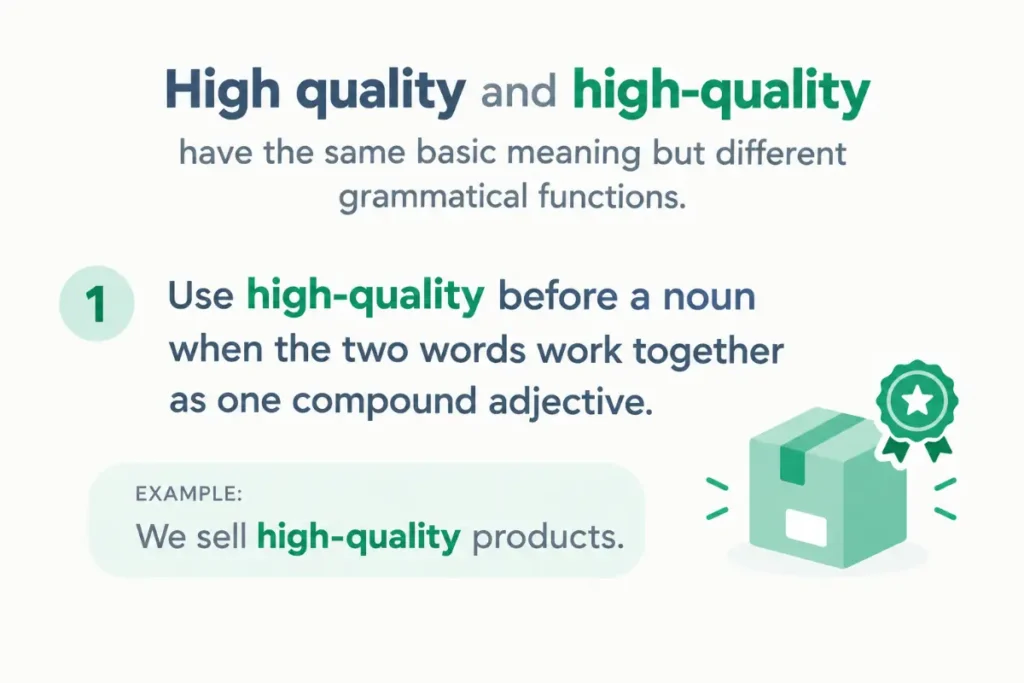
- High quality and high-quality have the same basic meaning but different grammatical functions.
- Use high-quality before a noun when the two words work together as one compound adjective.
- Use high quality after a linking verb when the phrase describes the subject.
- Write high-quality product.
- Write the product is high quality.
- The hyphen connects the words when they function together as a modifier.
- The hyphen does not normally change the pronunciation.
- American English commonly follows this compound modifier pattern.
- Do not add a hyphen simply because two words appear together.
- When in doubt check the phrase position and identify the noun being modified.
Conclusion
The simplest way to remember high quality vs high-quality is to look at the phrase position. Use high-quality when the words come together before a noun as one compound adjective. Use high quality when the phrase works as a noun phrase or appears after a linking verb.
This small punctuation choice can make your writing cleaner and easier to read. A sentence such as We offer high-quality services uses the hyphen because the phrase modifies services. A sentence such as Our services are high quality leaves the words open because the phrase follows the linking verb are.
Once you see the grammatical pattern the choice becomes almost automatic. Treat the hyphen as a bridge that connects words when they work together before a noun. Keep the words open when they function as a description after a linking verb. That simple habit will help you write more accurately in emails articles reports product descriptions and everyday professional communication.
Frequently Asked Questions
Is high quality hyphenated?
Use high-quality when the phrase directly modifies a noun. Use high quality after a linking verb when it describes the subject.
Is high quality one word?
No. High quality is normally written as two words. When the phrase acts as a compound adjective before a noun the two words are connected with a hyphen.
Should I write high-quality product?
Yes. High-quality product is the standard form because high-quality works together to modify product.
Should I write the product is high-quality?
In standard usage write The product is high quality. The phrase follows the linking verb and functions as a complement.
Is high quality vs high-quality the correct comparison?
Yes. The comparison describes two grammatical forms of the same expression. The open form works mainly as a noun phrase or complement. The hyphenated form works as a compound adjective before a noun.
Can I use high quality in formal writing
Yes. High quality is completely appropriate in formal writing when the grammar calls for the open form.
Can I use high-quality in professional writing?
Yes. High-quality is common in professional writing when it appears before a noun as a compound modifier.
Does the hyphen change the meaning?
Normally no. The hyphen mainly shows how the words function together in the sentence.
Do American writers use high-quality?
Yes. American English commonly uses high-quality before nouns when the two words form a compound modifier.
What is the easiest way to remember the rule?
Look at the word after the phrase. If a noun follows immediately and the phrase describes it use high-quality. If the phrase comes after a linking verb use high quality.
Can high quality describe services?
Yes. You can write The company provides high-quality services. You can also write The companys services are high quality.
Is high-quality always required before a noun?
In standard edited writing it is normally the best choice when high and quality work together as one modifier before the noun. Specific style guides can differ for some established compounds.

Confusing Words, Spelling & Word Choice
Claire Whitmore is a U.S.-based English editor who writes about commonly confused words, spelling differences, and word choice. Her work helps readers understand subtle distinctions between similar-looking words through simple definitions, practical examples, and modern usage guidance in both American and British English.