
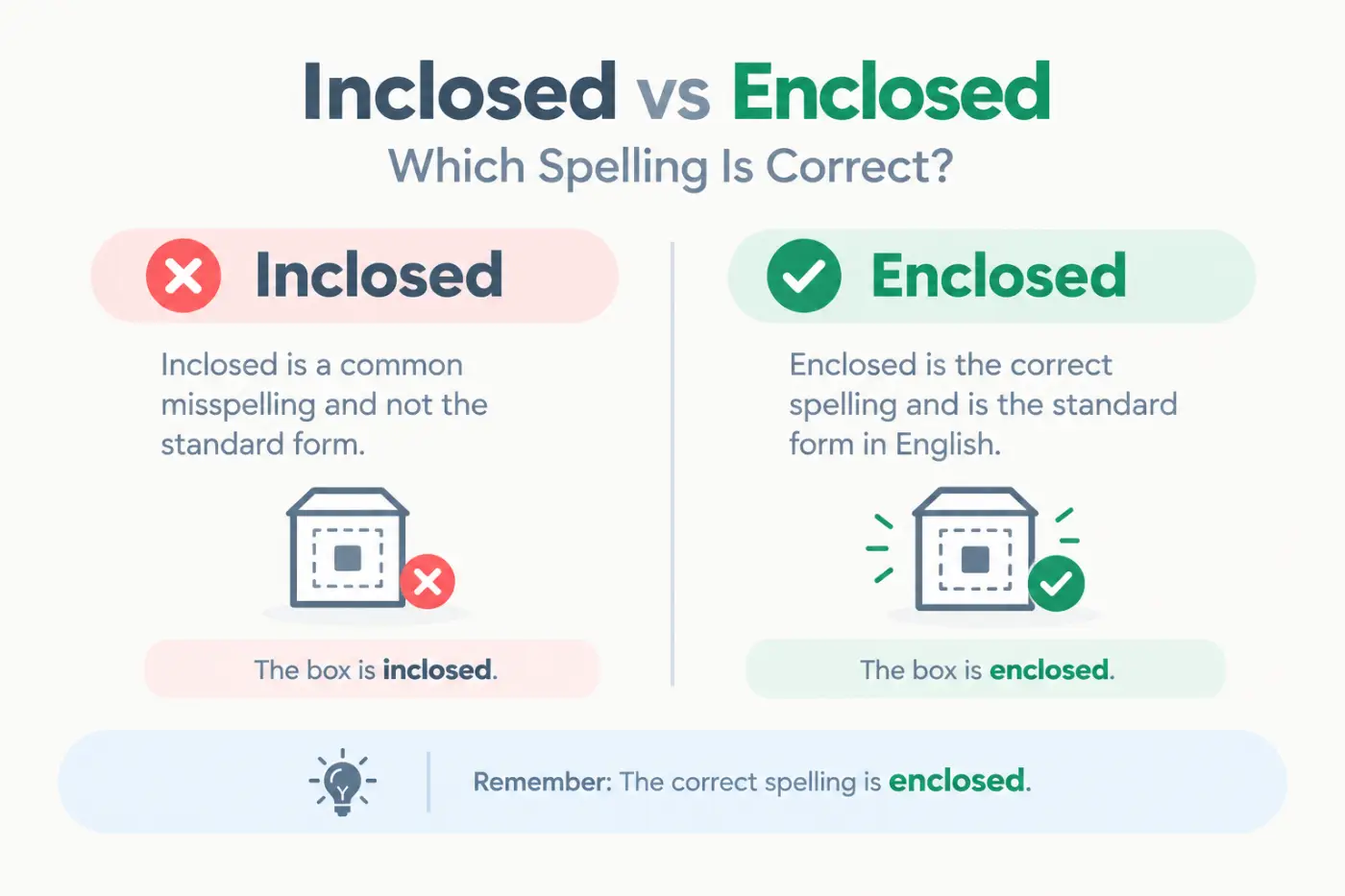
People often confuse inclosed vs enclosed because both forms have expressed the same basic idea. We use the word when someone surrounds or shuts something in or places it inside something else. You may also see it in letters when someone includes a document or item inside the same envelope or package.
For modern writing, enclosed is the clear choice. It is the standard form readers expect in American English. Major dictionaries still record inclose as a less common variant of enclose, so calling it a completely invented spelling would be inaccurate.
The confusion usually starts when someone finds inclosed in an old book, historical letter, legal record, or older piece of writing. That spelling has a genuine history in English. Still, language changes over time. A form can be historically valid and yet no longer be the best choice for everyday writing.
Short Answer
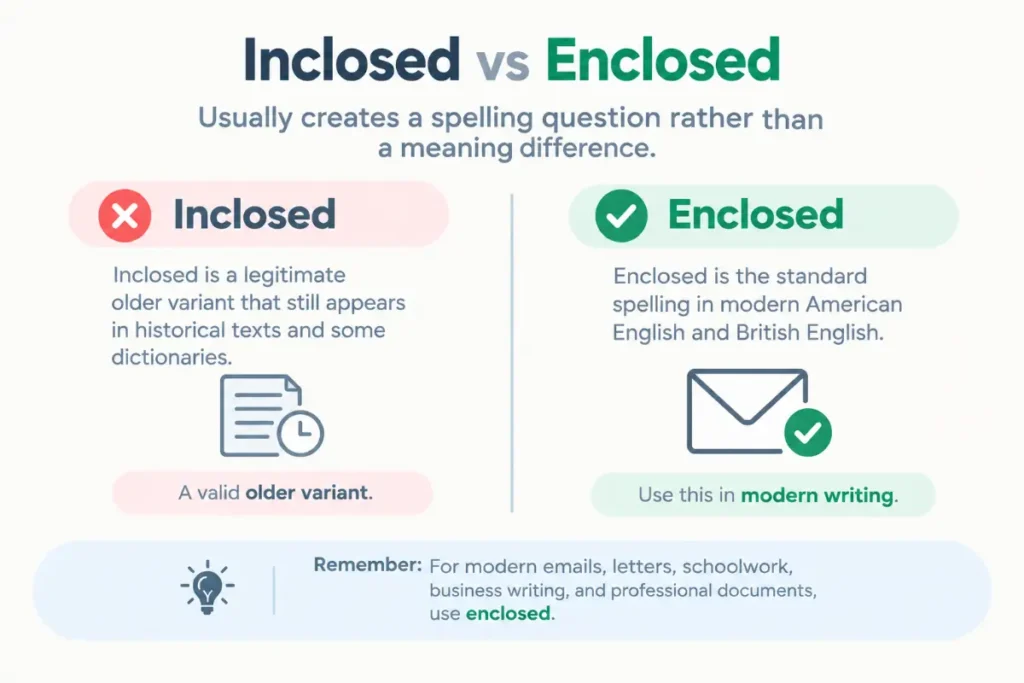
Inclosed vs enclosed usually creates a spelling question rather than a meaning difference. Enclosed is the standard spelling in modern American English and British English. Inclosed is a legitimate older variant that still appears in historical texts and some dictionaries. For modern emails, letters, schoolwork, business writing, and professional documents, use enclosed.
Table of Contents
- The quick difference.
- What enclosed means.
- What inclosed means.
- Why enclosed is the standard choice.
- Enclosed in American English.
- Enclosed in British English.
- How to use enclosed correctly.
- Enclosed in letters and packages.
- Enclosed in email and digital communication.
- Enclosed as an adjective.
- Enclosed as a verb form.
- Inclosed in historical writing.
- Pronunciation of enclosed and inclosed.
- Comparison of related forms.
- Common mistakes.
- Real life examples.
- Memory tips.
- Related grammar and usage notes.
- Professional writing advice.
- Frequently Asked Questions.
- Key Takeaways.
- Conclusion.
The Quick Difference
The simplest rule is easy to remember.
Enclosed is the standard modern spelling.
Inclosed is an older and much less common spelling variant.
The two forms generally carry the same meaning. The main difference is modern usage and spelling preference rather than meaning. Collins describes inclose as a less common spelling of enclose.
| Word | Modern status | Basic meaning | Best use |
|---|---|---|---|
| Enclosed | Standard | Surrounded or placed inside | Modern writing |
| Inclosed | Less common historical variant | Surrounded or placed inside | Historical texts |
| Enclose | Standard verb | To surround or put inside | Modern writing |
| Inclose | Less common variant | Same basic meaning as enclose | Historical or uncommon usage |
| Enclosure | Standard noun | Something that surrounds or something included with a letter | Modern writing |
| Inclosure | Older variant | Same basic idea as enclosure | Historical contexts |
If you are writing for a modern reader, choose enclosed. It is familiar, clear, and expected.
What Enclosed Means
Enclosed is the past participle and past tense form of the verb enclose. It can describe something placed inside another object or something surrounded by a physical boundary.
For example:
We enclose the documents with the application.
This means the fence surrounds the backyard.
The patio has an enclosed roof.
This means the patio has been covered or closed off so it is no longer completely open.
The word can describe physical spaces, objects, documents, packages, areas, and even abstract situations.
The central idea stays the same. Something is inside a boundary or surrounded by something else.
What Inclosed Means
Inclosed has essentially the same basic meaning as enclosed. The important difference is its status in modern English.
It is an older spelling variant of inclose. Modern dictionaries still document the form, but they mark inclose as less common or as a variant of enclose.
That distinction matters.
A dictionary can record a word or spelling without recommending it as the normal choice for current writing. Dictionaries document language as people have used it across time. Writers still need to choose the form that fits their audience and purpose.
For example, an older text might use:
The land was inclosed by a stone wall.
A modern writer would normally use:
The meaning has not changed much. The spelling has.
This is a useful lesson in English vocabulary. Not every uncommon form is a mistake. Sometimes it is a surviving piece of older language.
Why Enclosed Is the Standard Choice
English spelling has never been perfectly tidy. Many words have had competing spellings across different periods. Over time, some forms become dominant while others become rare.
Enclose became the normal modern form. Inclose survived as a less common variant.
Today, most readers expect enclosed in ordinary writing. That includes American business correspondence, school assignments, professional documents, websites, instructions, reports, and everyday messages.
Using the standard spelling has a practical advantage. Your reader can process the word immediately without stopping to wonder if you made a spelling error.
That is especially important in professional writing.
Suppose you write:
Please find the inclosed documents.
A reader will probably understand you. Still, the unusual spelling may distract from your message.
Now compare:
Please find the enclosed documents.
The second version feels natural and familiar.
Good writing removes unnecessary friction. Choosing the standard spelling is a simple way to do that.
Enclosed in American English
American English uses enclosed as the standard spelling.
You will commonly see it in business letters, legal documents, property descriptions, shipping information, instructions, applications, and general writing.
For example:
The signed agreement is enclosed.
The property has an enclosed courtyard.
Please review the enclosed documents.
The package contains an enclosed instruction sheet.
American readers may recognize inclosed from older writing. Still, most readers will not expect it in a current document. A modern American writer should normally choose enclosed.
This point matters for students and professionals because spelling questions often come from older material. Seeing an unusual form in a historical source does not mean you should copy it into modern writing.
Enclosed in British English
British English also uses enclosed as the normal modern form.
Inclose exists as a less common spelling variant in British English.
So the basic advice stays the same on both sides of the Atlantic.
American English uses enclosed.
British English uses enclosed.
Inclosed can appear in older or uncommon usage.
There is no useful modern spelling rule that tells American writers to use inclosed while British writers use enclosed. The distinction is mainly historical and stylistic.
How to Use Enclosed Correctly
The word enclosed can appear in several useful patterns.
Enclosed with a letter
Use enclosed when something is physically included with a letter or package.
Please find the enclosed receipt.
The receipt is inside the same mailing.
Enclosed in a package
Use enclosed to show that something is contained inside another object.
The warranty card is enclosed in the box.
The card is physically inside the box.
Enclosed by a boundary
Use enclosed when something is surrounded by a fence, wall, barrier, or similar structure.
The garden is enclosed by a brick wall.
The wall creates a boundary around the garden.
Enclosed space
Enclosed can describe a space that is closed or surrounded.
The workers entered an enclosed area.
The area has a defined boundary that separates it from the surrounding space.
Enclosed document
This is common in formal writing.
Please review the enclosed contract.
These patterns cover most everyday uses.
Enclosed in Letters and Packages
One of the most traditional uses of enclosed appears in formal letters.
A writer may say:
Please find the enclosed application.
This tells the reader that the application is included in the same envelope.
Another example is:
I have enclosed a copy of the receipt.
The writer means that a physical copy of the receipt has been placed inside the mailing.
You may also see:
The enclosed form must be completed and returned.
This usage remains correct. It simply belongs more naturally to physical correspondence than digital communication.
Enclosed in Email and Digital Communication
Email changed the way people use this word.
If you send a file by email, attached is usually the more natural word.
For example:
Please see the attached report.
Please review the attached invoice.
I have attached the completed form.
These sentences fit modern digital communication.
Enclosed traditionally suggests that something is physically inside an envelope, package, container, or bounded area. Attached tells the reader that a digital file accompanies an email.
The distinction is not merely about grammar. It is about choosing language that fits the medium.
For physical mail, enclosed is natural.
For email, attached is usually better.
That small choice can make professional writing sound more precise.
Enclosed as an Adjective
Enclosed can also work as an adjective.
Consider these examples:
The hotel has an enclosed pool.
The building contains an enclosed walkway.
The children played in an enclosed courtyard.
An enclosed pool is surrounded or protected by a structure.
An enclosed courtyard has some form of boundary around it.
In each case, enclosed describes the condition of a noun.
This use appears frequently in descriptions of buildings, transportation, public spaces, architecture, and facilities.
You may also encounter the term enclosed space in safety instructions and workplace guidance. The phrase can describe an area that limits movement or separates people from the surrounding environment.
The exact meaning depends on the context, but the basic idea remains containment or surrounding.
Enclosed as a Verb Form
Enclosed comes from the verb enclose.
The basic verb means to surround something or put something inside something else.
The main forms are simple:
Enclose.
Encloses.
Enclosed.
Enclosing.
For example:
I enclose the requested form.
She encloses the receipt with the letter.
They enclosed the yard with a fence.
The workers are enclosing the construction area.
Notice that the spelling remains consistent with enclose.
This is another reason modern writers should avoid switching to inclosed. The standard word family is built around enclose.
The related noun is enclosure.
The related present participle is enclosing.
The past tense and past participle are enclosed.
That family is familiar to modern readers and fits standard contemporary usage.
Inclosed in Historical Writing
Historical writing is where you are most likely to encounter inclosed.
Older books, letters, legal documents, land records, and other historical sources sometimes use the spelling.
This matters when you are reading primary sources.
Imagine you find this sentence in an old document:
The grounds were inclosed by a wall.
You should not automatically assume the writer made a spelling mistake.
The writer may have been using a spelling that was accepted at that time.
Historical spelling gives us a window into how English developed. Words that look unusual today can reveal older patterns and preferences.
If you are quoting a historical source exactly, preserve the original spelling when accuracy requires it.
If you are rewriting the historical material for a modern audience, enclosed will usually be the better choice.
That approach respects both historical accuracy and modern readability.
Pronunciation of Enclosed and Inclosed
Enclosed and inclosed are pronounced essentially the same in ordinary English.
The spelling difference does not create a meaningful pronunciation difference.
The word has two syllables.
The first part sounds like the beginning of the verb enclose.
The ending has the voiced sound found in words ending with the sound represented by ed in this context.
Because the two forms have nearly identical pronunciation, listening alone will not help you decide which spelling to write.
That is one reason this spelling question can persist. Someone may know the word perfectly well when speaking but still hesitate when typing it.
The safest solution is to remember the modern spelling pattern.
Enclose leads to enclosed.
Inclose is the older variant.
For modern writing, choose the first form.
Comparison of Related Forms
Understanding the whole word family makes the spelling easier to remember.
| Standard modern form | Less common older form | Meaning |
|---|---|---|
| Enclose | Inclose | To surround or put inside |
| Enclosed | Inclosed | Surrounded or put inside |
| Enclosing | Inclosing | Surrounding or putting inside |
| Enclosure | Inclosure | Something enclosed or an enclosed area |
The modern family is much more useful for everyday writing.
If you already know enclosure, then enclosed becomes easier to remember. The shared beginning gives you a consistent spelling pattern.
For example:
The documents are enclosed.
The documents are in an enclosure.
The enclosure is the container or bounded area.
These words connect naturally.
Common Mistakes
Many mistakes come from treating inclosed as a completely wrong word. That approach misses an important part of the story.
It is more accurate to say that inclosed is an established but much less common variant. Major dictionary sources record inclose as a variant of enclose.
The practical mistake is using the older form in modern writing.
Mistake with business letters
Incorrect for standard modern usage:
Please find the inclosed invoice.
Better:
Please find the enclosed invoice.
The second sentence matches modern professional expectations.
Mistake with documents
Incorrect for ordinary modern writing:
The inclosed form must be signed.
Better:
The enclosed form must be signed.
The meaning is clear in both sentences, but the second uses the standard spelling.
Mistake with physical spaces
Less suitable for modern writing:
The garden is inclosed by a fence.
Better:
The garden is enclosed by a fence.
Again, the issue is spelling rather than meaning.
Mistake with historical interpretation
Another mistake is assuming every appearance of inclosed is an error.
If you are reading an old document, the spelling may reflect the language of its time. Historical writing deserves historical context.
Mistake with email attachments
Another common issue involves the word enclosed itself.
Some writers use enclosed for digital files:
Please find enclosed the report.
A reader will understand the sentence. Still, attached is usually more natural for an email.
Use enclosed for something physically included with a letter or package.
Use attached for a file included with an email.
Real Life Examples
Real world examples make the distinction easier to remember.
Business letter
Please find the enclosed contract for your review.
The contract is physically included with the letter.
Formal notice
The enclosed form must be completed before submission.
The form is included with the notice.
Package
The enclosed instructions explain how to assemble the product.
The instructions are inside the package.
Property description
The home has an enclosed backyard.
The backyard is surrounded by a boundary.
Building description
The office includes an enclosed glass walkway.
The walkway is separated from the outdoor environment by glass.
Please see the attached report.
Attached is better because the report is a digital file.
Historical text
The estate was inclosed by a stone wall.
This spelling can appear in older sources and should be understood in its historical context.
Modern rewrite
The estate was enclosed by a stone wall.
This is the natural modern version.
The pattern is consistent. Modern writing favors enclosed. Historical writing may preserve inclosed.
Memory Tips
A good memory trick can save you from second guessing the spelling.
Think of E for everyday.
Enclosed is the form you will use in everyday modern writing.
You can also connect enclosed with enclosure.
If you know that the noun is enclosure, the spelling of enclosed becomes easier to recall.
Another useful trick is to remember the verb first.
Enclose.
Then add the ending.
Enclosed.
The spelling follows naturally.
If you see inclosed in an old book, think of it as an older spelling that has not completely disappeared.
You do not need to treat every unusual word as a spelling error. English has plenty of historical forms that survive in limited contexts.
The practical rule is still simple.
For modern writing, use enclosed.
Related Grammar and Usage Notes
Enclosed has several grammatical roles.
It can function as the past tense of enclose.
They enclosed the garden with a fence.
It can also function as a past participle.
The garden was enclosed by a fence.
It can also function as an adjective.
They entered an enclosed courtyard.
These roles are related but not identical.
In the first sentence, enclosed describes an action completed in the past.
In the second sentence, enclosed appears in a passive construction.
And in the third sentence, enclosed describes the courtyard.
Understanding these patterns helps you use the word naturally.
Active voice
The workers enclosed the garden with a fence.
The subject performs the action.
Passive voice
The garden was enclosed by a fence.
The subject receives the action.
Adjective use
The garden is enclosed.
Here the word describes the condition of the garden.
All three forms are grammatically useful.
Professional Writing Tips
Professional writing benefits from familiar spelling and precise word choice.
If your audience expects modern American English, enclosed is the safest choice.
Use it in reports, applications, contracts, cover letters, business correspondence, instructions, and formal notices.
When discussing older material, preserve inclosed only when the original wording matters.
For example, a historian may reproduce the spelling from an old document. A researcher may discuss an old legal record that uses the form. An editor preparing a historical edition may need to preserve original spelling.
Outside those situations, modernize the spelling.
This approach keeps your writing readable without erasing useful historical information.
The same principle applies to many language questions. A word can be real without being the best word for your current audience.
Good editing is not only about deciding what is technically possible. It is about choosing the form that communicates most clearly.
When Inclosed Can Still Be Appropriate
There are limited situations where inclosed can appear naturally.
Historical quotation is one.
If an old letter says that a document was inclosed, you may preserve the spelling when reproducing the source exactly.
Historical analysis is another.
A linguist or historian may discuss how spelling changed over time and use inclosed as evidence.
Archival transcription can also preserve the original spelling.
A scholarly edition may reproduce historical documents exactly rather than silently updating every word.
These cases are different from ordinary writing.
If you are writing a new email today, use enclosed.
If you are transcribing an old letter, the original spelling may need to remain.
Context controls the choice.
Why Spelling Variants Survive
English contains many words with competing forms.
Some variants disappear almost completely.
Others survive as regional forms.
Some remain in formal language.
Others live on in historical documents.
Inclose belongs to the group of forms that have survived but are much less common than their modern counterpart.
This illustrates an important point about dictionaries.
A dictionary entry does not automatically mean a word is the preferred choice for every situation.
Lexicographers record forms that exist in actual language use. Usage labels help readers understand frequency, region, age, and style.
That is why the label less common matters here.
Similar Words You May Confuse
Several related words can create confusion.
Enclose and enclosure
Enclose is the verb.
Enclosure is the noun.
Example:
Please enclose the receipt.
The receipt is inside the enclosure.
The noun can also describe something included with a letter.
Enclosed and enclosing
Enclosed normally describes something already surrounded or included.
Enclosing describes an action that is happening or a thing that surrounds something.
Example:
The enclosed document is signed.
The enclosing wall is made of brick.
The first describes the document.
The second describes the wall.
Enclosed and attached
Enclosed usually fits physical mail or a physical container.
Attached usually fits email and digital files.
Example:
The check is enclosed with the letter.
The report is attached to the email.
Choosing the right word makes the message more precise.
Enclosed in Formal Writing
Formal writing often uses enclosed in phrases that may sound traditional.
For example:
Please find the enclosed documents.
The enclosed agreement requires your signature.
Please return the enclosed form.
These phrases remain acceptable when referring to physical documents.
Still, you do not need to force formal language into every message.
A simpler sentence can often sound better:
I enclosed the signed agreement.
I included the receipt with the letter.
The form is inside the envelope.
Clear writing often beats ceremonial writing.
Enclosed and Included
Enclosed and included overlap but are not always interchangeable.
Included is broader.
It simply tells the reader that something forms part of a group or accompanies something else.
Enclosed gives a stronger sense of physical containment.
For example:
The receipt is included with the package.
This tells you the receipt comes with the package.
The receipt is enclosed in the package.
This tells you the receipt is physically inside the package.
That small distinction can matter.
Use included when you want to emphasize membership or presence.
Use enclosed when you want to emphasize containment or surrounding.
Enclosed and Surrounded
Surrounded focuses on something being on all sides.
Enclosed can carry that same meaning but can also refer to something being placed inside a container or package.
For example:
The house is surrounded by trees.
The garden is enclosed by a fence.
The first sentence focuses on the surrounding trees.
The second emphasizes the boundary created by the fence.
The words overlap but are not always perfect substitutes.
Enclosed and Contained
Contained also focuses on something being inside something else.
The box contains several documents.
The documents are enclosed in the box.
Contained often emphasizes what a container holds.
Enclosed often emphasizes the state of being shut in or surrounded.
Both can be correct depending on the sentence.
Good writers choose the word that best matches the relationship they want to describe.
Key Takeaways
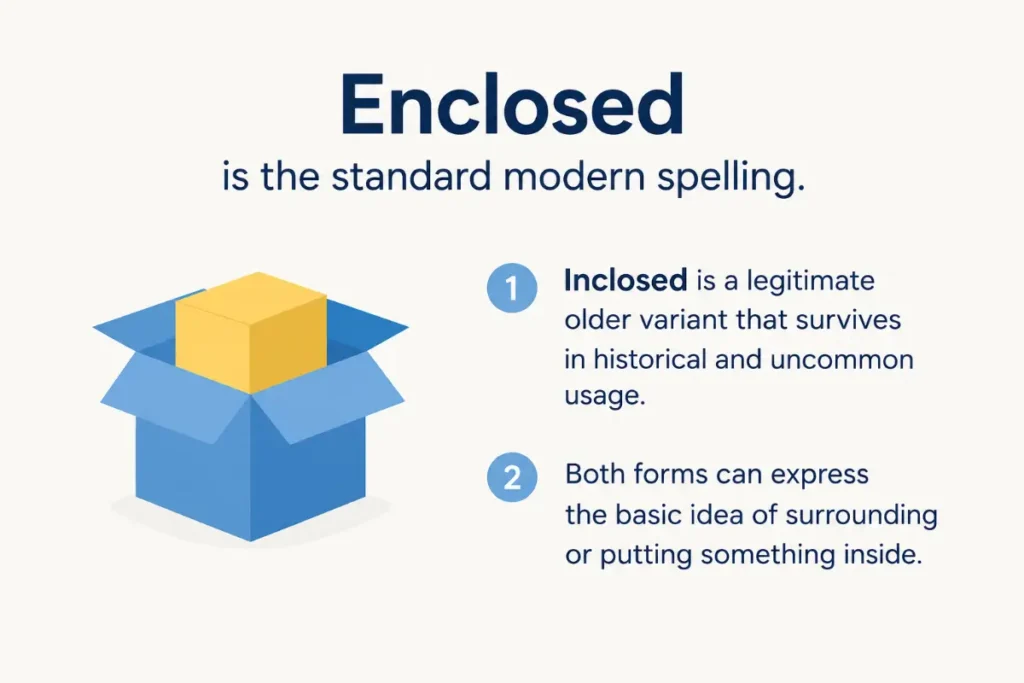
- Enclosed is the standard modern spelling.
- Inclosed is a legitimate older variant that survives in historical and uncommon usage.
- Both forms can express the basic idea of surrounding or putting something inside.
- Modern American English strongly favors enclosed.
- Modern British English also favors enclosed.
- Use enclosed for physical letters, packages, documents, spaces, and boundaries.
- Use attached for digital files sent by email in most professional situations.
- Use inclosed only when the historical or stylistic context makes the older spelling relevant.
- The word family includes enclose, enclosed, enclosing, and enclosure.
- Seeing inclosed in an old document does not automatically mean the original writer made a spelling mistake.
Conclusion
The practical answer to inclosed vs enclosed is straightforward. Use enclosed in modern writing. It is the standard spelling that readers in the United States and other English speaking regions expect. Inclosed has historical legitimacy, but it is much less common today.
If you are writing a letter, report, application, business document, school assignment, website, or everyday message, enclosed is the stronger choice. It communicates clearly without making the reader pause over an unfamiliar spelling.
Language changes over time. Inclosed is a good example of how an older form can survive in dictionaries and historical sources even after another form becomes the normal choice. When your goal is clear modern English, choose enclosed and keep your writing natural and easy to read.
Frequently Asked Questions
Is inclosed a correct English word?
Inclosed is a real historical spelling variant of inclose. Major dictionaries record inclose as a less common variant of enclose. It is not the normal spelling for modern writing.
What is the main difference between inclosed and enclosed?
The main difference lies in spelling and modern usage. Both forms describe something that surrounds or places an object inside something else. However, modern English speakers generally use enclosed as the standard form.
Is inclosed wrong?
Inclosed is not simply a meaningless misspelling. It has a documented history and remains recorded as a less common variant. However, using it in modern everyday writing can make your text look outdated or incorrect.
Should I write enclosed in a business letter?
Yes. Enclosed is the standard choice for a physical business letter. You can say that a contract, form, receipt, or other document accompanies the letter.
Should I use enclosed in an email?
Attached is usually better for an email file. Enclosed traditionally suggests physical containment inside an envelope or package. Attached clearly signals a digital file.
Why do old documents use inclosed?
Inclosed was an accepted spelling variant in earlier English. Older books, letters, legal records, and other historical sources can preserve the form.
Do American and British English use different spellings?
No major modern difference exists here. Enclosed is the normal spelling in both American and British English. Inclose remains a less common variant in dictionary records.
Are enclosed and inclosed pronounced differently?
People generally pronounce them the same. The main difference appears in writing rather than speech.
What is the noun form of enclosed?
The related noun is enclosure. It can describe a physical area that surrounds something or an item included with a letter or package.
What is the verb form of enclosed?
The base verb is enclose. Enclosed is its past tense and past participle form.
Can I use inclosed in historical writing?
Yes. If you are reproducing or discussing historical material, inclosed may be appropriate because it can preserve the original spelling. In new modern writing, enclosed is the better choice.

Confusing Words, Spelling & Word Choice
Claire Whitmore is a U.S.-based English editor who writes about commonly confused words, spelling differences, and word choice. Her work helps readers understand subtle distinctions between similar-looking words through simple definitions, practical examples, and modern usage guidance in both American and British English.