
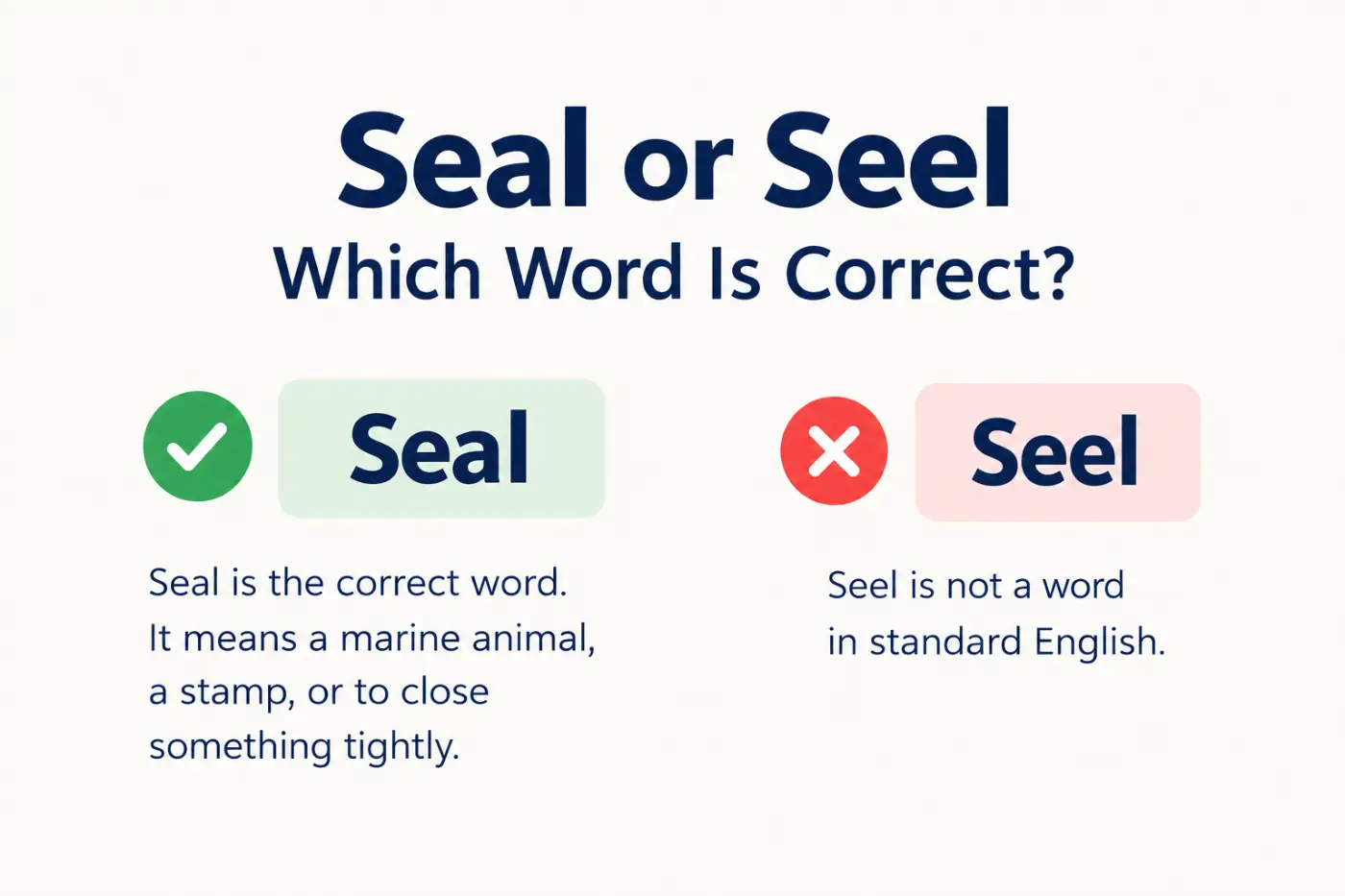
Seal or seel often creates confusion because English contains many words that sound alike but have different spellings. In this case the answer is simple. Seal is the standard spelling used in modern English for the common meanings most people intend.
You can use seal as a noun or a verb. A seal can describe a marine mammal. It can also mean an official mark placed on a document or a closure that keeps something secure. As a verb it can mean to close something firmly or make an agreement final.
The form seel has a much narrower history and does not belong to ordinary modern American English. If you are writing an email a school assignment a report or everyday communication then seal is almost certainly the word you need.
Short Answer
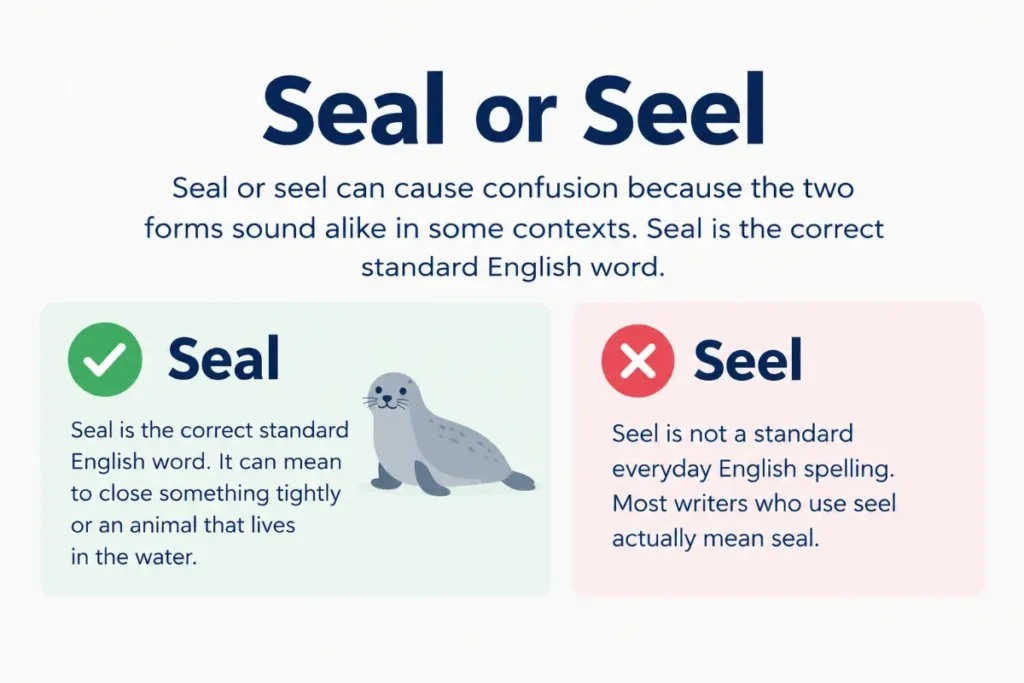
Seal or seel can cause confusion because the two forms sound alike in some contexts. Seal is the correct standard English word. It can mean to close something tightly or an animal that lives in the water. Seel is not a standard everyday English spelling. Most writers who use seel actually mean seal.
Table of Contents
- What seal means.
- What seel means.
- The difference between seal and seel.
- How to use seal correctly.
- Seal as a noun.
- Seal as a verb.
- Pronunciation of seal.
- Why seel causes confusion.
- Real life examples.
- Common mistakes.
- Memory tips.
- Related grammar and usage notes.
- Frequently asked questions.
- Key takeaways.
- Conclusion.
What Seal Means
Seal is a common English word with several meanings. The exact meaning depends on the context.
The most familiar meaning refers to a marine mammal. Seals live in oceans and coastal regions around the world. They have streamlined bodies and flippers that help them move through water.
For example:
- The seal rested on the rock near the shore.
In this sentence seal refers to the animal.
Seal can also mean an official mark or design used to show authority authenticity or approval.
For example:
- The document carried the official seal of the organization.
Here seal refers to a mark that represents an institution or authority.
Another common meaning involves closing something tightly.
For example:
- Please seal the envelope before you mail it.
In this sentence seal functions as a verb. It means to close the envelope securely.
Seal can also describe the process of making something final.
For example:
- The agreement sealed the partnership between the two companies.
The verb sealed means made the agreement firm or final.
This range of meanings makes seal a particularly useful word. Its meaning changes with the sentence but its spelling stays the same.
What Seel Means
Seel is not a common modern English word. Most American English dictionaries and ordinary usage guides do not treat it as a standard everyday alternative to seal.
You may encounter seel in historical texts specialized writing or older forms of English. It has appeared as a variant or specialized term in older language use. Some historical uses relate to sewing or closing the eyes. You may also find the word in literary or archaic contexts.
That history does not make seel an appropriate replacement for seal in ordinary writing.
If you are trying to describe an animal you should write seal.
If you mean making something final you should write seal.
For modern American English the practical rule is straightforward. Use seal unless you have a specific historical or specialized reason to use another form.
The Difference Between Seal And Seel
The main difference between seal and seel comes down to modern usage.
| Word | Standard modern usage | Common meaning | Example |
|---|---|---|---|
| Seal | Yes | Animal official mark or closure | The seal closed the package tightly. |
| Seel | No for ordinary modern usage | Historical or specialized uses | The older text uses seel in a specialized sense. |
The two forms can create confusion because spelling and sound do not always match neatly in English.
For most readers the important distinction is simple. Seal is a normal modern English word. Seel is uncommon and generally does not belong in ordinary American writing.
If your sentence needs a word for an ocean animal then use seal.
If your sentence needs a word for closing something then use seal.
How To Use Seal Correctly
Seal works as both a noun and a verb. Learning these two roles makes the word much easier to use.
Seal As A Noun
As a noun seal can name an animal.
- We watched a seal swim near the boat.
It can also refer to an official mark.
- The letter had the governor’s seal.
Seal can describe something that prevents air water or another substance from passing through an opening.
- The container has a tight seal.
It can also describe a state of closure.
- Check the seal before opening the package.
These meanings connect through the basic idea of security or closure. An animal is one meaning. An official mark and a tight closure are separate meanings.
Seal As A Verb
As a verb seal means to close something securely.
- Seal the bag before putting it in the refrigerator.
It can also mean to close an opening so nothing can pass through.
- Workers sealed the crack in the wall.
Another meaning involves making something final or confirmed.
- The final payment sealed the deal.
The expression sealed the deal is especially common in American English. It means an action or event made an agreement certain or final.
Seal can also mean confirming something with an official mark.
- The office sealed the document after approval.
The surrounding words tell you which meaning applies.
Seal In Common Expressions
Seal appears in several familiar English expressions. Understanding these phrases can help you recognize the word quickly.
Seal The Deal
To seal the deal means to complete an agreement or make a decision final.
- The signed contract sealed the deal.
The phrase works in business conversations and everyday speech.
Seal Of Approval
A seal of approval means official or strong approval.
- The new policy received the director’s seal of approval.
People also use the expression informally.
- Her parents gave the restaurant their seal of approval.
Keep Your Lips Sealed
To keep your lips sealed means to keep a secret.
- Don’t worry. I’ll keep my lips sealed.
This expression is informal and common in conversation.
Sealed With A Kiss
Sealed with a kiss traditionally describes a letter or message that ends with an affectionate kiss. The phrase can also be playful or romantic.
- She sent the card sealed with a kiss.
Seal The Fate
To seal someone’s fate means to make an outcome certain.
- Missing the final deadline sealed his fate.
The expression often appears when an action determines what happens next.
Pronunciation Of Seal
Seal is pronounced with a long vowel sound followed by the consonant sound at the end.
In American English the pronunciation is represented as /siːl/.
The word rhymes with several familiar words such as feel and meal.
That pronunciation can explain some of the spelling confusion. English contains many words where the same sound can have different spellings. Sound alone cannot always tell you which spelling to choose.
For writing purposes the safest approach is to connect the spelling with meaning.
Think of the animal.
Think of closing something.
All of these common meanings use seal.
Why Seel Causes Confusion
English spelling contains many irregular patterns. Sometimes two words sound alike while only one belongs to standard modern usage.
People may also create an incorrect spelling based on how a word sounds. This happens often with words containing long vowel sounds.
For example the sound in seal appears in many English words with different spellings. That does not mean every possible spelling represents a standard word.
Another source of confusion comes from older dictionaries books or historical documents. Readers sometimes encounter rare spellings and assume they are interchangeable with modern forms.
That assumption can lead to awkward writing.
A word can exist somewhere in the history of English without being a good choice for modern communication.
This distinction matters in professional writing. A spelling can look plausible and still distract the reader.
Real Life Examples
The best way to understand seal is to see how its meaning changes across different situations.
Talking About An Animal
- We saw a seal near the harbor.
The word identifies a marine mammal.
- The young seal followed its mother into the water.
The context makes the animal meaning clear.
- Several seals gathered on the beach.
Here the plural form is seals.
Talking About Closing Something
- Seal the container tightly.
The verb means close it securely.
- The machine uses a rubber seal to prevent leaks.
Here seal is a noun describing a physical barrier.
- Make sure the package has a proper seal.
The noun refers to the closed or protected connection.
Talking About Official Approval
- The certificate bears the official seal.
Here seal refers to an authorized mark.
- The city placed its seal on the document.
The word identifies the official symbol.
Talking About An Agreement
- The final signature sealed the agreement.
The verb means made the agreement final.
- The new contract sealed the partnership.
The event confirmed the relationship between the parties.
Talking About A Secret
- I promised to keep my lips sealed.
The phrase means the speaker will not reveal information.
These examples show why context matters. The same spelling can serve several grammatical and semantic roles.
Common Mistakes
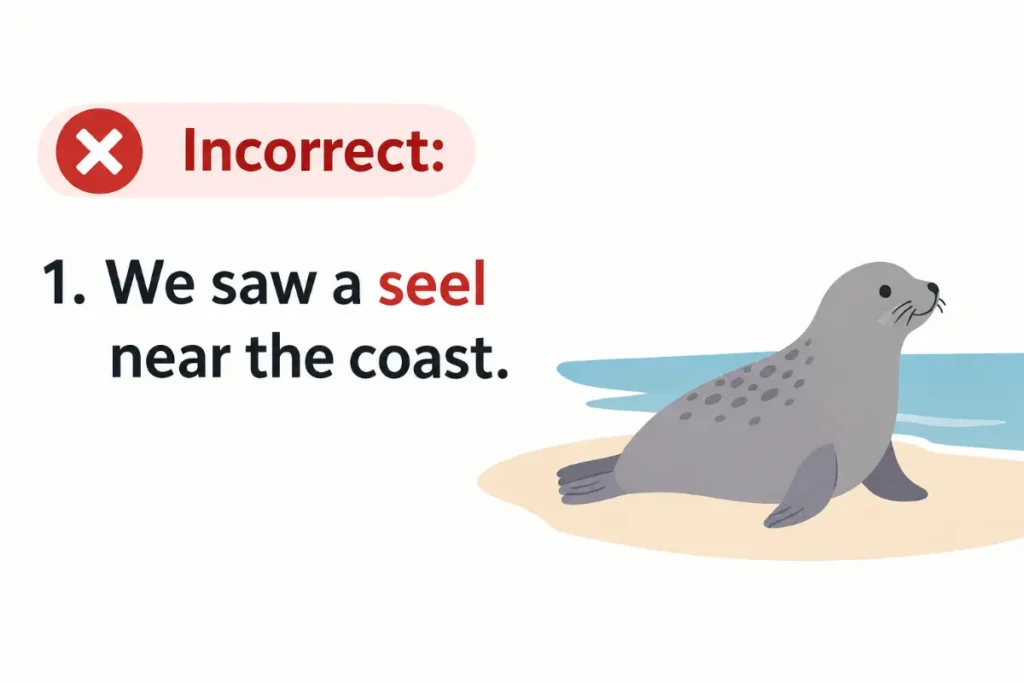
Mistake One Using Seel For The Animal
Incorrect:
- We saw a seel near the coast.
Correct:
- We saw a seal near the coast.
The standard spelling for the animal is seal.
Mistake Two Using Seel For A Closure
Incorrect:
- The bottle needs a new seel.
Correct:
- The bottle needs a new seal.
The noun seal describes the material or barrier that closes an opening.
Mistake Three Using Seel In Professional Writing
Incorrect:
- Please seel the package before shipping.
Correct:
- Please seal the package before shipping.
Professional writing benefits from standard vocabulary. An unusual spelling can make a sentence look careless even when the intended meaning remains clear.
Mistake Four Assuming Every Sound Has One Spelling
English does not work that way.
Words that sound similar or identical can have different spellings and meanings. The spelling must match the word’s established meaning and usage.
Mistake Five Treating Rare Words As Everyday Alternatives
Historical English contains many forms that modern readers rarely encounter. A dictionary entry does not automatically mean a word works as a normal substitute in modern American English.
When writing for a general audience choose the familiar standard form.
Memory Tips
A simple memory trick can make this spelling easy.
Think about the ocean.
A seal swims in the ocean.
Think about a package.
You seal the package.
Think about an official document.
It can carry an official seal.
Think about an agreement.
You can seal the deal.
All four ideas point to the same spelling.
Another useful trick is to connect seal with real words that rhyme with it. Feel meal and seal share the same basic vowel sound.
You can also remember the phrase seal the deal. It is one of the most common expressions containing the word.
If you see seel in ordinary writing ask yourself what you mean. In most cases you will find that seal is the spelling you need.
Related Grammar And Usage Notes
Seal has several grammatical forms.
The base form is seal.
The third person singular form is seals.
The past tense and past participle are sealed.
The present participle is sealing.
Here are some examples.
- I seal the envelope.
- She seals the package.
- They sealed the agreement yesterday.
- We are sealing the container now.
The word can function as a countable noun when it refers to an animal or a specific official mark.
- Three seals were swimming near the shore.
It can also describe a physical closure.
- The door has a damaged seal.
The context determines the grammatical role and meaning.
Seal In American And British English
American and British English both use seal as the standard spelling for the common meanings discussed in this article.
The core meanings remain the same.
A seal can be an animal.
A seal can be an official mark.
To seal something means to close it securely or make something final.
The difference does not come from American versus British spelling. You should not choose seel simply because you are writing for a particular English speaking country.
For ordinary writing in the United States the correct choice is seal.
Formal And Informal Usage
Seal works comfortably across different levels of English.
It appears in formal documents.
- The agreement bears the official seal of the organization.
It appears in business writing.
- The final payment sealed the transaction.
This flexibility makes seal a useful word to know. You do not need a more complicated alternative in most situations.
Seal Or Seel In A Sentence
If you are deciding between the two forms while writing a sentence then start with the meaning.
Ask yourself if you mean the marine animal.
If yes use seal.
Ask yourself if you mean closing something.
If yes use seal.
Ask yourself if you mean an official mark.
If yes use seal.
Ask yourself if you mean making something final.
If yes use seal.
For standard modern English these common meanings all point to the same spelling.
When Could Seel Appear
Although seel is not a normal modern alternative to seal it can appear in historical or specialized material.
This distinction matters because English has a long history. Older dictionaries literary works and specialized texts sometimes preserve words that have disappeared from ordinary speech.
A reader may therefore encounter seel in an old source and wonder if it represents an acceptable modern spelling.
The answer depends on the source and context. In a historical quotation or linguistic discussion the unusual form may have a legitimate role. In ordinary modern writing it is generally not the form you want.
If your goal is clear communication for a modern American audience use the standard word.
Professional Writing Tips
Good professional writing depends on precision. A small spelling choice can affect how polished a sentence looks.
Use seal when you mean the common modern word.
Do not replace it with seel simply because the pronunciation sounds right.
Check the surrounding context before choosing a word.
Read the complete sentence aloud after editing. Sound can help you catch confusion but spelling still needs to match the intended word.
When writing for customers clients students or colleagues choose familiar vocabulary. Rare historical forms can create unnecessary friction.
For example:
- Please seal the envelope before sending the letter.
This sentence is clear and natural.
A reader does not need to stop and interpret an unusual spelling.
Similar Words That Cause Confusion
Seal belongs to a larger group of English words that can cause spelling problems because sound does not always provide enough information.
Consider words such as sale and sail.
Sale refers to an event involving reduced prices or the act of selling.
Sail can refer to traveling by water or a piece of material used to catch wind.
They sound alike in many varieties of English but have different meanings and spellings.
The same general lesson applies here. Do not choose a spelling based only on pronunciation.
Think about the meaning first.
Then choose the established spelling that expresses that meaning.
How To Remember The Correct Spelling
The easiest memory sentence is this:
A seal can swim.
You can also seal a package.
The same spelling works for both ideas.
Another useful sentence is:
The seal helped seal the deal.
The first use refers to the animal. The second use refers to making something final.
That one sentence connects two major meanings and reinforces the spelling at the same time.
If you regularly confuse the word with seel then write the word seal several times in meaningful sentences. Context based practice usually works better than memorizing an isolated spelling.

Key Takeaways
- Seal is the standard modern spelling.
- Seal can refer to a marine animal.
- Seal can mean an official mark.
- Seal can describe a physical closure.
- Seal can function as a verb meaning to close something securely.
- Seal can also mean to make an agreement or outcome final.
- Seel is rare in modern English and does not normally replace seal.
- American and British English both use seal for the common meanings.
- The sound of a word does not always reveal its correct spelling.
- When writing for a modern American audience choose the familiar standard form.
Conclusion
Seal or seel can look like a difficult spelling choice but the practical answer is clear. Use seal for the marine animal the official mark the physical closure and the verb meaning to close or finalize something.
The spelling becomes easier once you connect it with meaning. A seal swims in the water. You seal a package. A document can carry a seal. You can also seal the deal when you make an agreement final.
For modern American English keep the standard form in your everyday writing. Unless you are discussing a historical or specialized use you almost always want seal.
Frequently Asked Questions
Is Seal Or Seel Correct?
Seal is the correct standard word for the common modern meanings. It can refer to a marine animal an official mark a closure or the act of making something final.
Is Seel A Real English Word?
Seel has appeared in historical and specialized English. However it is not a standard everyday replacement for seal in modern American English.
How Do You Spell The Animal Seal?
The animal is spelled seal. For example you can say that a seal was swimming near the shore.
How Do You Spell Seal A Package?
The verb is spelled seal. You seal a package when you close it securely.
Is Seal A Noun Or A Verb?
Seal can be both a noun and a verb. As a noun it can refer to an animal an official mark or a physical closure. As a verb it can mean close something securely or make something final.
What Does Seal The Deal Mean?
Seal the deal means to make an agreement final or certain. For example a final signature can seal the deal.
What Does Seal Of Approval Mean?
A seal of approval means official or strong approval. The phrase can apply to formal decisions or casual recommendations.
Why Do People Spell Seal As Seel?
People may use seel because the spelling seems to match the sound. English has many words where pronunciation does not provide enough information to determine spelling.
Is Seal Used In American English?
Yes. Seal is a common word in American English and has the same major meanings found in other major varieties of English.
Can I Use Seel In A School Assignment?
Avoid seel in ordinary school writing unless your assignment specifically discusses historical English or a specialized use of the word. For normal modern English use seal.

Confusing Words, Spelling & Word Choice
Claire Whitmore is a U.S.-based English editor who writes about commonly confused words, spelling differences, and word choice. Her work helps readers understand subtle distinctions between similar-looking words through simple definitions, practical examples, and modern usage guidance in both American and British English.