
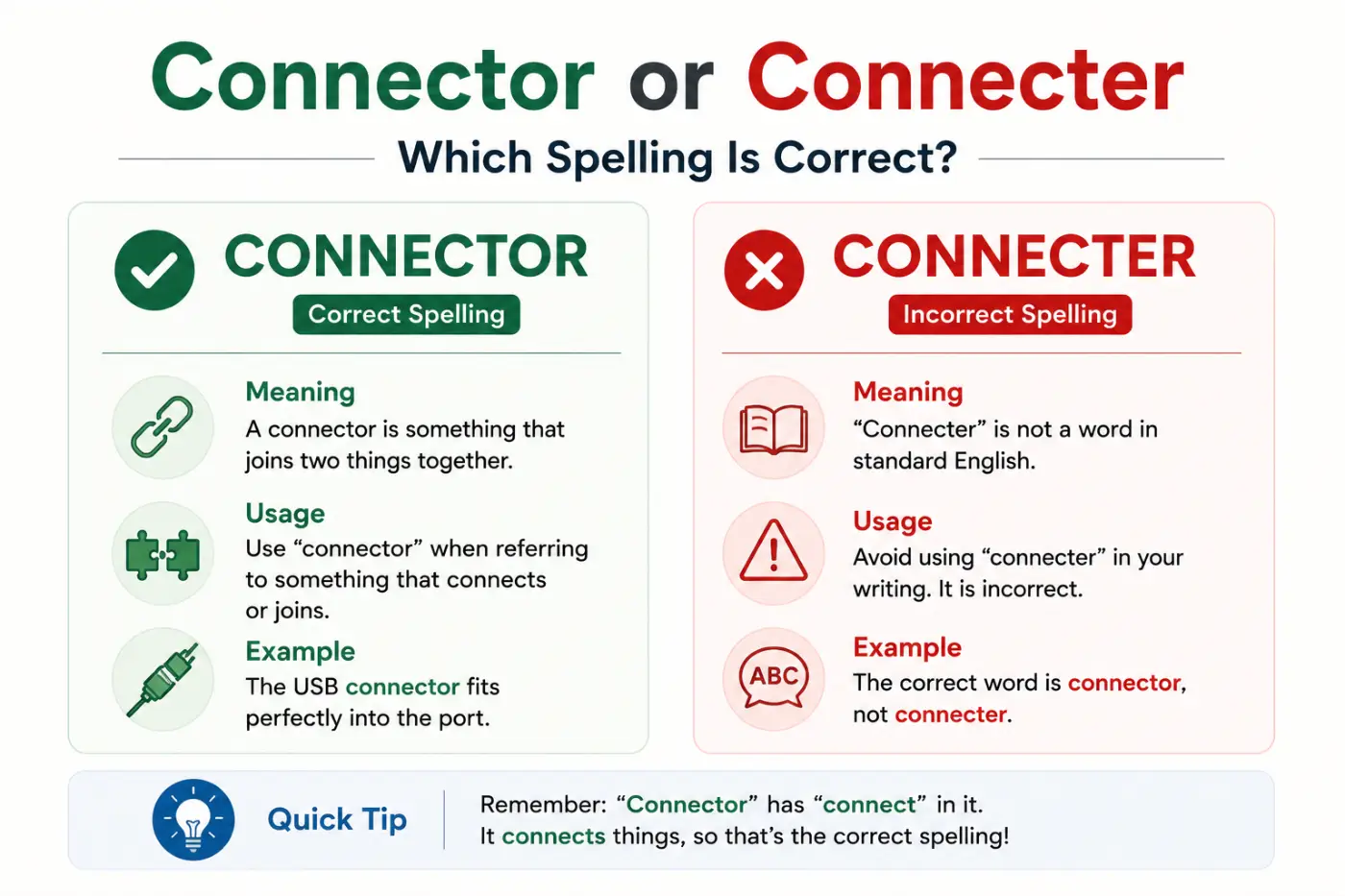
Connecter or connector is a common spelling question, especially because the verb connect naturally leads some writers to form the noun by simply adding er. The standard spelling used in modern English is connector. It refers to a person, thing, device, or component that connects something to something else.
The confusion comes from a normal English word formation pattern. Many nouns are created by adding er to a verb, such as teach to teacher and write to writer. That pattern can make connecter look perfectly reasonable. However, English spelling does not always follow a simple one rule system, and established nouns can develop forms that differ from what a writer might expect.
This distinction matters most in professional, technical, academic, and edited writing. If you need the standard noun for a device, part, person, or connecting component, connector is the form to choose. This guide explains the spelling, meaning, pronunciation, grammar, regional use, common mistakes, and practical examples so you can use the word confidently.
Quick Answer
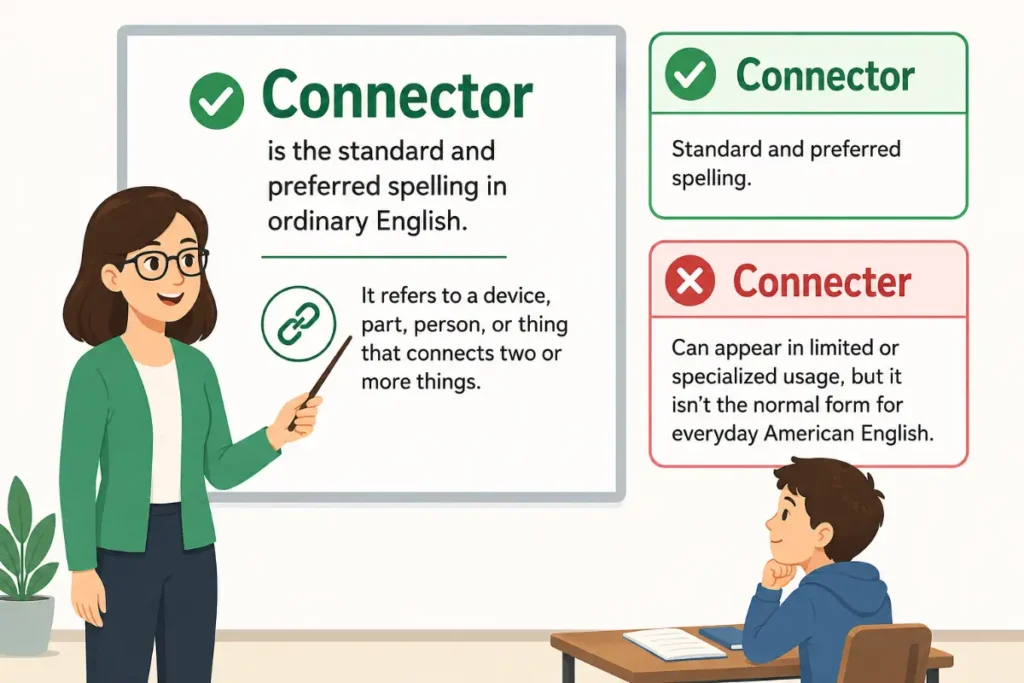
Connector is the standard and preferred spelling in modern American English. It is a noun for something that connects two or more things, such as an electrical component, cable fitting, or connecting element. Connecter may appear occasionally as a variant or nonstandard formation, but it is not the usual choice in edited English.
What Is the Correct Spelling?
The correct standard spelling is connector.
The word contains the ending or, not simply er:
connect + or = connector
This spelling is especially common when the noun refers to a device, part, or component designed to establish a connection. For example, a cable connector joins a cable to another cable, device, or port.
The spelling can also describe a person or thing that brings people, ideas, systems, or groups together. A person who regularly introduces people to one another may be called a connector.
The form connecter can be found in some dictionaries and historical or specialized contexts, but it is far less common. For general American English, professional writing, and technical documentation, connector is the safe and natural choice.
Connector Meaning and Definition
A connector is a noun that describes something that connects.
Its meaning depends on context. In everyday language, it can refer to a person who links people or groups. In technology, engineering, electronics, and construction, it often refers to a physical component that joins parts or allows systems to communicate.
Common meanings include:
- A device or component that joins two parts.
- A fitting used to attach cables, wires, pipes, or other materials.
- A person who brings people or groups together.
- A word or expression that links ideas in speech or writing.
For example:
The technician replaced the damaged connector.
Here, connector means a physical component.
In another sentence:
Maya is a natural connector who introduces people with similar interests.
Here, the word describes a person who creates social connections.
The basic idea remains the same: something is bringing separate things into a connection.
Is Connecter a Real Word?
Connecter does appear in English, but that does not make it the preferred spelling for ordinary modern usage.
Some English dictionaries have recorded connecter as a noun, particularly in older or less common usage. However, its presence in historical or specialized sources should not be taken to mean that it is equally common or equally suitable in every context.
For most readers, connector is the familiar standard form. It is the form normally expected in technical documents, workplace communication, educational materials, product descriptions, and general American English.
This is a useful distinction in spelling questions. A word can exist in a dictionary without being the best choice for modern everyday writing. English contains many rare, historical, regional, and specialized forms that are valid in particular settings but are not the normal choice for general communication.
If your goal is clear contemporary writing, use connector.
Connecter or Connector Comparison
| Form | Meaning | Part of Speech | Usage | Formality | Common Contexts | Example |
|---|---|---|---|---|---|---|
| connector | Something or someone that connects | Noun | Standard and common | Neutral to formal | Technology, electronics, writing, social relationships, general English | The connector fits securely into the port. |
| connecter | A person or thing that connects | Noun | Uncommon and less preferred | Less common | Rare, historical, or specialized usage | The form may appear in older texts. |
The key point is not that connecter can never be found. The practical point is that connector is the established form most readers expect.
Why Is Connector Spelled With Or?
The spelling reflects a broader pattern in English word formation.
English uses several noun forming endings, including er, or, and other forms. Both er and or can identify a person or thing associated with an action, but English does not always allow writers to choose between them freely.
Consider these examples:
- Act becomes actor.
- Inspect becomes inspector.
- Invent becomes inventor.
- Translate becomes translator.
- Connect becomes connector.
The or ending is especially common in many nouns with Latin based roots. Connect itself ultimately comes through Latin, and the established noun developed as connector.
That historical development helps explain why simply adding er is not the best way to form the modern noun. English spelling often preserves forms that developed over time rather than following a perfectly predictable formula.
Key Differences Explained
The main difference between the two forms is standardness and frequency rather than a major difference in meaning.
Spelling
The preferred spelling is connector.
It ends in or, giving the word its familiar form:
connector
The less common connecter ends in er and may appear in some sources, but it is not the usual spelling for modern general English.
Meaning
Both forms can relate to something or someone that connects. The practical distinction is that connector is the established form readers normally recognize and expect.
Part of Speech
Both forms function as nouns when they refer to a person or thing that connects.
For example:
The connector is damaged.
The word identifies a thing.
Pronunciation
The two forms are pronounced very similarly. This is one reason spelling confusion can persist.
Connector is commonly pronounced with three syllables:
kuh NEK tur
The ending sounds like ter in ordinary speech, even though it is spelled tor.
Formality
Connector works in both casual and formal writing.
It is appropriate in:
- Emails.
- Technical manuals.
- Academic writing.
- Business documents.
- Product descriptions.
- Everyday conversation.
Because it is the familiar standard form, it does not sound unusually formal.
Context
The word appears in many fields. You may encounter it in electronics, telecommunications, engineering, computing, writing, social science, and ordinary conversation.
A USB connector, for example, is a physical component. A connecting word can also be described as a connector in language.
Regional Usage
There is no major American versus British spelling difference that requires you to change connector to another form. The standard noun is widely understood across major varieties of English.
Which Form Should You Use?
Use connector in normal modern English.
If you are writing a report, email, instruction manual, website, academic paper, product description, or school assignment, connector is the form that will look natural to most readers.
You should not change it to connecter simply because the verb is connect and many other nouns end in er. Word formation in English is based on established usage, not always on a single productive rule.
A useful editing principle is simple: choose the established noun rather than creating a new form by mechanically attaching an ending to the verb.
That principle helps with many English spelling questions. A form may seem logical and still not be the standard word.
Sentence Examples
Here are natural examples showing how connector works in different contexts.
- The technician replaced the damaged connector before testing the equipment.
- Make sure the connector is fully inserted into the port.
- I need a different connector because this cable does not fit my laptop.
- The instruction manual explains how to attach the connector safely.
- The engineer designed a new connector for the electrical system.
- Our teacher used a connector such as however to link the two ideas.
- She is a great connector who knows people in several different industries.
- The company supplied every machine with the correct connector.
- The researcher used a connecting word to make the relationship between the two ideas clearer.
- Check the connector first if the device suddenly stops receiving power.
These examples show why context matters. The same noun can describe a physical component, a language element, or a person who connects others.
Common Mistakes and Misspellings
Spelling errors involving this word usually come from trying to apply a familiar word formation pattern.
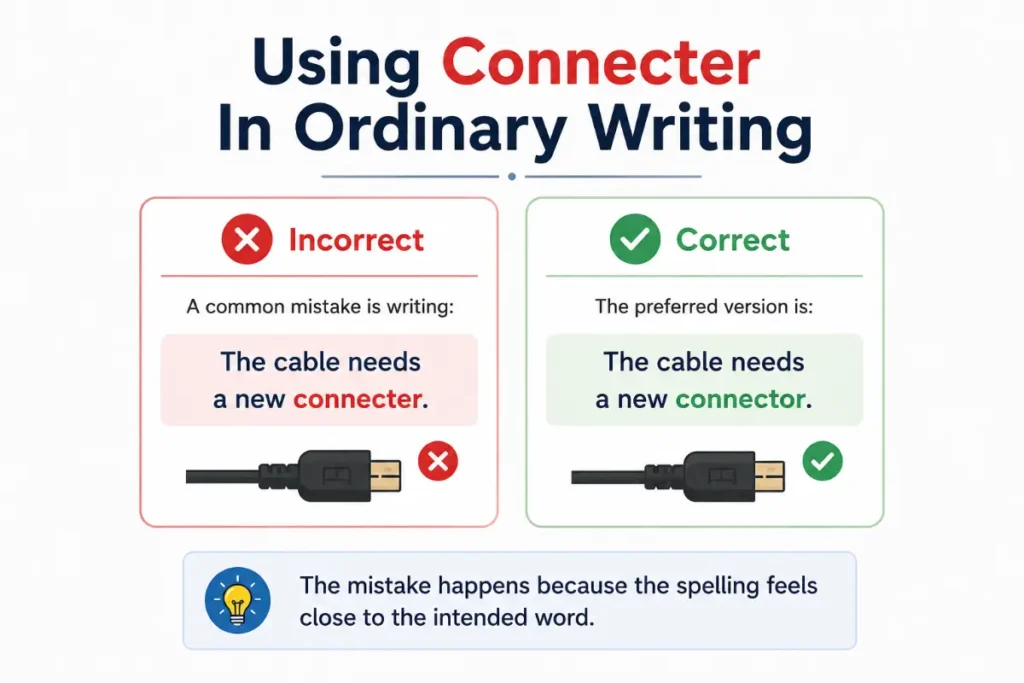
1. Writing connecter instead of connector
Incorrect or less preferred: connecter
Preferred: connector
The confusion comes from the common noun ending er. Since connect describes an action and many nouns formed from verbs end in er, connecter can seem natural. However, connector is the established form for standard modern usage.
2. Adding an extra o
Incorrect: connectorr
Correct: connector
This is a simple typing error. The standard spelling contains one r at the end.
3. Dropping the second c
Incorrect: conector
Correct: connector
The word retains the double n and double c pattern found in connect.
4. Confusing the noun with the verb
Incorrect: Please connector the cable.
Correct: Please connect the cable.
Connect is the verb. Connector is the noun.
This distinction is important because the ending changes the grammatical function of the word.
5. Treating the ending as completely predictable
A common mistake is assuming that every noun describing an agent must end in er. English has many nouns ending in or, and established vocabulary must be learned as it is used.
Pronunciation Guide
Connector is usually pronounced:
IPA: /kəˈnɛktər/
An easy pronunciation guide is:
kuh NEK tur
It has three syllables:
con · nec · tor
The main stress falls on the middle syllable:
con NECT or
The final sound is close to ter in ordinary American speech. This can make the spelling slightly confusing for learners because the spoken ending does not clearly reveal the written or.
The less common form connecter can sound almost identical in ordinary speech. That means pronunciation alone usually cannot tell you which spelling to write. When you are unsure, remember the established written form connector.
Etymology and Word Origin
The history of connector helps explain its spelling.
The verb connect comes from Latin connectere, meaning to join or bind together. It entered English through French and developed into the modern English verb connect.
The noun connector developed from the same word family. Its or ending reflects a noun forming pattern with strong Latin influence.
This is why the spelling does not simply follow the common English pattern of adding er to a verb. English vocabulary has developed through several languages and historical stages, so similar looking words can use different noun endings.
The modern word keeps the basic meaning found throughout this word family: joining, linking, or bringing things together.
Regional Usage
American English
Connector is the standard and familiar form in American English. It appears frequently in technical, business, educational, and everyday contexts.
American writers should use connector when referring to a physical component, a person who links people, or a language element that links ideas.
British English
British English also commonly uses connector. There is no major spelling change that requires British writers to replace it with connecter.
British technical writing, educational material, and general prose can all use connector naturally.
Australian English
Australian English generally follows the same standard spelling. Connector is the normal form in general and technical contexts.
There is no established Australian spelling rule that changes this noun to connecter.
Canadian English
Canadian English also commonly uses connector. The spelling does not create a significant regional distinction between Canadian and American English.
The practical rule is therefore simple: use connector across these major English varieties unless you are discussing a historical or specialized source that specifically uses another form.
Grammar Rules and Part of Speech
Connector is primarily a noun.
It can refer to a physical object:
It can also be used for a word or expression that links parts of language:
However is a useful connector between contrasting ideas.
The plural is connectors:
The box contains several different connectors.
The possessive forms follow ordinary noun rules:
The connector’s design was updated.
For plural possession:
The connectors’ shapes are different.
The word can appear after determiners such as a, the, this, that, each, and another.
Examples include:
I need a connector.
The connector is missing.
This connector is compatible with the device.
Each connector has a different function.
Do not use connector as the verb. The verb is connect.
Correct:
Connect the cable to the device.
Incorrect:
Connector the cable to the device.
This distinction is one of the easiest ways to remember the grammar. Connect names the action, while connector names the person or thing that performs or enables the connection.
Connector in Technical Language
Technical writing uses this noun very often.
In electronics, a connector is a component that joins electrical conductors or allows equipment to interface with another component. Different systems can require different connector designs based on size, shape, purpose, and compatibility.
Common technical expressions include:
- Cable connector.
- Electrical connector.
- Power connector.
- Audio connector.
- Network connector.
- USB connector.
- Connector port.
- Connector type.
For example:
The replacement cable uses a different connector.
Technical writing benefits from consistent terminology. If a product manual uses connector for a particular component, switching between connector and connecter can create unnecessary confusion.
Connector in Writing and Grammar
The word can also appear in discussions about language.
A connector can be a word or phrase that links ideas, sentences, or parts of a text. Depending on the grammar system being discussed, writers may also use terms such as linking word, transition, conjunction, or discourse marker.
For example:
I wanted to go; however, I was too tired.
Here, however helps signal a contrast between two ideas.
Other common connecting expressions include:
- Therefore.
- However.
- Also.
- Because.
- Although.
- In addition.
- For example.
- As a result.
The exact grammatical label can depend on how the word functions in the sentence. That is why it is better not to treat every connecting expression as the same type of grammatical unit.
Real Life Usage Examples
Daily Conversation
In everyday speech, the word often refers to a physical part.
Do you have a connector for this cable?
I think the connector is loose.
These sentences sound natural because the listener can understand that the word refers to a component that joins two parts.
Workplace Communication
Professional communication often uses the term in technical or practical instructions.
Please check the connector before replacing the entire cable.
The supplier sent the wrong connector for the new equipment.
The spelling connector is especially important in written workplace communication because technical terms need to remain consistent.
Academic Writing
In academic writing, the term can describe relationships between ideas or components.
The study examines how language connectors affect the flow of an argument.
The author uses several connectors to show contrast and cause.
In this context, the word has a language related meaning rather than a physical one.
News and Journalism
News writing may use the word to describe technology, infrastructure, or people.
The new system includes a connector designed for high speed data transfer.
The community leader became an important connector between local organizations.
The exact meaning depends on the subject being reported.
Literature and Storytelling
In storytelling, the noun can describe a person, object, or event that links separate parts of a story.
The old photograph became the connector between the two families.
Here, the word is being used more figuratively. The photograph creates a connection between people who might otherwise seem unrelated.
Related and Confused Terms
Several words are closely related to connector, but they are not always interchangeable.
Connect
Connect is the verb. It describes the action of joining or linking.
Connect the printer to the computer.
Connection
Connection is the noun describing the relationship, link, or act of being connected.
The internet connection is unstable.
Connecting
Connecting can function as a present participle, adjective, or gerund depending on the sentence.
The connecting cable is too short.
Link
Link can be a noun or verb and often has a meaning similar to connection.
Click the link to open the page.
Join
Join is a verb meaning to bring things together or become part of something.
Join the two pieces carefully.
Adapter
An adapter is a device that allows different systems, components, or formats to work together. An adapter may contain or use connectors, but the two terms do not always mean the same thing.
Interface
An interface is a point or system through which two components interact. In technology, it can refer to hardware, software, or a broader interaction point.
Transition
A transition is a word, phrase, or device that helps move from one idea, section, or state to another. In writing, transitions can overlap with the broader idea of connectors.
Understanding these related terms helps prevent vague word choices. Use connector when you mean a person, component, or linguistic element that creates a connection.
Why the Spelling Causes Confusion
The spelling problem is understandable because English gives learners strong patterns that do not always apply perfectly.
Words such as teach and teacher, write and writer, and drive and driver encourage writers to think that adding er is the normal way to create a noun from a verb.
That pattern works often enough to feel reliable. Yet English also has many nouns ending in or, including actor, editor, creator, translator, operator, and connector.
There is another source of confusion: the final syllable in connector sounds similar to the ending of many words spelled with er. In ordinary American pronunciation, the written or does not always sound distinctly different from an unstressed er.
So the ear does not provide a dependable spelling clue. The safest approach is to remember the established written form.
A Simple Memory Trick
A useful memory trick is to connect the spelling to the object itself.
A connector creates a connection.
Notice that both words contain the same connect base:
connect → connection → connector
This gives you a reliable spelling family to remember.
You can also think of the phrase:
A connector makes a connection.
The matching connect base in both nouns can help reinforce the correct spelling.
Another useful rule is not to assume that the person or thing performing an action must always be spelled with er. English uses both er and or endings, so established vocabulary should guide your choice.
Expert Editor Insight
An experienced editor would normally choose connector without hesitation in general American English. The main trap is the tempting er ending, which feels natural because many English agent nouns use it. Spelling tools may flag connecter because it is uncommon or less preferred in modern usage, while connector is the familiar standard form. In polished writing, consistency matters, so choose the established form and keep it consistent throughout the document.
Conclusion
Connector is the standard spelling you should use in modern American English. The word can refer to a physical component, a person who brings people together, or a language element that links ideas. Connecter may appear in some less common or historical contexts, but it should not be your default choice.
The spelling becomes easier to remember once you connect it with the related noun connection. Both words begin with connect, giving you a useful visual pattern: connect, connection, connector.
When editing your own work, do not rely only on pronunciation or the assumption that every verb based noun ends in er. English has established spelling patterns that must be learned word by word. For clear professional writing, choose connector.
FAQs
Is connecter a real English word?
Yes, connecter can be found in some English sources, including less common and historical usage. However, it is not the usual spelling in modern general English. For American English, professional documents, technical writing, and everyday communication, connector is the preferred choice.
What does connector mean?
A connector is a person, object, device, or language element that creates a connection. It can describe a physical component that joins cables or parts, a person who brings people together, or a word that helps link ideas in writing.
Which is correct: connecter or connector?
Connector is the standard and preferred spelling for modern general English. Connecter may appear as a less common variant, but it is not the form most writers should choose. If you are writing for a broad audience, use connector for clarity and consistency.
How do you pronounce connector?
Connector is commonly pronounced /kəˈnɛktər/, approximately kuh NEK tur. It has three syllables, with the main stress on the middle syllable. The final sound can resemble the sound found in words ending in er, which is one reason the spelling can be confusing.
Can connector start a sentence?
Yes. Connector can start a sentence whenever it functions as a noun.
For example:
Connector design has changed significantly over time.
Starting a sentence with the noun does not create a grammar problem. The important point is that the word must fit the meaning and grammatical structure of the sentence.
What is a synonym for connector?
Depending on the context, possible related words include link, connection, joiner, adapter, or interface. These words are not exact substitutes in every situation. For example, an adapter and a connector can be different types of technical components, so context should guide your choice.
Why do people spell connector as connecter?
The spelling confusion comes mainly from the common English pattern of forming nouns with er. Words such as teacher and writer make connecter look logical. Pronunciation adds to the problem because the final syllable of connector is not strongly pronounced like the spelling might suggest.
Is connector appropriate in formal writing?
Yes. Connector is fully suitable for formal, professional, academic, and technical writing. It is the preferred form when you need the noun for something or someone that connects. Using the established spelling also helps readers recognize the term quickly and prevents unnecessary distraction.

Confusing Words, Spelling & Word Choice
Claire Whitmore is a U.S.-based English editor who writes about commonly confused words, spelling differences, and word choice. Her work helps readers understand subtle distinctions between similar-looking words through simple definitions, practical examples, and modern usage guidance in both American and British English.