
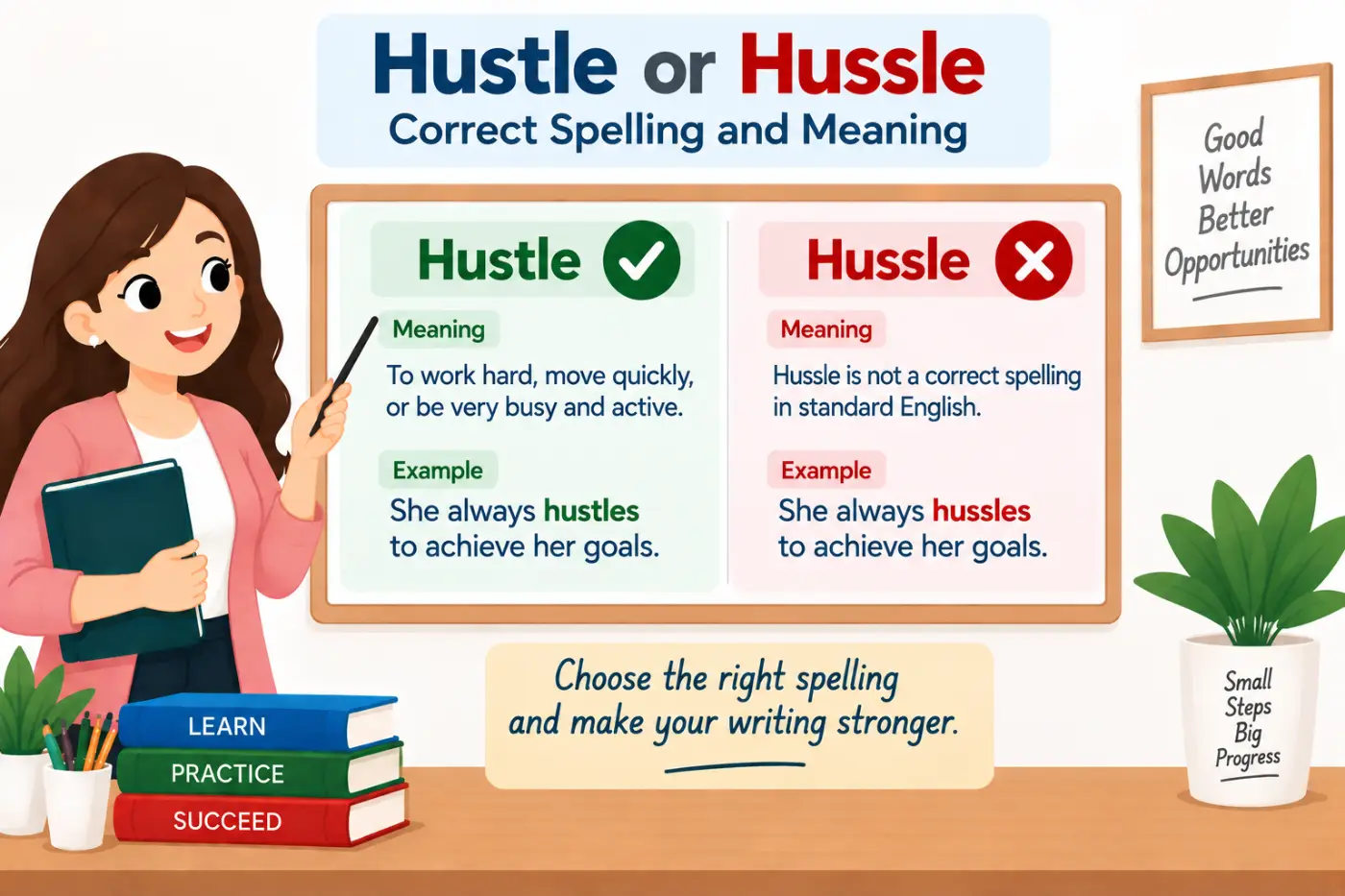
If you are unsure about hustle or hussle, the correct spelling in standard English is hustle. The form hussle is generally a misspelling and should not be used in standard writing. The confusion is understandable because the word is pronounced with a clear sound that can make the spelling pattern easy to misremember.
The word hustle has several meanings. It can describe moving quickly, pushing or urging someone to act, working hard, or making money through energetic effort. It can also refer to dishonest or aggressive activity in some contexts. Because the word has many uses, you may see it in everyday speech, business writing, sports, music, and informal online conversations.
This guide explains the correct spelling, meaning, pronunciation, grammar, origin, common mistakes, and real life usage. You will also see examples that show how native English speakers use the word naturally in different situations.
Quick Answer
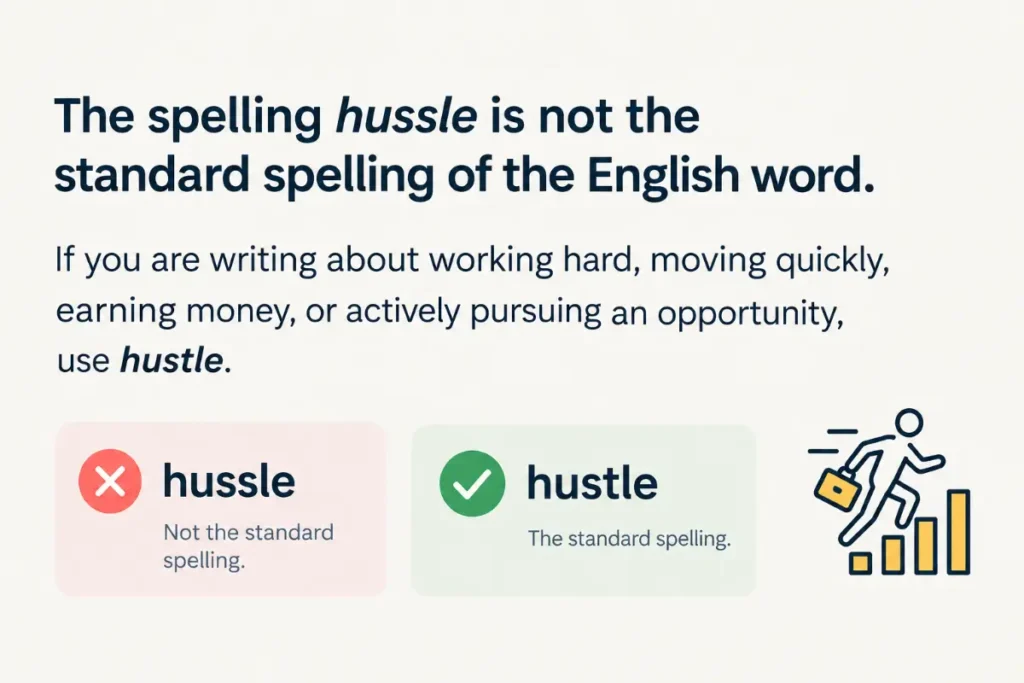
Hustle is the correct standard spelling. Hussle is normally a misspelling and should be corrected in formal and standard English writing. The correct word can be a verb or noun and can mean moving quickly, working energetically, making money through effort, or engaging in aggressive or dishonest activity depending on context.
Meaning of Hustle
The word hustle has more than one meaning, so context matters. Its basic idea often involves energy, speed, effort, or pressure.
As a verb, it can mean to move quickly or make someone move quickly.
For example:
We need to hustle if we want to catch the bus.
It can also mean working hard, especially when someone is actively trying to earn money or achieve a goal.
She hustles every day to build her business.
In another context, hustle can mean pushing, forcing, or persuading someone in an aggressive way.
The salesman tried to hustle the tourists.
As a noun, it can describe energetic activity or effort.
The daily hustle of city life can be exhausting.
It can also refer to a way of making money, especially through determined effort.
His side hustle helps him pay his monthly bills.
The meaning therefore depends strongly on the sentence. The word can have a positive, neutral, or negative sense.
Meaning of Hussle
Hussle is not the standard spelling of the common English word hustle.
Most uses of hussle in ordinary writing are simply spelling errors. A writer may add the second s because the pronunciation makes the spelling feel uncertain, or because English contains many words with repeated consonants.
There can be special cases where Hussle appears as part of a name, stage name, brand, title, username, or other proper name. A proper name can use an unusual spelling intentionally. That does not make hussle the standard spelling of the common English word.
For ordinary English writing, use hustle.
Hustle or Hussle Comparison
| Form | Meaning | Part of Speech | Standard English | Formality | Common Contexts |
|---|---|---|---|---|---|
| hustle | Move quickly, work energetically, pressure someone, or engage in a money making activity | Verb and noun | Yes | Informal to neutral | Conversation, work, sports, business, storytelling |
| hussle | Usually intended to represent the word hustle | Usually an incorrect spelling | No, except in names or special uses | Not standard | Typing errors, spelling mistakes, intentional names |
The key distinction is spelling, not pronunciation or meaning. If you intend the ordinary English word, choose hustle.
Which Form Is Correct?
Hustle is the correct form in standard English.
The word contains one s before the final l sound sequence. Adding another s produces hussle, which does not represent the standard spelling of the ordinary English word.
This is a spelling issue rather than a difference in meaning. You do not normally choose between two standard words. Instead, one form is standard and the other is usually an error.
For example:
- We need to hustle to finish the project on time.
- He started a side hustle to earn extra money.
- The coach told the players to hustle back onto the field.
In all three sentences, hustle is the correct choice.
Key Differences Explained
The difference can be understood through several simple points.
Spelling
The standard spelling is hustle.
The common incorrect spelling is hussle.
Remember that the word is spelled with one s after the u.
Meaning
Hustle has several established meanings. Hussle does not normally have a separate standard meaning in ordinary English.
Part of Speech
Hustle works as both a verb and a noun.
As a verb:
We need to hustle.
As a noun:
The morning hustle was exhausting.
Pronunciation
Both forms may be intended to sound the same when someone writes hussle by mistake. The spelling difference does not create a standard pronunciation distinction.
Formality
The word itself is common and natural, but some meanings are informal.
For example, hustle can sound perfectly natural in everyday conversation:
Hustle up. We’re late.
The phrase side hustle is also common in modern informal and business conversation.
In more formal writing, the word can still be correct when its meaning fits the context. A formal writer may choose a more precise alternative such as work, effort, activity, or rapid movement when that better matches the intended meaning.
Context
Context controls the meaning.
Someone can hustle to catch a train. A worker can hustle to earn extra money. A person can also hustle someone by using pressure or deception.
That range of meanings is one reason the word appears in many different settings.
Grammar and Part of Speech
Hustle can function as both a verb and a noun.
As a verb, it can be used without an object.
We hustled home before the rain started.
It can also take an object.
The coach hustled the players off the field.
In this use, the verb means to make someone move quickly.
The word can also describe energetic work.
She hustles to support her family.
As a noun, it can refer to busy activity or energetic effort.
The morning hustle starts early in the city.
A particularly common modern expression is side hustle. This means an additional way of earning money outside someone’s main job or regular source of income.
His photography business started as a side hustle.
The plural form is hustles when referring to more than one activity.
The past tense and past participle are hustled.
The present participle is hustling.
These forms follow normal English spelling patterns.
How to Pronounce Hustle
The standard pronunciation of hustle is:
IPA: /ˈhʌsəl/
An easy pronunciation guide is:
HUSS uhl
The first syllable receives the main stress.
The word has two syllables:
- HUS
- tle or uhl
The final part is pronounced as a weak vowel sound followed by the l sound. It does not sound like two fully stressed syllables.
A common mistake is to pronounce every letter strongly. Native speakers normally say the word smoothly, with the stress on the first syllable.
The pronunciation can help explain some spelling confusion, but it does not justify writing hussle in standard English.
Sentence Examples
Here are ten natural examples using the standard spelling.
- We need to hustle if we want to catch the next train.
- She started a side hustle selling handmade candles online.
- The coach told the players to hustle back onto the field.
- I had to hustle this morning because I woke up late.
- He has been hustling to grow his small business.
- The busy city has a constant hustle and energy.
- She works hard during the week and runs a small side hustle on weekends.
- The manager encouraged everyone to hustle and finish the project before Friday.
- They hustled through the crowded station to find their platform.
- His determination and daily hustle helped him reach his goal.
These examples show that the word can describe physical movement, hard work, business activity, or a busy lifestyle.
Real Life Usage
Daily Conversation
In casual conversation, the word often means moving quickly.
Hustle up or we’ll be late.
I had to hustle to get ready before everyone arrived.
This use is informal but very common.
Workplace Communication
The word can describe energetic work or determined effort.
We need to hustle today because the deadline is close.
Her hustle helped the team finish the project early.
In a formal workplace document, a more precise term may sometimes sound better. Words such as effort, initiative, productivity, or hard work can communicate the intended idea more clearly.
Business and Entrepreneurship
The expression side hustle is especially common in conversations about earning additional income.
His side hustle grew into a full time business.
She started a side hustle while working her regular job.
The phrase usually has a positive or neutral sense. It highlights extra work or an additional income source.
Academic Writing
The word can appear in academic writing, but writers should choose it carefully.
The study examines the economic pressures that encourage workers to pursue a side hustle.
This sentence works because the term refers to a recognizable social and economic activity. In highly formal writing, the writer may define the expression on first use if the audience may not know it.
News and Journalism
News writing may use hustle when reporting speech, business trends, sports, or social behavior.
The athlete’s hustle helped the team maintain its lead.
Many workers use a side hustle to supplement their income.
The best choice depends on the subject and tone of the article.
Literature and Storytelling
Writers often use the word to create a sense of movement or energy.
She hustled through the narrow streets before sunset.
It can also help describe the pressure and activity of urban life.
He was used to the hustle of the city.
Common Spelling Mistakes
Several errors can appear when people are unsure how to spell the word.
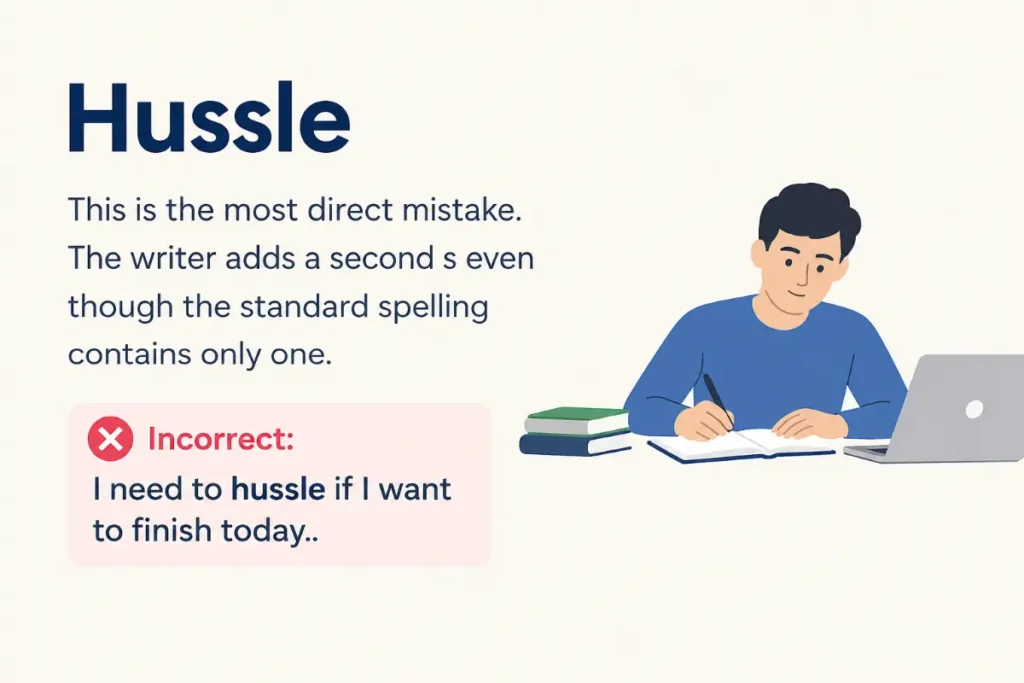
Writing Hussle
Incorrect:
She started a hussle to earn extra money.
Correct:
She started a hustle to earn extra money.
The extra s is the main spelling error.
Writing Hustel
Incorrect:
We need to hustel.
Correct:
We need to hustle.
This mistake can happen when writers remember the main sounds but place the final letters in the wrong order.
Writing Hustlle
Incorrect:
He has a small hustlle.
Correct:
He has a small hustle.
The extra l does not belong in the standard spelling.
Confusing Hustle With Muscle
The words hustle and muscle have similar spelling patterns and both end in sle, but they have different meanings.
The team showed plenty of hustle.
He injured a muscle in his leg.
Remembering the separate words can help prevent spelling errors.
Treating Hussle as an Alternative Spelling
Some writers assume hussle is an accepted variant because the pronunciation may seem to support it. In standard English, that assumption is incorrect.
Use hustle unless you are reproducing a specific proper name that intentionally uses another spelling.
Why Is Hustle Commonly Misspelled?
Spelling errors often happen because English spelling does not always match pronunciation perfectly. In this case, the final part of the word is not pronounced in a way that clearly reveals every written letter.
There is also a visual reason for the mistake. English contains many familiar words with doubled consonants, such as class, success, and address. A writer who remembers the sound but not the exact spelling may incorrectly add another s.
Typing habits can make the problem more common. When people type quickly, they often rely on sound based memory rather than checking the word’s written form.
The simplest solution is to memorize the standard pattern:
h u s t l e
Think of the middle letters as stl, not ssl.
Etymology and Word Origin
The history of hustle is interesting because the word has changed in meaning over time.
English dictionaries trace the word to Dutch husselen, a verb associated with shaking or tossing. The word entered English in the seventeenth century and developed meanings connected with pushing, moving, and handling things quickly.
Over time, English speakers expanded its use. The word came to describe moving with energy, making someone move, working actively, and later engaging in various forms of business activity.
Some later uses developed negative associations. Hustle can describe cheating, deception, or pressuring someone for money. At the same time, modern informal English often uses the word positively to describe determination and hard work.
This broad semantic range explains why the same word can sound positive in one sentence and negative in another.
For example:
She has an impressive hustle and works hard every day.
Here the word suggests determination.
Compare that with:
The scammer tried to hustle tourists out of their money.
Here it has a negative meaning involving dishonest activity.
American English
In American English, hustle is the standard spelling.
It is widely understood in everyday conversation and informal writing. Expressions such as side hustle, hustle up, and hustle and bustle are familiar to many American English speakers.
The word can also appear in sports.
The team won because of its hustle and determination.
In business and personal finance discussions, side hustle commonly refers to an additional income activity.
The spelling hussle is not the normal American English spelling of the word.
British English
British English also uses hustle as the standard spelling.
There is no major British spelling difference that changes hustle into hussle.
British speakers may use the word in similar ways to American speakers, although the frequency of particular informal expressions can vary by context.
For example:
He hustled to get home before dark.
The standard spelling remains hustle.
Canadian English
Canadian English also uses hustle as the standard spelling.
There is no established Canadian spelling rule that changes the ordinary word to hussle.
Canadian writers can therefore use the same standard form found in American and British English.
Australian English
Australian English also uses hustle as the standard spelling.
The word can appear in informal conversation, sports, business, and general writing. The spelling hussle is not a standard regional alternative.
So across the major English varieties discussed here, the ordinary word keeps the same spelling.
Hustle and Its Different Meanings
One reason this word can be confusing is that it has developed several related meanings.
Moving Quickly
Hustle or we’ll miss the bus.
Here it means to move quickly.
Making Someone Move
The staff hustled the guests toward the exit.
Here it means to move or encourage someone to move quickly.
Working Hard
She hustles every day to build her career.
Here it suggests energetic and determined effort.
Earning Extra Money
His side hustle brings in extra income.
Here it refers to an additional money making activity.
Pressuring or Deceiving Someone
The seller tried to hustle the customer.
Here the word can suggest dishonest or aggressive behavior.
Busy Activity
The hustle of downtown life can be exciting.
Here it describes energetic or busy activity.
Context tells the reader which meaning is intended.
Related and Confused Terms
Several words and phrases are closely connected with hustle.
Side Hustle
A side hustle is an additional income activity outside a person’s main job.
Photography is her side hustle.
Hustle and Bustle
This phrase describes noisy, energetic, and busy activity, often in a crowded place.
I enjoy the hustle and bustle of downtown.
Hard Work
Hard work is a broad and neutral phrase for putting in effort.
Hard work helped him improve his skills.
It is less informal than some uses of hustle.
Effort
Effort refers to the energy someone puts into doing something.
Her effort made a real difference.
It is often a better choice in formal writing.
Grind
Grind is an informal term for continuous or demanding work.
He is tired of the daily grind.
It overlaps with the hard work sense of hustle, but it often emphasizes routine or difficulty.
Push
Push can mean making an effort or encouraging someone to act.
We need to push ourselves to finish the project.
It can also mean physically moving something.
Rush
Rush means to move or act very quickly.
I had to rush to the airport.
It is close to one meaning of hustle, but it does not carry all of the same meanings.
Scam
A scam is a dishonest scheme designed to deceive people.
The email was a scam.
This term is much more specific than hustle when deception is the main idea.
Hustle in Common Expressions
The word appears in several familiar expressions.
Hustle Up
Hustle up means to move or act faster.
Hustle up. The movie is about to start.
This expression is informal.
Side Hustle
A side hustle is extra work or a business activity that produces income alongside a person’s main job or career.
Her side hustle became a successful business.
Hustle and Bustle
Hustle and bustle describes the energetic noise and activity of a busy place.
We escaped the hustle and bustle of the city for the weekend.
Hustle Hard
Hustle hard is an informal expression encouraging persistent effort.
She believes you have to hustle hard to reach your goals.
This phrase is common in motivational and casual language but may sound too informal for some professional documents.
Is Hustle Appropriate in Formal Writing?
Yes, but context matters.
The word itself is not grammatically wrong or automatically too informal for formal writing. However, some of its meanings and expressions have a strongly conversational tone.
For example, side hustle may be suitable in an article about modern employment or personal income. A formal academic paper might instead use secondary employment, additional income activity, or another more precise term if that wording better fits the subject.
Likewise, hustle up is natural in conversation but usually sounds too casual for a formal report.
A useful editing rule is simple: choose the word that communicates the exact meaning and matches the tone of the document.
Expert Editor Insight
An experienced editor would treat hustle as the normal spelling and hussle as an error unless the unusual form is part of a proper name. The confusion often comes from sound based spelling and the common English pattern of doubled consonants. Spell checkers usually recognize the standard form and may flag the extra s, but writers should still check the meaning and context because automatic correction cannot always understand intentional names or specialized uses.
A Simple Memory Trick
If you often write the wrong form, use this visual reminder:
HUSTLE = HUS + TLE
There is only one s after the u.
You can also connect the spelling to another familiar word ending:
bustle
hustle
Both words end in stle.
This gives you a useful pattern to remember. If you know how to spell bustle, you can use that pattern to help remember hustle.
Another helpful trick is to associate hustle with hustle and bustle. The two words share the same ending pattern.
When to Use Hustle
Use hustle when you mean one of the following ideas:
- Move quickly.
- Make someone move quickly.
- Work with energy and determination.
- Earn money through an additional activity.
- Describe busy or energetic activity.
- Describe aggressive or dishonest activity when the context supports that meaning.
For example:
We need to hustle to get there on time.
Her side hustle brings in extra money.
The hustle and bustle of the city never seems to stop.
The player showed great hustle throughout the game.
These uses are all standard.
When Not to Use Hussle
Do not use hussle as the ordinary spelling of the English word.
For example:
Incorrect: I need to hussle to finish this work.
Correct: I need to hustle to finish this work.
Similarly:
Incorrect: He has a successful side hussle.
Correct: He has a successful side hustle.
The only reason to preserve hussle would be if you are intentionally reproducing a name, title, username, brand, or another proper form that uses that spelling.
Expert Editor Insight
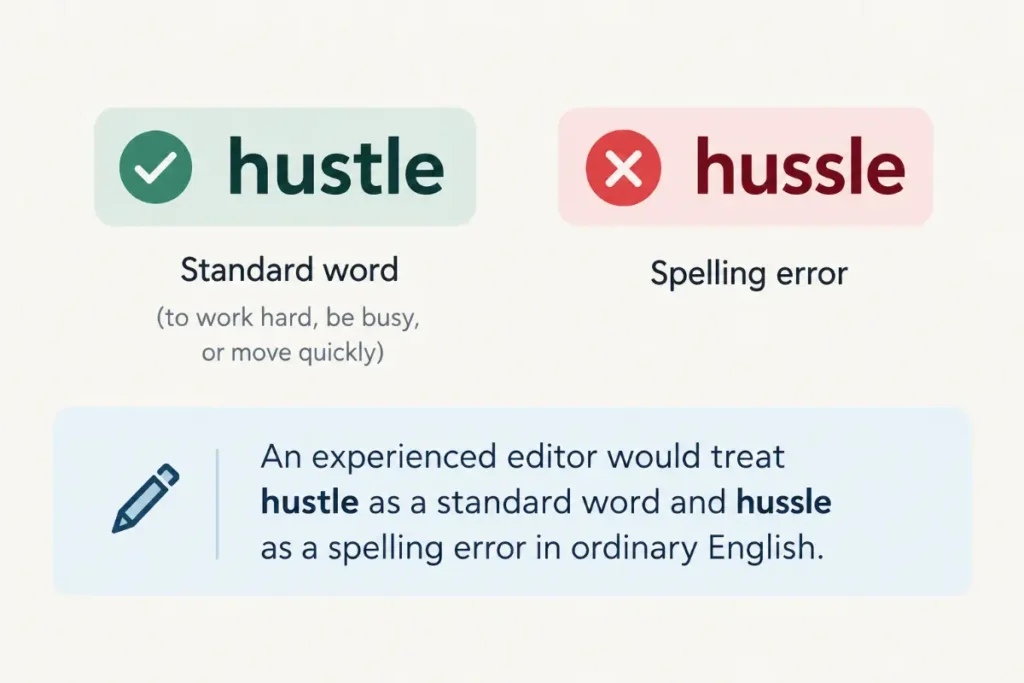
An experienced editor would treat hustle as a standard word and hussle as a spelling error in ordinary English. The confusion is understandable because the spoken form does not clearly reveal the spelling, and English has many words with repeated consonants. Editors also check meaning because hustle can describe quick movement, hard work, busy activity, persuasion, or money making. If the audience is formal, a more precise term may sometimes work better. The most useful proofreading habit is simple: remember that the standard word has one s before the t.
Key Takeaways
- Hustle is the standard spelling.
- Hussle is normally a misspelling.
- Hustle can function as both a noun and a verb.
- The word can mean moving quickly, working hard, earning extra money, or pressuring someone.
- The phrase side hustle refers to an additional income activity.
- Hustle and bustle describes busy and energetic activity.
- The standard pronunciation is approximately HUSS uhl.
- The word is used in American, British, Canadian, and Australian English.
- The unusual spelling hussle may appear intentionally in a proper name, but that does not make it the standard spelling.
- A useful memory trick is to remember the stle pattern in hustle and bustle.
Conclusion
Hustle or hussle is an easy spelling choice once you remember that hustle is the standard English form. The extra s in hussle does not belong in the ordinary word. Use the correct spelling in schoolwork, professional communication, websites, articles, and other standard writing.
The word itself has several meanings, including moving quickly, working with energy, earning extra money, and pressuring or deceiving someone. Its meaning comes from context, but its standard spelling stays the same. The word is also used across major varieties of English, so you do not need a different spelling for American, British, Canadian, or Australian English.
For an easy editing trick, connect hustle with bustle. Both use the stle ending. If you remember that pattern, you can quickly avoid the common hussle spelling mistake.
Frequently Asked Questions
Is hussle a real English word?
Hussle is not the standard spelling of the common English word meaning to move quickly, work energetically, or engage in certain money making activities. Most ordinary uses of hussle are spelling errors. It can still appear intentionally as part of a proper name, username, title, or brand, but that does not make it the standard spelling of the common word.
What does hustle mean?
Hustle can mean several things depending on context. It can mean moving quickly, making someone move quickly, working energetically, earning money through extra work, or pressuring or deceiving someone. As a noun, it can describe energetic activity or effort. The phrase side hustle refers to an additional income activity.
Which is correct, hustle or hussle?
Hustle is correct in standard English. Hussle is normally a misspelling. The two forms are often pronounced the same when someone writes the incorrect version, so the problem is mainly visual and spelling based. For school, work, websites, formal documents, and standard communication, use hustle.
How do you pronounce hustle?
Hustle is pronounced approximately HUSS uhl. Its IPA pronunciation is /ˈhʌsəl/. It has two syllables, with the main stress on the first syllable. The final syllable is weak, so the word is normally spoken smoothly rather than with equal stress on both parts.
Can hustle start a sentence?
Yes. Hustle can start a sentence when it functions as a verb or noun. For example, you can write, Hustle if you want to catch the bus. You can also begin with the noun: Hustle and bustle filled the streets. Starting a sentence with the word does not create a grammar problem.
Is hustle appropriate in formal writing?
Hustle can be appropriate in formal writing when its meaning fits the subject. However, informal expressions such as hustle up may sound too casual for a formal report. In professional or academic writing, choose a more precise term such as effort, rapid movement, or additional employment when that wording better matches the intended meaning.
Why do people spell hustle as hussle?
People may write hussle because the pronunciation does not clearly reveal the exact spelling. English also contains many familiar words with doubled consonants, so adding a second s can feel natural. Fast typing and sound based spelling can add to the problem. The best memory aid is to remember the stle ending.
What is a synonym for hustle?
The best synonym depends on the meaning. For moving quickly, rush or hurry may work. For energetic work, effort or hard work may fit. For extra income, side business or additional work may work in some contexts. For dishonest activity, scam or deceive may be more precise when those meanings are intended.

English Grammar & Usage
Nathan Holloway is an American grammar writer and language researcher who specializes in English grammar, sentence structure, verb usage, and common writing mistakes. He enjoys breaking down confusing grammar rules into practical explanations with clear examples, making English easier for students, professionals, and everyday writers.