
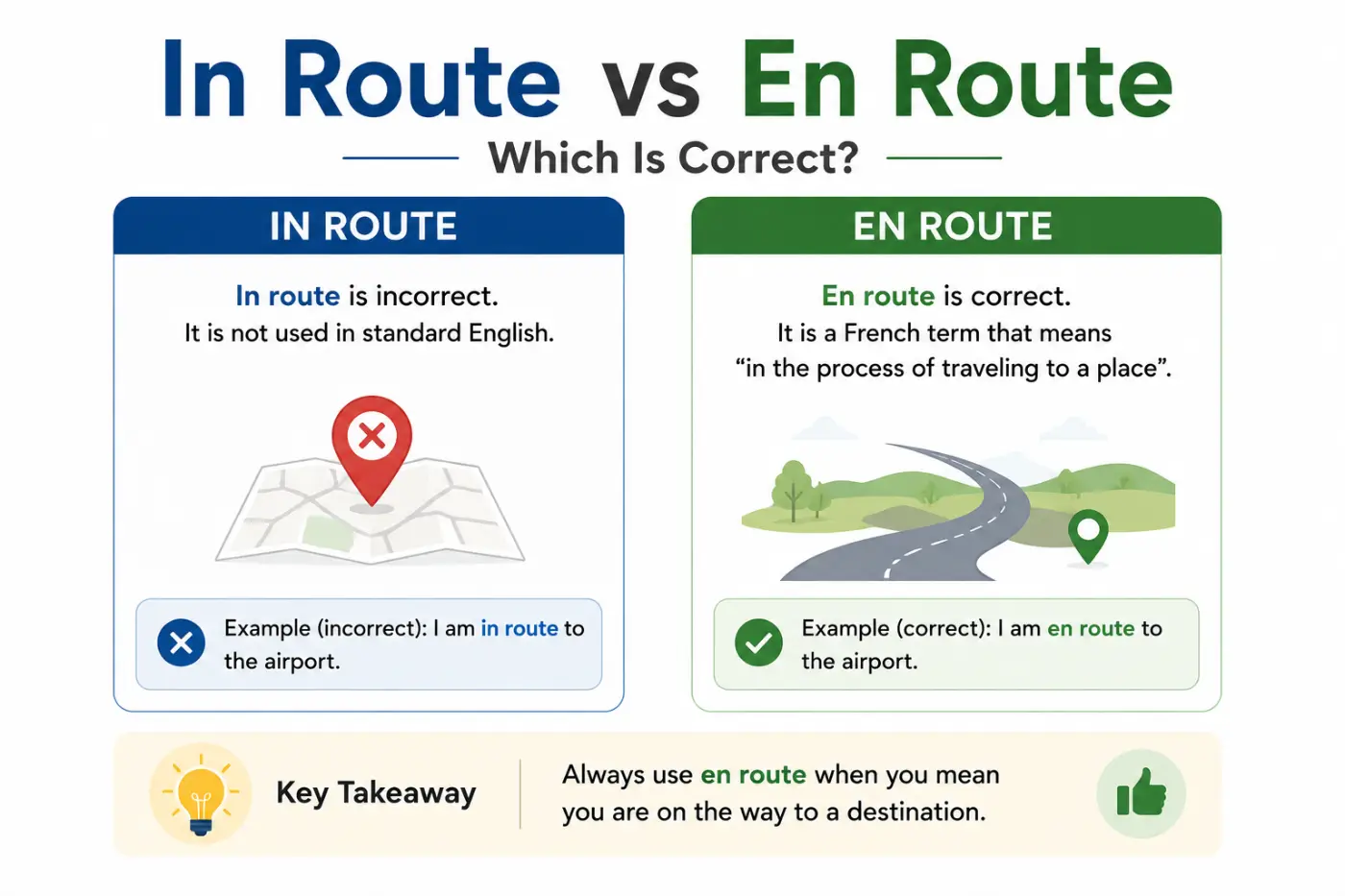
In route vs en route is a common spelling question because the two expressions sound similar, but only one is the standard expression used in English. The correct form is en route, which means traveling to a destination or on the way to a place. The form in route is generally considered a nonstandard spelling when used with this meaning.
The confusion is easy to understand. English speakers often hear the phrase rather than see it in writing, and the sound can make en seem like the more familiar word in. Since English also uses many phrases that begin with in, writers may naturally spell the expression that way.
Understanding the difference is useful in everyday messages, workplace writing, travel updates, journalism, and formal communication. This guide explains the meaning, spelling, pronunciation, grammar, history, regional usage, common mistakes, and natural alternatives so you can use the expression with confidence.
Quick Answer
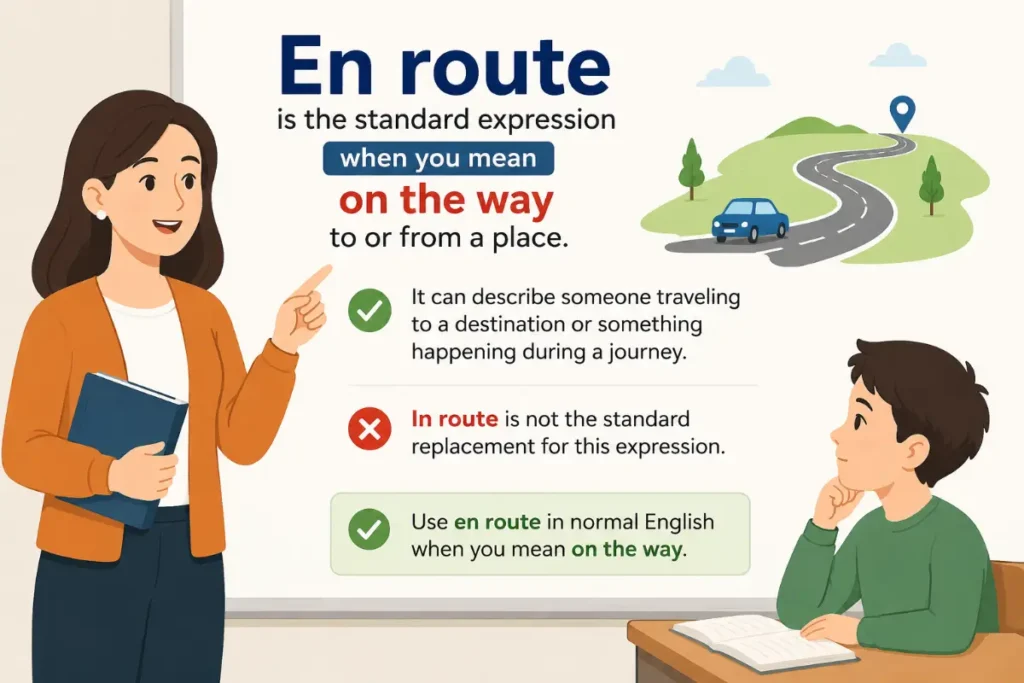
En route is the standard English expression for being on the way to a destination. In route is usually a misspelling or nonstandard form when it is intended to mean the same thing. The phrase comes from French and literally means on the way or on the route. Use en route in both formal and informal English.
Quick Answer to the Spelling Question
If you are deciding between the two forms, choose en route.
The expression is normally written as two words. It functions as an adjective or adverbial phrase depending on the sentence, and it describes someone or something that is traveling toward a destination or is on the way.
For example:
The package is en route to your address.
You could also say:
We are en route to the airport.
The first sentence uses the expression to describe the package. The second uses it to describe the action or state of traveling.
The spelling in route can appear in informal writing, typing, or learner English, but it is not the standard form for this meaning. A professional editor would normally change it to en route.
Comparison Table
| Form | Meaning | Part of Speech | Origin | Usage Frequency | Formality | Common Contexts | Example |
|---|---|---|---|---|---|---|---|
| en route | On the way to a destination | Adverbial or adjectival phrase | French | Common | Neutral to formal | Travel, shipping, work, news, everyday speech | The driver is en route to the office. |
| in route | Usually intended to mean on the way | Nonstandard phrase in this use | English spelling confusion | Less common | Informal and nonstandard | Typing errors, learner writing | The driver is in route to the office. |
The table shows the main point clearly. En route is the established expression. The other form usually results from spelling the phrase according to its sound or replacing the French word en with the familiar English word in.
Meaning and Definition
What Does En Route Mean?
En route means on the way to a destination.
It can describe people, vehicles, packages, documents, supplies, or other things that are moving from one place toward another. It can also describe something that happens during a journey.
Consider these examples:
The ambulance is en route to the hospital.
Your order is currently en route.
We stopped for coffee en route to Chicago.
In each sentence, the expression connects an action or situation with travel toward a destination.
The phrase doesn’t always require an actual physical vehicle. It can also be used more broadly for something that is progressing toward a particular place or goal.
For example:
The project is en route to completion.
This use is less literal. The project isn’t physically traveling, but the phrase suggests progress toward a desired result.
Meaning of the Nonstandard Form
In route is not normally the standard expression for this meaning.
People often write it because the phrase sounds similar to in route when spoken. English has many common expressions beginning with in, so the spelling may seem logical at first.
For example, English speakers are familiar with phrases such as in progress, in transit, in motion, and in place. That pattern can make in route look reasonable even though the established expression is en route.
If you encounter in route in ordinary writing, the safest interpretation is that the writer intended en route.
Key Differences Explained
The difference between the two forms is mainly a matter of standard usage and spelling rather than meaning.
- SpellingThe standard form is en route. It contains the French word en, not the English preposition in.
- MeaningEn route means on the way to a destination or during a journey. The nonstandard form is usually intended to express the same idea.
- GrammarEn route works as a phrase rather than as a single English verb or noun. It can describe a person, object, action, or stage of a journey.
- PronunciationThe phrase is commonly pronounced close to ahn ROOT in American English. The spelling does not directly tell an English reader how the phrase sounds.
- FormalityEn route is suitable for everyday speech, business writing, travel messages, journalism, and formal writing. It isn’t limited to highly formal situations.
- Regional usageThe standard spelling remains en route across major varieties of English. There isn’t a standard American spelling and a separate British spelling for this phrase.
- Standard usageEn route is the established form. Using it avoids confusion and follows normal English usage.
Which Form Is Correct?
En route is the correct standard form when you mean on the way.
The reason is historical as well as grammatical. English borrowed the expression from French, and the original French phrase uses en. English retained the expression in that form rather than replacing en with the English word in.
This is similar to other borrowed expressions that keep features of their original language. English contains many words and phrases that originated in French, Latin, Greek, Italian, Spanish, and other languages. Some have become completely natural parts of English while retaining their original spelling.
You don’t need to know French to use the phrase correctly. The practical rule is simple: when you mean on the way to a destination, write en route.
How to Use En Route in a Sentence
The phrase can appear in several positions.
Before a Destination
This is one of the most common patterns.
We are en route to the airport.
The truck is en route to the warehouse.
The structure is usually:
en route + to + destination
The destination can be a physical place such as a city, office, school, airport, or home.
Without a Destination
You can also use the phrase when the destination is already understood.
The doctor is en route.
Your replacement order is en route.
In these sentences, the listener already knows where the person or object is going.
During a Journey
The phrase can describe something that happens while traveling.
We stopped for lunch en route.
She called me en route to the meeting.
Here, the expression has the sense of while on the way.
With a Past Tense Verb
The phrase works naturally with past tense verbs.
We stopped at a small café en route to the coast.
The police found the vehicle en route to the border.
With a Future Context
It can also describe planned travel.
The team will be en route by six in the morning.
The expression itself doesn’t indicate tense. The verb around it provides the time information.
Sentence Examples
Here are ten natural examples showing how the standard expression works in different settings.
- Everyday conversation: We can grab some coffee en route to the mall.
- Text message: I’m en route now and should be there soon.
- Workplace communication: The replacement equipment is en route to our main office.
- Customer service: Your order has been shipped and is now en route.
- School: The students stopped at a museum en route to the university.
- Academic writing: The researchers collected additional observations en route to the study site.
- Formal writing: The delegation met with local officials en route to the capital.
- Social situation: We picked up Sarah en route to the restaurant.
- News style: Emergency crews were en route to the scene within minutes.
- Storytelling: En route to the village, they noticed smoke rising over the hills.
These examples show that the expression is flexible. It can fit casual conversation just as easily as professional or formal writing.
Common Mistakes and Misspellings
Several mistakes tend to appear because the phrase is pronounced differently from the way many English speakers expect it to be spelled.
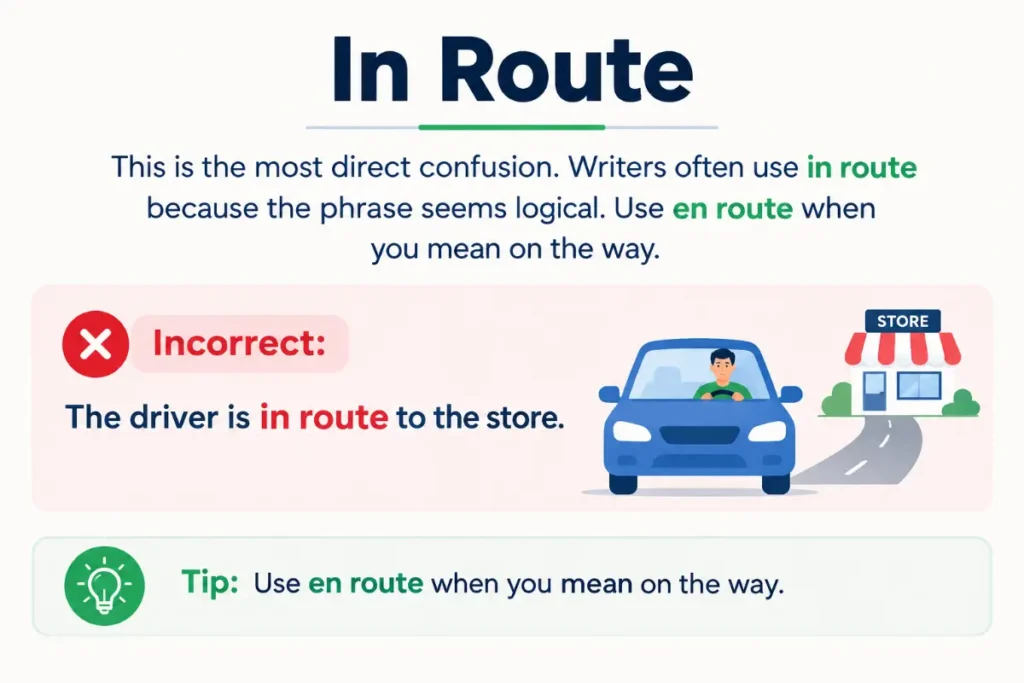
Mistake 1: Writing In Route
Incorrect in standard usage:
The package is in route.
Correct:
The package is en route.
The most common reason for this mistake is sound based spelling. Writers hear a short vowel sound and connect it with the familiar English word in.
Mistake 2: Writing Enroute
Incorrect:
The package is enroute.
Correct:
The package is en route.
The standard expression contains two words. Combining them into one changes the established spelling.
Mistake 3: Writing On Route
On route is not the standard expression when you are using the borrowed phrase discussed here.
For example:
We are en route to Dallas.
However, on the route is a normal English phrase with a slightly different structure.
We stopped at a gas station on the route to Dallas.
The second expression refers more literally to a particular route.
Mistake 4: Adding Unnecessary Words
Some writers use a longer construction when the simple phrase would be clearer.
We are currently in the process of being en route to the airport.
A natural version is:
We are en route to the airport.
Clear writing usually benefits from the shorter construction.
Mistake 5: Treating the Phrase as a Verb
En route isn’t a verb.
You wouldn’t normally write:
We en route to the airport.
Instead, use a suitable verb:
We are en route to the airport.
The verb are supplies the grammatical structure, while en route describes the situation.
Pronunciation Guide
The pronunciation of en route can surprise English learners because the spelling reflects its French origin.
In American English, it is commonly pronounced approximately:
ahn ROOT
A dictionary style pronunciation may represent it with IPA such as /ɑːn ˈruːt/, although exact pronunciation can vary by speaker and dialect.
The phrase has two main spoken parts:
en
route
The second part receives the main stress:
en ROUTE
The word route itself has more than one established pronunciation in English. American speakers commonly pronounce it as root or rowt, depending on the speaker and region. That variation does not change the spelling of the phrase.
A common mistake is to pronounce the phrase as if en were the English word in. The spelling and origin explain why the first part doesn’t simply follow the spelling pattern of ordinary English prepositions.
Etymology and Word Origin
The history of the expression explains its unusual spelling.
En route comes from French. The French word route means road, way, or route, while en can express the idea of being in or on a particular state or course. Together, the phrase conveys the idea of being on the way.
English borrowed the expression from French and retained its French spelling.
The English word route also came through French and ultimately has a longer history connected with Latin. Over time, en route became established in English as a useful expression for travel and movement.
This history matters because it explains why replacing en with the English word in creates a nonstandard form. The phrase entered English as a set expression, so its spelling is best learned as a whole.
You don’t have to translate the phrase every time you use it. Treat en route as an established English expression that means on the way.
Regional Usage
American English
En route is standard in American English. It appears in everyday conversation, business communication, shipping updates, journalism, travel writing, and formal documents.
American speakers may pronounce route as root or rowt, but both pronunciation patterns can occur independently of the spelling.
British English
British English also uses en route as the standard spelling. There is no separate British spelling that changes en to in.
British pronunciation of route can differ from common American pronunciation, but the written form remains the same.
Australian English
Australian English also uses en route as the established expression. There is no major regional spelling difference that turns it into in route.
Canadian English
Canadian English likewise uses en route. Canadian speakers may show some variation in pronunciation because Canadian English shares features with both American and British English, but the standard written form remains unchanged.
The important point across these varieties is simple: the spelling en route is broadly established in standard English.
Grammar Rules and Part of Speech
One reason the phrase can seem confusing is that it doesn’t behave like a simple English word.
It Is a Phrase
En route is a fixed expression made up of two words. It normally functions adverbially or adjectivally depending on how it is used.
For example:
The ambulance is en route.
Here, the phrase tells us the state or location of the ambulance in relation to its journey.
In another sentence:
The en route inspection took longer than expected.
This kind of adjectival use is possible, although writers often choose a clearer alternative depending on the context.
It Commonly Appears With To
A very common structure is:
en route to + destination
Examples include:
We are en route to Boston.
The shipment is en route to the customer.
She called en route to work.
The word to introduces the destination.
It Can Appear at the End of a Sentence
You can also place the expression at the end when the destination is already known.
The driver is en route.
The package is en route.
This is especially common in short updates.
It Can Appear at the Beginning
The phrase can begin a sentence when it describes something that happened during a journey.
En route to the station, we saw an accident.
This construction is grammatical and fairly common in formal or polished writing.
Real Life Usage Examples
Daily Conversation
In casual conversation, speakers often use en route when giving someone a travel update.
I’m en route to your house now.
We grabbed dinner en route to the movie.
The phrase can sound slightly more polished than on the way, but it is still natural in ordinary speech.
Email and Workplace Communication
Workplace messages often use the expression for deliveries, employees, equipment, and travel.
The technician is en route to the site.
The documents are en route to our New York office.
In a short business update, the phrase can communicate movement clearly without adding unnecessary detail.
Academic Writing
Academic writers may use the expression when describing movement between research locations or stages of a study.
The researchers collected samples en route to the field station.
It should not be added merely to make writing sound formal. On the way may be clearer in many academic sentences.
News and Journalism
News writing can use the phrase to describe emergency services, officials, vehicles, or other people traveling to a location.
Fire crews were en route to the building.
The expression works well in this setting because it communicates movement in a compact way.
Literature and Storytelling
Writers may use the phrase to describe a journey.
En route to the old farmhouse, she noticed that the road had become unusually quiet.
In storytelling, it can add a slightly polished or formal tone. A writer may choose on the way instead when a more conversational voice fits the scene.
Related and Confused Terms
Several expressions are closely related to en route, but they don’t always mean exactly the same thing.
On the Way
This is the closest everyday alternative.
I’m on the way home.
It is very natural in casual American English and often sounds more conversational than en route.
On the Road
This usually suggests traveling by road or being away from home while traveling.
We have been on the road since early morning.
It doesn’t always mean that someone is currently traveling toward one specific destination.
In Transit
In transit means moving from one place to another, especially during transportation.
Your package is currently in transit.
This expression is common in shipping and logistics.
Heading To
Heading to directly describes movement toward a destination.
I’m heading to the office.
It is highly natural in everyday conversation.
On the Route
On the route refers to being on a particular route or path.
There are three stops on the route.
This is different from the fixed expression en route.
Underway
Underway means that something has started and is progressing.
The repair work is underway.
It can describe an activity rather than physical travel.
Approaching
Approaching means moving closer to a person, place, or point.
The train is approaching the station.
It focuses on getting closer rather than simply being on a journey.
Bound For
Bound for means traveling toward a particular destination.
The train is bound for Chicago.
It is useful when the destination is the main point of the sentence.
En Route Compared With On the Way
For many everyday situations, on the way is the simplest alternative.
Compare these sentences:
We are en route to the airport.
We are on the way to the airport.
Both communicate that the speakers are traveling toward the airport. The difference is mainly one of style and tone.
On the way is extremely common and conversational. En route can sound a little more polished or formal, although it is not restricted to formal writing.
For a text message to a friend, I’m on the way may sound more natural. For a shipping update, Your order is en route can sound concise and professional.
En Route Compared With In Transit
These phrases overlap, but they aren’t identical in every context.
En route focuses on being on the way toward a destination.
The courier is en route to the office.
In transit focuses more broadly on something being transported from one location to another.
The package is in transit.
A package can be in transit even if it has stopped temporarily at a sorting center. The phrase describes the transportation process rather than necessarily saying that the package is physically moving at that exact moment.
This distinction is useful in logistics, shipping, and customer service.
Is En Route Formal or Informal?
En route can be used in both formal and informal English.
It is perfectly acceptable in a business email:
The representative is en route to the meeting.
It can also appear in a casual text:
I’m en route. See you soon.
Still, on the way is often more conversational in everyday American speech.
The best choice depends on the tone you want. Don’t assume that using a French expression automatically makes a sentence better. Choose the wording that communicates the idea clearly.
Why Do People Confuse the Two Forms?
The main reason is pronunciation.
When people hear en route, the first part can sound similar to the English word in. If someone has learned the phrase mainly through speech, they may spell it according to what they hear.
Another reason is familiarity. In is an extremely common English word that appears in countless expressions. En, by contrast, is less familiar to many English speakers when it appears by itself.
This creates a predictable spelling substitution. A writer hears the phrase, connects the sound to a familiar word, and writes in route.
The solution is simple. Learn the phrase as one fixed unit:
en route = on the way
That mental connection makes the spelling much easier to remember.
Memory Tip for the Correct Spelling
A useful memory trick is to connect en route with the French origin of the phrase.
Think:
en route = on the route = on the way
The important spelling point is the first word. It is en, not in.
Another simple trick is to remember that en route is a borrowed phrase. You don’t need to change its first word to make it look more like ordinary English.
If you’re editing a sentence and see in route, pause and ask:
Does this mean on the way?
If the answer is yes, change it to en route.
Expert Editor Insight
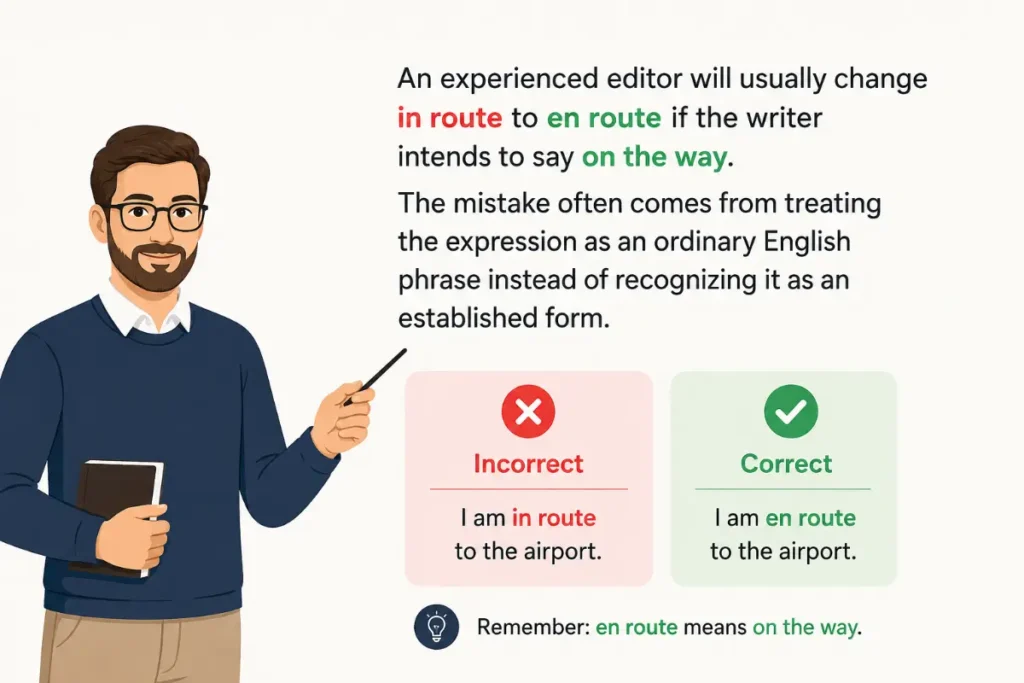
An experienced editor treats en route as a fixed expression and checks the surrounding sentence rather than correcting the phrase in isolation. The main issue is usually spelling, but context matters because on the way, in transit, and on the route may communicate slightly different ideas. Spelling tools can flag the nonstandard form, but a good editor also checks the intended meaning and chooses the clearest expression for the audience.
Key Takeaways
- En route is the standard spelling.
- The phrase means on the way or traveling toward a destination.
- In route is generally a nonstandard spelling when it is intended to have the same meaning.
- En route comes from French and has retained its established spelling in English.
- The phrase can be used in casual, professional, academic, journalistic, and formal contexts.
- A common structure is en route to + destination.
- On the way is the closest simple everyday alternative.
- In transit is related but focuses more on transportation or movement between locations.
- The pronunciation of route can vary, but the spelling remains the same.
- When editing, remember the simple connection: en route means on the way.
Conclusion
In route vs en route has a straightforward answer: use en route when you mean that someone or something is on the way to a destination. The spelling in route is generally a nonstandard form caused by the way the phrase sounds and by the familiarity of the English word in.
The expression comes from French and has become an established part of English. It works naturally in sentences such as “We are en route to the airport,” “The package is en route,” and “We stopped for lunch en route.” It can appear in both casual and formal communication.
The easiest editing tip is to connect the phrase with its meaning. Think en route = on the way. If you mean that a person, vehicle, package, or other thing is traveling toward a destination, write en route, keep the two words separate, and avoid the nonstandard spelling.
FAQs
Is in route a real English phrase?
In route can be found in informal writing and learner English, but it is not the standard expression for meaning on the way. In edited American English, the established form is en route. If you are writing a professional email, article, school assignment, or formal document, use en route when you mean that someone or something is traveling toward a destination.
What does en route mean?
En route means on the way or traveling toward a destination. For example, “The package is en route to your home” means the package is being transported toward your home. The phrase can also describe something that happens during a journey, as in “We stopped for lunch en route to the city.”
Which is correct: in route or en route?
En route is the standard form. It comes from French and has been established in English with that spelling. In route usually results from hearing the phrase and spelling the first part as the familiar English word in. For standard written English, choose en route.
How do you pronounce en route?
In American English, en route is commonly pronounced approximately ahn ROOT. The second word receives the main stress. The word route has more than one established pronunciation in English, so you may hear different versions from different speakers. The spelling remains en route regardless of that pronunciation variation.
Can en route start a sentence?
Yes. En route can naturally begin a sentence when it introduces information about a journey. For example, “En route to the airport, we stopped for coffee.” This structure is grammatical and can work well in formal writing, storytelling, travel writing, and ordinary communication.
What is a synonym for en route?
The closest everyday synonym is on the way. Other alternatives include heading to, on the road, in transit, and bound for, but their meanings can differ slightly. On the way is usually the best simple replacement when you want natural conversational American English.
Why do people misspell en route as in route?
The mistake mainly comes from pronunciation and familiarity. The first word can sound similar to in, which is a very common English word. People who learn the expression through speech may naturally spell it as they hear it. Remembering that the phrase comes from French helps preserve the standard spelling.
Is en route appropriate in formal writing?
Yes. En route is appropriate in formal writing, professional communication, journalism, academic work, and everyday English. It isn’t limited to formal contexts. Still, on the way may sound more natural in casual conversation. Choose between the two based on the tone and audience rather than assuming one is always better.

Confusing Words, Spelling & Word Choice
Claire Whitmore is a U.S.-based English editor who writes about commonly confused words, spelling differences, and word choice. Her work helps readers understand subtle distinctions between similar-looking words through simple definitions, practical examples, and modern usage guidance in both American and British English.