
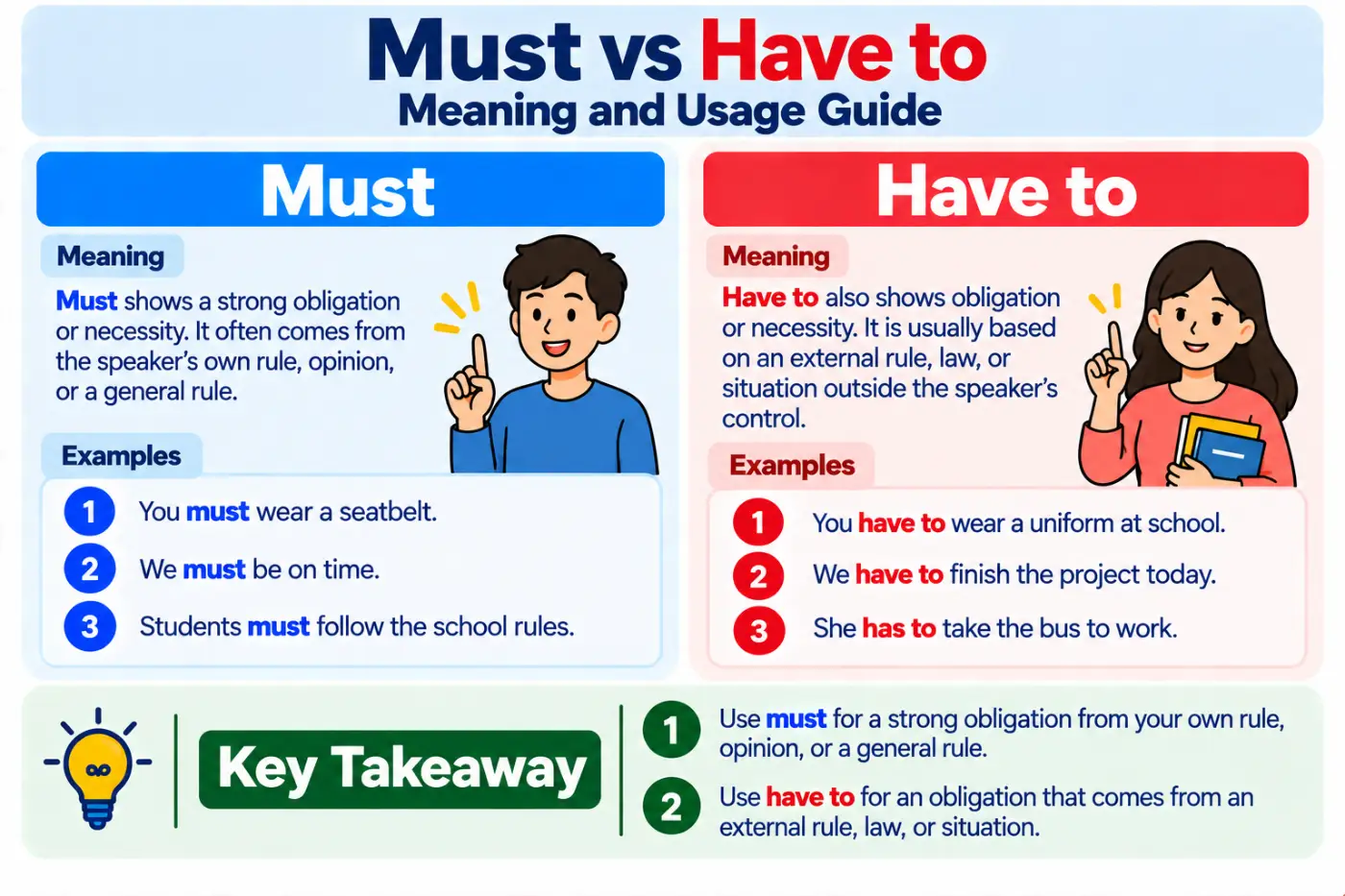
Must vs have to is one of the most common grammar questions for English learners because both forms can express necessity. You can use either form in many situations and still communicate the basic idea correctly. The difference becomes clearer when you look at where the obligation comes from and how the speaker presents it.
For example you might say I must finish this report tonight when the speaker personally feels a strong need to finish it. You might say I have to finish this report tonight because a manager set the deadline. Both sentences describe an obligation but they present its source differently.
The distinction also matters in negative sentences and questions. Must not usually means that something is prohibited. Do not have to means that something is not necessary. These meanings are very different. Understanding that contrast will help you avoid one of the most common mistakes with modal verbs.
Short Answer
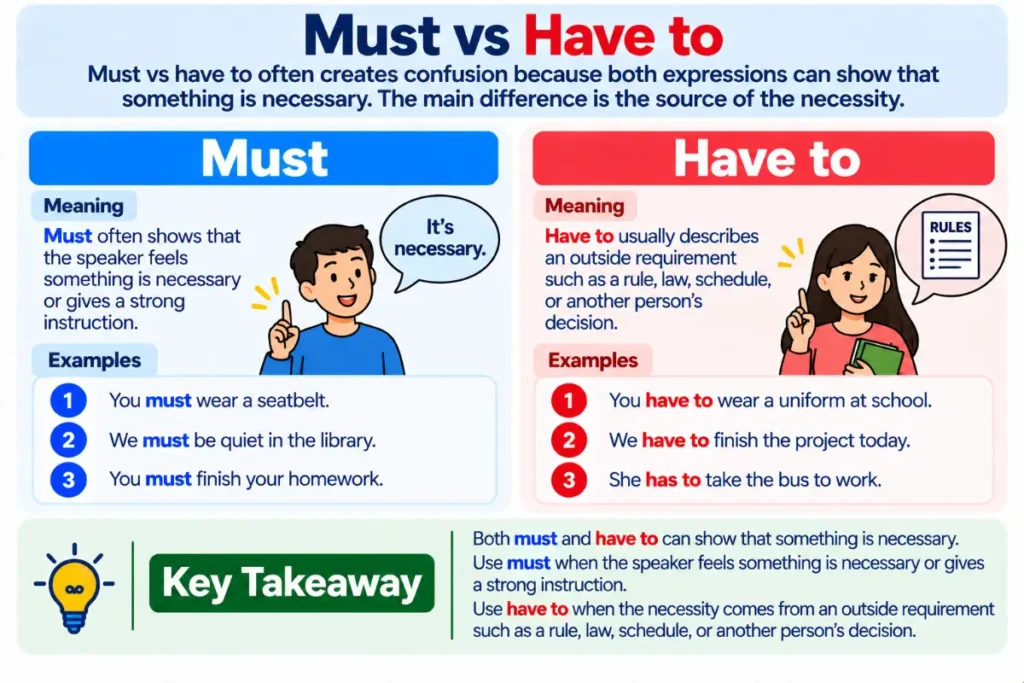
Must vs have to often creates confusion because both expressions can show that something is necessary. The main difference is the source of the necessity. Must often shows that the speaker feels something is necessary or gives a strong instruction. Have to usually describes an outside requirement such as a rule law schedule or another person’s decision.
Table Of Contents
- What must means.
- What have to means.
- The main difference between must and have to.
- When to use must.
- When to use have to.
- Must and have to in questions.
- Must not and do not have to.
- Must and have to across tenses.
- Must and have to in American English.
- Must and have to in formal writing.
- Common mistakes.
- Real life examples.
- Memory tips.
- Related grammar notes.
- Frequently asked questions.
- Key takeaways.
- Conclusion.
What Must Means
Must is a modal verb that expresses strong necessity obligation or logical certainty. When you use must to express an obligation you often present the requirement as something that comes from the speaker’s judgment.
Consider this example.
You must call your mother tonight.
The speaker is giving a strong instruction. The speaker may personally believe that the call is necessary.
Now consider this example.
I must remember to call my mother tonight.
Here the speaker is expressing a personal sense of obligation. The decision comes from the speaker rather than from an outside rule.
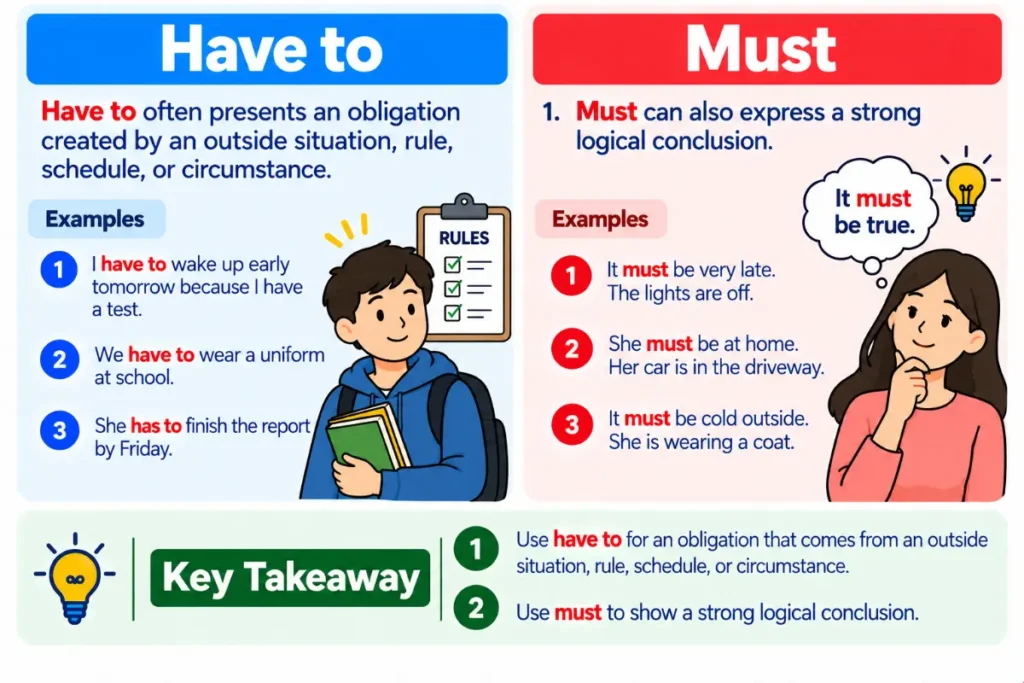
Must can also express a conclusion based on evidence.
She must be tired after working all night.
The speaker is not giving her an order. Instead the speaker believes that tiredness is a logical conclusion based on the available information.
That second use is important because must does not always describe an obligation. It can also show that the speaker considers something highly likely.
What Have To Means
Have to expresses necessity or obligation. It commonly points to a requirement created by an outside situation.
For example.
I have to wear a uniform at work.
The uniform requirement comes from the workplace. The speaker may not personally choose to wear it.
Another example is.
We have to submit the form by Friday.
The deadline creates the requirement. The speaker is describing a condition that already exists.
Have to also works naturally when circumstances force someone to do something.
I have to leave early because my flight leaves at six.
The flight schedule creates the need to leave early. The speaker is not necessarily expressing a personal command.
Have to is also useful because it can work across different tenses. You can say had to for past necessity and will have to for future necessity.
For example.
I had to work late yesterday.
I will have to work late tomorrow.
This flexibility makes have to extremely useful in everyday English.
The Main Difference Between Must And Have To
The clearest way to understand must vs have to is to ask one simple question.
Where does the necessity come from.
When the speaker presents the necessity as a personal decision or strong instruction must often fits well.
When an outside rule situation person schedule or authority creates the requirement have to often fits better.
Compare these sentences.
I must finish this project tonight.
I have to finish this project tonight.
The first sentence can suggest that the speaker personally feels responsible for finishing the project. The second can suggest that a deadline or another external requirement makes completion necessary.
Now compare these examples.
You must wear a seat belt.
You have to wear a seat belt.
Both can be correct. The first sounds like a strong instruction from the speaker. The second can describe a legal or practical requirement.
The distinction is not absolute. Native speakers often use must and have to in overlapping situations. Context determines the exact shade of meaning.
| Expression | Main idea | Typical source of necessity | Example |
|---|---|---|---|
| Must | Strong necessity or obligation | Speaker or authority | You must finish this today. |
| Have to | Necessity caused by circumstances | External situation or rule | I have to finish this today. |
| Must not | Prohibition | Speaker or rule | You must not enter this room. |
| Do not have to | No necessity | Situation | You do not have to come early. |
The table shows why these expressions cannot always replace one another without changing the meaning.
When To Use Must
Use must when you want to express a strong obligation.
For example.
You must follow the safety instructions.
The sentence gives a firm requirement. It can sound direct and authoritative.
You can also use must for a personal decision.
I must get more sleep.
Here the speaker recognizes a strong personal need.
Must works well in written instructions.
Visitors must show identification.
Employees must complete the form before entering.
Students must submit their work by Friday.
These sentences sound clear and firm. They are common in rules notices instructions and formal communication.
Must can also express strong advice.
You must try the chocolate cake.
In this context must does not mean a legal obligation. It means the speaker strongly recommends the cake.
Another important use is logical deduction.
That must be your brother.
The speaker sees evidence and reaches a strong conclusion.
The same pattern appears in sentences such as these.
You must be exhausted.
They must know the answer.
She must have forgotten the meeting.
In these examples must expresses a strong conclusion rather than an obligation.
When To Use Have To
Use have to when an outside situation creates the need to do something.
For example.
I have to renew my passport.
The need may come from a deadline or travel requirement.
She has to work on Saturday.
Her schedule creates the obligation.
We have to pay the bill before Friday.
The payment deadline creates the need.
Have to is especially natural in everyday American English. People use it frequently when discussing work school schedules appointments family responsibilities rules and practical problems.
For example.
I have to pick up my kids after work.
He has to take the train today.
We have to leave before traffic gets worse.
They have to bring identification.
The expression sounds natural and conversational in all of these sentences.
Have to can also describe necessity that comes from circumstances rather than a person.
The car broke down so we had to walk home.
The broken car created the necessity. Nobody necessarily ordered the speakers to walk.
This makes have to a useful choice when you describe events rather than personal decisions.
Must And Have To In Questions
Questions with must and have to can create different meanings.
Must I attend the meeting.
This question asks if attendance is required. It can sound formal or somewhat strong.
Do I have to attend the meeting.
This question also asks about necessity. It sounds more natural in everyday conversation.
In American English people commonly use do I have to when asking about an obligation.
For example.
Do I have to finish this today.
Do we have to bring our own food.
Does she have to sign the form.
Did they have to pay a fee.
Must I finish this today is grammatically correct but it can sound more formal than do I have to finish this today.
You will often hear must in formal rules instructions and official language. In ordinary conversation have to usually feels more natural when someone asks about a requirement.
Must Not And Do Not Have To
One of the most important differences between these expressions appears in negative sentences.
Must not means something is prohibited.
Do not have to means something is not necessary.
These meanings are not interchangeable.
You must not park here.
This means parking is prohibited.
You do not have to park here.
This means parking here is not necessary. You can choose another option.
Consider another pair.
You must not tell anyone.
The speaker says that telling anyone is forbidden.
You do not have to tell anyone.
The speaker says that telling anyone is optional.
This difference is extremely important in instructions.
If a teacher says You must not use your phone during the exam the student is prohibited from using it.
If the teacher says You do not have to bring your textbook the student can leave it at home.
The easiest memory trick is simple.
Must not means no permission.
Do not have to means no necessity.
Must And Have To Across Tenses
Must has limited tense forms. When you need to express necessity in the past you normally use had to.
For example.
I had to leave early yesterday.
You generally do not use must to create an ordinary past obligation.
For future necessity you can use will have to.
For example.
I will have to leave early tomorrow.
This gives have to a useful range of forms.
| Time | Common form | Example |
|---|---|---|
| Present | must | I must leave now. |
| Present | have to | I have to leave now. |
| Past | had to | I had to leave early. |
| Future | will have to | I will have to leave early. |
| Present perfect | have had to | I have had to work late. |
| Past perfect | had had to | She had had to wait for hours. |
The last example may look unusual because two forms of have appear together. It is grammatically possible but speakers often choose a different sentence when a simpler structure works.
For example.
She had to wait for hours.
Usually gives the same practical information with less complexity.
Must And Have To In American English
American English uses both forms regularly. Have to is especially common in everyday conversation.
A speaker might say.
I have to go.
I have to work tomorrow.
Do I have to pay now.
These forms sound completely natural in ordinary American speech.
Must remains common in formal writing rules signs instructions and strong statements.
For example.
Applicants must provide proof of identity.
Passengers must remain seated.
You must not enter this area.
American speakers also use must for logical conclusions.
He must be home by now.
She must be joking.
That must be the right address.
In casual conversation some speakers may prefer have to for obligation and save must for stronger formal instructions or deductions.
Still the two forms overlap. The difference depends on context tone and the source of necessity.
Must And Have To In Formal Writing
Must can sound more direct and authoritative in professional or official writing.
For example.
All visitors must sign in at reception.
Employees must follow the company safety policy.
Applicants must submit all required documents.
These sentences establish firm requirements.
Have to can also appear in professional writing when the writer describes practical requirements.
Employees have to complete annual training before renewing their certification.
However many formal policies prefer must because it creates a clear sense of obligation.
The choice should match the purpose of the sentence. Use must when you need to state a firm requirement. Use have to when you are describing a practical necessity or explaining what someone is required to do.
Must And Have To For Personal Decisions
Must often sounds natural when someone talks about a personal obligation.
I must start exercising.
I must remember her birthday.
These sentences can sound like the speaker is motivating or reminding themselves.
Have to can also describe a personal need but usually focuses more on the circumstances.
I have to finish this report before dinner.
I have to call the doctor tomorrow.
The difference is subtle. The first form can highlight the speaker’s own sense of duty. The second often highlights the situation that makes the action necessary.
Must And Have To For Rules
Both forms can describe rules.
For example.
Students must wear their identification cards.
Students have to wear their identification cards.
The first sounds like an official instruction. The second sounds more conversational.
Now consider a personal explanation.
I have to wear an identification card at work.
This sentence sounds natural because the speaker describes a workplace requirement.
You must wear your identification card.
This sounds more like someone giving an instruction.
That small shift in perspective can change the tone without changing the basic requirement.
Must And Have To For Strong Advice
Must can also give enthusiastic advice.
You must see that movie.
You must visit New York someday.
The speaker is not creating a literal obligation. Instead must adds strong emphasis.
Have to can express strong recommendations too.
You have to try this dessert.
In casual American English this sentence can sound very enthusiastic. Context tells the listener that the speaker means the experience is highly recommended rather than legally required.
This is a good example of why grammar cannot always be understood by looking at one word in isolation.
Common Mistakes
Many learners make predictable mistakes with these expressions.
Using Must For Every Past Obligation
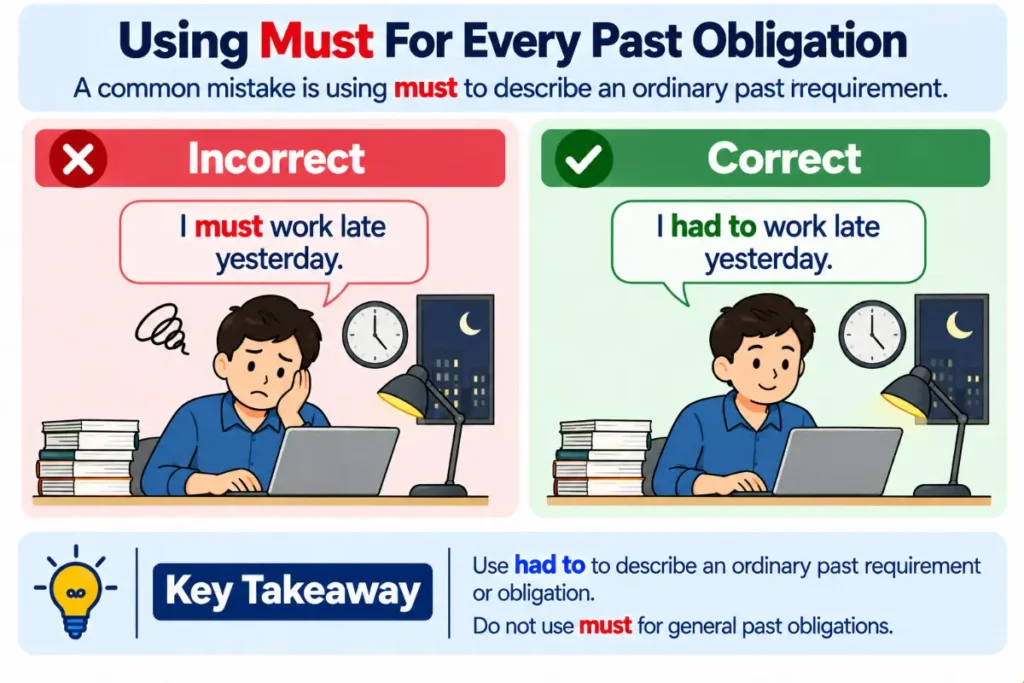
A common mistake is using must to describe an ordinary past requirement.
Incorrect.
I must work late yesterday.
Correct.
I had to work late yesterday.
Use had to for a past obligation.
Confusing Must Not With Do Not Have To
This is the most serious meaning difference.
I must not attend means attending is prohibited.
I do not have to attend means attending is optional.
Changing one form can completely reverse the intended message.
Using Must To Describe Every External Rule
Must can describe external rules. It is not restricted to personal decisions.
For example.
Passengers must show their tickets.
This is completely correct.
Do not assume that have to is the only correct form for external requirements.
Assuming Have To Is Less Correct
Have to is standard English. It is not an inferior replacement for must.
It is extremely common in spoken English and works naturally in many formal and informal contexts.
Forgetting The Third Person Form
The form changes in the present tense.
I have to work.
You have to work.
We have to work.
They have to work.
He has to work.
She has to work.
It has to work.
Must does not change.
I must go.
She must go.
They must go.
You must go.
This makes must grammatically simpler in the present tense.
Real Life Examples
The best way to understand the difference is to see how these expressions work in ordinary situations.
At Work
I have to finish this report before five.
The deadline creates the need.
I must make sure the numbers are correct.
The speaker expresses a personal responsibility.
Employees must wear safety equipment.
The sentence gives an official requirement.
We have to attend the training session tomorrow.
The sentence describes a scheduled obligation.
At School
Students must submit their assignments by Friday.
This sounds like a formal school rule.
I have to study tonight because I have an exam tomorrow.
The exam creates the need.
Do I have to bring my laptop.
The speaker asks about a requirement.
You must not use your phone during the test.
The speaker prohibits phone use.
At Home
I have to clean the kitchen before guests arrive.
The arrival of guests creates the need.
I must remember to buy milk.
The speaker is reminding themselves.
You do not have to cook tonight.
Cooking is optional.
While Traveling
We have to arrive at the airport two hours early.
The travel schedule creates the need.
Passengers must show identification.
The airport rule creates a firm requirement.
I had to change my flight.
A past situation created the necessity.
In Conversation
You must watch this show.
The speaker strongly recommends it.
I have to go now.
The speaker needs to leave because of a situation or obligation.
You must be tired.
The speaker makes a strong conclusion based on evidence.
She has to be at work already.
Here have to can describe a conclusion based on the speaker’s understanding of her schedule. This use is less common than the obligation use but it is possible in context.
A Simple Comparison
| Situation | Natural choice | Why |
|---|---|---|
| Personal sense of duty | Must | The speaker presents the need as personal. |
| Workplace requirement | Have to | An outside condition creates the obligation. |
| Official rule | Must | The language states a firm requirement. |
| Past obligation | Had to | Must does not normally express ordinary past obligation. |
| Future obligation | Will have to | This form clearly expresses future necessity. |
| Prohibition | Must not | The action is forbidden. |
| No necessity | Do not have to | The action is optional. |
| Strong recommendation | Must | The speaker strongly recommends something. |
| Logical conclusion | Must | The speaker sees something as strongly likely. |
| Everyday question | Do I have to | This is common in conversational American English. |
Memory Tips
A simple way to remember the difference is to think about the source of the pressure.
Must often comes from the speaker.
Have to often comes from the situation.
Imagine two voices.
The first voice is inside your head.
I must finish this.
The second voice comes from your schedule.
I have to finish this because the deadline is tomorrow.
That mental picture can make the difference easier to remember.
For negative forms use another simple trick.
Must not means stop.
Do not have to means optional.
You must not enter means stay out.
You do not have to enter means you can stay out if you want.
For past situations remember one more rule.
Past obligation usually uses had to.
I had to leave.
For future necessity remember will have to.
I will have to leave.
These three patterns cover a large part of everyday usage.
Related Grammar Notes
Must belongs to the group of modal verbs. Modal verbs behave differently from ordinary verbs.
After must use the base form of the verb.
Correct.
You must leave.
Incorrect.
You must to leave.
Correct.
She must study.
Incorrect.
She must studies.
Must does not take an s in the third person.
Correct.
He must go.
Incorrect.
He musts go.
Questions with must do not use do.
Correct.
Must I leave now.
Incorrect.
Do must I leave now.
However questions with have to normally use do or another auxiliary.
Do I have to leave.
Does she have to leave.
Did they have to leave.
This difference comes from the grammar of modal verbs.
Have to behaves more like an ordinary verb phrase. That is why it changes form and works with auxiliary verbs.
Must also has another important meaning related to deduction.
For example.
The lights are on so they must be home.
The speaker uses evidence to reach a conclusion.
You must be hungry after that long walk.
The speaker believes hunger is very likely.
This use has nothing to do with an external rule.
Must And Have To With Pronouns
Must stays the same with every subject.
I must leave.
You must leave.
He must leave.
She must leave.
We must leave.
They must leave.
Have to changes with the subject.
I have to leave.
You have to leave.
He has to leave.
She has to leave.
We have to leave.
They have to leave.
This difference is easy to overlook because the meaning remains similar.
The third person singular form is especially important.
He has to work.
She has to study.
It has to stop.
Do not write he have to or she have to in standard English.
Must And Have To In Everyday Speech
In everyday American conversation have to appears very often.
I have to run.
I have to finish this.
These short sentences are natural and common.
Must can sound stronger.
I must go.
I must remember.
You must listen.
The exact tone depends on the situation. Must is not automatically formal and have to is not automatically informal. Context plays a major role.
For example a parent might say You must clean your room. A friend might say You have to try this pizza. Both are natural. The first gives a command. The second gives an enthusiastic recommendation.
Pronunciation And Spoken English
In natural speech have to often sounds shorter than learners expect. The words may connect closely in conversation.
For example.
I have to go.
Native speakers may say this quickly with reduced vowel sounds.
Must usually keeps its basic pronunciation clearly because it is a short modal verb.
The negative forms deserve attention too.
Must not can sound strong because the phrase expresses prohibition.
Do not have to contains several words and often receives natural speech reduction.
Learners should focus on the meaning first and then practice the expressions in complete sentences. Memorizing isolated words is less useful than learning common sentence patterns.
Formality And Tone
Must often creates a firm tone.
You must complete the form.
Have to often creates a more neutral descriptive tone.
I have to complete the form.
Neither sentence is automatically better. The best choice depends on what you want the reader or listener to understand.
Use must when you want the obligation to sound direct or official.
Use have to when you want to describe the requirement as part of a situation.
In professional writing clarity matters more than forcing one form into every sentence.
Must Versus Have To In Different Contexts
| Context | Example with must | Example with have to |
|---|---|---|
| Personal duty | I must call her. | I have to call her. |
| Workplace | You must follow the policy. | You have to follow the policy. |
| School | Students must submit work. | Students have to submit work. |
| Travel | Passengers must show ID. | Passengers have to show ID. |
| Personal schedule | I must leave soon. | I have to leave soon. |
| Strong advice | You must see it. | You have to see it. |
| Past necessity | Not normally used. | I had to leave. |
| Future necessity | Not normally used. | I will have to leave. |
| Prohibition | You must not enter. | Not expressed with have to. |
| No necessity | Not expressed with must not. | You do not have to enter. |
How To Choose The Right Form
When you are unsure which expression to use ask yourself three questions.
- Am I giving a strong instruction or expressing a personal sense of necessity. If yes must may fit naturally.
- Is an outside situation rule deadline schedule or requirement creating the need. If yes have to may fit naturally.
- Am I talking about the past or future. If yes had to or will have to will usually be the practical choice.
Then check the negative meaning.
If you mean forbidden use must not.
If you mean unnecessary use do not have to.
This quick check can prevent most errors.
Key Takeaways
- Must and have to can both express necessity and obligation.
- Must often presents an obligation as a personal decision strong instruction or firm requirement.
- Have to often presents an obligation created by an outside situation rule schedule or circumstance.
- Must can also express a strong logical conclusion.
- Must does not normally change for different subjects.
- Have to becomes has to with he she and it.
- Use had to for ordinary past obligations.
- Use will have to for future obligations.
- Must not means something is prohibited.
- Do not have to means something is not necessary.
- Do I have to is common in everyday American English.
- Must often sounds firm or authoritative but context determines the exact tone.
Conclusion
Must vs have to becomes much easier when you focus on the source and type of necessity. Must often presents a strong obligation personal decision official instruction or logical conclusion. Have to commonly describes a requirement created by a situation schedule rule or other outside factor.
The biggest point to remember is that these expressions overlap. You can often use either one for an obligation without creating a serious grammatical problem. The choice mainly changes the focus and tone. Must can sound more direct while have to often sounds more conversational and descriptive.
Finally remember the negative forms because they carry very different meanings. Must not means something is forbidden. Do not have to means something is unnecessary. Once you understand that contrast along with had to for past necessity and will have to for future necessity you can use these expressions naturally and accurately.
Frequently Asked Questions
Is must stronger than have to?
Must can sound stronger or more direct because it often presents the requirement as a firm instruction or personal obligation. Have to often sounds more descriptive and can focus on an outside requirement. Still both forms can express strong necessity.
Can I use must and have to in the same sentence?
Yes. They can appear together when they serve different grammatical purposes.
For example.
I have to finish the report but I must check every number first.
The first expression describes an outside requirement. The second expresses the speaker’s personal responsibility.
Is must more formal than have to?
Must often appears more frequently in formal rules instructions notices and official writing. Have to is extremely common in everyday American English. Still both forms can work in formal and informal settings depending on context.
Should I use must or have to in American English?
Both are standard American English. Have to is especially common in everyday conversation. Must remains common for firm instructions official requirements strong recommendations and logical conclusions.
What is the difference between must not and do not have to?
Must not means an action is prohibited. Do not have to means the action is optional.
You must not touch the equipment means touching it is forbidden.
You do not have to touch the equipment means touching it is unnecessary.
Can must talk about the past?
Must does not normally express an ordinary past obligation. Use had to instead.
For example.
I had to work late yesterday.
Must can appear in sentences about past events when it expresses deduction.
For example.
She must have forgotten the appointment.
That sentence means the speaker strongly believes that she forgot it.
Can must talk about the future?
Must can express a future requirement in some contexts.
For example.
You must finish this by Friday.
For ordinary future necessity you can also use will have to.
For example.
You will have to finish this by Friday.
The second form makes the future time frame especially clear.
Why do Americans often say have to?
Have to is a natural and very common way to express necessity in American English. It works well in everyday conversation and can describe obligations created by schedules rules circumstances and responsibilities.
Can have to express a personal obligation?
Yes. A person can use have to for a personal obligation.
For example.
I have to start exercising.
The sentence does not require an outside authority. The speaker may simply describe something they feel they need to do.
Which is correct must I or do I have to?
Both can be correct.
Must I leave now.
Do I have to leave now.
Do I have to is generally more natural in everyday American conversation. Must I can sound more formal or direct.
Is have to a modal verb?
Have to expresses modal meaning because it communicates necessity but grammatically it behaves differently from a central modal such as must. Have changes form and can work with auxiliary verbs.
For example.
She has to leave.
Does she have to leave.
She had to leave.
This flexibility distinguishes it from must.
Can must and have to always replace each other?
No. They overlap in many affirmative sentences but they are not identical in every situation. Their negative forms have especially different meanings. Must not expresses prohibition while do not have to expresses lack of necessity.

English Grammar & Usage
Nathan Holloway is an American grammar writer and language researcher who specializes in English grammar, sentence structure, verb usage, and common writing mistakes. He enjoys breaking down confusing grammar rules into practical explanations with clear examples, making English easier for students, professionals, and everyday writers.