
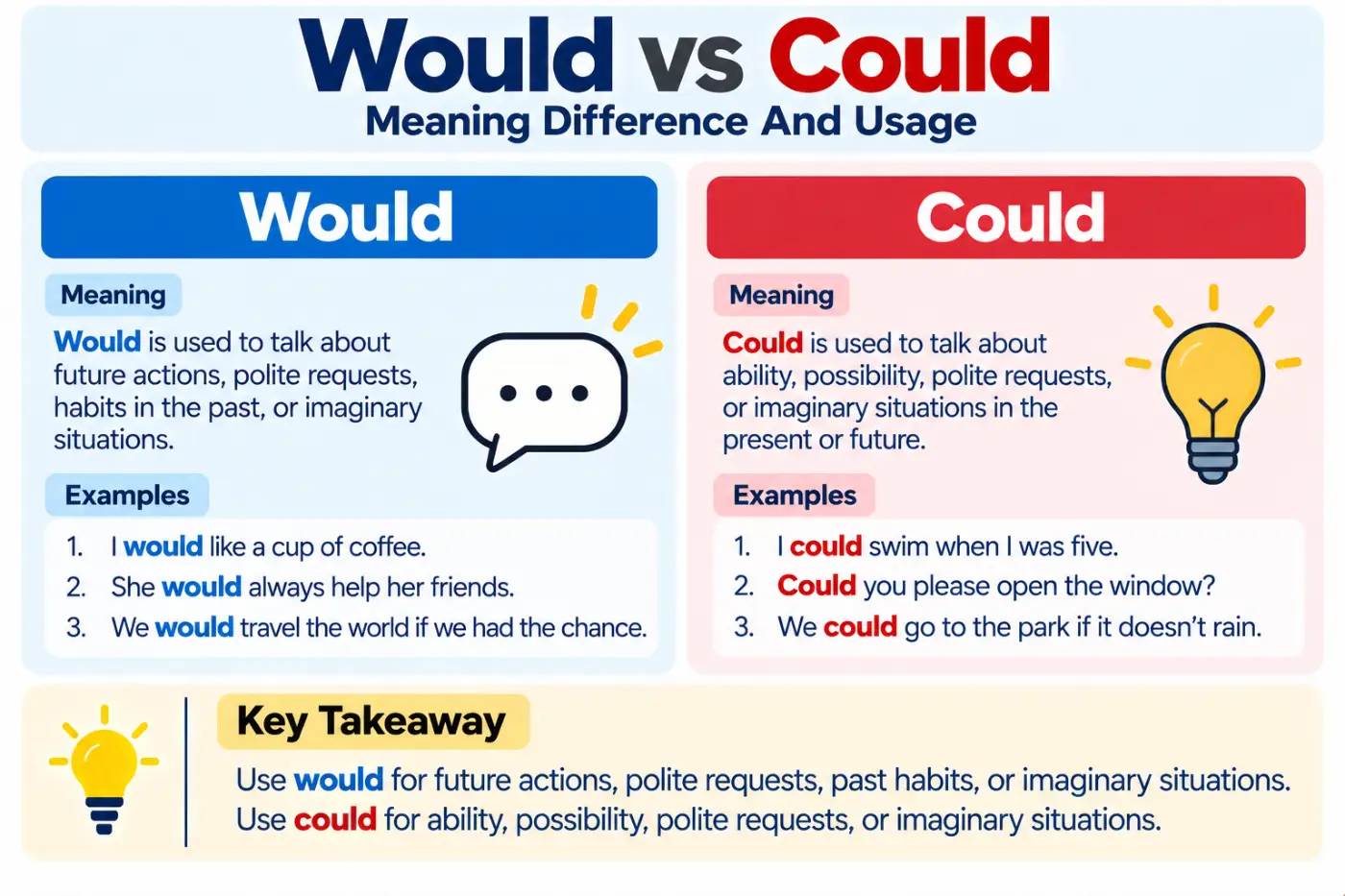
would vs could is a common grammar question because both words can appear in polite requests and imagined situations. The easiest starting point is this: would often focuses on willingness, preference, or an imagined result, while could often focuses on ability or possibility. The right choice depends on what you want the sentence to communicate.
Consider these two sentences. I would go with you. I could go with you. The first suggests willingness or a decision in an imagined situation. The second says that going is possible or that the speaker has the ability to go. The difference may look small, but it can change the meaning.
Both words are modal verbs. They work with the base form of another verb and help express ideas such as possibility, ability, intention, requests, conditions, and preferences. Once you understand the main job of each modal, choosing between them becomes much easier.
This guide explains their meanings, grammar, pronunciation, sentence patterns, formal and informal uses, common mistakes, real life examples, and memory tips. It also explains situations where both words can appear in the same sentence but communicate different ideas.
Short Answer
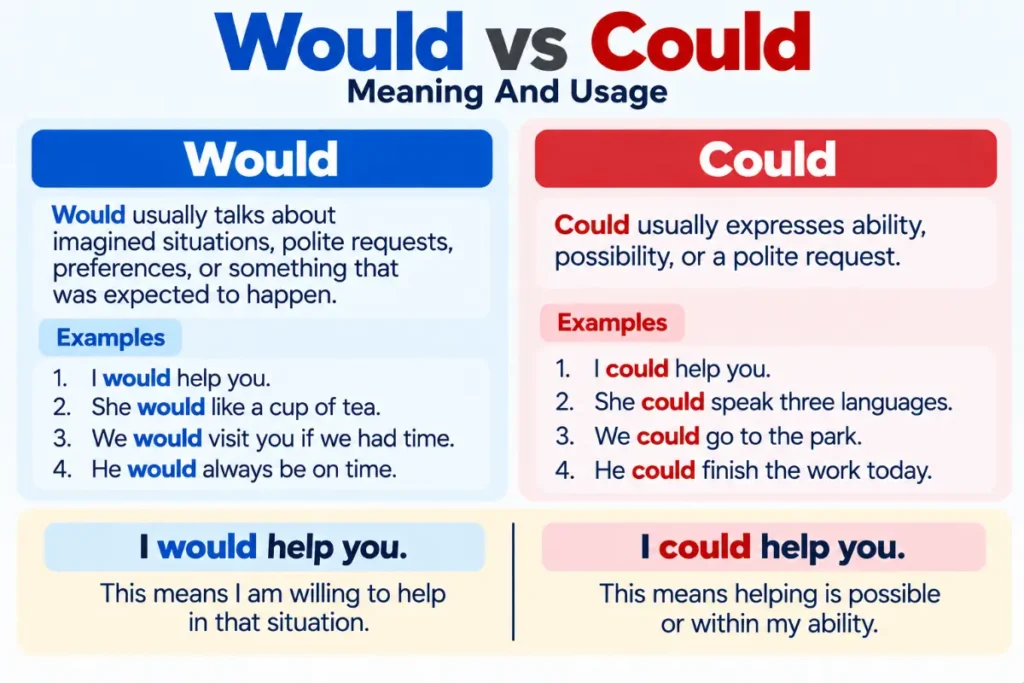
Would usually talks about imagined situations, polite requests, preferences, or something that was expected to happen. Could usually expresses ability, possibility, or a polite request. Compare these examples: I would help you means I am willing to help in that situation. I could help you means helping is possible or within my ability.
Table Of Contents
- What would means.
- What could means.
- The main difference.
- Grammar rules.
- Conditional sentences.
- Polite requests.
- Ability and possibility.
- Preferences and choices.
- Past uses.
- Common mistakes.
- Pronunciation.
- Real life examples.
- Related modal verbs.
- Memory tips.
- FAQs.
- Key takeaways.
- Conclusion.
What Would Mean
Would is a modal auxiliary verb. It has several uses, so its meaning depends strongly on context.
One common use is to talk about an imagined situation.
I would buy a house if I had enough money.
The sentence describes a possible response to a condition. The speaker is not saying that the purchase is happening now. Instead, the speaker is imagining what they would do under a certain condition.
Would can also express willingness.
I would help you if I could.
Here would shows willingness. The speaker is ready to help, although another condition prevents the action.
Would is also common when making polite requests.
Would you open the window?
This sounds polite and less direct than Open the window.
Another common use is preference.
I would rather stay home tonight.
Here would rather introduces a preference.
Would can also describe repeated actions in the past.
When we were children, we would visit our grandparents every summer.
This meaning is close to used to, although the two expressions aren’t interchangeable in every situation.
Would also appears in reported speech.
She said she would call me later.
The original idea may have been I will call you later. After the reporting verb moved the sentence into the past, will commonly becomes would.
What Could Mean
Could is also a modal auxiliary verb. Its main uses include past ability, present or future possibility, and polite requests.
The classic past ability use is simple.
When I was younger, I could run five miles without stopping.
Here could means had the ability to do something in the past.
Could can also express possibility.
It could rain tonight.
This means rain is possible. The speaker isn’t saying that rain will definitely happen.
Another example is:
The package could arrive tomorrow.
The sentence presents tomorrow as a possible delivery time.
Could is also common in polite requests.
Could you help me with this report?
This is a polite way to ask for help.
Could can also describe a possible choice or solution.
We could take the train instead.
The speaker is suggesting one possible option.
This gives could a strong connection with possibility. It can also suggest that someone has the ability or opportunity to do something.
The Main Difference
The simplest distinction is:
Would often focuses on what someone is willing to do, prefers to do, or imagines doing.
Could often focuses on what someone is able to do or what is possible.
Compare:
I would help you.
I could help you.
In the first sentence, the speaker expresses willingness.
In the second sentence, the speaker says helping is possible or within their ability.
Now compare:
I would travel more if I had more money.
I could travel more if I had more money.
The first sentence emphasizes the speaker’s intention or desire. The second emphasizes the possibility or ability created by having more money.
The difference becomes clearer when you ask a simple question.
Ask yourself: Am I talking about willingness or an imagined choice? Use would. Am I talking about ability or possibility? Use could.
This isn’t a rule that covers every use, but it works extremely well for the most common situations.
Would Vs Could In Conditional Sentences
Conditional sentences are one of the biggest sources of confusion.
Consider:
If I had more free time, I would learn Spanish.
The speaker is imagining the result of having more free time. Would introduces the imagined result.
Now consider:
If I had more free time, I could learn Spanish.
This sentence means that having more free time would make learning Spanish possible.
The difference is subtle but meaningful.
With would, the speaker focuses on the action they would choose or expect to happen.
With could, the speaker focuses on the opportunity or possibility.
Compare these pairs.
If I had enough money, I would buy the car.
If I had enough money, I could buy the car.
The first suggests a decision or intention. The second says the money would make the purchase possible.
Another pair:
If she studied harder, she would pass the exam.
If she studied harder, she could pass the exam.
The first presents passing as the expected result in the imagined situation. The second presents passing as a possibility created by studying harder.
Both sentences can be grammatically correct. The difference lies in the speaker’s intended meaning.
Would For Willingness
Would often expresses willingness.
For example:
I would gladly help you.
This means the speaker is willing to help.
Another example:
She would never lie to her friends.
This can express a strong belief about someone’s willingness or character.
Would can also appear in conditional situations.
I would help if I had more information.
The sentence suggests willingness but adds a condition.
A useful pattern is:
would + base verb
I would help.
She would agree.
They would come.
He would understand.
The verb after would does not take to and does not normally change form.
Incorrect:
I would to help.
Correct:
I would help.
Incorrect:
She would goes.
Correct:
She would go.
This is one of the most important grammar rules for modal verbs.
Could For Ability
Could is commonly used to describe general ability in the past.
I could swim when I was six.
He could read before he started school.
They could solve difficult problems quickly.
In these examples, could means had the ability to perform the action.
Could can also express present ability in certain contexts, especially when the focus is on available opportunity or a possible course of action.
I could help you after lunch.
This doesn’t necessarily mean that helping is already planned. It means helping is possible for the speaker.
Compare:
I can help you now.
I could help you after lunch.
Can sounds more direct and immediate. Could creates more distance and often sounds softer or less certain.
Could For Possibility
Could often tells the reader that something is possible but not certain.
The train could be late.
This means lateness is one possible outcome.
The problem could be caused by a damaged cable.
The speaker is presenting a possible explanation rather than stating a confirmed fact.
This use appears frequently in everyday speech, professional communication, news analysis, and academic writing.
Could can also describe a possible future action.
We could visit the museum tomorrow.
The sentence suggests an option.
The speaker isn’t necessarily promising to visit. They are presenting the idea as possible.
This is one reason could often sounds less definite than would.
Would For Preferences
Would is common in expressions of preference.
I would rather stay home.
She would prefer tea.
They would rather wait until tomorrow.
The pattern would rather is especially common.
I would rather walk than drive.
He would rather study at home.
We would rather leave early.
Would rather means that one option is preferred over another.
Could doesn’t normally perform this same grammatical function.
You wouldn’t say:
I could rather stay home.
The standard expression is:
I would rather stay home.
This distinction is worth remembering because the two modals can both appear in sentences about choices, but their grammatical jobs differ.
Would For Polite Requests
Would is frequently used in polite questions.
Would you please close the door?
Would you like some coffee?
Would you mind waiting for a moment?
These structures can sound courteous and natural in professional and social settings.
Would you like is especially common when offering something.
Would you like some water?
Would you like to join us?
Would you like to sit here?
The expression doesn’t necessarily describe a hypothetical situation. It functions as a polite way to ask about someone’s preference.
Could For Polite Requests
Could also makes requests more polite.
Could you send me the report?
Could you explain this part again?
Could you wait here for a moment?
Could is useful because it softens the direct command.
Compare:
Send me the report.
Can you send me the report?
Could you send me the report?
All three can request the same basic action, but the tone changes.
Could doesn’t mean the person literally lacks the ability to send the report. In a request, it functions as a polite modal.
This is a good example of why you shouldn’t memorize one meaning for each modal. Modal verbs are flexible. Context controls their exact meaning.
Would Vs Could In Polite English
Both modals can make a request sound polite, but the structure and meaning can differ.
Would you help me?
This asks about willingness.
Could you help me?
This asks if helping is possible or asks politely for the action.
In everyday conversation, both can sound natural. The distinction may be subtle because the practical result is often the same.
For example, someone who asks Could you carry this box? is usually not questioning your physical strength. They are politely asking for assistance.
Likewise, Would you carry this box? focuses more directly on willingness.
This difference is useful when you want to choose the exact tone.
Would For Hypothetical Situations
Would is strongly associated with imagined outcomes.
If I lived closer, I would visit you more often.
If he knew the answer, he would tell us.
If we had enough space, we would invite everyone.
These sentences imagine situations that aren’t presented as current facts.
Would commonly appears in the result clause of second conditional sentences.
If plus past tense, followed by would plus base verb, is a common pattern.
If I had more time, I would read more.
The past form in the if clause doesn’t necessarily mean past time. In this structure, it can create distance from reality and signal an imagined condition.
Could In Hypothetical Situations
Could can also appear in conditional sentences.
If I had more money, I could travel more.
Here could means the situation would make travel possible.
Compare:
If I had more money, I would travel more.
This emphasizes the speaker’s choice or intention.
If I had more money, I could travel more.
This emphasizes opportunity or possibility.
That distinction is one of the clearest ways to understand these modals.
Imagine a door.
Would says, I would choose to walk through it.
Could says, The door gives me the option to walk through it.
The first focuses on choice. The second focuses on possibility.
Would In Reported Speech
Would often appears when will changes in reported speech.
Direct speech:
She said, I will call you tomorrow.
Reported speech:
She said she would call me the next day.
This use is called backshift. The reporting verb is in the past, so will commonly changes to would.
Another example:
He promised he would help us.
The sentence reports a past promise about a future action from that earlier point in time.
Could can also appear in reported speech because it is the past form of can in many contexts.
Direct:
He said, I can finish it.
Reported:
He said he could finish it.
This is another important difference. Would and could can both appear as past related forms of other modals, but their meanings depend on the original context.
Could As The Past Of Can
Could is commonly described as the past form of can.
For example:
I can swim.
I could swim when I was five.
The first describes present ability. The second describes past ability.
However, could isn’t simply a past tense form in every sentence. It also expresses present or future possibility and polite requests.
For example:
It could snow tonight.
This is about future possibility.
Could you help me?
This is a present request.
So while could has a clear connection with can, context determines its actual meaning.
Common Mistakes
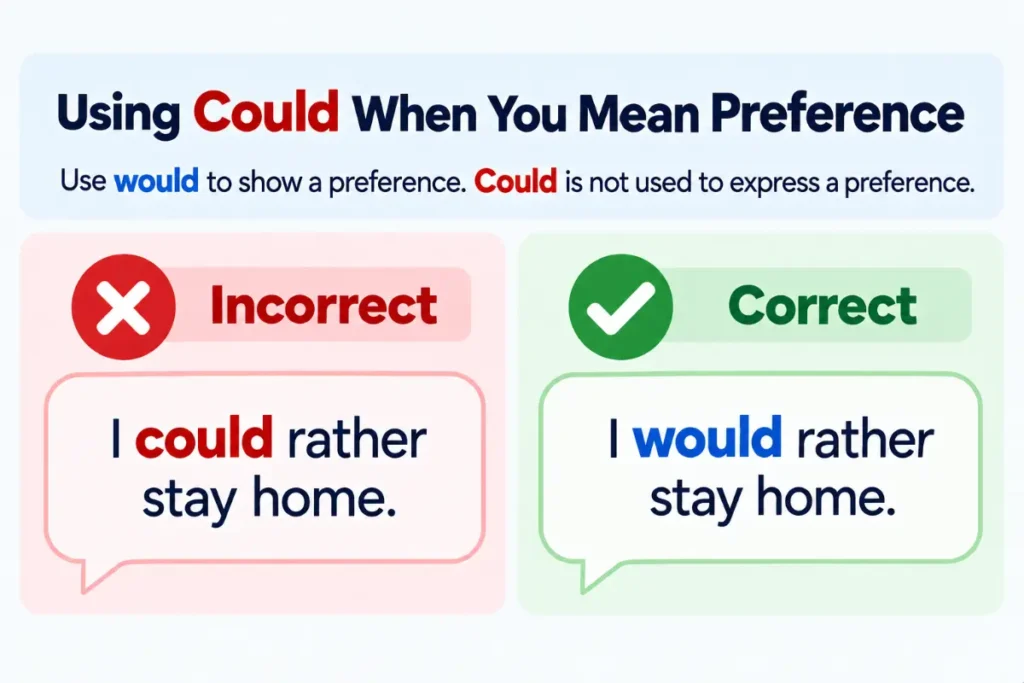
Using Could When You Mean Preference
Incorrect:
I could rather stay home.
Correct:
I would rather stay home.
Would rather is the standard structure for expressing a preference.
Using Would For Ability
Incorrect:
When I was ten, I would swim very well.
If you mean general past ability, could is normally the better choice.
Correct:
When I was ten, I could swim very well.
Would can describe repeated past behavior, but it isn’t the usual modal for general ability.
Confusing Possibility With Intention
Consider:
I could go tomorrow.
This presents tomorrow as a possible option.
I would go tomorrow.
This can suggest intention, willingness, or a conditional meaning depending on context.
The second sentence doesn’t automatically mean the action is definitely planned.
Adding To After A Modal
Incorrect:
I could to help you.
Correct:
I could help you.
The same rule applies to would.
Incorrect:
She would to come.
Correct:
She would come.
Modal verbs are followed by the base form of the main verb.
Changing The Main Verb Form
Incorrect:
He could goes.
Correct:
He could go.
Incorrect:
They would went.
Correct:
They would go.
The modal carries the tense or modal meaning, so the following verb remains in its base form.
Pronunciation Guide
Would is commonly pronounced /wʊd/.
Could is commonly pronounced /kʊd/.
Both have a short vowel sound and end with a d sound.
One important spelling and pronunciation point is the letter l. In standard pronunciation, the l in would and could is silent.
The same silent letter appears in should.
The three words are commonly pronounced differently at the beginning but share a similar ending sound.
Would sounds like the word wood.
Could rhymes with good and should.
Learners sometimes try to pronounce the l because it appears in the spelling. That produces an incorrect pronunciation in standard English.
Etymology And Word Origin
Would and could have long histories in English and are connected to older Germanic modal forms.
Would developed from an earlier form related to will. Over time, it became associated with past forms of will as well as hypothetical situations, polite requests, preferences, and other uses.
Could developed historically from an earlier form of can. Its connection with ability remains clear in modern English.
These historical relationships help explain some of their modern uses.
Would has a strong connection with will, intention, and imagined results.
Could has a strong connection with can, ability, and possibility.
Modern English has expanded both words beyond these basic relationships, so context remains essential.
American English And British English
The core grammar of would and could is broadly the same in American and British English.
Both varieties use would for hypothetical situations, preferences, willingness, polite requests, and reported speech.
Both use could for past ability, possibility, suggestions, and polite requests.
There can be differences in style, frequency, and conversational preference, but there isn’t a major regional rule that changes the basic distinction.
For example, an American speaker can say:
Could you help me?
A British speaker can use the same sentence naturally.
Likewise:
Would you like some tea?
works in both varieties.
The grammar is shared even when vocabulary or conversational style varies between regions.
Formal And Informal Usage
Both modals are standard in formal and informal English.
In professional writing, would can make requests sound polite.
Would you please provide the updated figures?
Could can also soften a request.
Could you provide the updated figures?
Both are appropriate.
The choice depends on the exact meaning and tone.
In casual conversation, speakers often use could and would naturally without consciously thinking about the grammar. In formal writing, however, precision matters more because a small modal change can alter the intended meaning.
For example, an instruction that says:
The company could reduce costs.
means cost reduction is possible.
The company would reduce costs.
can suggest that cost reduction is expected under a stated condition or situation.
Those are not interchangeable ideas.
Real Life Examples
Daily Conversation
I would go with you if I weren’t busy.
The speaker is expressing a willingness to go under a condition.
We could go after dinner.
The speaker is suggesting a possible plan.
Workplace Communication
Could you send the updated file by Friday?
This is a polite request.
I would be happy to discuss the proposal tomorrow.
This expresses willingness.
School
If I had more time, I would study another chapter.
This expresses an imagined choice.
If I finished my homework early, I could watch a movie.
This presents watching a movie as a possibility.
Academic Writing
The results could indicate a relationship between the two variables.
Here could presents a possible interpretation.
A larger sample would provide stronger evidence.
Here would describes an expected result under a condition.
Social Situations
Would you like to join us for dinner?
This asks about preference.
Could you pick me up at seven?
This is a polite request asking about possibility or availability.
Suggestions
We could try another approach.
This presents an option.
If I were in your position, I would talk to the manager.
This gives imagined advice.
Could And Can
Can and could are closely related.
Can usually expresses present ability or direct possibility.
I can drive.
Could can express past ability.
I could drive when I was sixteen.
Could can also make requests softer.
Could you help me?
The distinction between can and could is often about time, possibility, politeness, or distance.
Would And Will
Will and would are also closely related.
Will commonly expresses future intention or expectation.
I will call you tonight.
Would can express a hypothetical result.
I would call you if I had your number.
Would can also make a request or offer more polite.
Would you like some coffee?
Understanding this relationship helps explain why would often appears in conditional sentences and reported speech.
Should And Could
Should usually expresses advice, expectation, or something considered appropriate.
You should call your doctor.
Could often presents an option.
You could call your doctor.
The first sentence gives stronger advice. The second suggests a possible action.
This distinction is useful when choosing modal verbs in professional and personal communication.
May And Might
May and might often express possibility.
It may rain later.
It might rain later.
Could can also express possibility.
It could rain later.
The exact level of certainty isn’t always fixed by the modal alone. Context, speaker intention, and surrounding language all matter.
The key point is that could often highlights a possible outcome or available option.
Would Vs Could In Everyday Decisions
Imagine you’re planning a weekend.
You could go to the beach.
This means going to the beach is one possible option.
You would go to the beach if the weather were better.
This means the speaker’s choice depends on a condition.
Now imagine someone asks:
Would you like to go to the beach?
This asks about preference.
Could you go to the beach tomorrow?
This asks about possibility or availability.
These examples show how the same general topic can involve different modal verbs depending on the speaker’s intention.
Would Vs Could In Professional Writing
Precision matters in business communication because modal verbs can affect how readers interpret commitments and possibilities.
Consider:
We could complete the project by Friday.
This suggests Friday is possible.
We would complete the project by Friday.
This can suggest that completion would happen under a particular condition or arrangement.
Now consider:
Could you review the document?
This is a polite request.
Would you review the document?
This also asks for an action but can place more emphasis on willingness.
A professional writer should choose the modal that matches the intended message rather than simply choosing the softer sounding option.
A Practical Editing Test
When you’re unsure which modal to use, ask what the sentence is really doing.
If it describes an imagined choice, intention, willingness, or preference, would may fit.
If it describes ability, opportunity, possibility, or a suggestion, could may fit.
Then read the sentence without the modal and identify the missing idea.
For example:
If I had time, I ___ help you.
The speaker is describing a conditional willingness or imagined action. Would fits naturally.
If I had time, I ___ help you with the report.
Could can also work if the intended meaning is that having time would make helping possible.
This test helps because it focuses on meaning rather than memorizing isolated rules.
Memory Tips
The fastest memory trick is:
Would = willingness or imagined choice.
Could = capability or possibility.
Think of would as connected to a decision.
I would do it.
Think of could as connected to an opportunity.
I could do it.
Another useful pair is:
I would go if I wanted to.
I could go if I were able to.
The first centers on desire or choice. The second centers on ability or possibility.
You can also remember:
Would asks, What would happen or what would I choose?
Could asks, What is possible or what am I able to do?
These aren’t complete definitions, but they are practical mental shortcuts.
Expert Editor Insight
An experienced editor doesn’t treat modal verbs as interchangeable polite words. The editor looks at the speaker’s intended meaning first. Would often adds willingness, preference, intention, or hypothetical result, while could often adds possibility, ability, or an available option. Grammar tools can identify incorrect structures such as a modal followed by an unnecessary to, but they may not catch a subtle meaning problem. The strongest editing habit is to ask what the writer wants the reader to understand before changing the modal.
Key Takeaways
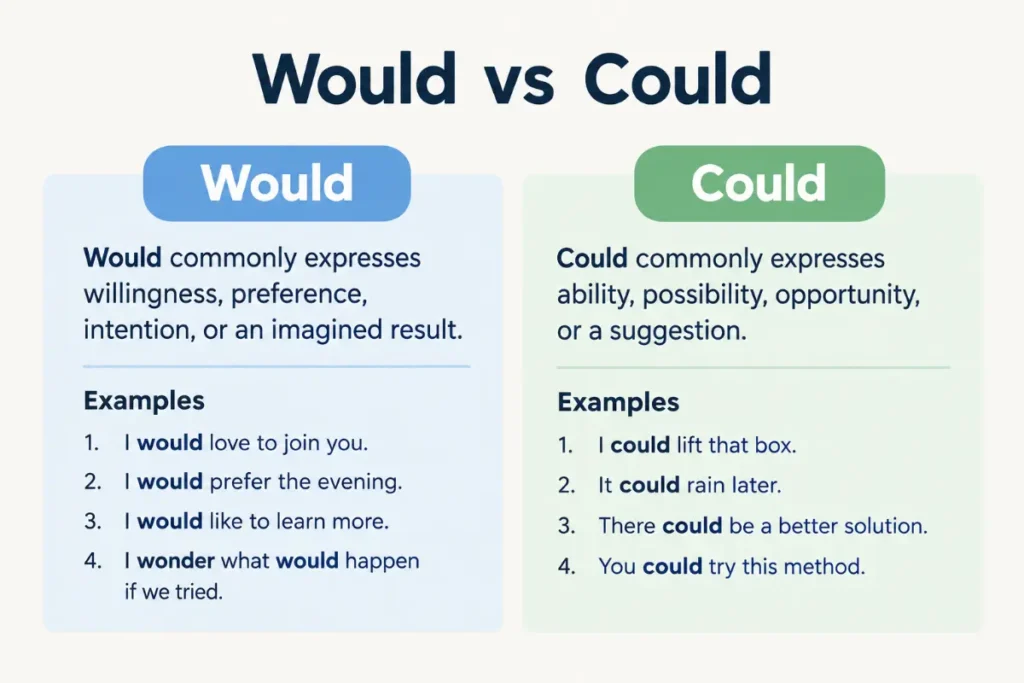
- Would commonly expresses willingness, preference, intention, or an imagined result.
- Could commonly expresses ability, possibility, opportunity, or a suggestion.
- Would you help me? focuses more on willingness.
- Could you help me? focuses more on possibility or ability and works as a polite request.
- If I had money, I would buy it emphasizes a choice or intention.
- If I had money, I could buy it emphasizes possibility.
- Would rather is used for preferences.
- Could often describes past ability.
- Both modals are followed by the base form of the main verb.
- Context matters more than memorizing a single definition for either word.
Conclusion
would vs could becomes much easier once you focus on the idea behind the sentence. Would commonly points to willingness, preference, intention, or an imagined result, while could often points to ability, possibility, or an available option. Both can also make requests more polite, but they can place emphasis on different ideas.
A useful editing habit is to ask one simple question before choosing the modal. Are you talking about what someone would choose or be willing to do, or are you talking about what is possible or possible through someone’s ability? That distinction will solve many common grammar problems.
Remember the shortcut: would often connects with choice, while could often connects with possibility. Then check the full sentence because context always has the final say.
FAQs
What is the main difference between would and could?
Would commonly expresses willingness, preference, imagined results, or conditional intention. Could commonly expresses ability, possibility, or an available option. Both can appear in polite requests, but would often focuses on willingness while could often focuses on possibility or ability. Context matters because modal verbs can serve several related functions.
Can would and could be used in the same conditional sentence?
Yes. They can express different meanings in the same type of conditional situation. For example, If I had more money, I would travel more emphasizes the speaker’s choice or intention. If I had more money, I could travel more emphasizes the possibility created by having more money. Both structures are grammatically correct.
Is could more polite than would?
Both can make requests sound polite, but they create slightly different meanings. Could you help me? politely asks if help is possible. Would you help me? focuses more on willingness. In ordinary conversation, the difference may be small because both can function as polite requests.
Does would mean the same as will?
No. Would is closely related to will but has several additional uses. It can describe hypothetical situations, preferences, polite requests, willingness, repeated past actions, and reported speech. For example, I will call you expresses a future intention, while I would call you if I had your number expresses a conditional situation.
Does could always mean past ability?
No. Could often expresses past ability, as in I could swim when I was six. However, it can also express present or future possibility, suggestions, and polite requests. For example, It could rain tonight describes possibility, while Could you help me? is a polite request.
Is would more formal than could?
Neither modal is automatically more formal. Both are standard in casual and formal English. Their meaning determines the choice. In professional writing, would may express willingness or a conditional result, while could may express possibility or make a request more polite. Good writing uses the modal that communicates the intended idea clearly.
Can I use could for a suggestion?
Yes. Could is commonly used to present an option or suggestion. For example, We could take the train suggests one possible course of action. It doesn’t necessarily mean that the speaker has made a decision. The modal leaves room for discussion and gives the listener an option.
Which is correct in the sentence If I had time I would help?
Would is correct when you mean that you are willing or intend to help if you had enough time. You could also use could if you mean that having enough time would make helping possible. The two sentences are grammatically sound but emphasize different ideas.
Why is would used in Would you like?
Would you like is a standard polite expression used to ask about someone’s preference or offer something. For example, Would you like some coffee? asks if the person wants coffee. Here would doesn’t describe a difficult hypothetical situation. It softens the question and focuses on the person’s preference.
Why does could sound less certain?
Could often presents an action or event as one possibility among several. For example, The meeting could end early means an early ending is possible but not guaranteed. Would can also describe uncertain situations, but it often connects the outcome to a condition, intention, or imagined choice. The surrounding sentence determines the exact level of certainty.

English Grammar & Usage
Nathan Holloway is an American grammar writer and language researcher who specializes in English grammar, sentence structure, verb usage, and common writing mistakes. He enjoys breaking down confusing grammar rules into practical explanations with clear examples, making English easier for students, professionals, and everyday writers.