
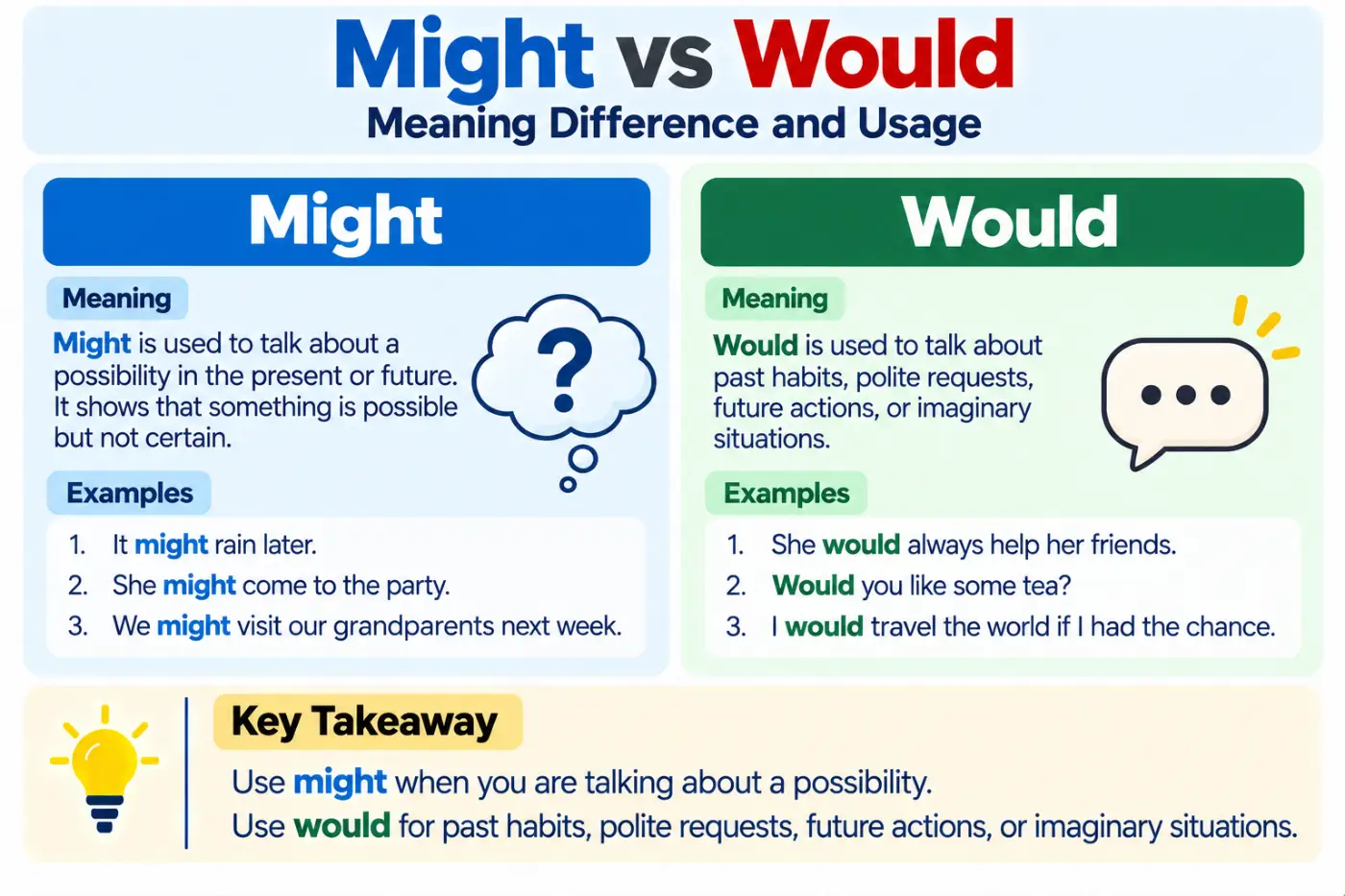
might vs would is a common grammar question because both words can appear in sentences about situations that are uncertain, imagined, or dependent on another event. They can sometimes occur in similar sentence patterns, but they don’t carry the same meaning. Might usually points to possibility, while would often connects an imagined condition with its expected result.
For example, you might say, I might go to the party. This means going to the party is possible, but you haven’t made a definite decision. Compare that with, I would go to the party if I had time. Here would presents an imagined result that depends on having enough time.
The difference becomes much easier once you stop treating these words as interchangeable choices. Instead, ask what the sentence is doing. Is it showing possibility, describing a conditional result, making a polite request, expressing a preference, or talking about a repeated past action? This guide explains those patterns with clear examples so you can choose the right modal naturally in conversation, school writing, emails, and formal English.
Short Answer
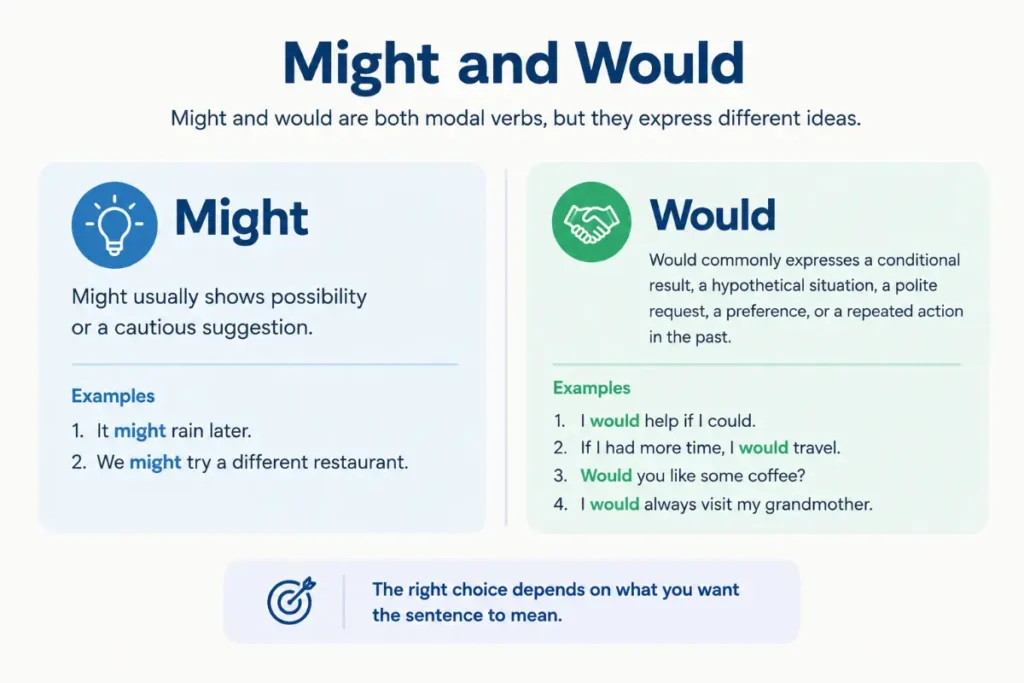
Might and would are both modal verbs, but they express different ideas. Might usually shows possibility or a cautious suggestion. Would commonly expresses a conditional result, a hypothetical situation, a polite request, a preference, or a repeated action in the past. The right choice depends on what you want the sentence to mean.
Table Of Contents
- Quick answer.
- What might means.
- What would means.
- The main difference.
- How might expresses possibility.
- How would expresses conditional meaning.
- When might and would can appear in similar sentences.
- Grammar rules and sentence patterns.
- Real life examples.
- Common mistakes.
- Pronunciation.
- Word origins.
- American and British usage.
- Memory tips.
- Related modal verbs.
- FAQs.
- Key takeaways.
- Conclusion.
What Might Means
Might is a modal verb that most often expresses possibility. It tells the reader or listener that something is possible but not certain.
Consider these examples.
I might go out tonight.
She might call later.
It might rain this afternoon.
He might be busy.
In each sentence, the speaker doesn’t present the event as certain. The event is simply possible.
Might can also make a statement sound cautious. Instead of saying, This is the answer, you might say, This might be the answer. The second sentence leaves room for uncertainty.
That cautious quality makes might useful in professional communication too.
You might want to check the figures again.
This doesn’t sound as direct as Check the figures again. It gives the suggestion a softer tone.
Might can also appear in polite suggestions.
You might try restarting the computer.
You might consider asking your teacher for help.
These sentences don’t necessarily mean that the speaker thinks the action is likely. They present an option for consideration.
What Would Means
Would has several important uses. It can describe an imagined result, a conditional situation, a polite request, a preference, or a repeated past action.
One of its most common uses appears in conditional sentences.
I would travel more if I had more money.
She would help you if she were available.
They would buy the house if the price were lower.
In these examples, would describes the result of an imagined condition.
Would also appears in polite questions.
Would you help me with this?
Would you like some coffee?
Would you mind closing the door?
It can make a request or offer sound more polite and less forceful.
Another use appears when talking about repeated actions in the past.
When we were children, we would visit our grandparents every summer.
Every Sunday, my father would cook breakfast for the family.
Here would doesn’t describe uncertainty. It describes something that happened repeatedly in the past.
Would can also express a preference.
I would rather stay home tonight.
She would prefer tea.
These uses show why would can’t be reduced to one simple definition. Its meaning comes from the structure and context of the sentence.
The Main Difference
The clearest distinction is this.
Might usually presents something as possible.
Would usually presents something as conditional, imagined, preferred, polite, or expected within a particular situation.
Compare these sentences.
I might buy the car.
I would buy the car if it were cheaper.
The first sentence says buying the car is a possibility. The second says buying it depends on a condition.
Another pair makes the difference even clearer.
She might come to dinner.
She would come to dinner if you invited her.
The first sentence leaves the decision uncertain. The second connects her attendance to an invitation.
This distinction helps you avoid one of the most common modal verb mistakes. Don’t choose between might and would simply because both sound natural. Look at the meaning you need first.
How Might Expresses Possibility
Might is useful when you don’t know exactly what will happen.
You might see him at the store.
The train might be late.
I might order pizza tonight.
The company might change its policy.
These sentences all contain uncertainty.
Might doesn’t guarantee that the event will happen. It simply leaves the door open.
This makes it useful when you want to avoid sounding too certain.
A manager might say:
The delivery might arrive tomorrow.
That statement leaves room for a different outcome.
Compare it with:
The delivery will arrive tomorrow.
Will presents the arrival as expected or certain. Might is much less definite.
Might can also describe possibilities that are fairly remote.
If you hurry, you might catch the bus.
This sentence doesn’t guarantee success. It simply says catching the bus remains possible.
How Would Expresses Conditional Meaning
Would commonly appears in sentences where one situation depends on another.
I would call her if I had her number.
The structure is:
If condition + would result.
The condition is having her number. The imagined result is calling her.
Here are more examples.
I would buy that laptop if it were cheaper.
She would move closer if she found a good job there.
We would visit you if we had more time.
They would accept the offer if the salary were higher.
The word would helps show that the result is connected to an imagined or unreal condition.
This is one of the most important uses to remember.
Might In Conditional Sentences
Might can also appear in conditional sentences. This is where learners often become confused because both modal verbs can occur in similar structures.
Consider:
If it rains, we might stay home.
The sentence means staying home is one possible result of the rain.
Now compare:
If it rains, we would stay home.
This can also be grammatical, but the meaning changes. It presents staying home as the expected or intended result under that condition.
The distinction is subtle but useful.
Might leaves the result open.
Would presents the result as more definite within the imagined condition.
Consider another pair.
If I had enough money, I might buy the car.
If I had enough money, I would buy the car.
The first says buying the car is one possibility. The second strongly suggests that having enough money would lead to the purchase.
This is why context matters more than memorizing a single formula.
When Might And Would Appear In Similar Sentences
Sometimes both words can fit grammatically, but the meaning changes.
Compare:
I might go if she invites me.
I would go if she invited me.
The first presents going as a possibility after a possible invitation.
The second presents an imagined situation and its result.
Another example:
He might help if you ask.
He would help if you asked.
The first sounds more uncertain about the result. The second gives a stronger impression that his help would follow the condition.
The difference can be small in everyday conversation, but it becomes important in careful writing.
Grammar Rules For Might
Might is followed by the base form of a verb.
Correct:
She might leave.
He might come.
They might stay.
Incorrect:
She might leaves.
He might came.
They might staying.
After a modal verb such as might, use the base form.
Might can also combine with have to discuss a possible past event.
She might have forgotten.
They might have missed the train.
He might have left already.
This structure suggests that the speaker thinks something happened in the past but isn’t certain.
Might can also appear with be.
She might be tired.
They might be waiting outside.
He might be working.
Again, the modal is followed by the base form be.
Grammar Rules For Would
Would is also followed by the base form of a verb.
Correct:
I would go.
She would help.
They would stay.
Incorrect:
I would went.
She would helps.
They would staying.
Would can appear in conditional structures.
I would help if I could.
She would come if you invited her.
They would stay if the weather improved.
Would can also combine with have and a past participle to discuss an imagined past result.
I would have called you if I had known.
She would have stayed if she had been invited.
They would have helped if they had known about the problem.
This structure often describes something that did not happen because the condition wasn’t met.
Would For Polite Requests
Would is one of the most useful modal verbs for polite communication.
Would you open the window?
Would you send me the file?
Would you mind waiting for a few minutes?
These requests sound softer than direct commands.
Compare:
Send me the file.
Would you send me the file?
The second version creates a more courteous tone.
Would also appears in offers.
Would you like some tea?
Would you like to join us?
These are standard polite expressions in American English.
Might can sometimes soften a suggestion, but it doesn’t normally replace would in these polite request patterns.
For example:
You might send me the file.
This sounds more like a suggestion than a direct polite request.
Would For Preferences
Would often appears with rather.
I would rather stay home.
She would rather walk.
They would rather wait.
The structure would rather + base verb expresses a preference.
You can also use would prefer.
I would prefer to leave early.
She would prefer to work from home.
Would rather and would prefer are common in both everyday and formal English.
Might doesn’t work as a direct replacement.
I might rather stay home is not the normal way to express a simple preference.
Would For Repeated Past Actions
Would can describe actions that happened repeatedly in the past.
When I was young, we would visit my grandparents every summer.
During college, she would study at the library after class.
Every winter, they would travel south.
This use is similar to used to, but there is an important difference.
Would works well for repeated actions. It doesn’t normally describe a permanent past state.
For example:
When I was young, I would play outside every afternoon.
This is natural because playing outside is a repeated action.
But:
I would know him when I was young.
That isn’t the normal way to express a past state. Used to would be more appropriate.
I used to know him.
This distinction helps explain why would has more uses than a simple conditional marker.
Comparison Table
| Feature | Might | Would |
|---|---|---|
| Core idea | Possibility or uncertainty | Conditional result, imagined situation, preference, polite request, or repeated past action |
| Verb form after it | Base verb | Base verb |
| Present possibility | Common | Not normally used for simple possibility |
| Conditional sentences | Can express a possible result | Common for imagined or expected conditional results |
| Polite requests | Less common | Very common |
| Preferences | Not normally used | Common with rather and prefer |
| Repeated past actions | Not normally used | Common |
| Past possibility | Common with have | Can describe an imagined past result with have |
| Formal writing | Appropriate | Appropriate |
| Everyday conversation | Very common | Very common |
Real Life Examples
Everyday Conversation
I might stay home tonight.
This means staying home is possible but not certain.
I would stay home if I weren’t feeling so tired.
This presents staying home as a result connected to a condition.
Would you like to get some coffee?
Here would creates a polite invitation.
She might call you later.
Here might expresses uncertainty about a future action.
Workplace Communication
The client might need more time to review the proposal.
The manager would approve the request if the budget allowed it.
Would you send me the updated document?
We might need to change the meeting time.
Each sentence uses the modal according to its intended meaning. Possibility takes might while conditional results and polite requests often take would.
Academic Writing
The results might suggest a connection between the two factors.
A larger sample would provide stronger evidence.
These examples show how modal verbs help writers communicate levels of certainty and hypothetical outcomes.
Academic writing often needs careful wording because claims may not be completely certain. Might can help avoid presenting a possibility as an established fact.
Formal Writing
The committee might reconsider the proposal.
The organization would face additional costs if the policy changed.
Would you please confirm receipt of the document?
These structures are common in professional and formal communication.
Social Situations
I might join you later.
I would go with you if I didn’t have work.
Would you like to come with us?
The context determines the modal naturally.
Common Mistakes
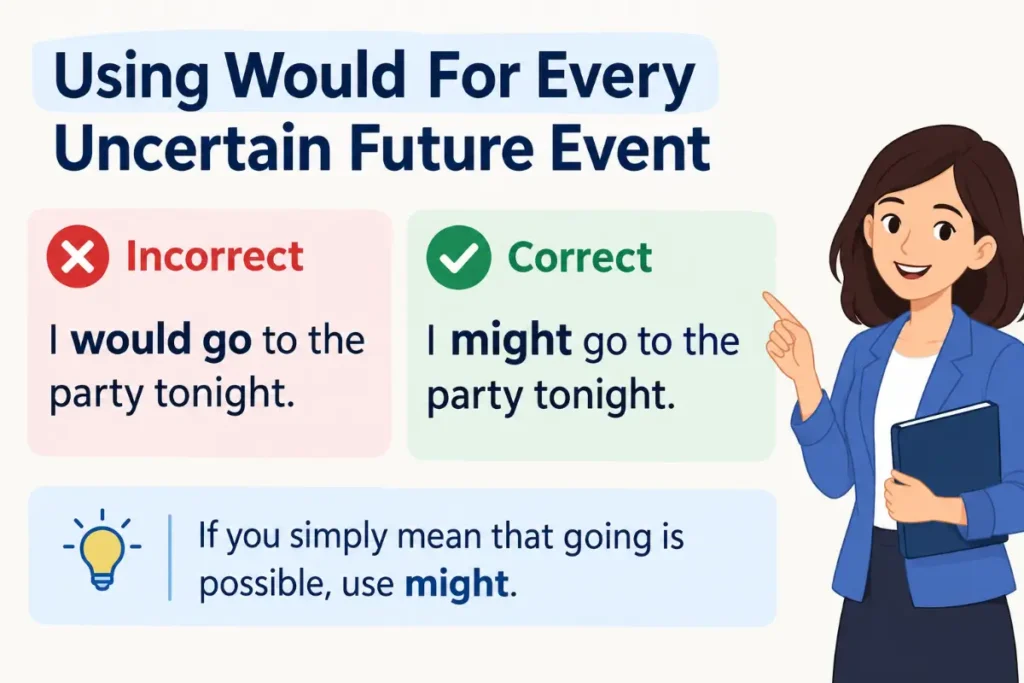
Using Would For Every Uncertain Future Event
Incorrect:
I would go to the party tonight.
If you simply mean that going is possible, use might.
Better:
I might go to the party tonight.
Would needs a suitable context such as a condition, preference, request, or repeated past action.
Using Might For A Conditional Result
Consider:
If I had more money, I might buy that house.
This is grammatical, but it says buying the house is only one possibility.
If your intended meaning is that you definitely plan to buy it under that condition, would is stronger.
If I had more money, I would buy that house.
The choice changes the level of commitment.
Confusing Might Have And Would Have
These forms describe different ideas.
She might have missed the train.
This means you think missing the train is possible.
She would have missed the train if she had left later.
This describes an imagined past result.
The first expresses uncertainty about what happened. The second describes a hypothetical result.
Using Would After Every If Clause
Not every if clause needs would.
Incorrect in standard conditional patterns:
If it would rain, we would stay home.
Usually:
If it rains, we will stay home.
Or:
If it rained, we would stay home.
Would normally belongs in the result clause of common conditional structures rather than directly after if in these patterns.
There are special uses of would after if, especially when expressing willingness or polite insistence, but they are different constructions.
Treating Might And May As Identical
Might and may both express possibility, but they can differ in tone and context.
It may rain.
It might rain.
Both indicate possibility. Might often sounds a little more tentative.
Still, context and speaker intention matter more than trying to assign an exact probability to each modal.
Pronunciation Guide
Might is pronounced /maɪt/.
Would is commonly pronounced /wʊd/.
The pronunciation difference is clear in careful speech, although would can become less prominent in fast conversation.
Might rhymes with words such as light and right.
Would has the same vowel sound heard in good and could.
One common learner mistake is pronouncing would as if it rhymed with loud or could be pronounced exactly like wood without considering connected speech. In standard American English, would has the short vowel sound found in good.
The l in would is silent.
This silent letter can surprise learners because English spelling often preserves historical patterns that aren’t reflected directly in modern pronunciation.
Word Origins
Might and would both have long histories in English.
Might developed from an older form related to the verb may. Historically, the relationship between may and might was connected to differences in tense and mood. Modern English uses might primarily for possibility, uncertainty, and certain hypothetical meanings.
Would developed from an older form of will. Its history explains its relationship with will and its role in expressing future ideas from a past point of view, conditional meanings, polite requests, preferences, and repeated past actions.
These historical relationships can make the modern grammar easier to understand.
Might is closely related to may.
Would is closely related to will.
Still, modern English does not use these pairs as simple mechanical tense changes in every situation. Meaning depends heavily on context.
American And British English
American English
Might and would are both standard and widely used in American English.
American speakers commonly use might for possibility.
I might go later.
They commonly use would for conditional results.
I would go if I had time.
Would is also common in polite requests.
Would you like some coffee?
The basic grammar is stable across American English.
British English
British English uses the same core distinction.
Might expresses possibility and would has its familiar conditional, polite, preference, and past habit uses.
There can be differences in style and frequency between individual speakers, but the fundamental grammar remains the same.
Australian English
Australian English follows the same basic modal patterns. Might is used for possibility while would appears in conditional structures, polite requests, preferences, and descriptions of repeated past actions.
Canadian English
Canadian English also follows the standard distinction. Both forms are widely understood and used in everyday and formal communication.
The main differences across English varieties tend to involve style and pronunciation rather than a different core rule for these modal verbs.
Formal And Informal Usage
Both might and would are appropriate in formal and informal English.
The difference comes from meaning rather than formality.
In casual conversation:
I might come over later.
In formal writing:
The results might indicate a need for further research.
Both sentences use might naturally.
Would works the same way.
I would go if I had time.
The company would need additional funding to expand.
One useful writing principle is to avoid replacing simple modal verbs with complicated phrases just to sound formal. Clear English is usually stronger.
Might Vs Would In Conditional Sentences
Conditional sentences deserve special attention because this is where the distinction can become subtle.
Consider three sentences.
If I had enough money, I might buy the car.
If I had enough money, I would buy the car.
If I had enough money, I could buy the car.
They are not identical.
The first presents buying as a possibility.
The second presents buying as the imagined result.
The third emphasizes ability or opportunity.
This gives you a useful comparison.
Might means the condition could lead to the result.
Would means the condition would lead to the result in the speaker’s imagined situation.
Could means the condition would make the result possible or achievable.
Understanding this three way distinction can improve both everyday speech and academic writing.
Might Have And Would Have
Past forms create another useful contrast.
Might have + past participle expresses a possible past event.
She might have forgotten the appointment.
The speaker doesn’t know for sure.
Would have + past participle commonly expresses an imagined past result.
She would have attended the meeting if she had known about it.
The meeting may have happened differently, but the condition was not met.
Compare:
He might have taken the wrong train.
He would have taken the wrong train if he hadn’t checked the sign.
The first is speculation. The second is a hypothetical result.
This distinction is especially useful when explaining events after they happen.
Could Might And Would
Could is another modal that often appears alongside these forms.
Consider:
I could go.
I might go.
I would go.
The meanings differ.
Could suggests ability or possibility.
Might suggests uncertainty or possibility.
Would suggests a conditional result or willingness depending on context.
For example:
I could help you.
This can mean I am able to help.
I might help you.
This means helping is possible but uncertain.
I would help you.
This can express willingness or a conditional idea depending on context.
These small differences matter because modal verbs communicate attitude as well as basic action.
May Might And Would
May and might both commonly express possibility.
It may rain.
It might rain.
Would usually serves a different purpose.
It would rain if the weather system moved east.
The first two sentences express possibility. The third describes a hypothetical condition and result.
This comparison can help learners avoid choosing a modal simply because all three sentences concern the future.
The important question is not only when the event happens. Ask what relationship you want to express between the speaker and the event.
Memory Tips
A simple memory system can make these words much easier.
Remember Might As Possibility
Think:
Might = maybe.
I might go.
This means maybe I will go.
Remember Would As A Condition
Think:
Would = imagined result.
I would go if I had time.
The condition is having time. The result is going.
Remember Would For Politeness
Would you help me?
Would you like some tea?
These are common polite patterns.
Remember Might For Uncertainty
She might call.
They might arrive late.
You might be right.
The speaker isn’t certain.
Remember Might Have For A Guess About The Past
He might have forgotten.
She might have left.
You are making a possible explanation.
Remember Would Have For An Imagined Past
I would have helped if you had asked.
This describes something that didn’t happen because the condition wasn’t met.
Related Grammar And Usage Notes
Modal Verbs
Might and would belong to the group of modal auxiliary verbs. Other common modals include can, could, may, must, shall, should, and will.
Modal verbs help speakers express ideas such as possibility, ability, obligation, prediction, permission, and hypothetical situations.
Base Verb Rule
After a modal verb, use the base form.
Might go.
Would go.
Might help.
Would help.
Not might goes or would went.
No To After A Modal
A modal normally takes the base verb directly.
I might go.
I would go.
Don’t write:
I might to go.
I would to go.
There are different constructions involving would rather and would like, but these follow their own patterns.
Negative Forms
Might not expresses lack of certainty or possibility that something will not happen.
I might not go.
Would not can express a conditional negative, refusal, or a past repeated action depending on context.
I wouldn’t do that.
I would not go if I were you.
These forms can sound quite different depending on the surrounding sentence.
Contractions
In everyday American English, would commonly contracts to would not and I’d, you’d, he’d, she’d, we’d, and they’d.
I’d go if I had time.
She’d help if she could.
Wouldn’t is also extremely common.
Might doesn’t have an equally common standard contraction in ordinary writing.
Professional Writing Tips
A strong editor doesn’t choose modal verbs by grammar rules alone. The editor also checks the strength of the claim.
Compare:
The change might improve productivity.
The change would improve productivity.
The first makes a cautious claim. The second sounds more definite and usually needs a clear condition or basis.
In professional or academic writing, this difference matters. Using would where you only have a possibility can make a claim sound stronger than the evidence supports.
Similarly, using might when you mean a firm conditional result can make your writing sound unnecessarily uncertain.
Choose the modal that matches the certainty and relationship you actually mean.
Expert Editor Insight
An experienced editor usually checks the sentence’s intended meaning before checking the modal itself. If the writer is guessing about a possibility, might often fits. If the writer is describing an imagined result, a polite request, a preference, or a repeated past action, would may be more appropriate. Grammar software can flag some modal patterns, but it cannot always understand the writer’s intended level of certainty. The best editing habit is to rewrite the sentence in plain language first and then choose the modal that preserves that meaning.
Key Takeaways
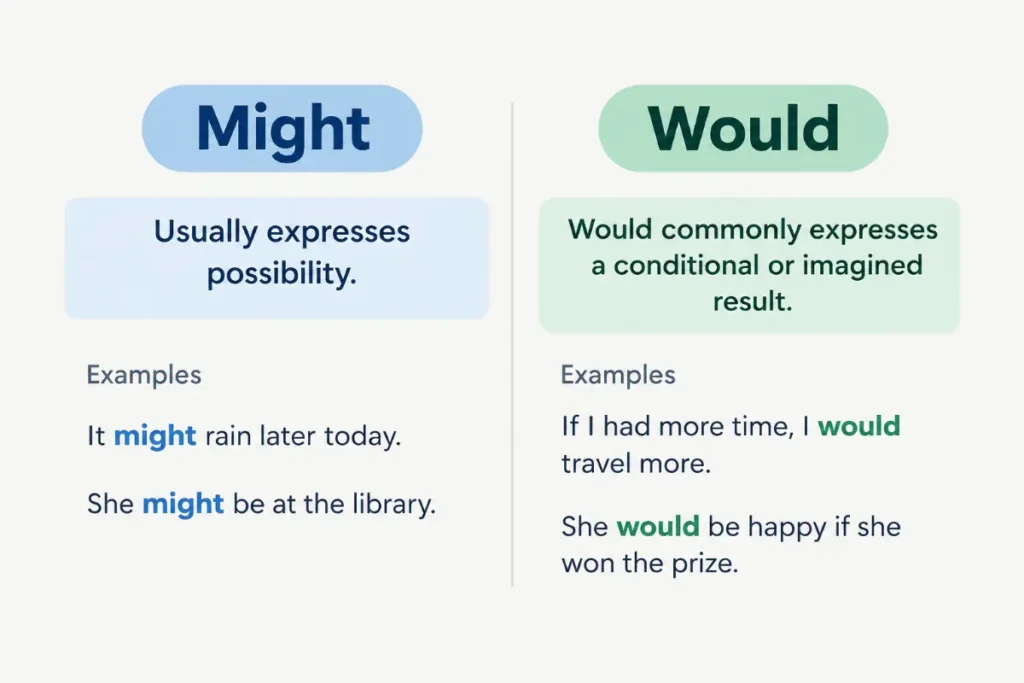
- Might usually expresses possibility.
- Would commonly expresses a conditional or imagined result.
- Might can make a statement sound cautious or tentative.
- Would is common in polite requests such as Would you help me?
- Would rather and would prefer express preferences.
- Would can describe repeated actions in the past.
- Might have often expresses uncertainty about a past event.
- Would have often describes an imagined past result.
- Both modal verbs take the base form of the main verb.
- The best choice depends on meaning and context rather than a simple tense rule.
Conclusion
might vs would becomes much clearer when you focus on the idea behind the sentence. Might usually shows possibility or uncertainty, while would commonly expresses a conditional result, imagined situation, polite request, preference, or repeated past action. The two words can appear in similar sentence structures, but they change the meaning in useful ways.
The best editing trick is to replace the modal with plain language before making your final choice. If you mean maybe, might is often the natural option. If you mean under this condition, I would do this, would is usually the better choice.
Once you connect might with possibility and would with conditional or imagined results, these modal verbs become much easier to use naturally in everyday and formal English.
FAQs
What is the difference between might and would?
Might usually expresses possibility or uncertainty. Would commonly expresses a conditional result, hypothetical situation, polite request, preference, or repeated past action. Compare I might go to the store with I would go to the store if I had a car. The first leaves the action uncertain. The second connects the action to a condition.
Can might and would be used in the same sentence?
Yes, they can appear together when they perform different jobs. For example, If I had more time, I would study harder because it might improve my results. Would introduces the imagined result while might expresses uncertainty about the possible effect. Their meanings remain separate even though they occur in one sentence.
Which is more uncertain might or would?
Might generally expresses more uncertainty because it presents an event as a possibility. Would usually presents a result as connected to a stated or understood condition. However, you shouldn’t treat these words as exact measurements of probability. Context matters. The difference is mainly about the relationship between the speaker, the condition, and the event.
Is might the past tense of may?
Might is historically related to may and can sometimes function as a past form in reported speech. Modern English also uses might independently to express present or future possibility. For example, She said she might come later refers to a possible future event from the current point of view. The relationship is therefore more complex than a simple past tense rule.
Is would the past tense of will?
Would developed historically from will and can serve as a past form in certain reported speech structures. However, modern English uses would for many other purposes, including conditional statements, polite requests, preferences, and repeated past actions. For example, I would help if I could is not simply a past version of I will help.
Can I use might in a conditional sentence?
Yes. Might can express a possible result in a conditional sentence. For example, If it rains, we might stay home. This means staying home is one possible outcome. Compare that with If it rains, we would stay home. The second sentence presents staying home as the expected result under that condition.
Can would express possibility?
Would can appear in contexts that involve imagined or conditional situations, but it is not the usual choice for simple uncertain possibility. If you mean that something may happen, might is often clearer. For example, I might visit tomorrow means the visit is possible. I would visit tomorrow usually needs additional context or a condition.
How do I remember might and would?
Use a simple mental shortcut. Think of might as maybe and would as an imagined result. I might go means maybe I will go. I would go if I had time means going depends on the condition. Then remember that would also appears in polite requests, preferences, and repeated past actions.
Is would more formal than might?
Neither word is simply more formal than the other. Both are standard in everyday conversation, professional writing, academic work, and formal communication. The difference is meaning rather than formality. Might often communicates uncertainty while would can express conditional meaning, politeness, preference, or repeated past action.
Should I use might or would in academic writing?
Choose the word that accurately reflects your claim. Use might when presenting a possibility or cautious interpretation. Use would for a conditional outcome or hypothetical result. For example, The treatment might reduce symptoms expresses a possibility. The treatment would reduce symptoms if the proposed mechanism were correct presents a conditional claim.

English Grammar & Usage
Nathan Holloway is an American grammar writer and language researcher who specializes in English grammar, sentence structure, verb usage, and common writing mistakes. He enjoys breaking down confusing grammar rules into practical explanations with clear examples, making English easier for students, professionals, and everyday writers.