
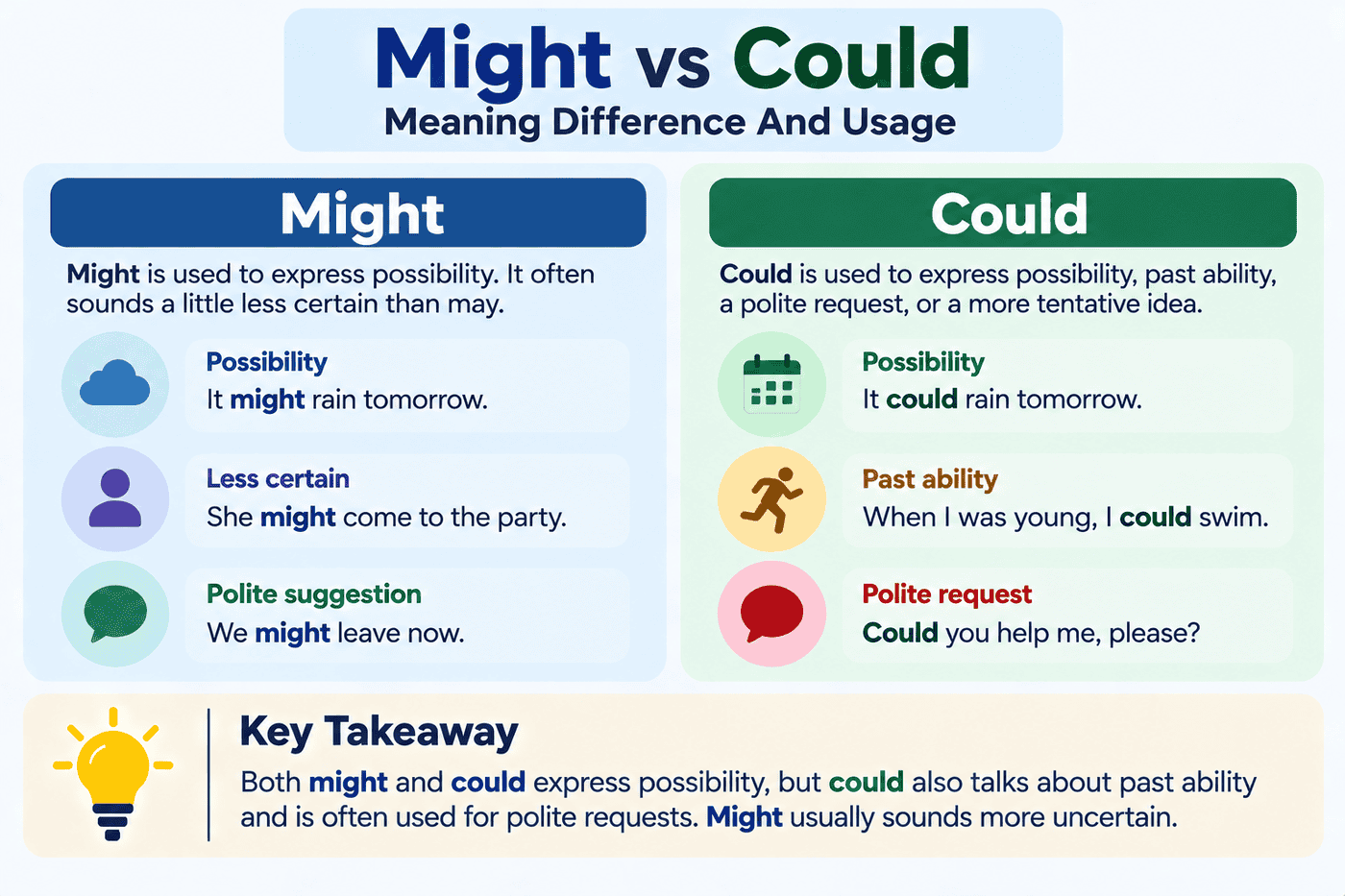
might vs could is a common grammar question because both modal verbs can express possibility. In many sentences, they can sound very similar, but they don’t always communicate the same idea. The main difference is that might often presents a possibility with uncertainty, while could often presents a possible outcome, available option, ability, or hypothetical result.
Consider these two sentences. It might rain tonight. It could rain tonight. Both sentences say rain is possible, so the difference is small in this context. Now compare She could swim when she was five with She might swim when she was five. The first sentence describes past ability, while the second suggests a possibility.
That distinction becomes easier once you look at the purpose behind the modal verb. You’ll learn how both words work with possibility, ability, permission, requests, suggestions, conditionals, past situations, and reported speech. You’ll also see natural examples and simple rules that help you choose the right form without memorizing complicated grammar terms.
Quick Definition
Might and could are both modal verbs that can express possibility. Might often emphasizes uncertainty about an event, while could can describe a possible outcome, an available option, past ability, or a hypothetical situation. In some possibility sentences, they are interchangeable, but the context can change the meaning.
Quick Answer
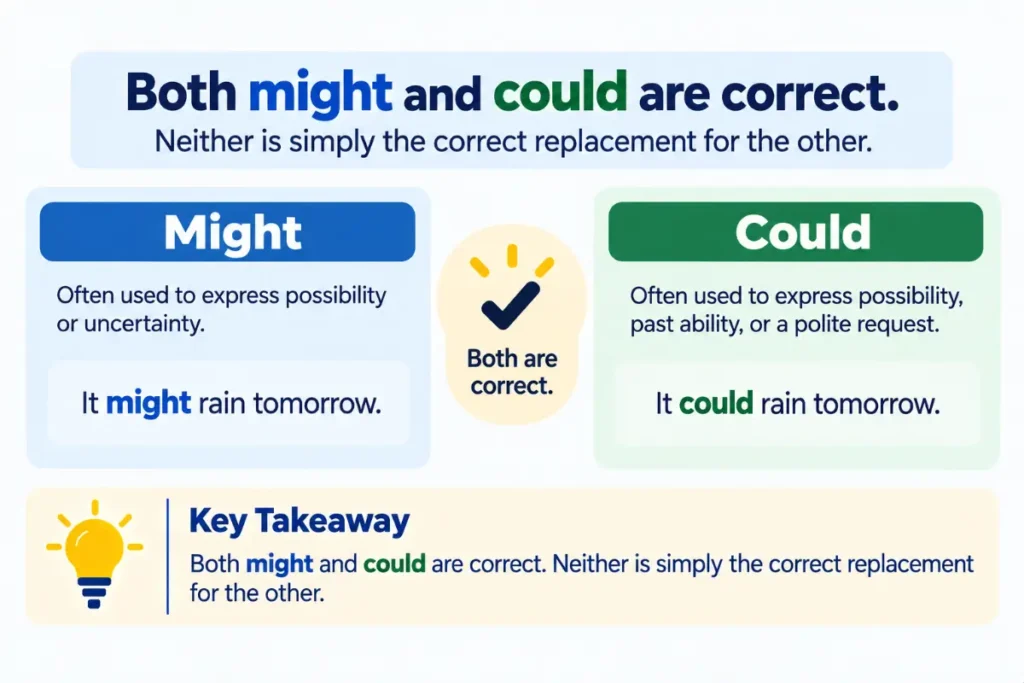
Both might and could are correct. Neither is simply the correct replacement for the other.
Use might when you want to present something as a possibility, especially when the outcome is uncertain. Use could when you want to express one possible outcome, an option, past ability, or a hypothetical result.
For example:
It might snow tonight.
It could snow tonight.
Both sentences express possibility. However, could can also appear in a sentence such as:
When I was younger, I could run five miles.
Here could describes past ability. Might cannot normally replace it.
Comparison Table
| Form | Main Meaning | Part of Speech | Origin | Usage Frequency | Formality | Common Contexts | Example |
|---|---|---|---|---|---|---|---|
| Might | Possibility, uncertainty, or a tentative suggestion | Modal auxiliary verb | Old English and Germanic roots | Very common | Neutral and formal | Possibility, reported speech, suggestions, uncertainty | She might come later. |
| Could | Possibility, past ability, polite requests, options, or hypothetical results | Modal auxiliary verb | Old English and Germanic roots | Very common | Neutral and formal | Ability, possibility, requests, conditionals, suggestions | We could leave early. |
The most important point is that these words overlap in meaning but have different grammatical jobs.
Meaning And Definition
Meaning Of Might
Might is a modal auxiliary verb. Its most familiar use is to express possibility.
For example:
I might go to the gym tonight.
This sentence says going to the gym is possible, but the speaker has not made a firm decision.
Might can also express uncertainty about an event.
The package might arrive tomorrow.
The speaker doesn’t know for certain that the package will arrive. The event remains possible.
Another common use appears in conditional or hypothetical situations.
If we leave now, we might catch the earlier train.
Might can also make a suggestion sound tentative.
You might want to check your email.
This doesn’t simply state that checking email is possible. It works as a polite suggestion.
Might can also appear in reported speech.
She said she might visit us later.
Here might helps report a possibility from another person’s perspective.
The word generally has a cautious tone. It doesn’t guarantee that something will happen.
Meaning Of Could
Could is also a modal auxiliary verb, but it has a wider range of uses.
One major use is possibility.
We could take the train instead.
This means taking the train is one available possibility.
Could also describes past ability.
When I was younger, I could play the piano.
Here the meaning isn’t uncertainty. The speaker had the ability to play.
Another use is polite requests.
Could you open the window?
This is a request. The speaker isn’t asking about possibility in the same way as the sentence It could rain.
Could also introduce hypothetical results.
If we saved enough money, we could buy a new car.
The sentence describes an option that could become possible under a certain condition.
Could therefore covers more meanings than might. Context tells you which meaning applies.
The Main Difference In Meaning
The easiest distinction is this.
Might usually focuses on uncertainty.
Could often focuses on possibility, ability, opportunity, or a possible outcome.
Compare these examples.
She might come to the party.
This means her attendance is possible, but the speaker doesn’t know if she will come.
She could come to the party.
This can also mean her attendance is possible. However, it can suggest that nothing prevents her from coming or that coming is one available option.
Now look at ability.
He could swim when he was six.
This means he had the ability to swim at that age.
He might swim when he was six.
This doesn’t normally express ability. It suggests that perhaps he swam at that age.
The difference becomes even clearer in conditional sentences.
If we leave now, we could catch the train.
This presents catching the train as a possible result.
If we leave now, we might catch the train.
This emphasizes uncertainty about the result.
The train may be caught, but the speaker isn’t confident about it.
Possibility And Uncertainty
Both modal verbs can talk about something that may happen.
That overlap explains much of the confusion.
Consider:
It might rain tomorrow.
It could rain tomorrow.
In ordinary conversation, both can communicate the basic idea that rain is possible.
However, might often feels more directly connected to uncertainty.
She might call tonight.
The speaker isn’t sure if she will call.
Could can sound broader.
She could call tonight.
This can mean calling is one possible event among several. Depending on context, it can also suggest that she has the opportunity or ability to call.
The difference is subtle. Native speakers don’t always use the two words according to a strict mathematical scale of probability. Context, tone, and surrounding words matter.
That means you shouldn’t try to assign a fixed percentage to might or could. Grammar doesn’t work that neatly.
Ability And Possibility
One of the clearest differences appears with ability.
Could can describe ability in the past.
I could read when I was four.
She could drive before she turned eighteen.
We could see the mountains from our old house.
Might doesn’t normally perform this function.
I might read when I was four.
This sentence doesn’t naturally mean I had the ability to read. It suggests uncertainty about the fact.
For present ability, can is usually the natural choice.
I can swim.
For past general ability, could is often appropriate.
I could swim when I was five.
This makes could especially useful when discussing skills or abilities from an earlier period.
Permission And Requests
Could can also appear in polite requests.
Could you help me with this?
Could I borrow your pen?
These sentences use could to make a request sound polite.
Might has a different relationship with permission.
Might I ask you a question?
This is grammatically correct, but it sounds very formal or old fashioned in many modern American contexts.
You may also see might in highly formal requests or literary dialogue, but ordinary speakers usually prefer could or can.
For example:
Could I leave early today?
sounds natural and polite.
Might I leave early today?
sounds much more formal.
The grammar is correct in both cases. The difference is tone and social context.
Suggestions And Advice
Both words can appear in suggestions, but the effect can differ.
You might try restarting your computer.
This sounds like a gentle suggestion.
You could try restarting your computer.
This also gives a suggestion, but it often feels more like presenting one possible solution.
That distinction can be useful at work.
If you’re helping a colleague, you might say:
You might want to review the report again.
This is soft and cautious.
You could revise the introduction.
This presents revision as one available action.
Neither sentence is automatically better. The speaker chooses based on how direct or tentative the suggestion should sound.
Conditional Sentences
Could is especially common in conditional sentences.
If I had more time, I could help you.
This means having more time would make helping possible.
If we left earlier, we could avoid traffic.
This presents avoiding traffic as a possible result of leaving earlier.
Might can also appear in conditional sentences.
If we left earlier, we might avoid traffic.
Now the speaker emphasizes uncertainty. Leaving early may help, but there is no guarantee.
Compare the two.
If we leave now, we could arrive before noon.
If we leave now, we might arrive before noon.
The first sentence presents arriving before noon as a possible outcome. The second puts more emphasis on uncertainty about that outcome.
Politeness And Tone
Could often sounds more polite than can in requests.
Can you help me?
Could you help me?
The second sentence usually sounds softer.
Might can sound even more tentative or formal in certain structures.
Might I speak with the manager?
This is polite but quite formal.
Might is more commonly used today for possibility and tentative suggestions than for everyday requests.
Tone matters because grammar isn’t only about rules. Native speakers also use modal verbs to manage how strong a statement sounds.
A direct statement can sound firm.
She will come.
A less certain statement sounds softer.
She might come.
A possible option can be presented with could.
She could come.
The surrounding context tells you how the listener should interpret the statement.
Key Differences Explained
- Possibility. Both words can describe something that may happen. Might often highlights uncertainty, while could can present one possible outcome or option.
- Past ability. Could can describe general ability in the past. Might doesn’t normally have this meaning.
- Polite requests. Could is common in polite requests. Might can form very formal requests but is much less common in everyday American English.
- Hypothetical situations. Could frequently describes a possible result under a condition.
- Tentative suggestions. Might often makes advice sound gentle or cautious.
- Opportunity. Could can suggest that someone has an available opportunity to do something.
- Reported speech. Might commonly appears when reporting a possibility expressed earlier.
- Tone. Might often sounds more tentative. Could can sound practical because it frequently presents an option.
Which Form Should You Use?
The right choice depends on what you mean.
Use might when the main idea is uncertainty.
I might go out tonight.
Use could when you mean an available possibility.
We could go out tonight.
Use could for past ability.
I could swim when I was six.
Use could for polite requests.
Could you send me the file?
Use might for a tentative suggestion.
You might want to call her first.
Use could for a hypothetical result.
If we saved more money, we could travel next year.
This approach is more useful than trying to memorize a single rule that says one modal is stronger or weaker than the other.
Sentence Examples
Here are ten natural examples that show how the two forms work.
- I might visit my parents this weekend if I have enough time.
- We could take the highway, but the train might be faster.
- She might call you after work.
- You could ask your teacher for extra help.
- He could swim across the pool when he was only seven.
- We might need more chairs for the meeting.
- If you leave now, you could reach the store before it closes.
- I might order pizza tonight.
- You could save the document before closing the program.
- The weather might improve later this afternoon.
Notice that several sentences allow both forms in a slightly different context.
We could eat outside.
We might eat outside.
The first presents eating outside as an available option. The second emphasizes that eating outside is one possibility among uncertain plans.
Common Mistakes
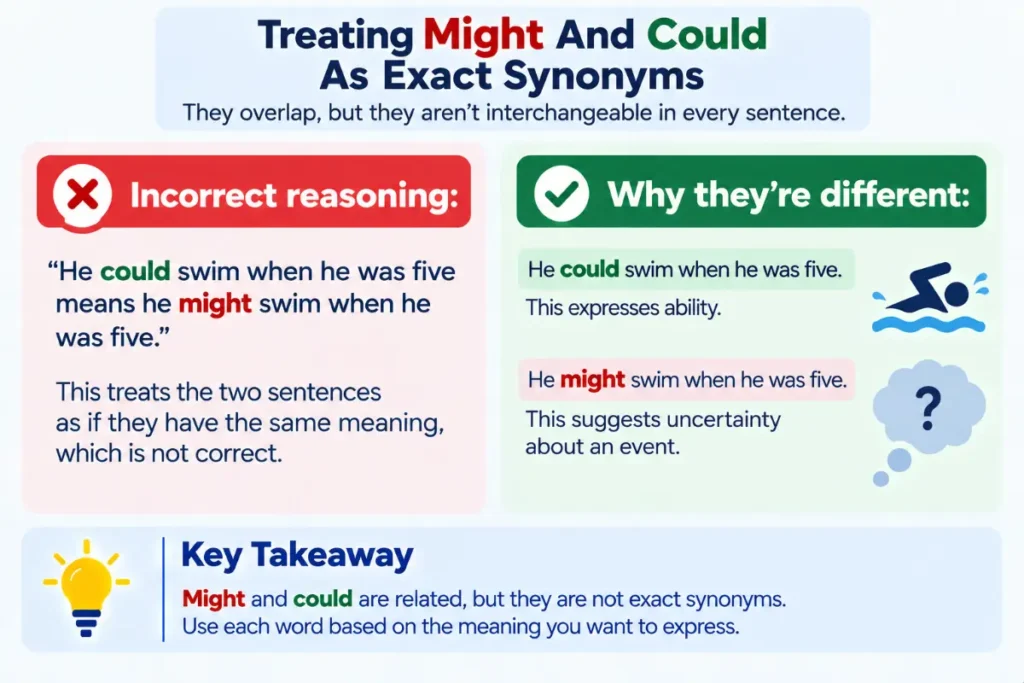
Treating Might And Could As Exact Synonyms
They overlap, but they aren’t interchangeable in every sentence.
Incorrect reasoning:
He could swim when he was five means he might swim when he was five.
The first sentence expresses ability. The second suggests uncertainty about an event.
Using Might For Past Ability
A common learner error is using might when talking about a skill someone had in the past.
I might speak French when I was ten.
If you mean the person had the ability, use:
I could speak French when I was ten.
Assuming Could Always Means Permission
Could can express permission in questions.
Could I use your phone?
But it can also express possibility, ability, or a hypothetical result.
The context determines the meaning.
Thinking Might Always Means Less Probability
English grammar doesn’t assign fixed probability levels to modal verbs. Might can suggest uncertainty, but speakers don’t always use it to communicate a precise degree of likelihood.
Avoid treating modal verbs like percentages.
Using Formal Might In Casual Requests
Might I borrow your phone?
This is grammatically possible but may sound stiff in casual American conversation.
Could I borrow your phone?
is usually more natural.
Pronunciation Guide
Might
Might is pronounced /maɪt/.
It has one syllable.
A simple pronunciation guide is mite.
The vowel sound is the same sound heard in words such as my and time.
The final t should be pronounced clearly in careful speech.
Could
Could is pronounced /kʊd/ in standard American English.
It has one syllable.
A simple guide is kood, with the vowel similar to the sound in good.
The letter l is silent.
This silent l can cause problems for English learners because the spelling suggests a sound that isn’t actually pronounced.
Do not pronounce it like cold or could with a strong l sound.
Say:
Could.
Not:
Coold.
Understanding pronunciation can help you recognize these words in conversation. It also helps explain why spelling alone can sometimes make the difference harder to notice.
Etymology And Word Origin
Might and could both have long histories in English and are connected to older forms of modal verbs.
Might developed as the past form associated historically with may. Over time, it developed several uses beyond simple past reference. Modern English commonly uses might to express possibility, uncertainty, tentative suggestions, and reported speech.
Could developed as the past form associated with can. Modern English uses it for several functions, including past ability, polite requests, possibility, and hypothetical situations.
The historical relationship with may and can helps explain some of their modern grammar.
May and might are closely related.
Can and could are closely related.
However, modern English doesn’t simply use might as a past version of may or could as a past version of can. Each modal has developed its own range of present day meanings.
Regional Usage
American English
Both forms are standard in American English. Might commonly expresses possibility and uncertainty.
Could is especially common for past ability, hypothetical situations, possible options, and polite requests.
In everyday American speech, could is also common in suggestions.
You could try restarting the computer.
Might is often used to soften advice.
You might want to check the address again.
British English
British English uses both forms in much the same way. The main grammatical distinctions remain consistent.
British speakers may use might in some formal or polite structures that sound less common in casual American speech, but the core meanings remain the same.
Australian English
Australian English follows the same broad grammar patterns. Might commonly expresses possibility while could has uses involving ability, possibility, requests, and hypothetical situations.
There is no major regional rule that changes the central distinction.
Canadian English
Canadian English also uses both modal verbs according to the standard distinctions. Speakers may choose either one for possibility depending on context and intended tone.
Could is common in polite requests and hypothetical statements, while might frequently signals uncertainty.
Grammar Rules And Sentence Position
Might and could are modal auxiliary verbs. They normally appear before the base form of another verb.
Might + base verb:
She might come.
Could + base verb:
She could come.
Do not add to after might.
Incorrect:
She might to come.
Correct:
She might come.
Do not use an unnecessary third person ending after the modal.
Incorrect:
He might goes home.
Correct:
He might go home.
The same rule applies to could.
Incorrect:
She could goes with us.
Correct:
She could go with us.
Modal verbs do not take the standard third person s ending.
They also form negatives without do.
She might not come.
He could not attend.
In informal American English, could not is often shortened to couldn’t. Might not is commonly written as might not rather than a contraction.
Could Have And Might Have
The forms could have and might have are especially useful for discussing past situations.
Could have can describe a possible past event.
She could have missed the train.
Depending on context, this can mean it was possible that she missed it.
Could have can also describe an unrealized opportunity.
I could have called you.
This can mean I had the opportunity to call but did not do so.
Might have often expresses uncertainty about a past event.
She might have missed the train.
Here the speaker doesn’t know if she missed it.
Compare:
He could have taken the wrong road.
He might have taken the wrong road.
Both can suggest that taking the wrong road was possible. The second more clearly emphasizes uncertainty about what actually happened.
Might Have And Regret
Might have can also appear in expressions that look back at a possible past result.
We might have arrived earlier if we had left sooner.
This sentence connects a past possibility with a condition.
Could have works differently in many contexts.
We could have arrived earlier if we had left sooner.
The first can emphasize uncertainty about the imagined outcome. The second often emphasizes that arriving earlier was possible under different circumstances.
The difference can be subtle, so context remains important.
Real Life Usage Examples
Daily Conversation
You might want to bring a jacket because it’s getting cold.
We could grab coffee before the movie.
The first sentence gives a gentle suggestion. The second presents an option.
Workplace Communication
We might need another person on the project if the deadline stays the same.
You could send the updated report before the meeting.
The first communicates uncertainty about future needs. The second suggests an available action.
Academic Writing
The results might indicate that sleep affects memory performance.
The researchers could have reached a different conclusion with a larger sample.
Academic writing often uses modal verbs to avoid making stronger claims than the evidence supports.
News Writing
The storm might affect travel across the region.
Officials could announce additional measures later in the week.
News writing frequently uses modal verbs because developing events can involve uncertainty.
Literature And Storytelling
She might return before sunset.
He could hear footsteps outside the door.
The first creates uncertainty about what may happen. The second can describe perception or ability depending on context.
Related And Confused Terms
May
May often expresses possibility or permission.
It may rain tonight.
May I leave early?
Might often sounds more tentative than may, although the difference isn’t a fixed probability scale.
Can
Can commonly expresses present ability or general possibility.
I can swim.
It can get very cold here.
It is also common in informal requests.
Can you help me?
Should
Should often expresses expectation, advice, or duty.
You should call her.
The package should arrive tomorrow.
It normally carries a different meaning from simple possibility.
Would
Would commonly appears in hypothetical situations, polite requests, preferences, and reported speech.
I would go if I had time.
Will
Will commonly expresses future intention, prediction, or willingness.
I will call you tomorrow.
It generally sounds more definite than might.
Must
Must can express strong necessity or a strong conclusion.
You must wear a seat belt.
She must be tired after that long trip.
This is much stronger than a simple possibility expressed with might.
May Have
May have can express a possibility about the past.
She may have forgotten the appointment.
It is closely related to might have.
Could Have
Could have can express past possibility or an unrealized opportunity.
He could have won the race.
The exact meaning depends on context.
How Native Speakers Choose Between Them
Native speakers don’t normally stop and calculate a grammar formula every time they use a modal verb. They respond to the meaning they want to communicate.
If the speaker is uncertain about an event, might often comes naturally.
I might stay home tonight.
If the speaker is presenting an option, could may sound more natural.
We could stay home tonight.
If the speaker is talking about an old skill, could is the natural choice.
I could ride a bike when I was four.
If the speaker wants to make a suggestion sound gentle, might works well.
You might want to bring an umbrella.
If the speaker is describing a possible result under a condition, could is common.
If we hurry, we could catch the bus.
This is why learning modal verbs through isolated definitions can be frustrating. The real meaning comes from the situation.
Expert Editor Insight
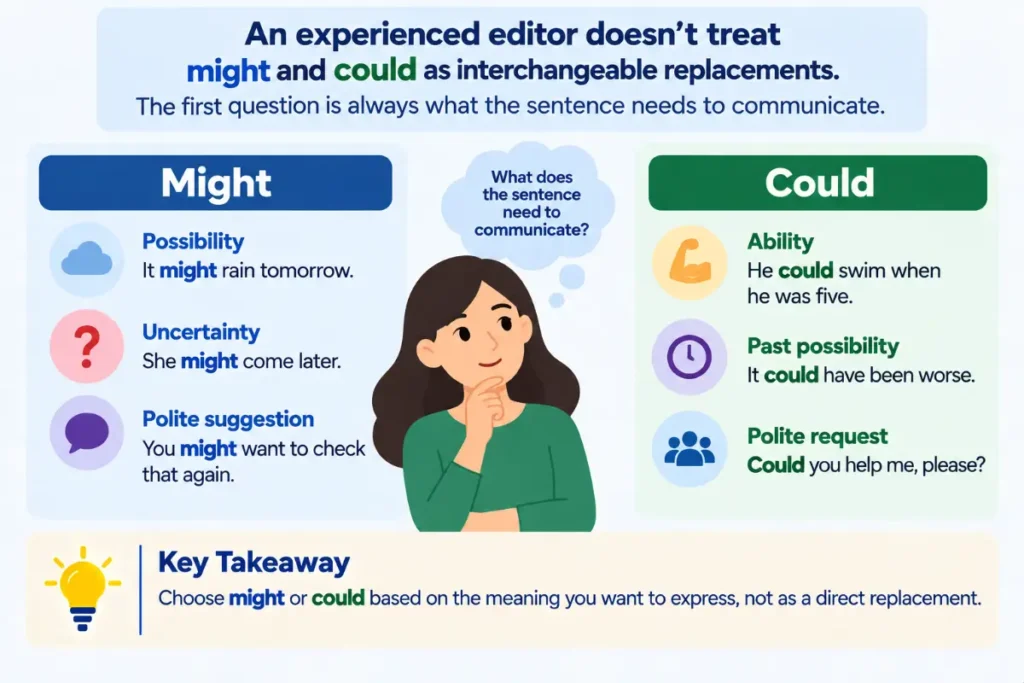
An experienced editor doesn’t treat might and could as interchangeable replacements. The first question is always what the sentence needs to communicate. If the writer means uncertainty, might often fits naturally. If the writer means ability, opportunity, a possible result, or a polite request, could may be the better choice. Grammar tools can identify some structural problems, but they usually can’t determine the intended nuance of every modal verb. The best editing tip is to replace the modal temporarily with a plain explanation such as may happen, is possible, was able to, or is one option. If that reveals the intended meaning, choosing the modal becomes much easier.
Conclusion
might vs could is not a case where one word is correct and the other is wrong. Both are standard modal verbs, but they perform different jobs. Might commonly expresses possibility or uncertainty, while could can express possibility, past ability, an available option, a polite request, or a hypothetical result.
The easiest way to choose is to ask yourself what you mean. If you’re saying something may happen but you’re not sure, might often fits. If you’re describing what was possible, what someone was able to do, or one available outcome, could often works better. Context can also make both choices possible with a small change in emphasis.
A useful editing trick is to replace the modal with its intended meaning before choosing the word. Think may happen for uncertainty, was able to for past ability, and was possible or was an option for possibility. That simple check can prevent most mistake.
FAQs
Is might stronger than could?
Neither word has one fixed level of certainty that works in every sentence. Might often highlights uncertainty, while could can present a possibility or available option. In some contexts, both sound almost identical. Avoid treating them as exact probability markers. The surrounding sentence and situation determine the intended meaning.
Can might and could be used for possibility?
Yes. Both modal verbs can express possibility. For example, It might rain tonight and It could rain tonight both say rain is possible. The first often emphasizes uncertainty, while the second can present rain as one possible outcome. In many everyday situations, native speakers may use either form without creating a major difference in meaning.
Can could describe past ability?
Yes. Could is commonly used for general ability in the past. For example, I could swim when I was six means the speaker had the ability to swim at that age. This is one of the clearest situations where might cannot normally replace could. Might would suggest uncertainty rather than past ability.
Can might describe ability?
Might doesn’t normally describe ability. If you say She might speak Spanish, the usual meaning is that it is possible she speaks Spanish. If you say She could speak Spanish, the meaning can be that she had the ability to speak it, depending on context. For ability, can and could are usually the natural choices.
Is could more polite than might?
Could is commonly used for polite requests in modern American English. For example, Could you help me? sounds natural and courteous. Might can also appear in a request such as Might I ask a question? but this sounds much more formal. For everyday requests, could is generally more natural.
Can might and could be used in conditional sentences?
Yes. Both can appear in conditional sentences, but they can create slightly different meanings. If we leave now, we could catch the train presents catching the train as a possible result. If we leave now, we might catch the train places more emphasis on uncertainty about the result.
What is the difference between might have and could have?
Might have often expresses uncertainty about a past event. She might have missed the bus means the speaker thinks this is possible. Could have can also express past possibility, but it can additionally describe an opportunity that existed but was not used. I could have called you can mean I had the chance to call but didn’t.
Which word is better for formal writing?
Both are appropriate in formal writing. The best choice depends on the intended meaning. Might works well when you need to show uncertainty or avoid making an overly strong claim. Could works well for possible outcomes, hypothetical situations, past ability, and polite requests. Good formal writing chooses the modal that matches the exact idea rather than choosing based on formality alone.

English Grammar & Usage
Nathan Holloway is an American grammar writer and language researcher who specializes in English grammar, sentence structure, verb usage, and common writing mistakes. He enjoys breaking down confusing grammar rules into practical explanations with clear examples, making English easier for students, professionals, and everyday writers.