
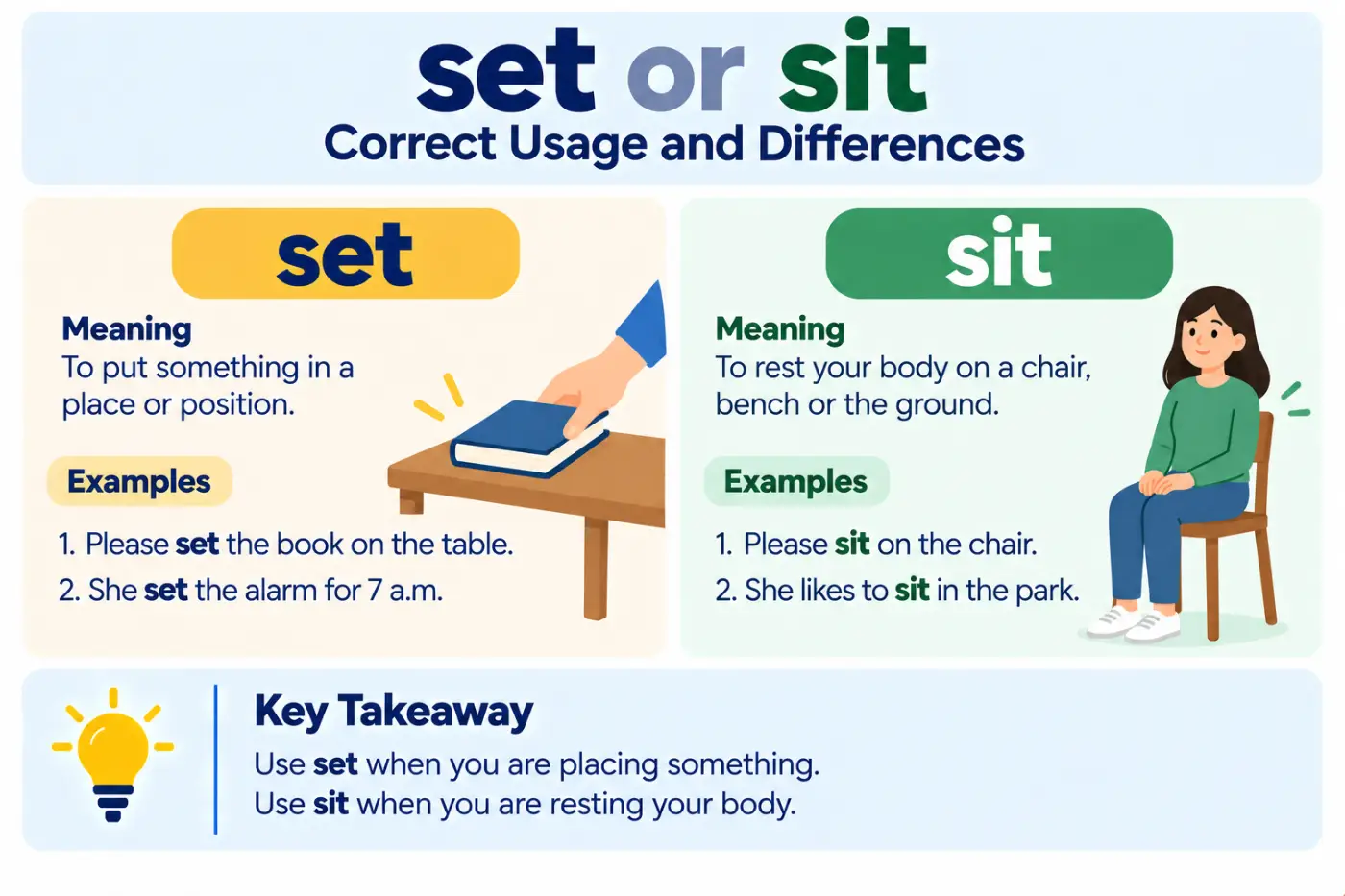
Set or sit causes confusion because both verbs can describe position, movement, and location. They often appear in similar sentences, yet they work in different ways. The simplest rule is this: you set something somewhere, but you sit somewhere yourself. Once you understand that basic difference, many confusing sentences become much easier to handle.
The trouble grows because set has several meanings and several grammatical forms. Sit also changes form as a verb, so learners sometimes choose the wrong word when they are thinking about past tense or an action that happens right now. For example, I set the book on the desk and I sit on the chair describe two completely different actions.
This guide explains the difference in plain American English. You’ll learn how each verb works, how their forms change, how native speakers use them, and why phrases such as set down, sit down, set the table, and sit at the table are easy to confuse. You’ll also get practical examples, common mistakes, pronunciation help, regional notes, and memory tricks you can use immediately.
Short Answer
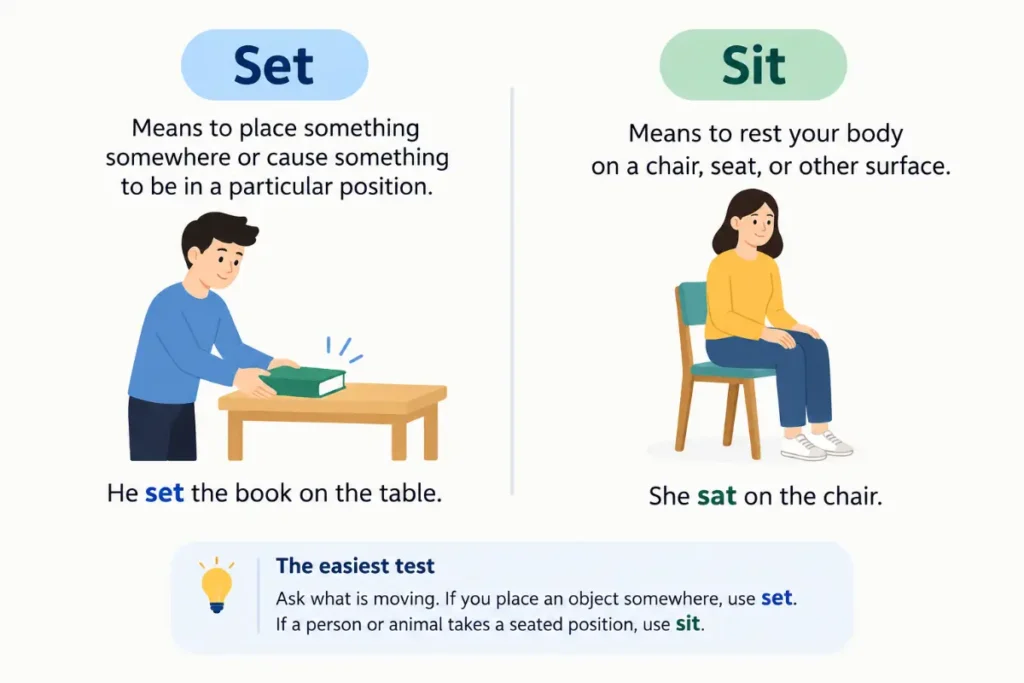
Set means to place something somewhere or cause something to be in a particular position. Sit means to rest your body on a chair, seat, or other surface. The easiest test is to ask what is moving. If you place an object somewhere, use set. If a person or animal takes a seated position, use sit.
Table Of Contents
- What set means.
- What sit means.
- The main difference.
- Verb forms and grammar.
- How to choose the right verb.
- Common phrases with set.
- Common phrases with sit.
- Pronunciation.
- Real life examples.
- Common mistakes.
- Memory tips.
- Related words.
- Formal and informal usage.
- American and British English.
- Expert editor insight.
- Frequently asked questions.
- Key takeaways.
- Conclusion.
What Set Means
Set is a highly flexible English verb. One of its most common meanings is to put something in a particular place or position.
For example:
Please set the book on the table.
In this sentence, someone is moving the book and placing it on the table. The book does not perform the action. The person performs the action on the book.
Set can also mean to arrange something.
Please set the table before dinner.
Here, set means arrange the plates, glasses, utensils, and other items needed for the meal.
The verb has many other meanings too. You can set an alarm, set a goal, set a price, set a timer, set a rule, set a date, or set a record. These meanings are related to the broader idea of putting something into a particular condition, position, or arrangement.
Another important point is that set has the same form in the present, past, and past participle.
| Form | Verb |
|---|---|
| Present | set |
| Past | set |
| Past participle | set |
| Present participle | setting |
Examples make this easier.
I set the alarm every night.
I have set the alarm already.
The verb stays set in the first three forms. Only the present participle changes to setting.
What Sit Means
Sit means to rest your body in a seated position. It normally describes what a person or animal does.
For example:
I sit on this chair every morning.
She sat beside her friend.
The dog is sitting near the door.
Unlike set, sit has different forms for different tenses.
| Form | Verb |
|---|---|
| Present | sit |
| Past | sat |
| Past participle | sat |
| Present participle | sitting |
This change is one reason learners sometimes struggle with the verb.
The present form is sit.
I sit here every day.
The past form is sat.
I sat here yesterday.
The past participle is also sat.
I have sat here for an hour.
The present participle is sitting.
I am sitting here now.
Notice that sit usually describes the subject taking or remaining in a seated position.
The Main Difference
The clearest distinction between the two verbs is based on the action.
Set usually takes an object. You set something.
Sit usually describes the subject itself taking a seated position.
Compare these sentences.
I set the phone on the desk.
I sit at the desk.
In the first sentence, the phone is being placed somewhere. In the second sentence, the speaker is taking a seated position.
Another useful comparison is:
She set the baby on the chair.
She sat on the chair.
The baby is the object in the first sentence. The woman is the person who sits in the second sentence.
This gives you a practical rule.
- Use set when you place or arrange something.
- Use sit when a person or animal rests in a seated position.
The distinction becomes even clearer with down.
Set the bag down.
Sit down.
The first sentence means place the bag somewhere. The second tells a person to take a seated position.
Set Or Sit In Everyday English
When deciding between these verbs, focus on the object and the subject.
If you can naturally ask what are you placing or arranging, set is often the right choice.
I set my keys on the counter.
What did I set?
My keys.
If the sentence describes someone taking a seated position, sit is the natural choice.
I sit near the window.
Who sits?
I do.
This simple question can save you from many mistakes.
Consider another pair.
She set her child on the bench.
She sat on the bench.
The first sentence contains an object after set. Her child receives the action. The second sentence uses sat because the subject herself took a seated position.
Verb Forms And Grammar
The grammar of these verbs deserves special attention because their past forms are very different.
Set is an irregular verb with an unchanged basic form.
Present:
I set the book down.
Past:
I set the book down yesterday.
Past participle:
I have set the book down already.
Sit changes to sat in the past.
Present:
I sit near the front.
Past:
I sat near the front yesterday.
Past participle:
I have sat near the front before.
The continuous form of sit is sitting.
I am sitting near the window.
The continuous form of set is setting.
I am setting the plates on the table.
There is another important distinction. Sit can be intransitive when it means to take or remain in a seated position. That means it does not need a direct object.
I sat quietly.
Set is often transitive when it means place something somewhere.
I set the cup on the table.
The cup receives the action.
Common Phrases With Set
Set appears in many everyday expressions. Learning these phrases as complete units can make your English more natural.
Set The Table
Set the table means arrange the things needed for a meal.
Please set the table before everyone arrives.
Set An Alarm
Set an alarm means program an alarm for a particular time.
I set my alarm for six.
Set A Goal
Set a goal means establish something you want to achieve.
She set a goal to read twenty books this year.
Set A Date
Set a date means choose a specific day for an event.
We need to set a date for the meeting.
Set A Rule
Set a rule means establish a rule that people should follow.
The school set a new rule about late assignments.
Set Something Down
Set something down means place it on a surface.
He set his bag down beside the door.
Set Something Aside
Set something aside means put something somewhere for later use or attention.
I set some money aside for emergencies.
These expressions all preserve the broad idea of placing, establishing, or arranging something.
Common Phrases With Sit
Sit also appears in many common expressions.
Sit Down
It means move into a seated position.
Please sit down and make yourself comfortable.
Sit Up
Sit up means move your upper body into a straighter position.
The child sat up when the teacher entered.
Sit Back
It can mean relax or lean back.
Sit Still
It means remain in one position without moving much.
Please sit still while I fix your hair.
Sit With Someone
Sit with someone means remain seated beside or near them.
Can I sit with you at lunch?
Sit At A Table
Sit at a table means occupy a seated position at the table.
We sat at the kitchen table.
These expressions describe a person or animal occupying a seated position. That is the core meaning behind sit.
How To Choose The Right Verb
When you see a sentence that seems confusing, use a simple three step test.
- Find the subject.
Ask who is performing the action.
- Look for an object.
Ask what is being placed or arranged.
- Think about the physical action.
If something is being placed somewhere, set is usually appropriate. If someone is taking a seated position, sit is usually appropriate.
Consider this example:
Please set the child on the chair.
The child receives the action.
Now compare:
Please sit on the chair.
The person receiving the instruction is expected to take a seated position.
The difference is small on the page but clear in meaning.
Why The Past Tense Causes Problems
One of the biggest sources of confusion is the past tense.
The past tense of sit is sat.
The past tense of set is set.
That means these sentences are correct.
I sat on the couch last night.
I set the remote on the couch last night.
The first sentence describes a person taking a seated position. The second describes someone placing an object.
A common error is using set as the past tense of sit.
I set on the couch last night.
In standard American English, this is incorrect when you mean that you were seated. The correct sentence is:
I sat on the couch last night.
Another mistake goes in the other direction.
I sat the book on the table.
If you mean that you placed the book on the table, use set.
I set the book on the table.
Pronunciation Guide
Sit and set differ by their vowel sounds.
Sit is pronounced /sɪt/.
Set is pronounced /sɛt/.
The consonants are the same at the beginning and end. The main difference is the vowel in the middle.
Sit uses the short vowel sound found in words such as bit, fit, and hit.
Set uses the vowel sound found in words such as bed, red, and get.
This difference matters because confusing the vowel can change the meaning of the sentence.
Practice the contrast slowly.
sit
set
Then use each word in a sentence.
I sit here.
I set it here.
The first describes a seated person. The second describes placing something.
For American English learners, listening for the middle vowel is especially useful. The difference is short but clear when pronounced carefully.
Real Life Examples
Everyday Conversation
I usually sit near the window when I eat breakfast.
This means the speaker takes or remains in a seated position near the window.
Please set your phone on the counter.
This asks someone to place the phone on the counter.
At Work
I sat in the conference room for two hours.
The past form sat shows that the speaker was seated.
Please set the documents on my desk.
The documents are being placed on the desk.
At School
The students sat quietly during the test.
The students were in a seated position.
The teacher set the books on the front table.
The teacher placed the books there.
At Home
I sat on the couch after dinner.
This describes the speaker taking a seated position.
I set my keys beside the television.
This describes placing the keys somewhere.
In Instructions
Set the bowl on the counter.
This tells someone to place the bowl.
Sit on the chair.
This tells someone to take a seated position.
Common Mistakes
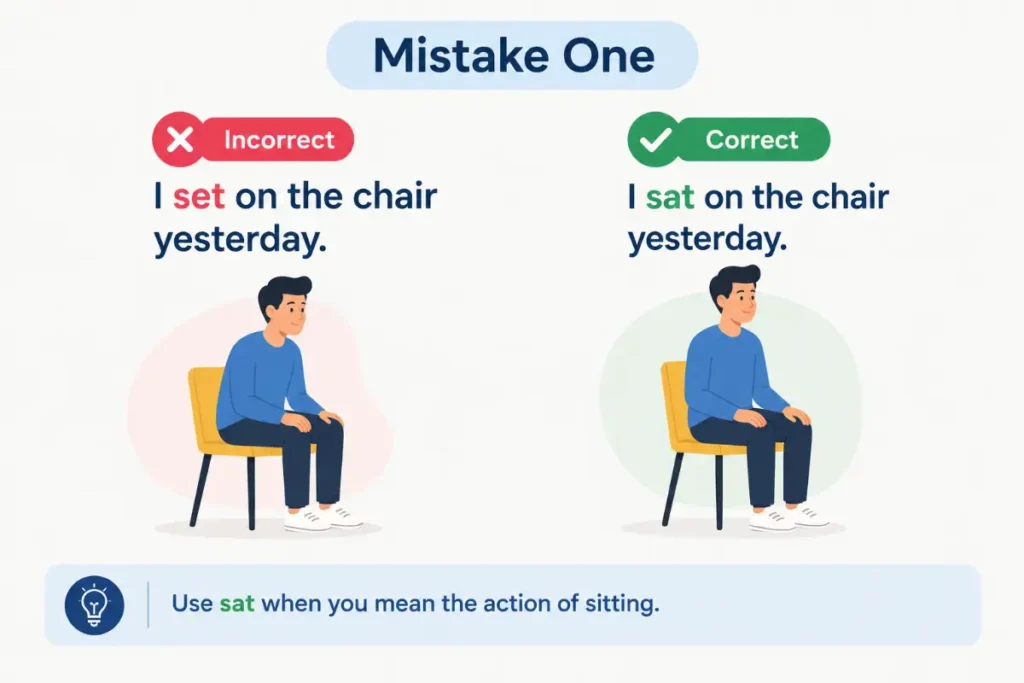
Mistake One
Incorrect:
I set on the chair yesterday.
Correct:
I sat on the chair yesterday.
The past tense of sit is sat.
Mistake Two
Incorrect:
I sat the cup on the table.
Correct:
I set the cup on the table.
The cup is being placed somewhere, so set is needed.
Mistake Three
Incorrect:
Please sit the book here.
Correct:
Please set the book here.
The book cannot take a seated position. Someone is placing it.
Mistake Four
Incorrect:
I have set here for an hour.
Correct:
I have sat here for an hour.
The speaker has remained seated, so the past participle of sit is needed.
Mistake Five
Incorrect:
I am set on the sofa.
Correct:
I am sitting on the sofa.
The first sentence can have a different meaning because set can function in other ways. If you simply mean that your body is in a seated position, sitting is the natural form.
Set And Sit In Different Sentence Patterns
Sentence structure can give you another useful clue.
Set often follows this pattern:
Subject + set + object + location.
For example:
She set the vase on the shelf.
Sit often follows this pattern:
Subject + sit + location.
For example:
She sat on the chair.
The location can be introduced by different prepositions.
I sat in the chair.
I sat beside my friend.
With set, the object normally comes before the location.
I set the plate on the table.
I set the phone near the computer.
This pattern is especially useful for learners because it gives you a grammatical clue before you even think about meaning.
Sit Versus Set Down
Sit down and set down are especially easy to confuse.
Set down means place something somewhere.
Set the box down.
Sit down means take a seated position.
Sit down and relax.
The first action affects an object. The second affects the person performing the action.
Compare:
I set the baby down.
I sat down.
In the first sentence, someone places the baby somewhere. In the second sentence, the speaker takes a seated position.
This distinction is worth memorizing because both phrases are common in everyday English.
Set Versus Sit At The Table
Another common confusion appears around meals.
You sit at the table.
You set the table.
These sentences describe two different actions.
Before dinner, someone may set the table by placing plates, glasses, napkins, and utensils in their proper places.
During dinner, people sit at the table.
So you can say:
Mom set the table before dinner.
Then:
The family sat at the table.
The two verbs often appear in the same situation, which explains why learners sometimes mix them up.
Set Versus Sit In A Chair
The distinction is also useful with chairs.
You sit in a chair or on a chair.
You set something on the chair.
For example:
I sat in the chair.
I set my jacket on the chair.
The person occupies the chair. The jacket is placed on it.
The choice between in and on depends on the type of chair and the intended image. With an ordinary chair, both forms can occur in natural English, although sit in often suggests being supported by the chair while sit on focuses more on the surface.
Memory Tips
A good memory trick can save you from repeated mistakes.
Set Has An Object
Think:
Set something.
You set a book.
You set a cup.
The word often needs something to receive the action.
Sit Is For The Seated Person
Think:
Sit yourself down.
You sit.
Your friend sits.
The dog sits.
The students sit.
This gives you a fast mental contrast.
Remember Sat
The past of sit is sat.
Think:
Today I sit.
Yesterday I sat.
I have sat before.
That pattern is worth memorizing exactly.
Remember Set Stays Set
Think:
Today I set it.
Yesterday I set it.
I have set it.
The form does not change in these basic verb forms.
Related Grammar And Usage Notes
Sit and set belong to different verb patterns, but both can appear in many phrasal expressions.
Set can combine with particles and prepositions to create new meanings.
Set up means arrange or prepare something.
Sit can also appear in phrasal expressions.
Sit down means take a seated position.
Because English uses these verbs in many expressions, learning only one definition is not enough. Learn the central meaning first, then build your vocabulary through common phrases.
Formal And Informal Usage
Both set and sit are standard English verbs. They work in casual speech, professional writing, academic writing, journalism, and formal communication.
The difference is not one of formality. The difference is meaning and grammar.
You can use set in a formal sentence:
The committee set a deadline for the project.
You can use sit in a formal sentence:
The committee members sat quietly during the hearing.
You can also use both in casual speech:
Sit down for a minute.
Set your bag over there.
The words themselves are neutral. The surrounding vocabulary determines the overall level of formality.
American And British English
Both uses set and sit with the same basic meanings and major verb forms.
American speakers say:
I sat on the couch.
British speakers also say:
I sat on the sofa.
The difference in that example comes from vocabulary preference rather than a different verb rule. Americans commonly use couch while British speakers often use sofa, but the verb remains sat.
Both varieties also use:
Set the table.
Sit at the table.
There is no major regional rule that changes the central distinction between these verbs.
Canadian and Australian English follow the same basic pattern as well.
Word Origins
Both verbs have long histories in English and Germanic languages.
Set has roots connected to older Germanic forms carrying ideas related to placing or putting something in position. Its modern use expanded over centuries and developed many meanings.
Sit also comes from an old Germanic word family associated with being seated or remaining in a seated position. Related forms appear across several Germanic languages.
The long history of both words helps explain why they have many established expressions today. They are not modern inventions. They are basic English verbs that have developed broad meanings over a very long period.
You do not need to memorize their historical roots to use them correctly. The most useful distinction remains simple: set usually places something, while sit describes a seated position.
Professional Writing Tips
Good editing involves more than checking individual words. Look at the action in the sentence.
If you write:
The manager sat the report on the desk.
Ask what the manager actually did. If the manager placed the report on the desk, set is the correct verb.
If you write:
The manager set in the chair.
Ask what the manager did. If the manager took a seated position, sat is needed.
A useful editing habit is to replace the verb temporarily with a clearer phrase.
Set can often become place.
Sit can often become take a seat.
If place makes sense, set may be the right choice.
If take a seat makes sense, sit may be the right choice.
This test is especially useful during proofreading because it focuses on meaning rather than appearance.
Expert Editor Insight
An experienced editor pays close attention to the object and the action rather than relying on sound alone. Set and sit are easy to confuse because both can occur around chairs, tables, furniture, and everyday movement. Professional editing tools may flag some incorrect forms, but they cannot always understand the intended meaning from grammar alone. The best test is simple: if you can replace the verb with place, think set. If you can replace it with take a seat, think sit.
Key Takeaways
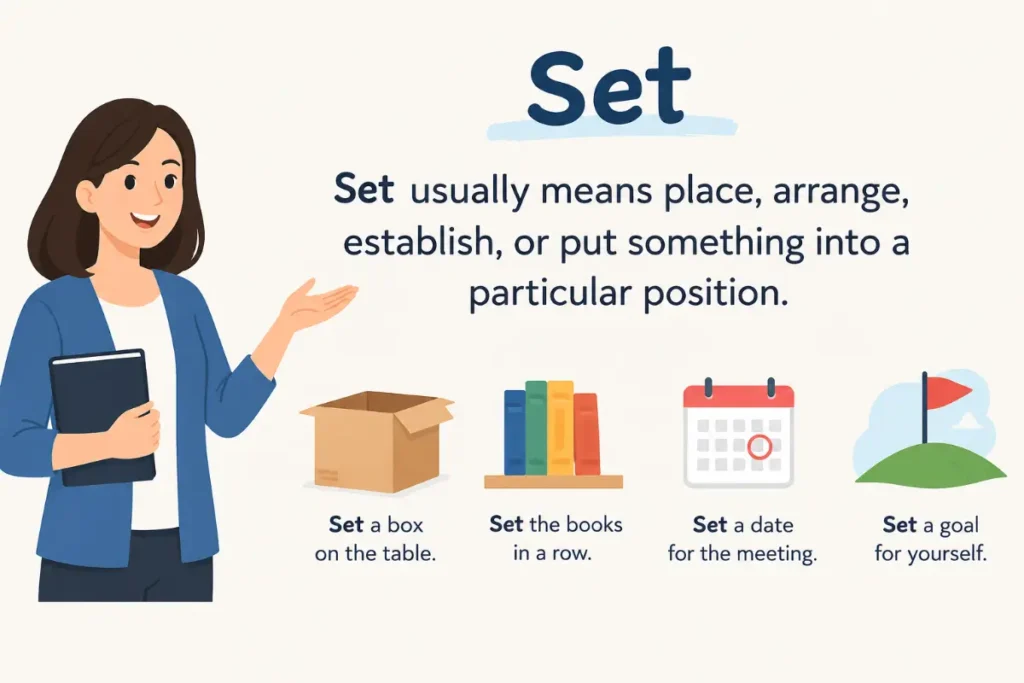
- Set usually means place, arrange, establish, or put something into a particular position.
- Sit means rest in a seated position.
- The past tense of sit is sat.
- The past tense of set is set.
- The past participle of sit is sat.
- The past participle of set is set.
- Set usually takes an object when it means place something.
- Sit often works without a direct object when it means take or remain in a seated position.
- You set the table but sit at the table.
- You set a book on a desk but sit at a desk.
- Set down means place something down.
- Sit down means take a seated position.
- If place works as a replacement, set is often the right choice.
- If take a seat works as a replacement, sit is often the right choice.
Conclusion
Set or sit becomes much easier once you focus on the action instead of the sound. Set usually means place, arrange, or establish something, while sit describes a person or animal taking or remaining in a seated position. The past forms are also different: set stays set, while sit changes to sat.
The most useful examples are easy to remember. You set the table, but you sit at the table. You set a book on a desk, but you sit at the desk.
For a quick editing test, replace the verb with place or take a seat. If place fits, set is likely correct. If take a seat fits, use sit. This simple habit can prevent many common grammar mistakes.
Frequently Asked Questions
What is the difference between set and sit?
Set usually means to place, arrange, or establish something, while sit means to rest in a seated position. You set a book on a table, but you sit at the table. Set often takes an object, while sit can stand without a direct object. This difference becomes especially useful when choosing between phrases such as set down and sit down.
Is the past tense of sit sat?
Yes. The past tense of sit is sat. For example, I sit here today becomes I sat here yesterday. The past participle is also sat, as in I have sat here before. Do not use set as the past tense of sit when you mean that someone was seated.
Is the past tense of set still set?
Yes. Set has the same basic form in the present, past, and past participle. You can say I set the book down today, I set the book down yesterday, and I have set the book down already. Only the present participle changes to setting.
Should I say set the table or sit the table?
The standard expression is set the table. It means arrange plates, glasses, utensils, and other items for a meal. Sit the table is not the normal expression for this meaning. People sit at the table after someone has set it.
Is it correct to say I sat the book on the desk?
No, not if you mean that you placed the book on the desk. The natural sentence is I set the book on the desk. The verb sat describes a person or animal taking a seated position, while set can describe placing an object somewhere.
Is it set down or sit down?
Both expressions are correct, but they have different meanings. Set down means place something on a surface or location. Sit down means take a seated position. For example, set the box down means place the box somewhere, while sit down tells a person to take a seat.
Can set and sit be used in the same sentence?
Yes. They can describe two different actions in the same situation. For example, I set the plates on the table before I sat at the table. The first action involves placing objects. The second describes the speaker taking a seated position.
Why do people confuse set and sit?
People often confuse these verbs because both occur in situations involving position, furniture, and movement. Their short vowel sounds are also similar, especially in fast speech. Past tense forms create another challenge because the past of sit is sat while the past of set remains set. Focusing on the action makes the distinction easier.
Which is correct for a person set or sit?
For a person taking a seated position, use sit. For example, Please sit here is correct. If the person is placing another object somewhere, use set. For example, Please set the bag here is correct. The important question is what the person is doing to what.
Is I am setting down correct?
Yes. I am setting down is correct when someone is placing something somewhere at the present time. For example, I am setting down the boxes. If you mean that you are taking a seated position, use I am sitting down. These two forms describe different actions.

Confusing Words, Spelling & Word Choice
Claire Whitmore is a U.S.-based English editor who writes about commonly confused words, spelling differences, and word choice. Her work helps readers understand subtle distinctions between similar-looking words through simple definitions, practical examples, and modern usage guidance in both American and British English.