
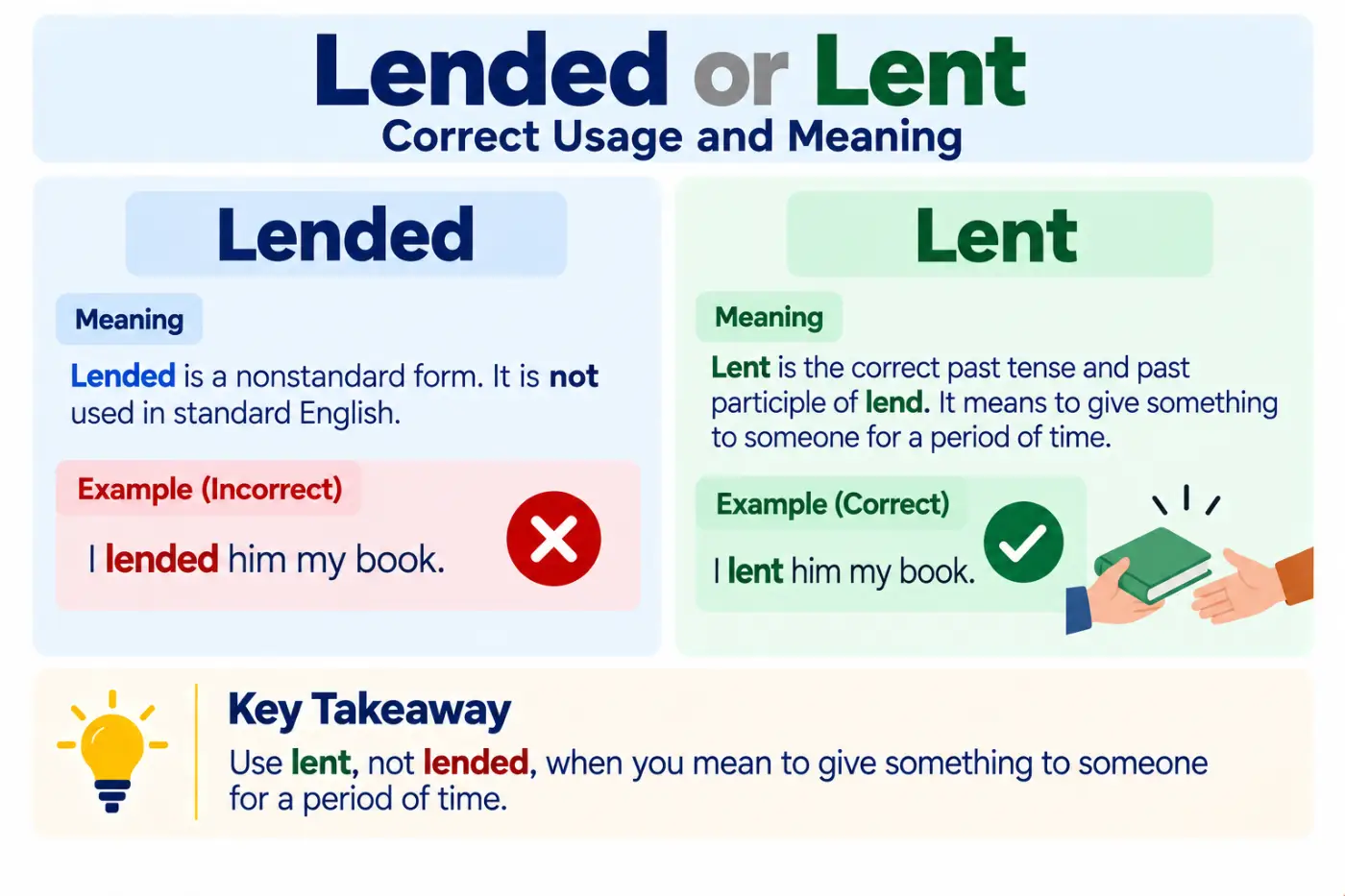
Lended or lent is a common English grammar question because lend looks like a regular verb at first glance. You might expect its past form to be lended, just as many verbs become verbs ending in ed. However, lend is an irregular verb, so its past form changes instead of simply taking an ed ending. The correct forms are lend, lent, and lent.
The word lend means to give something to another person for a period of time with the expectation that it will be returned. Its past form is lent. You can say I lent my friend some money or She lent me her notes. In standard English, lended is not the normal past form of lend.
This guide explains the difference clearly and shows how to use the verb in everyday speech, school writing, professional communication, and formal English. You’ll also learn its pronunciation, word history, common mistakes, related expressions, and a simple memory trick that makes the correct form easy to remember.
Short Answer
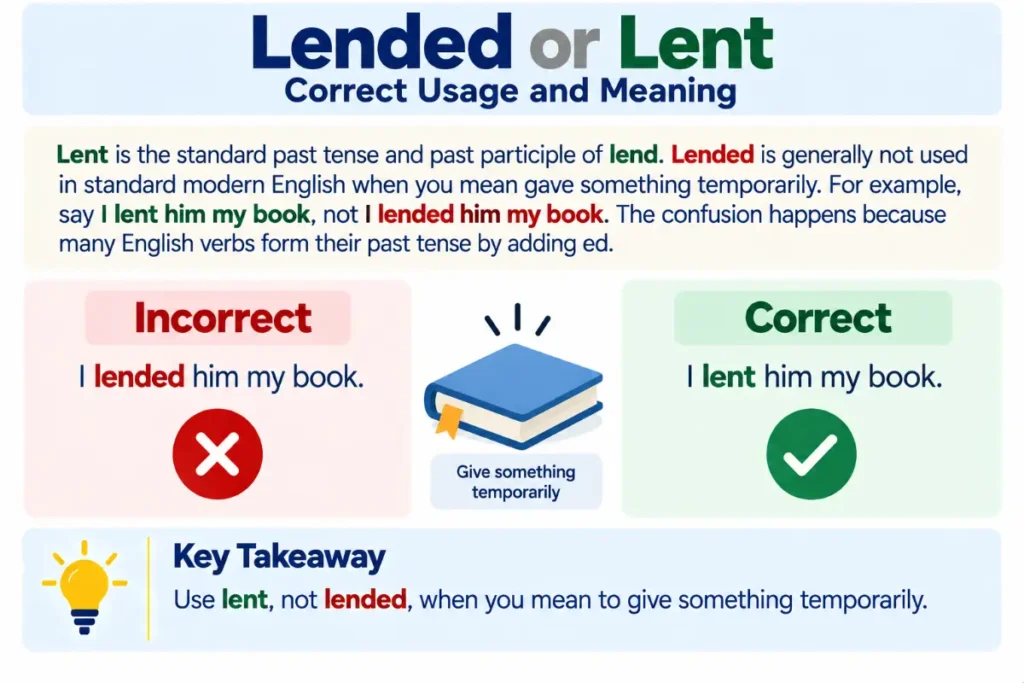
Lent is the standard past tense and past participle of lend. Lended is generally not used in standard modern English when you mean gave something temporarily. For example, say I lent him my book, not I lended him my book. The confusion happens because many English verbs form their past tense by adding ed.
Table of Contents
- Quick Answer
- Meaning of Lend and Lent
- Why Lent Is the Correct Past Form
- Comparison Table
- Lended or Lent Explained
- Grammar Rules
- Sentence Examples
- Common Mistakes
- Pronunciation Guide
- Word Origin
- American and British English
- Formal and Informal Usage
- Related Words and Expressions
- Memory Tips
- Real Life Usage
- Expert Editor Insight
- FAQs
- Key Takeaways
- Conclusion
Quick Answer
Lent is the correct past tense and past participle of lend.
The basic forms are:
Present: lend
Past: lent
Past participle: lent
Examples:
I lend my books to my classmates.
I have lent my car to my brother.
The form lended is not the standard past tense of lend in modern English. If you are writing an essay, email, report, message, or school assignment, use lent.
Meaning of Lend and Lent
To understand the grammar clearly, start with the meaning of the base verb.
Lend means to give something to another person temporarily. The person receiving it normally agrees to return it later.
For example:
I will lend you my laptop.
This means you can use my laptop for a period of time and then give it back.
Lend can also refer to money.
My brother lent me $50.
In this sentence, the money was given temporarily with an expectation of repayment.
The word can also have a broader meaning. Something can lend a quality or effect to another thing.
The large windows lend the room a bright and open feeling.
Here lend does not mean physically handing something over. It means contribute or give a particular quality.
Why Lent Is the Correct Past Form
Lend is an irregular verb. Irregular verbs do not always form their past tense by adding ed.
For regular verbs, the pattern is often straightforward.
Walk becomes walked.
Open becomes opened.
Clean becomes cleaned.
But English also contains many irregular verbs.
Go becomes went.
Take becomes took.
Give becomes gave.
Send becomes sent.
Lend belongs to this group.
Its past form is lent.
The pattern is:
lend → lent → lent
The first form is the present tense. The second is the simple past. The third is the past participle.
That means you should write:
I lend him money every month.
I have lent him money before.
The form stays simple once you remember that lend belongs to the irregular verb group.
Comparison Table
| Verb Form | Correct Form | Grammatical Function | Example | Meaning |
|---|---|---|---|---|
| Base form | lend | Present tense and infinitive | I lend books to my friends. | Give something temporarily |
| Simple past | lent | Completed past action | I lent him my book yesterday. | Gave something temporarily |
| Past participle | lent | Used with have, has, or had | She has lent me her notes. | Has given something temporarily |
| Incorrect standard form | lended | Not the standard past form of lend | I lended him money. | Usually intended to mean lent |
Lended or Lent Explained
The easiest answer is that lent is the standard form you need.
The word lended may appear occasionally in nonstandard writing, historical material, dialectal contexts, or creative language. Its appearance in a text does not make it the normal modern past tense of lend. Standard English uses lent.
This distinction matters because English has many verbs that look as if they should take ed but do not.
Think about these examples:
Give becomes gave.
Take becomes took.
Write becomes wrote.
Send becomes sent.
Keep becomes kept.
Lend becomes lent.
The form is learned through usage rather than by applying the regular ed rule to every verb.
Why Lended Sounds Possible
The confusion is understandable. When English learners see lend they may naturally apply the regular past tense pattern.
Lend + ed seems logical.
That produces lended.
The problem is that English does not build every past tense mechanically. Some common verbs developed irregular forms over centuries and kept those forms in modern English.
The same issue appears with many everyday verbs. Native speakers generally learn these forms through repeated exposure, while learners often need a clear rule or memory aid.
Is Lended Ever Used
You may encounter lended in old texts, nonstandard writing, regional speech, or creative language. It can also appear because someone has applied the regular ed pattern to the verb.
However, that does not make it the preferred form in standard contemporary English.
For normal communication, use lent.
Grammar Rules
Lend has several common grammatical patterns. Learning these patterns helps you avoid mistakes beyond the past tense.
Lend Something To Someone
This is one of the most common structures.
I lent my phone to my sister.
She lent her notes to me.
They lent the equipment to the school.
The object comes after lend and the recipient can be introduced with to.
Lend Someone Something
English also allows the recipient to come directly after the verb.
I lent my sister my phone.
She lent me her notes.
They lent the school the equipment.
Both structures can express the same basic idea.
Compare:
I lent my car to John.
I lent John my car.
Both are standard.
Lend Money
Lend is especially common with money.
My father lent me some money.
She lent her friend $100.
The bank lent the company money.
The important distinction is between lend and borrow.
The person who gives something lends it.
The person who receives it borrows it.
I lent him my book.
He borrowed my book.
This difference causes many English learners trouble.
Use Lent For Completed Past Actions
When the action happened in the past use lent.
She lent me her umbrella yesterday.
We lent our car to our neighbors last weekend.
He lent his notes to a classmate.
The time expressions yesterday, last week, last month, and two days ago often signal the simple past.
Use Lent After Have, Has, And Had
Lent also functions as the past participle.
I have lent him my camera.
She has lent her car to her sister.
They had lent the equipment before the event began.
The auxiliary verb tells you that the sentence uses a perfect tense.
Common Mistakes
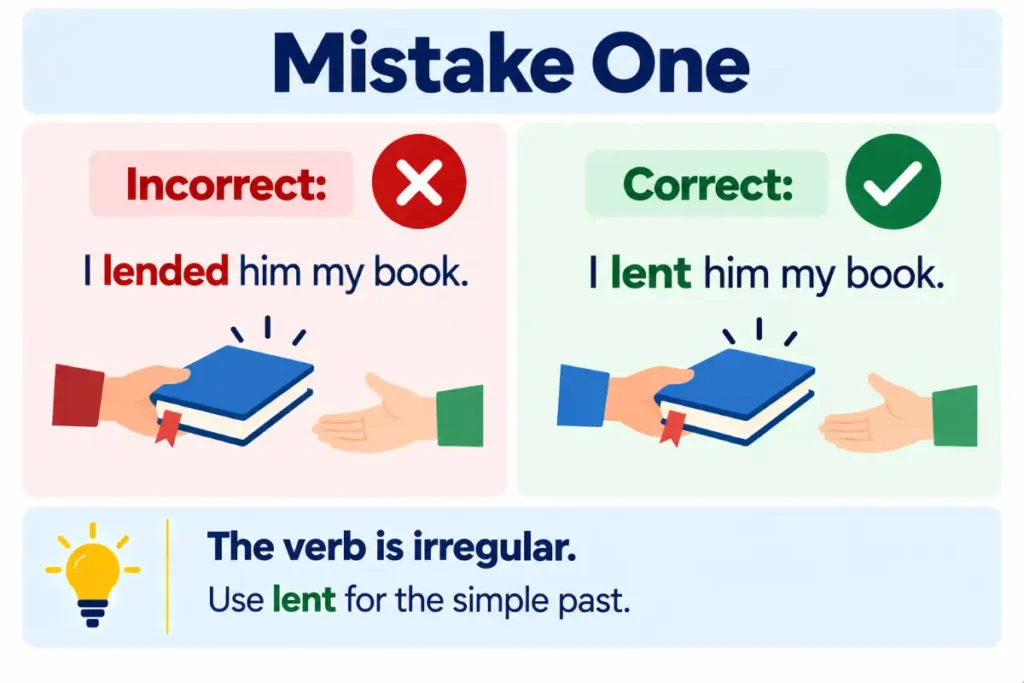
Mistake One
Incorrect: I lended him my book.
Correct: I lent him my book.
The verb is irregular. Use lent for the simple past.
Mistake Two
Incorrect: She lended me some money.
Correct: She lent me some money.
The same rule applies with money. The past form remains lent.
Mistake Three
Incorrect: I have lended my car to him.
Correct: I have lent my car to him.
After have use the past participle. For lend the past participle is also lent.
Mistake Four
Incorrect: He borrowed me his laptop.
Correct: He lent me his laptop.
Borrow means receive something temporarily. Lend means give something temporarily.
Mistake Five
Incorrect: Can you borrow me your pen?
Correct: Can you lend me your pen?
The speaker is asking another person to give them the pen temporarily. That requires lend.
Lend Versus Borrow
Lend and borrow describe the same temporary exchange from different sides.
If you give something, you lend it.
If you receive something, you borrow it.
Consider this short situation.
Maria has a calculator. Ali needs it for an hour.
Maria lends Ali the calculator.
Ali borrows the calculator from Maria.
The direction of the action determines the verb.
This distinction becomes particularly useful in school and workplace communication.
You can say:
Can you lend me your notes?
I borrowed her notes.
You should not swap lend and borrow simply because both words describe a temporary transfer.
Sentence Examples
Here are natural examples showing the correct use of lent.
- I lent my friend my favorite book last week.
This describes a completed action in the past.
- She lent me her umbrella because it started raining.
The speaker received the umbrella from her.
- My brother lent his car to our parents.
The brother gave temporary use of the car.
- We lent the chairs to the community center.
The chairs were provided temporarily.
- He lent me enough money to buy lunch.
The sentence describes a temporary financial arrangement.
- I have lent my notes to three classmates this semester.
Here lent is the past participle after have.
- The library lent the school several books.
The library provided the books temporarily.
- She had lent her camera to a friend before the trip.
The past perfect uses had plus lent.
- They lent their equipment to the local team.
The action involved temporary use.
- My teacher lent me a useful reference book.
The teacher gave the book to the student temporarily.
Real Life Usage
Daily Conversation
Lend and lent appear naturally in everyday conversations.
Can you lend me your charger?
I lent my charger to Jake yesterday.
These sentences are short and common because people often lend small personal items to family and friends.
School
Students frequently use the verb when talking about books, notes, calculators, and other supplies.
I lent my science book to a classmate.
My friend lent me her notes before the test.
Using the correct past form matters in school writing because grammar errors can affect clarity and marks.
Workplace Communication
The verb also appears in professional situations.
The company lent us some equipment for the project.
Our department has lent staff members to another team.
In these examples the word refers to temporary access or support.
Financial Contexts
Lend is common when discussing money.
The bank lent the business money to expand.
My uncle lent me some money for the repair.
In formal financial writing, loan may often appear as the noun.
The bank provided a loan.
The bank lent the company money.
These sentences describe related ideas but use different grammatical structures.
Academic Writing
Academic writers may use lend in a broader sense.
The evidence lends support to the theory.
The findings lend credibility to the argument.
Here lend does not describe giving an object temporarily. It means contribute or add something that strengthens another idea.
The past form can also appear:
The evidence lent support to the theory.
This meaning is worth learning because it appears often in formal writing.
Pronunciation Guide
Lend is pronounced with a short vowel sound and ends with the consonant sound represented by d.
Lent has the same basic vowel sound but ends with a t sound.
The pronunciation difference is small but important.
The final consonant in lent should sound like t rather than d. Because the words are short they can sometimes sound similar in fast speech.
A useful practice method is to say the two words slowly and focus on the final consonant.
lend
lent
The spelling also gives you a helpful visual reminder. The past form replaces the final d with a t.
Word Origin
Lend has Old English roots and belongs to an old Germanic word family connected with the idea of granting or giving something for temporary use.
The modern forms developed through historical changes in English. The irregular past form lent is part of that older verb pattern.
English contains many irregular verbs because modern English inherited several older patterns instead of rebuilding every verb around the regular ed ending.
This is why learners sometimes find irregular verbs frustrating. There isn’t always a modern spelling rule that lets you predict the past form from the base form.
For lend the safest approach is to learn the complete verb family:
lend, lent, lent.
American English
American English uses lend as the present form and lent as both the simple past and past participle.
Examples include:
I lent him my car yesterday.
She has lent me her notes.
The form lended is not the standard choice in American English for these meanings.
The same distinction between lend and borrow also applies.
Can you lend me your pen?
I borrowed your pen.
American speakers use lend in both casual and formal settings.
British English
British English also uses lend, lent, and lent.
For example:
She lent me her umbrella.
He has lent his bicycle to a friend.
There is no major British alternative that replaces lent with lended in standard English.
The basic grammar rule is shared across American and British English.
Formal And Informal Usage
Lent works in every normal level of English.
You can use it in casual conversation.
I lent him my jacket.
You can use it in professional writing.
The company lent equipment to the research team.
You can also use it in academic writing.
The findings lent support to the proposed explanation.
Because lent is the standard past form, you do not need to avoid it in formal writing.
The more formal issue often involves the meaning of the verb rather than its tense.
For example, lend can mean provide support or contribute a quality.
The evidence lends credibility to the claim.
That construction is common in formal prose.
Related Words And Expressions
Several words are closely connected to lend.
Borrow
Borrow means to receive something temporarily from another person.
I borrowed her laptop.
Loan
Loan can function as a noun and is also used as a verb in standard English.
The bank gave him a loan.
The bank loaned him the money.
In ordinary conversation, lend is often the natural choice when describing the action from the giver’s perspective.
Give
Give has a much broader meaning. Unlike lend, it does not normally imply that the item will be returned.
I gave him my old phone.
I lent him my new phone.
The first sentence suggests permanent transfer. The second suggests temporary use.
Rent
Rent involves payment for temporary use.
I rented a car.
Lend normally implies that the owner is allowing temporary use without charging a rental fee.
Provide
Provide means to supply something that is needed. It does not automatically imply that the item will be returned.
The company provided equipment.
The company lent equipment.
The second sentence suggests temporary use.
Offer
Offer means to make something available or propose help.
She offered me her notes.
She lent me her notes.
An offer does not necessarily mean the person actually gave the notes.
Give Back
Give back means return something.
I gave the book back to her.
This is the opposite stage of a typical lending situation.
Return
Return means take or give something back to its owner or original place.
I returned the book after a week.
Memory Tips
The simplest memory trick is to learn lend as a three part verb.
lend → lent → lent
Do not try to build the past tense by adding ed.
Another useful trick is to connect lend with similar irregular verbs.
Send becomes sent.
Spend becomes spent.
Lend becomes lent.
The ending pattern can help you remember the past form.
You can also create a short sentence pair.
Today I lend. Yesterday I lent.
This contrast makes the tense difference easy to recall.
For the perfect tense remember:
I have lent.
Not:
I have lended.
If you regularly make this mistake while writing quickly, save the three forms together in your study notes. Repeated exposure will make the correct form feel natural.
Related Grammar Notes
Present Tense
Use lend for habits and current actions.
I often lend books to my friends.
She lends money to her family.
Notice the third person singular form lends.
Simple Past
Use lent for completed actions.
I lent him my book yesterday.
She lent me her notes last week.
Present Perfect
Use have or has plus lent.
I have lent him my car before.
She has lent me her calculator.
Past Perfect
Use had plus lent.
I had lent him the book before the meeting.
Future
Use will lend.
I will lend you my notes tomorrow.
The future form returns to the base verb.
Infinitive
Use to lend.
I want to lend you my book.
Modal Verbs
After can, could, may, might, should, or will use the base form lend.
Can you lend me a pen?
Could you lend me your notes?
I will lend you the book tomorrow.
Do not use lent after a modal.
Incorrect: Can you lent me your book?
Correct: Can you lend me your book?
Why English Learners Make This Mistake
The main problem is overapplying the regular past tense rule.
Learners see a verb and instinctively add ed.
Work becomes worked.
Play becomes played.
Clean becomes cleaned.
That pattern is so common that it feels automatic.
However, common irregular verbs interrupt the pattern.
Lend becomes lent.
Teach becomes taught.
Keep becomes kept.
Leave becomes left.
Once learners recognize that English has two major past tense patterns, the mistake becomes easier to understand.
Another factor is memory. A learner may know the word lend but have less experience hearing or reading its past form. Regular exposure to sentences such as I lent him my book helps build the correct pattern.
Expert Editor Insight
An experienced editor treats lent as a basic irregular verb form rather than a difficult vocabulary item. The most useful check is to look at the auxiliary verb and time reference. A completed past action takes lent, while a construction after can or will takes lend. Editors also watch for confusion between lend and borrow because that error changes the direction of the action. My practical tip is to learn the complete sequence lend, lent, lent instead of memorizing only the base verb.
Key Takeaways
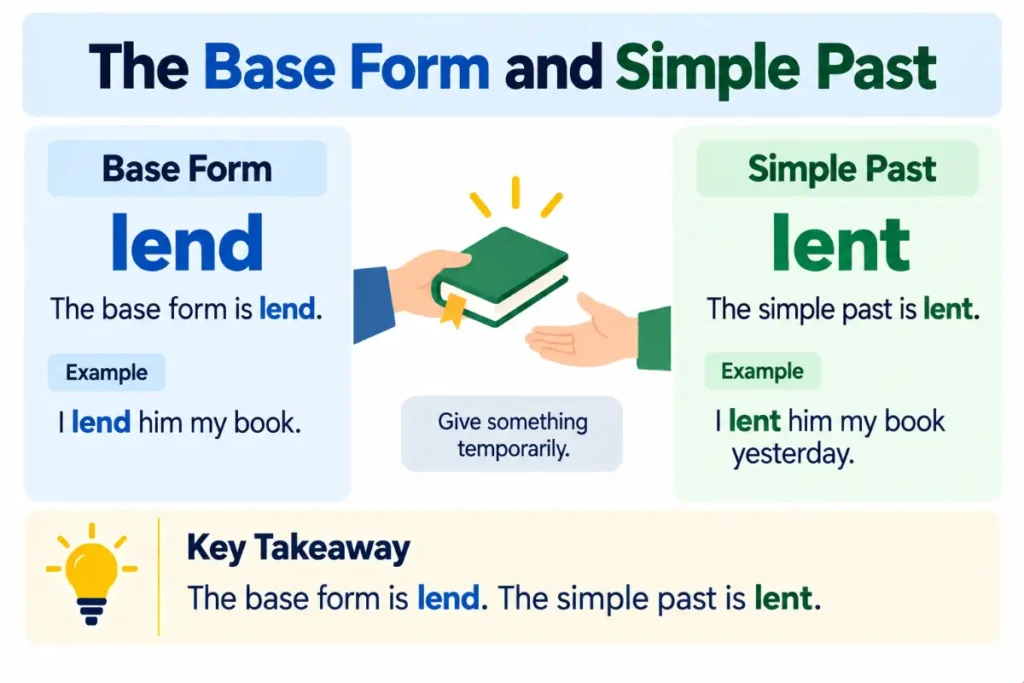
- The base form is lend.
- The simple past is lent.
- The past participle is also lent.
- Lended is not the standard modern past form of lend.
- Use lend after modal verbs such as can, could, and will.
- Use lent for completed past actions.
- Use lent after have, has, and had.
- Lend means give something temporarily.
- Borrow means receive something temporarily.
- Remember the pattern lend, lent, lent.
Conclusion
Lended or lent has a clear answer for standard English. Lent is the correct past tense and past participle of lend. Use it for completed actions such as I lent her my book and for perfect constructions such as I have lent her my book. Lended is not the normal standard form.
The confusion comes from a common English pattern. Many verbs take ed in the past, but lend is an irregular verb. Learning the complete form lend, lent, lent is much easier than trying to create the past tense from a general rule.
For a simple memory trick, connect lend with send and spend. Send becomes sent, spend becomes spent, and lend becomes lent. Keep that small pattern in mind and you’ll avoid this mistake in everyday speech, school assignments, and professional writing.
Frequently Asked Questions
Is lended a correct word?
Lended is not the standard past tense or past participle of lend in modern standard English. The accepted forms are lend for the base form and lent for both the simple past and past participle. You should use lent in school assignments, professional writing, formal documents, and ordinary conversation when describing a completed lending action.
What is the past tense of lend?
The past tense of lend is lent. For example, you can say I lent my friend my book yesterday. The same form also works as the past participle, as in I have lent my friend my book before. The complete verb pattern is lend, lent, lent.
What is the past participle of lend?
The past participle is lent. It appears with auxiliary verbs such as have, has, and had. For example, She has lent me her notes and They had lent the equipment to the school. Do not use lended as the standard past participle in modern English.
Why do people say lended?
People may say lended because they apply the regular English past tense pattern to lend. Many verbs form their past tense by adding ed, so lended can seem logical. However, lend is an irregular verb. Its standard past form developed as lent, so standard English uses lent rather than lended.
Is lent the past tense and past participle?
Yes. Lent serves as both the simple past and past participle of lend. You can say I lent him my book for the simple past. You can also say I have lent him my book for the present perfect. The surrounding grammar tells you which function the word has.
What is the difference between lend and borrow?
Lend means to give something temporarily. Borrow means to receive something temporarily. If you give your friend a book, you lend the book. If your friend takes the book from you for temporary use, your friend borrows it. Remembering the direction of the action makes the distinction much easier.
Can I use lent in formal writing?
Yes. Lent is the standard past form of lend and is completely appropriate in formal writing. You can use it in academic papers, business documents, reports, emails, and professional communication. There is no need to replace lent with a more complicated word. The important point is using the correct verb form for the sentence.
Is lended used in American English?
Lended is not the standard past form used in American English. Standard American English uses lent. You may encounter lended in informal writing or as an error, but it should not be used in polished English when you mean the past form of lend.
Is lent always related to lending?
No. Lent can have another meaning as the name of a Christian season. That use is a noun and is unrelated to the verb form of lend. Context makes the difference clear. In a sentence such as I lent her my book, lent is the past form of lend. In religious contexts, Lent refers to the season before Easter.

English Grammar & Usage
Nathan Holloway is an American grammar writer and language researcher who specializes in English grammar, sentence structure, verb usage, and common writing mistakes. He enjoys breaking down confusing grammar rules into practical explanations with clear examples, making English easier for students, professionals, and everyday writers.