
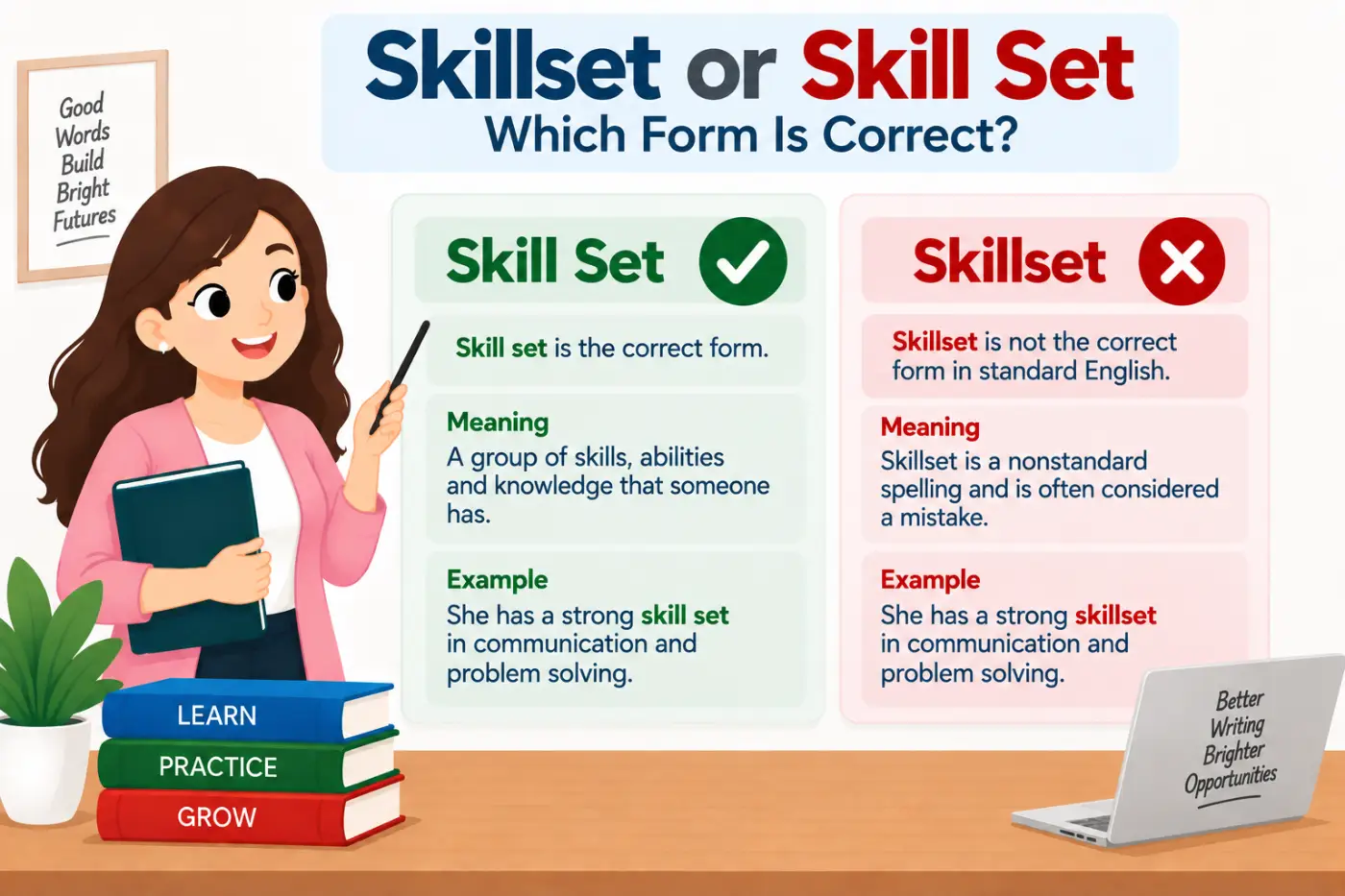
skillset or skill set is a common spelling question because both forms appear frequently in modern English. The short answer is that skill set is the traditional and widely accepted form for describing a group of abilities. Skillset also appears as a closed compound noun and has gained noticeable use, especially in workplace language, recruiting, education, and professional profiles.
The confusion comes from the way English compounds develop. Two separate words can gradually become a compound and eventually appear as one word. English has many examples of this process, but not every frequently seen closed form becomes the preferred spelling. In this case, both forms can be found in real usage, so simply calling one a spelling mistake misses the more interesting part of the language question.
For most readers, the practical choice is easy. Use skill set when you want the safest standard form, especially in formal or carefully edited writing. This article explains the difference, meaning, grammar, pronunciation, history, regional usage, common mistakes, and situations where the closed form may appear.
Short Answer
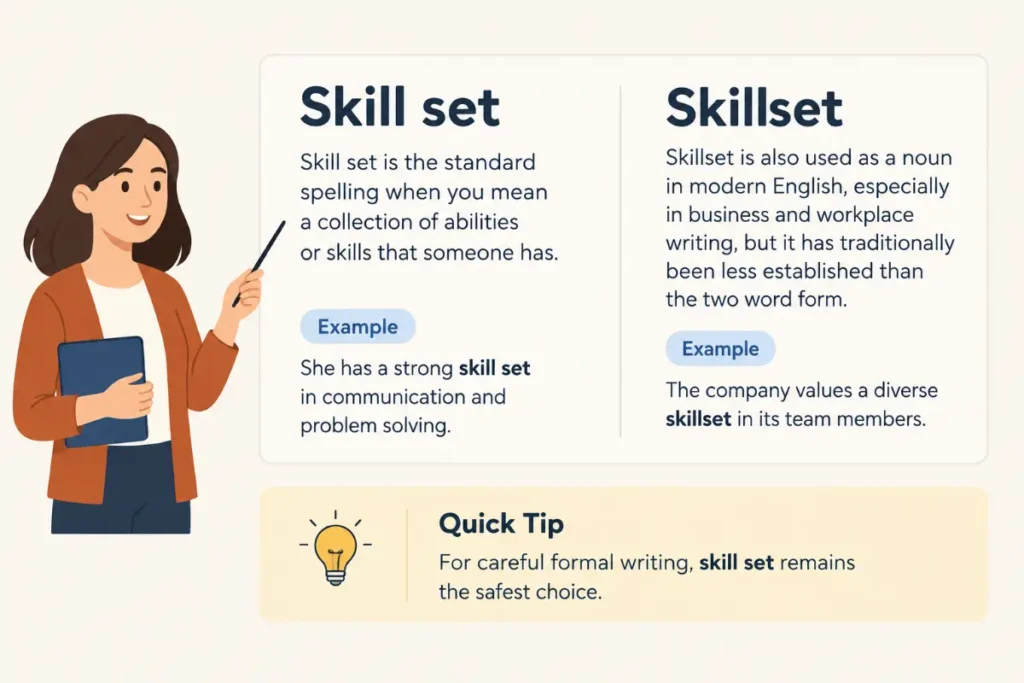
Skill set is the standard spelling when you mean a collection of abilities or skills that someone has. Skillset is also used as a noun in modern English, especially in business and workplace writing, but it has traditionally been less established than the two word form. For careful formal writing, skill set remains the safest choice.
Table Of Contents
- Quick Answer
- Meaning And Definition
- Why The Spelling Causes Confusion
- Key Differences
- Which Form Should You Use
- Grammar And Part Of Speech
- Sentence Examples
- Common Mistakes
- Pronunciation Guide
- Word Origin
- Regional Usage
- Formal And Informal Writing
- Real Life Usage
- Related Terms
- Memory Tips
- Expert Editor Insight
- FAQs
- Key Takeaways
- Conclusion
Meaning And Definition
Meaning Of Skill Set
A skill set is a collection of skills that a person possesses or needs for a particular activity job field or task.
For example, a software developer might have a skill set that includes programming database management testing and problem solving. A teacher might have a different set of abilities involving communication classroom management lesson planning and assessment.
The word set matters because it describes a group rather than one isolated ability. If someone has excellent writing skills but little experience with public speaking you might describe their writing ability as one skill and their broader professional abilities as a skill set.
The expression works in many fields because it is flexible. You can talk about a professional skill set, technical skill set, leadership skill set, communication skill set, or creative skill set.
The phrase can describe existing abilities or abilities required for a role.
The candidate has a strong skill set for the position.
The job requires a broad skill set.
In both examples the meaning is clear. The first describes abilities the candidate already has. The second describes abilities that the job demands.
Meaning Of Skillset
Skillset is the closed compound version of the same basic expression. It is used as a noun to mean a collection or range of skills.
You may encounter it in professional profiles, job advertisements, business articles, educational material, and online writing.
For example:
Her skillset includes graphic design and video editing.
The role requires a specialized skillset.
The meaning is easy to understand because readers already know the words skill and set. The issue is mainly one of conventional spelling rather than a major difference in meaning.
Modern English contains many compounds that have shifted from separate words to closed forms. This makes skillset understandable and increasingly familiar. Still, familiarity does not automatically mean that every style guide or editor will prefer the closed form.
Are They Different In Meaning
Usually no.
The two forms generally refer to the same basic idea: a group or combination of skills.
The main difference is spelling and editorial preference.
If a sentence says that someone has a strong skill set and another says that someone has a strong skillset, most readers will understand both sentences in exactly the same way.
The distinction becomes important when you need to choose the most conventional form for formal writing. In that situation, skill set is the safer choice.
Why The Spelling Causes Confusion
English compounds are not always predictable.
Some combinations remain two words.
High school.
Real estate.
Post office.
Others become hyphenated.
Well known.
Part time.
Long term.
Others eventually become closed compounds.
Notebook.
Bedroom.
Football.
This creates a problem for writers because there is no simple rule that tells you exactly when two words should become one.
Skill set sits in an interesting position because the two word form has a long established history while the closed form has become increasingly visible in modern usage.
People also naturally shorten familiar expressions when they use them often. Once speakers understand a combination as one concept, they may begin treating it as one lexical unit.
That process can happen gradually.
A writer may first learn skill set as two words. Later they see skillset in business articles or professional profiles. Eventually both forms start to look normal.
Search behavior can add to the confusion. Online writing contains formal publications, personal websites, resumes, social media posts, advertisements, and quickly produced content. These sources don’t all follow the same editorial standards.
So seeing the closed form frequently is not enough to establish that it is always the best choice.
Key Differences
The most useful distinction is not meaning. It is spelling convention and level of editorial safety.
- Spelling. Skill set consists of two separate words. Skillset is written as one closed compound.
- Meaning. Both generally refer to a collection of abilities or skills.
- Grammar. Both function as nouns when used to describe a collection of skills.
- Usage. Skill set has long been the conventional form. Skillset appears increasingly often in contemporary professional writing.
- Formality. Skill set is the safer choice for formal documents and carefully edited work.
- Pronunciation. The two forms are normally pronounced the same way.
- Regional usage. Neither form represents a major American versus British spelling distinction.
- Professional writing. If you want to avoid editorial disagreement, choose skill set.
- Compound development. Skillset reflects a common English tendency to turn familiar word combinations into closed compounds.
- Meaningful distinction. There is generally no useful semantic difference between the two forms.
This is a good example of why spelling questions sometimes require more than a simple right or wrong answer. Language changes through usage, but formal writing often moves more slowly than everyday writing.
Which Form Should You Use
For most formal writing, use skill set.
This form is clear, familiar, and widely accepted. It also follows the established pattern of treating skill and set as two words when the expression means a collection of abilities.
You can confidently write:
The position requires a diverse skill set.
The candidate has an impressive skill set.
She developed a new skill set through years of training.
The organization wants employees with a broad skill set.
These sentences sound natural in American English and work well in professional contexts.
Skillset is understandable and does appear in contemporary usage. It is not best described as meaningless or unintelligible. Instead, it is better viewed as a closed compound form that has developed alongside the traditional two word expression.
That distinction matters for good editing.
A careful editor doesn’t simply label every less common spelling wrong. The editor asks what the form means, how established it is, where it is used, and what the intended audience expects.
For a school paper, formal report, business proposal, resume, cover letter, or academic assignment, skill set gives you the least controversial choice.
Grammar And Part Of Speech
Skill set is a compound noun.
A compound noun consists of two or more words that work together as one naming unit.
Examples include:
Bus stop.
Coffee shop.
Swimming pool.
Skill set.
In the expression skill set, skill modifies or specifies the kind of set being discussed. The entire phrase refers to a collection of abilities.
Singular Form
Use skill set when discussing one collection of abilities.
She has an impressive skill set.
The job requires a specialized skill set.
The singular form is especially common after words such as a, one, this, that, and each.
Plural Form
The plural is skill sets.
Different careers require different skill sets.
The course helps students build several useful skill sets.
The plural refers to multiple collections of skills.
Possessive Form
You can also make the expression possessive.
His skill set is impressive.
Her skill set matches the position.
The company’s preferred skill set has changed.
The possessive construction works just as it would with other noun phrases.
Attributive Use
The phrase can appear before another noun.
Skill set development is important for career growth.
Skill set requirements vary from one role to another.
However, writers should avoid packing too many nouns together. Technical business writing can become difficult to read when several nouns are stacked in a row.
For example, instead of:
Skill set development program requirements.
You might write:
Requirements for the skill set development program.
The second version gives the reader a clearer path through the sentence.
Sentence Examples
Here are natural examples using the preferred two word form.
- She has a strong skill set in communication and project management.
This sentence describes the collection of abilities the person brings to her work.
- The position requires a broad skill set.
Here the phrase identifies the range of abilities needed for the job.
- He developed a valuable skill set through years of practical experience.
The sentence connects the abilities with long term experience.
- The course helps students build a skill set that employers value.
Here the expression refers to several abilities developed through education.
- Her technical skill set makes her a strong candidate.
The adjective technical narrows the type of abilities being discussed.
- Good leaders need a balanced skill set.
This example uses the phrase in a general statement about leadership.
- The company is looking for candidates with a diverse skill set.
The word diverse emphasizes variety within the group of skills.
- His skill set includes writing, research, and public speaking.
This sentence gives specific examples of the abilities included in the collection.
- She expanded her skill set by learning a new programming language.
The sentence shows how someone can add new abilities to an existing collection.
- The training program was designed to strengthen the skill set needed for the role.
This example uses the expression in a workplace development context.
Common Mistakes
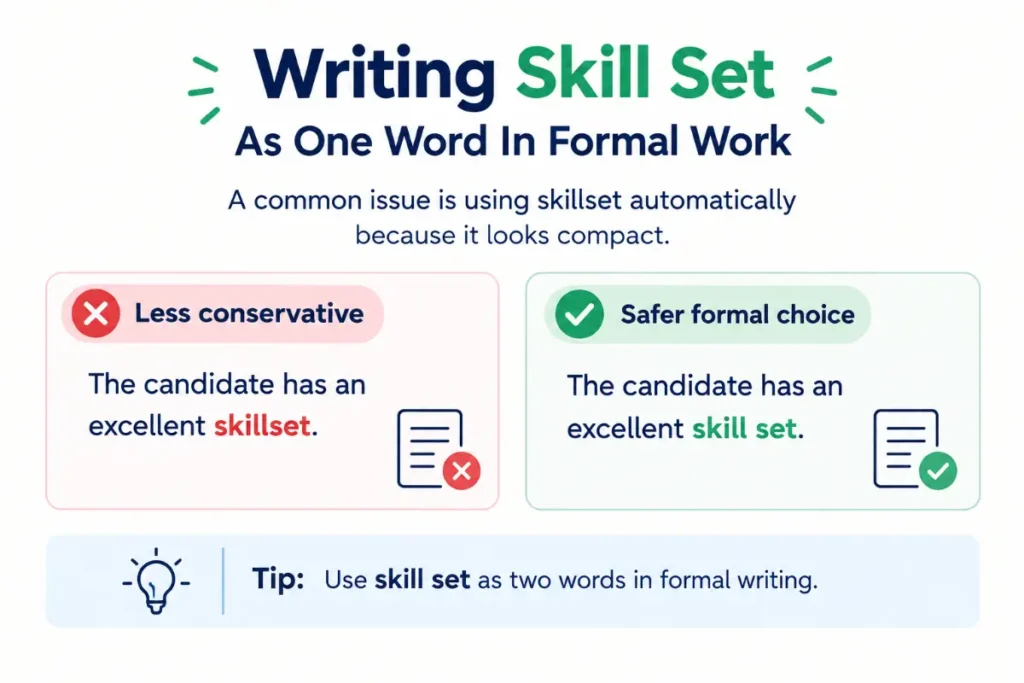
Writing Skill Set As One Word In Formal Work
A common issue is using skillset automatically because it looks compact.
Less conservative: The candidate has an excellent skillset.
Safer formal choice: The candidate has an excellent skill set.
The closed form may be accepted by some readers, but the two word form avoids unnecessary style questions.
Treating Skill Set As A Single Skill
A skill set normally means a collection of abilities.
If you mean one ability, use skill.
For example:
She has strong writing skills.
She has a strong skill set.
The first sentence focuses on a particular category of ability. The second refers to a broader combination.
Confusing Skill Set With Experience
Skills and experience are related but not identical.
Someone can have ten years of experience without having every skill needed for a particular role.
For example:
He has extensive experience in sales.
He has a strong skill set in negotiation and client communication.
The first statement describes time and background. The second describes abilities.
Using Skill Set Without Explaining A Technical Context
The phrase is broad.
If precision matters, tell the reader what skills you mean.
Instead of:
She has a valuable skill set.
You might write:
She has a valuable skill set that includes research, data analysis, and presentation skills.
The second sentence gives the reader useful information instead of making a vague claim.
Overusing The Phrase
Professional writing sometimes relies too heavily on phrases such as skill set, expertise, capabilities, and competencies.
Strong writing uses precise language.
Instead of repeatedly saying someone has a strong skill set, identify the actual abilities.
She can analyze financial reports and explain complex findings clearly.
That sentence tells the reader far more than a general claim about skills.
Pronunciation Guide
Both forms are normally pronounced the same way because the spelling difference does not create a meaningful difference in ordinary speech.
A common pronunciation is represented approximately as:
/ˈskɪl sɛt/
You can think of it as:
skill set
The main stress falls naturally on both parts because the expression contains two short lexical words.
The first part rhymes with words such as still and fill.
The second part sounds like set as in set the table.
There is no need to pronounce skillset as a special new sound simply because it is written as one word.
This is a useful reminder that spelling and pronunciation don’t always develop together. English speakers may pronounce two spellings identically even when writers treat the forms differently on the page.
Word Origin
The expression is built from two ordinary English words.
Skill has a long history in English and is connected with ideas involving knowledge, ability, practical expertise, or proficiency. Set is an extremely old and productive English word with many meanings, including a group or collection arranged together.
The phrase skill set is therefore semantically straightforward. It combines skill with the group related sense of set.
The modern closed form reflects a broader pattern in English word formation. Frequently used combinations can become compounds over time. Speakers begin to perceive the combination as a single concept, and spelling may eventually move toward a closed form.
This kind of change is not unusual.
Words such as notebook and bedroom were once more visibly transparent combinations. English continues to create and reshape compounds as usage changes.
That doesn’t mean every two word expression eventually becomes one word. Some remain permanently open compounds because speakers and editors continue to treat them as separate words.
Skillset appears to be an example of an expression where the closed form has gained ground without completely displacing the established two word form.
For writers, this historical perspective explains why you may encounter both spellings without needing to assume that one must always be a simple typo.
Regional Usage
American English
In American English, skill set is the safest conventional form for formal writing. You’ll see it in workplace communication, education, resumes, job descriptions, professional development, and general discussion of abilities.
Skillset also appears in American usage, particularly in contemporary business and online writing. The meaning is usually identical.
If your goal is polished professional American English, skill set is the better default.
British English
British English also uses skill set as the established two word form. The closed version may appear in modern writing, but it does not create a major difference in meaning.
There is no important British spelling rule that requires writers to use skillset.
Australian English
Australian English follows the same general pattern. Skill set remains a familiar and conventional expression, while skillset may occur as a modern closed compound.
The difference is not a distinct Australian vocabulary issue. It is mainly a matter of compound spelling and editorial preference.
Canadian English
Canadian English likewise uses skill set as a standard expression. Writers may encounter skillset in contemporary professional material, but the two word form remains a safe choice for careful writing.
Across these major English varieties, the meaning stays stable.
Formal And Informal Writing
The choice becomes easier when you consider your audience.
Academic Writing
Use skill set in essays, research papers, reports, and other carefully edited academic work.
For example:
The program helps students develop a skill set that supports independent research.
The two word form looks conventional and creates no unnecessary spelling question.
Business Writing
Skill set works naturally in reports, presentations, internal documents, and professional correspondence.
For example:
The new position requires a skill set that combines technical knowledge with communication ability.
Skillset may appear in business writing, especially in less formal material, but the open form remains a reliable editorial choice.
Resumes And Cover Letters
A resume should focus on specific abilities rather than vague claims.
Instead of writing:
I have an excellent skill set.
Write:
My skills include data analysis, client communication, and project coordination.
The second approach is stronger because it shows what you can actually do.
If you do use the expression, skill set is the safer form.
Casual Writing
In casual online writing, you may see skillset more often.
A person might write:
My skillset has changed a lot over the years.
Most readers will understand the sentence immediately.
Still, casual acceptance doesn’t mean you should automatically transfer that spelling into every formal document.
Real Life Usage
Daily Conversation
People often use the expression when talking about work or personal abilities.
Her skill set is perfect for the new position.
I need to build a new skill set before I apply.
In ordinary speech, nobody hears the space between the two words. The distinction exists on the page.
Workplace Communication
The expression is common when discussing hiring, training, career development, and job responsibilities.
The manager said the role requires a broad skill set.
We need someone whose skill set matches the technical requirements.
These examples show why the phrase is especially common in professional English.
Academic Writing
Students and researchers can use the expression when discussing education and professional preparation.
The program develops a skill set that prepares students for laboratory work.
Students need a varied skill set to succeed in independent research.
For formal academic work, the two word spelling is the safer choice.
Journalism
News and feature writing may use the phrase when describing professionals or changing job markets.
The new training program gives workers a broader skill set.
Employers are seeking candidates with a different skill set as technology changes.
Journalists generally choose wording based on clarity and established usage.
Storytelling
The phrase can also appear naturally in personal stories.
Years of working with customers gave him a skill set he never expected to use in management.
Her experience as a teacher gave her a surprisingly useful skill set for public speaking.
These examples show how the expression can describe abilities gained through life experience.
Skill Set Compared With Similar Terms
Skills
Skills are individual abilities or groups of abilities.
She has strong writing skills.
This is often more specific than saying she has a strong skill set.
Expertise
Expertise means specialized knowledge or ability developed through learning and experience.
His expertise is in financial analysis.
Expertise can sound stronger than a general reference to skills because it suggests a high level of competence.
Competencies
Competencies are abilities and behaviors needed to perform a role effectively. The term is common in human resources and organizational settings.
The company identified five core competencies for managers.
Qualifications
Qualifications are credentials, education, training, experience, or other conditions that make someone suitable for a position.
A degree may be a qualification. Communication ability is a skill.
Abilities
Abilities are things someone can do successfully.
The word is broad and works in many contexts.
Capabilities
Capabilities describe what a person or organization is able to do.
The term can sound more formal than skills.
Strengths
Strengths are areas in which someone performs particularly well.
Communication is one of her main strengths.
Talent
Talent usually refers to a natural or developed ability to perform something well.
Talent and skill overlap, but talent often carries a stronger sense of natural aptitude.
Knowing these distinctions helps you avoid using skill set as a catchall phrase. Precise language usually produces stronger writing.
Memory Tips
If you’re unsure how to spell the expression, remember that a set is a group.
A skill set is literally a set of skills.
That visual connection makes the spelling easy to remember.
Think of the phrase as:
skill + set
Then picture a collection of skills sitting together as one group.
You can also remember the contrast between a single skill and a skill set.
A skill is one ability.
A skill set is a collection of abilities.
For formal writing, keep the two words separate.
Another useful editing trick is to read the sentence aloud and ask what you are trying to describe. If you mean several related abilities, skill set is probably the phrase you want.
Why Skillset Appears So Often
The closed spelling has a natural appeal.
Writers often prefer shorter compounds because they make familiar concepts look like single units. Professional language also contains many compounds that have gradually become closed words.
The growth of skillset does not necessarily mean that skill set has become wrong. Language can support competing forms during periods of change.
Think about other English expressions that exist in different stages of compound development. Some remain open for generations. Others eventually become closed. Still others vary according to style, dictionary, publication, or context.
This is why responsible language advice should distinguish between nonstandard, less established, and incorrect.
Calling skillset completely invalid would ignore real usage. Calling it equally preferable in every context would also be too broad.
For a writer who simply wants the safest standard choice, skill set is the answer.
When To Choose The Closed Form
There are situations where you may encounter or choose skillset.
If you are writing in a context where the publication or organization consistently uses the closed spelling, consistency may matter more than personal preference.
A brand, website, software interface, or specialized publication may have its own house style.
If you are editing someone else’s work, you should also consider the document’s established style. Changing every instance simply because you personally prefer another form may create unnecessary inconsistency.
Still, if no style guide or house preference applies, skill set is the conservative choice.
This is a broader lesson in editing. Good editors don’t change language just to make it look different. They make changes that improve clarity, correctness, consistency, or suitability for the audience.
Expert Editor Insight
An experienced editor would normally recommend skill set for formal American English because it is clear, familiar, and safely established as an open compound. The closed form skillset is understandable and appears in contemporary usage, so it should not automatically be treated as an unintelligible error. The real issue is editorial consistency. If a document uses one form throughout, changing randomly between forms can look careless. My practical tip is to choose skill set as your default unless a trusted style guide or publication clearly prefers the closed form.
Key Takeaways
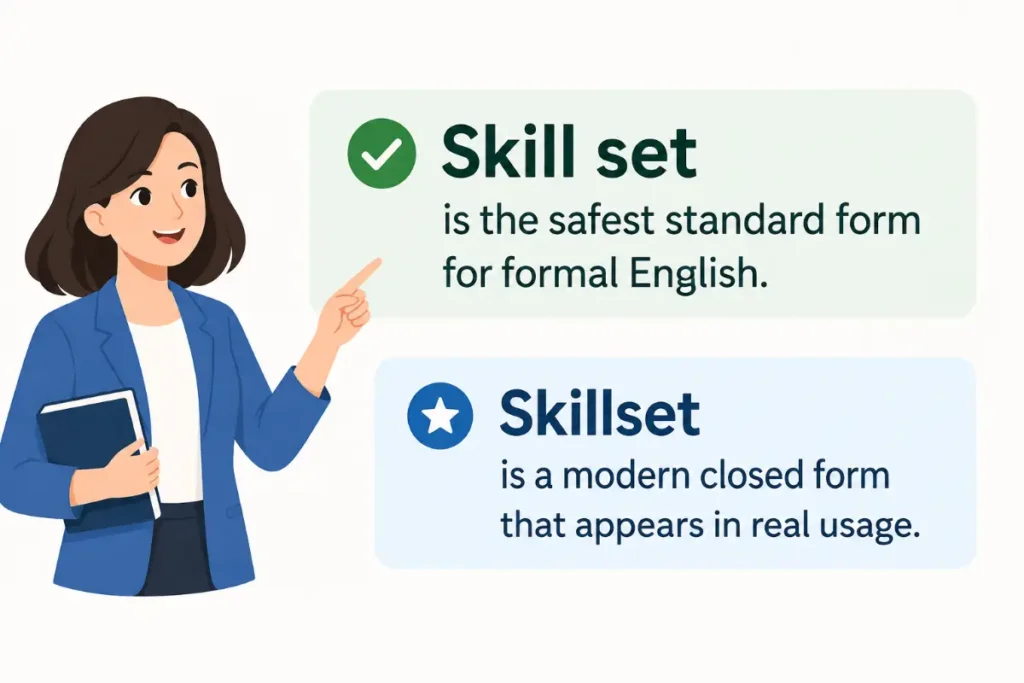
- Skill set is the safest standard form for formal English.
- Skillset is a modern closed form that appears in real usage.
- The two forms usually have the same meaning.
- Skill set is a compound noun referring to a collection of abilities.
- The plural form is skill sets.
- The pronunciation is normally the same for both forms.
- There is no major American British Canadian or Australian difference that requires the closed spelling.
- For resumes academic work professional documents and formal writing, skill set is the conservative choice.
- Specific skills are often clearer than broad statements about someone’s skill set.
- If a publication or organization has a house style, follow it consistently.
Conclusion
skillset or skill set presents a spelling question with a slightly more interesting answer than simply calling one form wrong. Skill set is the safest established form for formal and carefully edited English, while skillset is a recognizable closed compound that appears in modern professional and online usage.
Both forms generally describe the same collection of abilities, so the difference is mainly editorial rather than semantic. The expression functions as a compound noun, and its plural form is skill sets.
For professional writing, keep the words separate unless a trusted style guide or publication specifically prefers the closed form. The easiest memory trick is also the simplest one: a skill set is a set of skills. That connection makes the standard spelling easy to remember.
FAQs
Is skillset one word or two words?
Skill set is the safest standard form when you mean a collection of abilities. Skillset is also used as a closed compound in modern English, particularly in professional and online writing. The two forms usually have the same meaning. For academic papers, formal reports, resumes, and carefully edited business writing, skill set is the more conservative choice.
What does skill set mean?
A skill set is a collection of skills or abilities that a person has or needs for a particular task, job, or field. For example, a manager may have a skill set that includes leadership, communication, planning, and decision making. The expression can describe technical abilities, interpersonal abilities, creative abilities, or a combination of different types of skills.
Is skillset grammatically correct?
Skillset is understandable and appears in real modern usage, so calling it grammatically meaningless would be inaccurate. The main issue is spelling convention rather than grammar. Skill set remains the safer established form for formal writing. If you are following a specific publication or organizational style guide, follow that guide consistently.
Is skill set hyphenated?
Usually no. When the expression functions as a noun meaning a collection of skills, the standard form is skill set as two separate words. A hyphen is generally unnecessary. For example, you can write She has a strong skill set. The expression should not normally be written as skill set with a hyphen between the words.
What is the plural of skill set?
The normal plural is skill sets. For example, you can write Different careers require different skill sets. The word set becomes plural because you are referring to multiple collections of abilities. You do not normally need to change skill into skills when using the expression as a compound noun.
Should I use skill set on a resume?
Yes, skill set is acceptable on a resume, but specific skills are usually more useful to employers than a broad statement about your skill set. Instead of saying you have a strong skill set, name the abilities that matter for the position. Specific terms such as project management, data analysis, customer service, or technical writing give the reader clearer information.
What is another word for skill set?
Depending on the context, alternatives include skills, abilities, competencies, capabilities, expertise, qualifications, and strengths. These terms are not perfect replacements in every sentence. Expertise usually suggests specialized knowledge, while qualifications can include education and credentials. Competencies often refers to abilities needed for effective performance in a particular role.
Why do people write skillset as one word?
People write skillset as one word because familiar English expressions often develop into closed compounds over time. The meaning is easy to recognize, so writers may naturally treat the phrase as one lexical unit. Modern professional and online writing has helped the closed form become more visible. Even so, skill set remains the safer conventional spelling for formal writing.

Confusing Words, Spelling & Word Choice
Claire Whitmore is a U.S.-based English editor who writes about commonly confused words, spelling differences, and word choice. Her work helps readers understand subtle distinctions between similar-looking words through simple definitions, practical examples, and modern usage guidance in both American and British English.