
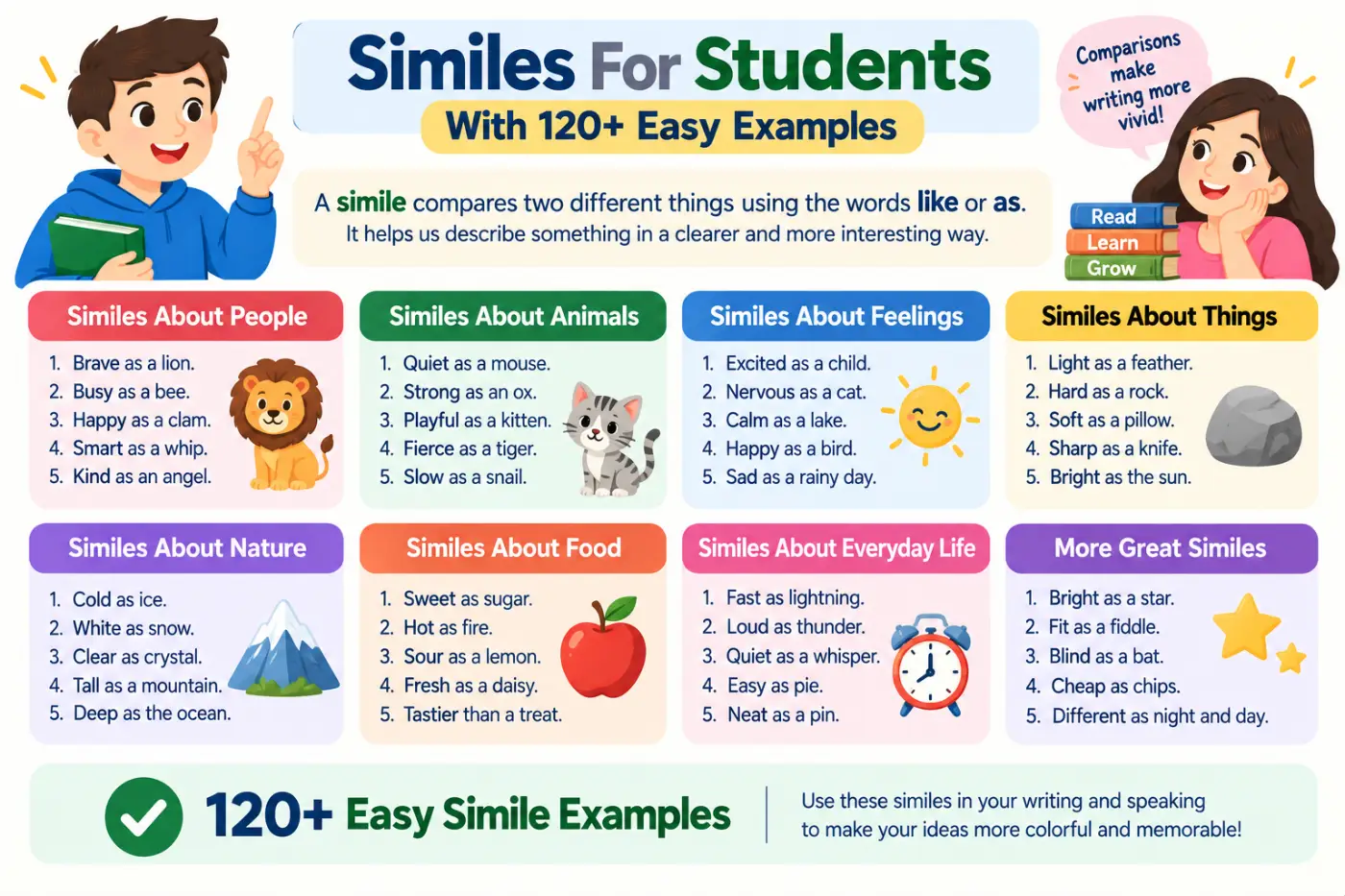
Similes for students make writing more colorful because they turn plain ideas into pictures that readers can almost see. Instead of saying that a student was very nervous you can say the student was as nervous as a rabbit near a barking dog. The comparison gives the feeling more shape and personality.
A simile works by comparing two different things while usually using like or as. The two things don’t need to be similar in every way. They only need to share one clear quality that makes the comparison meaningful. That’s why a strong simile can make an ordinary sentence memorable without making it complicated.
Students can use similes in stories poems essays descriptions speeches and creative writing. The trick is choosing comparisons that fit the subject instead of adding fancy language just to sound impressive. The examples below cover school life nature emotions people animals food sports weather and many other familiar topics. Each one also includes a short explanation so you can see why the comparison works and how to use it naturally.
Short Answer
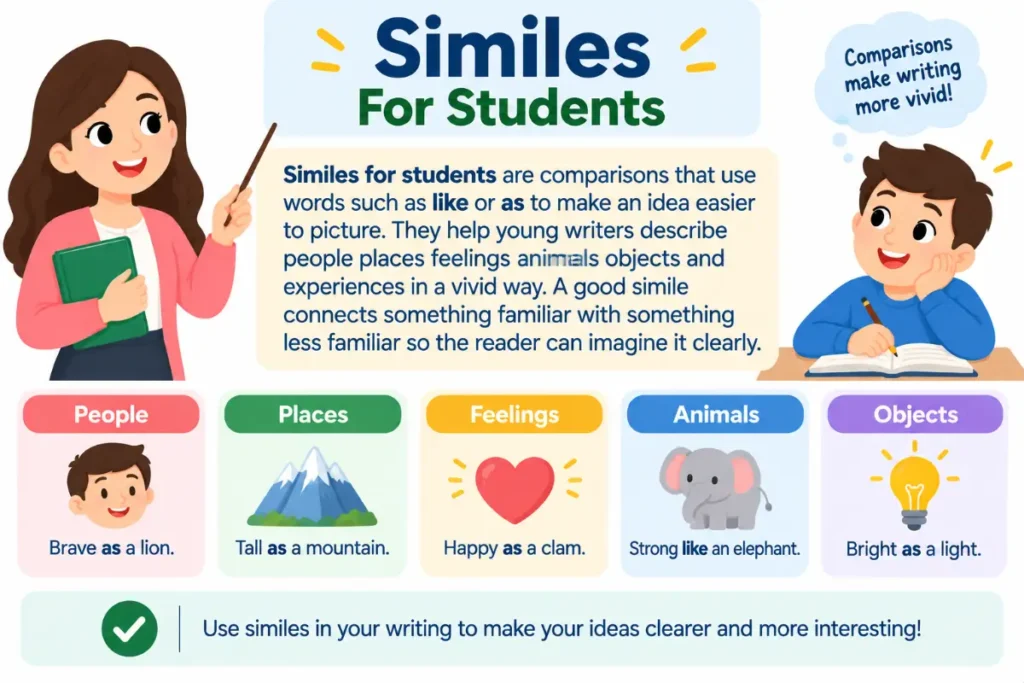
Similes for students are comparisons that use words such as like or as to make an idea easier to picture. They help young writers describe people places feelings animals objects and experiences in a vivid way. A good simile connects something familiar with something less familiar so the reader can imagine it clearly.
Table Of Contents
- What Is A Simile.
- How Similes Work.
- Similes For Students In School.
- Similes About People.
- Similes About Feelings.
- Similes About Animals.
- Similes About Nature.
- Similes About Weather.
- Similes About Food.
- Similes About Speed.
- Similes About Strength.
- Similes About Appearance.
- Similes About Sound.
- Similes About Movement.
- Similes For Creative Writing.
- Similes For Essays And Descriptions.
- Common Simile Mistakes.
- How To Create Your Own Similes.
- Memory Tips.
- Related Figurative Language.
- FAQs.
- Key Takeaways.
- Conclusion.
What Is A Simile
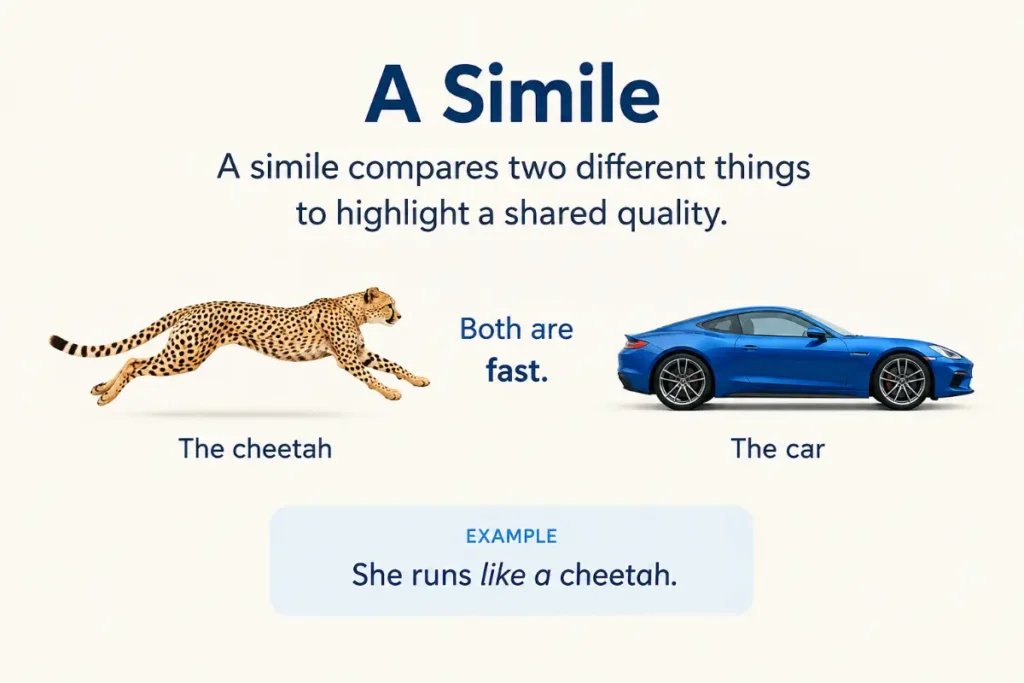
A simile is a figure of speech that compares two different things to highlight a shared quality. The comparison often uses like or as.
For example:
The classroom was as quiet as a library.
The classroom isn’t literally a library. The writer compares the two because both can be very quiet.
Another example is:
Her smile was like sunshine.
A smile isn’t sunshine. The comparison suggests warmth brightness happiness or comfort.
Similes are useful because readers understand familiar images quickly. If you describe a person as being as busy as a bee most readers immediately understand that the person is active and constantly doing something.
A simile should have a clear purpose. If the comparison doesn’t help the reader understand the subject then it may feel forced.
How Similes Work
A simple simile has three main parts.
- The subject. This is the thing you’re describing.
- The comparison word. Common choices include like and as.
- The image. This is the familiar thing you use to make the description clearer.
Consider this sentence:
The new student was as quiet as a mouse.
The new student is the subject. As introduces the comparison. A mouse provides the familiar image associated with quietness.
Similes don’t always need the same grammatical structure. You can write:
The moon looked like a silver coin.
You can also write:
He ran as fast as a cheetah.
Both sentences create comparisons but use different patterns.
The strongest examples usually compare things that share an obvious quality. A reader shouldn’t have to stop and solve a puzzle before understanding the sentence.
Similes For Students In School
School provides endless material for creative comparisons because students experience classrooms homework exams teachers friendships sports and school events every day.
- The classroom was as quiet as a sleeping cat. This shows that everyone was unusually silent.
- The teacher’s voice was as clear as a bell. This suggests that every student could hear the teacher easily.
- My backpack felt as heavy as a bag of bricks. This emphasizes how much the student was carrying.
- The school hallway was like a busy airport. This creates an image of crowds and constant movement.
- The bell rang like a fire alarm. This suggests a loud and sudden sound.
- My homework pile looked like a small mountain. This shows that there was a large amount of work.
- The test felt as difficult as climbing a steep hill. This describes a challenging exam.
- Her handwriting was as neat as printed letters. This shows careful and tidy writing.
- The students moved like ants after the bell. This creates an image of many people moving quickly together.
- My pencil moved across the page like a racing car. This shows fast writing.
- The library was as peaceful as a quiet garden. This emphasizes calm surroundings.
- His answer was as sharp as a needle. This suggests a quick and precise response.
- The school bus was packed like a crowded elevator. This shows how little space remained.
- The science project stood like a tiny tower. This creates a clear visual image.
- My first day at school felt like stepping onto a new planet. This expresses unfamiliarity and excitement.
Similes About People
People are easier to describe when you connect their qualities with familiar images.
- She was as cheerful as a sunny morning. This describes someone naturally happy.
- He was as quiet as a mouse. This suggests that he spoke very little.
- My brother is as stubborn as a mule. This describes someone who refuses to change his mind.
- She moved like a graceful dancer. This emphasizes smooth movement.
- He was as brave as a lion. This highlights courage.
- The little boy was as curious as a cat. This shows a strong desire to discover things.
- Her eyes sparkled like stars. This creates an image of bright excited eyes.
- He stood as still as a statue. This shows complete stillness.
- She was as busy as a bee. This describes someone constantly working.
- His face became red like a ripe tomato. This can describe embarrassment or anger.
- The old man walked like a tired turtle. This emphasizes slow movement.
- She smiled like a child opening a birthday gift. This creates an image of genuine excitement.
- He was as gentle as a lamb. This suggests kindness and softness.
- Her voice was like a soft breeze. This describes a calm and gentle voice.
- He stood as tall as a tree. This emphasizes height.
Similes About Feelings
Feelings can be difficult to describe directly. A strong comparison gives an invisible emotion a physical image.
- I was as nervous as a rabbit before the race. This shows strong nervousness.
- She was as happy as a child on Christmas morning. This expresses intense happiness.
- His heart beat like a drum. This suggests excitement or fear.
- I felt as lonely as a single star in the sky. This creates an image of isolation.
- Her anger burned like a hot flame. This shows intense anger.
- He was as excited as a puppy seeing its owner. This suggests energetic happiness.
- My fear spread like ice through my body. This shows how quickly fear took over.
- She felt as calm as a lake on a windless morning. This describes deep peace.
- His sadness hung over him like a dark cloud. This suggests a heavy emotional state.
- My excitement bubbled like boiling water. This shows an emotion that keeps building.
- She was as confused as a traveler without a map. This describes uncertainty.
- He felt as proud as a champion holding a trophy. This expresses strong pride.
- My disappointment fell over me like a sudden rainstorm. This shows a quick change into sadness.
- She was as worried as a parent waiting for a late child. This expresses deep concern.
- His confidence was like a bright lamp in a dark room. This suggests that his confidence gave him strength.
Similes About Animals
Animals provide familiar images that students can easily use in descriptive writing.
- The dog was as playful as a puppy in a park. This emphasizes energetic fun.
- The cat moved like a shadow. This suggests quiet and almost unnoticed movement.
- The horse ran like the wind. This shows great speed.
- The owl was as quiet as falling snow. This emphasizes silent movement.
- The puppy was as excited as a child at a fair. This shows energetic happiness.
- The turtle moved as slowly as a clock on a lazy afternoon. This emphasizes very slow movement.
- The eagle flew like a silver arrow. This suggests fast direct movement through the sky.
- The monkey was as curious as a young explorer. This shows a desire to investigate everything.
- The snake moved like a ribbon across the ground. This describes smooth winding movement.
- The rabbit was as quick as a flash. This emphasizes sudden speed.
- The elephant walked like a slow moving mountain. This emphasizes its large size and steady movement.
- The fish moved like colorful ribbons underwater. This creates a flowing visual image.
- The butterfly floated like a piece of paper in the breeze. This emphasizes light movement.
- The bear was as strong as a giant tree. This highlights strength.
- The squirrel was as busy as a shopkeeper before closing time. This shows constant activity.
Similes About Nature
Nature gives writers an enormous collection of images. Mountains trees rivers flowers clouds and stars can all strengthen descriptions.
- The mountain stood like a giant wall. This emphasizes height and size.
- The river moved like a silver ribbon. This creates an image of a long shining stream.
- The stars glittered like tiny diamonds. This highlights their brightness.
- The clouds floated like soft pillows. This creates a gentle image.
- The leaves danced like tiny green flags. This describes movement in the wind.
- The flowers were as colorful as a painter’s palette. This emphasizes many bright colors.
- The moon looked like a glowing lantern. This highlights its light.
- The grass felt as soft as a green carpet. This describes a smooth surface.
- The waterfall sounded like a roaring drum. This emphasizes its loud noise.
- The forest was as dark as a closed room. This highlights the lack of light.
- The sun shone like a golden coin. This emphasizes brightness and color.
- The waves crashed like wild horses. This describes powerful movement.
- The snow covered the ground like a white blanket. This creates a familiar winter image.
- The sunset spread across the sky like spilled paint. This emphasizes broad colors.
- The tree branches reached upward like open hands. This gives the tree a human quality.
Similes About Weather
Weather descriptions become much more vivid when readers can picture the conditions.
- The rain fell like tiny glass beads. This describes small drops and their appearance.
- The wind howled like a hungry wolf. This emphasizes a loud powerful wind.
- The sun felt as hot as an oven. This describes intense heat.
- The morning air was as cold as ice. This emphasizes freezing conditions.
- The storm moved like a dark army across the sky. This creates an image of something large and threatening.
- The clouds were as gray as ashes. This describes a dull overcast sky.
- The thunder sounded like a giant knocking on a door. This creates a dramatic sound image.
- The snow fell like feathers from the sky. This emphasizes soft gentle snowfall.
- The breeze felt like a cool hand on my face. This describes refreshing air.
- The lightning flashed like a camera. This emphasizes its sudden brightness.
- The fog spread like a white curtain. This shows how it covered the landscape.
- The heat hung over the city like a heavy blanket. This describes uncomfortable heat.
- The rainstorm arrived like an unexpected guest. This shows how suddenly it appeared.
- The clouds raced like ships across the sky. This emphasizes movement.
- The morning was as bright as a freshly polished window. This creates an image of clear bright weather.
Similes About Food
Food descriptions become more appealing when they appeal to familiar sights textures and sounds.
- The cake was as soft as a pillow. This emphasizes its light texture.
- The popcorn smelled like warm butter. This creates a familiar sensory image.
- The apple was as crisp as fresh snow. This emphasizes its crunch.
- The soup was as hot as a summer afternoon. This describes high temperature.
- The lemonade tasted like sunshine in a glass. This creates a cheerful image of freshness.
- The bread was as soft as a cloud. This emphasizes tenderness.
- The chips were as crunchy as dry leaves. This focuses on sound and texture.
- The chocolate melted like snow in the sun. This emphasizes how quickly it disappeared.
- The strawberries were as red as rubies. This highlights their color.
- The ice cream was as cold as winter air. This emphasizes its chill.
- The honey was as smooth as silk. This describes its texture.
- The pizza smelled like a warm kitchen after dinner began. This creates a cozy sensory image.
- The watermelon was as juicy as a summer rainstorm. This emphasizes its high moisture.
- The candy was as bright as tiny jewels. This highlights its colorful appearance.
- The cookie was as sweet as a spoonful of honey. This emphasizes sweetness.
Similes About Speed
Speed is easier to understand when you compare it with something known for moving quickly.
- He ran like a cheetah. This shows very fast running.
- The car moved as fast as a rocket. This emphasizes extreme speed.
- She typed like a machine. This suggests very fast and continuous typing.
- The cyclist moved like an arrow. This emphasizes direct fast movement.
- The rabbit disappeared like a flash of light. This shows sudden speed.
- The news spread like wildfire. This describes information moving rapidly.
- The children rushed like birds escaping a cage. This suggests sudden energetic movement.
- The runner moved as quickly as a shooting star. This emphasizes impressive speed.
- The ball flew like a bullet. This shows fast movement through the air.
- The leaves raced across the ground like tiny boats. This describes wind driven movement.
Similes About Strength
Strength can describe physical power emotional courage or the ability to endure difficulty.
- He was as strong as an ox. This describes great physical strength.
- Her determination was like a steel wall. This suggests that she refused to give up.
- The bridge stood as firm as a mountain. This emphasizes stability.
- His grip was as strong as a vise. This describes powerful holding strength.
- She stood like a sturdy tree during the storm. This suggests resilience.
- The team fought like lions. This describes courage and determination.
- His voice was as powerful as thunder. This emphasizes force and volume.
- The old building stood as strong as stone. This describes durability.
- Her courage was like a bright flame in darkness. This suggests hope and bravery.
- He held the rope as tightly as a clamp. This emphasizes a firm grip.
Similes About Appearance
Descriptions become more memorable when readers can picture the person or object.
- Her hair was as dark as midnight. This emphasizes deep darkness.
- His eyes were like bright stars. This highlights brightness.
- The dress was as white as fresh snow. This emphasizes a clean white color.
- Her cheeks were as red as roses. This highlights a strong red color.
- The building was as tall as a giant. This emphasizes height.
- The lake was like a polished mirror. This describes a smooth reflective surface.
- His shoes were as black as coal. This emphasizes deep black color.
- The necklace sparkled like tiny stars. This highlights its shine.
- The old chair looked like a weathered tree. This suggests age and roughness.
- The glass was as clear as a mountain stream. This emphasizes transparency.
- Her dress flowed like a waterfall. This describes smooth flowing fabric.
- The clouds looked like cotton balls. This emphasizes their soft rounded appearance.
- The road stretched like a long gray ribbon. This describes its shape and length.
- The moon was as round as a silver plate. This emphasizes its circular shape.
- The puppy’s ears were like two soft leaves. This creates a gentle visual comparison.
Similes About Sound
Sound can be difficult to describe because readers can’t see it. Comparisons give sound a recognizable quality.
- The alarm rang like a siren. This emphasizes loudness.
- The baby’s cry was as sharp as a whistle. This describes a high piercing sound.
- The leaves rustled like whispering voices. This creates a quiet natural sound.
- The thunder crashed like a giant drum. This emphasizes deep volume.
- The stream sounded like tiny bells. This gives the water a light musical quality.
- The door slammed like a cannon. This describes a sudden powerful noise.
- The crowd roared like a stadium full of lions. This emphasizes enormous volume.
- Her laugh was like a ringing bell. This suggests a bright clear sound.
- The rain tapped the roof like gentle fingers. This describes repeated soft sounds.
- The wind screamed like a frightened animal. This emphasizes a loud unpleasant sound.
Similes About Movement
Movement becomes more vivid when the reader can imagine its shape rhythm or speed.
- The dancer moved like flowing water. This suggests smooth graceful movement.
- The leaves spun like tiny wheels. This describes circular movement.
- The kite floated like a feather. This emphasizes lightness.
- The child jumped like a spring. This describes quick upward movement.
- The snake twisted like a rope. This shows winding movement.
- The boat rocked like a cradle. This suggests gentle repeated movement.
- The runner turned like a spinning top. This emphasizes quick rotation.
- The curtain moved like a wave. This describes flowing motion.
- The bird dropped like a stone. This emphasizes sudden downward movement.
- The dancers moved as smoothly as silk. This highlights graceful motion.
Similes For Creative Writing
Creative writing gives students more freedom to use unusual comparisons. The best imaginative similes still need a clear connection.
- The castle rose like a forgotten dream. This gives the setting a mysterious quality.
- The moon followed us like a silent friend. This makes the moon feel personal.
- The old house stood like a tired giant. This suggests age and size.
- The road disappeared like a secret under the trees. This creates mystery.
- Her thoughts raced like birds in a storm. This describes mental confusion.
- The empty room felt like a frozen moment. This creates stillness.
- His words fell like stones into the silence. This gives his speech emotional weight.
- The city glittered like a box of scattered jewels. This emphasizes many lights.
- The forest breathed like a sleeping animal. This makes the setting feel alive.
- The memory returned like an old song. This suggests something familiar and emotional.
- The stars watched like distant eyes. This creates a mysterious mood.
- The river carried secrets like an old storyteller. This gives nature a human role.
- The darkness spread like spilled ink. This describes darkness covering an area.
- The abandoned road waited like an unanswered question. This creates suspense.
- The morning opened like a bright window. This suggests a fresh beginning.
Similes For Essays And Descriptions
Not every simile needs to be poetic. Students can use clear comparisons in descriptive and school writing too.
- The library was as quiet as a museum.
- The experiment was as simple as following a recipe.
- The problem looked like a puzzle missing one piece.
- The graph rose like a steep hill.
- The city grew like a tree reaching toward sunlight.
- The team worked like a well practiced orchestra.
- The process was as clear as a road with signs.
- The new system worked like a carefully tuned machine.
- The evidence fit together like pieces of a puzzle.
- The final result was like the last piece of a picture.
These comparisons can make explanatory writing easier to understand. Still use them carefully in academic work. A simile should clarify an idea rather than replace a precise explanation.
Common Mistakes With Similes
Students often understand the basic idea but make mistakes when building their own comparisons.
Using A Weak Comparison
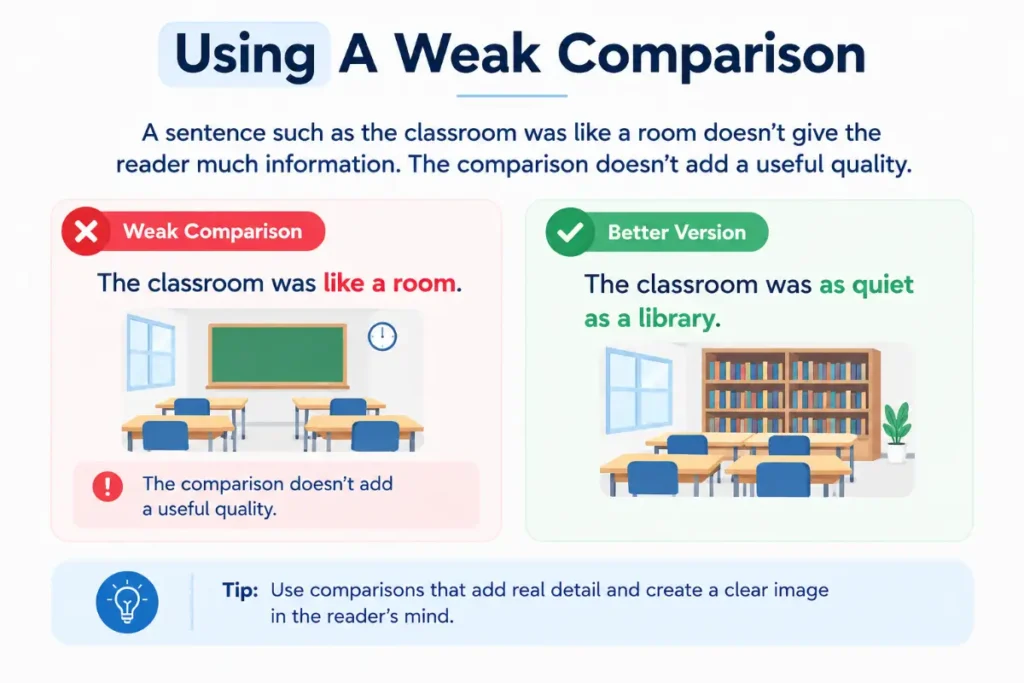
A sentence such as the classroom was like a room doesn’t give the reader much information. The comparison doesn’t add a useful quality.
A better version might be:
The classroom was as quiet as a library.
Now the comparison gives the reader a specific quality.
Comparing Things Without A Clear Connection
A comparison can be imaginative without being random. If the reader can’t see the shared quality the simile becomes confusing.
Instead of writing:
The pencil was like the ocean.
Explain the connection.
The blue pencil was as bright as the summer ocean.
Now the color creates a clear reason for the comparison.
Mixing Simile And Metaphor
A simile usually signals comparison with like or as.
Her voice was like music.
A metaphor makes the comparison directly.
Her voice was music.
Both can be effective. They simply use different structures.
Overusing Similes
A paragraph packed with comparisons can feel crowded. Readers need plain sentences too.
One strong comparison can often do more work than five weak ones.
Choosing Clichés Too Often
Some comparisons are so common that they can lose their impact. Students should learn familiar examples first because they help explain the concept. Once the structure is understood they can create fresher comparisons that fit their own ideas.
How To Create Your Own Similes
Creating original similes becomes easier when you start with the quality you want to describe.
- Choose the subject. Think about the person object place or feeling you want to describe.
- Choose the quality. Decide if you want to show speed size brightness fear happiness strength silence or another trait.
- Think of familiar images. Make a quick list of things associated with that quality.
- Connect the ideas. Use like or as to build the comparison.
- Read the sentence aloud. If it sounds forced change the comparison.
- Remove unnecessary words. A good simile should make the sentence stronger rather than heavier.
For example suppose you want to describe a very nervous student.
Start with the quality: nervous.
Think of familiar nervous images: shaking hands racing hearts frightened animals uncertain travelers.
Build a comparison:
The student was as nervous as a rabbit hearing a strange noise.
That comparison gives the reader an immediate image.
You can also make the image more creative:
Her thoughts jumped like popcorn in a hot pan.
The comparison doesn’t literally describe nervousness. Instead it captures the restless movement of her thoughts.
Memory Tips
Remembering the basic rule is simple.
- Like often introduces a direct comparison. She runs like the wind.
- As often forms a paired comparison. He is as quiet as a mouse.
- Compare one clear quality. Don’t force unrelated objects together.
- Choose familiar images. Your reader should understand the comparison quickly.
- Make the image fit the mood. A funny comparison may work in a playful story but not in a serious essay.
- Prefer clarity over fancy language. A simple strong image beats an impressive comparison that nobody understands.
A useful classroom test is to ask yourself one question. What does this comparison help my reader see feel hear or understand.
If you have a good answer the simile probably has a purpose.
Related Figurative Language
Similes belong to a larger family of figurative language. Understanding the differences can help students choose the right device.
Metaphor
A metaphor compares two things directly without using like or as.
The classroom was a zoo.
The writer doesn’t mean the classroom is literally full of wild animals. The comparison suggests noise or disorder.
Personification
Personification gives human qualities to nonhuman things.
The wind whispered through the trees.
Wind can’t literally whisper like a person. The expression makes the scene feel more alive.
Hyperbole
Hyperbole uses deliberate exaggeration.
I have a million pages of homework.
The speaker doesn’t literally have one million pages. The exaggeration emphasizes how much work there seems to be.
Alliteration
Alliteration repeats the beginning sound of nearby words.
Peter picked purple pencils.
This can make writing more rhythmic and memorable.
Onomatopoeia
Onomatopoeia uses words that imitate sounds.
The bees buzzed around the flowers.
The word buzz helps the reader imagine the sound.
Imagery
Imagery uses descriptive language to create sensory pictures.
Warm sunlight spilled across the wooden floor.
The sentence appeals to sight and temperature while creating a clear scene.
Understanding these devices helps students avoid treating every creative comparison as the same type of figurative language.
Why Similes Matter In Student Writing
Good writing doesn’t only tell readers information. It helps them experience the idea.
Consider this sentence:
The storm was frightening.
The meaning is clear but the description remains general.
Now consider:
The storm roared like a giant beast outside the window.
The second sentence gives the reader something to imagine. The comparison adds sound movement and mood.
That’s the real value of a simile. It turns an abstract quality into a concrete image.
Students can also use comparisons to show character. A person who moves like a turtle seems slow. Someone who works like a bee seems busy. A voice like thunder seems powerful.
The comparison lets the reader reach the meaning quickly.
Choosing Better Comparisons
The best simile isn’t always the most unusual one. It should fit the audience purpose and tone.
For younger readers a familiar comparison may work best.
The puppy was as soft as a cloud.
For older students a more original image may create stronger writing.
The puppy curled beside me like a warm comma at the end of a long sentence.
The second comparison is more imaginative but also more complex. It works best in creative writing where the writer has room to experiment.
Think about the reader before choosing the image. A clear comparison that everyone understands will usually beat a clever comparison that requires explanation.
Using Similes Without Making Writing Sound Forced
A common student mistake is adding figurative language to every sentence. Strong writing needs rhythm.
Try this pattern:
The sun dropped behind the hills. The sky turned orange and pink. The clouds looked like strips of glowing cotton. Soon the first stars appeared.
Only one sentence uses a simile. That is enough to create an image without overwhelming the paragraph.
Another useful technique is to place a simile at an important moment. Use it when the reader needs help seeing a character a setting or an emotion.
The comparison then feels purposeful.
Key Takeaways
- A simile compares two different things to highlight a shared quality.
- Like and as are common signals of a simile.
- The comparison should help the reader picture understand or feel something.
- Familiar images are useful for beginners.
- Original comparisons can make creative writing more memorable.
- One strong simile is often better than several weak ones.
- Similes can describe people emotions animals nature weather food movement sound and school experiences.
- Similes differ from metaphors because metaphors make direct comparisons.
- Formal writing can use comparisons when they improve clarity.
- The best similes fit the subject audience mood and purpose.
Conclusion
Similes for students give young writers a simple way to make ordinary sentences more vivid. A comparison such as as quiet as a mouse or bright like a star can help readers picture an idea immediately. The strongest examples don’t use complicated vocabulary. They choose an image that feels natural and clearly connects to the subject.
Students can use similes in stories poems descriptions speeches and selected forms of school writing. The key is balance. Let the comparison strengthen the sentence instead of covering up a weak idea or filling every line with figurative language.
When creating your own comparison start with one quality you want to show. Find a familiar image that shares that quality then connect the two with like or as. Read the result aloud and keep it only if it makes the picture clearer. That simple habit can turn plain writing into memorable writing.
FAQs
What is a simile for students?
A simile is a comparison between two different things that share a quality. Writers commonly use like or as to make the connection clear. For example a student might write that the classroom was as quiet as a library. The comparison helps readers picture the level of silence instead of simply being told that the room was quiet.
What are some easy similes for students?
Easy examples include as busy as a bee as quiet as a mouse as brave as a lion and runs like the wind. These work well for beginners because the shared qualities are easy to understand. Students can start with familiar comparisons and then create their own once they understand how the structure works.
How do you write a good simile?
Start with the thing you want to describe and decide which quality matters most. Then think of a familiar object animal place or experience that has the same quality. Connect the two with like or as. Finally read the sentence aloud and ask if the comparison gives the reader a clearer picture.
What is the difference between a simile and a metaphor?
A simile usually makes a comparison using like or as. A metaphor makes the comparison directly. For example she runs like the wind is a simile while she is a racing machine is a metaphor. Both forms create imagery but they use different grammatical structures to connect the ideas.
Can a simile use as instead of like?
Yes. Similes commonly use as in structures such as as quiet as a mouse or as bright as the sun. The paired as structure makes the comparison clear. Similes can also use like in sentences such as he runs like a cheetah. Both patterns are standard and useful in student writing.
How many similes should a student use in an essay?
There isn’t a fixed number. The right amount depends on the assignment and purpose. A descriptive essay may benefit from several carefully chosen comparisons while a formal analytical essay may need fewer. The main rule is to use a simile when it adds clarity or imagery. Avoid adding comparisons simply to make the writing look more creative.
Can similes be used in academic writing?
Yes but they should serve a clear purpose. In formal academic writing precise language usually matters more than decorative description. A carefully chosen comparison can explain a difficult idea or make an abstract concept easier to understand. However students should avoid relying on figurative language when a direct factual explanation would communicate the point more accurately.
What is the easiest way to remember a simile?
Remember that a simile compares two things to show a shared quality. Look for comparison words such as like and as. If you can explain exactly what quality connects the two things then your comparison probably works. A simple mental formula is subject plus like or as plus familiar image plus shared quality.

Idioms, Expressions & Figurative Language
Mason Ellsworth is an American language writer with a passion for English expressions, figurative language, and everyday communication. He explains idioms, similes, popular phrases, and commonly misunderstood expressions in a straightforward, engaging style that helps readers improve both their writing and spoken English.