
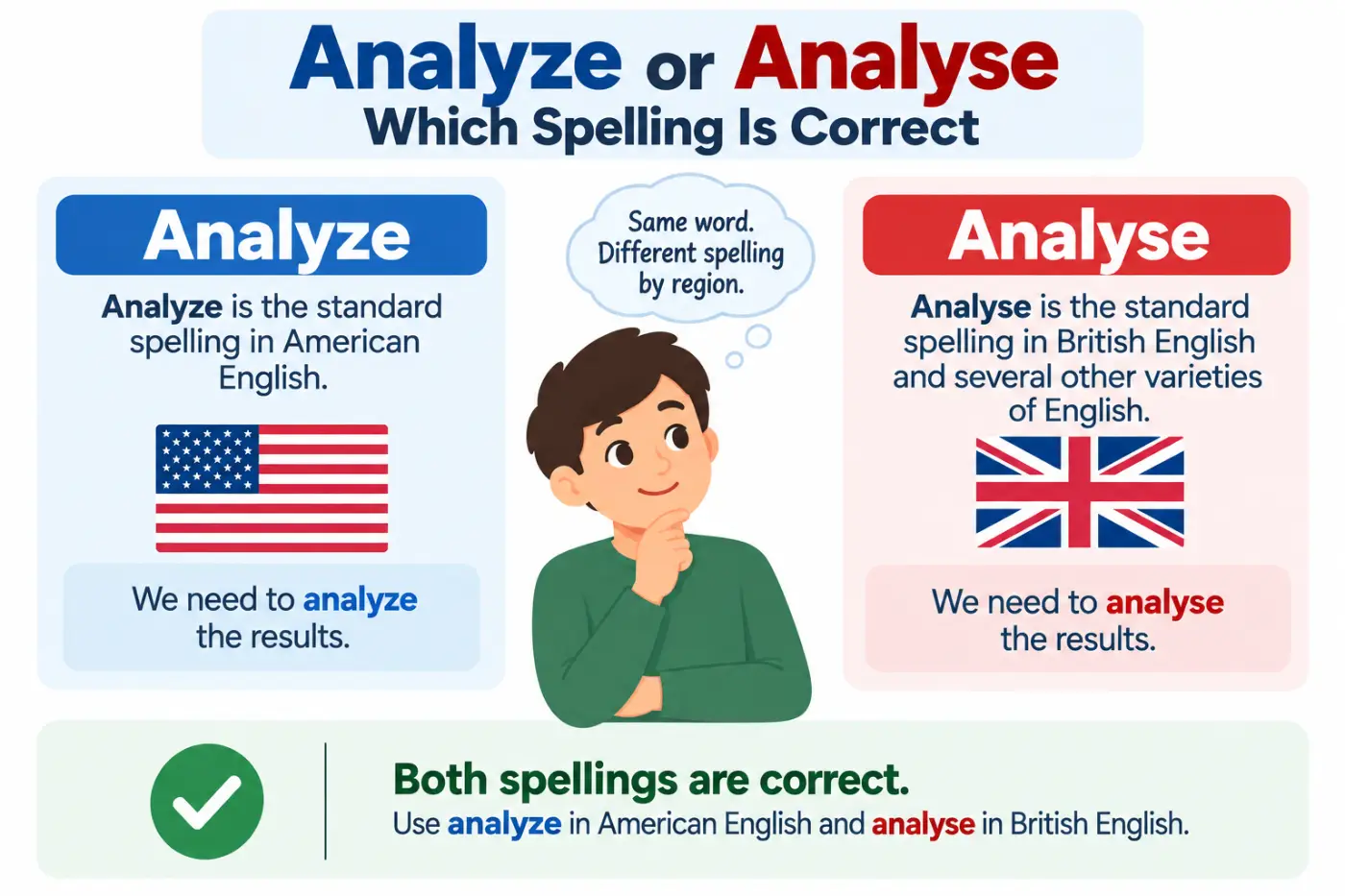
Analyze or Analyse can be confusing because both forms are correct English words. The main difference isn’t meaning or grammar. It comes from regional spelling conventions. American English normally uses analyze while British English uses analyse.
If you’re writing for a US audience then analyze is the form you should choose. If you’re following British English conventions then analyse is the usual choice. The same distinction appears in related words such as analyzer and analyser and in some other English words ending in ize or ise.
This difference matters most in professional writing academic work publishing and other situations where consistent spelling gives your writing a polished appearance. A reader will usually understand either form but a document written in American English should generally follow American spelling throughout. This guide explains the meaning pronunciation history grammar usage regional differences common mistakes and the simple rule that makes the choice easy.
Short Answer
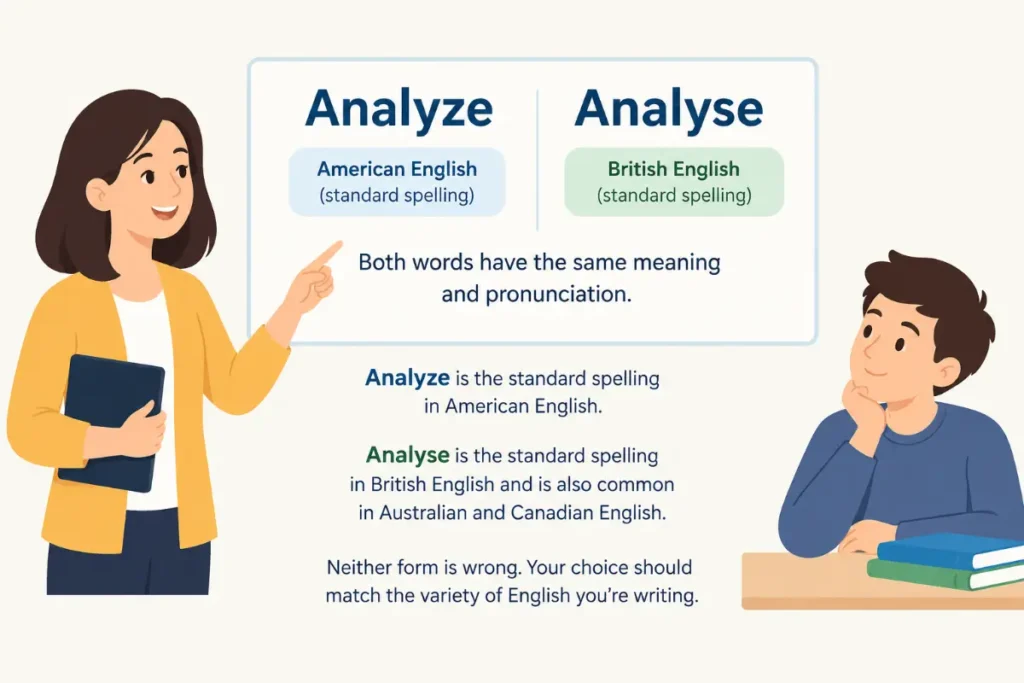
Analyze and analyse have the same meaning and pronunciation. The difference is mainly regional spelling. Analyze is the standard spelling in American English. Analyse is the standard spelling in British English and is also common in Australian and Canadian English. Neither form is wrong. Your choice should match the variety of English you’re writing.
Table Of Contents
- Analyze or Analyse at a glance.
- Meaning of both forms.
- The main spelling difference.
- Why American English uses analyze.
- Why British English uses analyse.
- Which spelling should you use.
- Pronunciation guide.
- Grammar and sentence structure.
- Examples in everyday English.
- Examples in professional writing.
- Examples in academic writing.
- Common spelling mistakes.
- Related words and expressions.
- Memory tips.
- Expert editor insight.
- Frequently asked questions.
- Key takeaways.
- Conclusion.
Analyze or Analyse at a glance
The simplest answer is this. Analyze is preferred in American English. Analyse is preferred in British English and is widely used in several other varieties that follow British spelling conventions.
| Feature | Analyze | Analyse |
|---|---|---|
| Meaning | Examine something carefully | Examine something carefully |
| Part of speech | Verb | Verb |
| Main US usage | Standard | Uncommon |
| Main UK usage | Less common | Standard |
| Pronunciation | Same | Same |
| Meaning difference | None | None |
| Formality | Standard | Standard |
| Common contexts | Research business data writing | Research business data writing |
| Related noun | Analysis | Analysis |
| Related person or tool | Analyzer | Analyser |
The important point is that this isn’t a case of one spelling being correct and the other being a mistake. Both forms belong to standard English. The right choice depends mainly on the English variety you’re following.
Meaning And Definition
Meaning of analyze
Analyze is a verb meaning to examine something carefully so you can understand its parts structure meaning behavior or significance.
You might analyze a report to understand its findings. You might analyze sales data to identify a trend. A student might analyze a poem to explain its themes. A scientist might analyze a sample to understand its properties.
The word often suggests careful examination rather than a quick look.
For example:
The researcher analyzed the results.
This means the researcher examined the results carefully and drew conclusions from them.
Meaning of analyse
Analyse has exactly the same basic meaning. It is the spelling traditionally used in British English and other varieties influenced by British spelling.
For example:
The researcher analysed the results.
The meaning doesn’t change. Only the spelling changes.
This is similar to other regional spelling differences in English. American and British English can use different spellings for the same word while sharing the same definition and pronunciation.
Is either form more correct
Neither form is universally more correct.
For American English use analyze.
For British English use analyse.
The real rule is consistency. If the rest of your document follows American spelling then analyze fits naturally. If your document follows British spelling then analyse is the better choice.
The Main Spelling Difference
The difference comes down to one letter.
American English commonly uses the ending ize in this word.
British English commonly uses ise.
That gives us:
Analyze.
Analyse.
The pronunciation stays essentially the same. The meaning stays the same. The grammatical function stays the same.
This distinction can look small but it matters in edited writing because regional spelling conventions help create consistency.
Consider these related forms.
American English uses analyze.
British English uses analyse.
American English uses analyzer.
British English uses analyser.
However the noun analysis doesn’t change in the same way. Both American and British English use analysis.
That makes this word family especially useful for understanding the spelling pattern.
Why American English Uses Analyze
American English generally favors analyze with a z spelling.
This preference fits a broader tendency in American spelling to use ize endings in many words. You can see the same pattern in words such as organize and recognize.
American spelling developed its own conventions over time. Writers and dictionary editors in the United States helped establish spelling patterns that differ from traditional British usage.
That doesn’t mean American English changed the meaning of the word. It simply settled on a different spelling convention.
If you’re writing an American business report you would normally write:
The team will analyze customer feedback.
An American university paper would also normally use:
The study analyzes changes in consumer behavior.
The same sentences could appear with analyse in British English without changing their meaning.
Why British English Uses Analyse
British English traditionally favors analyse with an s spelling.
This pattern appears in many British publications educational materials and formal documents. Writers who follow British spelling normally keep this convention throughout their work.
For example:
The team will analyse customer feedback.
The study analyses changes in consumer behavior.
British English also has other spelling conventions that differ from American English. Some words use additional letters or different vowel patterns. These differences form part of the larger contrast between the two varieties.
The key point is consistency. British writing doesn’t become more formal because it uses analyse. American writing doesn’t become less formal because it uses analyze. They are simply regional spelling choices.
Which Spelling Should You Use
Choose based on your audience and the style guide you’re following.
- Use analyze for American English.
- Use analyse for British English.
- Use analyse when a publication or organization specifically follows British spelling.
- Use analyze when an American institution or client expects US spelling.
- Keep the same convention throughout the document.
For writers targeting readers in the United States the answer is straightforward. Choose analyze.
For international organizations the situation may require a style decision. Look at the existing documents and follow the organization’s established English variety.
If you’re editing someone else’s writing don’t change every instance simply because you personally prefer one spelling. First identify the document’s regional style. Consistency matters more than personal preference.
Pronunciation Guide
Both spellings have the same standard pronunciation in ordinary English.
The IPA pronunciation is commonly represented as:
/ˈænəlaɪz/
A simple pronunciation guide is:
AN uh lize
The stress falls on the first syllable.
You can think of the word as three sound groups:
AN
uh
lyze
The final sound is like the word eyes with a l sound before it.
The spelling can create a false impression for learners. Someone who sees analyse may expect the s to sound like the s in some other English words. In this word the final sound is a voiced z sound.
Both analyze and analyse are pronounced the same way in standard usage.
That gives you an easy rule. Don’t try to hear the spelling difference. You won’t normally hear one. The distinction exists in writing.
Grammar And Sentence Structure
Analyze and analyse are transitive verbs in their most common use. That means they usually take an object.
You analyze something.
You analyse something.
For example:
The students analyzed the poem.
The students analysed the poem.
The verb tells us what the students did. The object is the poem.
The word can also appear in different verb forms.
Present tense
Researchers analyze the data.
Researchers analyse the data.
Third person singular
The researcher analyzes the data.
The researcher analyses the data.
Notice the additional spelling change in the third person form.
American English:
Analyze.
Analyzes.
Analyzed.
Analyzing.
British English:
Analyse.
Analyses.
Analysed.
Analysing.
This is one area where writers can accidentally mix regional conventions.
For example an American document might contain analyze and analyzed while a British document might contain analyse and analysed.
Mixing them isn’t usually a comprehension problem but it can make the writing look inconsistent.
Past tense
The past tense is analyzed in American English.
British English normally uses analysed.
Present participle
American English uses analyzing.
British English normally uses analysing.
These forms are related to the same regional spelling pattern.
Analyze Or Analyse In Formal Writing
Both forms are suitable for formal writing.
The choice depends on the English variety.
American formal writing:
The researchers analyzed the findings before preparing the report.
British formal writing:
The researchers analysed the findings before preparing the report.
Neither version is informal.
This matters because some learners assume that analyse looks more sophisticated or that analyze sounds more casual. That’s not how native English usage works. Regional spelling doesn’t determine the level of formality.
A professional editor focuses on consistency and audience expectations.
If you’re preparing a document for a US company use American spelling. If you’re submitting work to a British institution follow British spelling.
Real Life Examples
Daily Conversation
You can use the verb naturally in everyday conversation.
I need to analyze what went wrong.
She wants to analyze the situation before making a decision.
In casual speech people often use the word when they mean examine a situation carefully. The word can apply to practical problems as well as technical subjects.
Workplace Communication
The finance team will analyze the quarterly results.
We need to analyze the customer feedback before changing the product.
In workplace writing the verb often appears with data reports results trends feedback performance and business decisions.
A British workplace may use the same sentences with analyse instead.
Academic Writing
The study analyzes the effects of sleep on memory.
The researchers analyzed data from several experiments.
Academic writing uses the verb frequently because research often involves examining evidence and drawing conclusions.
In British academic writing the equivalent forms are analyses and analysed.
News Writing
Experts analyzed the economic data after the announcement.
The committee will analyze the findings before releasing its report.
Journalists often use the word when describing how experts examine information or evidence.
Storytelling
She stopped to analyze the strange message.
He analyzed every detail of the conversation in his mind.
Here the word can describe careful thought rather than formal research.
Common Mistakes
Using analyze and analyse randomly
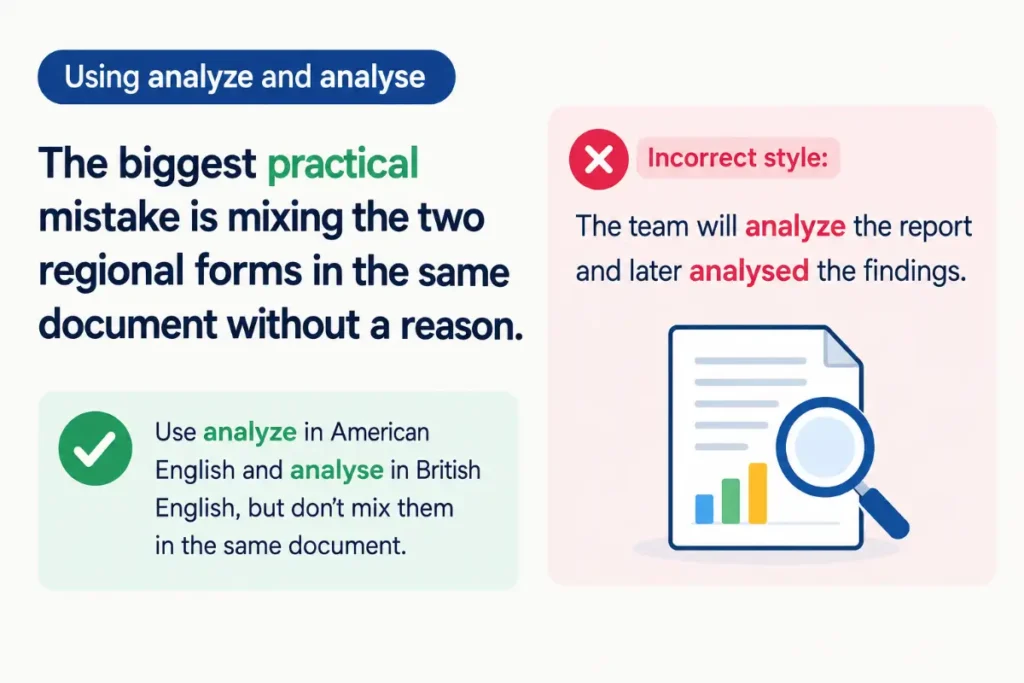
The biggest practical mistake is mixing the two regional forms in the same document without a reason.
Incorrect style:
The team will analyze the report and later analysed the findings.
The spelling changes halfway through the document.
A consistent American version would use analyzed.
A consistent British version would use analysed.
Writing analize
Analize is an incorrect spelling in standard English.
The mistake happens because the final sound is a z sound. Writers may assume the spelling should directly represent that sound.
For American English the correct form is analyze.
Writing analise
Analise is also incorrect as the standard spelling of the verb.
The correct British form is analyse.
The correct American form is analyze.
Confusing analysis with analyze
Analysis is a noun.
Analyze and analyse are verbs.
For example:
The analysis was detailed.
The researchers analyzed the data.
You cannot normally replace one with the other because they perform different grammatical jobs.
Mixing analyzed and analysed
These are both legitimate forms in their respective spelling systems.
American English uses analyzed.
British English uses analysed.
The problem arises when a document switches between systems without a clear reason.
Memory Tips
A simple memory trick can make the choice much easier.
Think about your audience
If your readers are primarily in the United States remember:
American English uses analyze.
If you’re following British English remember:
British English uses analyse.
Remember the z
For American English think of analyze with a z.
This fits the broader American preference for ize in many related words.
Remember the s
For British English think of analyse with an s.
This matches the traditional British spelling pattern.
Don’t memorize the meaning twice
You don’t need separate definitions.
Both forms mean the same thing.
The spelling changes. The meaning doesn’t.
That distinction saves a lot of unnecessary memorization.
Related Words And Expressions
Understanding the word family helps you use the verb accurately.
Analysis
Analysis is the noun form. It refers to the careful examination of something.
The analysis revealed several problems.
Analyst
An analyst is a person who examines information and interprets it.
The financial analyst reviewed the report.
Analytical
Analytical is an adjective meaning related to careful examination or logical reasoning.
She has a highly analytical approach to problems.
Analyze data
This is a common phrase in research business technology and science.
The team analyzed the data before making a recommendation.
Analyze results
This phrase often appears in academic and professional writing.
The researchers analyzed the results carefully.
Examine
Examine is a close synonym but doesn’t always carry exactly the same sense. Analyze often suggests breaking information into parts and interpreting those parts.
Evaluate
Evaluate means to judge the value quality importance or effectiveness of something.
You may analyze evidence and then evaluate what it means.
Interpret
Interpret means to explain or understand the meaning of something.
Analysis can lead to interpretation but the two words aren’t identical.
Analyze Or Analyse In American English
American English strongly favors analyze.
If your target audience is in the United States this is the spelling you should normally use in articles essays reports presentations workplace documents and educational material.
The related forms follow the same general pattern.
Analyze.
Analyzes.
Analyzed.
Analyzing.
American style guides and dictionaries commonly use these forms.
One useful point for writers is that American English doesn’t change the pronunciation simply because it uses z. The spelling convention is separate from the sound.
So if you are writing for an American audience you can confidently use analyze without worrying that the word sounds different from analyse.
Analyse In British English
British English normally uses analyse.
The related forms include:
Analyse.
Analyses.
Analysed.
Analysing.
This spelling appears naturally in British education journalism publishing business communication and academic writing.
A British writer wouldn’t normally switch to analyze simply because it looks familiar to American readers. The spelling belongs to a wider regional style.
However international publications sometimes choose a house style that differs from a writer’s regional preference. In that situation the publication’s style guide takes priority.
Australian English
Australian English generally follows British spelling conventions for this word. Analyse is therefore the expected form in standard Australian writing.
Australian writers may encounter American spelling in software interfaces online publications and international business communication. That exposure can make analyze familiar but it doesn’t make the spelling the usual Australian choice.
The safest approach is to follow the style required by the publication school workplace or institution.
Canadian English
Canadian English can show influence from both British and American spelling traditions. For this particular verb analyse is commonly used in Canadian English.
That makes Canadian usage a useful reminder that English spelling isn’t always divided neatly into two boxes.
If you’re writing for a Canadian audience follow the specific style guide of the organization or publication when one exists.
Etymology And Word Origin
The history of analyze is closely connected to Greek.
The word ultimately comes from Greek analyein meaning to loosen or break up. The idea behind the historical word is useful because analysis involves breaking something into parts so it can be understood.
The word entered English through Latin and French influence and developed into the modern forms associated with analysis.
The spelling difference between analyze and analyse developed through English spelling traditions rather than through a difference in meaning.
This history also explains why the noun analysis looks different from both modern verb spellings. English has preserved several forms from the same historical word family.
Knowing the origin isn’t necessary for everyday use but it gives the spelling a logical foundation. The word has always carried the basic idea of breaking something down for examination.
Similar Spelling Patterns
Analyze belongs to a wider group of words that can show ize and ise differences across English varieties.
Examples include:
Organize and organise.
Recognize and recognise.
Realize and realise.
Apologize and apologise.
These examples help explain why learners sometimes hesitate over the spelling.
American English generally favors the z form in these words. British English often uses the s form.
Still you shouldn’t assume that every English word ending in ise or ize follows the same regional pattern. Some words have established spellings that need to be learned individually.
That is why a dictionary or style guide remains useful when you’re unsure.
How Native Speakers Use The Word
Native speakers commonly use the verb when discussing careful examination of information.
A person can analyze a problem.
A researcher can analyze evidence.
A business can analyze customer behavior.
A scientist can analyze a sample.
A student can analyze a novel.
A journalist can analyze an event.
The word usually suggests more than simply looking at something. It involves examining parts relationships patterns or evidence to reach a clearer understanding.
That distinction helps separate analyze from simple verbs such as see or look at.
For example:
I looked at the report.
I analyzed the report.
The first sentence only tells us that the person reviewed or saw it. The second suggests a deeper examination.
When To Use Examine Instead
Analyze and examine overlap but they aren’t always interchangeable.
Examine can mean inspect something closely.
The doctor examined the patient.
Analyze usually suggests studying information or components to understand them.
The researcher analyzed the results.
You can analyze a report because it contains information that can be broken down and interpreted. You wouldn’t normally analyze a person in the same direct physical sense as a doctor examines a patient.
Context determines the better verb.
When To Use Evaluate Instead
Evaluate means judge something based on criteria.
The manager evaluated the proposal.
Analyze means examine something carefully.
The manager analyzed the proposal.
The two actions can happen together. A manager might analyze a proposal first and then evaluate its value.
That distinction is useful in academic and professional writing because precise verbs make your meaning clearer.
When To Use Interpret Instead
Interpret focuses on meaning.
The analyst interpreted the results.
Analyze focuses on the examination that helps produce that interpretation.
The analyst analyzed the results.
A researcher may analyze data and then interpret the findings.
Using these verbs precisely can make formal writing much stronger.
Expert Editor Insight
An experienced editor doesn’t treat analyze and analyse as competing words with different meanings. The first question is always the intended English variety. For US writing choose analyze and its related American forms. For British style choose analyse and its related British forms. The bigger editing issue is inconsistency. A document that switches between American and British spelling can look careless even when every individual form is technically correct. Check the document as a whole rather than correcting isolated words without considering the style.
Key Takeaways
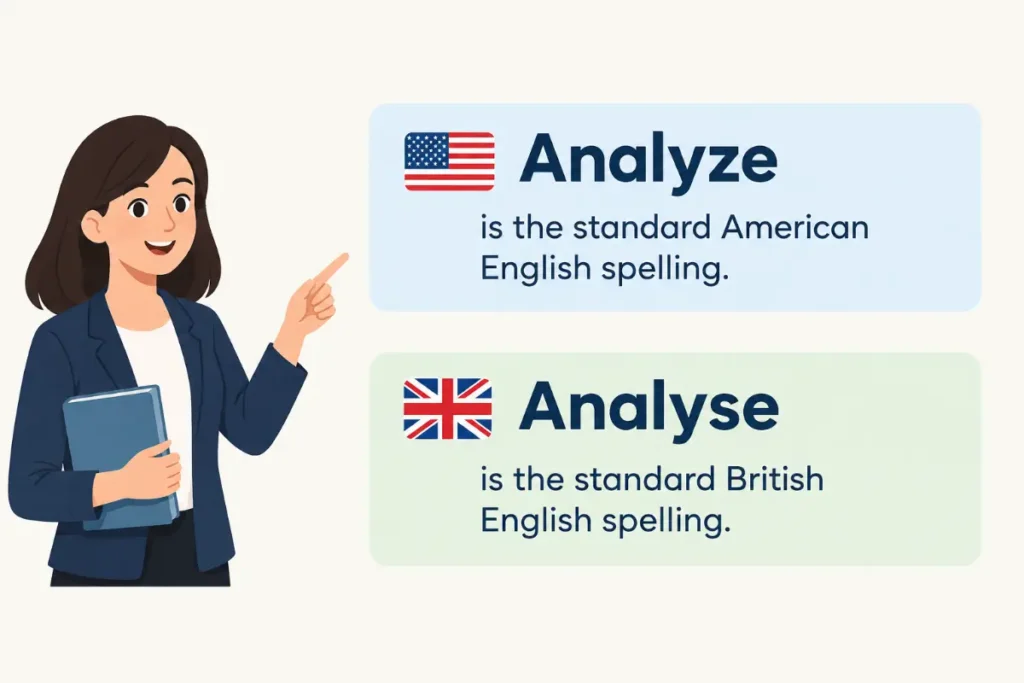
- Analyze is the standard American English spelling.
- Analyse is the standard British English spelling.
- Both forms have the same meaning.
- Both forms have essentially the same pronunciation.
- Analyze functions as a verb.
- The noun form is analysis in both varieties.
- American English uses analyzed and analyzing.
- British English uses analysed and analysing.
- The safest choice depends on your audience and style guide.
- Consistency matters more than personal preference.
Conclusion
Analyze or Analyse has a simple answer once you know the regional spelling rule. Analyze is the standard form for American English while analyse is the standard form for British English. Both words mean the same thing and have essentially the same pronunciation. Neither spelling is an error when it follows the appropriate English variety.
The main difference appears in writing rather than speech. This same regional pattern can appear in related forms such as analyzed and analysed. If you’re writing for a US audience use the American forms consistently. If you’re following British conventions use the British forms throughout your document.
The easiest memory tip is to connect the spelling with your audience. Think American English and choose analyze with z. Think British English and choose analyse with s. Once that habit becomes automatic you’ll rarely hesitate over this spelling choice again.
Frequently Asked Questions
Is analyze or analyse correct?
Both forms are correct. Analyze is the standard spelling in American English while analyse is the standard spelling in British English and common in other varieties that follow British spelling. The meaning and pronunciation are the same. Your choice should match your audience and the style guide you’re following.
Is analyze American or British English?
Analyze is the preferred American English spelling. British English normally uses analyse. This difference appears in other related words as well. American English generally favors ize endings in this group while British English often uses ise. If you’re writing for readers in the United States use analyze.
Is analyse wrong in American English?
Analyse isn’t usually treated as the preferred American spelling. American English normally uses analyze. A US reader will understand analyse without difficulty but it may look like British spelling. For polished American writing consistency matters so analyze is normally the better choice.
Is analyze wrong in British English?
Analyze is understood in British English but analyse is the traditional standard spelling in British usage. British publishers schools and organizations commonly use analyse. Some British style systems may allow or prefer ize spellings in certain words but the established form for this verb is analyse.
Do analyze and analyse mean the same thing?
Yes. Analyze and analyse have the same basic meaning. Both mean to examine something carefully in order to understand its parts meaning structure or significance. The difference is spelling rather than meaning. The pronunciation is also essentially the same in standard English. Regional writing conventions determine which spelling looks natural.
How do you pronounce analyze and analyse?
Both forms are commonly pronounced /ˈænəlaɪz/. A simple learner guide is AN uh lize. The final sound is a voiced z sound. The spelling difference doesn’t normally create a pronunciation difference. This is why learners often have trouble deciding which spelling to write because they cannot hear the difference.
Should I use analyze in academic writing?
Use analyze if you’re writing academic work in American English. If your university publication or instructor follows British English then analyse may be expected. Academic writing values consistency so don’t switch between regional spelling systems without a clear reason. Check the required style guide before finalizing an important paper.
What is the noun form of analyze?
The noun is analysis. Both American and British English use analysis. Its plural form is analyses. The noun refers to the careful examination of information ideas evidence or other material. For example a detailed analysis can help explain why a particular result occurred.
What is the past tense of analyze?
The American English past tense is analyzed. British English normally uses analysed. Both forms come from the same verb and carry the same meaning. The spelling follows the regional convention used in the document. If you’re writing American English keep the z spelling consistent in the related verb forms.
Why do Americans spell analyze with z?
American English developed spelling conventions that commonly favor ize endings in this group of words. Analyze follows that pattern. British English traditionally uses analyse. The difference reflects regional spelling history and editorial convention rather than a difference in pronunciation or meaning.

Confusing Words, Spelling & Word Choice
Claire Whitmore is a U.S.-based English editor who writes about commonly confused words, spelling differences, and word choice. Her work helps readers understand subtle distinctions between similar-looking words through simple definitions, practical examples, and modern usage guidance in both American and British English.