
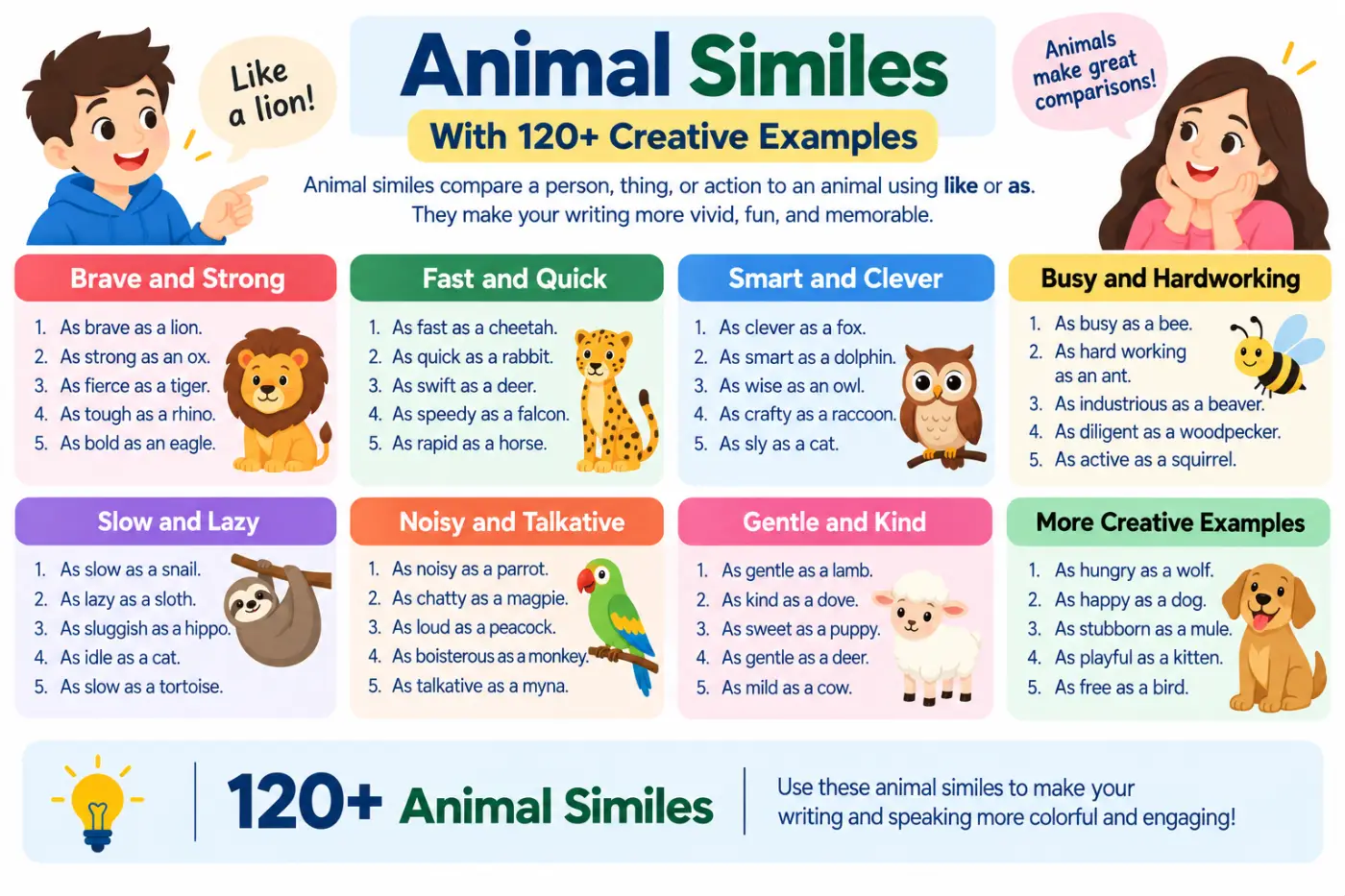
Animal Similes give ordinary descriptions more life. Saying someone is fast tells the reader one simple fact. Saying someone is as fast as a cheetah creates a much stronger picture. Writers and speakers have used animal comparisons for centuries because animals have recognizable traits. A lion suggests courage. An owl suggests wisdom. A fox often suggests cleverness. A snail suggests slowness. A bee suggests hard work. These familiar associations help readers understand an idea almost instantly.
A simile is a figure of speech that compares two different things using words such as like or as. Animal comparisons are especially useful because they connect an abstract quality to something concrete and familiar. You can use them in creative writing school assignments stories speeches poems conversations and even marketing copy. The key is choosing a comparison that actually fits the idea you want to express.
This guide gives you more than 120 original examples grouped by meaning. You’ll also learn how similes work how they differ from metaphors how to create your own comparisons and how to avoid weak or confusing examples.
Short Answer
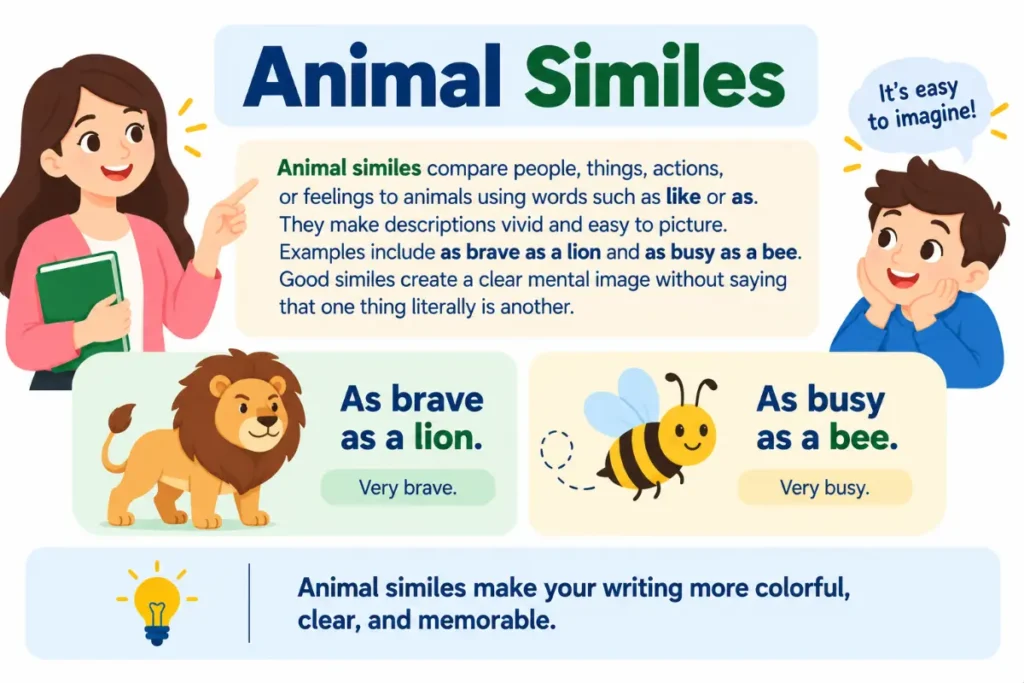
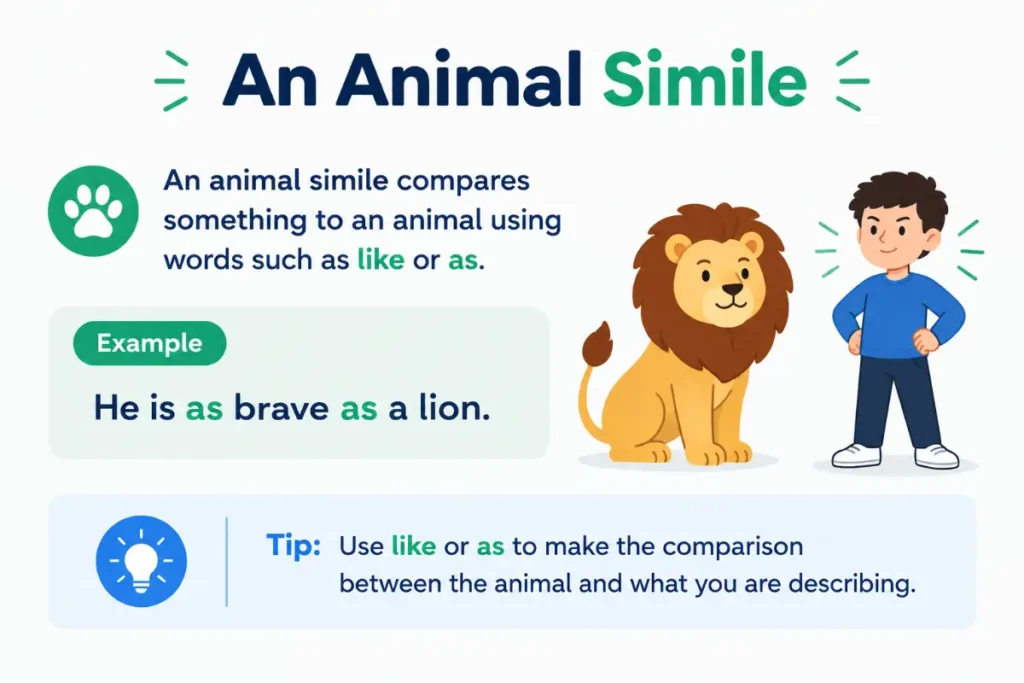
Animal similes compare people things actions or feelings to animals using words such as like or as. They make descriptions vivid and easy to picture. Examples include as brave as a lion and as busy as a bee. Good similes create a clear mental image without saying that one thing literally is another.
Table Of Contents
- What Animal Similes Mean
- How Animal Similes Work
- Animal Similes For Personality
- Animal Similes For Speed
- Animal Similes For Strength
- Animal Similes For Hard Work
- Animal Similes For Intelligence
- Animal Similes For Courage
- Animal Similes For Fear
- Animal Similes For Happiness
- Animal Similes For Anger
- Animal Similes For Sadness
- Animal Similes For Appearance
- Animal Similes For Movement
- Animal Similes For Quietness
- Animal Similes For Noise
- Animal Similes For Persistence
- Animal Similes For Freedom
- Animal Similes For Affection
- Animal Similes For Writing And Storytelling
- Common Mistakes
- How To Create Your Own Similes
- Simile Or Metaphor
- Memory Tips
- Related Grammar And Usage Notes
- FAQs
- Key Takeaways
- Conclusion
What Animal Similes Mean
Animal Similes compare one thing with an animal to highlight a particular quality.
For example:
She was as quiet as a mouse.
The sentence does not mean she literally resembles a mouse. It means she was very quiet.
Another example is:
He ran like a deer through the forest.
The comparison emphasizes speed and graceful movement.
The animal itself matters because readers bring familiar ideas to the comparison. A turtle is associated with slow movement. A rabbit is associated with quick movement. A peacock is associated with striking appearance. A wolf can suggest independence or fierceness.
These associations make similes powerful shortcuts for description.
Still you should use them thoughtfully. A comparison works best when the connection is clear and relevant.
How Animal Similes Work
A basic simile usually follows one of two patterns.
As + adjective + as + animal
Example:
She is as gentle as a dove.
Verb + like + animal
Example:
He moved like a cat.
The first pattern focuses on a quality. The second often focuses on an action or behavior.
Similes can also appear in longer sentences.
The children rushed toward the playground like puppies chasing a ball.
The comparison gives the reader a picture of excited uncontrolled movement.
A strong simile usually has three parts.
- The subject being described.
- The quality or action being emphasized.
- The animal used to create the comparison.
The best comparisons feel natural. They add something instead of simply decorating a sentence.
Animal Similes For Personality
Animals are useful for describing personality because people naturally associate certain animals with recognizable traits.
As Gentle As A Lamb
This describes someone who is kind calm and gentle.
The new teacher was as gentle as a lamb with nervous students.
The comparison creates an image of patience and softness.
As Clever As A Fox
This describes someone who thinks quickly and solves problems skillfully.
Maya was as clever as a fox when she found a way around the difficult puzzle.
The fox gives the sentence a sense of intelligence and strategy.
As Proud As A Peacock
This describes someone who takes great pride in appearance or achievement.
He walked into the room as proud as a peacock after winning the award.
The comparison emphasizes visible confidence and pride.
As Stubborn As A Mule
This describes someone who refuses to change their mind.
My brother is as stubborn as a mule when he thinks he is right.
The simile makes the person’s persistence feel humorous.
As Sly As A Fox
This describes someone who is clever and sometimes deceptive.
The little boy was as sly as a fox when he tried to hide the broken vase.
The comparison suggests clever behavior with a mischievous edge.
As Faithful As A Dog
This describes someone who stays loyal and dependable.
She remained as faithful as a dog to her oldest friend.
The animal comparison highlights loyalty.
As Curious As A Cat
This describes someone who wants to know everything.
The curious child was as curious as a cat about the strange package.
The repetition of curious makes the comparison especially direct.
As Social As A Parrot
This describes someone who enjoys talking and interacting with people.
Daniel is as social as a parrot at family gatherings.
The image suggests lively conversation.
Animal Similes For Speed
Animals provide some of the clearest comparisons for fast movement.
As Fast As A Cheetah
This describes exceptional speed.
The runner moved as fast as a cheetah during the final stretch.
The comparison gives the reader an immediate sense of rapid movement.
Like A Rabbit
This can describe someone moving quickly or suddenly.
The child darted away like a rabbit when the gate opened.
The simile emphasizes sudden movement.
Like A Deer
This can describe swift graceful movement.
She crossed the field like a deer.
The comparison suggests both speed and light movement.
Like A Falcon
This can describe fast movement toward a target.
The player raced toward the ball like a falcon diving toward its prey.
The comparison makes the action feel focused and powerful.
Like A Horse At Full Speed
This describes someone moving rapidly with force.
He charged down the track like a horse at full speed.
The image emphasizes momentum.
Like A Hummingbird
This can describe rapid small movements.
Her hands moved like a hummingbird as she decorated the cake.
The comparison focuses on quick repeated movement.
Animal Similes For Strength
Animals can make descriptions of physical or emotional strength more vivid.
As Strong As An Ox
This describes someone with great physical strength.
The farm worker was as strong as an ox.
The comparison is direct and easy to understand.
As Strong As A Bear
This describes powerful physical strength.
The wrestler looked as strong as a bear.
The image suggests size and force.
Strong Like A Bull
This emphasizes raw physical power.
He stood strong like a bull against the heavy wind.
The comparison creates a forceful image.
Like An Elephant
This can describe someone or something displaying great strength.
The machine pushed through the barrier like an elephant through tall grass.
The comparison highlights power and persistence.
As Tough As A Rhino
This describes someone who can handle pressure or hardship.
She was as tough as a rhino during the difficult training program.
The animal creates an image of resilience.
Animal Similes For Hard Work
Some animals are strongly associated with effort and steady work.
As Busy As A Bee
This describes someone who has many tasks and stays active.
I’ve been as busy as a bee all morning.
This is one of the most familiar animal comparisons in English.
Like An Ant
This can describe someone working steadily and carrying out tasks with purpose.
The students worked like ants to prepare the garden.
The image suggests organized effort.
As Industrious As An Ant
This describes someone who works hard and consistently.
The young farmer was as industrious as an ant.
The comparison highlights steady effort rather than sudden bursts of energy.
Like A Beaver
This describes someone working hard to build or repair something.
They worked like beavers to repair the old cabin.
The image suggests practical effort.
As Persistent As A Beaver
This describes someone who keeps working toward a goal.
She was as persistent as a beaver when building her small business.
The comparison emphasizes determination.
Animal Similes For Intelligence
Animals can also help describe cleverness wisdom or sharp thinking.
As Wise As An Owl
This describes someone who seems very wise.
Grandfather was as wise as an owl when giving advice.
The owl creates a familiar image of wisdom.
As Sharp As An Eagle
This describes someone with strong observation or judgment.
Her eyes were as sharp as an eagle’s as she searched the crowd.
The comparison emphasizes alertness.
As Clever As A Fox
This describes quick intelligent thinking.
The detective was as clever as a fox when solving the case.
The fox suggests strategy and cleverness.
Like A Hawk Watching Its Prey
This describes close attention.
The manager watched the presentation like a hawk watching its prey.
The comparison emphasizes intense observation.
As Observant As An Owl
This describes someone who notices small details.
The editor was as observant as an owl and caught every tiny error.
The comparison connects careful attention with the animal.
Animal Similes For Courage
Animals are often used to make bravery feel vivid.
As Brave As A Lion
This describes someone who faces danger or difficulty without giving up.
The firefighter was as brave as a lion during the rescue.
The lion creates an image of courage and strength.
As Fearless As A Tiger
This describes someone who appears confident in dangerous situations.
The climber was as fearless as a tiger on the steep mountain.
The comparison makes the courage feel dramatic.
Like A Lion In Battle
This describes someone fighting with courage and determination.
She defended her team like a lion in battle.
The comparison emphasizes fierce determination.
Like A Wolf Facing The Storm
This describes someone standing firm during hardship.
He faced the difficult season like a wolf facing the storm.
The image suggests endurance and courage.
As Bold As A Rooster
This describes someone who acts with confidence.
The young speaker was as bold as a rooster in front of the crowd.
The comparison gives the description a playful quality.
Animal Similes For Fear
Animals can also help describe nervousness and fear.
As Scared As A Mouse
This describes someone who is extremely frightened.
The child was as scared as a mouse during the thunderstorm.
The comparison makes the fear easy to visualize.
Like A Rabbit Caught In Headlights
This describes someone who freezes because of fear or surprise.
He stood like a rabbit caught in headlights when everyone looked at him.
The comparison emphasizes helpless surprise.
Like A Deer In A Headlight
This describes someone who suddenly freezes under pressure.
She looked like a deer in a headlight when the teacher called her name.
The expression is especially common in informal American English.
As Nervous As A Cat
This describes someone who feels anxious or uneasy.
I was as nervous as a cat before my first presentation.
The image suggests restless nervous energy.
Like A Bird Trapped In A Cage
This describes someone feeling frightened and unable to escape.
He paced around the room like a bird trapped in a cage.
The comparison emphasizes fear and helplessness.
Animal Similes For Happiness
Animals can make joyful descriptions feel energetic and warm.
As Happy As A Lark
This describes someone who is extremely happy.
She was as happy as a lark after hearing the good news.
The comparison creates an image of lighthearted joy.
As Cheerful As A Songbird
This describes someone who seems naturally happy.
The new neighbor was as cheerful as a songbird every morning.
The comparison connects happiness with pleasant sound.
Like A Puppy At Play
This describes someone who is playful and excited.
The children ran around like puppies at play.
The image creates a sense of innocent energy.
As Excited As A Puppy
This describes intense youthful excitement.
He was as excited as a puppy when the package arrived.
The comparison makes the excitement feel warm and energetic.
Like A Bird Released From A Cage
This describes the feeling of sudden freedom and happiness.
She felt like a bird released from a cage after finishing the final exam.
The comparison emphasizes relief as well as joy.
Animal Similes For Anger
Animal comparisons can make anger more visual.
As Angry As A Bull
This describes intense anger.
He was as angry as a bull after hearing the accusation.
The comparison gives the anger physical force.
Like A Bear With A Sore Paw
This describes someone who is irritated and difficult to approach.
I wouldn’t bother him right now because he’s like a bear with a sore paw.
The comparison adds humor to the description.
Like A Snarling Dog
This describes aggressive behavior.
The guard stood like a snarling dog at the entrance.
The comparison creates a clear image of hostility.
Like A Tiger Ready To Pounce
This describes someone who appears ready to act aggressively.
She stood like a tiger ready to pounce during the heated argument.
The comparison creates tension.
As Fierce As A Wolf
This describes intense aggressive determination.
The team played as fierce as a wolf protecting its territory.
The image emphasizes controlled aggression and determination.
Animal Similes For Sadness
Animals can also express loneliness grief or emotional heaviness.
As Lonely As A Wolf
This describes deep loneliness.
He felt as lonely as a wolf wandering through the winter forest.
The comparison creates a strong image of isolation.
Like A Lost Puppy
This describes someone who seems confused sad or helpless.
The new student looked like a lost puppy on the first day of school.
The comparison makes the vulnerability easy to picture.
Like A Bird With A Broken Wing
This describes someone who feels emotionally hurt or unable to move forward.
After losing her job she felt like a bird with a broken wing.
The comparison creates an image of vulnerability.
As Quiet As A Sad Dove
This describes subdued behavior after disappointment.
He became as quiet as a sad dove after the argument.
The image focuses on silence and emotional withdrawal.
Like A Rain Soaked Cat
This can describe someone who looks miserable or defeated.
After walking home in the storm he looked like a rain soaked cat.
The comparison creates a humorous but sympathetic image.
Animal Similes For Appearance
Animal comparisons can describe physical appearance in memorable ways.
Eyes Like An Eagle
This describes sharp focused eyes.
She had eyes like an eagle and noticed the smallest movement.
The comparison connects appearance with observation.
Hair Like A Lion’s Mane
This describes thick full hair.
His wild hair looked like a lion’s mane.
The comparison gives the reader a strong visual picture.
As White As A Swan
This can describe something very white and clean.
Her dress was as white as a swan.
The comparison emphasizes brightness and purity.
As Bright As A Peacock
This describes vivid colorful appearance.
The dancer wore clothes as bright as a peacock’s feathers.
The comparison focuses on color.
As Soft As A Kitten
This describes something very soft or gentle.
The blanket felt as soft as a kitten.
The comparison creates a warm tactile image.
As Smooth As A Seal
This describes something unusually smooth.
The polished stone was as smooth as a seal’s skin.
The comparison highlights texture.
As Tall As A Giraffe
This describes someone who is very tall.
The basketball player looked as tall as a giraffe beside the children.
The comparison makes the height easy to imagine.
As Small As A Mouse
This describes something tiny.
The cabin was as small as a mouse hole.
The comparison emphasizes limited size.
Animal Similes For Movement
Movement becomes easier to visualize when you connect it to a familiar animal.
Move Like A Cat
This describes quiet graceful movement.
She moved like a cat across the dark room.
The comparison emphasizes silence and control.
Run Like A Deer
This describes fast graceful running.
The athlete ran like a deer across the field.
The comparison combines speed with light movement.
Crawl Like A Turtle
This describes very slow movement.
The tired child crawled like a turtle toward the finish line.
The comparison makes the slowness obvious.
Fly Like An Eagle
This describes swift or soaring movement.
The kite seemed to fly like an eagle above the trees.
The comparison emphasizes height and freedom.
Leap Like A Frog
This describes sudden jumping movement.
The boy leaped like a frog across the puddle.
The comparison gives the movement a playful quality.
Glide Like A Swan
This describes smooth graceful movement.
The skater glided like a swan across the ice.
The comparison emphasizes elegance.
Bounce Like A Kangaroo
This describes repeated energetic jumping.
The children bounced like kangaroos on the soft floor.
The comparison makes the movement playful.
Scurry Like A Squirrel
This describes quick nervous movement.
The workers scurried like squirrels before the storm arrived.
The comparison suggests hurried activity.
Animal Similes For Quietness
Quiet behavior can be difficult to describe without repetition. Animal comparisons give writers more options.
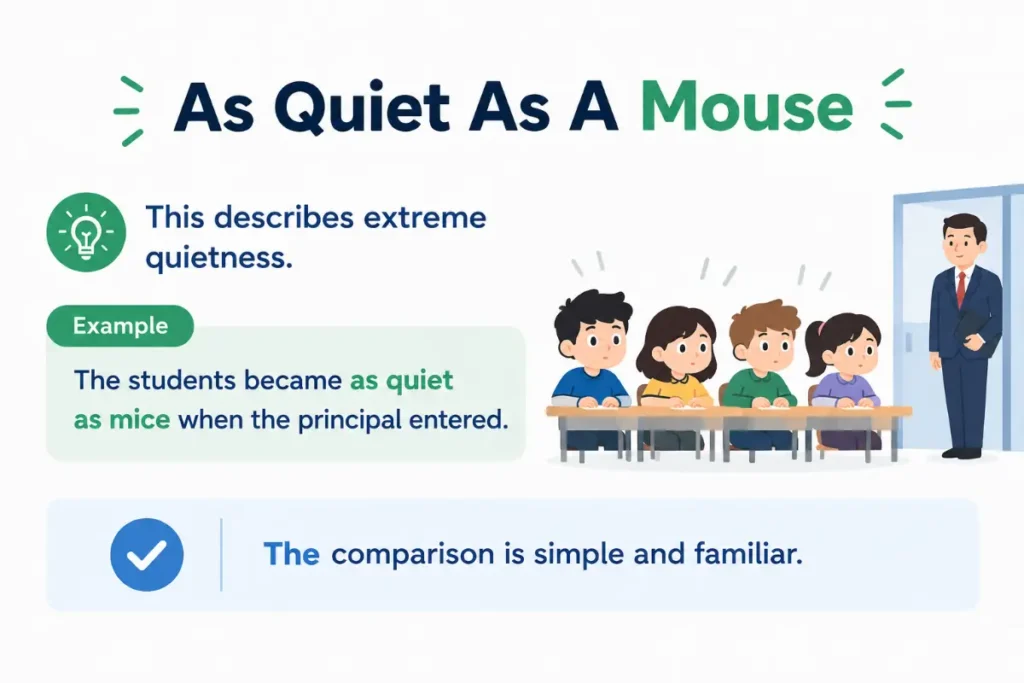
As Quiet As A Mouse
This describes extreme quietness.
The students became as quiet as mice when the principal entered.
The comparison is simple and familiar.
Quiet Like A Cat
This describes silent movement.
He slipped into the room quiet like a cat.
The comparison focuses on stealth.
As Silent As An Owl
This describes complete silence.
The forest was as silent as an owl watching from a branch.
The image creates a calm mysterious mood.
Like A Snake Moving Through Grass
This describes nearly silent movement.
The fox moved like a snake through the tall grass.
The comparison emphasizes stealth.
Animal Similes For Noise
Animal sounds can make descriptions of loudness vivid.
As Loud As A Rooster
This describes a very loud voice or sound.
His alarm was as loud as a rooster at sunrise.
The comparison gives the reader an immediate sound image.
As Noisy As A Monkey
This describes a lively loud environment.
The classroom was as noisy as a group of monkeys.
The comparison creates a playful image.
Like A Pack Of Howling Wolves
This describes several people or animals making loud cries.
The fans shouted like a pack of howling wolves.
The comparison emphasizes volume and intensity.
Like A Screeching Parrot
This describes a sharp unpleasant voice.
The old speaker sounded like a screeching parrot.
The comparison focuses on sound quality.
Like A Roaring Lion
This describes a powerful loud voice.
The singer’s voice rose like a roaring lion.
The comparison creates strength and drama.
Animal Similes For Persistence
Persistence means continuing despite difficulty. Several animals make useful comparisons here.
As Persistent As An Ant
This describes steady effort.
She was as persistent as an ant while building her career.
The comparison suggests small but consistent progress.
As Determined As A Dog Chasing A Ball
This describes someone who refuses to give up.
He was as determined as a dog chasing a ball.
The image makes persistence playful.
Like A Salmon Swimming Upstream
This describes continuing against difficult conditions.
She kept working like a salmon swimming upstream.
The comparison highlights resistance and effort.
Like A Tortoise On A Long Road
This describes slow but steady progress.
He kept moving forward like a tortoise on a long road.
The comparison reminds readers that progress doesn’t need to be fast to be meaningful.
As Persistent As A Woodpecker
This describes someone who keeps working at the same problem.
The engineer was as persistent as a woodpecker until she found the fault.
The repeated action creates a strong picture of determination.
Animal Similes For Freedom
Animals in open spaces can create powerful images of independence.
Free Like A Bird
This describes someone who feels unrestricted.
After graduation she felt free like a bird.
The comparison connects freedom with flight.
Like An Eagle In An Open Sky
This describes complete independence.
He felt like an eagle in an open sky after leaving the crowded city.
The image emphasizes space and possibility.
Like A Horse Running Wild
This describes unrestricted movement.
The children raced across the field like horses running wild.
The comparison gives the scene energy.
As Free As A Butterfly
This describes someone enjoying independence and lightness.
She felt as free as a butterfly in the summer garden.
The comparison creates a gentle image of freedom.
Animal Similes For Affection
Animals can make descriptions of love warmth and tenderness feel natural.
As Gentle As A Dove
This describes tender behavior.
He was as gentle as a dove when holding the newborn baby.
The comparison emphasizes care.
As Loving As A Mother Bear
This describes protective affection.
She was as loving as a mother bear toward her children.
The comparison highlights both love and protection.
Like A Puppy Greeting Its Owner
This describes enthusiastic affection.
The children rushed toward their grandfather like puppies greeting their owner.
The image creates warmth and excitement.
As Loyal As A Dog
This describes deep loyalty.
She remained as loyal as a dog throughout the difficult years.
The comparison emphasizes dependable affection.
Like Two Birds On A Branch
This describes two people sitting or spending time together peacefully.
The aging couple sat together like two birds on a branch.
The comparison creates a quiet affectionate image.
Animal Similes For Writing And Storytelling
Good similes can change the mood of an entire scene.
Consider this sentence:
The old man walked slowly.
It communicates the basic action but gives the reader little to picture.
Now compare it with:
The old man walked like a tired turtle through the rain.
The second sentence gives us speed mood and atmosphere.
That is the real value of a simile. It adds information without explaining everything directly.
Writers can use animal comparisons to create humor.
The toddler charged toward the cake like a hungry puppy.
They can create tension.
The stranger watched the doorway like a hawk.
They can create tenderness.
The baby slept like a kitten beside her mother.
They can create beauty.
The dancer moved like a swan across the stage.
They can also create exaggeration.
He ate like a starving wolf after the long hike.
A strong writer chooses the animal because it supports the mood and meaning of the scene.
More Creative Animal Similes
The following examples expand the range beyond the most familiar classroom comparisons.
Like A Fox Slipping Through Shadows
The thief moved like a fox slipping through shadows.
This creates an image of secrecy and clever movement.
Like A Sparrow In A Busy Market
She moved like a sparrow in a busy market.
This suggests quick movement through a crowded place.
As Restless As A Caged Tiger
He was as restless as a caged tiger before the announcement.
The comparison shows nervous energy and frustration.
Like A Turtle Carrying Its House
He traveled like a turtle carrying its house.
The comparison suggests someone carrying many belongings.
As Alert As A Meerkat
The guard was as alert as a meerkat at sunrise.
The comparison emphasizes constant attention.
Like A Butterfly Finding The Sun
Her mood changed like a butterfly finding the sun.
The comparison suggests a gentle transformation into happiness.
As Patient As A Heron
The fisherman was as patient as a heron waiting beside the river.
The image highlights stillness and patience.
Like A Penguin On Ice
The child shuffled like a penguin on ice.
The comparison creates a humorous image of awkward movement.
As Graceful As A Crane
The dancer was as graceful as a crane beside the water.
The comparison highlights controlled elegant movement.
Like A Hedgehog Protecting Its Nest
He became quiet and defensive like a hedgehog protecting its nest.
The comparison suggests withdrawal and self protection.
As Calm As A Turtle In Still Water
She remained as calm as a turtle in still water during the crisis.
The comparison emphasizes emotional control.
Like A Fox Guarding A Secret
He smiled like a fox guarding a secret.
The comparison suggests mystery and cleverness.
As Energetic As A Squirrel
The little girl was as energetic as a squirrel all afternoon.
The comparison creates a picture of constant activity.
Like A Swan On A Quiet Lake
The boat moved like a swan on a quiet lake.
The comparison emphasizes smooth peaceful movement.
As Patient As A Spider Building Its Web
The artist was as patient as a spider building its web.
The comparison highlights careful repeated work.
Like A Wolf Under A Full Moon
The singer’s voice rose like a wolf under a full moon.
The comparison creates a dramatic mysterious mood.
As Light As A Butterfly
The fabric felt as light as a butterfly.
The comparison emphasizes delicate weight.
Like A Rabbit Through Tall Grass
The child disappeared like a rabbit through tall grass.
The comparison suggests sudden quick movement.
As Alert As A Deer In The Woods
The hikers remained as alert as deer in the woods.
The comparison emphasizes awareness.
Like A Dog Waiting By The Door
He waited like a dog waiting by the door for its owner.
The comparison highlights loyalty and expectation.
Common Mistakes With Animal Similes
Animal comparisons are easy to understand but they can still go wrong.
Confusing Similes And Metaphors
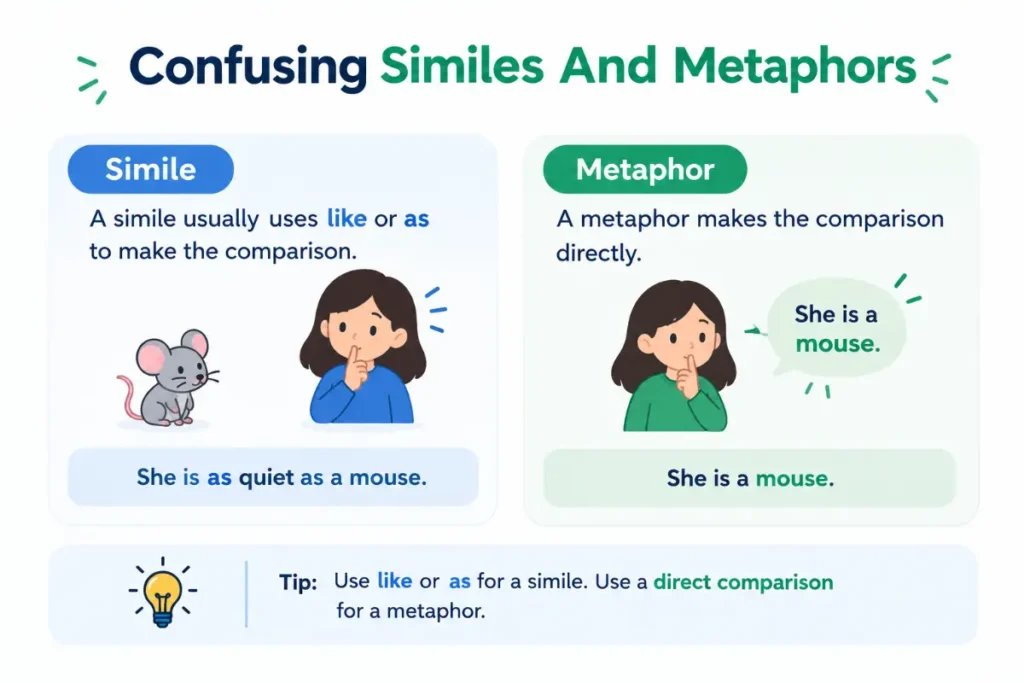
A simile usually uses like or as to make the comparison.
She is as quiet as a mouse.
A metaphor makes the comparison directly.
She is a mouse in the classroom.
The first is a simile. The second is a metaphor.
Using An Animal With The Wrong Trait
A comparison should make sense.
Calling someone as slow as a cheetah creates confusion because cheetahs are known for speed.
Likewise calling someone as quiet as a rooster creates an unexpected image because roosters are associated with loud calls.
Creative writing can deliberately reverse expectations but ordinary explanatory writing should use clear comparisons.
Mixing Two Similes
Avoid combining unrelated comparisons.
For example:
He ran like a cheetah as strong as an ox.
This creates two separate ideas without a clear grammatical structure.
A cleaner version would be:
He ran like a cheetah.
Or:
He was as strong as an ox.
Overusing Familiar Expressions
Expressions such as as busy as a bee and as brave as a lion are useful but very familiar.
They can sound predictable if used too often.
Fresh writing often benefits from a more specific comparison.
Instead of:
She was as busy as a bee.
You might write:
She moved through the kitchen like a squirrel preparing for winter.
The second example creates a more specific image.
Making The Comparison Too Long
A simile should support the sentence rather than bury it.
If the comparison takes several lines to explain the reader may lose the original point.
Keep the image focused.
Forgetting The Purpose
A simile should add meaning.
Don’t add one simply because you need a figure of speech. Ask what quality you want the reader to notice.
Then choose an animal that naturally supports that quality.
How To Create Your Own Animal Similes
Creating original comparisons becomes easier when you follow a simple process.
Start With The Quality
First decide what you want to describe.
Maybe the person is patient.
Maybe the character is frightened.
Think Of An Animal
Choose an animal strongly associated with that quality.
For patience you might think of a heron.
For speed you might think of a cheetah.
Choose The Structure
Use an as pattern.
She was as patient as a heron.
Or use like.
She waited like a heron beside the river.
Make The Image Specific
Specific details often create stronger writing.
Instead of:
He was like a wolf.
Try:
He stood like a wolf guarding the edge of the forest.
The second sentence gives the reader a scene rather than a vague comparison.
Check The Meaning
Ask yourself if the animal actually supports the quality.
If the comparison feels forced replace the animal.
A good simile should click into place naturally.
Simile Or Metaphor
Similes and metaphors both create comparisons but they do so differently.
A simile normally signals the comparison with like or as.
The child was as quiet as a mouse.
A metaphor makes the comparison directly.
The child was a mouse in the quiet classroom.
The simile says the child resembles a mouse in one specific way.
The metaphor presents the child as a mouse for figurative effect.
Both devices can be effective. Similes are often easier for young readers because the comparison is explicit.
Metaphors can feel stronger and more direct.
The choice depends on the effect you want.
Memory Tips
If you’re learning animal comparisons for school or creative writing a few simple strategies can help.
Remember The Animal Trait
Connect each animal with its strongest familiar association.
Lion means courage.
Fox means cleverness.
Owl means wisdom.
Bee means hard work.
Cheetah means speed.
Turtle means slowness.
Mouse means quietness or fear.
Peacock means pride.
Dog means loyalty.
Butterfly means lightness or transformation.
Build Small Groups
Instead of memorizing dozens of comparisons randomly group them by meaning.
For speed think cheetah rabbit deer and falcon.
For hard work think bee ant beaver and woodpecker.
Grouping makes recall easier.
Turn Them Into Sentences
Don’t memorize only the phrase.
Use it in a complete sentence.
The athlete was as fast as a cheetah.
This helps you remember both the meaning and the grammatical structure.
Related Grammar And Usage Notes
Similes are figures of speech so they are not restricted to one part of speech.
They can describe nouns.
The boy was as quiet as a mouse.
They can describe verbs.
The boy moved like a mouse.
They can describe objects.
The pillow was as soft as a kitten.
They can also appear in longer descriptive phrases.
The little boat drifted across the lake like a swan resting on calm water.
The word like deserves special attention because it has several functions in English.
In a simile it introduces the comparison.
She sings like a bird.
Here like connects the action of singing with the familiar sound of a bird.
As can also introduce comparisons.
He is as strong as an ox.
The pattern is commonly:
as + adjective + as
Examples include:
As brave as a lion.
As quiet as a mouse.
The comparison does not mean the person literally possesses every characteristic of the animal. It highlights one relevant quality.
That point matters in clear writing. A lion may symbolize courage in one context but aggression in another. The intended meaning comes from the sentence and surrounding context.
Using Animal Comparisons In School Writing
Students often use similes in descriptive paragraphs stories poems and personal narratives.
A basic sentence might say:
The storm was loud.
A simile can make it more vivid.
The storm roared like a lion outside the windows.
The comparison adds sound and mood.
Another example is:
The girl was nervous.
A stronger descriptive version might be:
The girl was as nervous as a rabbit hearing footsteps nearby.
The second sentence gives the reader a visual image.
Still you shouldn’t fill every sentence with figurative language. Too many comparisons can make writing feel crowded.
One strong simile can do more work than five weak ones.
Using Animal Comparisons In Creative Writing
Fiction writers use similes to shape characters and scenes.
A brave character might:
Stand like a lion at the gate.
A frightened character might:
Hide like a mouse beneath the table.
A graceful character might:
Move like a swan across the floor.
A clever character might:
Smile like a fox who already knew the answer.
These comparisons can reveal personality without directly explaining it.
Instead of writing:
He was very clever.
You can show his cleverness through an image.
He smiled like a fox that had already spotted the hidden path.
That approach gives readers something to picture.
Using Animal Comparisons In Everyday Speech
Many animal comparisons have become part of ordinary conversation.
You might say:
I’ve been as busy as a bee today.
Or:
He eats like a horse.
Or:
She’s as quiet as a mouse.
These expressions are usually easy to understand because the comparison is familiar.
Some are humorous.
He sleeps like a log.
Although this is not technically an animal simile because a log is not an animal it shows why comparisons work well in casual speech.
The important point is that familiar comparisons often become idiomatic. Their meaning may be understood instantly without the listener consciously analyzing the animal.
How Many Animal Similes Should You Use
There is no fixed number that works for every piece of writing.
A school paragraph might need one or two.
A short story might use several throughout different scenes.
A poem might use many because figurative language is central to the form.
The goal is balance.
If every sentence contains an animal comparison the writing can become predictable. If you use one at exactly the right moment it can make the description memorable.
Think of a simile as seasoning. A little can bring a sentence to life. Too much can overwhelm it.
Key Takeaways
- An animal simile compares something to an animal using words such as like or as.
- Similes help readers create a mental picture quickly.
- The animal should have a clear connection to the quality or action being described.
- Common examples include as brave as a lion and as busy as a bee.
- You can create original comparisons by starting with a quality and finding an animal associated with it.
- Similes and metaphors are related but they are not identical.
- Strong writing uses comparisons with purpose rather than filling every sentence with figurative language.
- Specific comparisons often feel fresher than familiar expressions.
- Context matters because an animal can suggest different qualities in different situations.
- The best simile is usually the one that helps the reader see or feel the idea immediately.
Conclusion
Animal Similes make descriptions more vivid because they connect familiar animal traits with people things actions and feelings. A lion can suggest courage. A fox can suggest cleverness. A bee can suggest hard work. A turtle can suggest patience or slow movement.
The strongest comparisons are clear purposeful and easy to picture. You don’t need to add a simile to every sentence. Choose one when it gives the reader a better image or a stronger feeling.
When creating your own comparison start with the quality you want to describe. Then choose an animal that naturally represents it. Finally build the sentence with like or as. A well chosen animal simile can turn a plain sentence into an image readers remember.
FAQs
What Is An Animal Simile?
An Animal Simile compares a person thing action or feeling to an animal using a comparison word such as like or as. For example as quiet as a mouse compares a person’s quietness with the familiar quiet behavior associated with a mouse. The comparison is figurative rather than literal.
What Are Five Examples Of Animal Similes?
Five simple examples are as brave as a lion for courage as busy as a bee for hard work as wise as an owl for wisdom as strong as an ox for strength and as quiet as a mouse for quietness. Each comparison connects a quality with a familiar animal trait.
What Is A Good Animal Simile For Fast?
A strong choice is as fast as a cheetah. It clearly communicates exceptional speed and works well in everyday writing. You can also use like a deer or like a falcon when you want to describe quick movement with a particular style or direction.
What Is A Good Animal Simile For Intelligence?
As wise as an owl is a familiar choice for wisdom. As clever as a fox works well for clever thinking or strategy. You can also create a more specific comparison such as she watched the problem like an owl watching from a high branch when you want a more original image.
What Is A Good Animal Simile For Fear?
As scared as a mouse is a simple choice. You can also use like a rabbit caught in headlights to describe someone who freezes because of fear or surprise. A more creative option is like a bird trapped in a cage when you want to emphasize helplessness.
What Is The Difference Between A Simile And A Metaphor?
A simile makes a comparison using words such as like or as. A metaphor makes the comparison directly. He is as strong as an ox is a simile. He is an ox is a metaphor. Both use figurative language but their structures are different.
Can Animal Similes Be Used In Formal Writing?
Yes. Animal similes can work in formal writing when they clarify an idea or create an appropriate image. They are especially useful in essays that discuss literature and in descriptive or creative writing. However academic writing should use figurative language carefully and avoid comparisons that sound vague or overly casual.
How Do I Create An Original Animal Simile?
Start with the quality you want to describe. Then choose an animal that strongly suggests that quality. Finally connect the two with like or as. For example if you want to describe patience you might choose a heron and write she waited as patiently as a heron beside the river.
What Animal Represents Hard Work In A Simile?
A bee is one of the most familiar choices for hard work. You can say as busy as a bee to describe someone with many tasks. Ants and beavers can also work well when you want to emphasize steady effort construction or persistence.
What Animal Represents Courage?
A lion is one of the most familiar choices for courage. You can write as brave as a lion to describe someone who faces danger confidently. A tiger can also suggest fearlessness while a wolf can suggest strength and determination depending on the context.
What Animal Simile Describes Someone Who Is Very Quiet?
As quiet as a mouse is the most familiar choice. You can also write quiet like a cat when you want to describe someone moving silently. For a more creative image you could compare someone’s silence to an owl waiting on a branch.
Why Are Animal Comparisons Effective?
Animal comparisons work because readers already have mental associations with many animals. A cheetah suggests speed while an owl often suggests wisdom. This lets a writer communicate a quality quickly without explaining it at length. A good comparison turns an abstract idea into a concrete picture.

Idioms, Expressions & Figurative Language
Mason Ellsworth is an American language writer with a passion for English expressions, figurative language, and everyday communication. He explains idioms, similes, popular phrases, and commonly misunderstood expressions in a straightforward, engaging style that helps readers improve both their writing and spoken English.