
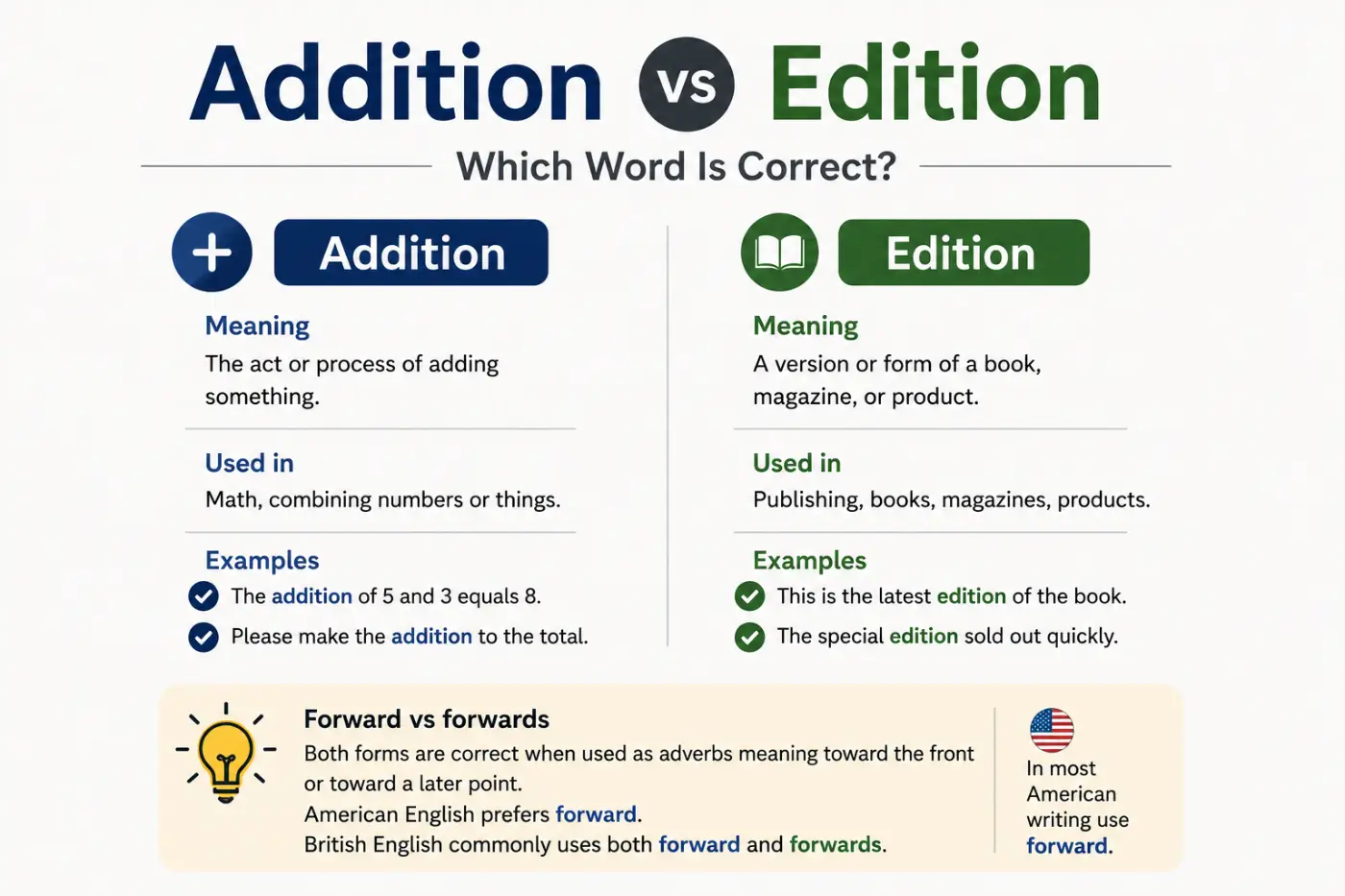
Addition vs Edition is a common word choice problem because the two words sound similar and share several letters. The correct choice depends entirely on what you mean. If you’re talking about something being added or the process of adding something then addition is correct. If you’re talking about a particular version of a book magazine newspaper or published work then edition is the right word.
The confusion often comes from pronunciation. Both words begin with a similar sound and both contain the familiar ending that appears in many English nouns. When you’re writing quickly it’s easy to type one while thinking of the other. The meanings however are quite different. One centers on adding something while the other centers on a particular version or release.
This guide explains the difference in plain American English. You’ll learn the meanings grammar roles pronunciation word origins common expressions sentence examples and the mistakes that cause writers to confuse these words. You’ll also get simple memory tricks that make the distinction easy to remember the next time you need to choose between them.
Short Answer
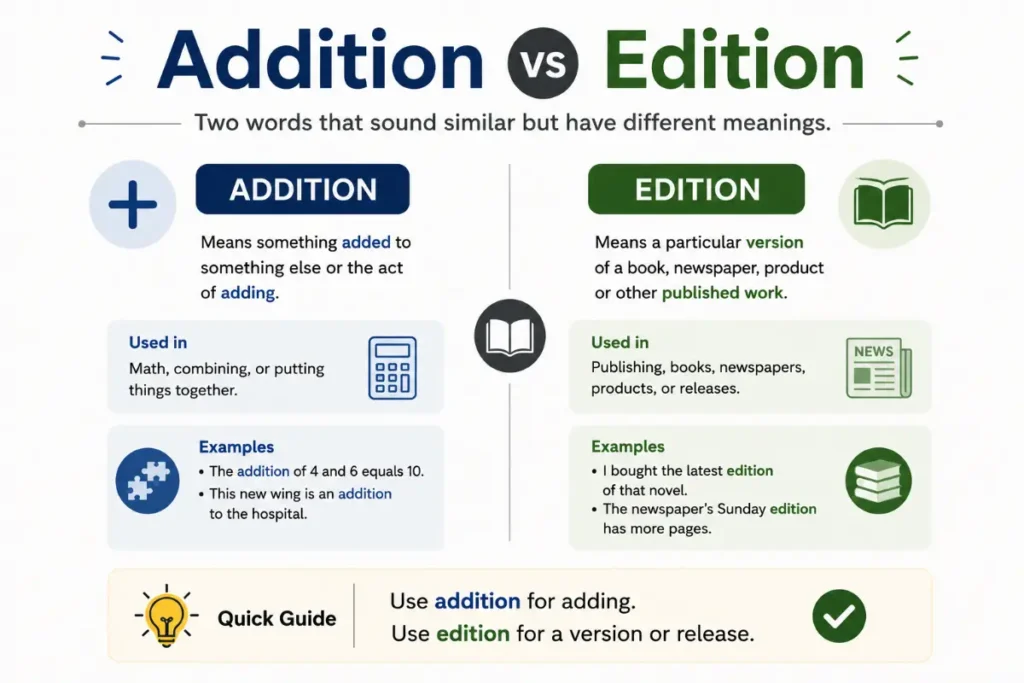
Addition vs Edition compares two words that sound similar but have different meanings. Addition means something added to something else or the act of adding. Edition means a particular version of a book newspaper product or other published work. Use addition for adding and edition for a version or release.
Table Of Contents
- The Quick Difference.
- What Addition Means.
- What Edition Means.
- Addition vs Edition In Plain English.
- Comparison Table.
- When To Use Addition.
- When To Use Edition.
- Grammar And Part Of Speech.
- Real Life Examples.
- Common Mistakes.
- Pronunciation Guide.
- Word Origins.
- American And British Usage.
- Formal And Informal Usage.
- Related Words.
- Memory Tips.
- Expert Editor Advice.
- Key Takeaways.
- FAQs.
- Conclusion.
The Quick Difference
The easiest way to separate the two words is to focus on the action or idea behind them.
Addition is connected to add.
Edition is connected to a version.
For example:
The addition of a new chapter improved the book.
The second edition of the book contains a new chapter.
The first sentence talks about something being added. The second sentence identifies a particular version of the book.
You can think of addition as something that goes into something else.
You can think of edition as one form or version of something that has been published or released.
That distinction covers most everyday situations.
What Addition Means
Addition is a noun related to the verb add. It can refer to the act of putting something together with something else or to something that has been added.
For example:
The addition of fresh vegetables improved the meal.
Here the word refers to the act or result of adding vegetables.
Another example is:
The house has a new addition.
In this sentence addition refers to a new part that has been added to a building.
The word can also describe a person or thing included in an existing group.
The new employee is a valuable addition to the team.
The phrase valuable addition is very common. It means the person or thing improves or strengthens the existing group.
Addition also has a mathematical meaning.
In mathematics addition is the process of combining numbers to find a total.
For example:
Five plus three equals eight.
This calculation uses addition.
So the word has several closely related meanings but they all share the same central idea. Something is being brought together with something else.
What Edition Means
Edition refers to a particular version of a publication or work.
You can have a first edition of a book followed by a second edition and later editions.
For example:
I bought the latest edition of the dictionary.
Here edition identifies a particular published version.
The word is especially common with books newspapers magazines textbooks and other published materials.
For example:
The revised edition includes several new chapters.
The Sunday edition of the newspaper arrived early.
The collector owns a rare first edition.
The word can also refer to a particular release of something that comes in different versions.
For example:
The newest edition of the software includes additional features.
In this context the word has moved beyond traditional printed books but keeps the central idea of a particular version or release.
Addition vs Edition In Plain English
The simplest explanation is this.
Use addition when something is added.
Use edition when something is a version.
Consider these examples:
The addition of an index made the book easier to use.
The latest edition includes a new index.
The first sentence focuses on the thing that was added.
The second sentence focuses on the version of the book.
This distinction works in many contexts.
If you add another room to a house then the room is an addition.
If the company releases a new version of the product then that version may be called an edition.
The words sometimes appear in the same sentence because adding something can create a new edition.
For example:
The addition of three chapters led to a revised edition.
Here each word performs a different job.
Comparison Table
| Word | Core Meaning | Part Of Speech | Common Context | Example |
|---|---|---|---|---|
| Addition | Something added or the act of adding | Noun | Mathematics writing buildings teams products | The addition improved the design. |
| Edition | A particular version or release | Noun | Books newspapers magazines software publications | I bought the latest edition. |
| Add | To put something with something else | Verb | General English mathematics | Please add your name. |
| Edit | To revise or correct something | Verb | Writing publishing documents | She edited the manuscript. |
| Additional | Extra or added | Adjective | General English | We need additional information. |
| Editorial | Related to editing or an editorial | Adjective and noun | Publishing journalism | The newspaper published an editorial. |
When To Use Addition
Use addition when you mean something that has been added.
Addition In General Writing
You can use addition to describe something included in an existing situation.
For example:
The addition of a second entrance made the building more accessible.
The word tells the reader that something new was added to what already existed.
Another example:
Her experience was a useful addition to the project.
Here the person’s experience is treated as something that strengthens the project.
Addition In Construction
In construction addition often refers to a new part added to an existing building.
For example:
The family built an addition onto the back of the house.
The new bedroom is an addition to the house.
In this context the word can describe a physical extension.
Addition In Mathematics
Mathematics gives the word a precise meaning.
Addition combines quantities.
For example:
Four plus six equals ten.
The operation used to reach ten is addition.
Common mathematical language includes:
Addition.
Addend.
Sum.
The first two numbers in an addition problem are called addends. The result is called the sum.
Addition In Teams And Groups
The word is also common when describing people who join a team.
For example:
The new coach is a great addition to the staff.
The young player was an exciting addition to the roster.
In both sentences something or someone new has joined an existing group.
Common Expressions With Addition
Several expressions use the word naturally.
In addition means also or additionally.
For example:
In addition to the main course the restaurant offers several desserts.
In addition to introduces something extra.
For example:
In addition to English she speaks Spanish.
A welcome addition describes something that improves an existing situation.
For example:
The new park is a welcome addition to the neighborhood.
A valuable addition describes something useful or beneficial.
For example:
Her research was a valuable addition to the report.
When To Use Edition
Use edition when you mean a particular version of a published or released work.
Edition Of A Book
This is probably the most familiar use.
For example:
I need the latest edition of the textbook.
The third edition contains updated information.
A first edition is an early published version of a book. Collectors may place special value on certain first editions.
Edition Of A Newspaper
Newspapers often publish different editions.
For example:
The evening edition contains the latest results.
The local edition focuses on events in the area.
Here edition means a particular version of the newspaper prepared for a particular time or audience.
Edition Of A Magazine
Magazines can also have editions.
For example:
The international edition contains different advertisements.
The special edition celebrates the company’s anniversary.
The word helps identify one particular release.
Edition Of A Reference Book
Dictionaries encyclopedias style guides and other reference works often come in multiple editions.
For example:
The newest edition contains thousands of updated entries.
The fifth edition changed several definitions.
Each edition may contain corrections additions revisions or reorganized material.
Edition Of Software
Modern usage has expanded beyond printed material.
A company might describe a product as a standard edition professional edition or special edition.
For example:
The professional edition includes advanced tools.
Here edition identifies a particular version of the product.
Grammar And Part Of Speech
Both addition and edition are nouns.
They can function as subjects objects complements and objects of prepositions.
Addition As A Noun
For example:
The addition was expensive.
Here addition is the subject.
Another example:
They approved the addition.
Here addition is the object of the verb approved.
You can also use it after a preposition.
The cost of the addition was higher than expected.
Edition As A Noun
For example:
The edition was published in 2026.
Here edition is the subject.
Another example:
I ordered the latest edition.
Here edition is the object of the verb ordered.
It can also follow a preposition.
The information appears in the latest edition.
Plural Forms
The plural of addition is additions.
The plural of edition is editions.
For example:
The report contains several additions.
The publisher released several editions.
Both forms simply add the standard plural ending.
Real Life Examples
Everyday Conversation
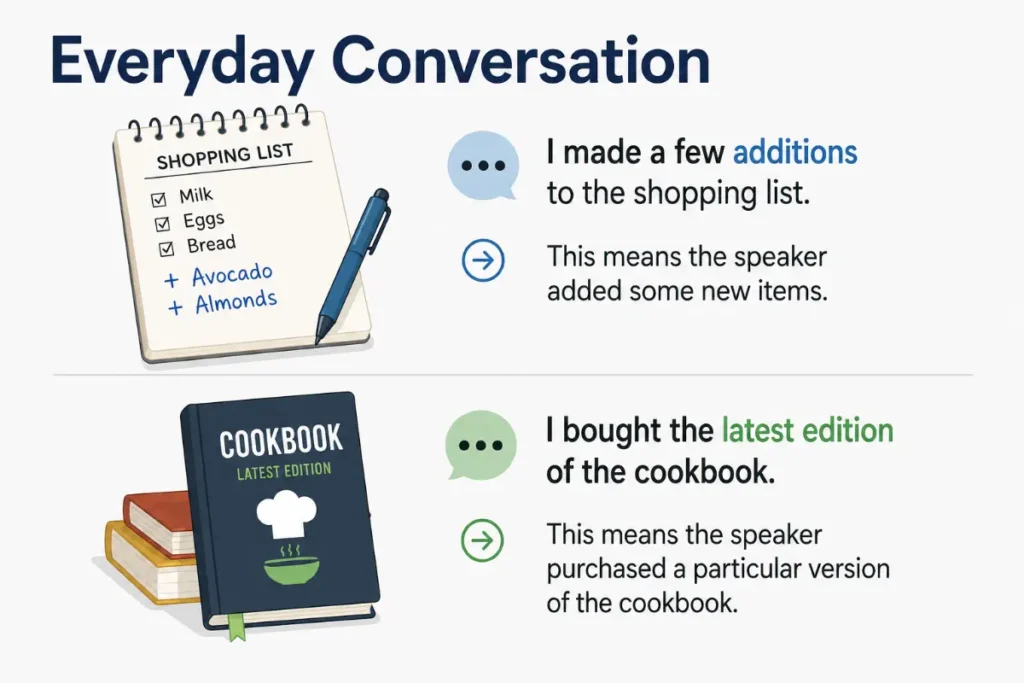
I made a few additions to the shopping list.
This means the speaker added some new items.
I bought the latest edition of the cookbook.
This means the speaker purchased a particular version of the cookbook.
School And College
The addition of more examples made the lesson clearer.
The professor recommended the latest edition of the textbook.
The first sentence describes something added to the lesson. The second identifies a particular textbook version.
Business Writing
The new employee is a valuable addition to our team.
The company released a professional edition of its software.
The first sentence describes a person joining a group. The second identifies a product version.
Publishing
The editor approved the addition of a new chapter.
The publisher released a revised edition.
The two words can easily appear together because a revision may involve adding material.
Construction
The homeowner planned an addition to the kitchen.
This use refers to a new part added to an existing structure.
News
The morning edition reported the latest developments.
This refers to a particular version of the newspaper.
Common Mistakes
Using Edition When You Mean Something Added
Incorrect:
The edition of a new room increased the value of the house.
Correct:
The addition of a new room increased the value of the house.
A room added to a house is an addition.
Using Addition For A Book Version
Incorrect:
I need the newest addition of the textbook.
Correct:
I need the newest edition of the textbook.
A particular version of a textbook is an edition.
This mistake is common because addition and edition sound similar.
Confusing Edit With Add
The verbs also cause confusion.
Add means to put something in or together.
Edit means to revise or correct something.
For example:
Please add another paragraph.
Please edit the paragraph.
The first request asks someone to include new material.
The second asks someone to revise existing material.
Confusing Additional With Edition
Additional is related to addition.
It means extra or added.
For example:
We need additional information.
Edition doesn’t mean extra.
It refers to a particular version.
Confusing Editorial With Edition
An editorial is an article or statement expressing an opinion or representing the editorial position of a publication.
An edition is a particular version or release.
For example:
The newspaper published an editorial about the election.
The newspaper’s evening edition arrived at six.
These words belong to the same publishing vocabulary but have different meanings.
Pronunciation Guide
The pronunciation difference becomes easier once you hear the stressed syllables.
Addition is commonly pronounced:
uh DICH un.
The main stress falls on the second syllable.
In standard American English it is commonly represented with an IPA form close to /əˈdɪʃən/.
Edition is commonly pronounced:
uh DISH un.
The main stress also falls on the second syllable.
Its American English pronunciation is commonly represented as /ɪˈdɪʃən/.
The words sound similar because both contain the stressed dish sound.
That shared sound is one reason writers sometimes confuse them.
The beginning of addition has an uh sound while edition begins with a sound closer to ih.
When speaking quickly those sounds can become less distinct.
A good way to practice is to exaggerate the first syllable:
uh DICH un.
ih DISH un.
Then say them naturally.
Word Origins
The word addition comes from Latin roots associated with adding or putting something toward something else. It entered English through French and developed into the modern noun connected with the verb add.
The Latin root is linked to addere, meaning to add or put toward.
That history fits the modern meaning closely.
Something is added.
The act is addition.
The word edition also has Latin roots. It comes from Latin editio, connected with edere, meaning to give out or publish.
This origin explains the connection between edition and publishing.
An edition is something given out or published as a particular version.
The two words therefore have different historical paths even though their modern forms look and sound similar.
Their meanings also reflect their origins.
Addition centers on adding.
Edition centers on issuing or publishing a version.
American And British Usage
American and British English use both addition and edition with essentially the same meanings.
Unlike spelling pairs such as color and colour, there isn’t a major American versus British spelling difference here.
American writers say:
the latest edition.
a valuable addition.
British writers use the same forms.
the latest edition.
a valuable addition.
The important distinction is meaning rather than regional spelling.
This makes the problem easier once you understand the vocabulary. You don’t need to choose one form for American English and another for British English.
You need to choose the word that matches the idea.
Formal And Informal Usage
Both words are completely appropriate in formal writing.
Addition appears in academic papers business reports technical documents mathematics textbooks and everyday communication.
Edition appears in publishing academic writing journalism product descriptions and professional documents.
For example:
The addition of new evidence strengthened the argument.
The revised edition contains updated references.
Both sentences sound natural in formal American English.
The words are also common in casual conversation.
I made a few additions to the list.
Do you have the latest edition?
You don’t need a more formal alternative.
Addition And Edition In Academic Writing
Academic writing uses both words frequently but for different purposes.
A researcher might discuss the addition of new evidence to an argument.
A professor might recommend a new edition of a textbook.
For example:
The addition of recent studies strengthens the conclusion.
The seventh edition of the textbook includes updated research.
The first sentence concerns added information.
The second concerns a particular version of a book.
Academic writers should be especially careful because using the wrong word can change the meaning of a sentence.
Addition And Edition In Publishing
Publishing creates many situations where both terms appear.
An editor may make an addition to a manuscript.
A publisher may release a revised edition.
For example:
The editor requested the addition of a glossary.
The publisher included the glossary in the second edition.
The relationship is easy to see.
The glossary is an addition to the work.
The book containing that change may become a new edition.
This distinction is useful for authors editors teachers students and anyone working with published material.
Related Words
Understanding related vocabulary can make the difference easier to remember.
Add
Add is the verb connected with addition.
For example:
Please add your phone number.
Added
Added is the past tense and past participle of add.
For example:
She added another example.
Additional
Additional means extra or added.
For example:
We need additional information.
Additive
Additive can describe something added to another substance or system.
For example:
The food contains a natural additive.
Edit
Edit means to revise or correct existing material.
For example:
Please edit the final paragraph.
Edited
Edited describes something that has been revised.
For example:
The edited manuscript is ready.
Editor
An editor is a person who reviews and revises written material or manages editorial content.
For example:
The editor checked the manuscript carefully.
Editorial
An editorial can refer to an opinion article in a newspaper or to something connected with editorial work.
For example:
The newspaper published an editorial about the issue.
These related forms help create a useful word family around both concepts.
Memory Tips
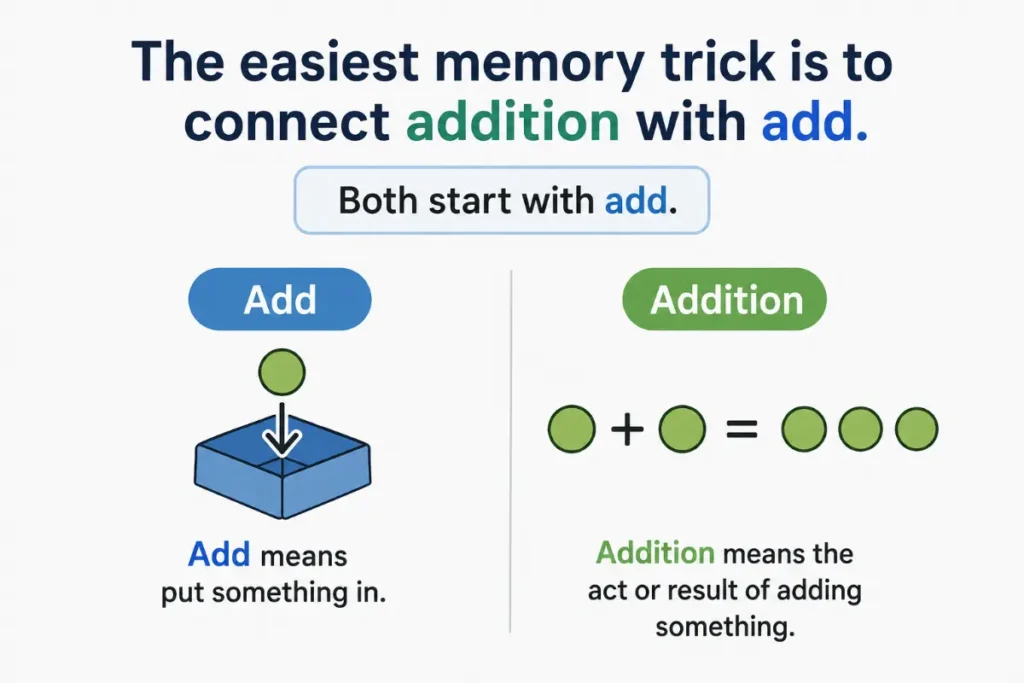
The easiest memory trick is to connect addition with add.
Both start with add.
Add means put something in.
Addition means the act or result of adding something.
For edition, think about a book or publication.
You can have:
First edition.
Second edition.
Special edition.
Revised edition.
Collector’s edition.
That gives you a strong mental picture.
Another useful trick is to remember this sentence:
Add something and you make an addition. Publish a version and you make an edition.
If you’re talking about a new room added to a house, choose addition.
If you’re talking about a revised manuscript, you may use edit.
The words are close in sound but far apart in meaning.
A Simple Decision Test
When you’re unsure which word to use, ask yourself one question.
Am I talking about adding something or identifying a version?
If you’re talking about adding something, use addition.
If you’re identifying a version, use edition.
Try the test with these examples.
The publisher released the fifth ___ of the book.
The answer is edition because the sentence identifies a version.
The ___ of a new chapter improved the book.
The answer is addition because the sentence describes something being added.
The team welcomed the new player as a valuable ___.
The answer is addition because the player has been added to the team.
I bought the collector’s ___.
The answer is edition because the phrase identifies a special version.
This test works in most everyday situations.
Expert Editor Advice
A professional editor usually checks the meaning before checking the spelling. Addition belongs to the word family built around add, while edition belongs to the vocabulary of publishing and versions. If you can replace the word with something added, choose addition. If you can replace it with version, choose edition. That substitution test is quick and reliable.
An editor should also watch for context.
For example:
The addition was released last month.
This sentence sounds strange because a thing being released is more likely to be an edition.
But:
The edition included three additions.
This sentence is perfectly natural because a published version can contain several newly added elements.
The surrounding words often reveal the intended meaning.
Key Takeaways
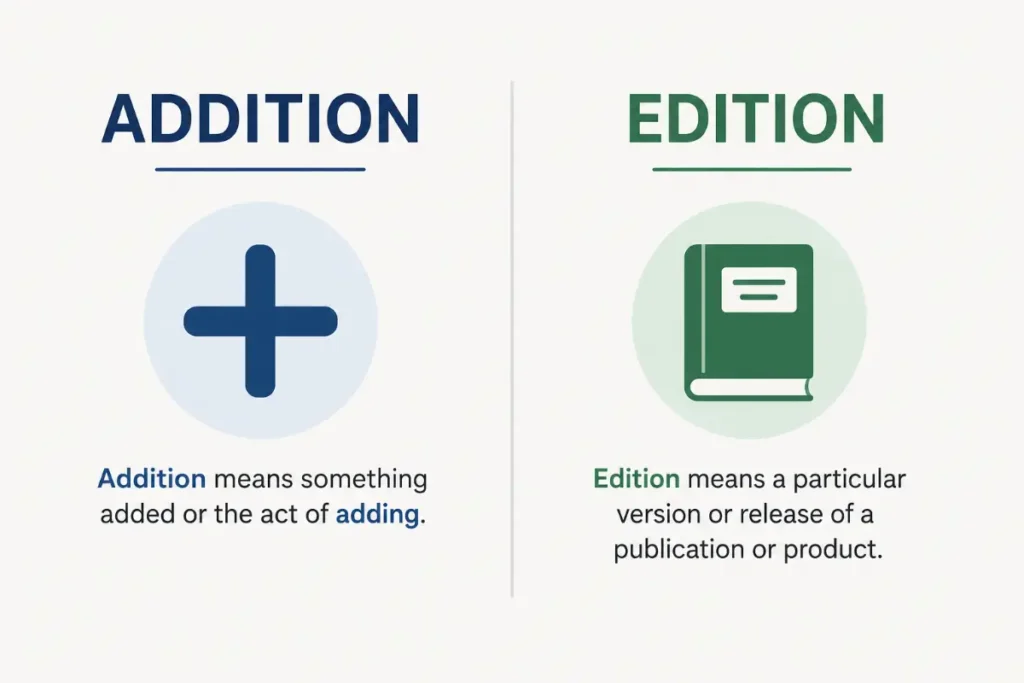
- Addition means something added or the act of adding.
- Edition means a particular version or release of a publication or product.
- Addition is connected to the verb add.
- Edition is strongly associated with publishing and versions.
- Add and addition belong to the same word family.
- Edit and edition are related to revision and publishing but aren’t interchangeable.
- A new chapter can be an addition to a book.
- The book containing that chapter may be a new edition.
- Both words are standard in American and British English.
- The easiest test is to ask if you mean something added or a version.
Conclusion
Addition vs Edition becomes simple once you focus on meaning rather than sound. Addition is connected to adding something. It can describe an extra part of a building a new person joining a team new material in a book or the mathematical operation of combining numbers. Edition refers to a particular version or release such as a first edition of a novel or a revised edition of a textbook.
The easiest rule is to connect addition with add and edition with version. If something has been added then choose addition. If you’re identifying a particular published or released version then choose edition. When you pause over these two words remember one simple question: am I talking about something added or a particular version? That quick test will usually give you the right answer.
FAQs
What Is The Difference Between Addition And Edition?
Addition refers to something that has been added or the act of adding. Edition refers to a particular version of a book publication product or other released work. For example the addition of a new chapter changes a book while the second edition is a particular published version that may contain that new chapter.
Is It Addition Or Edition Of A Book?
For a particular version of a book use edition. You can say the first edition of the book or the latest edition of the textbook. Use addition when you mean material that was added to the book. For example the addition of a new chapter improved the book.
Is The Addition Of A New Chapter Correct?
Yes. Addition is correct when you mean that new material was put into an existing work. You can write the addition of a new chapter improved the book. If you’re referring to the published version that contains the new chapter then use edition. For example the revised edition includes a new chapter.
Is It The Latest Addition Or The Latest Edition?
It depends on your meaning. Use latest edition for the newest published version of a book newspaper magazine or similar work. Use latest addition only when you’re referring to something recently added. For example the latest addition to the team refers to a person who recently joined.
Is Addition Related To Add?
Yes. Addition is the noun formed from the verb add. Both words express the idea of putting something together with something else. You can add a number to another number or add a new feature to a product. The resulting action or something added can be described as an addition.
Is Edition Related To Edit?
The words are historically and semantically connected with publishing and the preparation of written works but they don’t mean the same thing. Edit means to revise or correct material. Edition usually means a particular published version. An editor may edit a manuscript and a publisher may later release that work as a new edition.
Can Edition Be Used For Software?
Yes. Edition can describe a particular version or package of software. Companies may offer standard professional enterprise or special editions of a product. In this context the word doesn’t necessarily refer to a printed publication. It still carries the basic idea of a distinct version or release.
Can Addition Mean A New Part Of A House?
Yes. In construction and real estate addition can refer to a new part added to an existing building. For example the family built an addition to the house means they expanded the existing structure. This is a direct use of the central meaning of addition because something new has been added to what was already there.
Which Word Is Correct In Addition Or Edition?
Both words are correct but they aren’t interchangeable. Use addition when you mean something added or the act of adding. Use edition when you mean a particular version or release. The correct choice depends on the meaning of your sentence rather than on American or British spelling.
What Is A Synonym For Addition?
Depending on context synonyms for addition include extra, increase, addition, supplement, extension, and inclusion. The best choice depends on what you’re describing. For example supplement can work for extra material while extension can describe something added to a building. No single synonym works naturally in every context.
What Is A Synonym For Edition?
Depending on context edition can be replaced by words such as version, release, issue, or printing. These terms aren’t exact substitutes in every situation. Issue often works for newspapers and magazines. Version works broadly for books products and software. Printing usually refers to a particular production run of a publication.
Is Addition Used In Mathematics?
Yes. In mathematics addition is the operation of combining quantities to find a total. For example when you calculate 7 plus 5 equals 12 you are performing addition. The numbers being combined are called addends and the result is called the sum. This mathematical meaning comes directly from the broader idea of putting quantities together.

Confusing Words, Spelling & Word Choice
Claire Whitmore is a U.S.-based English editor who writes about commonly confused words, spelling differences, and word choice. Her work helps readers understand subtle distinctions between similar-looking words through simple definitions, practical examples, and modern usage guidance in both American and British English.