
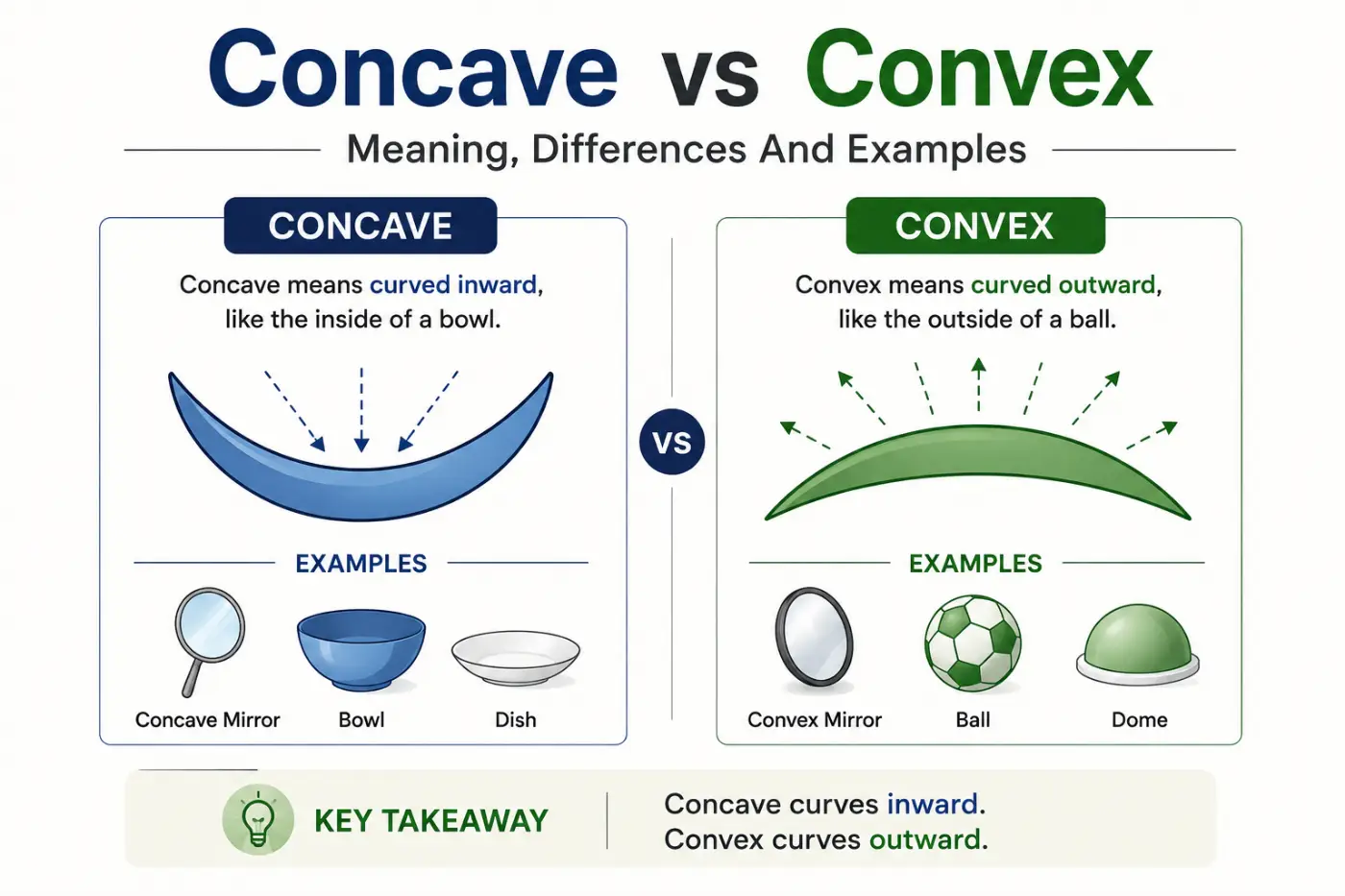
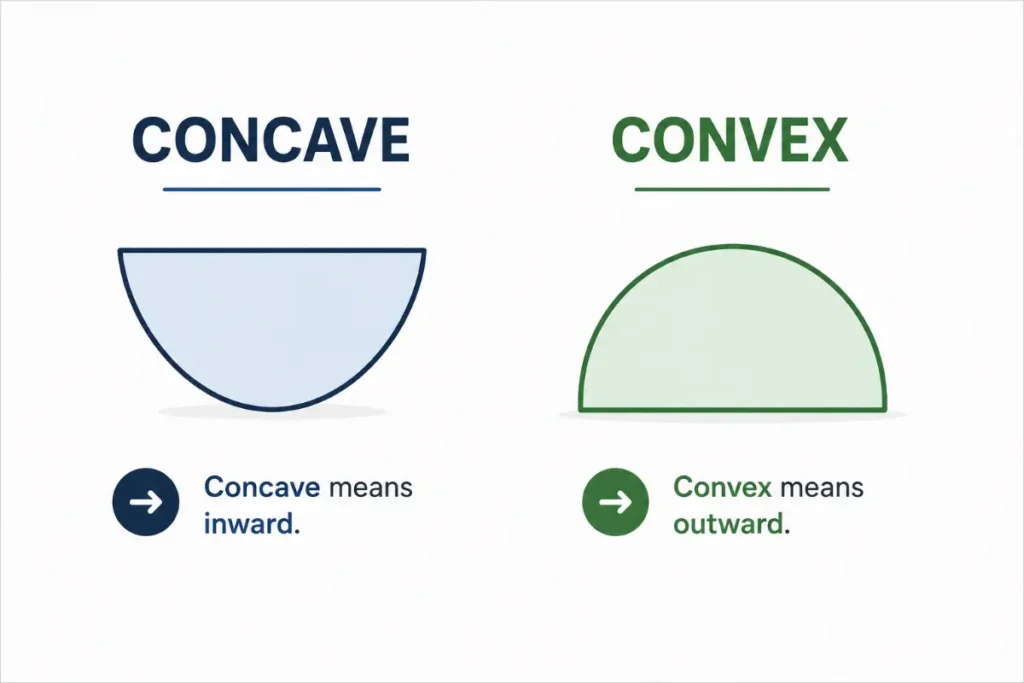
Concave vs Convex is a common question when learning about curves, shapes, and geometric terms. The main difference is simple: concave means curved inward, while convex means curved outward. Think of the inside of a cave to remember concave and the rounded surface of a ball to remember convex. These simple visual clues make it easier to recognize each shape and understand how the two words differ.
Once you understand this distinction, you can identify concave and convex shapes more confidently. A concave surface curves inward, creating a hollow or dipped appearance, while a convex surface bulges outward. You can see these shapes in bowls, mirrors, lenses, hills, and geometric figures. Although both terms describe curves, each one represents a different direction or shape.
Concave and convex also appear in mathematics, physics, and optics. Geometry uses these terms to describe curves and polygons, while optics uses them to explain the shapes of mirrors and lenses. In mathematics, functions can also be classified as concave or convex based on how their graphs bend. This guide explains their meanings, differences, practical examples, and memory tricks to help you use both terms correctly.
Short Answer
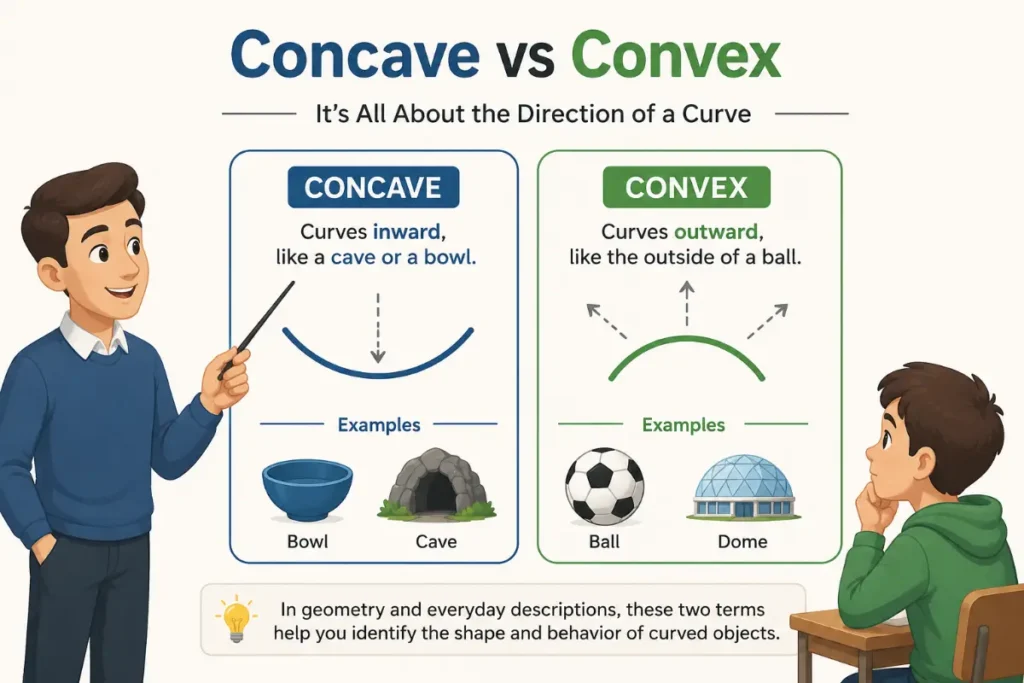
Concave vs Convex comes down to the direction of a curve or surface. A concave shape curves inward and can look like a cave or a bowl. A convex shape curves outward and can look like the outside of a ball. In geometry and everyday descriptions these two terms help you identify the shape and behavior of curved objects.
Table Of Contents
- What Concave Means.
- What Convex Means.
- The Main Difference.
- A Simple Visual Test.
- Concave And Convex In Geometry.
- Concave And Convex Polygons.
- Concave And Convex Curves.
- Concave And Convex Lenses.
- Concave And Convex Mirrors.
- Concavity In Functions.
- Comparison Table.
- Real Life Examples.
- Common Mistakes.
- Memory Tricks.
- Related Mathematical Terms.
- Pronunciation Guide.
- Word Origins.
- Professional Usage Tips.
- Key Takeaways.
- FAQs.
- Conclusion.
What Concave Means
Concave describes a surface or curve that bends inward.
The easiest image to remember is the inside of a bowl. The middle of the bowl sits lower than the edges and the surface curves inward around the space that holds food or liquid.
A cave gives you another useful mental picture. A cave goes inward into a rock formation. That association can make the word much easier to remember.
In geometry a concave shape has an inward indentation. The boundary does not simply bulge outward around the entire shape.
Consider a polygon with a section that points inward. That indentation makes the polygon concave.
The idea also applies to curved surfaces.
Examples include:
- The inside surface of a bowl.
- The inner side of a spoon.
- A concave mirror.
- A valley shaped surface.
- A curve that bends downward in a mathematical graph under a common coordinate convention.
The exact behavior can depend on the mathematical context. That point becomes especially important when you study functions because concavity is determined by how the slope changes rather than simply by whether something looks like a bowl.
What Convex Means
Convex describes a surface or curve that bends outward.
A ball is a simple example. Its surface bulges outward in every direction.
The outside of a spoon also gives you a useful visual reference. One side curves outward while the opposite side curves inward.
In geometry a convex shape has no inward indentation. If you draw a straight line between any two points inside a convex shape the entire line stays inside the shape.
That property gives mathematicians a precise way to define convexity.
Common examples include:
- A circle.
- A sphere.
- The outside of a ball.
- The outer surface of a dome.
- A convex lens.
- Many regular polygons.
Convex doesn’t simply mean rounded. A square is convex even though it has straight sides and sharp corners.
That’s an important point.
A shape doesn’t need to have a curved edge to be convex. Convexity describes a geometric property involving the entire shape.
The Main Difference
The simplest distinction is direction.
Concave means inward.
Convex means outward.
Imagine placing your hand on a curved object.
If the surface dips away from you and creates an indentation you can think of it as concave.
If the surface pushes outward toward you like the outside of a ball you can think of it as convex.
Another useful test involves the shape’s interior.
A convex shape has no inward dent.
A concave shape has at least one inward dent.
This rule works particularly well for polygons.
For example a square is convex.
A regular triangle is convex.
A regular pentagon is convex.
A star shaped polygon is usually concave because some parts of its boundary point inward.
The difference is visual at a basic level but mathematical definitions make it much more precise.
A Simple Visual Test
If you struggle to remember the terms use the cave test.
Think:
Cave equals concave.
A cave goes inward.
Then think:
Convex equals bulging outward.
Picture the outside of a basketball.
This gives you a quick mental shortcut.
You can also use your hand.
Make your palm slightly cupped.
The inside of your cupped hand resembles a concave surface.
Now curve the back of your hand outward.
That gives you a rough physical picture of convexity.
Another useful method is to look for an indentation.
If you can clearly see a part of the shape pushing inward then the shape may be concave.
If the entire boundary pushes outward without an indentation then it may be convex.
Remember that this visual shortcut works best for basic shapes. Mathematical functions and higher dimensional geometry require more precise definitions.
Concave And Convex In Geometry
Geometry uses these terms to classify shapes and curves.
A convex set has a useful mathematical property. Take any two points within the set and connect them with a straight line segment. Every point on that segment remains inside the set.
A concave shape fails this property.
For example imagine a crescent shaped region. Choose two points inside the region. A straight line between them may pass outside the shape. That indicates nonconvex behavior.
This distinction matters because convex sets have many useful mathematical properties.
They appear in:
- Optimization.
- Geometry.
- Economics.
- Computer science.
- Engineering.
- Statistics.
- Machine learning.
- Operations research.
Concavity also has an important role in mathematical analysis.
The words may start as simple shape descriptions but they become powerful technical terms in advanced mathematics.
Concave And Convex Polygons
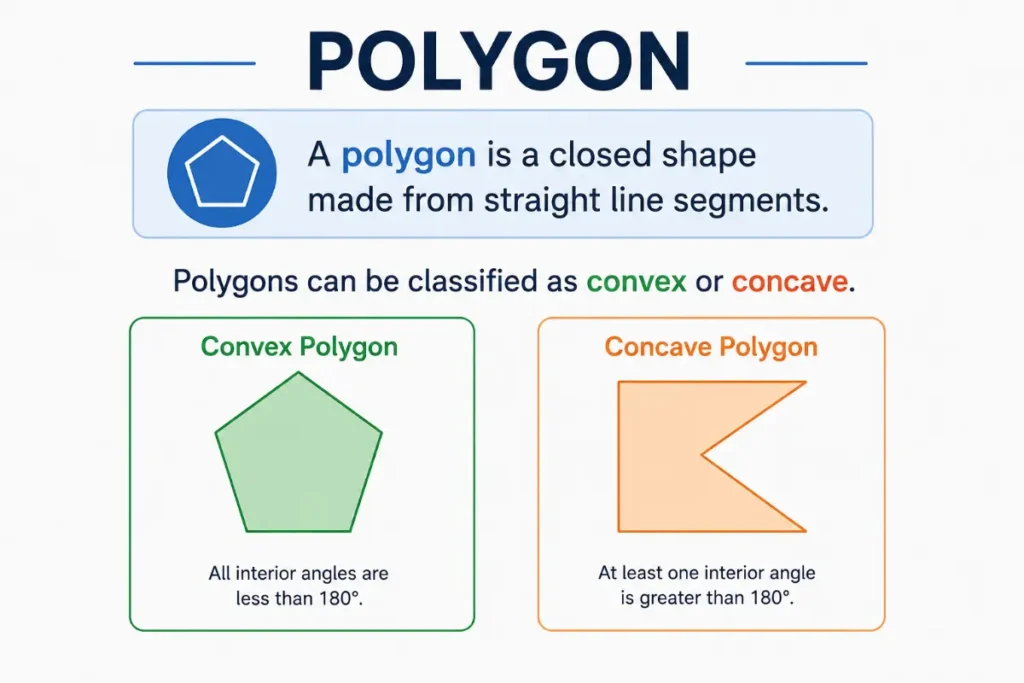
A polygon is a closed shape made from straight line segments.
Polygons can be classified as convex or concave.
Convex Polygon
A convex polygon has no inward angle that creates an indentation.
Every interior angle is less than 180 degrees.
Examples include:
- Triangle.
- Square.
- Rectangle.
- Regular pentagon.
- Regular hexagon.
A useful rule is this.
If every interior angle is less than 180 degrees the polygon is convex.
Concave Polygon
A concave polygon has at least one interior angle greater than 180 degrees.
That angle points inward and creates an indentation.
A simple arrow shape can be concave if its outline contains an inward notch.
A star shaped polygon often provides an easy visual example.
The shape doesn’t have to contain curves to be concave. Straight line segments are enough to create concavity.
Concave And Convex Curves
Curves introduce another layer of meaning.
A curve can bend in different directions depending on its position and the mathematical function that produces it.
For a graph of a function you can often think about concavity using the second derivative.
If the second derivative is positive over an interval then the function is commonly described as concave up.
If the second derivative is negative over an interval then the function is commonly described as concave down.
This can surprise beginners because a graph that looks like a bowl is often called concave up.
For example the function
y = x²
opens upward.
Its second derivative is positive.
So it is concave up.
The function
y = −x²
opens downward.
Its second derivative is negative.
So it is concave down.
This shows why the word concave can have a more technical meaning in calculus than the simple everyday idea of something curving inward.
The direction of concavity depends on the mathematical definition being used.
Concave And Convex Lenses
Optics gives us some of the most familiar examples.
A convex lens is thicker in the middle than at the edges. It bends incoming light toward a focal point under common conditions.
A magnifying glass usually contains a convex lens.
A concave lens is thinner in the middle and thicker near the edges. It spreads incoming light outward.
The shapes look almost opposite.
A convex lens bulges outward.
A concave lens curves inward.
This distinction matters in eyeglasses cameras microscopes telescopes and many other optical systems.
Convex Lens
A convex lens is often called a converging lens because it can bring parallel light rays together.
For example a magnifying glass uses a convex lens to create an enlarged view of an object when you hold the object within the appropriate focal range.
Concave Lens
A concave lens is commonly called a diverging lens.
It causes parallel rays of light to spread apart after passing through the lens.
Concave lenses are used in optical systems that require this type of light behavior.
Concave And Convex Mirrors
Mirrors provide another clear example.
A concave mirror curves inward like the inside of a bowl.
A convex mirror curves outward like the outside of a sphere.
The two mirror types produce different images because they reflect light in different ways.
Concave Mirror
A concave mirror can bring reflected light rays toward a focal point.
You can find concave mirrors in applications such as:
- Reflecting telescopes.
- Searchlights.
- Shaving mirrors.
- Dental mirrors.
- Certain optical instruments.
The exact image depends on the object’s distance from the mirror.
Convex Mirror
A convex mirror curves outward.
It spreads reflected rays apart and generally produces a virtual upright reduced image.
Convex mirrors are useful when a wide field of view matters.
You may see them in:
- Vehicle side mirrors.
- Security mirrors.
- Store surveillance mirrors.
- Road safety mirrors.
A convex mirror lets you see a wider area than a flat mirror.
Concavity In Functions
The terms become especially important in calculus.
When mathematicians discuss the concavity of a function they aren’t simply asking if an object looks like a cave.
They’re examining how the slope changes.
For a twice differentiable function the second derivative provides a standard test.
If:
f”(x) > 0
over an interval then the function is concave up there.
If:
f”(x) < 0
over an interval then the function is concave down there.
A point where the concavity changes can be an inflection point.
Consider:
f(x) = x².
The first derivative is:
f'(x) = 2x.
The second derivative is:
f”(x) = 2.
Because the second derivative is positive the graph is concave up everywhere.
Now consider:
f(x) = −x².
Its second derivative is negative.
So the graph is concave down everywhere.
This mathematical meaning is worth learning separately from the everyday inward and outward shortcut.
Comparison Table
| Feature | Concave | Convex |
|---|---|---|
| Basic meaning | Curves inward | Curves outward |
| Visual idea | Cave or bowl | Ball or dome |
| Polygon | Has an inward indentation | Has no inward indentation |
| Interior angle rule | At least one angle can exceed 180 degrees | Every interior angle is less than 180 degrees |
| Line segment test | A segment between two interior points can leave the shape | A segment between any two interior points stays inside |
| Lens | Thinner in the middle | Thicker in the middle |
| Mirror | Curves inward | Curves outward |
| Common optics term | Diverging lens | Converging lens |
| Everyday example | Inside of a bowl | Outside of a ball |
| Function language | Concave up or concave down | Convexity can describe a function or set under a mathematical definition |
Real Life Examples
Bowl
The inside of a bowl is concave.
Its surface curves inward and creates a space for holding food or liquid.
Ball
The outer surface of a ball is convex.
It bulges outward from the center.
Spoon
A spoon demonstrates both ideas.
The inside of the spoon is generally concave.
The back of the spoon is generally convex.
This makes a spoon one of the easiest objects to use when learning the difference.
Cave
A cave provides a memorable example of concavity.
The space extends inward from the surrounding rock.
This is why the word association cave equals concave works so well.
Dome
The outside of a dome is convex.
The surface rises outward from its base and forms a rounded exterior.
Valley
A valley can provide an intuitive example of a concave landscape because the land dips inward toward a lower region.
The exact geometric classification depends on what surface and direction you’re analyzing.
Road
A road can contain both concave and convex curves.
A dip in the road can form a concave profile.
A raised section can form a convex profile.
Engineers use precise geometric and physical measurements rather than relying only on visual appearance.
Contact Lens
Different optical designs use different curved surfaces.
The terms concave and convex describe the geometry of those surfaces and help explain how they interact with light.
Common Mistakes
Mistaking Concave For Outward
This is probably the most common basic error.
Some learners remember that both words describe curves but forget which direction belongs to which word.
Use the cave trick.
A cave goes inward.
Therefore concave means inward.
Thinking Convex Means Curved
Not every curved shape is automatically convex.
A shape can contain both inward and outward sections.
Also remember that a square can be convex even though it has no curved sides.
Convexity is a mathematical property rather than a synonym for rounded.
Confusing Concave Up With Concave Inward
Calculus creates a special source of confusion.
A graph can be described as concave up even though the graph does not resemble the inside of a physical cave.
The phrase concave up describes how the slope changes.
It doesn’t simply mean the curve looks like an inward indentation.
Assuming Every Bowl Is Mathematically Concave
A bowl gives a useful everyday picture but mathematical classification depends on the surface and the direction you’re considering.
Visual analogies help you learn the vocabulary.
They don’t replace formal definitions in advanced mathematics.
Forgetting The Lens Difference
A convex lens is thicker in the middle.
A concave lens is thinner in the middle.
This is a valuable pair to memorize because it appears frequently in physics.
Forgetting The Mirror Difference
A concave mirror curves inward.
A convex mirror curves outward.
The same basic direction rule applies.
Memory Tips
The strongest memory trick is simple:
Concave contains cave.
A cave goes inward.
So concave means inward.
For convex think about a balloon or ball.
A ball bulges outward.
So convex means outward.
Another trick is to use your hand.
Cup your palm.
The inside of your palm gives you a rough picture of concavity.
Turn your hand around and look at the rounded back.
That gives you a simple picture of convexity.
You can also remember this pair:
Concave catches.
A concave shape can form a hollow space that catches or holds something.
Convex bulges.
A convex shape pushes outward.
These shortcuts aren’t mathematical definitions. They’re memory aids that help you recall the correct direction quickly.
Related Mathematical Terms
Curvature
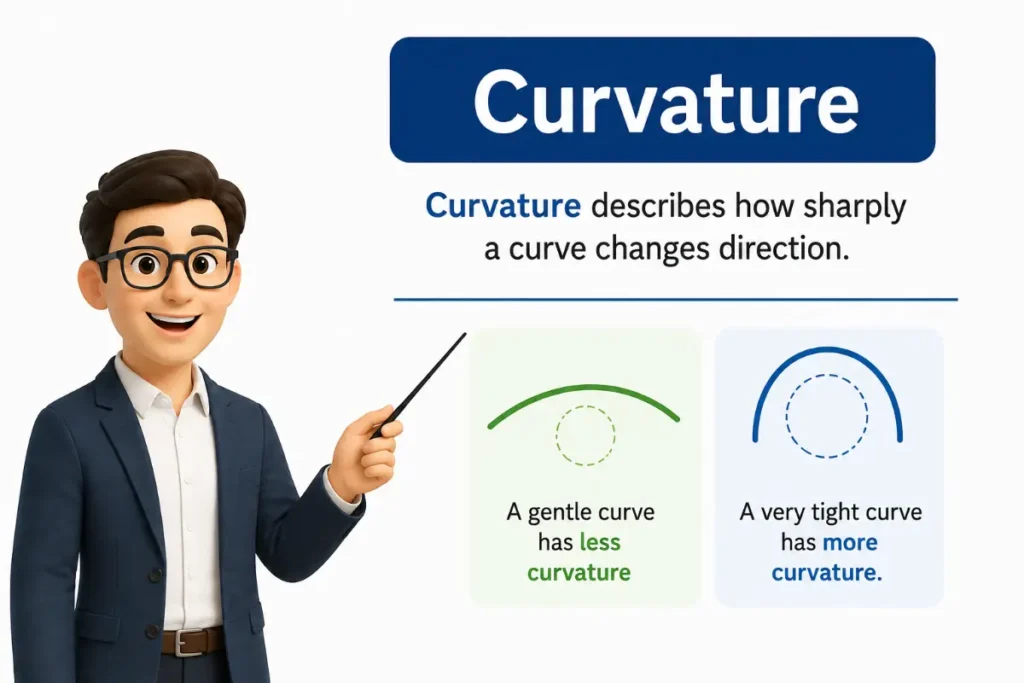
Curvature describes how sharply a curve changes direction.
A gentle curve has less curvature than a very tight curve.
Indentation
An indentation is a part of a shape that pushes inward.
It often signals a concave polygon.
Bulge
A bulge is an outward swelling.
It provides an intuitive picture of convexity.
Inflection Point
An inflection point is a point where the concavity of a function changes.
For example a graph may change from concave up to concave down.
Convex Set
A convex set contains the entire line segment connecting any two points within the set.
This is a formal mathematical definition of convexity.
Concave Function
A concave function has a graph that bends downward in the standard mathematical sense.
Its slope decreases as you move from left to right under the usual differentiability conditions.
Convex Function
A convex function bends upward in the standard mathematical sense.
Its slope increases as you move from left to right under the usual differentiability conditions.
Focal Point
In optics a focal point is a location where rays converge or appear to originate from after reflection or refraction.
Concave mirrors and convex lenses can produce converging light under appropriate conditions.
Pronunciation Guide
Concave is commonly pronounced:
kuhn KAYV
It has two syllables.
The second syllable receives the main stress.
Convex is commonly pronounced:
KON veks
It also has two syllables.
The first syllable receives the main stress.
Don’t let the spelling intimidate you.
Once you’ve heard the words a few times they become easy to recognize.
Word Origins
The word concave comes from Latin concavus which means hollow or curved inward.
The word convex comes from Latin convexus which carries the idea of being vaulted or rounded outward.
Their Latin roots are useful because the original meanings connect closely to the modern mathematical ideas.
Concave developed around the idea of a hollow surface.
Convex developed around the idea of a rounded or bulging surface.
That historical connection also explains why these terms work so well in geometry optics and other scientific fields.
Why The Terms Matter In Science
These aren’t just vocabulary words.
Scientists engineers and mathematicians use concavity and convexity to describe measurable properties.
In optics the shape of a lens or mirror affects how light behaves.
Convexity also appears in economics statistics computer science engineering and operations research.
Learning the basic distinction gives you a foundation for understanding much more advanced concepts.
Concave And Convex In Optimization
Convexity has a major role in optimization.
A convex optimization problem has mathematical properties that can make finding a global optimum more manageable.
For a convex function the line segment connecting two points on the graph lies on or above the graph.
For a concave function the opposite relationship applies under the corresponding definition.
This matters because optimization problems often involve finding the lowest or highest possible value of a function.
Convexity can help researchers determine how a function behaves and how an optimization method is likely to perform.
You don’t need advanced calculus to remember the basic vocabulary.
At the introductory level keep the distinction simple.
Convex functions bend upward.
Concave functions bend downward.
Then build the formal rules around that foundation.
Concave And Convex In Economics
Economics also uses these terms.
A production function can be described using concavity.
Utility functions can have concave properties.
Convex preferences are another important concept in economic theory.
These uses aren’t about physical surfaces.
They describe mathematical relationships and the way values change.
That is a good reminder that concave and convex can shift from physical geometry to abstract mathematical analysis.
The underlying concept remains related to how something bends or behaves.
Professional Usage Tips
If you’re writing about geometry or physics keep the definitions precise.
Don’t simply say that concave means curved and convex means round.
Those descriptions are too vague.
Instead say:
Concave means curved inward.
Convex means curved outward.
For functions use the mathematical language of concave up and concave down.
This approach makes your explanation useful to beginners while keeping it accurate enough for technical readers.
Key Takeaways
- Concave means inward.
- Convex means outward.
- A cave is a useful memory clue for concave.
- A ball is a useful memory clue for convex.
- A concave polygon has an inward indentation.
- A convex polygon has no inward indentation.
- Every interior angle of a convex polygon is less than 180 degrees.
- A concave lens is thinner in the middle.
- A convex lens is thicker in the middle.
- A concave mirror curves inward.
- A convex mirror curves outward.
- In calculus concavity describes how the slope changes.
- A function can be concave up or concave down.
- Convexity is also a major concept in optimization and other mathematical fields.
Conclusion
Conclusion
Understanding the difference between concave and convex becomes easier when you focus on the direction of the curve. Concave means curving inward, like the inside of a bowl, while convex means curving outward, like the surface of a ball. These simple examples help you remember the basic difference between the two terms.
In geometry, a concave polygon has an inward indentation, while a convex polygon has no inward indentation. These terms are also used in lenses, mirrors, calculus, and other scientific fields, where their exact meanings depend on the context.
An easy way to remember the difference is to connect concave with a cave, which goes inward, and convex with a ball that bulges outward. Remembering these two images will help you identify the correct term more quickly and understand more advanced concepts with greater confidence.
FAQs
What Is the Difference Between Concave and Convex?
The main difference is the direction of the curve. Concave describes a shape that curves inward, while convex describes a shape that bulges outward. The inside of a bowl is a common example of a concave surface, while the outside of a ball is convex. In geometry, these terms have precise mathematical definitions based on the shape’s interior and the line segments connecting points within it.
Is a Bowl Concave or Convex?
The inside of a bowl is concave because it curves inward and forms a hollow space. The outside is generally convex because it bulges outward. A single object can have both concave and convex surfaces. The correct term depends on the specific surface you are describing.
Is a Ball Concave or Convex?
The outer surface of a ball is convex because it curves outward from its center. A solid ball is a simple example of a convex shape. However, a hollow spherical object can have an inner surface that curves inward. Always consider the specific surface when describing an object’s shape.
Is a Circle Concave or Convex?
A filled circle is convex. If you choose any two points inside the circle and connect them with a straight line, the entire line segment remains inside the circle. This satisfies the mathematical definition of a convex shape. Although the circle has a curved boundary, it does not have an inward indentation.
Is a Square Convex or Concave?
A square is convex because all four interior angles measure 90 degrees, which is less than 180 degrees. It also passes the line segment test because a straight line connecting any two points inside the square stays entirely within its boundaries. This shows that convex shapes can have straight edges as well as curved surfaces.
Is a Concave Lens Thicker in the Middle?
No. A typical concave lens is thinner in the middle and thicker at the edges. It spreads parallel light rays apart, so it is known as a diverging lens. A typical convex lens has the opposite shape. It is thicker in the middle and can bring parallel light rays together at a focal point.
Is a Concave Mirror Curved Inward?
Yes. A concave mirror curves inward, similar to the inside of a bowl. It can reflect light toward a focal point, depending on the mirror’s shape and the object’s position. A convex mirror curves outward and provides a wider field of view. These properties make the two types of mirrors useful for different purposes.
Is Concave Up the Same as Concave Inward?
No. In calculus, concave up describes how a graph bends as its slope changes. It does not simply mean that a physical object curves inward. For a twice differentiable function, a positive second derivative indicates that the graph is concave up over the relevant interval. This mathematical meaning differs from the everyday description of concave shapes.
What Is the Easiest Way to Remember Concave and Convex?
Think of a cave for concave because a cave extends inward. For convex, picture a ball that bulges outward. You can also remember the inside and outside of a bowl. Its inner surface is concave, while its outer surface is generally convex. These familiar examples make the difference easier to remember during a test or geometry lesson.
What Is a Concave Polygon?
A concave polygon is a polygon with at least one inward indentation. At least one interior angle is greater than 180 degrees. It fails the convex line segment test because a line segment connecting two points inside the polygon can extend outside its boundaries. A polygon shaped like an arrow with an inward notch is a useful example.
What Is a Convex Polygon?
A convex polygon has no inward indentations. Every interior angle is less than 180 degrees, and every line segment connecting two points inside the polygon remains entirely within its boundaries. Triangles, squares, rectangles, regular pentagons, and regular hexagons are common examples. These shapes are useful in geometry because their properties are often easier to analyze.
Why Is Convexity Important in Mathematics?
Convexity is important because it helps mathematicians understand shapes, functions, and sets. It is used in geometry, calculus, economics, statistics, engineering, and computer science. For example, convex optimization studies methods for finding the best solutions to certain mathematical problems. Although the basic idea comes from the shape of an object, convexity has many practical applications in science and technology.

Confusing Words, Spelling & Word Choice
Claire Whitmore is a U.S.-based English editor who writes about commonly confused words, spelling differences, and word choice. Her work helps readers understand subtle distinctions between similar-looking words through simple definitions, practical examples, and modern usage guidance in both American and British English.