
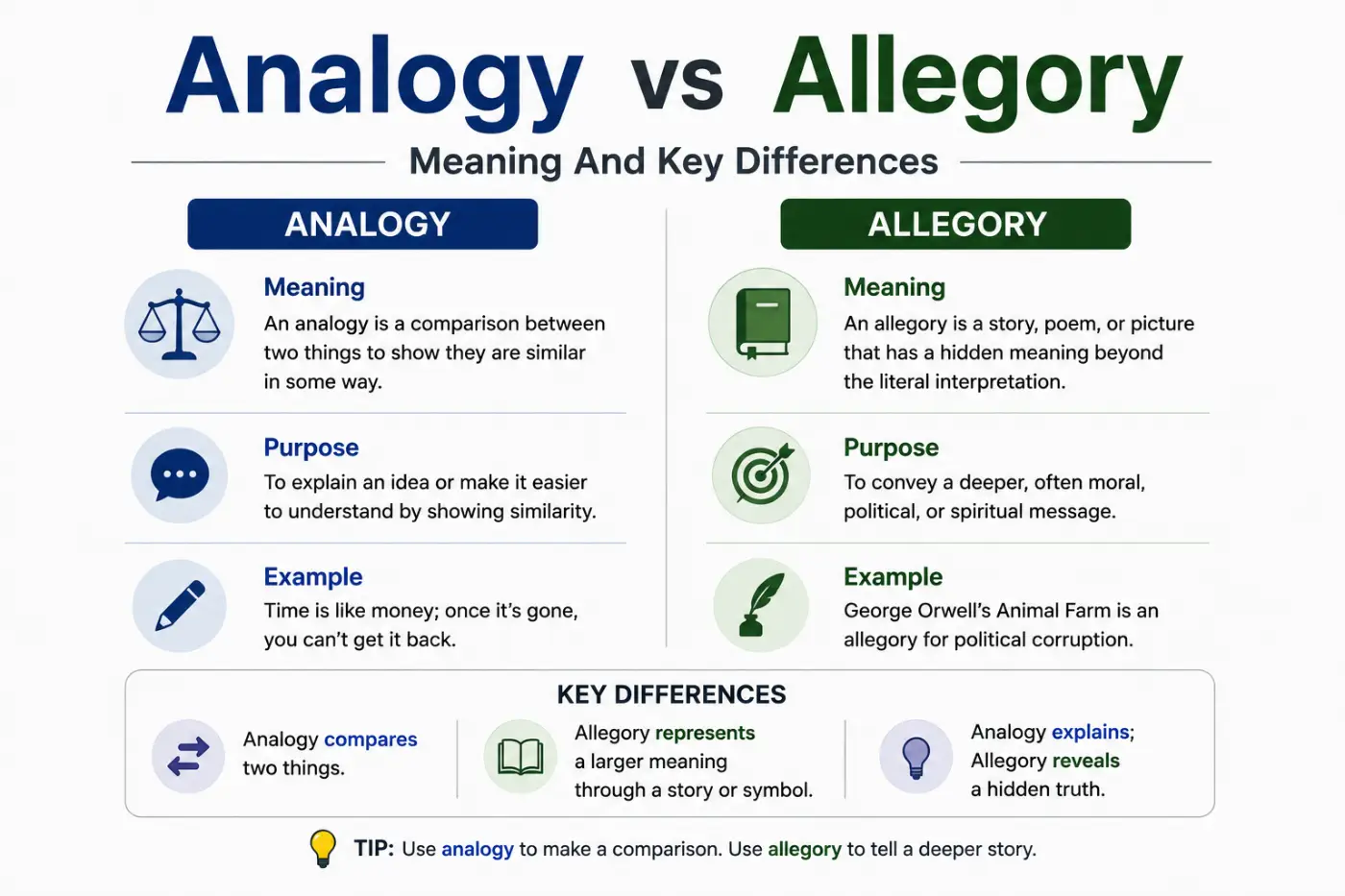
Analogy vs Allegory can confuse even strong writers because both terms involve one thing representing or explaining another idea. The simplest distinction is this. An analogy uses a comparison to make an idea clearer. An allegory uses an entire story or sustained narrative to communicate a deeper meaning. The two concepts overlap but they aren’t interchangeable.
The confusion often comes from the fact that both devices ask readers to look beyond the literal meaning. When someone compares the brain to a computer they aren’t saying the two are identical. They’re using one familiar idea to explain another. An allegorical story works differently. Its characters actions places and events can consistently stand for larger concepts such as freedom greed power morality or political conflict.
Once you understand that difference the terms become much easier to recognize. This guide explains their meanings origins structures purposes and grammatical use. You’ll also see clear examples from everyday speech literature education politics and popular storytelling so you can identify each device without second guessing yourself.
Short Answer
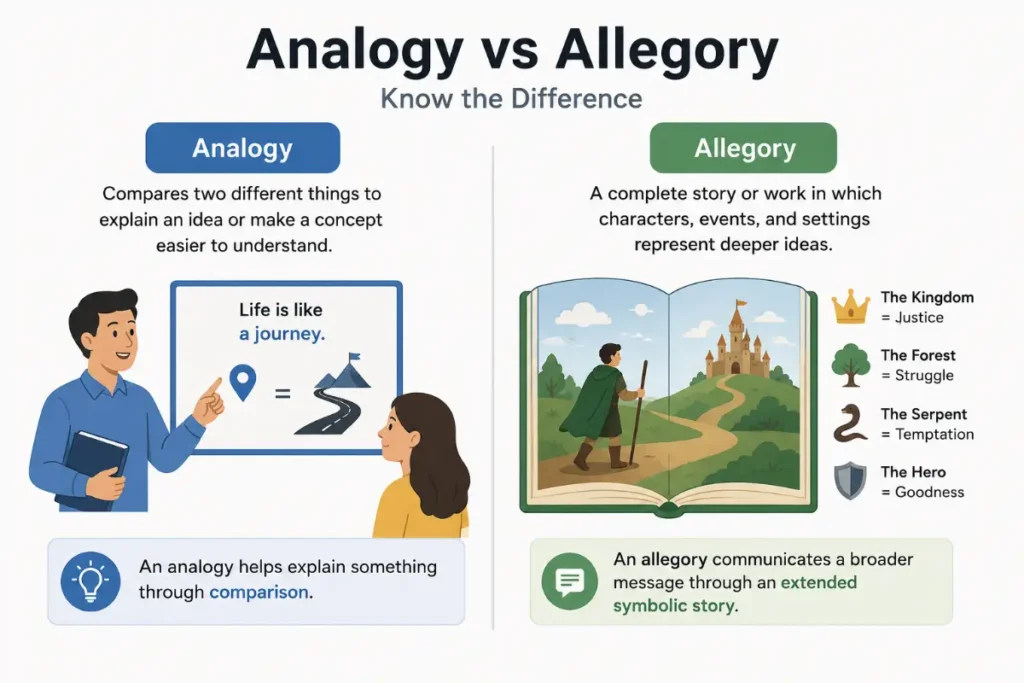
Analogy compares two different things to explain an idea or make a concept easier to understand. Allegory is a complete story or work in which characters events and settings represent deeper ideas. An analogy helps explain something through comparison. An allegory communicates a broader message through an extended symbolic story.
Table Of Contents
- What An Analogy Means.
- What An Allegory Means.
- The Main Difference.
- Analogy vs Allegory Compared.
- How An Analogy Works.
- How An Allegory Works.
- Analogy In Everyday Communication.
- Allegory In Literature.
- Examples Of Analogies.
- Examples Of Allegory.
- How To Tell Them Apart.
- Common Mistakes.
- Analogy And Metaphor.
- Allegory And Symbolism.
- Analogy And Simile.
- Types Of Analogy.
- Types Of Allegory.
- Grammar And Word Usage.
- Pronunciation Guide.
- Word Origins.
- Formal And Informal Usage.
- Memory Tips.
- Related Terms.
- Expert Editor Advice.
- Key Takeaways.
- FAQs.
- Conclusion.
What An Analogy Means
An analogy is a comparison between two things that are different but share a useful similarity.
The purpose isn’t simply to say that two things look alike. An analogy usually helps explain an unfamiliar idea by connecting it to something familiar.
For example:
Learning a language is like building a house.
This comparison doesn’t claim that language learning literally involves construction. Instead it suggests that both processes require a strong foundation and gradual development.
You can make the idea more specific:
Learning vocabulary is like collecting building materials. Grammar provides the structure that holds those materials together.
That comparison gives the reader a mental model.
Analogies are common in teaching because they make complicated ideas easier to understand. A teacher might compare electrical current to water flowing through pipes. A doctor might explain a biological process by comparing it with a familiar mechanical system. A manager might compare a business budget to a household budget.
The comparison creates a bridge between two areas of knowledge.
The Core Purpose Of An Analogy
An analogy usually has one central purpose.
It explains.
It clarifies.
The two things being compared don’t need to be identical. They only need to share a relevant feature.
For example:
A good editor is like a gardener.
The editor removes unnecessary growth and helps the strongest ideas flourish.
The editor isn’t literally a gardener. The analogy focuses on the shared idea of careful selection and improvement.
What An Allegory Means
An allegory is a story or extended work in which characters events settings or other elements represent deeper ideas.
The literal story operates on one level while the symbolic meaning operates on another.
An allegory can explore political ideas moral questions religious beliefs social criticism or philosophical concepts.
A classic example is George Orwell’s Animal Farm. On the surface the book tells a story about farm animals who rebel against their human owner. At a deeper level the story reflects political power revolution corruption and the rise of authoritarian rule.
The animals and events don’t function as isolated comparisons. The entire narrative carries symbolic meaning.
That distinction matters.
An analogy can be one sentence.
An allegory usually extends across a story or substantial work.
The Core Purpose Of An Allegory
An allegory can entertain while also communicating a deeper message.
It may criticize society without stating the criticism directly.
It may allow readers to interpret a story on multiple levels.
An allegorical work doesn’t always have one perfectly fixed interpretation. Some works contain clear symbolic structures while others invite debate.
The Main Difference
The clearest difference is scope.
An analogy is usually a comparison used to explain something.
An allegory is usually an extended symbolic representation expressed through a narrative or work.
Consider this example:
Your brain is like a computer.
That’s an analogy.
Now imagine a story about a kingdom whose ruler represents unchecked authority while different characters represent freedom justice fear and ambition. The entire plot explores how those forces interact.
That’s an allegory.
An analogy gives you a comparison.
An allegory gives you a symbolic world.
This is the most useful distinction to remember.
Analogy vs Allegory Compared
| Feature | Analogy | Allegory |
|---|---|---|
| Basic meaning | Comparison used to explain or illustrate an idea | Extended symbolic representation |
| Typical form | Sentence paragraph explanation or comparison | Story poem novel painting or other complete work |
| Main purpose | Clarification or explanation | Deeper symbolic meaning |
| Scope | Usually limited | Usually extended |
| Characters required | No | Often but not always |
| Narrative required | No | Usually |
| Symbolism | May appear | Central to the structure |
| Example | Memory is like a filing cabinet | A fictional kingdom representing political power |
| Common use | Teaching speech argument explanation | Literature politics morality religion |
| Interpretation | Usually fairly direct | Often layered |
The table shows why the terms shouldn’t be treated as synonyms.
An analogy can exist inside an allegory.
An allegory can contain analogies.
But an analogy doesn’t automatically become an allegory just because it has a deeper meaning.
How An Analogy Works
An analogy usually has three basic parts.
The Familiar Idea
The writer introduces something the reader already understands.
For example:
A classroom is like a small community.
Most readers understand what a classroom and community are.
The Shared Relationship
The writer identifies the connection.
A classroom has rules roles responsibilities cooperation and conflict just as a community does.
The New Idea
The analogy then helps explain something unfamiliar.
This comparison can help students understand how social systems work.
The strength of an analogy depends on the relevance of the shared relationship.
A weak analogy compares things that have little meaningful connection.
A strong analogy highlights a useful structural similarity.
A Simple Formula
You can think of an analogy like this:
A is to B as C is to D.
For example:
A teacher is to a classroom as a coach is to a team.
The relationship isn’t based on physical similarity. It is based on function.
The teacher guides students.
The coach guides players.
That relationship makes the comparison useful.
How An Allegory Works
An allegory usually builds meaning across multiple elements.
A character might represent a political leader.
A journey might represent personal growth.
A storm might represent social turmoil.
A kingdom might represent an entire political system.
The important point is that these elements work together.
Imagine a story about a city ruled by a leader who promises safety. Over time the leader removes freedoms in the name of protection. Citizens gradually lose the ability to speak openly.
The story might function as an allegory about authoritarianism.
The deeper meaning isn’t located in one sentence. It develops through the entire narrative.
Allegory Can Be Direct Or Subtle
Some allegories make their symbolism easy to recognize.
Others are much more subtle.
A writer might never tell readers exactly what every character represents. Instead the story provides enough patterns and parallels for readers to form an interpretation.
That openness can make allegorical literature especially interesting.
Analogy In Everyday Communication
You don’t need to study literature to use analogies.
People use them constantly.
Consider these examples:
- Managing a busy schedule is like juggling several balls at once.
The comparison explains how losing focus on one task can cause problems elsewhere.
- Building trust is like filling a bank account.
Small positive actions add up while careless behavior can reduce the balance.
- Editing a paragraph is like cleaning a crowded room.
Removing unnecessary material makes the important things easier to see.
- Learning grammar is like learning the rules of a game.
Once you understand the rules you can make better choices during play.
- A strong password is like a good lock.
Both create a barrier against unwanted access.
These are analogies because they use familiar situations to explain another idea.
Allegory In Literature
Allegory has a long history in literature.
Writers have used it to discuss morality politics religion social behavior and human nature.
One famous example is John Bunyan’s The Pilgrim’s Progress. The story presents a journey filled with characters and locations that carry religious and moral significance.
Edmund Spenser’s The Faerie Queene also uses allegorical figures and events to explore virtues and moral ideas.
George Orwell’s Animal Farm uses animals and political events to create a broader commentary on power and political revolution.
Plato’s Allegory of the Cave presents prisoners who mistake shadows for reality. The story becomes a philosophical exploration of knowledge perception and enlightenment.
These works show how allegory can transform abstract ideas into concrete stories.
Examples Of Analogies
Education
A textbook is like a map.
A map doesn’t contain every detail of a landscape. It gives you useful information that helps you understand where things are.
The analogy explains why a textbook simplifies a subject without necessarily being incomplete or useless.
Technology
A computer’s memory is like a desk.
A larger desk gives you more space to keep active materials nearby. Computer memory similarly supports information that needs to be readily available.
The comparison helps beginners understand a technical concept.
Relationships
Trust is like a glass.
It can be built carefully but a serious break can leave permanent damage.
The analogy emphasizes fragility and repair.
Business
A company is like a ship.
Everyone has a role and the whole organization needs direction to move toward its destination.
The comparison helps explain teamwork and leadership.
Writing
A paragraph is like a sandwich.
The opening and closing provide structure while the middle contains the main material.
The analogy makes a writing concept memorable.
Examples Of Allegory
Political Allegory
A fictional nation might ban books and punish citizens who question the government.
The literal story concerns that nation.
The deeper meaning concerns censorship and political control.
Moral Allegory
A character may choose between a comfortable dishonest life and a difficult honest one.
The character’s journey can represent the conflict between temptation and integrity.
Religious Allegory
A journey through darkness toward light can represent spiritual transformation.
The physical movement becomes a representation of inner change.
Social Allegory
A fictional town might divide residents into groups based on wealth.
The social structure can represent inequality and class divisions.
Psychological Allegory
A character might enter a house filled with locked rooms.
The rooms could represent memories or parts of the person’s mind.
The story’s physical setting then becomes a symbolic representation of internal conflict.
How To Tell Them Apart
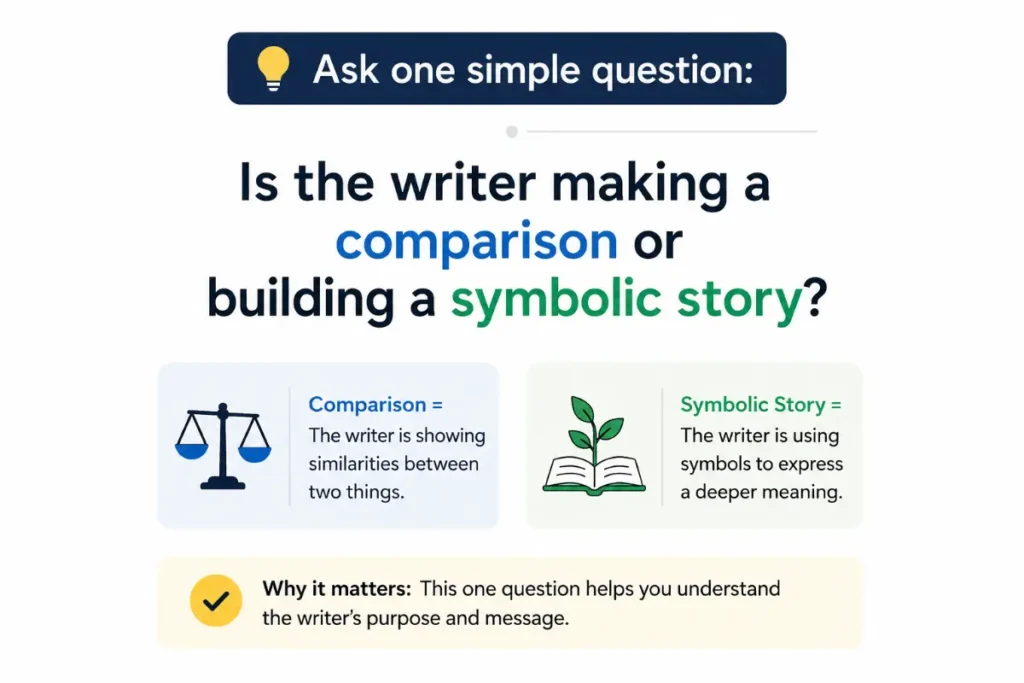
Ask one simple question:
Is the writer making a comparison or building a symbolic story?
If the writer compares one thing with another to explain an idea, you’re probably looking at an analogy.
If the writer builds a story in which characters events and settings carry deeper symbolic meanings, you’re probably looking at an allegory.
Consider these two examples.
Example one:
Managing money is like managing water. If you let small leaks continue you can eventually lose a lot.
This is an analogy.
Example two:
A story follows a town whose residents ignore a small leak in their water system until the entire town loses its supply. The story explores how societies ignore gradual problems until they become crises.
This could function as an allegory.
The first example uses comparison.
The second develops a symbolic narrative.
Analogy And Metaphor
An analogy and a metaphor are closely related but they aren’t identical.
A metaphor usually says that one thing is another in a figurative sense.
For example:
Time is a thief.
The writer doesn’t mean that time literally steals objects.
An analogy usually develops the comparison further.
For example:
Time is like a thief because it quietly takes moments from us while we’re busy with other things.
The second example explains the relationship.
That makes it an analogy.
A metaphor can therefore serve as the starting point for an analogy.
The distinction isn’t always rigid in everyday language. Writers and teachers sometimes use the terms broadly. Still, the practical rule is useful.
A metaphor makes a figurative comparison.
An analogy explains a relationship through comparison.
Allegory And Symbolism
Allegory and symbolism are also closely connected.
A symbol is something that represents a deeper idea.
A dove can symbolize peace.
A broken chain can symbolize freedom.
A dark road can symbolize uncertainty.
An allegory uses symbolic elements across a larger work.
A single symbol doesn’t automatically create an allegory.
A story filled with recurring symbols can become allegorical when those elements work together to communicate a sustained deeper meaning.
Think of symbolism as a tool.
Allegory can be a larger structure built from that tool.
Analogy And Simile
A simile normally compares two things using words such as like or as.
For example:
Her voice was like a soft bell.
That’s a simile.
An analogy can be longer and more explanatory:
Learning to write well is like learning to play an instrument. You need basic techniques first and then you improve through practice and feedback.
The second comparison explains a process rather than simply describing one quality.
So a simile is often brief and descriptive.
An analogy is often explanatory and relational.
Types Of Analogy
Literal Analogy
A literal analogy compares two situations that share actual similarities.
For example:
A manager’s role in a project can be compared with a conductor’s role in an orchestra.
Both coordinate people toward a shared result.
Figurative Analogy
A figurative analogy compares unrelated things to explain an abstract concept.
For example:
Fear is a shadow that grows when you run from it.
This uses imagery to communicate an idea about fear.
Structural Analogy
A structural analogy focuses on relationships.
For example:
A key opens a lock as a password opens access to a protected account.
The important feature is the relationship between the objects.
Causal Analogy
A causal analogy compares cause and effect.
For example:
A small crack in a foundation can weaken a building over time just as a small unresolved conflict can weaken a relationship.
The comparison focuses on gradual consequences.
Types Of Allegory
Moral Allegory
A moral allegory uses characters and events to explore right and wrong.
The story may show how greed courage honesty or pride affects people’s lives.
Political Allegory
Political allegory uses fictional situations to comment on governments power leadership or social systems.
It can allow writers to criticize political behavior indirectly.
Religious Allegory
Religious allegory uses symbolic journeys characters and events to communicate spiritual ideas.
Many works of medieval and early modern literature use this form.
Philosophical Allegory
A philosophical allegory explores abstract questions about knowledge reality morality or human existence.
Plato’s Cave is a classic example.
Social Allegory
Social allegory uses fictional situations to examine class inequality prejudice identity or cultural conflict.
The symbolic story gives readers a concrete way to think about abstract social issues.
Grammar And Word Usage
Both analogy and allegory are nouns.
The plural of analogy is analogies.
The plural of allegory is allegories.
Examples:
The teacher used several analogies.
The novel contains several allegories.
Both words can appear after common verbs such as use, create, develop, write, explain, and interpret.
For example:
The professor used an analogy to explain the concept.
The author created an allegory about political power.
You can also use them with adjectives.
A useful analogy.
A powerful analogy.
A detailed analogy.
A political allegory.
A religious allegory.
A subtle allegory.
Pronunciation Guide
Analogy is commonly pronounced:
uh NAL uh jee
Its standard pronunciation is commonly represented as /əˈnælədʒi/.
The strongest stress falls on the second syllable.
Allegory is commonly pronounced:
AL uh gor ee
Its standard pronunciation is commonly represented as /ˈæləɡɔːri/ in many dictionary systems.
The first syllable receives the main stress.
A common mistake is to confuse the endings.
Analogy ends with a sound similar to jee.
Allegory ends with a sound similar to ree.
The words also begin differently.
Analogy starts with an.
Allegory starts with al.
Word Origins
The word analogy comes from Greek analogia, a term associated with proportion or correspondence. It entered English through Latin and French influence.
The original idea involved a relationship or proportion between things.
That historical meaning fits the modern concept well. An analogy depends on a relationship between two things.
The word allegory comes from Greek allegoria, meaning a way of speaking that communicates something beyond the literal words. It passed through Latin and French before entering English.
The underlying concept is therefore connected with indirect expression.
The history of both words helps explain their modern meanings.
Analogy emphasizes correspondence.
Allegory emphasizes an extended way of expressing another meaning through a story or representation.
Formal And Informal Usage
Both words are suitable for formal writing.
You’ll find analogy in academic papers legal arguments scientific explanations educational materials and professional communication.
You’ll find allegory in literary criticism religious studies philosophy history and cultural analysis.
In everyday conversation, analogy is much more common.
Someone might say:
That’s a good analogy.
The word allegory is more likely to appear when people are discussing literature art politics or symbolism.
For example:
The movie is an allegory about social inequality.
That sentence sounds natural in an analytical conversation.
Why Writers Use Analogies
Analogies save explanations from becoming abstract.
Suppose you need to explain a complicated scientific process to someone without a technical background.
You could provide a dense definition.
Or you could connect the process to something familiar.
That connection gives the reader a mental picture.
A strong analogy doesn’t replace accurate information. It supports it.
This point matters in professional writing. An analogy should clarify the important relationship without introducing a misleading comparison.
For example, comparing the human brain to a computer can help explain information processing. But the brain and a computer aren’t identical systems.
Good writers know where an analogy stops working.
Why Writers Use Allegories
Allegories give writers room to explore complicated ideas indirectly.
A political essay can state an argument directly.
A political allegory can turn that argument into a story.
The story can make the reader experience the conflict rather than simply read a statement about it.
This technique can also make difficult subjects more memorable.
Instead of presenting an abstract argument about power, an author might create a fictional kingdom where a ruler gradually changes the rules to increase control.
Readers can observe the consequences through characters and events.
That makes the abstract idea concrete.
Common Mistakes
Treating Them As Synonyms
This is the biggest mistake.
An analogy is a comparison.
An allegory is an extended symbolic representation.
They can overlap but they aren’t the same thing.
Calling Every Metaphor An Allegory
A single metaphor isn’t automatically an allegory.
A story needs a sustained symbolic structure before the term becomes appropriate.
Assuming An Allegory Must Be A Novel
An allegory can appear in a novel but doesn’t have to.
It can occur in a poem painting fable film speech or other artistic work.
Assuming An Analogy Must Use Like
Analogies often use like or as, but they don’t have to.
For example:
The relationship between a teacher and student resembles the relationship between a coach and player.
That’s an analogy without the exact word like.
Thinking An Allegory Has Only One Meaning
Some allegories have a clear intended interpretation.
Others allow multiple readings.
Literary interpretation can depend on historical context authorial intention cultural context and the reader’s perspective.
Memory Tips
The easiest memory trick is to connect analogy with analysis.
Both involve examining relationships.
An analogy helps you understand one thing by comparing it with another.
For allegory, think of a longer story carrying a second meaning.
You can also remember this:
Analogy compares.
Allegory represents.
That’s short enough to remember when you’re writing.
Another useful test is length.
If you can explain the device in one sentence, it may be an analogy.
If the symbolic meaning continues through characters and events across an entire story, it may be an allegory.
Length isn’t an absolute rule but it gives you a useful first clue.
Related Terms
Metaphor
A figurative comparison in which one thing is described in terms of another.
Simile
A comparison that commonly uses like or as.
Symbol
Something that represents a broader idea.
Parable
A short story designed to communicate a moral or spiritual lesson.
Fable
A brief story that often uses animals or fictional characters to teach a moral lesson.
Personification
Giving human qualities to nonhuman things.
Figurative Language
Language that goes beyond literal meaning to create comparisons images or other effects.
Extended Metaphor
A metaphor that continues across multiple sentences or a larger section of writing.
These concepts can overlap. Understanding their boundaries helps you choose precise terminology.
Expert Editor Advice
When editing a sentence that uses an analogy ask yourself what relationship the comparison is explaining. If the comparison disappears after one or two sentences, analogy is probably the better term. If characters events and settings continue to represent an abstract idea across a larger work, allegory is more accurate. Don’t label every symbolic comparison an allegory. Precision makes literary and academic writing stronger.
Key Takeaways
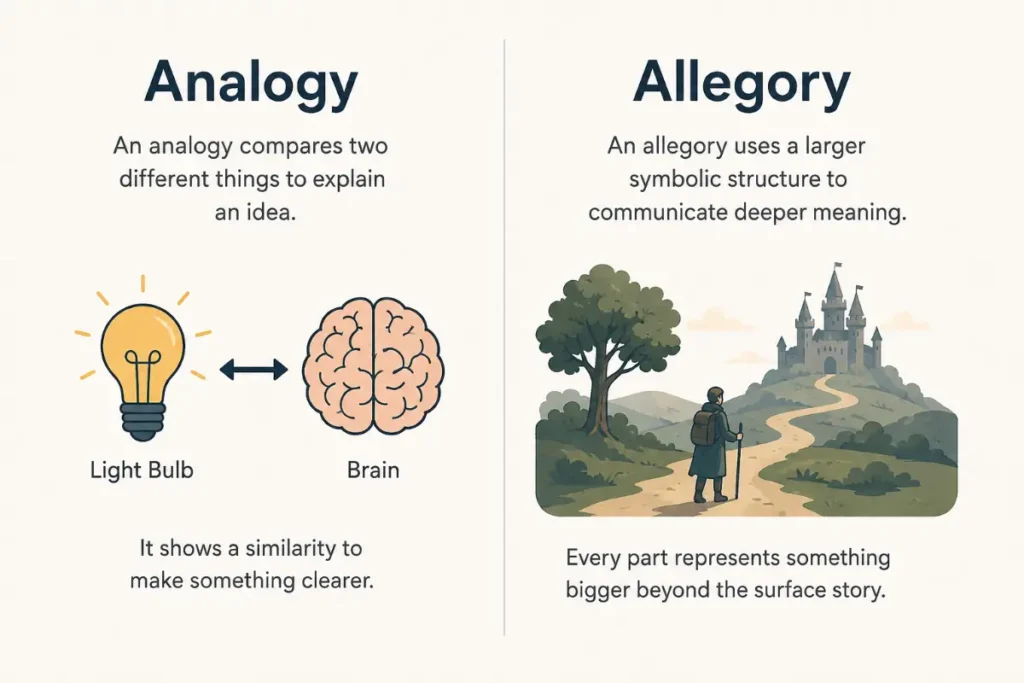
- An analogy compares two different things to explain an idea.
- An allegory uses a larger symbolic structure to communicate deeper meaning.
- An analogy can be as short as one sentence.
- An allegory usually develops through a story poem artwork or extended narrative.
- Analogies are common in teaching science business writing and everyday conversation.
- Allegories are especially common in literature philosophy religion political writing and social commentary.
- A metaphor can become part of an analogy.
- Symbols can become part of an allegory.
- Not every metaphor or symbol is an allegory.
- The simplest memory rule is that an analogy compares while an allegory represents.
Conclusion
Analogy vs Allegory is easier to understand when you focus on the job each device performs. An analogy compares two things to explain a relationship or make an unfamiliar idea easier to understand. An allegory creates a broader symbolic structure in which characters events settings or other elements communicate deeper meaning.
The key difference is scope and purpose. You can use an analogy in a single sentence or paragraph. An allegory usually develops across a complete story poem film artwork or other extended work. Metaphors symbols similes and analogies can all appear inside an allegory but they don’t automatically create one.
Remember the simplest rule. An analogy compares. An allegory represents. When you’re explaining an idea through a useful comparison choose analogy. When a larger symbolic story carries a deeper message choose allegory. That distinction will keep your word choice accurate and your writing much clearer.
FAQs
What Is The Difference Between Analogy And Allegory?
An analogy is a comparison used to explain or clarify a relationship between two different things. An allegory is an extended symbolic representation usually presented through a story or work of art. An analogy might compare learning to building a house. An allegory might tell an entire story in which a house represents a person’s life or society.
Is An Allegory A Type Of Analogy?
An allegory can contain analogical relationships but it isn’t simply a type of analogy. An analogy usually explains one idea by comparing it with another. An allegory creates a sustained symbolic framework. The distinction is mainly about how the comparison or representation works and how extensively it continues through the work.
Is Animal Farm An Allegory?
Yes. George Orwell’s Animal Farm is widely treated as a political allegory. The story uses animals and events on a farm to represent broader ideas about political revolution power corruption propaganda and authoritarian rule. The symbolic meaning develops throughout the narrative rather than appearing as one isolated comparison.
Is A Metaphor The Same As An Analogy?
No. A metaphor makes a figurative comparison while an analogy usually explains a relationship between two things in greater detail. For example, time is a thief is a metaphor. Explaining that time behaves like a thief because it quietly takes moments from our lives develops that idea into an analogy.
Can An Analogy Be An Allegory?
An analogy can appear within an allegorical work, but the two terms describe different things. An analogy usually provides a comparison that clarifies an idea. An allegory uses a sustained symbolic structure. A novel could contain several analogies while also functioning as an allegory. The presence of an analogy alone doesn’t make a work allegorical.
What Is An Example Of An Analogy?
A common example is learning a language is like building a house. The analogy compares language learning with construction. Vocabulary can be compared with building materials while grammar can be compared with the structure that holds everything together. The comparison helps readers understand why strong fundamentals make later learning easier.
What Is An Example Of An Allegory?
Plato’s Allegory of the Cave is a famous example. Prisoners see shadows and mistake them for reality. The story represents deeper philosophical ideas about knowledge perception education and the movement from ignorance toward understanding. The meaning comes from the entire situation rather than from one simple comparison.
How Can I Remember The Difference?
Use the phrase analogy compares while allegory represents. An analogy creates a bridge between two ideas so one becomes easier to understand. An allegory creates a symbolic story in which people places objects and events can stand for larger ideas. If you’re explaining a relationship think analogy. If you’re interpreting a sustained symbolic story think allegory.
Is An Allegory Always A Story?
Not necessarily. Allegorical elements can appear in poetry visual art films speeches and other forms of expression. Still, allegory usually involves an extended representation in which several elements carry deeper meanings. The idea of sustained symbolic meaning matters more than the exact format. A work doesn’t need to be a traditional novel to contain allegory.
What Is The Difference Between Allegory And Symbolism?
A symbol is an individual object image character action or feature that represents a broader idea. Allegory is a larger structure that uses symbolic elements to communicate meaning. A rose might symbolize love in a poem. An entire story in which flowers consistently represent different emotional states could function as an allegory.
Can An Analogy Be Used In Academic Writing?
Yes. Analogies are common in academic writing when they clarify complicated relationships. They work especially well in teaching and explanatory material. A writer should make sure the comparison is accurate and should explain the relevant similarity. A weak analogy can oversimplify a subject, so academic writers should use comparisons carefully.
Why Do Writers Use Allegory?
Writers use allegory to explore complicated ideas through concrete stories and images. It can make political moral religious philosophical and social issues easier to examine. Allegory can also give readers room for interpretation. Instead of stating an abstract argument directly, the writer allows characters and events to demonstrate the idea through a fictional or symbolic situation.

Confusing Words, Spelling & Word Choice
Claire Whitmore is a U.S.-based English editor who writes about commonly confused words, spelling differences, and word choice. Her work helps readers understand subtle distinctions between similar-looking words through simple definitions, practical examples, and modern usage guidance in both American and British English.