
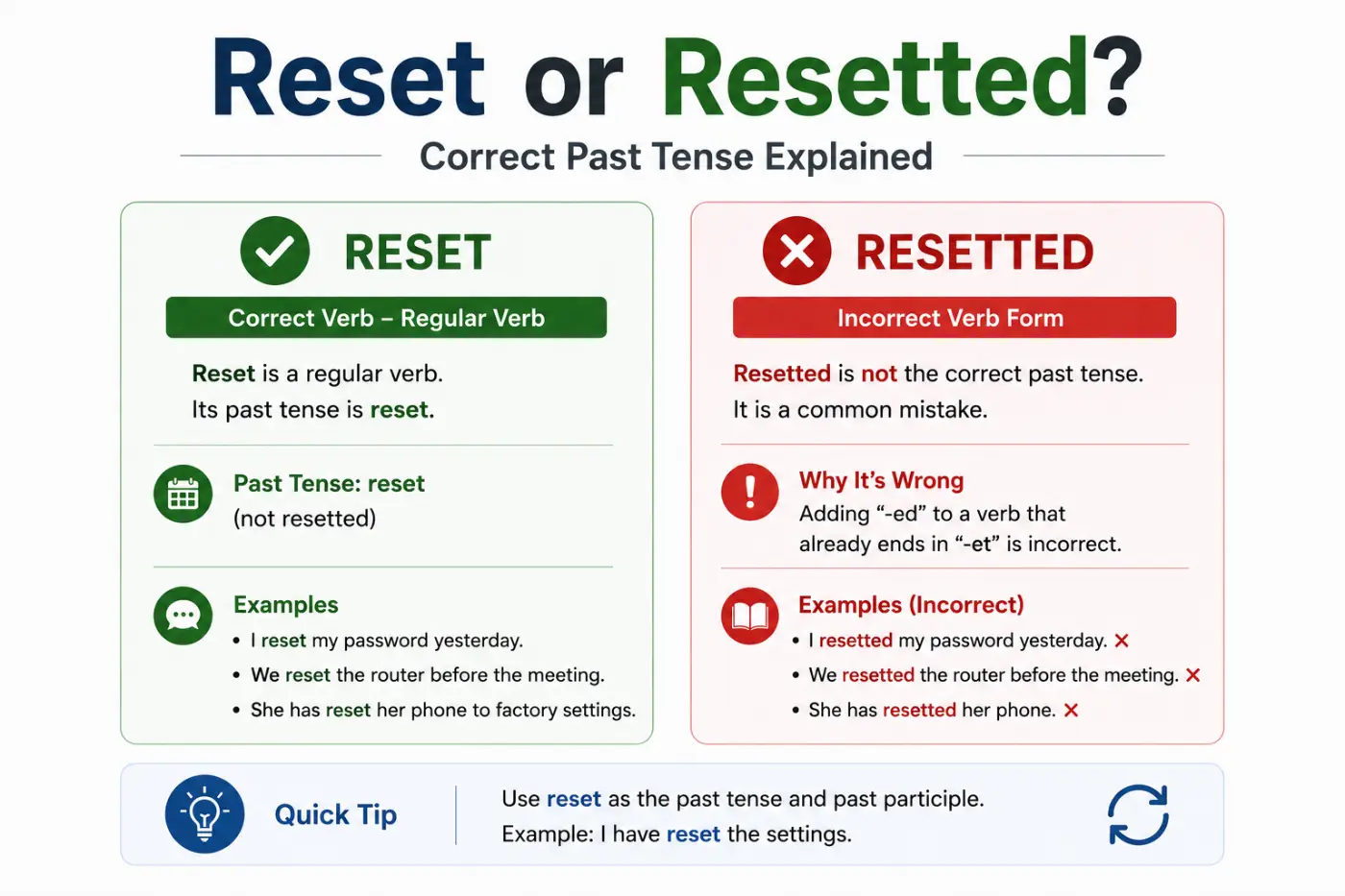
Reset or Resetted is a common grammar question because English verbs usually change form when we talk about the past. We say walked instead of walk and changed instead of change. So when people see reset they naturally wonder if the past form should become resetted. The answer is simple. Reset is the standard past tense and past participle of reset.
The confusion comes from a useful English pattern called an unchanged verb form. Some verbs keep the same spelling across several grammatical forms. Reset belongs to this group. You can say I reset the device today, I reset the device yesterday, and I have reset the device several times. The surrounding words and sentence structure tell you which tense the sentence uses.
This guide explains the grammar behind reset in plain American English. You’ll learn how to use the verb in different tenses, why resetted appears in informal writing, how native speakers use reset, and how to avoid the mistake in professional communication. You’ll also see examples involving technology, work, machines, accounts, settings, and everyday situations.
Short Answer
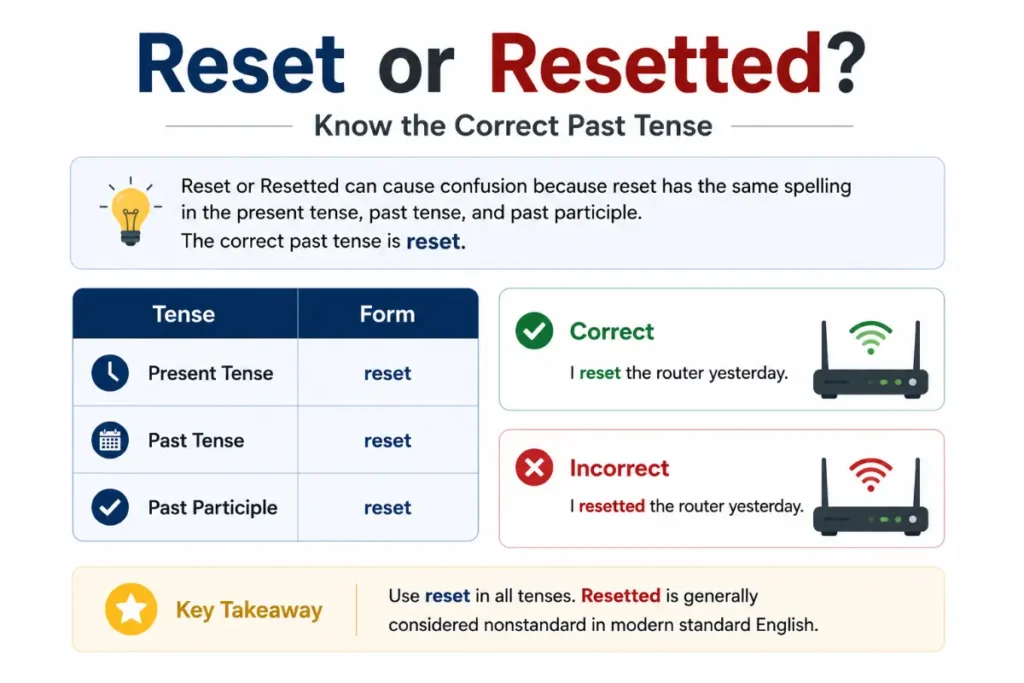
Reset or Resetted can cause confusion because reset has the same spelling in the present tense, past tense, and past participle. The correct past tense is reset. You should say I reset the router yesterday rather than I resetted the router yesterday. Resetted is generally considered nonstandard in modern standard English.
Table of Contents
- The quick answer.
- Why reset stays the same.
- How reset works as a verb.
- Reset in different tenses.
- Reset compared with resetted.
- Real life examples.
- Common mistakes.
- Why people say resetted.
- Pronunciation guide.
- Formal and informal usage.
- American and British English.
- Related verbs.
- Memory tips.
- Professional writing advice.
- Frequently asked questions.
- Key takeaways.
- Conclusion.
The Quick Answer
The standard past tense of reset is reset.
You should write:
I reset my password yesterday.
You should not write:
I resetted my password yesterday.
The same rule applies to the past participle.
She has reset the account.
Not:
She has resetted the account.
Reset is one of those verbs that looks unusual because the spelling does not visibly change when the tense changes.
Why Reset Stays The Same
English has several verbs that keep the same form in the present, past, and past participle.
Examples include:
- Cut, cut, cut.
- Put, put, put.
- Hit, hit, hit.
- Set, set, set.
- Shut, shut, shut.
- Cost, cost, cost.
- Hurt, hurt, hurt.
- Reset, reset, reset.
The important point is that a verb does not need a different spelling to express past time.
Consider the verb cut.
I cut the paper every morning.
I have cut the paper already.
The word cut remains unchanged. Reset works in much the same way.
I reset the phone every month.
I have reset the phone several times.
The tense comes from the surrounding grammar and the time expression. Words such as yesterday and last night can show past time. Helping verbs such as have and has can create the present perfect.
This is why adding ed to reset is unnecessary. The verb already has its standard past form.
How Reset Works As A Verb
Reset means to set something again or return something to a previous or starting condition.
The word commonly appears in technology. You can reset a password, reset a phone, reset a router, reset an account, reset a device, or reset a system.
The verb can also describe physical objects and situations.
You might reset a clock after a power outage. You might reset a timer before starting an experiment.
The figurative meaning is also common.
Someone might say they need to reset after a stressful week. In that use, reset means to regain balance or return to a better state.
The basic grammatical pattern stays the same across these meanings.
Present
I reset the timer.
Past
I reset the timer yesterday.
Past participle
I have reset the timer.
The form does not change.
Reset Or Resetted In Standard English
Reset or Resetted becomes easier to understand once you recognize the verb pattern.
The standard forms are:
| Verb Form | Correct Form | Example |
|---|---|---|
| Base form | Reset | I reset the device often. |
| Third person singular | Resets | She resets the system every morning. |
| Past tense | Reset | She reset the system yesterday. |
| Present participle | Resetting | She is resetting the system now. |
| Past participle | Reset | She has reset the system already. |
Notice the one form that changes in the present tense.
We say he resets and she resets.
We also say resetting for the continuous form.
But the simple past remains reset.
The extra ed in resetted isn’t needed because English already has an established past form for this verb.
The Grammar Rule Behind Reset
The best way to understand reset is to look at the larger category of verbs that don’t change in the simple past.
These verbs are sometimes called invariant verbs because the same form can serve different grammatical functions.
For example:
I set the alarm.
I have set the alarm.
Set stays the same.
Reset behaves similarly because it developed from set with the prefix re.
The prefix re means again or back to a previous state. So reset essentially means set again.
That connection helps explain the grammar.
Set does not become setted in standard English.
Therefore reset does not become resetted.
The past form remains reset.
Reset In Different Tenses
Understanding all the major forms makes the rule much easier to remember.
Simple Present
Use reset for regular or repeated actions.
I reset my router every Sunday.
The sentence describes a routine.
Another example is:
She resets her password regularly.
The subject she requires resets because standard present tense grammar adds s to the third person singular form.
Simple Past
Use reset when the action happened in the past.
I reset the router last night.
The word reset looks exactly like the base form. The phrase last night makes the past meaning clear.
Another example is:
He reset the machine after the error.
The action happened before now.
Present Perfect
Use have or has with reset.
I have reset the device.
She has reset her password.
Here reset is the past participle.
The form remains unchanged.
Past Perfect
Use had with reset.
They had reset the system before the technician arrived.
The resetting happened before another past event.
Again the main verb stays reset.
Future
Use will with reset.
I will reset the account tomorrow.
The base form follows will.
Present Continuous
Use am, is, or are with resetting.
I am resetting the device now.
Here the spelling changes because English uses the ing form.
The correct form is resetting rather than reseting.
Past Continuous
Use was or were with resetting.
She was resetting the router when the power went out.
The action was in progress at a particular point in the past.
Future Continuous
Use will be with resetting.
They will be resetting the system tonight.
The action will be in progress at a future time.
Why Resetted Sounds Natural To Some Speakers
Many English learners and even native speakers create resetted because they apply a familiar pattern. A huge number of English verbs form the past tense by adding ed.
Examples include:
- Talk becomes talked.
- Clean becomes cleaned.
- Change becomes changed.
- Reset sounds like it should become resetted.
- Update becomes updated.
- Repair becomes repaired.
That pattern is so common that the brain may automatically apply it to reset.
There is another reason.
The pronunciation of reset can make the word feel like a regular verb. Since the final t sound remains strong, adding ed may seem logical.
But English grammar doesn’t always follow the simplest visible pattern.
Set is already an established unchanged verb. Reset follows that pattern.
This is a good example of why English spelling and grammar can’t always be predicted by adding the most common ending.
Real Life Examples
Technology
I reset my phone because it stopped responding.
The action happened in the past. Reset is correct.
She reset the Wi Fi router after the connection failed.
Again, reset functions as the simple past.
The technician has reset the server.
Here reset is the past participle after has.
Passwords And Accounts
I reset my password yesterday.
The time expression yesterday clearly places the action in the past.
He reset his account settings after noticing a problem.
The action happened before the current moment.
We have reset your login information.
The present perfect uses have plus the unchanged past participle reset.
Household Situations
I reset the clock after the power came back.
Reset describes a completed past action.
She resets the thermostat every morning.
The action happens regularly, so resets is correct.
We will reset the timer before dinner.
Will requires the base form reset.
Workplace Situations
The manager reset the system after the error appeared.
Reset is the correct past tense.
The team has reset the equipment.
Reset is the correct past participle.
The technician is resetting the controls now.
Resetting is used because the action is currently in progress.
Common Mistakes
Using Resetted For The Past
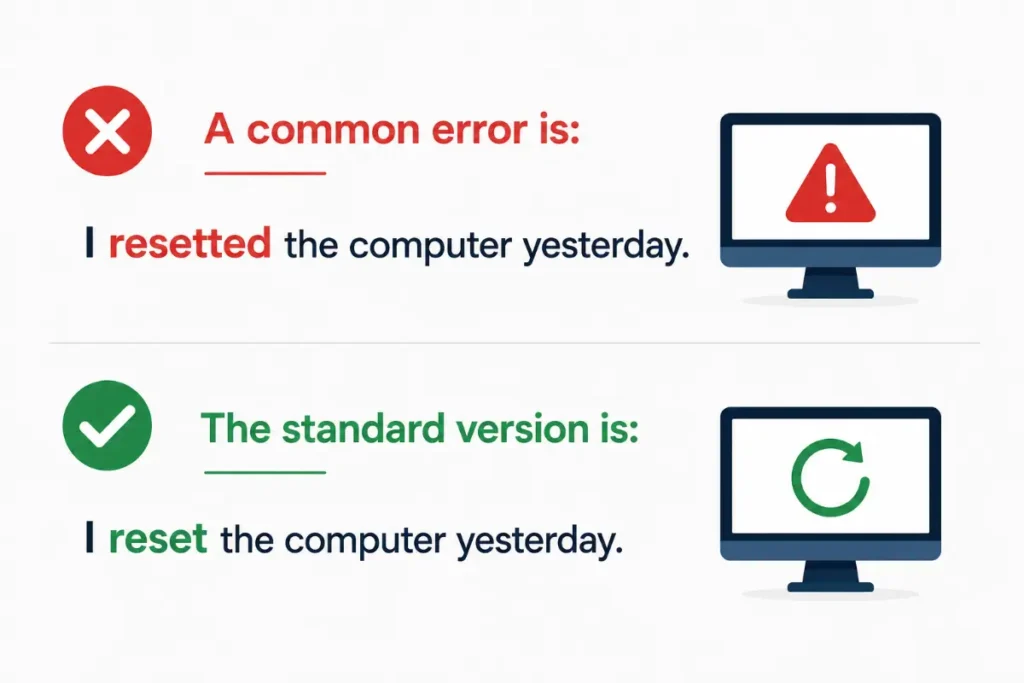
A common error is:
I resetted the computer yesterday.
The standard version is:
I reset the computer yesterday.
The problem is the unnecessary ed ending.
Using Resetted After Have
Another common mistake is:
She has resetted the password.
The standard form is:
She has reset the password.
After have or has you need the past participle. For this verb the past participle is reset.
Writing Reseting
Some writers remove one t before adding ing.
That produces reseting.
The correct spelling is resetting.
The final consonant is doubled before the ing ending.
Confusing Reset With Restart
Reset and restart can overlap in technology but they don’t always mean exactly the same thing.
Restart usually means stopping something and starting it again.
Reset often means returning something to a default or previous state.
For example a router can be restarted without its settings being erased. A factory reset can remove settings and return a device to its original configuration.
Assuming Every Past Verb Needs Ed
This is a broader grammar mistake.
English has many irregular verbs and several unchanged verbs. You can’t form every past tense by adding ed.
Go becomes went.
Take becomes took.
Set remains set.
Reset remains reset.
Common Questions About Reset Grammar
People often ask why reset looks the same in several tenses. The answer is that English doesn’t require visible spelling changes for every verb.
Compare these sentences.
I reset the phone.
I have reset the phone.
The word stays the same. Grammar supplies the tense through context and auxiliary verbs.
This is completely normal.
English readers don’t need the word itself to change in order to understand the time relationship.
Pronunciation Guide
Reset has two common stress patterns depending on the grammatical form.
As a verb the pronunciation is commonly represented as:
/ˌriːˈset/
An easy pronunciation guide is:
ree SET
The stress falls on the second syllable.
The word contains two syllables.
- Ree.
- Set.
The past tense reset has the same pronunciation as the base verb in standard usage.
That means the spoken language doesn’t give you a special sound that tells you the action happened in the past.
Context does that job.
For example:
I reset the device every morning.
I reset the device yesterday.
The word reset sounds the same. The time phrase changes the meaning.
This is another reason learners may feel tempted to create resetted. They may expect the past form to sound different. Standard English doesn’t require that change here.
Formal And Informal Usage
Reset is suitable for virtually every level of English.
You can use it in casual speech.
I reset my phone.
You can use it in professional writing.
The technician reset the system after identifying the fault.
You can use it in academic writing.
The device was reset before each trial.
You can use it in technical documentation.
Reset the unit before beginning the installation procedure.
Resetted does not have the same status in standard formal English. You may encounter it in informal online writing or learner writing but that doesn’t make it the preferred standard form.
For professional communication the safest choice is simple.
Use reset for the past tense and past participle.
American And British English
American and British English use reset in the same standard way.
An American writer would say:
I reset the computer yesterday.
A British writer would also say:
I reset the computer yesterday.
The past tense does not change to resetted in standard American or British English.
This is not one of those spelling differences that separates the two varieties.
Words such as color and colour have established regional variants. Reset and resetted don’t work that way.
If you’re writing for an American audience use reset.
If you’re writing for a British audience use reset.
The same standard grammar applies.
Related Verbs
Several verbs behave like reset because they share a similar grammatical pattern or come from related base verbs.
Set
Set is one of the clearest examples.
I set the alarm yesterday.
Not:
I setted the alarm yesterday.
Because reset contains set as its base, the same unchanged past form carries into reset.
Upset
Upset behaves in a similar way.
She upset the schedule yesterday.
Not:
She upsetted the schedule yesterday.
Beset
Beset is another example.
The team was beset by problems.
Its form doesn’t change in the same way regular verbs do.
These examples can help you remember the pattern. Reset isn’t an isolated oddity. English contains several verbs that retain the same form across the simple present base, simple past, and past participle in relevant constructions.
Memory Tips
A good memory trick is to connect reset with set.
Think:
Set stays set. Reset stays reset.
If you know the phrase:
I set it yesterday.
You can transfer the same pattern:
I reset it yesterday.
Don’t add ed just because the action happened in the past.
Another useful trick is to remember three short sentences.
I reset it.
I have reset it.
The verb remains unchanged in all three.
The third person singular is the exception you should remember separately.
She resets it.
And the continuous form is:
She is resetting it.
That gives you the core pattern without memorizing a long grammar chart.
Related Grammar And Usage Notes
Reset As A Transitive Verb
Reset is often transitive. That means it commonly takes a direct object.
I reset the device.
The device receives the action.
She reset the password.
The password receives the action.
Reset Without An Object
Reset can also appear without a direct object when the context makes the meaning clear.
Try restarting the machine and then reset.
This use is less common in ordinary conversation but can occur in instructions and technical contexts.
Reset To
Reset often appears with to when you specify the new or original state.
The system was reset to its default configuration.
The preposition to helps identify the destination state.
Reset After
Reset can also be followed by after when you describe the event that caused or preceded the action.
I reset the router after the connection failed.
Reset Before
Before works similarly.
Reset the timer before starting the test.
These patterns are common in technical instructions and everyday conversation.
Professional Writing Tips
Professional writing rewards precision. You don’t need complicated language to sound knowledgeable.
When describing a completed reset use reset.
For example:
The administrator reset the account after verifying the user’s identity.
That sentence is direct and grammatically standard.
Avoid:
The administrator resetted the account.
You may also want to distinguish between reset and restart in technical documents.
If a process returns a device to default settings then reset may be the right term.
If the process simply stops and starts the system again then restart may be more accurate.
That distinction matters because technical writing depends on exact meaning.
A good editor won’t correct a sentence simply because reset looks unusual in the past tense. Instead the editor checks the verb pattern and sentence context.
Expert Editor Insight
One of the easiest ways to catch this mistake is to stop thinking about reset as a regular verb. Treat it as a member of the set family. Set stays set in the past and reset follows the same pattern. When you see resetted in polished American English, the extra ed should immediately stand out. The same principle applies to other unchanged verbs. Don’t force a regular pattern onto a verb that already has its own established grammar.
Key Takeaways
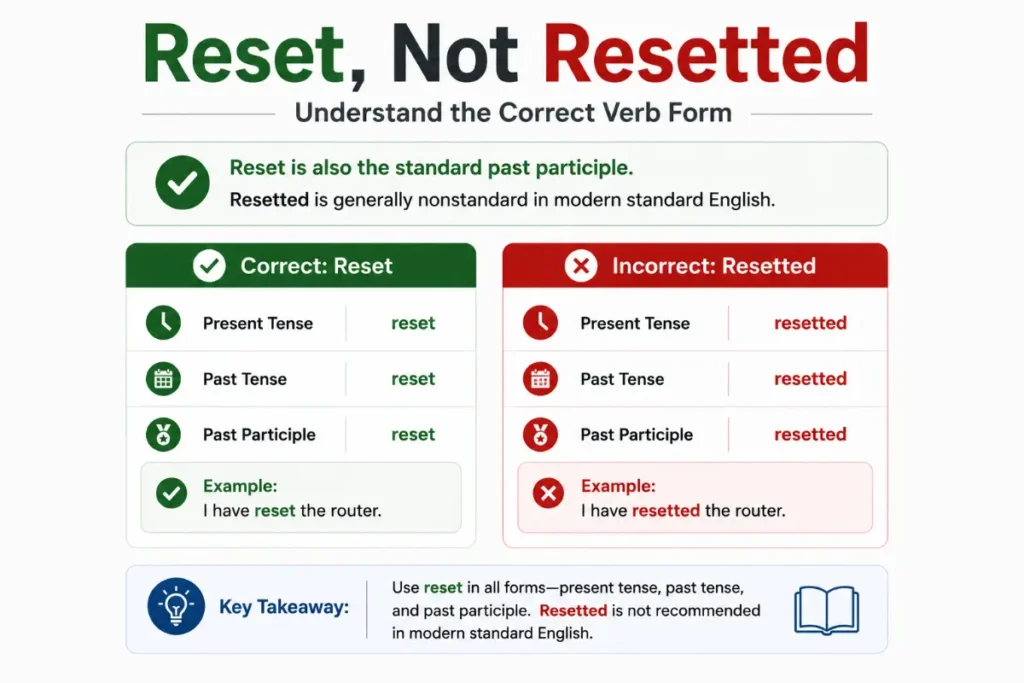
- Reset is the standard past tense of reset.
- Reset is also the standard past participle.
- Resetted is generally nonstandard in modern standard English.
- Reset follows the same basic pattern as set.
- The simple past can be reset even though the spelling doesn’t change.
- The present third person singular form is resets.
- The continuous form is resetting.
- Reset works in both American and British English.
- Reset and restart can have different technical meanings.
- The easiest memory trick is set stays set and reset stays reset.
Conclusion
Reset or Resetted has a straightforward answer. The correct standard form is reset. You can use reset for the base verb, simple past, and past participle. The form doesn’t become resetted simply because the action happened in the past.
The reason is tied to the verb set. Set keeps the same form in the simple past and past participle, and reset follows that established pattern. So you can write I reset the device yesterday, I have reset the account, and She reset the timer without changing the main verb.
The best practical tip is to remember one short line: set stays set and reset stays reset. Once that pattern sticks, you’ll have little reason to use resetted in standard English again.
Frequently Asked Questions
Is reset the past tense of reset
Yes. Reset is the standard past tense of reset. The spelling stays unchanged even though the sentence can describe a completed action. For example, I reset the router yesterday is grammatically correct. The word yesterday provides the past time reference. The form does not need an ed ending.
Is resetted grammatically correct
Resetted is generally not considered standard English for the past tense or past participle of reset. You may see it in informal writing or learner English, but standard edited English uses reset. Write I reset the device and I have reset the device instead of using resetted.
Why does reset not become resetted
Reset follows the same basic pattern as set. Set has the same form in its simple past and past participle. Because reset is formed from set with the prefix re, its past form remains reset. English contains several verbs that don’t take the regular ed ending in the past.
Can I say I reset it yesterday
Yes. I reset it yesterday is completely correct. Reset is the standard simple past form. The word yesterday clearly shows that the action occurred in the past. You don’t need to change reset to another spelling. The sentence works naturally in both American and British English.
Is reset an irregular verb
Reset can be described as an irregular or unchanged verb because its simple past and past participle don’t follow the regular ed pattern. More specifically, it belongs to a group of verbs whose forms remain unchanged in these positions. Thinking of it as a verb that follows set is often more useful than memorizing a label.
What is the past participle of reset
The past participle is reset. Use it after have, has, or had. For example, I have reset the device is correct. She has reset her password is also correct. The same form appears in the simple past, but the auxiliary verb helps identify the present perfect or past perfect construction.
What is the difference between reset and restart
Reset usually means returning something to a previous or default state. Restart generally means stopping something and starting it again. A computer can restart without losing its settings. A device can undergo a factory reset that removes settings and returns it to its original configuration. The exact distinction depends on context.
How do you spell resetting
The correct spelling is resetting with two t letters before ing. The base word reset ends in a consonant preceded by a stressed short vowel sound, so the final consonant is doubled when the ing ending is added. For example, The technician is resetting the device is correct.
Can reset be used as a noun
Yes. Reset can function as a noun in some contexts. For example, a technician might refer to a system reset or a factory reset. The noun is especially common in technology and technical writing. The verb is also extremely common. Context tells readers which grammatical role the word has.
Is reset the same in American and British English
Yes. Standard American and British English both use reset as the past tense and past participle. Resetted is not a standard regional alternative. You can use reset confidently in writing for either audience. The word does not have an American and British past tense difference.

English Grammar & Usage
Nathan Holloway is an American grammar writer and language researcher who specializes in English grammar, sentence structure, verb usage, and common writing mistakes. He enjoys breaking down confusing grammar rules into practical explanations with clear examples, making English easier for students, professionals, and everyday writers.