
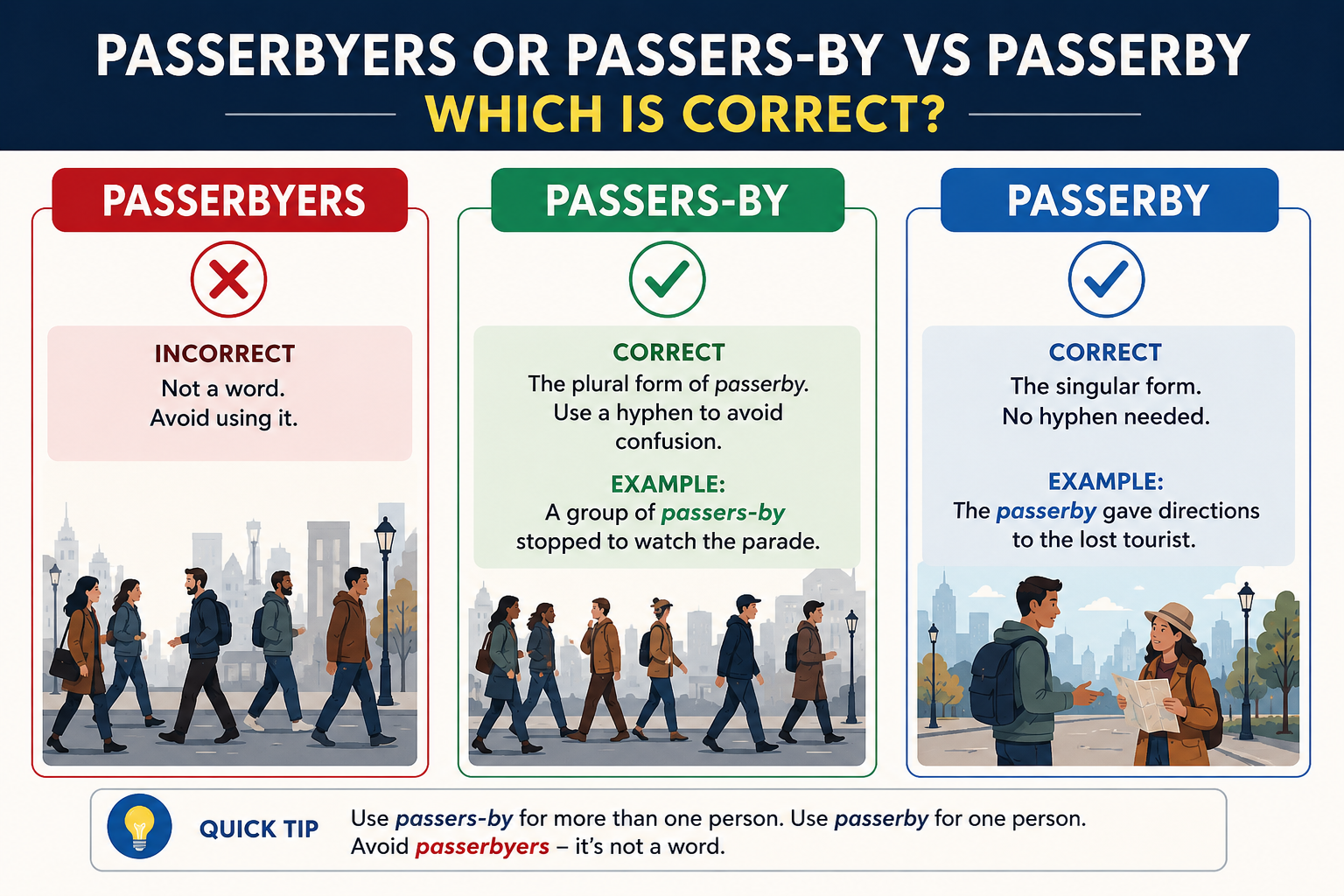
Passerbyers or Passers-By vs Passerby can look confusing because English has several ways to describe people who happen to pass a place. The correct singular noun is passerby, meaning a person who passes by. For the plural, passersby is the standard form. Passerbyers is not a standard plural and should not be used in formal or everyday English.
The confusion comes from the unusual structure of the word. Many English nouns form their plurals by adding s to the end, so a writer may naturally see passerby and create passerbyers. That instinct makes sense at first glance, but passerby is a compound noun. Its plural form changes the first part rather than simply adding a plural ending to the whole word.
Once you understand that pattern, the spelling becomes much easier to remember. This guide explains the meaning, grammar, plural rule, pronunciation, word origin, American and British usage, sentence structure, common mistakes, and practical examples. You’ll also see why passersby works and why passerbyers does not.
Short Answer
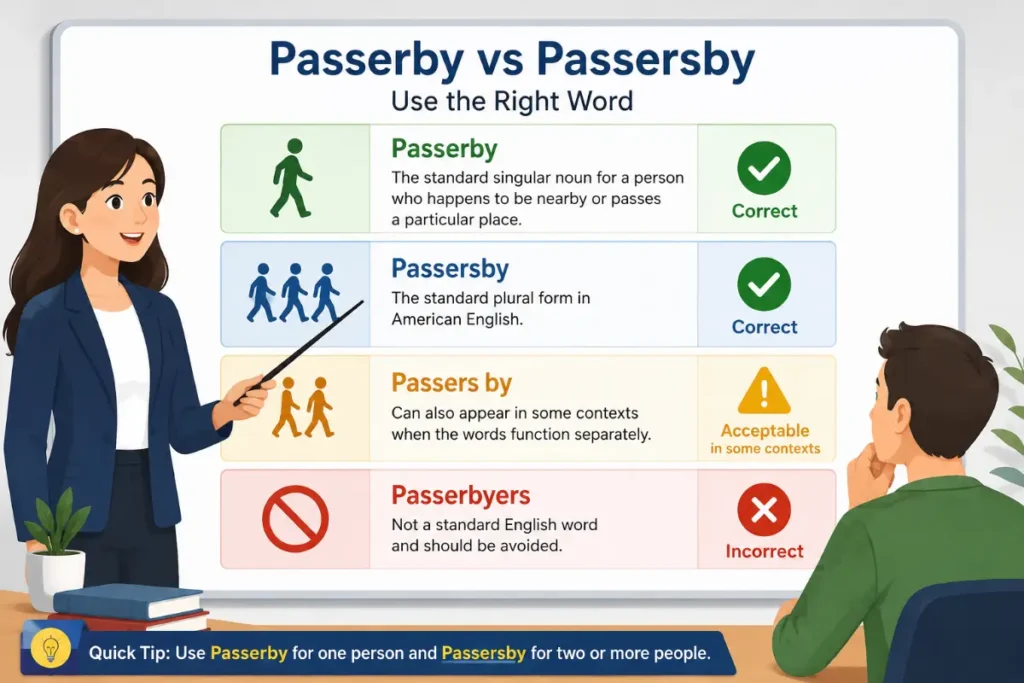
Passerby is the standard singular noun for a person who happens to be nearby or passes a particular place. Passersby is the standard plural form in American English. Passers by can also appear in some contexts when the words function separately. Passerbyers is not a standard English word and should be avoided
Table Of Contents
- The Correct Form.
- What Passerby Means.
- Why Passersby Is The Correct Plural.
- Why Passerbyers Is Incorrect.
- Passers By As Two Words.
- Comparison Of The Forms.
- Grammar Rules For Passerby.
- How To Use Passersby In A Sentence.
- Pronunciation Guide.
- Word Origin And History.
- American And British Usage.
- Formal And Informal Usage.
- Real Life Examples.
- Common Mistakes.
- Memory Tips.
- Related Words And Expressions.
- Expert Editor Advice.
- Key Takeaways.
- FAQs.
- Conclusion.
The Correct Form
The correct singular noun is passerby.
The standard plural noun is passersby.
The form passerbyers is incorrect.
The expression passers by can also be grammatically correct in a different sentence structure. The important distinction is that passersby is a plural noun while passers by can describe people who pass by in a particular construction.
For ordinary writing, remember this simple pattern:
One person: passerby.
Two or more people: passersby.
Incorrect plural: passerbyers.
For example:
A passerby called the police.
Several passersby stopped to help.
You would not normally write:
Several passerbyers stopped to help.
The mistake is easy to understand because many nouns take a simple plural ending. However, compound nouns don’t always follow that pattern.
What Passerby Means
A passerby is a person who happens to pass a particular place. The person doesn’t need to have any connection with the location or event.
For example:
A passerby noticed the broken window.
The sentence tells us that someone happened to be passing when they noticed the window.
Another example is:
A passerby helped the people older than 70 cross the street.
The person who helped wasn’t necessarily a friend, family member, employee, or official. The word simply identifies someone who was passing by.
The term is especially useful when the identity of the person isn’t known or isn’t relevant.
You might see it in news reports:
A passerby reported the accident.
You might see it in storytelling:
A passerby stopped and looked toward the strange noise.
You might also see it in everyday conversation:
A passerby gave us directions.
The word therefore has a practical job. It identifies an unknown or incidental person who happens to be moving past a particular location.
Why Passersby Is The Correct Plural
The plural form passersby follows a pattern found in several English compound nouns.
The word passerby is made from passer and by. Historically and grammatically the main noun is passer. The word describes someone who passes by.
When the noun becomes plural, the plural marker applies to passer:
passerby.
passersby.
This is similar to other compound nouns in which the main noun receives the plural form.
Consider:
mother in law.
mothers in law.
attorney general.
attorneys general.
runner up.
runners up.
These compounds don’t simply receive an s at the very end. English identifies the central noun and places the plural marking there.
The same idea explains passersby.
A passerby is one person.
Several passersby are several people.
The structure may seem unusual because by remains unchanged. That’s perfectly normal. By functions as part of the compound rather than as the noun that needs the plural marker.
Why Passerbyers Is Incorrect
Passerbyers looks plausible because English speakers frequently form plurals by adding s or es. But the problem is that passerby isn’t pluralized by attaching an extra ending to the entire word.
The correct plural is passersby.
Adding ers to the end creates a form that doesn’t belong to standard English vocabulary.
This kind of error can be described as a morphological overgeneralization. A writer knows that English often adds a suffix to create a new form and applies that familiar pattern to a word that follows a different rule.
The same basic problem appears in other areas of English.
A learner may see mother in law and write mother in laws.
The standard plural is mothers in law.
Someone may see attorney general and write attorney generals when referring to multiple officeholders.
The traditional plural is attorneys general.
These examples show why looking only at the final letter can lead you astray. The structure of a compound noun matters.
Passers By As Two Words
Passers by can be correct, but it doesn’t always mean exactly the same grammatical thing as the noun passersby.
When passersby functions as a single compound noun, it refers to people who pass a location.
For example:
The passersby watched the parade.
Here passersby is the plural noun.
The two word expression passers by can appear when passers is functioning as a noun and by is functioning separately.
For example:
The passers by the old building noticed the new sign.
In this sentence, passers is the noun and by the old building identifies the people who passed the building.
However, this construction is less common in ordinary modern writing than the compound noun passersby.
Another example can make the distinction clearer:
The passersby stopped to watch.
Here the whole word functions as a plural noun.
The people passing by the store stopped to watch.
Here passing by is part of a verb phrase.
The distinction matters because English often allows related words to operate as either compounds or separate grammatical units.
Comparison Of The Forms
| Form | Correct | Main Function | Meaning | Example |
|---|---|---|---|---|
| passerby | Yes | Singular noun | One person who passes by | A passerby called for help. |
| passersby | Yes | Plural noun | Two or more people who pass by | Several passersby stopped. |
| passerbyers | No | Not standard | Intended as plural of passerby | Avoid this form. |
| passers by | Sometimes | Separate grammatical words | People who pass by in a particular construction | The passers by the entrance noticed the crowd. |
| passing by | Yes | Verb phrase | Moving past a person or place | People were passing by the store. |
This table highlights the key point. Passersby and passers by are not always interchangeable. The first is a compound plural noun. The second can consist of separate words that happen to occur together.
Grammar Rules For Passerby
Singular Usage
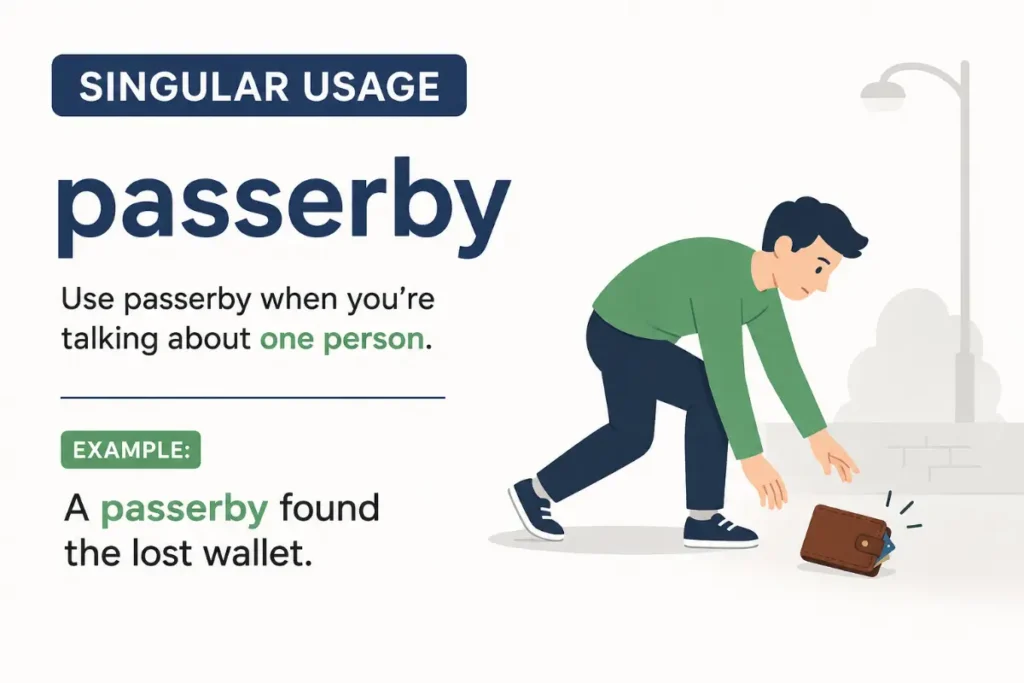
Use passerby when you’re talking about one person.
For example:
A passerby found the lost wallet.
The article a confirms that the noun is singular.
You can also use the:
The passerby gave the police a description.
The word can function as the subject or object of a sentence.
A passerby noticed the smoke.
The firefighter thanked the passerby.
Plural Usage
Use passersby when you’re talking about more than one person.
For example:
Several passersby gathered outside the building.
The police asked passersby for information.
Notice that the plural marker appears on passer rather than at the end of the whole compound.
Possessive Usage
The possessive form follows normal noun rules.
For one person:
The passerby’s account was helpful.
For multiple people:
The passersby’s accounts were consistent.
The plural possessive can look complicated because passersby already contains an internal plural ending.
The basic forms are:
passerby.
passer’s.
passersby.
passersby’s.
In polished writing, context usually makes the intended meaning clear.
Capitalization
Passerby is normally lowercase unless it begins a sentence or appears in a proper name.
For example:
A passerby called the police.
The word doesn’t need capitalization simply because it refers to a person.
How To Use Passersby In A Sentence
The word passersby usually works as a plural noun.
Consider these examples:
Several passersby stopped to watch the street performer.
The passersby continued walking despite the rain.
Police asked passersby if they had seen the missing vehicle.
The store attracted the attention of several passersby.
Passersby gathered around the injured cyclist.
In each example, the word refers to multiple people who happened to be passing through the area.
The word can appear in different positions.
As the subject:
Passersby helped the driver.
As the object:
The loud noise startled several passersby.
After a preposition:
The sign caught the attention of passersby.
In a possessive phrase:
The passersby’s comments helped the investigation.
Pronunciation Guide
Passerby is commonly pronounced with three syllables.
A simple American English approximation is:
PASS er bye.
The first part sounds like pass.
The second syllable is weaker.
The final syllable sounds like bye.
The plural passersby adds an s sound to the first part:
PASS erz bye.
The spelling can make the word look more complicated than it sounds. Once you hear it spoken, the structure becomes much easier to recognize.
A common mistake is to pronounce passerby as if by were a separate word that needs extra emphasis. In natural speech, the compound is usually pronounced smoothly.
Word Origin And History
The word passerby developed from the ordinary English phrase pass by. The verb pass has a long history in English and entered through Anglo French and Old French forms connected with the idea of moving past or going through. The word by is an old English preposition and adverb associated with proximity and movement past something.
Over time, English combined the idea of a person who passes by with the noun forming element passer.
A passer is someone who passes.
A passerby is someone who passes by.
This type of word formation is common in English. A familiar phrase can gradually become a fixed compound noun.
The modern spelling passerby is now well established in dictionaries and general English usage.
The plural pattern also reflects the structure of the compound. The person is the passer, so the plural form becomes passersby.
American And British Usage
American and British English generally agree on the basic forms passerby and passersby. This is different from spelling pairs such as color and colour or center and centre.
You don’t normally need to change passerby to another regional spelling simply because you’re writing for a Brit ish audience.
British writers also use passerby and passersby.
American writers use the same forms.
The bigger issue is style and consistency rather than regional spelling. You may encounter variations in older texts or specialized publications, but modern standard English strongly favors passerby for one person and passersby for multiple people.
Formal And Informal Usage
Passerby works well in both formal and informal writing.
It’s common in:
News reports.
Police reports.
Academic writing.
Narrative writing.
Everyday conversation.
Business communication.
For example:
A passerby reported the incident to authorities.
This sounds perfectly natural in formal writing.
You could also say:
A person who happened to be nearby reported the incident.
That version is longer but more explicit.
In most cases, passerby is the cleaner choice.
The word can also sound slightly more literary than simply saying someone walking past. That’s not a problem. In news writing and descriptive prose, it can be especially useful because it communicates the idea efficiently.
Real Life Examples
Daily Conversation
A passerby helped me find the right street. Several passersby stopped when they heard the noise. These examples show ordinary situations in which an unknown person happens to be nearby.
News Writing
A passerby alerted emergency workers after noticing smoke coming from the building. Several passersby witnessed the collision and provided information to investigators. News writers often use the word because the identity of the person isn’t known or isn’t relevant.
Academic Writing
The researchers observed how passersby responded to the public display. The study recorded the number of passersby who stopped near the installation. In academic writing, the word can describe people participating unintentionally in an observation.
Fiction
A passerby paused beneath the streetlamp. Two passersby hurried across the square as the rain began. The word works well in descriptive prose because it introduces people who enter a scene without being central characters.
Professional Writing
A passerby discovered the damaged sign and notified the property manager. The entrance receives heavy foot traffic from passersby throughout the day. These sentences show that the word isn’t limited to literary writing.
Common Mistakes
Writing Passerbyers
This is the most obvious error.
Incorrect:
Several passerbyers stopped to help.
Correct:
Several passersby stopped to help.
The mistake comes from treating passerby like an ordinary noun that takes a plural ending at the end.
Writing Passerby’s For A Plural Noun
Incorrect:
The passerby’s watched the event.
Correct:
The passersby watched the event.
The apostrophe doesn’t belong in the ordinary plural.
Writing Passersbys
This form is also unnecessary and incorrect in standard usage.
The plural is already passersby.
You don’t need to add another s at the end.
Confusing Passerby With Passer By
These forms can serve different grammatical purposes.
Passerby is a noun.
Passer by can be a verb and preposition combination.
For example:
A passerby called the police.
A person may pass by the store.
The first sentence names a person.
The second describes an action.
Using Passerby For Multiple People
Incorrect:
Five passerby saw the accident.
Correct:
Five passersby saw the accident.
Once the noun is plural, the s belongs after passer.
Memory Tips
The easiest way to remember the plural is to focus on the person rather than the location.
A passerby is a passer who goes by.
One passer goes by.
Several passers go by.
Therefore:
passerby.
passersby.
Think of the word as saying people who pass by.
Another useful memory trick is to remember that the plural changes the person word.
You don’t say:
personby.
You say:
people who pass by.
Likewise, the plural changes passer to passers.
This gives you passersby.
If you see passerbyers, pause. The word has already identified the person as a passer. Adding another ending creates a form English doesn’t need.
Related Grammar And Usage Notes
Passer
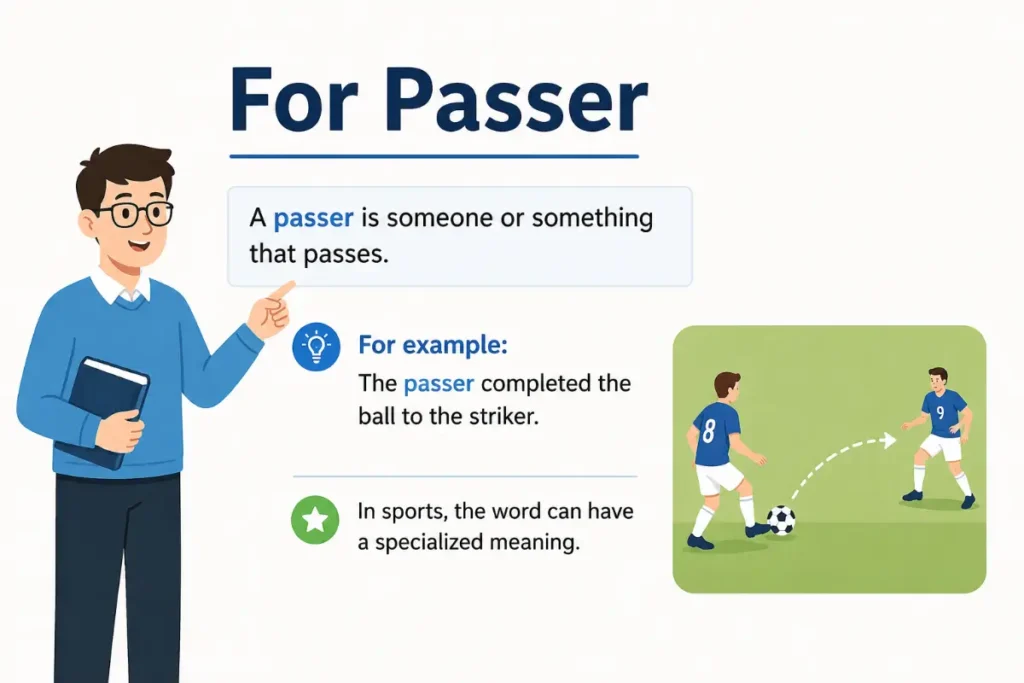
A passer is someone or something that passes.
For example:
The passer completed the ball to the striker.
In sports, the word can have a specialized meaning.
Passing By
Passing by describes the action of moving past something.
For example:
People were passing by the window.
This isn’t a noun like passerby.
Pass By
Pass by is commonly used as a verb phrase.
For example:
I pass by that store every morning.
It can also appear in other forms:
She passed by the house.
They passed by without stopping.
Bystander
A bystander is a person who is present at an event but isn’t directly involved.
A passerby may become a bystander after stopping to observe something.
For example:
A passerby saw the accident.
After stopping to watch, the person became a bystander.
The two words overlap but aren’t exact synonyms.
Pedestrian
A pedestrian is a person traveling on foot, especially in contrast with someone in a vehicle.
A pedestrian doesn’t have to be a passerby.
For example:
The pedestrian crossed the street.
A passerby might be walking past a particular location, but the word focuses on passing rather than simply being on foot.
Onlooker
An onlooker is someone who watches an event.
A passerby may become an onlooker if they stop to watch.
Again, the words describe different aspects of the person’s role.
Semantic Difference Between The Related Terms
Understanding related vocabulary helps prevent subtle word choice mistakes.
Passerby focuses on movement past a place.
Bystander focuses on being present without direct involvement.
Onlooker focuses on watching.
Pedestrian focuses on traveling on foot.
Visitor focuses on coming to a place for a purpose.
For example, imagine someone walking past a restaurant.
At first, that person is a passerby.
If the person stops to watch an accident, they become an onlooker.
If you’re emphasizing that the person is walking rather than driving, pedestrian may be the better term.
These distinctions make writing more precise.
Why The Plural Rule Feels Unusual
English learners often expect plural nouns to behave predictably.
Dog becomes dogs.
Car becomes cars.
Teacher becomes teachers.
So why doesn’t passerby become passerbys?
The answer lies in compound noun structure.
English has many compound nouns whose plural forms preserve the grammatical role of the main noun.
Consider:
father in law.
fathers in law.
commander in chief.
commanders in chief.
runner up.
runners up.
These examples demonstrate that the final word doesn’t always receive the plural ending.
The same pattern appears in passersby.
The word refers to people who are passers. The plural marker therefore attaches to passer.
This is a useful grammatical pattern to learn because it applies beyond one vocabulary item.
When Passersby Sounds Better Than A Longer Phrase
Writers sometimes replace passersby with phrases such as people walking past or people who happened to be nearby.
Those phrases aren’t wrong, but they can make a sentence heavier.
Compare:
Several people who happened to be walking past stopped to help.
Several passersby stopped to help.
The second sentence is shorter and cleaner.
That doesn’t mean passersby should appear everywhere. If your audience needs a very plain expression, people walking past may feel more conversational.
For most general writing, though, passersby is clear and familiar.
Professional Writing Tips
If you’re editing an article, report, essay, or news story, check three things.
First, confirm that the singular form is passerby.
Second, check that the plural form is passersby.
Third, make sure you’re not confusing the noun with the verb phrase pass by.
Context usually makes the difference obvious.
For example:
A passerby noticed the damaged vehicle.
This is a noun.
Several passersby noticed the damaged vehicle.
This is the plural noun.
Several people passed by the damaged vehicle.
This is a verb phrase.
The grammatical structure changes even though all three sentences involve people moving past something.
Expert Editor Advice
A professional editor would almost always change passerbyers to passersby in standard English. The form passerbyers is not a normal dictionary plural and adds an unnecessary morphological ending. If you need the singular, use passerby. If you need the plural, use passersby. And If you mean the action, use pass by or passing by. That three way distinction solves nearly every usage problem involving this group of words.
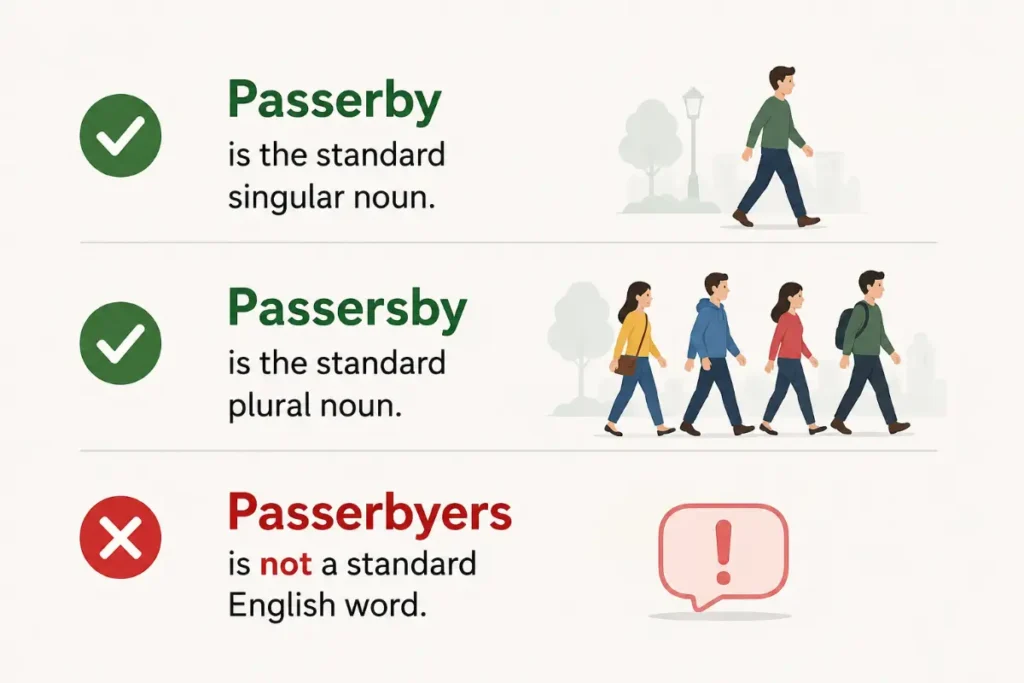
Key Takeaways
- Passerby is the standard singular noun.
- Passersby is the standard plural noun.
- Passerbyers is not a standard English word.
- Passers by can be correct when passers and by function as separate grammatical elements.
- The plural marker belongs to passer, giving us passersby.
- Passerby and passersby are used in both American and British English.
- Passerby refers to someone who happens to pass a place.
- Bystander, onlooker, and pedestrian are related terms but have different meanings.
- The easiest memory trick is to think one passer goes by and several passers go by.
Conclusion
Passerbyers or Passers By vs Passerby becomes much easier once you identify the grammatical structure. Passerby is the correct singular noun for one person who happens to pass a place. Passersby is the standard plural form for two or more people. Passerbyers is not a standard English form and should be avoided.
The main trick is to remember that the plural marker belongs to passer, not to the end of the entire compound. One person is a passerby. Several people are passersby. When you mean the action instead, use pass by or passing by.
If you ever hesitate, think of the phrase people who pass by. One is a passerby. More than one are passersby. That simple pattern will keep your writing accurate and natural.
FAQs
Is Passerbyers A Correct Word?
No. Passerbyers is not a standard English word. If you’re referring to one person who passes by, use passerby. If you’re referring to several people, use passersby. The incorrect form probably develops because writers expect to create a plural by adding an ending to the entire noun. The standard plural changes passer to passers instead.
What Is The Plural Of Passerby?
The standard plural of passerby is passersby. The plural marker appears after passer rather than at the end of the compound. For example, you can write A passerby stopped to help for one person and Several passersby stopped to help for multiple people. Passerbys and passerbyers should be avoided in standard English.
Is Passers By Grammatically Correct?
Passers by can be grammatically correct when the two words perform separate functions in a sentence. However, when you need the plural noun meaning multiple people who pass by, the standard form is passersby. For example, Several passersby stopped uses the compound noun. The exact sentence structure determines which form fits.
Why Is The Plural Passersby Instead Of Passerbys?
The plural is passersby because passer is the main noun within the compound. English places the plural marker on the principal noun in several compound expressions. Similar patterns occur in forms such as mothers in law and runners up. The same grammatical structure produces passersby instead of passerbys.
What Does Passerby Mean?
A passerby is a person who happens to pass a particular place. The person’s identity or purpose usually isn’t central to the sentence. For example, A passerby called the police means that someone who happened to be passing noticed a situation and contacted the police. The word is common in news reports, stories, everyday conversation, and formal writing.
Can Passerby Be Used In Formal Writing?
Yes. Passerby is appropriate in formal and informal English. It appears in journalism, academic writing, reports, professional documents, and literature. It can be especially useful when the identity of a person isn’t known or isn’t relevant. If a simpler phrase fits your audience better, you can also use expressions such as a person walking past.
Is Passerby The Same As Bystander?
No. The words overlap but focus on different ideas. A passerby is someone who passes a location. A bystander is someone present at an event without directly participating. A passerby can become a bystander after stopping to observe an incident. The best word depends on the person’s role in the situation you’re describing.
How Do You Pronounce Passersby?
Passersby is commonly pronounced with three syllables. A simple American English guide is PASS erz bye. The first part receives the strongest stress, while the final part sounds like bye. The pronunciation follows the natural structure of the compound. The spelling may look unusual, but the spoken form is straightforward once you recognize the two parts.
Is Passersby Used In American English?
Yes. Passersby is standard in American English and is widely understood. It isn’t a British only form. American writers use passerby for one person and passersby for more than one person. The same forms are also used in British English. This word doesn’t have the kind of major regional spelling difference found in words such as color and colour.
What Is Another Word For Passerby?
Depending on the context, alternatives include pedestrian, bystander, onlooker, person walking past, and someone passing by. These words aren’t perfect substitutes in every situation. Pedestrian emphasizes walking, onlooker emphasizes watching, and bystander emphasizes being present without direct participation. Passerby specifically emphasizes the person’s movement past a location.
Can I Write Passerbyers In Casual English?
It’s best to avoid passerbyers, even in casual English. The form isn’t a recognized standard plural and may distract readers or make the writing look careless. Casual writing allows many informal expressions, but this particular form isn’t needed because passersby already provides the correct plural. Use passersby when referring to more than one person.
What Is The Difference Between Passerby And Passersby?
Passerby is singular and refers to one person. Passersby is plural and refers to two or more people. For example, A passerby noticed the accident refers to one person. Several passersby noticed the accident refers to several people. The plural changes passer to passers while leaving by unchanged.

Confusing Words, Spelling & Word Choice
Claire Whitmore is a U.S.-based English editor who writes about commonly confused words, spelling differences, and word choice. Her work helps readers understand subtle distinctions between similar-looking words through simple definitions, practical examples, and modern usage guidance in both American and British English.