
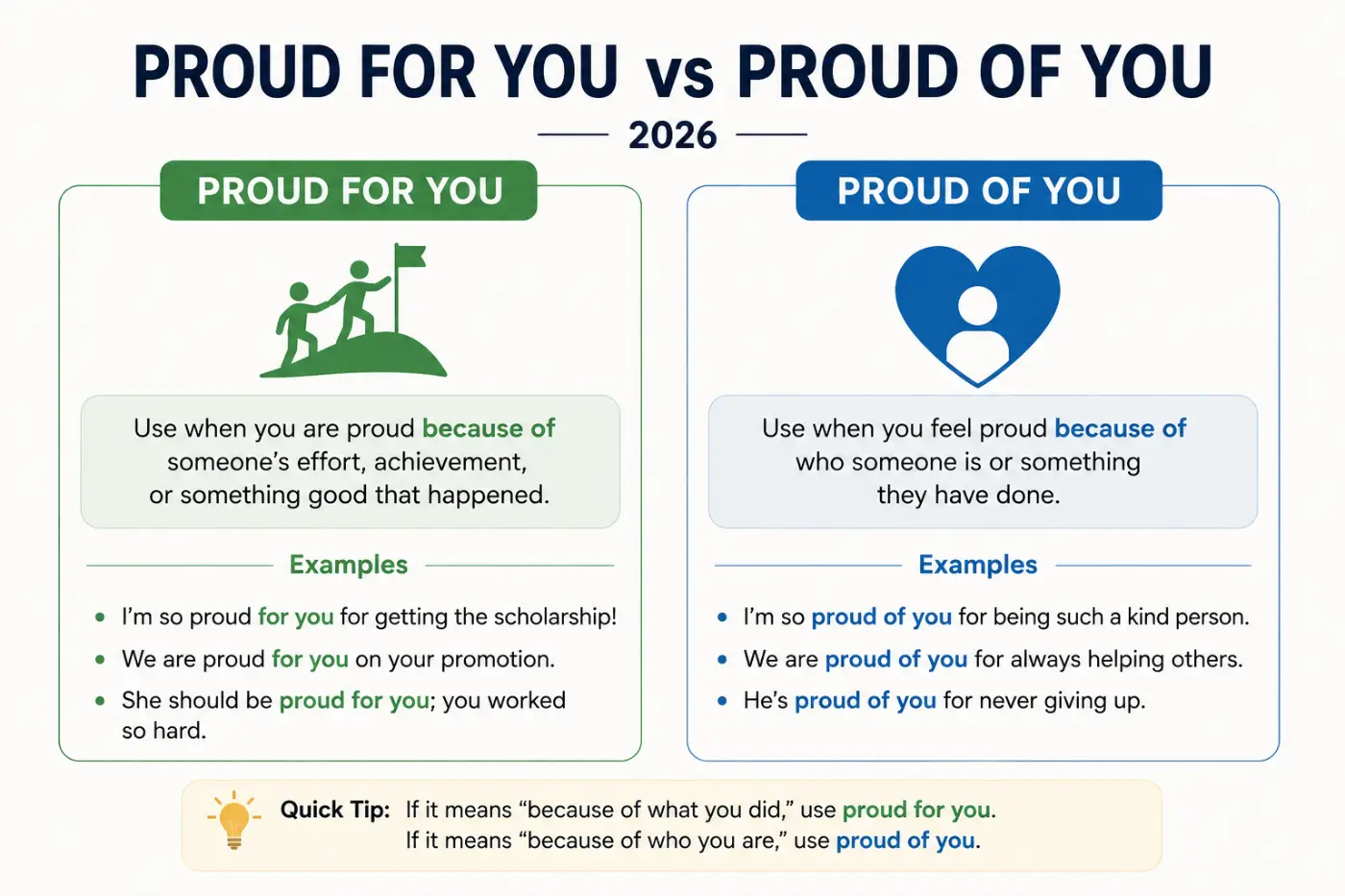
Proud for You vs Proud of You can be confusing because both phrases seem to express a positive feeling toward another person. The difference comes from the preposition that follows proud. In standard English the usual construction is proud of someone when you feel admiration or satisfaction because of that person’s actions achievements character or progress.
If someone graduates gets a new job finishes a difficult project or reaches an important personal goal you can say I’m proud of you. The phrase sounds natural in everyday American English and works in both personal and professional situations. Proud for you can sometimes appear in informal speech because speakers may connect it with phrases such as happy for you. However it does not normally replace proud of you.
This guide explains Proud for You vs Proud of You from every useful angle. You’ll learn the grammar behind proud of the meaning of proud for why speakers sometimes use it the difference between proud of you and happy for you and how to choose the right expression in real conversations. You’ll also see examples that show exactly how these phrases work.
Short Answer
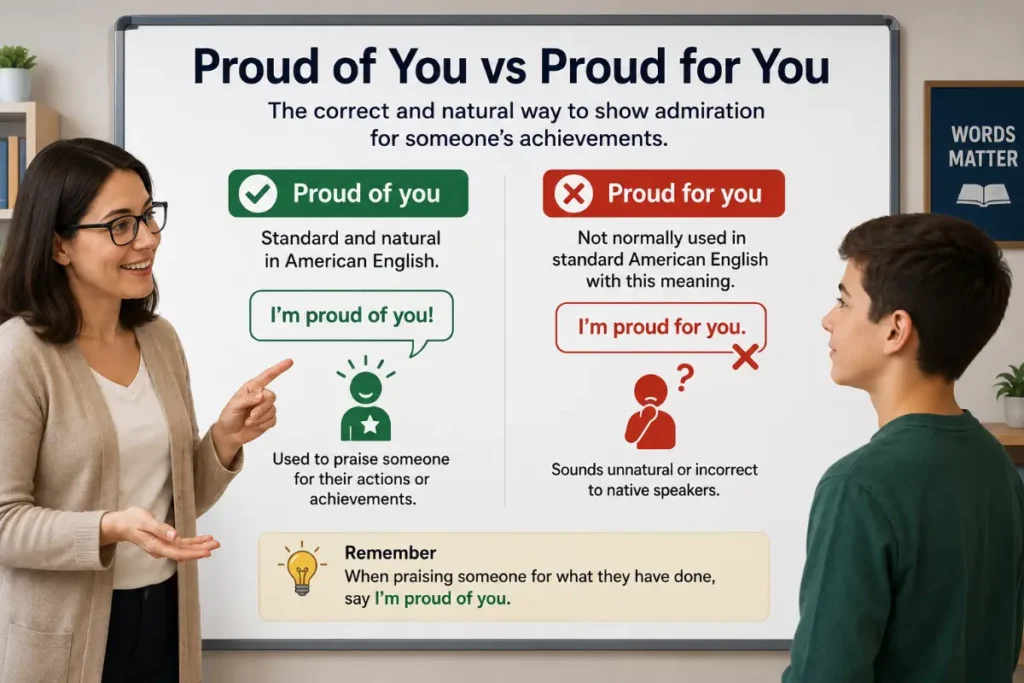
Proud of you is the standard and natural expression when you feel admiration or satisfaction because of another person’s actions or achievements. Proud for you is not normally used in standard American English with this meaning. Native speakers usually say I’m proud of you when praising someone for what they have done.
Table Of Contents
- The Quick Grammar Rule.
- What Proud Of You Means.
- What Proud For You Means.
- The Main Difference Between The Phrases.
- Why Proud Of Is The Standard Choice.
- When Proud For You May Appear.
- Proud Of You And Happy For You.
- Proud Of You And Proud Of Yourself.
- Grammar Patterns With Proud.
- Examples In Real Conversations.
- Common Mistakes.
- Formal And Informal Usage.
- American And British English.
- Pronunciation Guide.
- Memory Tips.
- Related Expressions.
- Professional Writing Tips.
- Frequently Asked Questions.
- Key Takeaways.
- Conclusion.
The Quick Grammar Rule
The simplest rule is this.
Use proud of when you identify the person or thing that causes your feeling of pride.
- I’m proud of you.
- She’s proud of her daughter.
- They’re proud of their team.
- He’s proud of his work.
- We’re proud of our students.
The preposition of connects the adjective proud to the person or thing that inspires the feeling.
This pattern is deeply established in standard English. You will hear it constantly in conversations and see it in professional writing personal messages speeches interviews and other forms of communication.
The expression proud for you does not normally follow this standard pattern. If you want to congratulate someone because their success makes you feel happy and proud then I’m proud of you is the safest and most natural choice.
What Proud Of You Means
Proud of you means that you feel admiration satisfaction pleasure or emotional pride because of another person and something connected to that person.
The reason can be an achievement.
I’m proud of you for passing the exam.
The reason can also be personal growth.
I’m proud of you for becoming more confident.
It can describe effort even when the person did not achieve the desired result.
You didn’t win this time but I’m still proud of you.
That point matters because proud of you does not always mean that someone accomplished something spectacular. A parent can say it to a child after a small act of kindness. A teacher can say it to a student who kept trying. A friend can say it to someone who handled a difficult situation with courage.
The phrase often communicates emotional support as much as admiration.
For example:
I know this year was difficult but I’m proud of you for keeping going.
The speaker is not simply praising an outcome. The speaker is recognizing the person’s effort and character.
What Proud For You Means
The phrase proud for you is not the normal standard construction when you mean admiration toward another person.
A speaker might produce it because English has several closely related expressions.
For example:
I’m happy for you.
This is completely natural.
Because happy for you is common some speakers may unconsciously create proud for you by analogy. The intended meaning is usually understandable. Still the expression can sound unusual or nonstandard to many native speakers.
There are contexts in which for can appear after proud as part of a larger structure.
Consider:
I’m proud for my country to be represented at the international event.
Here for does not simply replace of. It introduces a different grammatical relationship. The sentence has a more formal structure in which for introduces the person or group connected with an event or situation.
Another example is:
It was a proud moment for our family.
This is fully natural because for our family tells us who experienced the significance of the moment. It does not mean the same thing as proud of our family.
This distinction is useful because it shows that the word for itself is not grammatically impossible near proud. The problem is using it as a direct substitute for of in the ordinary expression.
The Main Difference Between The Phrases
The clearest way to understand Proud for You vs Proud of You is to focus on the relationship between the adjective and the preposition.
| Expression | Standard usage | Main meaning | Example |
|---|---|---|---|
| Proud of you | Yes | Feeling admiration because of someone | I’m proud of you. |
| Proud for you | Usually no in this meaning | Unusual alternative to proud of you | I’m proud for you. |
| Happy for you | Yes | Feeling pleased about someone’s good news | I’m happy for you. |
| Proud of your work | Yes | Admiring the quality or achievement | She’s proud of her work. |
| A proud moment for you | Yes | A significant moment experienced by you | It was a proud moment for you. |
The key distinction is simple.
Of commonly identifies the person or thing that inspires pride.
For commonly identifies the person who benefits from or experiences something.
Compare these sentences.
I’m proud of you.
The person is the source of the speaker’s pride.
I’m happy for you.
The person is the beneficiary of the good situation and the speaker feels happiness on that person’s behalf.
These meanings overlap emotionally but the grammatical structures differ.
Why Proud Of Is The Standard Choice
English adjectives often require particular prepositions. These combinations are sometimes called adjective and preposition collocations.
For example:
- Good at something.
- Interested in something.
- Afraid of something.
- Responsible for something.
- Proud of something.
- Excited about something.
- Similar to something.
- Different from something.
Native speakers learn these combinations as natural patterns. Changing the preposition can make a sentence sound awkward even when the meaning seems obvious.
The adjective proud normally takes of when the object is the person or thing that inspires pride.
Maria is proud of her son.
The company is proud of its employees.
I’m proud of this achievement.
We’re proud of our community.
He’s proud of himself.
Because this pattern is so established the listener expects of after proud in these situations.
That is why I’m proud of you sounds immediate and natural while I’m proud for you may make the listener pause.
Proud For You vs Proud Of You In Meaning
The difference becomes easier when you imagine two emotional situations. Imagine your friend receives a promotion.
I’m proud of you.
You are expressing happiness because your friend received something good.
I’m proud for you.
The intended meaning may be clear but the sentence does not sound like the conventional English expression. Now imagine a parent watching a child perform on stage.
I’m so proud of you.
This means the parent admires the child or feels deep satisfaction because of the child’s performance effort or personal growth.
If the parent says:
I’m so happy for you.
The emotional focus changes. The parent is celebrating the child’s positive experience.
Both expressions can be appropriate in the same conversation.
Proud Of You And Happy For You
These two phrases are often confused because they can appear together.
I’m so proud of you and happy for you.
This sentence is completely natural.
The two expressions communicate different ideas.
Proud of you focuses on admiration.
Happy for you focuses on happiness about someone else’s good fortune or positive experience.
Consider a friend who gets accepted into college.
I’m proud of you.
The speaker highlights the friend’s effort achievement or personal development
This distinction helps explain why proud for you can feel tempting. Speakers already know happy for you and proud of you. When the two patterns blend together the unusual phrase proud for you can emerge.
Proud Of You And Proud Of Yourself
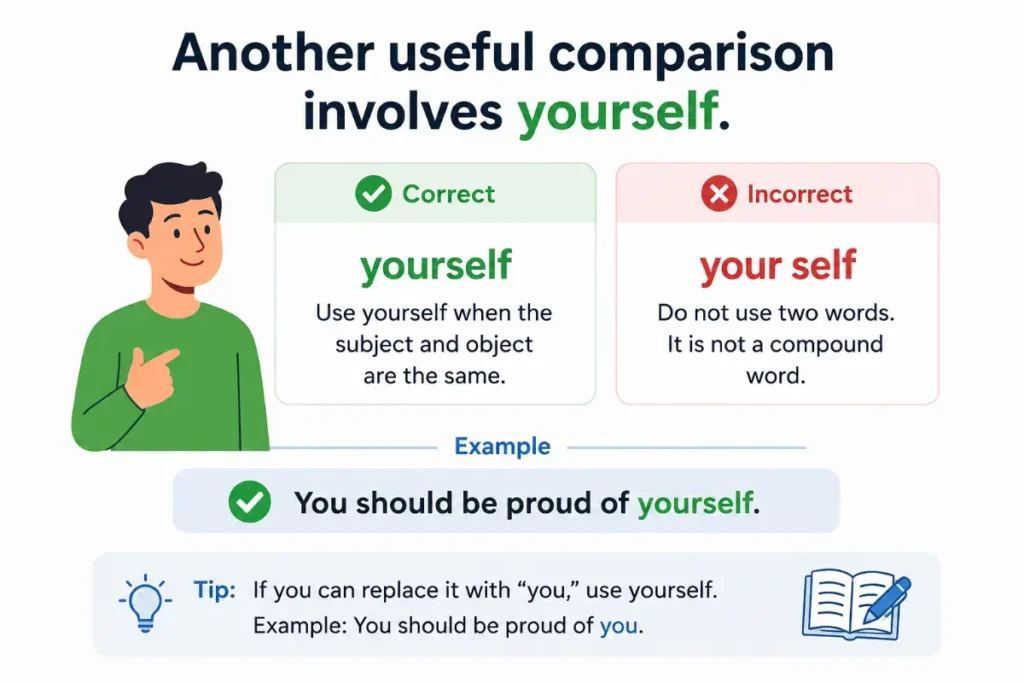
Another useful comparison involves yourself.
You should be proud of yourself.
This tells someone that they should recognize their own achievement or effort.
The structure is:
proud + of + reflexive pronoun
Examples include:
- I’m proud of myself.
- She’s proud of herself.
- He’s proud of himself.
- We’re proud of ourselves.
- They’re proud of themselves.
The same grammatical pattern works with other pronouns.
I’m proud of you.
She’s proud of him.
We’re proud of them.
They’re proud of us.
The preposition remains of because the relationship between proud and its object stays the same.
Grammar Patterns With Proud
Learning a few common structures will help you use proud naturally in many situations.
Proud Of Someone
Use this when someone inspires your pride.
I’m proud of my daughter.
The daughter is the person who inspires the speaker’s pride.
We’re proud of our students.
The students are the source of the institution’s pride.
Proud Of Something
Use this when an achievement object result or quality inspires pride.
She’s proud of her painting.
The painting is what gives her a feeling of pride.
He’s proud of his progress.
His progress is the reason for his pride.
Proud Of Someone For Something
This is one of the most useful patterns.
I’m proud of you for trying.
She’s proud of him for telling the truth.
They’re proud of their daughter for standing up for herself.
The first of connects proud with the person. The second part beginning with for explains the reason.
This structure is important because it shows why for can appear in a sentence involving proud without replacing of.
Compare:
I’m proud of you for finishing the project.
The sentence has both prepositions but each performs a different job.
Of you identifies the person who inspires pride.
For finishing the project gives the reason for that pride.
Proud To Do Something
English also uses proud with an infinitive.
I’m proud to be part of this team.
She was proud to represent her school.
We’re proud to support the community.
Here to introduces an action or state connected to the speaker’s pride.
Proud That Something Happened
A clause can also follow proud.
I’m proud that you stood up for yourself.
She’s proud that her students succeeded.
This construction focuses on a fact or situation that creates the feeling of pride.
Real Life Examples
Understanding grammar becomes easier when you see how people actually use the expression.
Family Conversations
- I’m proud of you for working so hard.
This could be said by a parent to a child after seeing consistent effort.
- Your grandmother would be proud of you.
The sentence expresses admiration associated with the grandmother.
- We’re incredibly proud of you.
The speaker emphasizes strong emotional pride.
- You should be proud of yourself.
The speaker encourages someone to recognize their own achievement.
Friendships
- I’m proud of you for taking that chance.
The speaker admires the friend’s courag
2. I’m proud of you and excited about what comes next.
The speaker combines admiration with enthusiasm.
School And Education
- Your teacher is proud of you.
The teacher feels admiration for the student.
- I’m proud of the progress you’ve made.
The speaker focuses on improvement.
- We’re proud of our graduating class.
The institution expresses collective pride in the students.
Work And Professional Life
- I’m proud of the work our team completed.
The speaker expresses satisfaction with the team’s achievement.
- She’s proud of her contribution to the project.
Her contribution is the source of her pride.
- We’re proud of our employees.
The company expresses admiration for its employees.
Personal Growth
- I’m proud of you for setting a healthy boundary.
The speaker praises personal development.
- You’ve come a long way and you should be proud of yourself.
The sentence recognizes progress over time.
- I’m proud of how you handled the situation.
The speaker admires the person’s behavior.
Common Mistakes
Using For Instead Of Of
The most common mistake is:
I’m proud for you.
For standard everyday English the better sentence is:
I’m proud of you.
The correction is small but it makes the sentence sound natural to native speakers.
Confusing Proud With Happy
Another common mistake is assuming proud and happy always mean the same thing.
They do not.
I’m proud of you.
This expresses admiration or satisfaction connected to the person.
I’m happy for you.
This expresses happiness because something good happened to the person.
The expressions can overlap but they have different emotional centers.
Saying Proud About You
Another unusual construction is:
I’m proud about you.
Standard English normally uses proud of you instead.
About can appear with other expressions such as excited about you in certain contexts but it is not the normal preposition after proud when identifying the person who inspires pride.
Dropping The Preposition
A learner might write:
I’m proud you.
This is not the normal structure.
Use:
I’m proud of you.
Or use a different structure such as:
I’m proud that you succeeded.
The grammar changes depending on what follows proud.
Formal And Informal Usage
Proud of you works across a wide range of situations.
It can sound warm and personal.
I’m proud of you.
It can also sound deeply emotional.
I can’t tell you how proud I am of you.
The phrase is not limited to casual conversation.
In professional writing you may want to specify the achievement or contribution so the sentence feels precise.
Instead of:
We’re proud of you.
A manager might write:
We’re proud of the work you did to complete the project ahead of schedule.
The second sentence gives the reader a clear reason for the praise.
American And British English
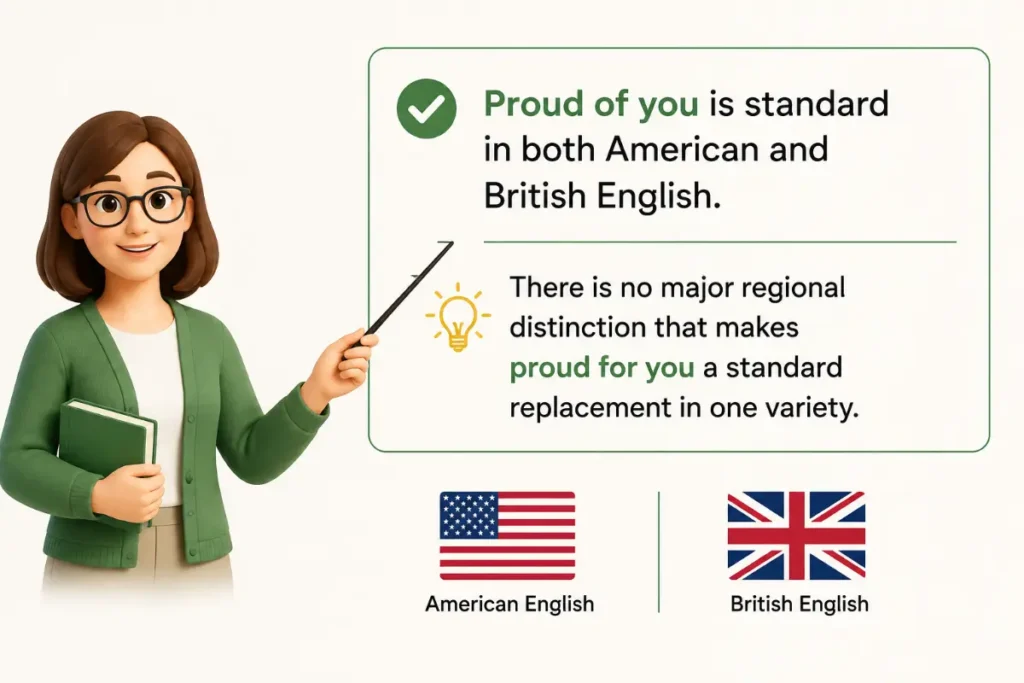
The expression proud of you is standard in both American and British English.
There is no major regional distinction that makes proud for you a standard replacement in one variety.
American speakers commonly use:
I’m proud of you.
British speakers also commonly use:
I’m proud of you.
The same applies to related forms.
proud of myself
proud of himself
proud of herself
proud of our team
proud of our country
Regional vocabulary can differ between American and British English but this particular preposition pattern remains stable.
Pronunciation Guide
The word proud is pronounced approximately like prowd.
The vowel sound is similar to the sound in cloud and loud.
The full phrase proud of you is commonly spoken smoothly rather than as three strongly separated words.
In natural conversation it may sound close to:
proud uh you
The word of often becomes weak in connected speech. This is normal English pronunciation and does not change the written form.
The phrase proud of you may also receive strong stress on proud.
I’m PROUD of you.
The speaker can shift emphasis depending on emotion.
Word Origin And Meaning
The adjective proud has a long history in English and is related to older words connected with ideas such as excellent appearance self importance and satisfaction.
Modern English uses proud in several related senses.
A person can feel personal satisfaction.
She’s proud of her achievement.
A person can display excessive self importance.
He sounded proud and arrogant.
A group can express collective dignity.
The community is proud of its history.
The positive sense in I’m proud of you is usually connected with admiration satisfaction and approval.
Context determines the emotional tone.
When Proud Can Have A Negative Meaning
The word proud is not always positive.
Consider:
He’s too proud to apologize.
Here proud suggests excessive self regard or stubbornness.
Another example is:
Her pride prevented her from asking for help.
This sense is different from:
I’m proud of you.
The phrase proud of you normally carries a positive meaning when someone is praising another person.
Still context matters.
A sarcastic speaker could say:
Well I’m proud of you.
The words look positive but the tone could communicate criticism.
This is a useful reminder that meaning comes from grammar context tone and situation together.
Why Prepositions Matter In English
Prepositions can seem small but they often determine whether an expression sounds natural.
English learners sometimes try to translate a phrase directly from another language. That approach can create unusual combinations.
For example the idea of feeling pride toward someone may be expressed differently across languages. English has settled on the conventional pattern proud of someone.
This is why memorizing common collocations can be more useful than translating individual words.
Instead of memorizing only:
proud = feeling admiration
Learn the complete pattern:
proud of someone
Then expand it:
proud of something
proud of someone for something
proud to do something
proud that something happened
This approach gives you a practical grammar framework instead of a single vocabulary definition.
How To Choose The Right Expression
When you want to praise someone ask yourself what emotion you want to express.
If you mean admiration because of what the person has done use proud of you.
It was a proud moment for you.
If you want to explain the reason for your pride use:
I’m proud of you for working so hard.
These four structures cover most everyday situations.
Memory Tips
A simple memory trick is to connect proud with of.
Think:
Pride comes from someone’s actions.
Then say:
I’m proud of you.
Another useful trick is to pair the common expressions.
Proud of you.
Happy for you.
The two phrases can both be positive but they use different prepositions.
You can also remember this sentence:
I’m proud of you for what you did.
This sentence contains the complete pattern and makes the grammar easier to recall.
A second memory method is to remember that of points toward the source of the pride.
proud of my son
proud of my work
proud of our team
proud of myself
This consistent pattern makes the preposition easier to recognize.
Related Expressions
English has many ways to express pride and admiration.
I’m Proud Of You
This is the most direct expression.
I’m proud of you for telling the truth.
I’m So Proud Of You
Adding so increases emotional emphasis.
I’m so proud of you.
I’m Really Proud Of You
Really adds emphasis while keeping the tone natural.
I’m really proud of you.
You Should Be Proud Of Yourself
This encourages someone to recognize their own accomplishment.
You should be proud of yourself for finishing the course.
I Couldn’t Be Prouder
This is a strong idiomatic expression.
I couldn’t be prouder of you.
It means the speaker feels an extremely high level of pride.
I’m Happy For You
This expresses happiness about another person’s good fortune.
I’m happy for you and your family.
You Did A Great Job
This focuses directly on performance.
You did a great job on the presentation.
You Should Be Proud
This is a shorter form that relies on context.
You should be proud. You worked incredibly hard.
Professional Writing Tips
Professional communication benefits from specific praise.
Instead of writing:
We’re proud of you.
You might write:
We’re proud of the dedication you showed throughout the project.
This gives the compliment substance.
Instead of:
I’m proud of our team.
You could write:
I’m proud of our team for delivering the project on schedule.
The second version tells the reader why the team deserves recognition.
In workplace communication the phrase can also appear in company announcements.
We’re proud of our employees for supporting the community.
Here of our employees identifies the people who inspire the company’s pride. For supporting the community gives the reason.
This structure is grammatically clear and professionally useful.
Examples With Corrections
Here are common incorrect or awkward forms with natural alternatives.
- Incorrect or unnatural: I’m proud for you.Better: I’m proud of you.The standard expression uses of when the person inspires the speaker’s pride.
- Unnatural: She is proud about her son.Better: She is proud of her son.Of is the conventional preposition after proud in this structure.
- Unnatural: We are proud our students.Better: We are proud of our students.The preposition cannot normally be omitted.
- Natural: I’m happy for you.This is correct because happy commonly takes for when someone else’s good situation causes happiness.
- Natural: I’m proud of you for trying.This is correct because of you identifies the person while for trying gives the reason for the pride.
- Natural: It was a proud moment for her.This is correct because for her identifies the person connected with the moment rather than functioning as a replacement for proud of her.
Proud Of You In Different Emotional Situations
The phrase can carry slightly different shades of meaning depending on context.
Pride In Achievement
I’m proud of you for earning your degree.
The speaker admires the achievement.
Pride In Effort
I’m proud of you for giving it your best.
The speaker values effort rather than only the final result.
Pride In Character
I’m proud of you for being honest.
The speaker admires a personal quality.
Pride In Growth
I’m proud of you for how much you’ve grown.
The speaker recognizes development over time.
Pride In Courage
I’m proud of you for speaking up.
The speaker admires bravery or confidence.
Pride During Failure
You didn’t get the result you wanted but I’m still proud of you.
The phrase can communicate unconditional support.
This flexibility is one reason proud of you is such a useful expression.
Is Proud For You Ever Correct
It can be grammatical in a larger construction where for serves a different function.
For example:
It was a proud moment for her family.
Here for her family means the moment was significant to her family.
Another structure can be:
I’m proud for my son to represent our school.
This construction is different from the simple expression I’m proud of my son. The word for introduces an infinitive construction and connects the subject to the situation described by the infinitive.
These examples should not be used as evidence that proud for you is a normal substitute for proud of you.
The safest rule for everyday English remains straightforward.
I’m proud of you.
How Native Speakers Usually Hear The Difference
A native speaker who hears:
I’m proud of you.
Will immediately recognize a familiar expression of praise affection or admiration.
A native speaker who hears:
I’m proud for you.
May understand the intended meaning but may notice that the phrase sounds unusual. Some speakers may interpret it as a nonstandard blend of proud of you and happy for you.
That does not necessarily make the speaker’s meaning impossible to understand. It simply means the expression does not match the most established English pattern.
For learners writers and anyone trying to sound natural the best choice is to use the conventional form.
A Simple Decision Guide
Use this quick guide whenever you are unsure.
- You admire someone because of something they did.Say I’m proud of you.
- You feel happy because something good happened to someone.Say I’m happy for you.
- You feel both emotions.Say I’m proud of you and happy for you.
- You want to explain the reason for your pride.Say I’m proud of you for working so hard.
- You are describing an important moment connected with someone.Say It was a proud moment for you.
This covers the overwhelming majority of situations where the choice causes confusion.
Key Takeaways
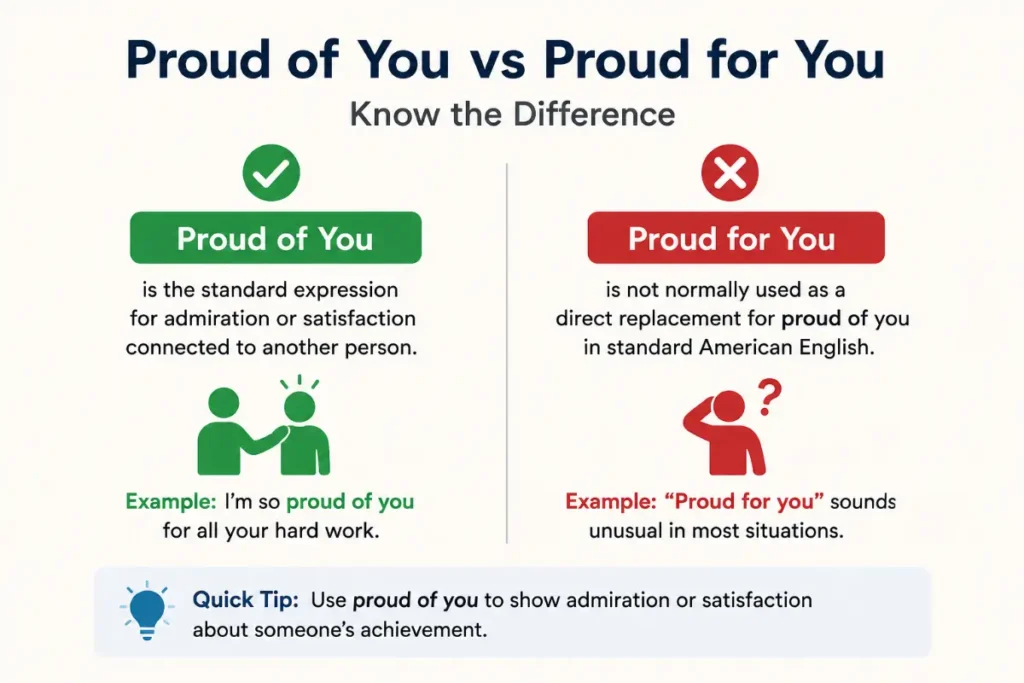
- Proud of you is the standard expression for admiration or satisfaction connected to another person.
- Proud for you is not normally used as a direct replacement for proud of you in standard American English.
- Happy for you is the natural expression when you want to celebrate someone else’s good fortune.
- Proud of you for doing something is a useful structure that explains the reason for the speaker’s pride.
- A proud moment for you is correct because for has a different grammatical function in that structure.
- The preposition of is part of the established collocation proud of.
- The same pattern works with people things achievements and reflexive pronouns.
- The phrase works in casual professional educational family and formal settings.
- American and British English both commonly use proud of you.
- If you want natural everyday English the safest choice is simple: I’m proud of you.
Conclusion
Proud for You vs Proud of You has a simple answer once you understand the preposition pattern. In standard English the natural expression is I’m proud of you when you feel admiration or satisfaction because of another person’s actions achievements effort or character. Proud for you is not normally used as a direct substitute.
The confusion often comes from the perfectly natural expression I’m happy for you. Both phrases express positive feelings but they focus on different things. Proud of you highlights admiration while happy for you highlights happiness about someone else’s good fortune. You can also combine them when both meanings apply.
When in doubt keep the core pattern in mind: proud of someone. Use proud of you for praise and admiration. Use happy for you when celebrating someone’s good news. That small distinction will make your English sound more natural and grammatically precise.
Frequently Asked Questions
Is Proud For You Correct?
It can occur in certain grammatical structures but it is not the standard expression when you mean that you admire someone because of their actions or achievements. In that situation use I’m proud of you.
Is It Proud Of You Or Proud For You?
The normal choice is proud of you. Use proud of when the person is the source of your pride. Use happy for you when you are expressing happiness about something good happening to that person.
Can I Say I’m Proud For You?
You may be understood if you say it but it can sound unusual to native English speakers. For natural standard English say I’m proud of you.
Why Do We Say Proud Of You?
Proud commonly takes the preposition of when you identify the person or thing that inspires the feeling of pride. This is an established English collocation.
What Is The Difference Between Proud Of You And Happy For You?
Proud of you expresses admiration or satisfaction connected to someone. Happy for you expresses happiness because that person has experienced something positive. You can use both in the same sentence.
Can Proud Be Followed By For?
Yes. The word for can appear after proud in other structures. For example It was a proud moment for her is natural. The phrase proud for you should not normally be used as a replacement for proud of you.
Can I Say I’m Proud Of You For Trying?
Yes. This is a very natural structure. Of you identifies the person who inspires the pride and for trying explains the reason for that pride.
Is Proud Of You Used In British English?
Yes. Proud of you is standard in both British and American English. The basic preposition pattern does not change between these varieties.
Is Proud Of You Formal Or Informal?
It can be either. The phrase works in personal conversations and professional or ceremonial settings. The surrounding context determines the tone.
Can I Say Proud Of Myself?
Yes. Proud of myself is standard English. The same structure applies to other reflexive pronouns such as yourself himself herself and themselves.
What Is The Easiest Way To Remember Proud Of You?
Remember the pair proud of you and happy for you. Proud normally goes with of when someone inspires your pride while happy commonly goes with for when you celebrate someone else’s good fortune.
What Is The Most Natural Way To Praise Someone?
For direct praise related to their effort achievement growth or character say I’m proud of you. You can make it more specific by adding the reason such as I’m proud of you for working so hard.

English Grammar & Usage
Nathan Holloway is an American grammar writer and language researcher who specializes in English grammar, sentence structure, verb usage, and common writing mistakes. He enjoys breaking down confusing grammar rules into practical explanations with clear examples, making English easier for students, professionals, and everyday writers.