
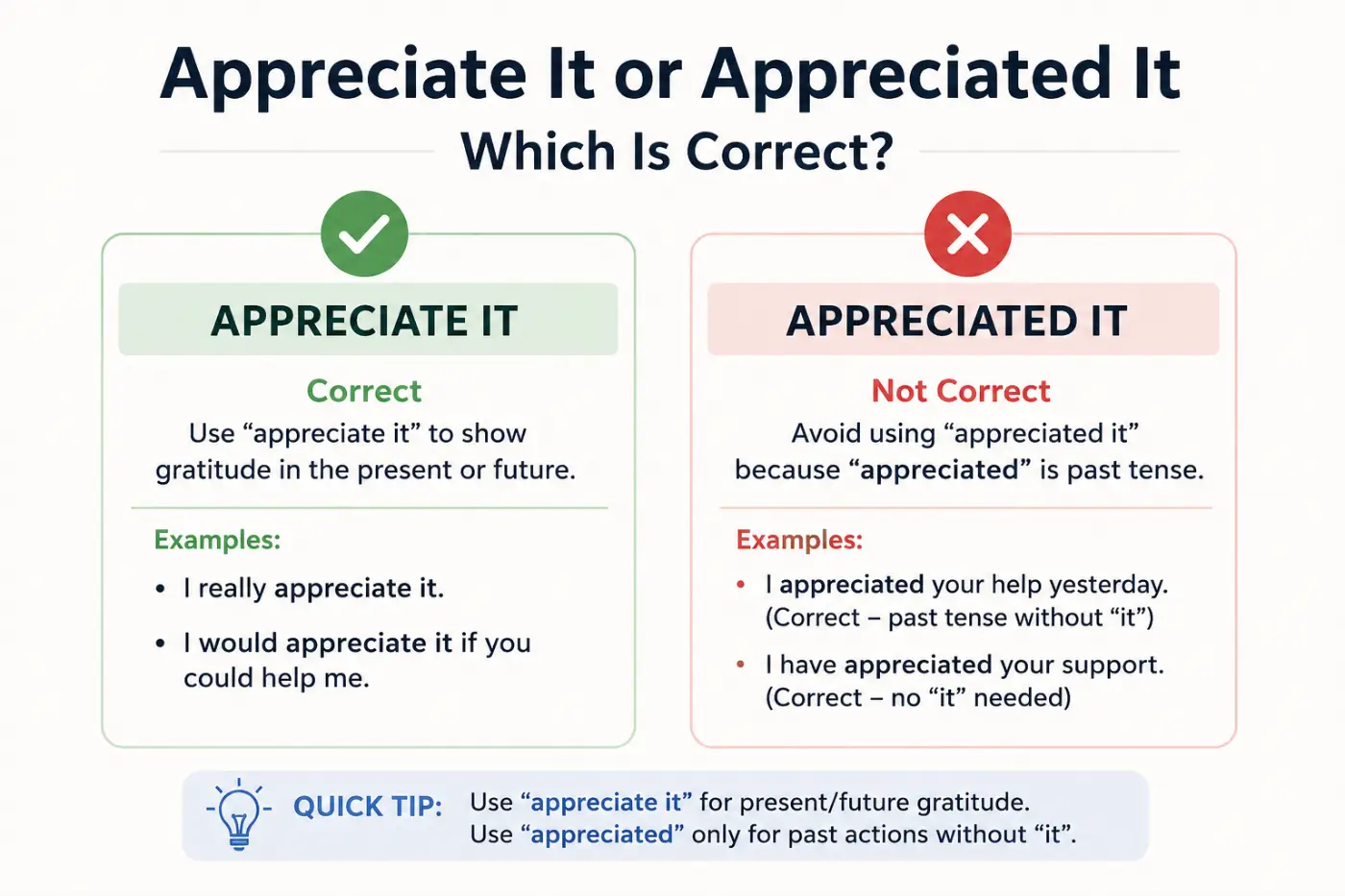
Appreciate It or Appreciated It can look like a tiny grammar choice, but the verb tense changes the meaning. If someone helps you right now, you might say, “I appreciate it.” If you are talking about help you received yesterday, you might say, “I appreciated it.” The difference is mainly about time and context.
English speakers use both expressions constantly in conversations, emails, workplace messages, customer service situations, and personal communication. The confusion usually happens because both forms express gratitude, and the difference between present and past tense can feel subtle when the subject is thankful for an action rather than a physical object.
This guide explains the difference in plain American English. You will learn when each expression works, how tense affects the meaning, how to sound natural in professional and casual settings, which common mistakes to avoid, and how to choose the right form quickly.
Short Answer
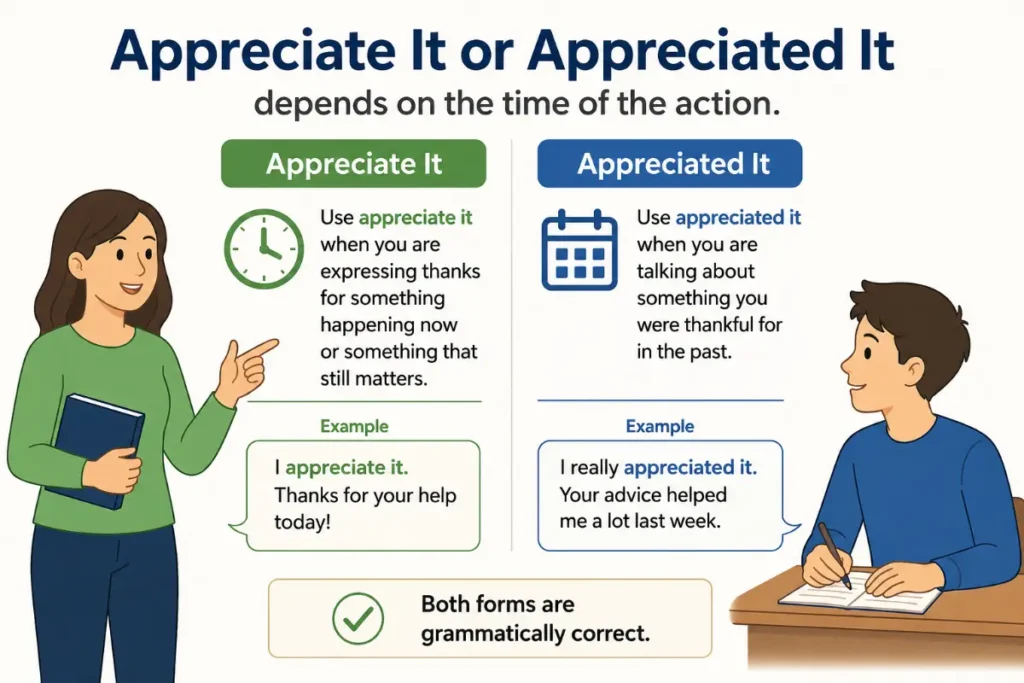
Appreciate It or Appreciated It depends on the time of the action. Use appreciate it when you are expressing thanks for something happening now or something that still matters. Use appreciated it when you are talking about something you were thankful for in the past. Both forms are grammatically correct.
Table Of Contents
- The Basic Difference
- What Appreciate It Means
- What Appreciated It Means
- Present Tense And Past Tense
- How Context Changes The Meaning
- Examples In Everyday English
- Examples In Professional Writing
- Common Grammar Mistakes
- Appreciate It In Polite Requests
- Appreciated It When Referring To The Past
- How To Choose The Right Form
- Pronunciation And Natural Speech
- Formal And Informal Usage
- Related Expressions
- Memory Tips
- Expert Usage Notes
- Frequently Asked Questions
- Key Takeaways
- Conclusion
The Basic Difference
The easiest way to understand Appreciate It or Appreciated It is to look at the verb tense.
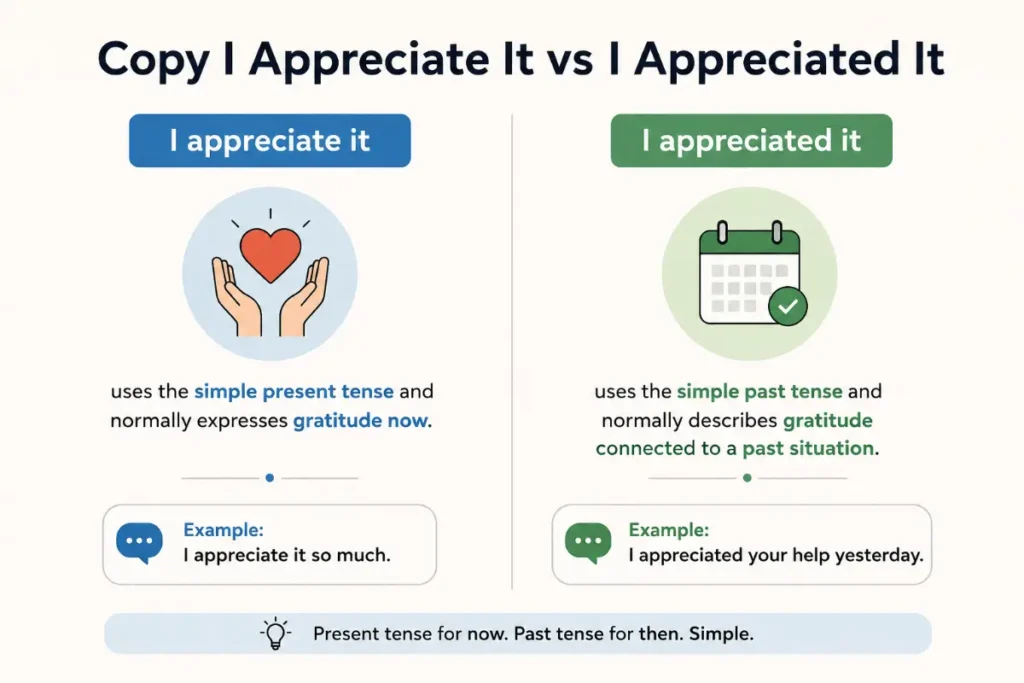
Appreciate it uses the simple present tense.
Appreciated it uses the simple past tense.
The present form normally refers to gratitude that exists now. The past form normally refers to gratitude connected to a completed situation in the past.
| Expression | Tense | Basic meaning | Typical situation |
|---|---|---|---|
| I appreciate it | Present | I am thankful for it | Help happening now or gratitude that still applies |
| I appreciated it | Past | I was thankful for it | Help or support received in the past |
| I really appreciate it | Present | I am very thankful | Current gratitude |
| I really appreciated it | Past | I was very thankful | Past gratitude |
| I appreciate your help | Present | I am thankful for your help | Current or ongoing support |
| I appreciated your help | Past | I was thankful for your help | Completed past assistance |
The tense does not change the basic idea of gratitude. Instead, it changes the time perspective.
For example, imagine that your coworker is helping you finish a report. You can say:
“I appreciate it.”
The help is happening now, so the present tense feels natural.
Now imagine that your coworker helped you last week and the project is finished. You might say:
“I appreciated it.”
The support belongs to a completed past situation.
What Appreciate It Means
Appreciate it is a common way to express gratitude. It is short for an expression such as “I appreciate your help” or “I appreciate what you did.”
The verb appreciate can mean to recognize the value of something, understand its importance, or feel grateful for something. In everyday conversation, the gratitude meaning is especially common.
Consider this sentence:
“I appreciate it.”
The word it usually refers to something already understood from the context.
Someone might hold the door open for you.
You say:
“I appreciate it.”
The listener understands that it refers to the helpful action.
The expression can also refer to support, kindness, advice, time, patience, assistance, or consideration.
For example:
“I appreciate your advice.”
“I appreciate everything you have done.”
The present form often sounds warm and immediate. It tells the listener that you feel grateful now.
Why It Sounds Natural
Native English speakers frequently use I appreciate it as a polite response.
Imagine this conversation:
“Don’t worry. I’ll send you the file tonight.”
“Thanks. I appreciate it.”
The speaker is thanking the other person for an action that has been promised or is expected to happen.
The expression can also respond to something that has already happened if the gratitude remains relevant in the present.
For example:
“Thanks for helping me with the presentation.”
“I appreciate it.”
The help happened earlier, but the speaker is expressing gratitude now. That is why the present tense can still be appropriate.
This point is important because verb tense does not always match the exact moment when the helpful action occurred. It can reflect the time when the speaker feels or expresses the gratitude.
What Appreciated It Means
Appreciated it is the past tense form of appreciate it.
It usually describes gratitude that existed at an earlier time.
For example:
“I appreciated it when you checked on me.”
The speaker is describing a past situation and explaining that the kindness meant something at that time.
Another example is:
“I really appreciated your help during the move.”
The move happened in the past, and the speaker is describing how thankful they were for the assistance.
The past form is especially natural when the sentence contains another past event.
For example:
“When you called me after the interview, I appreciated it.”
The phone call happened in the past. The speaker is looking back at that moment.
You can also use the past form in storytelling.
“Sarah stayed late to help me finish the report. I appreciated it because I had an early meeting the next morning.”
The first sentence establishes the past situation. The second sentence describes the speaker’s reaction to that situation.
Present Tense And Past Tense
Understanding tense makes this distinction much easier.
The simple present often describes something that is true now.
“I appreciate your support.”
The simple past describes something that was true at an earlier time.
“I appreciated your support.”
Both sentences are grammatically correct. The difference is the speaker’s time perspective.
Consider these examples.
- “I appreciate your help with this project.”
This means the speaker feels grateful now. The project may still be active, or the speaker may simply be expressing current gratitude.
- “I appreciated your help with that project.”
This places the project and the gratitude in a completed past situation.
- “I appreciate you coming today.”
The speaker is thanking someone for coming and expressing gratitude in the present moment.
- “I appreciated you coming yesterday.”
The speaker is looking back at the person’s visit.
A useful rule is simple:
Present gratitude uses appreciate. Past gratitude uses appreciated.
However, context can make the choice more flexible. A past action can still receive a present expression of gratitude.
That is why you can naturally say:
“I appreciate everything you did for me.”
The actions happened in the past, but the gratitude exists now.
How Context Changes The Meaning
Context often matters more than the individual words.
Suppose your friend helps you carry a heavy box. You say:
“I appreciate it.”
You are expressing thanks right now.
Now imagine you are telling another friend about the same event two weeks later.
“John helped me move. I appreciated it.”
The second sentence presents the gratitude as part of a past story.
But you could still say:
“John helped me move, and I really appreciate it.”
That sentence works because the speaker is looking at the past action from a present point of view. The help happened earlier, but the speaker still feels grateful.
This is one reason learners sometimes think the expressions are interchangeable. They can refer to similar events, but the tense changes the speaker’s perspective.
Present Gratitude After Past Help
English often uses the present tense to express feelings that continue.
“I appreciate what you did for me.”
The action is finished, but the gratitude remains.
Compare it with:
“I appreciated what you did for me.”
The second sentence sounds more connected to a particular past period or situation.
The distinction becomes clearer when you add time expressions.
“I appreciate what you did for me.”
“I appreciated what you did for me at the time.”
The phrase at the time strongly points toward a past emotional response.
Examples In Everyday English
Real conversations make the difference easier to understand.
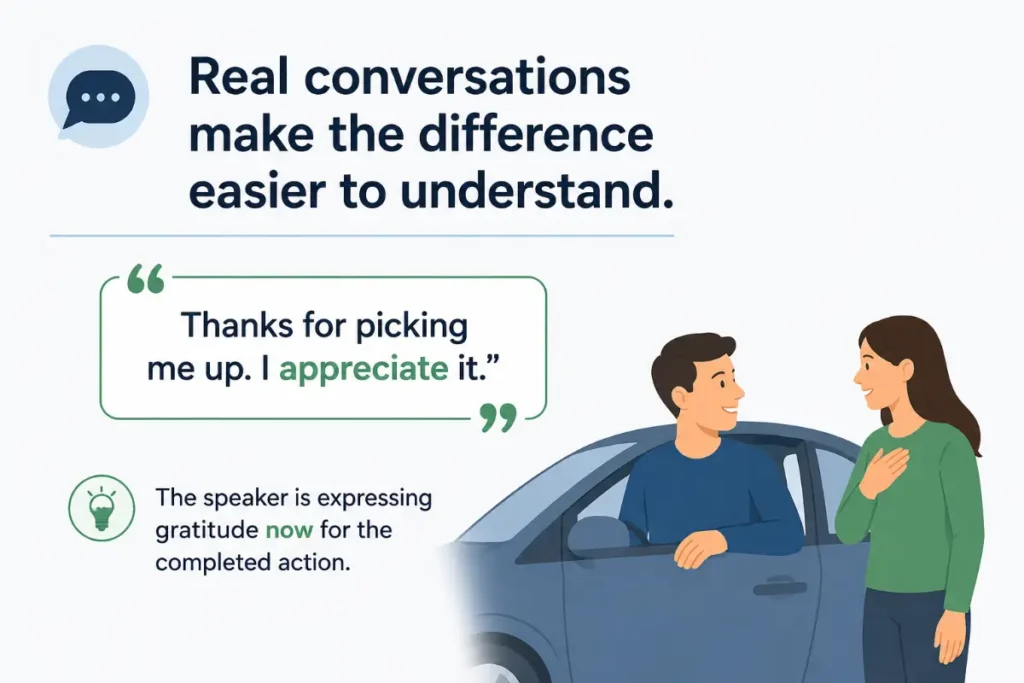
- “Thanks for picking me up. I appreciate it.”
The speaker is expressing gratitude now for the completed action.
- “You stayed late to help me. I really appreciated it.”
The speaker is looking back at a past situation.
The gratitude concerns ongoing actions.
3. “I appreciated everything you did during the event.”
The event is finished and the speaker is referring to past assistance.
4. “I appreciate your honesty.”
The speaker is expressing present gratitude for someone’s honesty.
5. “I appreciated your honesty during our conversation yesterday.”
The conversation happened in the past and the sentence looks back on it.
These examples show that the tense depends on the speaker’s viewpoint rather than simply the date of the helpful action.
Examples In Professional Writing
Both forms can appear in professional communication.
Present Form In Emails
“I appreciate your help with this request.”
This is a polite and natural way to thank a colleague, client, manager, or business contact.
You can also write:
“I appreciate your quick response.”
“I appreciate your attention to this matter.”
These expressions are common because they sound polite without becoming overly formal.
Past Form In Emails
“I appreciated your assistance during the meeting.”
This works when you are referring to completed assistance.
Another example is:
“I appreciated your detailed feedback on the proposal.”
The feedback was given earlier, and the writer is looking back on it.
Still, the present form may sound more natural if the writer wants to emphasize current gratitude.
“I appreciate your detailed feedback on the proposal.”
That sentence can refer to feedback already received because the gratitude is being expressed now.
Which Form Sounds Better At Work
For a direct thank you in a current email, I appreciate it or I appreciate your help will often sound more natural.
For a story about a previous event, I appreciated it may fit better.
The key is not formality. The key is time perspective.
Common Grammar Mistakes
Many errors come from choosing the tense based only on when the helpful action happened.
Mistake 1
“I appreciated it” is always required because the person already helped me.
That is not correct.
You can say:
“Thanks for helping me yesterday. I appreciate it.”
The action happened yesterday, but the speaker is expressing gratitude now.
Mistake 2
“I appreciate it yesterday.”
This is incorrect because the present tense does not fit the past time marker yesterday.
The natural version is:
“I appreciated it yesterday.”
Mistake 3
“I appreciate you helped me.”
This structure is not natural in standard English.
Better options include:
“I appreciate your help.”
“I appreciate you helping me.”
The gerund phrase you helping me works naturally after appreciate in this kind of construction.
Mistake 4
“I appreciated it” is used for every thank you.
That can make your writing sound as if the gratitude belongs entirely to the past.
If you are thanking someone now, the present form is usually more direct.
“Thanks for your help. I appreciate it.”
Appreciate It In Polite Requests
The expression I appreciate it can also appear after a request.
For example:
“If you could send the document today, I’d appreciate it.”
This is a polite way to request an action.
Another common pattern is:
“I’d appreciate it if you could call me tomorrow.”
The speaker is asking for something while showing gratitude in advance.
The phrase can sound professional and courteous, especially in emails.
For example:
“I’d appreciate it if you could confirm the appointment.”
This does not mean the speaker has already received the favor. Instead, the speaker is politely expressing anticipated gratitude.
You can also use:
“I’d really appreciate your help.”
“I’d appreciate any feedback you can provide.”
These patterns are especially useful in workplace communication.
A Subtle Meaning Difference
“I appreciate it” usually expresses actual present gratitude.
“I’d appreciate it” often expresses polite gratitude connected to a requested or expected action.
Compare these:
“Thanks for sending the report. I appreciate it.”
“If you could send the report today, I’d appreciate it.”
The first sentence thanks someone for something already done.
The second politely asks for something.
Appreciated It When Referring To The Past
The past form is particularly useful when you tell a story.
For example:
“When I started my new job, my manager showed me around the office. I appreciated it because I was nervous.”
The speaker is describing an earlier experience.
Another example:
“My neighbor watched my dog while I was away. I really appreciated it.”
The action happened in the past and the speaker is presenting the gratitude as part of that past event.
You can also use the form when describing a former attitude.
“When I was younger, I appreciated quiet evenings more than crowded parties.”
Here appreciated does not simply mean someone did a favor. It describes a past preference or feeling.
This broader use of appreciate is worth remembering. The verb can mean more than saying thank you.
How To Choose The Right Form
Use this simple decision process.
Ask When The Gratitude Is Being Expressed
If you are thanking someone now, use:
“I appreciate it.”
If you are describing gratitude from a past situation, use:
“I appreciated it.”
Look For Time Words
Words such as now, today, currently, and still often support the present form.
Words such as yesterday, last week, earlier, at the time, and when I was younger often support the past form.
These words are clues rather than absolute rules because context can override them.
Consider The Purpose
If your purpose is to thank someone directly, the present form is often the best choice.
If your purpose is to tell a story or describe a past reaction, the past form often fits better.
Compare These Sentences
“I appreciate your help.”
This is a direct thank you.
“I appreciated your help during the conference.”
This refers to a completed past event.
“I appreciate everything you did during the conference.”
This refers to past actions but expresses gratitude now.
That last example is particularly useful because it demonstrates why tense depends on viewpoint.
Pronunciation And Natural Speech
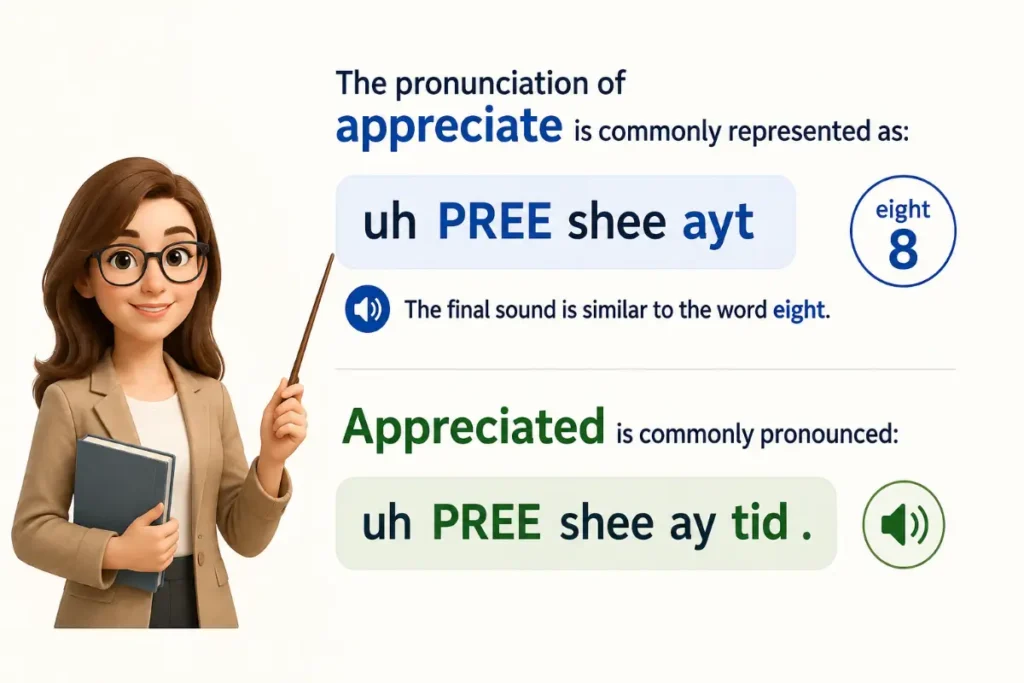
The pronunciation of appreciate is commonly represented as:
uh PREE shee ayt
The final sound is similar to the word eight.
Appreciated is commonly pronounced:
uh PREE shee ay tid
In natural American speech, I appreciate it often flows together.
Instead of carefully separating every word, speakers may connect the sounds:
“I appreciate it.”
The expression is common enough that fluent speakers often say it quickly and naturally.
For learners, pronunciation matters less than stress and rhythm. The strongest emphasis usually falls around pree in appreciate.
Formal And Informal Usage
Both forms work across a wide range of situations.
Casual Conversation
“Thanks. I appreciate it.”
This is extremely natural among friends, family members, coworkers, and acquaintances.
Workplace Communication
“I appreciate your help with this.”
This is polite and professional.
Customer Service
“I appreciate your assistance.”
This sounds slightly more formal.
Personal Messages
“I really appreciate everything you did.”
This can sound warm and sincere.
Formal Correspondence
“I greatly appreciated your assistance during the event.”
The word greatly gives the expression a more formal tone.
The basic tense rule stays the same across these contexts.
Related Expressions
English has many ways to express gratitude. Choosing the right expression can help your writing sound more natural.
| Expression | Meaning | Tone |
|---|---|---|
| I appreciate it | I am thankful | Natural and versatile |
| I really appreciate it | I am very thankful | Warm |
| I appreciate your help | I am thankful for your help | Professional and natural |
| Thanks | Thank you | Casual |
| Thank you so much | Strong gratitude | Warm |
| I’m grateful | I feel thankful | Sincere |
| I’m thankful | I feel gratitude | Personal |
| Many thanks | Thank you | Polite |
| I greatly appreciate it | I am very thankful | More formal |
| I’d appreciate it | I would be thankful if you did something | Polite request |
These expressions are not exact substitutes in every sentence. Tone, context, and timing influence the best choice.
Appreciate Versus Thank
Appreciate and thank are closely related, but their grammar works differently.
You can say:
“I appreciate your help.”
You can also say:
“Thank you for your help.”
But you normally would not say:
“I appreciate you for your help.”
A natural structure is:
“I appreciate your help.”
With thank, the usual structure is:
“I thank you for your help.”
In everyday English, the more common expression is:
“Thank you for your help.”
The verb appreciate often takes a noun phrase, gerund phrase, or clause.
“I appreciate your patience.”
“I appreciate that you came.”
These structures are useful for avoiding awkward constructions.
Memory Tips
A simple memory trick can make the distinction almost automatic.
Think of appreciate as gratitude that is alive in the present.
Think of appreciated as gratitude viewed from the past.
If you are standing in front of the person and saying thank you now, I appreciate it is usually the natural choice.
If you are telling a story about how you felt during a previous event, I appreciated it often fits.
Another useful trick is to replace the expression with I am thankful or I was thankful.
“I appreciate it” is close to “I am thankful for it.”
“I appreciated it” is close to “I was thankful for it.”
This substitution can help you hear the tense difference.
Expert Usage Notes
There is an important distinction between the time of the action and the time of the speaker’s gratitude.
Suppose a friend helped you three months ago.
You can say:
“I appreciated your help.”
This places the gratitude in the past.
You can also say:
“I appreciate your help.”
This expresses gratitude now for something that happened three months ago.
Neither sentence is automatically wrong. The difference comes from the perspective the speaker wants to create.
The first sounds more retrospective. The second sounds more immediate and current.
This distinction appears throughout English. Speakers often choose tense based on the time of the state, feeling, belief, or perspective rather than only the time when an event occurred.
Why Present Tense Can Refer To Past Actions
Present tense can describe a current relationship with a past event.
Consider:
“I appreciate everything my teacher taught me.”
The teaching happened in the past. The appreciation exists now.
Likewise:
“I appreciate what my parents did for me.”
The actions may have happened years ago, but the speaker is expressing present gratitude.
By contrast:
“When I was a child, I appreciated the extra attention.”
This sentence places the feeling itself in the past.
That is the real distinction.
Real Life Situations
When Someone Helps You Now
Your coworker finishes a task for you.
You say:
“Thanks. I appreciate it.”
The gratitude is immediate.
When You Remember Past Help
You are discussing a former coworker.
“She helped me prepare for my first presentation. I really appreciated it.”
The situation belongs to the past.
When Past Help Still Matters
You are speaking to someone who helped you years ago.
“I still appreciate everything you did for me.”
The word still clearly shows that the gratitude continues.
When Making A Request
You need a document from a colleague.
“I’d appreciate it if you could send it by noon.”
This is a polite request.
When Writing A Thank You Email
“Thank you for taking the time to meet with me. I appreciate your advice.”
The meeting has already happened, but the writer is expressing gratitude now.
Common Questions About Tense
A frequent question is why someone can say I appreciate it after the action has already happened.
The answer is that the verb describes the speaker’s current feeling. The action can be finished while the gratitude remains present.
Another common question is why I appreciated it can sound strange in a direct thank you.
The reason is conversational perspective. When you thank someone face to face, you are normally expressing your current reaction. The present form therefore feels more immediate.
Past tense can make the statement sound retrospective.
Compare:
“Thanks for helping me. I appreciate it.”
“Thanks for helping me. I appreciated it.”
The first sounds like a normal direct thank you. The second can sound as if the speaker is discussing a past episode from some distance.
That does not make the second sentence grammatically impossible. It simply gives the sentence a different tone and time perspective.
Professional Writing Tips
In professional communication, clarity matters more than complicated wording.
Use I appreciate your help when you want to thank someone directly.
Use I appreciated your help when you are discussing a previous situation and want to describe your reaction to it.
Avoid adding unnecessary words.
Instead of:
“I would just like to say that I really and truly appreciate all of the help that you gave me.”
A cleaner version is:
“I really appreciate your help.”
Shorter wording often sounds more confident and sincere.
For formal messages, you can increase the level of formality without changing the tense.
“I appreciate your assistance.”
“I greatly appreciate your assistance.”
The best choice depends on your relationship with the reader and the situation.
Related Grammar And Usage Notes
The verb appreciate can take several useful structures.
Appreciate Plus Noun
“I appreciate your support.”
Here your support functions as the object of the verb.
Appreciate Plus Gerund
“I appreciate you helping me.”
Here you helping me identifies the action being appreciated.
Appreciate Plus Clause
“I appreciate that you took the time to visit.”
The clause explains the action or situation that creates the gratitude.
Appreciate Plus Pronoun
“I appreciate it.”
The pronoun it refers to something already known from the context.
These patterns give writers several ways to express gratitude naturally.
When Appreciate Means Understand Or Value
The verb appreciate does not always mean thank.
It can also mean to understand the value or importance of something.
For example:
“I appreciate how difficult this decision is.”
Here the speaker is not simply saying thank you. The speaker means that they understand the difficulty.
Another example is:
“She appreciates good music.”
This means she recognizes and enjoys its value.
The past form works in the same way.
“He appreciated the importance of the opportunity.”
This means he understood or valued the opportunity.
This broader meaning explains why appreciate is such a flexible English verb.
When Appreciated Can Mean Valued
You may also see appreciated used as an adjective or participial form.
For example:
“Your efforts are appreciated.”
This means your efforts are valued or recognized.
That sentence is different from:
“I appreciated your efforts.”
In the first sentence, appreciated describes the status of the efforts. In the second, appreciated is the past tense verb describing the speaker’s reaction.
This distinction can be useful in professional writing.
A Quick Decision Chart
| If you mean | Use |
|---|---|
| I am thankful now | I appreciate it |
| I was thankful then | I appreciated it |
| I am thankful for ongoing help | I appreciate your help |
| I was thankful for past help | I appreciated your help |
| I still feel thankful | I still appreciate it |
| I am politely requesting something | I’d appreciate it |
| I am describing a past reaction | I appreciated it |
The fastest test is to ask yourself one question:
Am I expressing gratitude now or describing gratitude from the past?
If the answer is now, choose appreciate.
If the answer is a past feeling, choose appreciated.
Key Takeaways
- I appreciate it uses the simple present tense and normally expresses gratitude now.
- I appreciated it uses the simple past tense and normally describes gratitude connected to a past situation.
- A past action does not automatically require appreciated. You can still say I appreciate it if you are expressing gratitude in the present.
- I’d appreciate it is commonly used to make polite requests.
- Context determines the most natural choice.
- The main distinction is the time perspective of the gratitude rather than only the time of the helpful action.
- In direct thank you messages, I appreciate it is usually the more natural choice.
- In stories about past experiences, I appreciated it often fits better.
- Appreciate can also mean understand, recognize, or value something.
- Learning the difference between present and past perspective will help you use both expressions naturally.
Conclusion
Understanding Appreciate It or Appreciated It becomes much easier once you focus on the time of the gratitude rather than only the time of the action. I appreciate it normally expresses gratitude that you feel and communicate now. I appreciated it normally describes gratitude that belonged to a past situation.
The important detail is that a completed action can still receive a present expression of gratitude. If someone helped you yesterday, you can naturally say, “I appreciate it,” because you are thanking that person now. If you are telling someone about how grateful you felt yesterday, “I appreciated it” may be the better choice.
When you need a quick answer, remember this simple rule:
present gratitude uses appreciate, while past gratitude uses appreciated. Once you pay attention to the speaker’s time perspective, choosing the right expression becomes natural.
Frequently Asked Questions
Is Appreciate It Or Appreciated It Correct?
Both forms are correct. I appreciate it expresses present gratitude, while I appreciated it normally describes gratitude connected to a past situation.
Should I Say I Appreciate It Or I Appreciated It?
Use I appreciate it when you are thanking someone now. Use I appreciated it when you are describing how thankful you were during a past situation.
Can I Say I Appreciate It For Something That Happened Yesterday?
Yes. You can say “I appreciate it” when the action happened yesterday but your gratitude is being expressed now. The tense describes your current feeling.
Is I Appreciated It More Formal?
No. The difference is mainly grammatical and contextual, not formal versus informal. Both forms can appear in casual conversation and professional writing.
Can I Say I Appreciate It In A Work Email?
Yes. I appreciate it is common and professional in workplace emails. You can also write “I appreciate your help” or “I appreciate your quick response.”
When Should I Use I Appreciated It?
Use I appreciated it when you are looking back at a completed situation and describing the gratitude you felt at that time.
Is I Appreciate It A Polite Expression?
Yes. I appreciate it is a polite and natural way to thank someone. It works in casual conversations, workplace communication, emails, and many other situations.
What Is The Difference Between I Appreciate It And Thank You?
Both express gratitude, but they use different grammatical structures. Thank you is a direct expression of thanks, while I appreciate it uses the verb appreciate to express gratitude for something.
Can I Use I Appreciate It After Someone Has Already Helped Me?
Yes. This is extremely common. You can thank someone after an action is complete and still use the present tense because your gratitude is being expressed now.
Is I’d Appreciate It A Request?
Often, yes. I’d appreciate it if you could help is a polite way to request an action. It expresses anticipated gratitude rather than simply thanking someone for something already done.

English Grammar & Usage
Nathan Holloway is an American grammar writer and language researcher who specializes in English grammar, sentence structure, verb usage, and common writing mistakes. He enjoys breaking down confusing grammar rules into practical explanations with clear examples, making English easier for students, professionals, and everyday writers.