
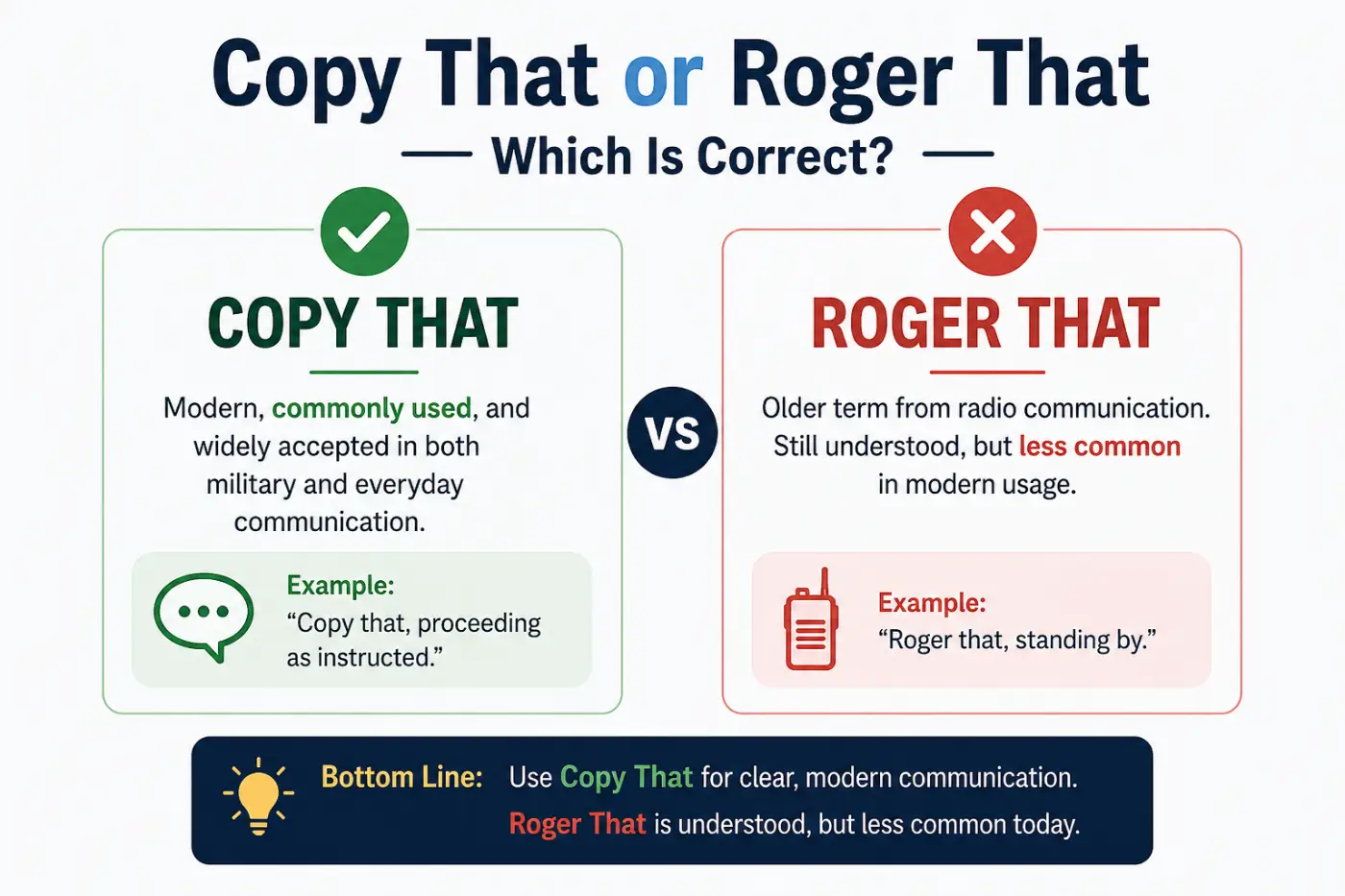
Copy That or Roger That can both tell someone that you heard their message and understood what they meant. The two expressions overlap in meaning so people often use them interchangeably. Still they have different histories and slightly different tones that can affect which one sounds natural in a particular situation.
If someone gives you an instruction and you respond with Copy That you are confirming that the message came through clearly. Roger That does much the same job but carries a stronger association with radio communication military language aviation and older communication styles. In casual American English Copy That often sounds more natural.
This guide explains the meaning pronunciation history tone grammar and everyday use of both expressions. You will also see practical examples that show when each phrase works best. By the end you will know which expression to choose in casual conversation workplace communication radio style dialogue and professional settings.
Short Answer
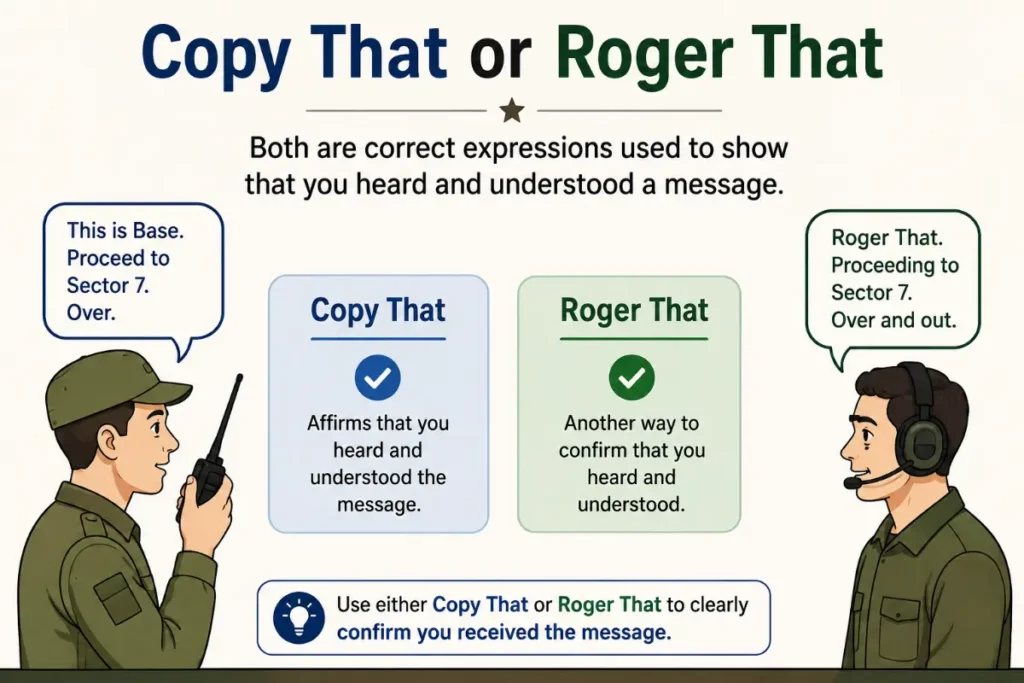
Copy That or Roger That are both correct expressions used to show that you heard and understood a message. Copy That is common in everyday and professional communication. Roger That has a more traditional radio and military flavor. Both can mean that you received the message but Roger That can also sound more formal or stylized.
Table Of Contents
- What Copy That Means.
- What Roger That Means.
- Copy That or Roger That Compared.
- The Main Difference Between The Expressions.
- When To Use Copy That.
- When To Use Roger That.
- Pronunciation Guide.
- Are They Formal Or Informal.
- Real Life Examples.
- Common Mistakes.
- Can They Be Used Interchangeably.
- Why Roger Means Received.
- Memory Tips.
- Related Expressions.
- Professional Writing Advice.
- Frequently Asked Questions.
- Key Takeaways.
- Conclusion.
What Copy That Means
Copy That means that you received and understood a message. It is especially common when the speaker wants confirmation that an instruction or piece of information was heard correctly.
The verb copy has an older communication related meaning here. It does not mean making a duplicate of a document. Instead it means receiving or understanding a transmission.
For example:
- “Meet me at the north entrance at six.”
“Copy That.”
The response means the listener received the instruction and understands it.
- “The delivery will arrive after lunch.”
“Copy That. I will be ready.”
Here the speaker confirms that the information was received.
- “Please send the revised file before five.”
“Copy That.”
This sounds natural in workplace conversation when the speaker wants a brief confirmation.
Copy That is especially common in American English and appears in workplace conversations military style dialogue emergency communication entertainment and ordinary speech. Its exact level of formality depends heavily on context.
What Roger That Means
Roger That is an expression used to confirm that a message has been received and understood. It has a strong connection with radio communication and military terminology.
The word Roger does not mean the speaker is talking about a person named Roger. In this expression Roger originated as a radio code word representing the letter R. R was associated with the word received.
As radio communication developed people needed short words that could be understood clearly over noisy connections. Roger became a convenient way to indicate that a message had been received.
For example:
- “Proceed to the second checkpoint.”
“Roger That.”
The response confirms receipt of the instruction.
- “Keep the channel open.”
“Roger That.”
The speaker is confirming that the instruction was heard.
- “We will meet at the usual location.”
“Roger That.”
The phrase works as a brief acknowledgment.
Today Roger That can sound military aviation related old fashioned playful or strongly associated with radio communication. The meaning remains clear but the tone can be different from ordinary everyday speech.
Copy That or Roger That Compared
| Feature | Copy That | Roger That |
|---|---|---|
| Basic meaning | Message received and understood | Message received and understood |
| Main association | Modern communication and radio style speech | Military radio aviation and traditional radio speech |
| Everyday use | Common | Less common |
| Tone | Direct and practical | Traditional or radio styled |
| American English | Common | Well understood |
| Military association | Possible | Strong |
| Workplace use | Natural in informal settings | Possible but can sound stylized |
| Casual conversation | Common enough | Often playful or deliberate |
| Grammar | Fixed expression | Fixed expression |
| Main purpose | Confirm receipt and understanding | Confirm receipt and understanding |
The biggest difference is not basic meaning. It is tone and association.
Copy That generally feels more contemporary. Roger That has a stronger historical connection to radio communication.
The Main Difference Between The Expressions
The clearest way to understand Copy That or Roger That is to separate meaning from tone. Both expressions can confirm that a person heard a message. The difference comes from the atmosphere each phrase creates.
Copy That sounds practical and direct. You might hear it in a workplace where someone wants to acknowledge an instruction without repeating the entire message.
Roger That sounds more like radio language. It may appear in military scenes aviation conversations action movies games or humorous conversations where someone intentionally adopts a radio style.
Consider these examples:
- Your manager says “Please update the report before the meeting.”
“Copy That.”
This is a straightforward acknowledgment.
- A fictional pilot receives an instruction from air traffic control.
“Roger That.”
The phrase fits the radio setting.
- Your friend asks you to bring snacks to a party.
“Roger That.”
The sentence is understandable but it may sound playful because the situation does not require radio language.
The meaning remains similar but the speaker creates a different tone.
When To Use Copy That
Use Copy That when you want to acknowledge that you received information or an instruction. It works especially well when the conversation is direct and you do not need to repeat the entire message.
It can be useful in several situations.
Workplace Communication
Copy That can work in informal workplace communication between colleagues who are comfortable with concise language.
Example:
- “Please add the latest numbers to the report.”
“Copy That. I will handle it.”
The response confirms the instruction and signals that the speaker will act on it.
For highly formal written communication however a complete sentence may be better.
Instead of writing:
- “Copy That.”
You could write:
- “Understood. I will update the report.”
That choice sounds more polished in a formal business email.
Team Communication
Teams often use short acknowledgments when tasks are clear. Copy That can be useful because it communicates receipt without unnecessary repetition.
Example:
- “Take the first section and send me your notes by noon.”
“Copy That.”
The phrase works because the instruction is already understood.
Casual Conversation
Copy That can also appear in casual speech. Some speakers use it naturally while others use it because they like the radio style.
Example:
- “Remember to lock the door when you leave.”
“Copy That.”
The response means “I heard you and understand.”
When To Use Roger That
Roger That works best when you want a radio communication flavor or when the context naturally involves military aviation emergency services or other forms of radio communication.
It can also be used jokingly.
Radio Style Communication
Roger That fits naturally into dialogue modeled on radio communication.
Example:
- “Unit three proceed to the eastern gate.”
“Roger That.”
The expression immediately creates a radio communication atmosphere.
Military Style Dialogue
The phrase is strongly associated with military communication in popular culture and historical usage.
Example:
- “Hold your position until further instructions.”
“Roger That.”
The response sounds concise and authoritative.
Aviation Style Dialogue
Roger That is also widely recognized in aviation themed communication and fictional portrayals of pilots.
Example:
- “Turn left heading two seven zero.”
“Roger That.”
The phrase clearly signals acknowledgment.
Real aviation communication follows specific procedures and phraseology. A person should not assume that an expression heard in movies represents the complete rules used in professional aviation communication.
Pronunciation Guide
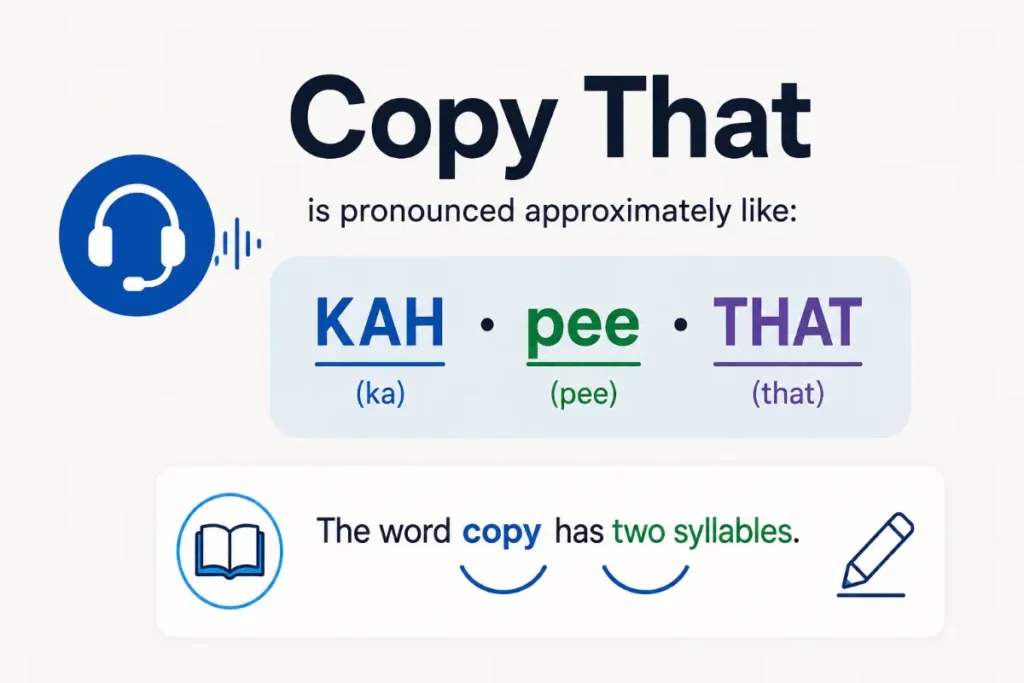
Copy That is pronounced approximately like:
KAH pee THAT
The word copy has two syllables. The second word is pronounced with the normal sound of that.
Roger That is pronounced approximately like:
RAH jer THAT
Roger contains two syllables in standard American pronunciation. The first vowel can vary slightly depending on accent.
The phrases are easy to pronounce because both use familiar English words. The main challenge is understanding the specialized meaning of copy and Roger in communication contexts.
Are They Formal Or Informal
Neither expression belongs exclusively to formal or informal English. Context matters.
Copy That is usually conversational and concise. It can work in informal workplace communication but may feel too casual for a formal report or carefully written business letter.
Roger That is also conversational but has a distinct stylistic flavor. It can sound military radio based playful or old fashioned depending on the situation.
For formal writing consider alternatives such as:
- Understood.
- Received.
- I understand.
- I have received your instructions.
- Acknowledged.
- I will take care of it.
These expressions make the intended meaning clearer in professional writing.
Real Life Examples
The following examples show how the expressions behave in different situations.
Everyday Instructions
- “Please pick up some milk on your way home.”
“Copy That.”
The response confirms that the request was heard.
- “Remember to charge your phone tonight.”
“Copy That.”
The speaker acknowledges the reminder.
Workplace Communication
- “Please review the document before the meeting.”
“Copy That.”
The phrase gives a short acknowledgment.
- “Send me the final version once you finish editing.”
“Roger That.”
This is understandable but may sound more casual or playful than a standard professional response.
Radio Style Conversation
- “Team two move to the next location.”
“Roger That.”
The expression fits the radio style.
- “Keep the channel clear.”
“Copy That.”
Both expressions can work in this context.
Friendly Conversation
- “Do not forget your keys.”
“Copy That.”
This sounds casual and direct.
- “You are picking me up at eight.”
“Roger That.”
This can sound humorous because the phrase gives an ordinary plan a radio communication flavor.
Fictional Action Dialogue
- “We have movement on the west side.”
“Roger That.”
The phrase supports the atmosphere of coordinated communication.
- “Stay where you are until I call you.”
“Copy That.”
The acknowledgment is brief and clear.
Common Mistakes
Several mistakes appear when people use these expressions.
Mistake One
Some people think Roger That refers to a person named Roger.
It does not. In the expression Roger functions as a historical communication code word connected with received.
Mistake Two
Some speakers assume Copy That means making a copy of something.
That is not the intended meaning in this expression. Copy has a specialized communication sense meaning that the message was received or understood.
Mistake Three
People sometimes use Roger That in every situation.
The phrase is understandable in most contexts but it can sound deliberately theatrical when the conversation has nothing to do with radio communication.
For example:
- “Please pass the salt.”
“Roger That.”
There is nothing grammatically wrong with the response. The unusual part is the tone.
Mistake Four
Some writers use these phrases in formal documents without considering tone.
A formal business email may benefit from “Understood” or “I will take care of it” instead.
Mistake Five
People sometimes assume the phrases always mean agreement.
They primarily acknowledge receipt and understanding. An acknowledgment does not automatically mean that the person agrees with the instruction or accepts every part of it.
That distinction matters.
If someone says:
- “The deadline is Friday.”
“Copy That.”
The response confirms that the speaker heard the deadline. It does not necessarily mean the speaker is happy about it.
Can They Be Used Interchangeably
In many everyday situations Copy That or Roger That can serve the same basic purpose. Both can confirm that a message was received and understood.
Still the phrases are not always equally natural.
Copy That usually fits modern conversational situations better. Roger That is more strongly marked by radio and military associations.
Consider this workplace exchange:
- “Please send the invoice to accounting.”
“Copy That.”
This sounds natural in an informal team conversation.
Now consider:
- “Please send the invoice to accounting.”
“Roger That.”
The meaning is clear but the response can sound playful or intentionally radio styled.
So the safest choice for ordinary conversation is often Copy That. Choose Roger That when the tone makes sense or when you want the communication to sound like radio dialogue.
Why Roger Means Received
The history of Roger That explains why the expression can seem strange to modern speakers.
Early radio communication needed words that could be distinguished clearly over poor audio connections. Single letters could easily be misunderstood because different sounds can become unclear through static or interference.
The letter R became associated with the word received in communication systems. Roger was later used as the spoken code word for R.
That historical connection produced the expression Roger meaning that a message was received.
The expression continued into military and aviation language and later became widely recognized by the general public through radio culture entertainment and popular media.
This history also explains why Roger That sounds different from ordinary expressions such as “I understand.”
What Does Copy Mean In Radio Language
Copy has a specialized meaning in communication language. When someone says they copy a message they mean they received it clearly enough to understand.
This usage is especially associated with radio communication.
For example:
- “Do you copy?”
This means “Can you hear and understand me?”
A response such as:
- “I copy.”
means the message was received.
Copy That developed naturally from this communication meaning. It is not related to copying text or duplicating a document.
Copy That Or Roger That In American English
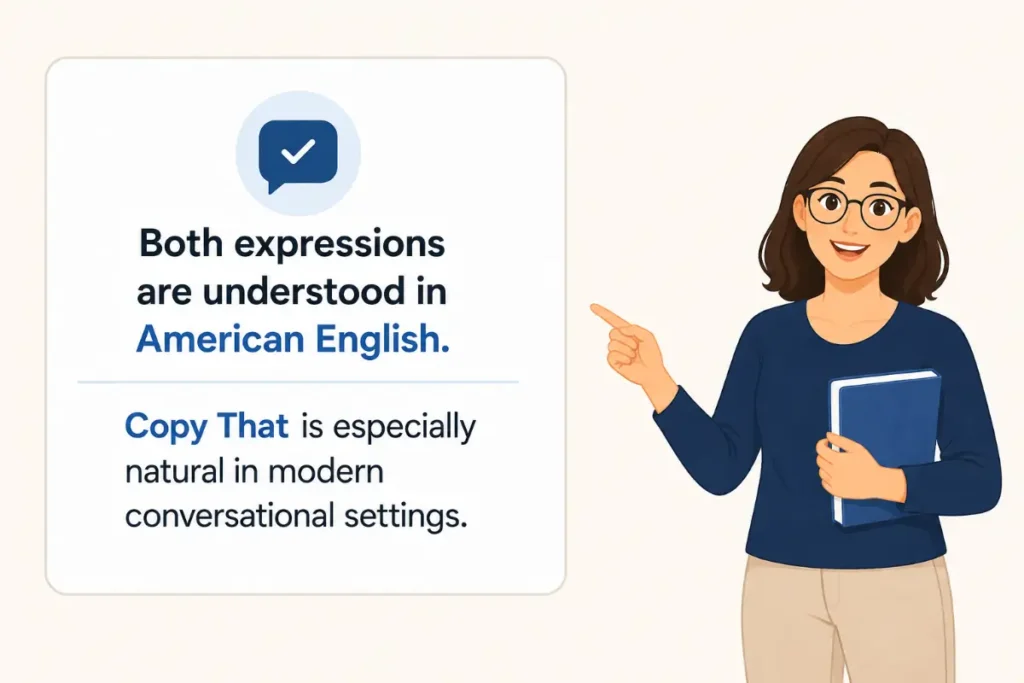
Both expressions are understood in American English. Copy That is especially natural in modern conversational settings.
Roger That remains familiar because of its long history and frequent appearance in movies television games books and radio related contexts.
American speakers may also use both expressions humorously. Someone might say Roger That simply to make an ordinary conversation sound like a military operation.
For example:
- “Please bring the pizza inside.”
“Roger That.”
The speaker probably does not believe they are actually communicating through a military radio. The phrase adds personality.
Copy That can also have this effect but usually feels less strongly tied to a particular historical style.
Copy That Or Roger That In British English
British English speakers understand both expressions. Their frequency and naturalness can vary by speaker and context.
The expressions are not exclusive to American English. Their meaning is broadly recognized across English speaking communities.
Regional differences matter less than context. Radio communication military settings aviation themed dialogue and popular culture can influence how familiar a speaker feels with each phrase.
For formal British or American writing the same general advice applies. Use a direct formal acknowledgment when professional tone matters more than conversational style.
Grammar And Sentence Structure
Copy That and Roger That function as fixed conversational expressions rather than ordinary sentences with a complete subject and predicate.
They are often used independently.
For example:
- “Copy That.”
- “Roger That.”
Both can stand alone as responses.
You can also expand the response into a complete sentence.
- “Copy That. I will send the report this afternoon.”
- “Roger That. We will wait for your signal.”
The short form is useful because the purpose of the expression is acknowledgment. Adding unnecessary words can make communication less efficient when speed matters.
Do You Need A Comma
You generally do not need a comma inside Copy That or Roger That.
They are normally written as separate words without internal punctuation.
Correct:
- Copy That.
- Roger That.
Incorrect forms may appear in informal writing but they do not improve clarity.
If the phrase appears as part of a larger sentence punctuation depends on the surrounding grammar.
For example:
- He replied “Copy That” and continued working.
In formal writing quotation marks may be appropriate when you are discussing the exact words someone said. In ordinary usage however the phrase can simply appear as part of dialogue.
Professional Writing Tips
Professional communication often benefits from precise acknowledgments rather than slang or radio expressions.
Choose the wording based on the relationship and setting.
For an informal team message you might write:
- “Copy That. I will take care of it.”
For a formal email you might write:
- “Understood. I will complete the update by Friday.
The goal is not to avoid Copy That or Roger That. The goal is to match the phrase to the communication setting.
Memory Tips
A simple memory trick can help distinguish the two.
Think of copy as receiving a message.
If someone asks “Do you copy?” they are asking if you can hear and understand them.
Think of Roger as the older radio word associated with received.
So:
Copy = I received your message.
Roger = I received your message.
The meaning overlaps but Roger carries a stronger historical radio flavor.
Another useful trick is to think about tone.
Copy That sounds practical.
Roger That sounds radio styled.
That distinction will help you choose naturally.
Related Expressions
English has many ways to acknowledge a message.
Understood
Understood is direct and professional. It works in both speech and writing.
Example:
- “Please send the report before noon.”
“Understood.”
Got It
Got It is very common in everyday American English.
Example:
- “Call me when you arrive.”
“Got It.”
It sounds natural and friendly.
Received
Received is concise and can sound formal or technical.
Example:
- “The files have been sent.”
“Received.”
Acknowledged
Acknowledged sounds formal and deliberate.
Example:
- “Your instructions have been updated.”
“Acknowledged.”
I Understand
I Understand is clear and complete.
Example:
- “The deadline cannot be extended.”
“I understand.”
This phrase can communicate understanding without necessarily expressing agreement.
Affirmative
Affirmative means yes or confirmed. It is associated with radio and official communication.
Example:
- “Is the team ready?”
“Affirmative.”
It differs slightly from Copy That because it generally confirms a proposition rather than simply acknowledging receipt of a message.
How Copy That Differs From Got It
Copy That and Got It can both acknowledge information, but their tones differ.
Got It is extremely common in casual American conversation. Copy That has a more communication oriented sound.
Compare:
- “Please call Sarah this afternoon.”
“Got It.” - “Please call Sarah this afternoon.”
“Copy That.”
Both are clear. Got It sounds more ordinary. Copy That can sound more deliberate or radio influenced.
How Roger That Differs From Affirmative
Roger That means the message was received and understood.
Affirmative generally means yes or a positive confirmation.
For example:
- “Did you receive the instructions?”
“Roger That.”
The speaker confirms receipt.
- “Are you ready to leave?”
“Affirmative.”
The speaker confirms that the answer is yes.
They can appear in similar communication settings but they perform different functions.
How These Expressions Work In Conversation
One reason these phrases remain useful is that they are efficient.
Imagine someone gives you a long instruction:
“Take the package to the front office then leave the signed form on my desk and call me when everything is finished.”
You do not need to repeat every detail.
A simple:
“Copy That.”
can confirm that you received the instruction.
The value comes from brevity. In situations where the message itself is already clear a short acknowledgment keeps the conversation moving.
At the same time a short acknowledgment can sometimes be too vague. If the instruction is complicated or important it may be better to repeat the key detail.
For example:
“Copy That. I will deliver the package to the front office and call you afterward.”
That response provides confirmation and shows exactly what the speaker understood.
When Not To Use These Expressions
There are situations where a different expression is more appropriate.
Avoid using them in highly formal writing when a standard acknowledgment would sound clearer.
For example:
- “Roger That” in a formal legal letter can sound inappropriate.
- “Copy That” in an academic essay would usually be unnecessary.
- “Roger That” in a serious apology may sound emotionally detached.
- “Copy That” in a formal customer complaint response may sound too casual.
The expressions are useful tools but they are not universal replacements for “I understand.”
Is Copy That Correct English
Yes. Copy That is a legitimate English expression used to acknowledge receipt and understanding of a message.
Its meaning comes from the communication sense of copy. The phrase is particularly natural in spoken English and informal communication.
It does not mean that you are literally copying something.
Is Roger That Correct English
Yes. Roger That is also a legitimate English expression.
Its historical connection to radio communication gives it a distinctive tone. It remains widely understood even though modern speakers may use it more often for stylistic effect than as part of actual radio procedure.
Which One Should You Choose
Choose Copy That for ordinary informal communication when you want to confirm that you heard and understood something.
Use Roger That when the situation has a radio military or aviation flavor or when you intentionally want that style.
Choose Understood or I Understand when the setting is formal and you want a neutral professional tone.
Choose Got It when you want a relaxed everyday response.
Choosing the right phrase is mainly a matter of tone rather than basic meaning.
Key Takeaways
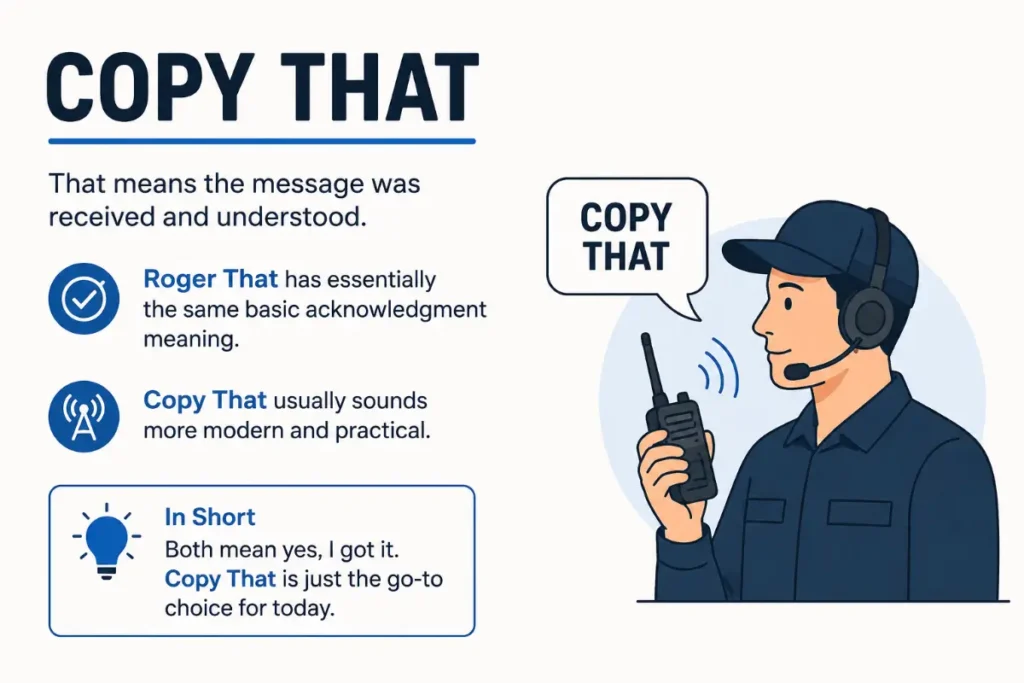
- Copy That means the message was received and understood.
- Roger That has essentially the same basic acknowledgment meaning.
- Copy That usually sounds more modern and practical.
- Roger That has a stronger radio military and aviation association.
- Neither expression automatically means agreement.
- Both phrases can stand alone as conversational responses.
- Understood and I Understand are safer choices for formal communication.
- Got It is often more natural in relaxed everyday conversation.
- The best choice depends mainly on context and tone.
- Roger comes from historical radio communication and its association with the letter R and received.
Conclusion
Copy That or Roger That are both correct expressions for confirming that you received and understood a message. Copy That usually feels more natural in modern conversational English while Roger That carries a stronger radio military and aviation flavor.
The difference is mainly about tone rather than basic meaning. Copy That works well for practical informal communication while Roger That can add a traditional radio style or a playful sense of authority. In formal writing phrases such as Understood Acknowledged or I Understand are often clearer choices.
If you remember one simple rule keep the setting in mind. Use Copy That for a straightforward acknowledgment and choose Roger That when the context or tone calls for radio style language. Both expressions are useful when you want to confirm that a message came through clearly.
Frequently Asked Questions
Is Copy That or Roger That better for everyday conversation?
Copy That usually sounds more natural in everyday conversation. Roger That is also understood but can sound more playful or radio styled.
Can I say Roger instead of Roger That?
Yes. Roger can function as a brief acknowledgment in radio style communication. Roger That is the fuller and more familiar expression.
Can I say Copy instead of Copy That?
Yes. Copy can be used as a short acknowledgment in communication contexts. Copy That sounds more complete and familiar to many speakers.
Does Roger That mean yes?
Not exactly. Roger That primarily confirms receipt and understanding. It does not always mean simple agreement.
Is Copy That slang?
It is better described as an informal communication expression rather than simple slang. Its meaning comes from a specialized use of copy in radio communication.
Should I use these phrases in academic writing?
Usually not. Academic writing generally benefits from direct and formal language. Expressions such as “I understand” or “This has been received” are more appropriate when acknowledgment is needed.
Which phrase sounds more military?
Roger That has the stronger military association. Copy That can also sound like radio communication but is less strongly tied to military language.
What is the simplest alternative to Copy That?
Got It is one of the simplest casual alternatives. Understood is a good neutral alternative.

Idioms, Expressions & Figurative Language
Mason Ellsworth is an American language writer with a passion for English expressions, figurative language, and everyday communication. He explains idioms, similes, popular phrases, and commonly misunderstood expressions in a straightforward, engaging style that helps readers improve both their writing and spoken English.