
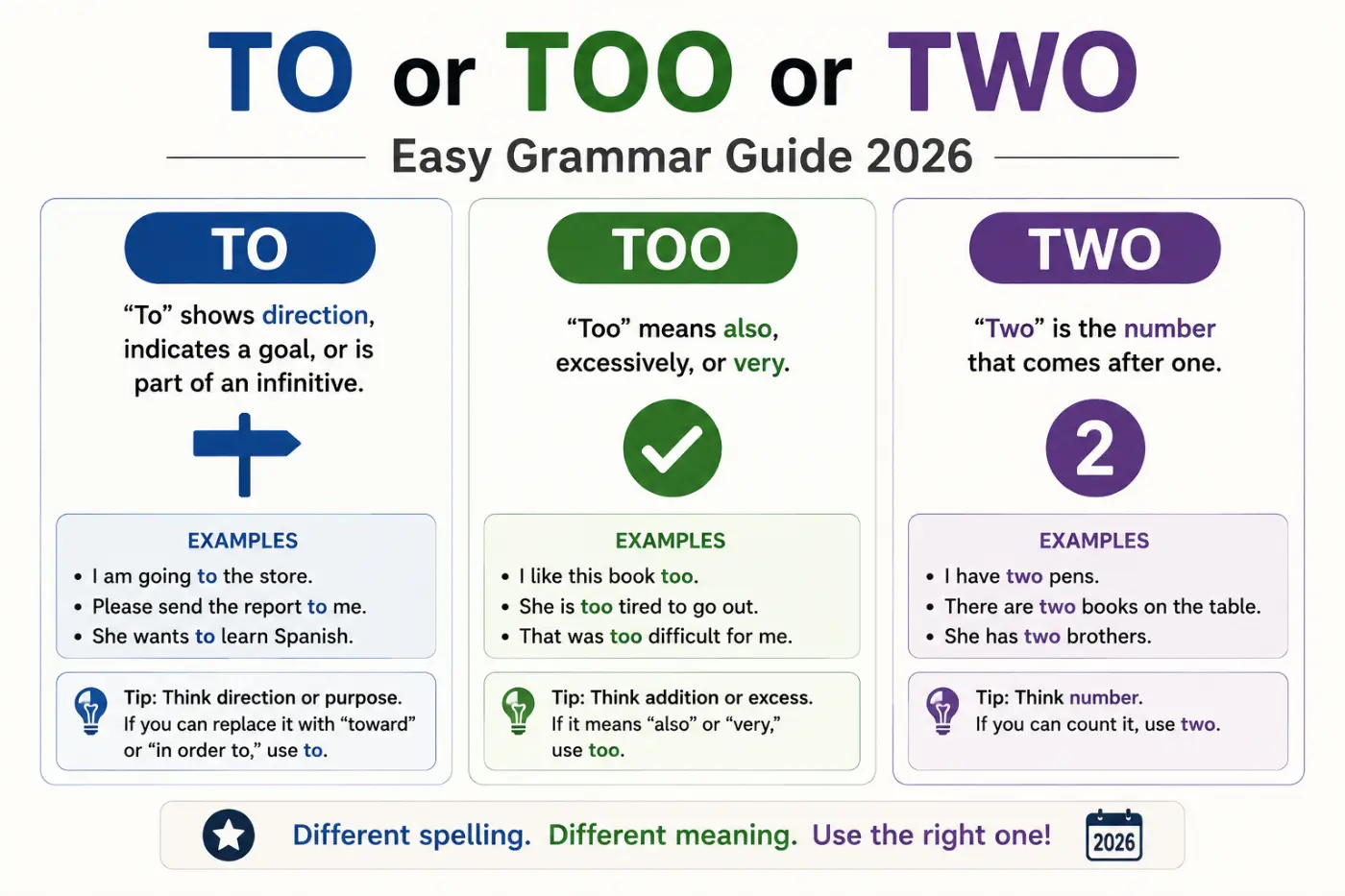
To or Too or Two can cause a surprisingly large number of mistakes because all three words usually sound the same in everyday speech. When you hear them in a sentence you cannot rely on pronunciation to tell them apart. You have to look at meaning and grammar. The good news is that each word has a clear job.
To often connects a person or thing with a destination or introduces a verb. You can walk to school or decide to study. Too has two common meanings. It can mean also as in “I want to come too.” It can also mean more than enough as in “The coffee is too hot.” Two is the number 2. You can have two books two friends or two choices.
Major dictionaries make these distinctions clear. Cambridge identifies to as a preposition that also works as part of the infinitive and defines too as an adverb with meanings such as “also” and “more than enough.” Oxford identifies two as the number 2.
Short Answer
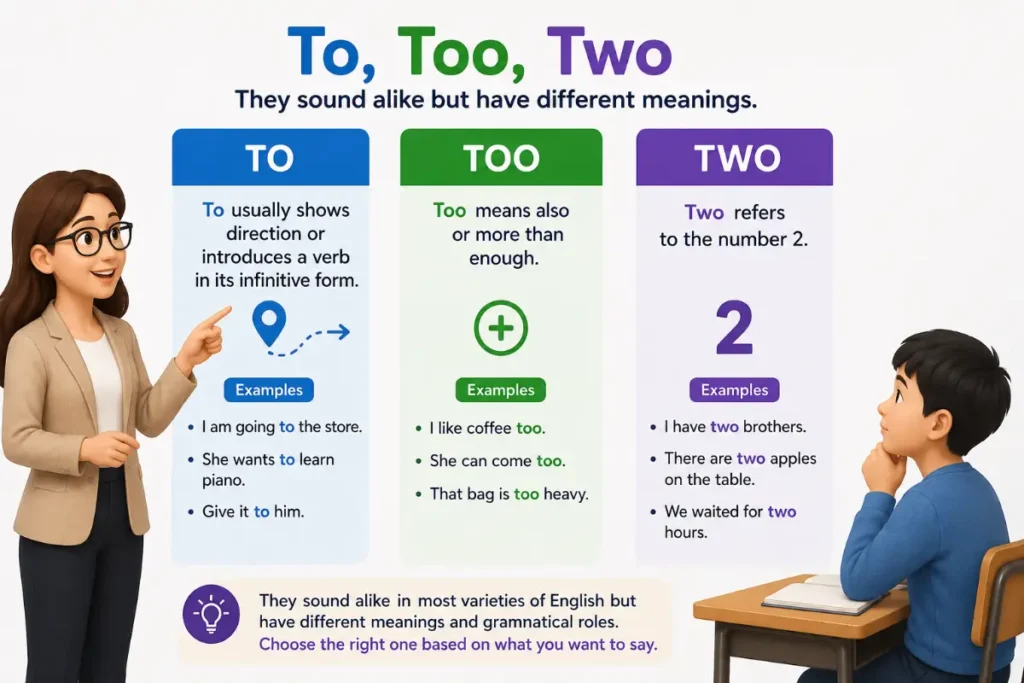
To usually shows direction or introduces a verb in its infinitive form. Too means also or more than enough. Two refers to the number 2. They sound alike in most varieties of English but have different meanings and grammatical roles. Choosing the right form depends on what you want the sentence to say.
Table Of Contents
- What To Means
- What Too Means
- What Two Means
- To or Too or Two In One Simple Comparison
- How To Use To
- How To Use Too
- How To Use Two
- When To Use To Before A Verb
- When Too Means Also
- When Too Means More Than Enough
- How To Use Two With Numbers
- To or Too or Two In Everyday Sentences
- Common Mistakes
- Pronunciation Guide
- Grammar Differences
- American And British Usage
- Word Origins
- Memory Tips
- Related Grammar Patterns
- Real Life Examples
- Professional Writing Tips
- Frequently Asked Questions
- Key Takeaways
- Conclusion
What To Means
To is one of the most common words in English. It has several grammatical functions but two uses matter most when you’re trying to distinguish it from too and two. First to can work as a preposition. It can show movement toward a place or person.
For example:
I walked to the store.
She drove to work.
They traveled to Chicago.
In each sentence to connects the action with a destination. Cambridge and Oxford both describe this directional use.
Second to can introduce the infinitive form of a verb.
For example:
I want to sleep.
She needs to study.
We decided to leave.
The word following to is a base form of a verb such as sleep study or leave.
This pattern appears constantly in English. You can think of to as a small grammatical bridge. It often connects an action with its destination or connects another verb with the action that follows.
What Too Means
Too is an adverb with two major meanings.
The first means also or as well.
For example:
I want to go too.
She likes pizza too.
He came with us too.
In this use too adds another person or thing to the statement.
The second meaning is more than enough or more than is desirable.
For example:
The soup is too hot.
This bag is too heavy.
The movie was too long.
Cambridge explains both major meanings and notes that too commonly appears at the end of a clause when it means “also.” It also commonly appears before adjectives and adverbs when it means more than is wanted or suitable. That gives you a useful shortcut. If you can replace the word with also the spelling is probably too. If you can replace it with more than enough the spelling is also too.
What Two Means
Two is the number 2.
That’s the easiest meaning of the three words.
Examples include:
I have two brothers.
She bought two tickets.
We need two chairs.
Oxford defines two as the number 2 and traces the word to Old English twā with Germanic and Indo European connections.
Because two represents a number it can appear before nouns.
Two books.
Two people.
Two hours.
Two dollars.
It can also stand alone.
I only need two.
She bought two.
The number is clear from context.
To or Too or Two In One Simple Comparison
| Word | Main meaning | Part of speech | Typical use | Example |
|---|---|---|---|---|
| To | Direction or infinitive marker | Preposition or infinitive marker | Shows destination or comes before a base verb | I went to school. |
| Too | Also or more than enough | Adverb | Adds information or shows excess | I want to come too. |
| Two | Number 2 | Number or determiner | Identifies a quantity | I have two books. |
The fastest way to distinguish them is to ask what the word is doing.
If it shows direction or comes before a verb use to.
If it represents the number 2 use two.
This simple test solves most spelling questions.
How To Use To
Use to when you are talking about movement toward a destination.
Examples:
I went to school.
She walked to the park.
We drove to the airport.
He ran to his mother.
The children went to the library.
The destination can be a physical place but it doesn’t have to be.
You can also use to with a person who receives something.
I gave the book to Sarah.
She sent an email to her manager.
They handed the keys to the owner.
Cambridge lists this receiving function among the major uses of to.
To Before A Verb
Use to before the base form of a verb in many infinitive constructions.
Examples:
I want to learn.
She hopes to win.
They decided to stay.
We need to talk.
He promised to help.
The important point is that the verb after to stays in its base form.
Correct:
I want to go.
Incorrect:
I want to went.
Correct:
She needs to study.
Incorrect:
She needs to studied.
Cambridge describes this as the to infinitive.
To Showing Purpose
To can also explain why someone does something.
For example:
I went outside to get some fresh air.
She called to ask a question.
He saved money to buy a car.
We stopped to eat lunch.
In these sentences to introduces an infinitive that expresses purpose.
You can often test this use by asking “Why?”
Why did she call?
She called to ask a question.
Why did he save money?
He saved money to buy a car.
How To Use Too
Use too when you mean also.
This is especially common at the end of a sentence.
Examples:
I want to go too.
She likes the movie too.
He wants some coffee too.
They are coming too.
I saw that show too.
Cambridge notes that too meaning “also” commonly appears at the end of the clause and is especially common in informal speech.
You can often replace too with also without changing the basic meaning.
I want to go too.
I also want to go.
She likes coffee too.
She also likes coffee.
The sentence structure changes slightly but the core meaning remains the same.
Too Meaning More Than Enough
Use too before an adjective or adverb when something exceeds a desirable or acceptable level.
Examples:
The water is too cold.
The box is too heavy.
She speaks too quickly.
The room is too small.
The test was too difficult.
Cambridge explains that too can appear directly before adjectives and adverbs to show that something is more than needed or suitable.
This meaning often carries a negative result.
The coffee is too hot to drink.
The bag is too heavy to carry.
The road is too dangerous to cross.
The child is too tired to play.
In each case the amount or degree creates a problem.
When To Use To Before A Verb
One of the most useful grammar tests is to look at the word immediately after the confusing form. If the next word is a base verb and the phrase expresses an infinitive you probably need to.
Examples:
I need to work.
She wants to leave.
We hope to win.
They plan to travel.
He agreed to help.
Notice the pattern.
to + base verb
To work.
Oxford explains that to often comes before the base form of a verb to create the infinitive.
There are exceptions to the larger rule because some verbs take an infinitive without to. Modal verbs such as can could may might will would should and must normally take the base verb directly.
For example:
She can swim.
He must leave.
They should study.
You would agree.
Not:
She can to swim.
He must to leave.
Cambridge explains that modal verbs take the infinitive without to.
When Too Means Also
A simple substitution test works well here.
Replace too with also.
If the sentence still makes sense the spelling is too.
For example:
I want pizza too.
I also want pizza.
She came too.
She also came.
He knows the answer too.
He also knows the answer.
This test is especially useful when you’re writing quickly.
Me Too
Me too is one of the most familiar expressions using this meaning.
A:
I love this song.
B:
Me too.
The phrase means:
I love this song too.
In informal American English me too is completely natural.
Cambridge specifically notes that informal short answers commonly use me too rather than I too.
When Too Means More Than Enough
When too means excess it often appears before an adjective.
Examples:
Too expensive.
Too difficult.
The word can also combine with quantity expressions.
Too much goes with uncountable nouns.
There is too much water.
There is too much noise.
We have too much information.
Too many goes with countable nouns.
There are too many cars.
She bought too many books.
We invited too many people.
Cambridge explains the distinction between too much and too many as part of its grammar guidance on excess and quantity.
How To Use Two
Use two whenever you mean the number 2.
Examples:
I have two dogs.
She bought two apples.
We need two chairs.
He has two sisters.
They stayed for two days.
You can also use two in measurements.
Two miles.
Two inches.
Two pounds.
Two hours.
Two weeks.
Two years.
The word can also appear in compound expressions.
A two hour meeting.
A two page report.
When a number and noun work together as a compound adjective before another noun the measurement expression normally stays singular.
So you write:
A two hour meeting.
Not:
A two hours meeting.
The plural form returns when the expression functions normally after a verb or preposition.
The meeting lasted two hours.
This is a useful grammar distinction for professional writing.
To or Too or Two In Everyday Sentences
Seeing the three words together makes the distinction much easier.
Consider this sentence:
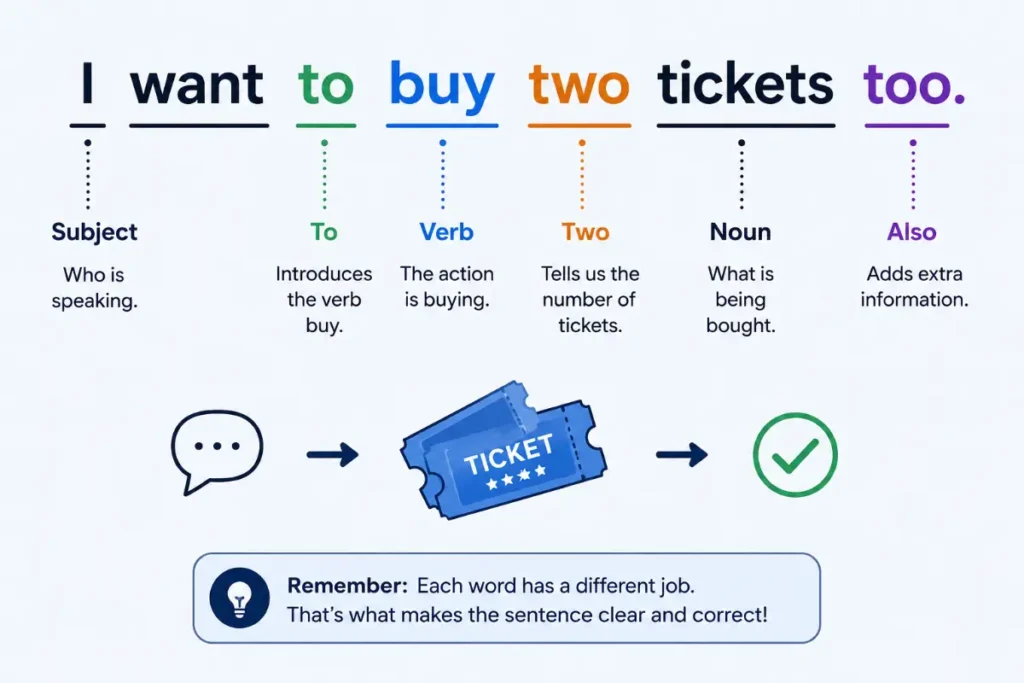
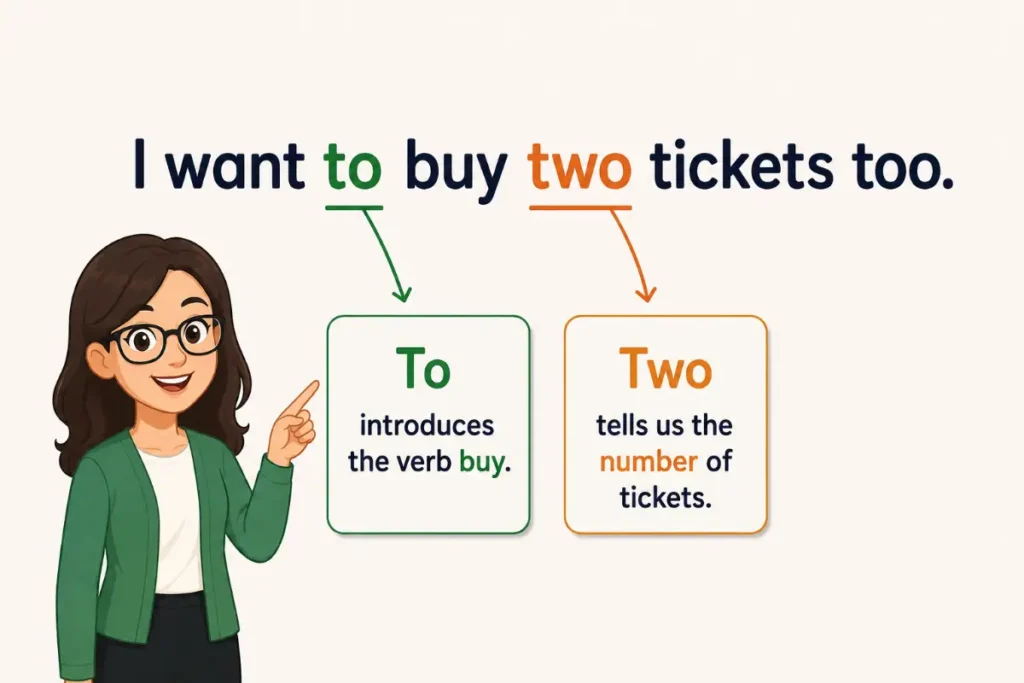
I want to buy two tickets too.
Each word has a different job.
To introduces the verb buy.
Two tells us the number of tickets.
Too means also.
Change the sentence slightly:
I went to the store because I needed two notebooks too.
Again each spelling performs a different grammatical job. This is why pronunciation alone cannot solve the problem. The words sound alike but their meanings and functions are completely different.
Common Mistakes
Using Too Instead Of To
Incorrect:
I want too go home.
Correct:
I want to go home.
The word before go introduces an infinitive so the correct form is to.
Using To Instead Of Too
Incorrect:
I want to come to.
Correct:
I want to come too.
Here the intended meaning is also.
Using To Instead Of Two
Incorrect:
I have to brothers.
Correct:
I have two brothers.
The word represents the number 2 so the correct spelling is two.
Using Two Instead Of Too
Incorrect:
The soup is two hot.
Correct:
The soup is too hot.
The sentence describes excessive heat so the correct word is too.
Writing To Much
Incorrect:
There is to much sugar in the coffee.
Correct:
There is too much sugar in the coffee.
The phrase too much expresses an excessive amount.
Writing To Many
Incorrect:
There are to many people here.
Correct:
There are too many people here.
Again too expresses excess.
Writing Two Before A Verb
Incorrect:
I want two learn Spanish.
Correct:
I want to learn Spanish.
The word introduces the infinitive to learn.
Pronunciation Guide
The three words are homophones in most varieties of English. That means they have the same pronunciation while having different meanings and spellings. The common pronunciation is approximately:
to /tə/ in its weak form and /tuː/ in its strong form.
too /tuː/
two /tuː/
Cambridge gives several pronunciations for to because its pronunciation changes according to stress and position in a sentence. The strong form is /tuː/ while weak forms such as /tə/ are extremely common.
Oxford gives too as /tuː/ and two as /tuː/.
This explains why spelling mistakes happen so easily.
If someone says:
I want to buy two books too.
you hear three forms that sound alike.
You have to use grammar and meaning to determine the spelling.
Grammar Differences
The clearest way to understand these words is to classify them by grammatical role.
To As A Preposition
Example:
She went to school.
Here to introduces a destination.
To As An Infinitive Marker
Example:
She wants to study.
Here to introduces the base verb study.
Too As An Adverb
Example:
The coffee is too hot.
Here too modifies the adjective hot.
Another example:
She speaks too quickly.
Here too modifies the adverb quickly.
Too As An Addition Word
Example:
I want some too.
Here too means also.
Two As A Number
Example:
I have two books.
Here two identifies a quantity.
Once you understand these grammatical roles the spelling becomes much easier.
American And British Usage
The three spellings remain the same in standard American and British English.
The main differences concern pronunciation and some usage patterns rather than the spelling itself.
To is used in both varieties.
Too is used in both varieties.
Two is used in both varieties.
British and American speakers may differ in accent and rhythm but the three written forms remain distinct.
One useful point concerns the pronunciation of to. In natural speech American and British speakers commonly reduce it to a weak form such as /tə/ when it is unstressed. The strong form /tuː/ appears when the word receives emphasis. Cambridge records these variations.
This means you shouldn’t expect to to sound exactly like too in every sentence.
For example:
I want to go.
The to is usually weak.
I said TO go.
The word can receive stronger stress.
Even so the written distinction remains important.
Word Origins
The histories of these three words are related in interesting ways but they developed along different paths.
Origin Of To
To comes from Old English and has a long history as a preposition. Its uses expanded over time to cover direction purpose relationship and the infinitive construction.
Oxford records to as a preposition and Cambridge documents its many functions including direction receiving an action time and the infinitive.
Origin Of Too
Too has an interesting historical connection with to.
Oxford explains that too developed from an Old English stressed form of to and that the spelling too became established from the sixteenth century.
That history helps explain why the two words look so similar.
Their modern meanings are different but their historical relationship is real.
Origin Of Two
Two comes from Old English twā and belongs to the Germanic family of number words. Oxford connects it with related forms in Dutch and German and ultimately with an Indo European root shared with Latin and Greek forms for two.
The spelling changed over centuries but the basic numerical meaning remained remarkably stable.
Memory Tips
You don’t need a complicated mnemonic to remember these words.
Try these simple associations.
To Means Toward
Think of to as pointing toward something.
I walked to school.
She drove to work.
They went to the beach.
Too Has An Extra O
Think of the extra o in too as an extra amount.
Too much.
Too hot.
The extra o can remind you of something extra.
It also helps to remember that too can mean also.
I want to come too.
That gives you two common meanings for the same spelling.
Two Means 2
The w in two doesn’t sound like the number but the word still represents 2.
Think:
Two = 2.
If you can replace the word with the numeral 2 without changing the meaning use two.
I have two cats.
I have 2 cats.
The meaning stays the same.
Related Grammar Patterns
Several expressions can help reinforce the distinction.
Too Much
Use too much with uncountable nouns.
Too much water.
Too much time.
Use too many with countable plural nouns.
Too many people.
Too many cars.
Two Of
Use two of when selecting a pair from a larger group.
Two of my friends came.
I ate two of the cookies.
Two of the students finished early.
To Be
To be is one of the most common infinitive combinations.
I want to be honest.
She hopes to be successful.
They need to be careful.
To Have
To have is another common infinitive structure.
I want to have more time.
She hopes to have a chance.
We need to have a plan.
These patterns are useful because they make the spelling almost automatic once you recognize the grammar.
Real Life Examples
At Home
I need to buy two more towels.
The sentence uses to before the verb buy and two for the number of towels.
The towels are too expensive.
Here too means more expensive than acceptable.
I bought two anyway.
Here two gives the quantity.
My sister wants one too.
Here too means also.
At Work
I need to send two emails.
The first word introduces the action and the second identifies the number.
The message is too long.
Here too shows excess.
My manager needs one too.
Here too means also.
At School
We have two tests this week.
The word represents the number 2.
I need to study tonight.
The word introduces the infinitive study.
The first test is too difficult.
Here too means more difficult than acceptable.
My friend wants to study too.
The final word means also.
Professional Writing Tips
These three words appear constantly in professional communication. A single spelling mistake can make an otherwise polished sentence look careless.
Consider this email sentence:
I need to send two files too.
Every word has a precise function.
Another example:
The report is too long to review today.
The first too means excessive.
The second to introduces the verb review.
This pattern is worth studying because it places the two most frequently confused forms next to each other.
You can also have all three in one sentence:
I need to send two copies too.
That sentence is grammatically correct and perfectly natural.
The best editing habit is to slow down whenever one of these words appears in a sentence where the meaning isn’t immediately obvious.
Ask three questions.
- Am I showing direction or introducing a verb?
- Am I saying also or more than enough?
- Am I referring to the number 2?
The answer tells you the spelling.
A Fast Editing Test
When proofreading your writing search mentally for every to too and two.
Then test each one.
If the word means toward or introduces a verb choose to.
If it means 2 choose two.
For example:
I have to go to the store.
Both forms are to because they serve grammatical functions.
I have two dollars too.
Two gives the number.
Too means also.
The movie was too long to finish.
Too means excessively.
To introduces the infinitive.
This method is simple enough to use during proofreading and reliable enough for everyday writing.
Why These Words Cause So Many Errors
The main reason is sound.
English contains many homophones and near homophones. When words sound alike the brain can’t always rely on pronunciation to select the spelling.
Context has to do the work.
Children learning English often encounter this problem in school. Adult writers can make the same mistake when typing quickly because the fingers may follow the sound rather than the meaning. Autocorrect doesn’t always solve the issue either. All three forms are legitimate English words so a spelling checker may not flag the wrong choice.
For example:
I have to dogs.
The sentence is grammatically wrong because to should be two. Yet a basic spell checker may not identify the problem because to is correctly spelled as a word.
This is called a contextual spelling error.
The spelling itself is valid.
The word is simply wrong for the intended meaning.
That is why understanding grammar is more useful than relying entirely on spell checking.
To or Too or Two In Formal Writing
Formal writing follows the same basic rules.
There is no special formal spelling for these words.
You still write:
To.
Too.
Two.
The difference comes from how you use them.
For example:
The committee agreed to review two proposals.
Both forms are correct.
The proposal was too expensive for the committee.
Again too has its standard meaning.
In academic writing business communication reports and professional emails accuracy matters because these small words carry specific grammatical functions.
A sentence with the wrong form can change the meaning or make the writer appear careless.
Related Confusing Words
English has many word pairs and groups that behave like to too and two.
Examples include:
- There and their.
- They’re and their.
- Your and you’re.
- Its and it’s.
- Then and than.
- Affect and effect.
- Accept and except.
- Principal and principle.
- Compliment and complement.
- Stationary and stationery.
These words aren’t all homophones but they share one important feature. Their forms can look or sound similar while their meanings differ.
The best way to master them is to learn each word by function rather than memorizing isolated spellings.
Key Takeaways
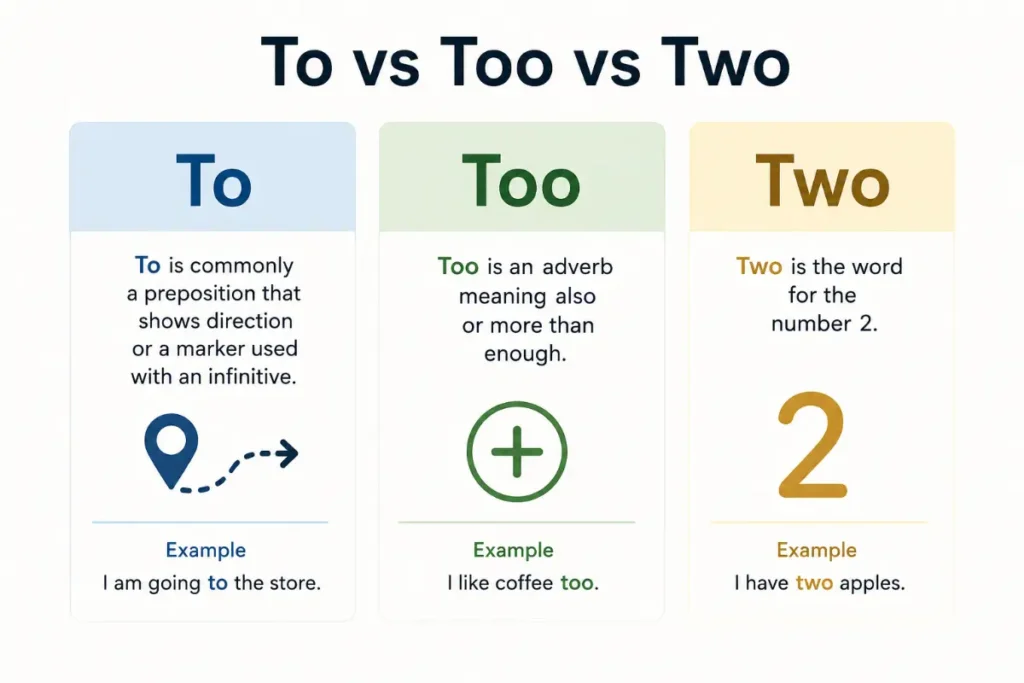
- To is commonly a preposition that shows direction or a marker used with an infinitive.
- Too is an adverb meaning also or more than enough.
- Two is the word for the number 2.
- To often appears before a base verb such as to eat or to study.
- Too can mean also as in I want one too.
- Too can show excess as in The coffee is too hot.
- Two identifies a quantity as in two books.
- The three words often sound alike so pronunciation alone cannot determine the spelling.
- Context and grammatical function provide the best clues.
- A spell checker may miss an error because all three forms are legitimate English words.
Conclusion
The difference between to too and two becomes much easier once you stop relying on sound and focus on meaning. That one sentence captures the whole rule. To introduces the action. Two gives the quantity. Too adds another person or idea.
A simple proofreading trick is to look at the word’s function before deciding how to spell it. Choose to for direction or before a base verb. Use too when it means also or shows excess. Choose two when the sentence refers to the number 2. This quick check can prevent most common mistakes.
Once you learn those three functions the confusion stops being a guessing game. The spelling follows the meaning.
Frequently Asked Questions
What is the difference between to too and two?
To usually shows direction or introduces an infinitive. Too means also or more than enough. Two represents the number 2. They often sound alike but they have different meanings and grammatical roles. Understanding what the word does in the sentence is the fastest way to choose the correct spelling.
How do I remember To or Too or Two?
A simple way to remember these words is to connect each spelling with its job. To often shows direction or comes before a verb. Too has an extra o and can mean something extra or an additional person. Two represents the number 2. Linking each word to its meaning makes the difference much easier to remember.
Is too always used to mean more than enough?
No. Too has two major everyday meanings. It can mean more than enough as in “The bag is too heavy.” It can also mean also as in “I want one too.” Context tells you which meaning applies. Cambridge documents both uses.
Can to be used before a noun?
Yes. To commonly works as a preposition before a noun or pronoun. It can show direction or the receiver of an action. Examples include “I went to school” and “She gave the book to him.” Cambridge and Oxford both document these uses.
Can too come before a noun?
Yes but the structure matters. Too can appear before quantity expressions such as too much and too many. For example “There is too much water” and “There are too many cars.” In these structures too modifies the quantity expression rather than functioning like the preposition to.
Is two always a number?
In ordinary modern English two is the word representing the number 2. It can identify a quantity or stand alone as a pronoun like expression in sentences such as “I only need two.” Oxford classifies two as a number and gives examples of its use with nouns and by itself.
Why do to too and two sound the same?
They developed through different historical paths but their modern pronunciations overlap. Too and two are normally pronounced /tuː/. To often has a weak pronunciation such as /tə/ in unstressed speech but can have the strong form /tuː/.
Can all three words appear in one sentence?
Yes. For example “I want to buy two tickets too.” The first to introduces the verb buy. Two identifies the number of tickets. The final too means also. This sentence is a useful way to see how three homophones can perform completely different grammatical jobs.
Is me too grammatically correct?
Yes. Me too is a natural informal expression meaning that you share the statement or feeling just mentioned. For example if someone says “I love this book” you can reply “Me too.” Cambridge specifically notes this informal pattern.
What is the easiest way to choose between to too and two?
Focus on the meaning of the word rather than its sound. Choose to when it shows direction or comes before a verb. Use too when it means also or more than enough. Choose two when you mean the number 2. Since all three can sound alike, meaning and sentence structure provide the clearest clue.

Confusing Words, Spelling & Word Choice
Claire Whitmore is a U.S.-based English editor who writes about commonly confused words, spelling differences, and word choice. Her work helps readers understand subtle distinctions between similar-looking words through simple definitions, practical examples, and modern usage guidance in both American and British English.