
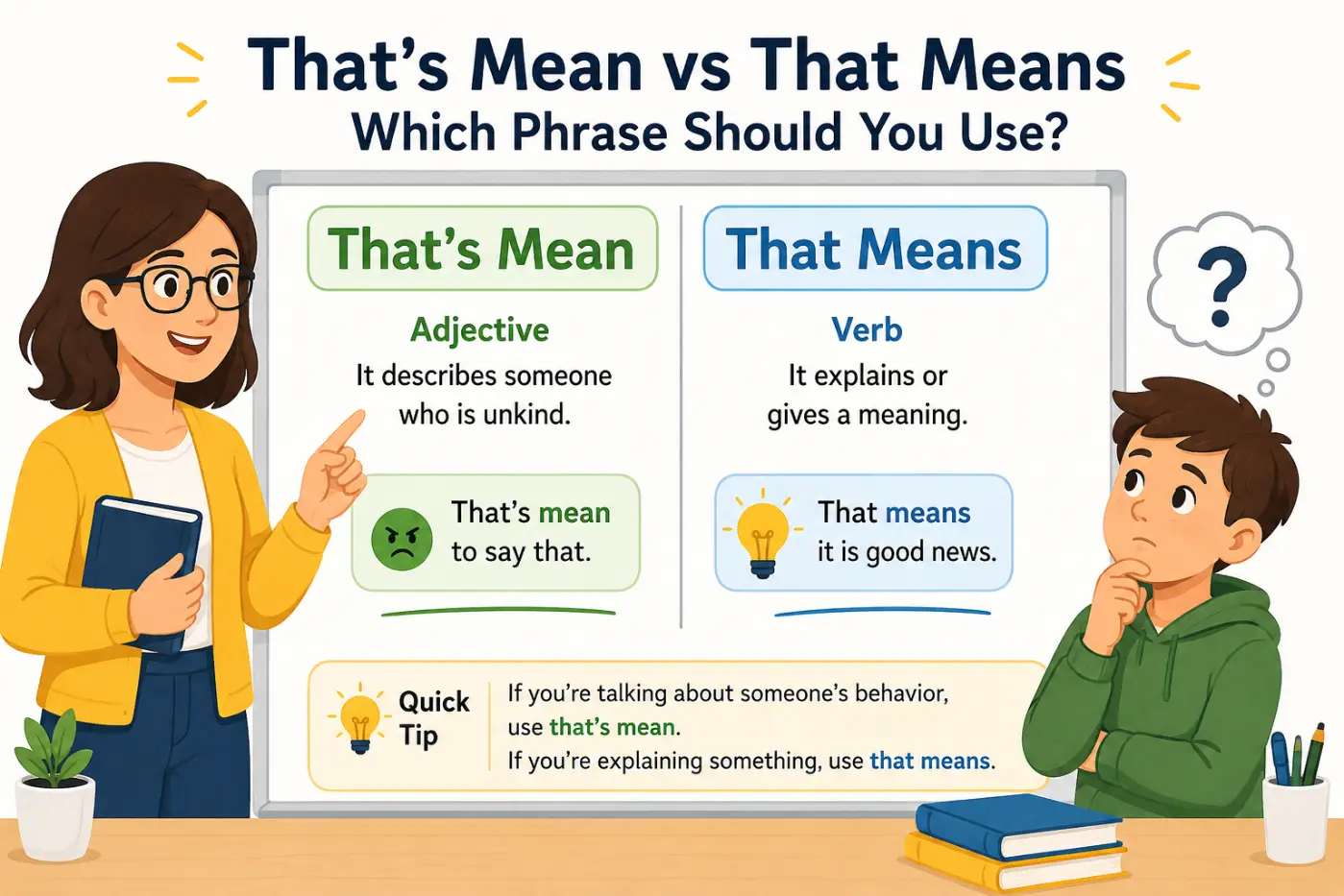
That’s Mean vs That Means confuses many English learners because the difference is only one letter, yet the meanings are completely different. Many people accidentally type or say the wrong expression, especially in casual conversations, text messages, or social media posts.
The good news is that the distinction is easy once you understand the grammar behind each phrase. One expression talks about the meaning of something, while the other describes behavior or attitude. Knowing when to use each one will make your writing clearer and help you avoid a very common English mistake.
This guide explains the meaning of both expressions, their grammar, pronunciation, examples, common mistakes, memory tricks, and professional writing tips. By the end, you’ll know exactly when to use each phrase with confidence.
Short Answer
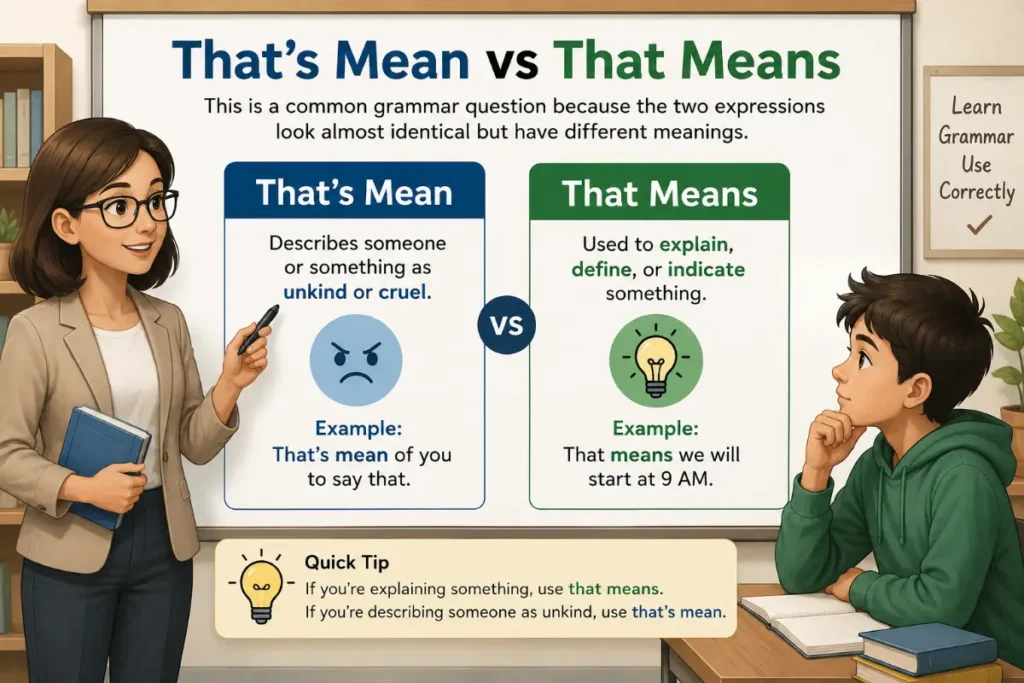
That’s Mean vs That Means is a common grammar question because the two expressions look almost identical but have different meanings. In standard English, that means is the correct phrase when you want to explain, define, or indicate something. That’s mean is also correct, but it has a completely different meaning. It describes someone or something as unkind or cruel.
Table of Contents
- Quick Comparison
- What Does That’s Mean Mean
- What Does That Means Mean
- Why People Confuse That’s Mean vs That Means
- The Grammar Rule Behind Both Expressions
- When to Use That’s Mean
- When to Use That Means
- Real Life Examples
- Common Mistakes
- Memory Tips
- Related Grammar Notes
- Frequently Asked Questions
- Key Takeaways
- Conclusion
That’s Mean vs That Means Comparison Table
| Feature | That’s Mean | That Means |
|---|---|---|
| Grammar | Correct | Correct |
| Meaning | Describes someone or something as unkind | Explains the meaning or result of something |
| Part of Speech | Linking verb + adjective | Subject + verb |
| Common Use | Talking about behavior | Giving explanations or conclusions |
| Formal Writing | Yes | Yes |
| Everyday Conversation | Yes | Yes |
The important point is that both expressions are grammatically correct. The mistake happens when someone uses one in place of the other.
What Does That’s Mean Mean
That’s mean is a shortened form of that is mean.
In this expression:
- That’s = That is
- Mean = an adjective describing someone’s behavior.
Here, mean has nothing to do with definitions or explanations. Instead, it describes a person, action, comment, or behavior that is cruel, rude, or unkind.
Examples:
- That’s mean. You shouldn’t laugh at him.
Explanation: The speaker says the behavior is unkind.
2. That’s mean because she tried her best.
Explanation: The speaker believes someone acted unfairly.
What Does That Means Mean
That means is different.
Here:
- That is the subject.
- Means is the verb.
The verb means comes from mean, which means to signify, indicate, explain, or represent.
Examples:
- The red light is on. That means the battery is low.
Explanation: The second sentence explains the meaning of the first.
- You passed the exam. That means you can graduate.
Explanation: It shows the result.
Notice that means is always a verb in these examples.
Why People Confuse That’s Mean vs That Means
The confusion usually happens because the two expressions sound similar in fast speech. People often write quickly without thinking about the grammar.
For example:
❌ That’s means you’re ready.
This sentence mixes two different structures.
The correct sentence is:
✅ That means you’re ready.
Another example:
❌ That mean.
Correct:
✅ That means.
Or if describing behavior:
✅ That’s mean.
The apostrophe also contributes to the confusion. Many writers forget that that’s already contains the verb is.
Compare these:
- That’s mean.
- That is mean.
Both sentences are identical.
Now compare:
- That means…
- That signifies…
Here means functions as the main verb.
The Grammar Rule Behind Both Expressions
Understanding one grammar rule solves the confusion forever.
That’s Mean
Sentence pattern:
That + is + adjective
Example:
That is funny.
That is kind.
In every sentence, the final word is an adjective describing something.
That Means
Sentence pattern:
That + verb
Examples:
That works.
That explains.
That shows.
That indicates.
That means.
Here, means is an action verb.
It tells what that does.
How to Know Which One You Need
Ask yourself a simple question. Are you describing someone’s behavior?
If yes, write:
That’s mean.
Example:
He laughed when she fell.
That’s mean.
Are you explaining information or giving a conclusion?
If yes, write:
That means…
Example:
The weather forecast predicts rain.
Real Life Examples
At School
Teacher: You scored 95 percent.
Student: That means I passed with an A.
The teacher explains the result.
Another example:
Student: They laughed at the new kid.
Teacher: That’s mean.
Here the teacher comments on behavior.
At Home
Mom: Your room is clean.
Dad: That means we can leave now.
The second sentence explains the result.
Another conversation:
Brother: She hid my homework.
Sister: That’s mean.
The adjective describes the action.
At Work
Manager: The client approved the proposal.
Employee: That means we can start the project.
The sentence explains what happens next.
Coworker: He took credit for your work.
Employee: That’s mean.
The speaker criticizes the behavior.
Online Conversations
Friend: My package arrived today.
Reply: That means you’ll have it before the weekend.
Another example:
Friend: Someone left rude comments.
Reply: That’s mean.
Both expressions are correct because each serves a different purpose.
Common Grammar Mistakes
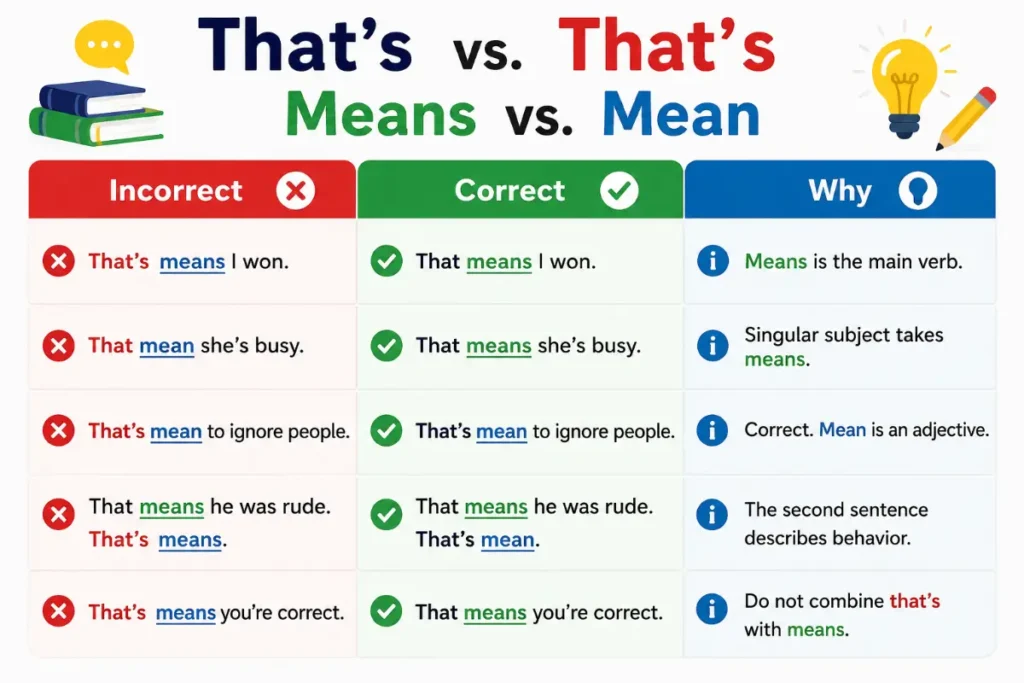
Many mistakes happen because people confuse the adjective mean with the verb means. Once you recognize the role each word plays in a sentence, the correct choice becomes obvious.
| Incorrect | Correct | Why |
|---|---|---|
| That’s means I won. | That means I won. | Means is the main verb. |
| That mean she’s busy. | That means she’s busy. | Singular subject takes means. |
| That’s mean to ignore people. | That’s mean to ignore people. | Correct. Mean is an adjective. |
| That means he was rude. That’s means. | That means he was rude. That’s mean. | The second sentence describes behavior. |
| That’s means you’re correct. | That means you’re correct. | Do not combine that’s with means. |
The biggest mistake is writing that’s means. Remember that that’s already means that is, so adding means creates an incorrect sentence.
Why That’s Means Is Incorrect
Many learners naturally write that’s means because it sounds acceptable in fast speech.
Let’s expand the contraction.
That’s means…
becomes
That is means…
Now the error is obvious.
A linking verb (is) cannot be followed by another finite verb (means) without changing the sentence structure.
Correct versions include:
- That means you’re right.
- That’s right.
- That’s interesting.
- That’s mean.
Each sentence follows a proper grammar pattern.
Sentence Patterns
Learning the patterns makes choosing the correct phrase much easier.
Pattern One
That + is + adjective
Examples:
- That’s funny.
- That’s nice.
- That’s amazing.
- That’s strange.
- That’s mean.
The final word always describes something.
Pattern Two
That + verb
Examples:
- That works.
- That explains everything.
- That sounds reasonable.
- That means we should leave.
Here the second word is the action performed by that.
More Examples of That’s Mean
These examples show mean used as an adjective.
- That’s mean to say to a friend.
The speaker describes the comment as hurtful.
- That’s mean, and you should apologize.
The action is considered unkind.
- That’s mean because she didn’t do anything wrong.
The speaker judges someone’s behavior.
- That’s really mean of him.
The adjective modifies his behavior.
- That’s mean, even as a joke.
The sentence criticizes the joke.
- That’s mean to your little brother.
The behavior is unfair.
- That’s incredibly mean.
The adjective is strengthened by incredibly.
- That’s mean and unnecessary.
Two adjectives describe the action.
More Examples of That Means
These examples use means as a verb.
- The lights are off. That means nobody is home.
The second sentence explains the first.
- The restaurant is full. That means we’ll have to wait.
A conclusion is drawn.
- She accepted the offer. That means she’s moving.
The sentence explains the result.
- You finished early. That means you have extra time.
A logical consequence follows.
- The website is offline. That means maintenance is in progress.
Information is interpreted.
- He didn’t answer. That means he’s probably busy.
The speaker reaches a conclusion.
- The train is delayed. That means we’ll arrive late.
The result is explained.
- You received a confirmation email. That means your order was successful.
The meaning of the email is explained.
Formal and Informal Usage
Both expressions are appropriate in formal and informal English.
Formal writing:
- That means the policy will take effect next month.
- That’s mean behavior and should not be tolerated.
Informal conversation:
- That’s mean.
- That means we’re done.
The grammar stays the same regardless of the setting.
American and British English
Unlike many English expressions, there is no American or British difference here.
Both American English and British English use:
- That’s mean.
- That means.
The grammar, spelling, and meanings remain identical.
Pronunciation
Although the two expressions look similar, they are pronounced slightly differently.
That’s mean
The final word is pronounced like meen.
The sentence flows smoothly because that’s ends with an s sound.
That means
The word means also sounds like meenz, ending with a soft z sound because of the final s in the verb.
This small pronunciation difference often disappears in rapid speech, which explains why many people confuse the two expressions when writing.
Word Origin
The adjective mean, meaning unkind or cruel, has been part of English for centuries. Over time, it developed the modern sense of describing someone who behaves unfairly or hurtfully.
The verb mean comes from a different historical development. It refers to intending, signifying, or expressing an idea. The third-person singular form is means, which is why we say:
- That means…
- It means…
- This means…
Although both words share the same spelling in their base form, they belong to different grammatical categories.
Professional Writing Tips
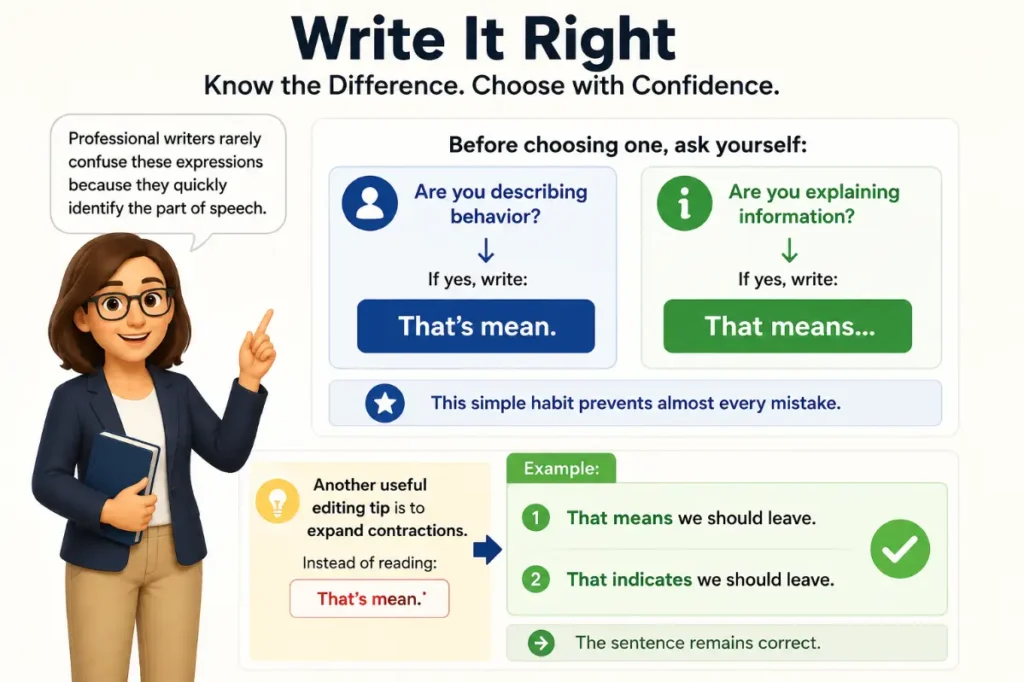
Professional writers rarely confuse these expressions because they quickly identify the part of speech. Before choosing one, ask yourself:
Are you describing behavior?
If yes, write:
That’s mean.
Are you explaining information?
If yes, write:
That means…
This simple habit prevents almost every mistake.
Another useful editing tip is to expand contractions.
Instead of reading:
That’s mean.
Example:
That means we should leave.
That indicates we should leave.
The sentence remains correct.
Memory Tricks
Simple memory tricks make the difference easy to remember.
Trick One
That’s always equals That is.
So:
That’s mean
becomes
That is mean.
If the expanded sentence sounds correct, your grammar is correct.
Trick Two
Means explains something.
Think:
That means…
That shows…
That indicates…
All three verbs perform the same job.
Trick Three
If you can replace the last word with kind, rude, nice, or funny, you need mean as an adjective.
Example:
That’s mean.
That’s funny.
These all fit the same grammar pattern.
Related Expressions
Learning similar expressions helps reinforce the grammar.
Adjective pattern:
- That’s nice.
- That’s helpful.
- That’s honest.
- That’s generous.
- That’s funny.
- That’s unfair.
- That’s rude.
- That’s thoughtful.
Verb pattern:
- That explains everything.
- That suggests a problem.
- That proves my point.
- That shows improvement.
- That demonstrates the idea.
- That means we’re finished.
Notice how every sentence follows one of the two grammar structures discussed throughout this guide.
Quick Practice
Choose the correct answer.
- The store is closed. _____ we’ll come back tomorrow.
Answer:
That means we’ll come back tomorrow.
- You laughed after he fell.
Answer:
That’s mean.
- The forecast predicts snow. _____ school might close.
Answer:
That means school might close.
- Making fun of someone isn’t funny.
Answer:
That’s mean.
- Your application was approved. _____ you got the job.
Answer:
That means you got the job.
These simple exercises reinforce the difference through real situations.
Related Grammar and Usage Notes
Understanding That’s Mean vs That Means becomes easier when you learn a few related grammar rules. These patterns appear frequently in spoken and written English.
Its vs It’s
Another common mistake involves contractions.
Correct:
- It’s cold today.
- Its color is blue.
Remember that it’s means it is, just as that’s means that is.
You’re vs Your
Correct:
- You’re doing well.
- Your book is on the table.
A contraction always replaces two words.
They’re vs Their vs There
Correct:
- They’re leaving now.
- Their car is outside.
- Put the box over there.
These words sound alike but serve different grammatical purposes.
This Means vs This Is Mean
Compare these examples:
- This means we have enough time.
- This is mean.
The first sentence explains something. The second sentence describes something as unkind. The same grammar rule applies as in That’s Mean vs That Means.
People Also Ask
Is “That’s mean” grammatically correct?
Yes. That’s mean is completely correct. It is a contraction of that is mean, where mean is an adjective describing someone or something as rude, cruel, or unkind.
Is “That means” grammatically correct?
Yes. That means is also grammatically correct. Here, means is the third-person singular form of the verb mean, meaning to explain, indicate, or signify something.
Why do people confuse these expressions?
The expressions look and sound very similar, especially in fast speech. The confusion disappears once you recognize that mean is an adjective in one expression and means is a verb in the other.
Can I use both in the same conversation?
Absolutely. For example:
“She ignored my message.”
“That’s mean.”
“I guess that means she’s upset.”
Both expressions are correct because they serve different purposes.
Everyday Conversation Examples
Seeing both expressions together makes the difference much clearer.
Example 1
Alex: Everyone forgot my birthday.
Emma: That’s mean.
Alex: I know. That means they probably didn’t check the calendar.
The first sentence describes behavior.
The second explains a conclusion.
Example 2
Teacher: Your score improved by twenty points.
Student: That means I passed.
Teacher: Yes, and that’s great.
The verb means explains the result.
Example 3
Friend: Someone deleted my project.
Friend: That means I’ll have to start over.
Again, each expression performs a different grammatical job.
Editing Checklist
Before you finish writing, ask yourself these questions.
- Am I describing someone’s behavior?
Use That’s mean.
- Am I explaining a meaning, result, or conclusion?
Use That means.
- Can I expand the contraction?
If that’s becomes that is and the sentence still sounds correct, you’ve chosen the right form.
- Can I replace means with indicates or shows?
If yes, that means is correct.
This quick review catches nearly every mistake
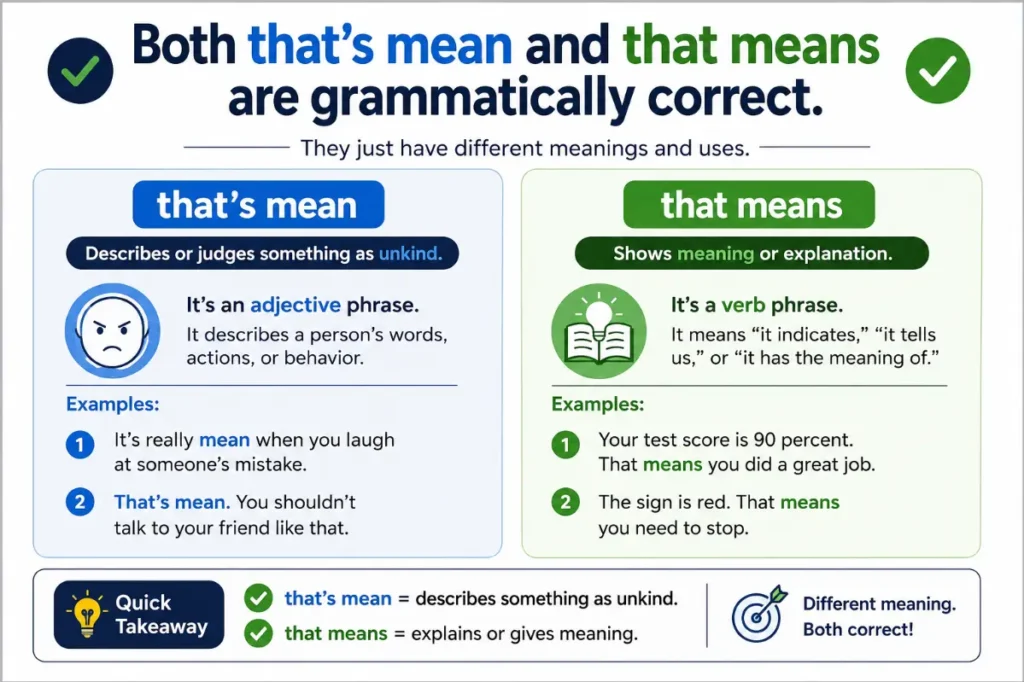
Key Takeaways
- Both that’s mean and that means are grammatically correct.
- They do not have the same meaning.
- That’s mean describes behavior that is rude, cruel, or unkind.
- That means explains, indicates, or introduces a conclusion.
- Never write that’s means because it combines two different grammar structures.
- Expanding that’s to that is is an easy way to check your grammar.
- If you are explaining information, that means is almost always the correct choice.
Conclusion
The difference between That’s Mean vs That Means comes down to grammar and meaning, not spelling. That’s mean is a contraction of that is mean and describes someone or something as rude, cruel, or unkind. That means uses means as a verb to explain, indicate, or introduce a conclusion.
A simple way to remember the difference is to ask yourself what you want to say. If you’re describing behavior, choose that’s mean. If you’re explaining information or drawing a conclusion, choose that means. This one question will guide you to the correct expression almost every time.
Once you understand these two sentence patterns, you’ll avoid one of the most common English grammar mistakes. Use the correct expression consistently, and your speaking and writing will sound clearer, more natural, and more profession.
Frequently Asked Question
Which is correct: That’s mean or that means?
Both are correct, but they have different meanings. That’s mean describes unkind behavior, while that means explains or indicates something.
Is “that’s means” ever correct?
No. That’s means is grammatically incorrect because that’s already means that is. Use either that’s mean or that means, depending on your intended meaning.
Why is “that means” written with an s?
The subject that is singular, so the verb mean changes to means in the present simple tense.
Is “that’s mean” formal English?
Yes. It is acceptable in both formal and informal English when describing behavior as rude or unkind.
Can “mean” be both a verb and an adjective?
Yes. As a verb, mean refers to indicating or signifying something. As an adjective, mean describes someone or something that is unkind or cruel.
How can I remember the difference?
Think of that’s as that is. If you’re describing behavior, use that’s mean. If you’re explaining a result or meaning, use that means.
Is this mistake common among native speakers?
Yes. Because the expressions sound similar in fast speech, even native speakers occasionally mistype one for the other, especially in text messages and social media posts.
Does American English differ from British English?
No. Both American and British English use that’s mean and that means in exactly the same way.
Which expression is more common?
That means appears more frequently because it is used whenever someone explains information, draws a conclusion, or clarifies meaning. That’s mean is used specifically when describing unkind behavior.
Can grammar checkers detect this mistake?
Most grammar and spelling tools can identify that’s means as incorrect, but they may not catch every situation. Understanding the grammar rule helps you choose the correct expression confidently.

English Grammar & Usage
Nathan Holloway is an American grammar writer and language researcher who specializes in English grammar, sentence structure, verb usage, and common writing mistakes. He enjoys breaking down confusing grammar rules into practical explanations with clear examples, making English easier for students, professionals, and everyday writers.