
Confidence is something we all notice. It shows in the way people speak, walk, smile, and face challenges. Learning similes for confident can help you describe these moments in a more colorful and natural way. Instead of saying someone is simply confident, you can compare that confidence to something familiar that readers instantly understand.
Writers, students, teachers, and English learners often use similes to make descriptions more interesting. They help readers picture a person’s attitude without using long explanations. A good simile can make your writing sound lively and memorable.
In this guide, you’ll learn the best similes for confident, what they mean, when to use them, and how they can make your everyday English more expressive. Each example is explained in simple language, making it easy for anyone to understand and use.
Simple Answer in One Look
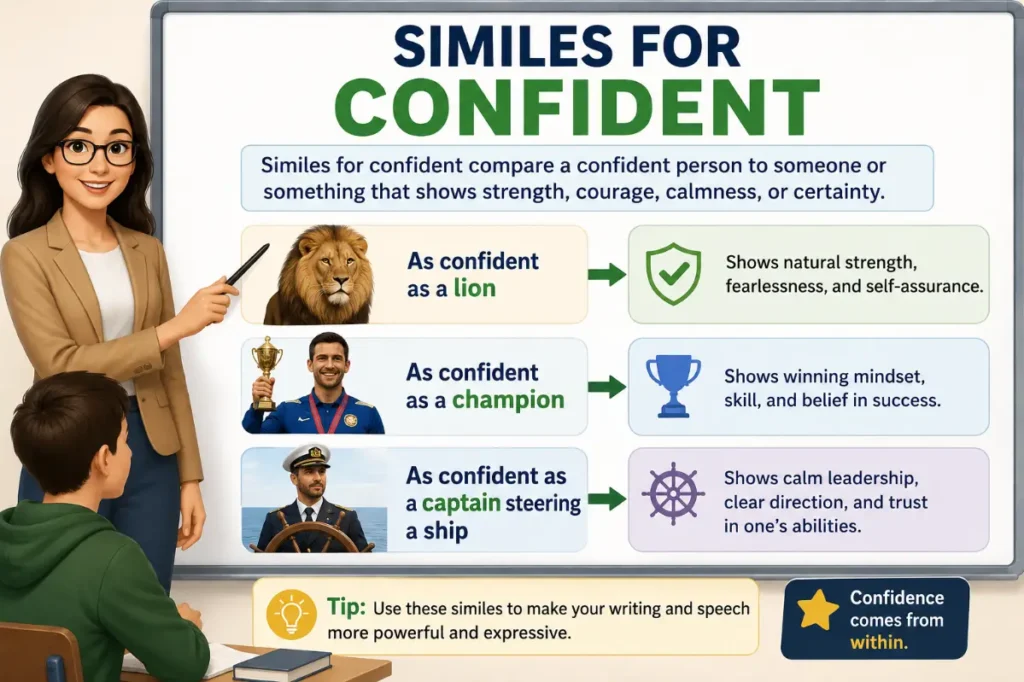
Similes for confident compare a confident person to someone or something that shows strength, courage, calmness, or certainty. Examples include as confident as a lion, as confident as a champion, and as confident as a captain steering a ship.
What Similes for Confident Mean in Simple English
A simile is a comparison that uses the words like or as. It helps readers imagine something more clearly. When you use similes for confident, you compare a person’s confidence to someone or something that naturally reminds people of confidence.
For example:
She was as confident as a lion.
This does not mean she became a lion. It means she showed courage and believed in herself. Here is another example:
He stood like a captain leading his crew.
This tells readers that he looked calm, strong, and ready to lead. Similes make writing more interesting because they create clear pictures in the reader’s mind.
Instead of writing:
The speaker was confident.
You can write:
The speaker was as confident as a champion before the final game. The second sentence helps readers imagine the scene much better.
Why People Look for Similes for Confident
Many students and writers know the word confident, but they want more interesting ways to describe it. Using the same word again and again can make writing feel repetitive.
For example:
- Sarah was confident.
- Her brother was confident.
- Their teacher was confident.
Now compare these sentences:
- Sarah was as confident as a lion.
- Her brother stood like a captain guiding a ship.
- Their teacher spoke as confidently as a judge making a decision.
The second group sounds more vivid and engaging. People also search for similes for confident because they want to:
- Improve school assignments.
- Write better stories.
- Make speeches more interesting.
- Describe characters clearly.
- Expand their English vocabulary.
Similes for Confident Explained Simply
Different similes highlight different kinds of confidence.
As Confident as a Lion
A lion is often seen as brave and fearless.
Example:
The firefighter was as confident as a lion during the rescue.
As Confident as a Champion
Champions believe in their skills because they practice hard.
Example:
She walked onto the stage as confident as a champion.
As Confident as a Captain
A ship’s captain stays calm even during storms.
Example:
He remained as confident as a captain during the meeting.
As Confident as a Teacher
Teachers often speak with certainty because they know their subject.
Example:
She answered every question as confident as a teacher.
As Confident as an Eagle
An eagle flies high without fear.
Example:
The young athlete looked as confident as an eagle soaring across the sky.
As Confident as a King
Kings are often shown making decisions with authority.
Example:
He entered the room as confident as a king.
Like a Rock
A rock stays steady and strong.
Example:
She stayed like a rock during the difficult interview.
Clear Difference Between Confidence and Arrogance
People sometimes confuse confidence with arrogance.
They are not the same.
| Confidence | Arrogance |
|---|---|
| Believes in personal ability | Thinks they are better than everyone |
| Respects other people | Often ignores others |
| Calm and positive | Proud in an unhealthy way |
| Learns from mistakes | Refuses to admit mistakes |
A confident person says:
“I think I can do this.”
An arrogant person says:
“I’m better than everyone.”
Most similes for confident describe healthy confidence, not arrogance.
Which Similes for Confident Should You Use?
Choose a simile that matches the situation.
For School Writing
- As confident as a teacher
- As confident as a champion
For Stories
- As confident as a lion
- As confident as a king
- As confident as an eagle
In Business Settings
- Like a captain steering a ship
- Like a skilled leader
- As confident as an experienced guide
In Daily Speech
- As confident as ever
- Like someone who knows exactly what to do
Simple comparisons usually sound the most natural.
Easy Real Life Sentences Using Similes for Confident
Here are some simple examples you can copy or practice.
- Emma walked into class as confident as a champion.
- Dad stayed like a rock during the emergency.
- The coach sounded as confident as a leader.
- Mia smiled as confident as a queen.
- Jake answered every question as confident as a teacher.
- The singer stood as confident as a lion.
- The pilot looked as confident as a captain before takeoff.
- Our guide spoke as confident as an expert.
Each sentence creates a stronger picture than simply saying someone was confident.
Where Similes for Confident Come From
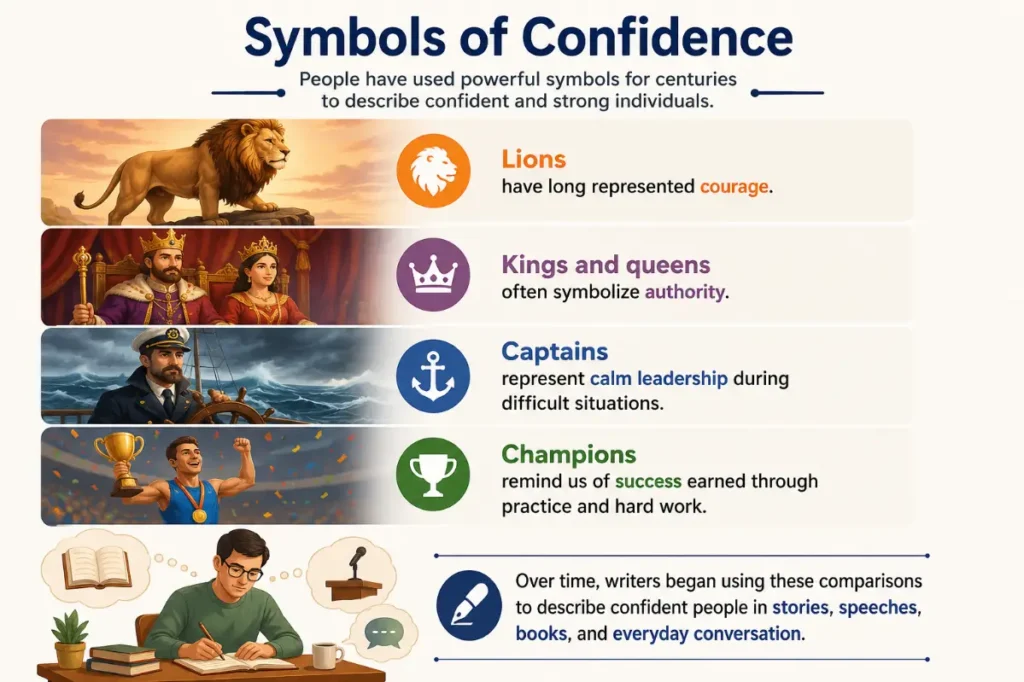
People have compared confidence to strong animals and respected leaders for hundreds of years. Lions have long represented courage. Kings and queens often symbolize authority. Captains represent calm leadership during difficult situations. Champions remind us of success earned through practice and hard work. Over time, writers began using these comparisons to describe confident people in stories, speeches, books, and everyday conversation.
Today, these similes are easy for readers to understand because the images are familiar across many cultures. As language continues to grow, writers also create new comparisons based on modern life. Athletes, astronauts, firefighters, and skilled professionals are now common symbols of confidence because people admire their courage, preparation, and self-belief. In the next section, you’ll discover many more similes for confident, learn when each one works best, explore common mistakes to avoid, and see how native English speakers naturally use them in everyday conversations and writing.
Similes for Confident in Culture and Stories
Many cultures admire confidence because it helps people face challenges without fear. That is why many stories, movies, and books use similes for confident to describe brave heroes, strong leaders, and determined people. A confident person is not always loud. True confidence often means staying calm, trusting yourself, and making good choices even during difficult times.
Here are some common ideas connected with confidence:
- A knight riding into battle without fear.
- A captain leading a ship through a storm.
- An eagle flying high above the mountains.
- A teacher speaking clearly in front of a classroom.
- A musician performing before a large audience.
These examples show that confidence is often connected with courage, preparation, and self-belief instead of pride.
Similes for Confident in the Bible and Mythology
The Bible does not usually use modern similes for confident, but it teaches confidence through stories about faith and trust. For example, David faced Goliath with courage because he believed God would help him. His confidence came from faith instead of physical strength. Moses also showed confidence after accepting God’s call to lead the Israelites. At first, he felt unsure, but he became a strong leader. In Greek mythology, heroes like Hercules displayed confidence while completing difficult tasks. Their stories remind readers that confidence often grows through experience and hard work. These examples teach an important lesson. Real confidence comes from preparation, faith, wisdom, and persistence.
Symbolism Behind Similes for Confident
What Confidence Represents
Many similes for confident symbolize positive qualities.
They often represent:
- Courage.
- Self-belief.
- Leadership.
- Calm thinking.
- Determination.
- Experience.
- Inner strength.
- Trust in your abilities.
When someone says, “She is as confident as a lion,” they are describing much more than bravery. They are suggesting leadership and strength.
What Lack of Confidence Represents
The opposite of confidence can symbolize:
- Fear.
- Doubt.
- Uncertainty.
- Nervousness.
- Hesitation.
- Low self-esteem.
- Worry about failure.
Comparing these ideas helps learners understand why similes create stronger mental pictures than ordinary descriptions.
Related Words to Similes for Confident
Learning similar words helps you expand your vocabulary.
Confident
Someone who believes in their own abilities.
Example:
She felt confident before the interview.
Brave
Someone willing to face danger or fear.
Example:
The firefighter was brave during the rescue.
Bold
Someone who acts without fear.
Example:
He made a bold decision.
Self Assured
Someone who trusts their own judgment.
Example:
She sounded self assured during the meeting.
Courageous
Someone who stays strong during difficult situations.
Example:
The young athlete was courageous after the injury.
Fearless
Someone who does not appear afraid.
Example:
The explorer looked fearless.
Determined
Someone who keeps trying until reaching a goal.
Example:
She remained determined throughout the competition.
Poised
Someone who stays calm and graceful under pressure.
Example:
The speaker looked poised during the presentation.
How People Use Similes for Confident Every Day
People naturally use similes in conversations without realizing it.
Here are everyday examples.
- She walked into the room as confident as a queen.
- He answered every question as calm as a judge.
- Our coach stood as steady as a rock.
- My sister looked as fearless as a lion.
- The student spoke as confidently as a news reporter.
- Dad remained as cool as ice during the emergency.
- The singer performed as confidently as a superstar.
- The little boy marched around as proud as a peacock.
- The lawyer sounded as sharp as a razor.
- The pilot stayed as steady as a mountain.
These expressions make conversations more colorful and interesting.
Common Mistakes
Many English learners make similar mistakes.
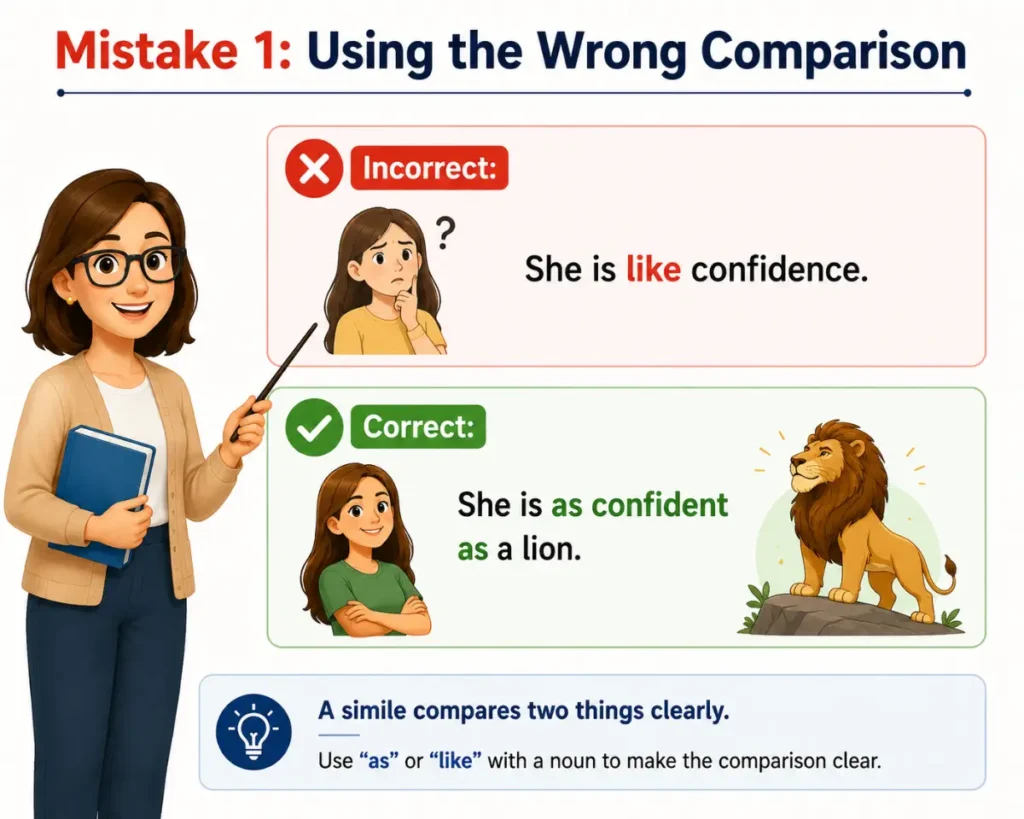
Mistake 1: Using the Wrong Comparison
Incorrect:
She is like confidence.
Correct:
She is as confident as a lion.
Mistake 2: Mixing Metaphors and Similes
Incorrect:
He is a lion like confidence.
Correct:
He is as brave as a lion.
Or
He is a lion.
Mistake 3: Choosing an Unclear Comparison
Not every comparison creates a clear picture.
Instead of saying:
She is as confident as a spoon.
Use:
She is as confident as a queen.
Mistake 4: Using Too Many Similes
Using several similes in one sentence can confuse readers. Simple writing is usually stronger.
Mistake 5: Forgetting the Context
A simile should match the situation. Someone giving a speech may be “as calm as a judge.” An athlete may be “as fierce as a tiger.” Choosing the right comparison improves your writing.
Final Teacher Explanation About Similes for Confident
Think of similes as picture makers. Instead of simply saying someone is confident, you compare that person to something readers already understand. That comparison helps people imagine the feeling immediately. If you remember only one thing from this lesson, remember this simple pattern:
As + adjective + as + noun
Examples include:
As confident as a lion.
Calm like fresh snow
As proud as a peacock.
Steady like a mountain.
As fearless as an eagle.
These expressions make your English more natural, colorful, and memorable. The more you read and practice, the easier they become.
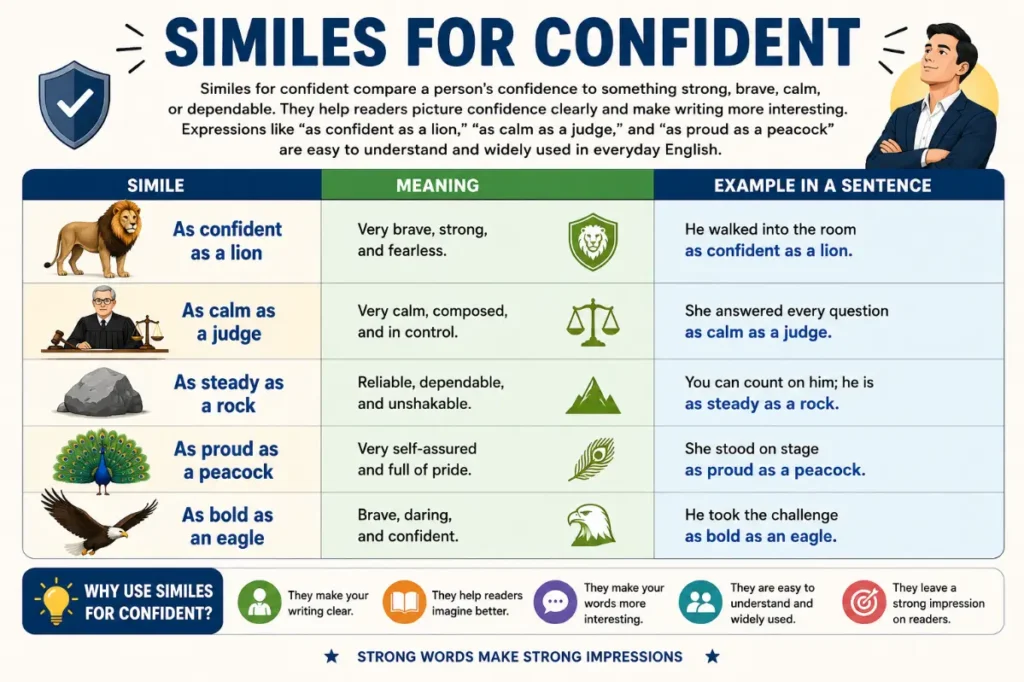
Final Answer About Similes for Confident
Similes for confident compare a person’s confidence to something strong, brave, calm, or dependable. They help readers picture confidence clearly and make writing more interesting. Expressions like “as confident as a lion,” “as calm as a judge,” and “as proud as a peacock” are easy to understand and widely used in everyday English.
Conclusion
Confidence is one of the easiest qualities to describe with similes because people naturally connect confidence with strength, courage, calmness, and leadership. Learning similes for confident gives you better ways to speak and write without repeating the same words again and again.
The best similes create a clear picture in the reader’s mind. They make stories, conversations, essays, and speeches more vivid while keeping your language simple and natural.
As you continue improving your English, practice using different similes for confident in daily conversations and writing. Over time, these expressions will become a natural part of your vocabulary and help you communicate with greater confidence yourself.
Frequently Asked Questions About Similes for Confident
What are similes for confident?
Similes for confident compare a confident person to something strong, calm, or brave using words like “as” or “like.”
What is the best simile for confident?
“As confident as a lion” is one of the most popular and widely understood similes.
Why do writers use similes for confident?
They help readers picture confidence clearly and make writing more interesting and memorable.
Can I use similes for confident in school essays?
Yes. Appropriate similes make essays more descriptive and engaging when used naturally.
Are similes for confident common in everyday English?
Yes. Native speakers often use them in conversations, speeches, books, and stories.
What is the difference between a simile and a metaphor?
A simile uses words like “as” or “like” to compare two things. A metaphor makes the comparison directly without using those words.
How can I learn more similes for confident?
Reading books, listening to native speakers, and practicing your own comparisons are excellent ways to build your vocabulary.
Can children use similes for confident?
Yes. They are easy to understand and help young learners make their writing more creative.

Idioms, Expressions & Figurative Language
Mason Ellsworth is an American language writer with a passion for English expressions, figurative language, and everyday communication. He explains idioms, similes, popular phrases, and commonly misunderstood expressions in a straightforward, engaging style that helps readers improve both their writing and spoken English.