
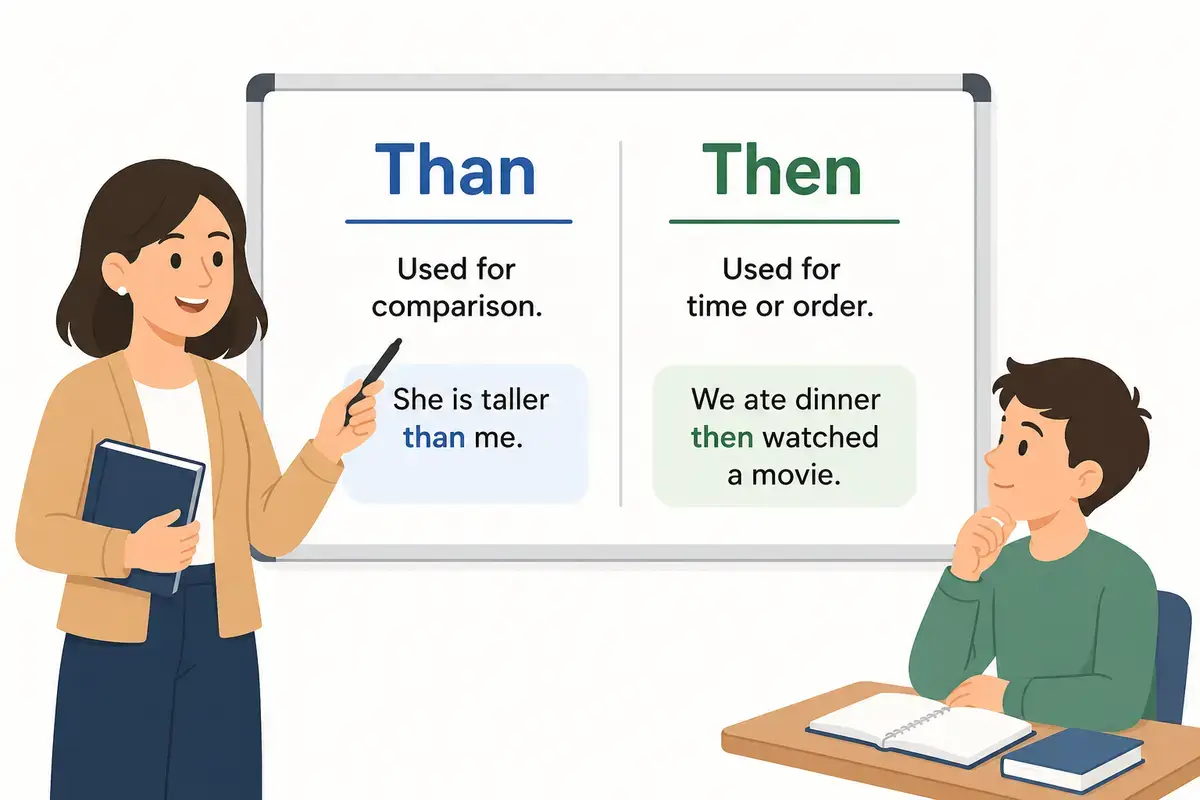
Few English word pairs cause as much confusion as Than vs Then. They look similar, sound almost alike in fast speech, and are easy to mistype. Even experienced writers occasionally use the wrong one because of typing habits rather than a lack of grammar knowledge. The good news is that the difference is simple once you understand the role each word plays in a sentence.
Than helps compare two or more things.
Then tells readers about time, order, or the next step.
Learning this distinction improves your writing, makes your emails and essays clearer, and helps you avoid one of the most common grammar mistakes in English. This guide explains every important rule, provides plenty of examples, highlights common errors, offers memory tricks, and answers the questions people ask most often.
Short Answer
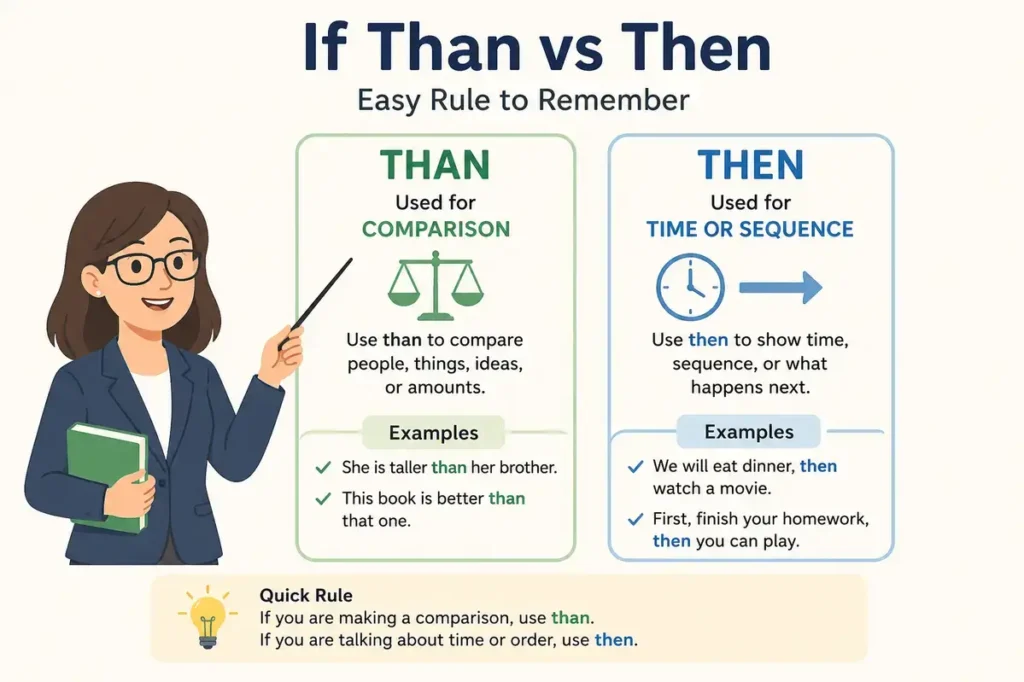
Than vs Then is one of the most common word pairs people confuse in English. Than is mainly used to compare people, things, ideas, or amounts. Then usually refers to time, sequence, or what happens next. If you are making a comparison, use than. If you are talking about time or order, use then.
Table of Contents
- What Is the Difference Between Than and Then
- Quick Comparison Table
- What Does Than Mean
- What Does Then Mean
- Grammar Rules for Than
- Grammar Rules for Then
- Side by Side Examples
- Common Mistakes and How to Fix Them
- Easy Memory Tricks
- Real Life Examples
- Related Grammar Notes
- Frequently Asked Questions
- Key Takeaways
- Conclusion
What Is the Difference Between Than and Then
The simplest way to remember the difference is this.
| Word | Main Use | Example |
|---|---|---|
| Than | Makes a comparison | Emma is taller than Liam. |
| Then | Refers to time or sequence | Finish your homework, then watch television. |
If your sentence compares two things, use than.
If your sentence talks about time, the next event, or the next step, use then.
Quick Rule
Ask yourself one question.
Am I comparing two things?
If the answer is yes, choose than.
If the answer is no and your sentence refers to time or sequence, choose then.
Comparison Table
| Feature | Than | Then |
|---|---|---|
| Part of speech | Conjunction or preposition | Adverb, adjective, or noun in limited uses |
| Main purpose | Comparison | Time or sequence |
| Answers which question | Compared with what | When or what happens next |
| Common with | More, less, better, taller, faster | Next, afterward, at that time |
| Example | My car is newer than yours. | We ate dinner, then went home. |
What Does Than Mean
Than is a word used to compare two or more people, places, objects, qualities, or ideas.
It usually follows comparative adjectives or comparative adverbs.
Examples
- Sarah is younger than her brother.
Explanation: The sentence compares Sarah’s age with her brother’s age.
- This road is shorter than the highway.
Explanation: Two routes are being compared.
- He speaks more confidently than before.
Explanation: The comparison is between two levels of confidence.
- Water is heavier than oil.
Explanation: The sentence compares weight.
- Reading is more relaxing than watching the news.
Explanation: Two activities are compared.
Common Words That Use Than
You will often see than after comparative words.
| Comparative Word | Example |
|---|---|
| Better | She sings better than I do. |
| Worse | Today feels worse than yesterday. |
| Bigger | This house is bigger than ours. |
| Smaller | My office is smaller than yours. |
| More | I need more time than expected. |
| Less | We spent less money than planned. |
| Faster | The train is faster than the bus. |
| Slower | Walking is slower than cycling. |
| Higher | Prices are higher than last year. |
| Lower | Interest rates are lower than before. |
Than After Other Expressions
Than also appears in several common expressions.
- More than.
Example.
The museum has more than one million visitors each year.
- Less than.
Example.
The meeting lasted less than an hour.
- Rather than.
Example.
I would read a book rather than watch television.
- Other than.
Example.
Everyone other than Jake arrived early.
- No sooner than.
Example.
No sooner had we arrived than it started raining.
Although this expression is less common in everyday conversation, it still appears in formal writing.
What Does Then Mean
Then usually refers to time.
It tells readers what happened next, what happened afterward, or what existed at a particular moment.
Examples
- We finished lunch, then visited the museum.
Explanation: The museum visit happened after lunch.
- Turn left, then continue for two miles.
Explanation: The word shows the next step.
- She was living in Texas then.
Explanation: It refers to a specific time in the past.
- If you agree, then we can begin.
Explanation: It introduces the result or next action.
- Back then, life was much quieter.
Explanation: The phrase refers to an earlier period.
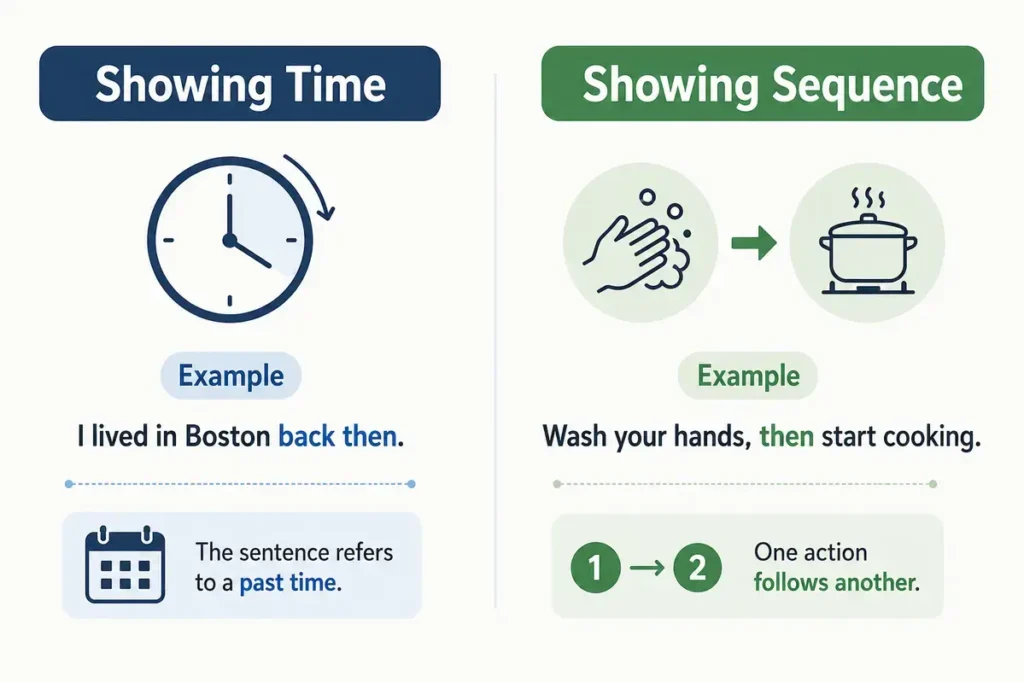
Common Uses of Then
Showing Time
Example.
I lived in Boston back then.
The sentence refers to a past time.
Showing Sequence
Example.
Wash your hands, then start cooking.
One action follows another.
Showing Result
Example.
If the roads are clear, then we can leave now.
The second part depends on the first.
Referring to Someone’s Situation
Example.
The then manager approved the proposal.
Here then means the person who held that position at that time.
This use is common in newspapers, biographies, history books, and legal writing.
Grammar Rules for Than
Understanding the grammar behind than helps you avoid mistakes in both formal and informal writing.
Rule One
Use than after comparative adjectives.
Examples.
The blue shirt is cheaper than the black one.
Mountains are higher than hills.
Children usually learn languages faster than adults.
Rule Two
Use than after comparative adverbs.
Examples.
She arrived earlier than expected.
He drives more carefully than his brother.
The team performed better than last season.
Rule Three
Use than in comparisons involving numbers.
Examples.
The city has more than five million residents.
Less than twenty people attended the meeting.
The package weighs more than ten pounds.
Rule Four
Use than after words like rather, other, more, less, and sooner when they create comparisons.
Examples.
I would rather stay home than go out.
No one other than Maria knew the answer.
We expected more rain than sunshine.
Grammar Rules for Then
Unlike than, then usually acts as an adverb because it describes time or sequence.
Rule One
Use then to describe what happens next.
Examples.
Finish your work, then take a break.
Read the instructions, then complete the exercise.
Turn off the computer, then unplug it.
Rule Two
Use then to describe a specific time.
Examples.
I was a college student then.
The company was much smaller then.
Life looked very different back then.
Rule Three
Use then after conditional statements when introducing the result.
Examples.
If you finish early, then you can leave.
If the payment arrives today, then we will ship the order.
If everyone agrees, then we can move forward.
Rule Four
Use then before a title to describe someone who held that position at that time.
Examples.
The then president addressed the nation.
The then coach resigned after the season.
The then owner sold the business.
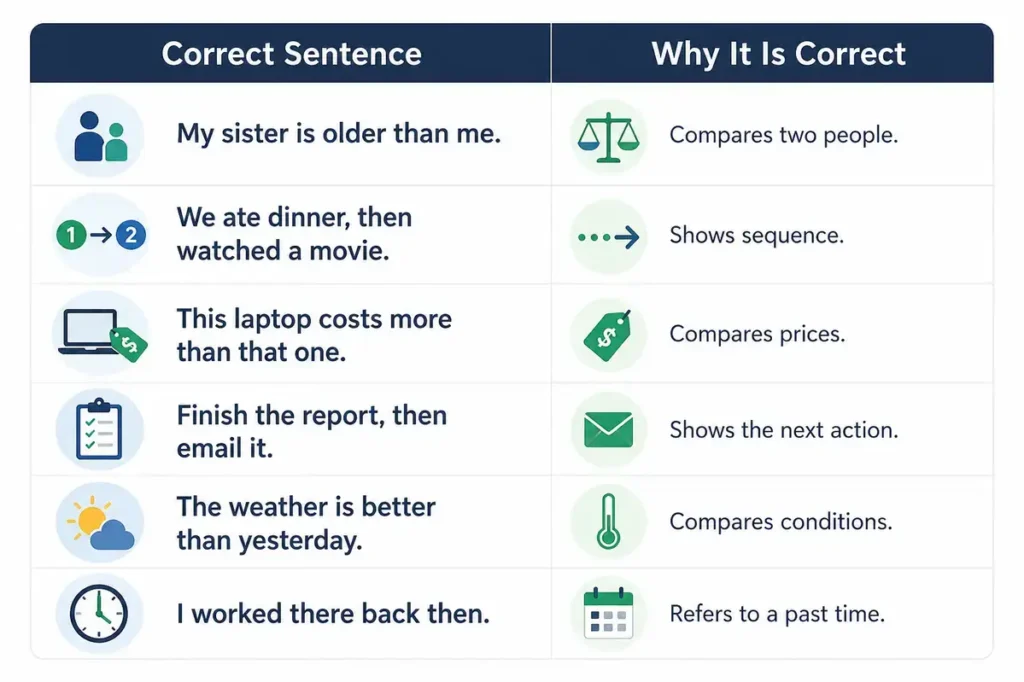
Than vs Then in Everyday Sentences
Looking at both words side by side makes the distinction much easier.
| Correct Sentence | Why It Is Correct |
|---|---|
| My sister is older than me. | Compares two people. |
| We ate dinner, then watched a movie. | Shows sequence. |
| This laptop costs more than that one. | Compares prices. |
| Finish the report, then email it. | Shows the next action. |
| The weather is better than yesterday. | Compares conditions. |
| I worked there back then. | Refers to a past time. |
Can Than and Then Ever Replace Each Other
No.
These words have completely different grammatical jobs.
Replacing one with the other changes the meaning of the sentence and creates a grammar mistake.
Consider these examples.
Correct: She is taller than her sister.
Incorrect: She is taller then her sister.
The first sentence compares two people’s heights.
The second sentence is grammatically incorrect because then cannot introduce a comparison.
Likewise.
Correct: We finished dinner, then went for a walk.
Incorrect: We finished dinner, than went for a walk.
The first sentence describes the order of events.
The second sentence is incorrect because than cannot express sequence.
Common Mistakes and How to Fix Them
Many people know the rule but still type the wrong word. That often happens because than and then are pronounced similarly in casual speech. A quick proofread can catch these errors before you send an email, submit an assignment, or publish an article.
Mistake One
Incorrect
My phone is faster then yours.
Correct
My phone is faster than yours.
Explanation
The sentence compares two phones, so than is the correct word.
Mistake Two
Incorrect
We went shopping than ate dinner.
Correct
We went shopping then ate dinner.
Explanation
The sentence describes the order of events, so then is needed.
Mistake Three
Incorrect
This test was easier then I expected.
Correct
This test was easier than I expected.
Explanation
The word easier creates a comparison.
Mistake Four
Incorrect
Finish your assignment than call me.
Correct
Finish your assignment then call me.
Explanation
The second action happens after the first one.
Mistake Five
Incorrect
She earns more then her coworkers.
Correct
She earns more than her coworkers.
Explanation
The sentence compares salaries.
Real Life Examples
The following examples show how these words appear in everyday English.
At School
Correct:
Emma scored higher than Noah on the science test.
The sentence compares two scores.
Correct:
Finish the quiz, then hand it to your teacher.
The sentence gives instructions in order.
At Work
Correct:
This project took longer than expected.
The sentence compares the actual time with the expected time.
Correct:
Review the report, then send it to the client.
The sentence explains the next step.
At Home
Correct:
Our living room is larger than the dining room.
Two rooms are compared.
Correct:
Clean your room, then you can play outside.
The second action follows the first.
While Traveling
Correct:
The train was faster than driving.
A comparison is made.
Correct:
We checked into the hotel, then explored the city.
The sentence shows the sequence of events.
In Sports
Correct:
The new team played better than last season.
Performance is compared.
Correct:
The referee blew the whistle, then the game began.
The sentence describes the order of events.
Than vs Then in Questions
Questions follow the same grammar rules.
Comparison Questions
Is this restaurant better than the one downtown?
Who is taller than Alex?
Which option costs less than fifty dollars?
Each question compares two things.
Time or Sequence Questions
What happened then?
What did you do then?
If the meeting ends early, then what?
Each question asks about time or the next event.
Than vs Then in Formal Writing
Professional writing follows the same rules as everyday English.
Business reports, research papers, legal documents, and academic essays all use than for comparisons and then for time or sequence.
Business Example
Sales increased more than expected during the second quarter.
The sentence compares actual sales with expectations.
Academic Example
Students who practiced daily performed better than those who studied only once a week.
The sentence compares two groups.
Technical Example
Install the software, then restart the computer.
The sentence gives instructions in order.
Historical Example
The then governor announced new education reforms.
Here, then means the person serving as governor at that time.
Than vs Then in Informal Conversation
People often shorten sentences while speaking, but the grammar stays the same.
Examples include:
I’d rather stay home than go out.
Call me then.
Back then, we had no smartphones.
He’s taller than I remembered.
We’ll eat first, then leave.
Even in casual conversation, each word keeps its own meaning.
Than vs Then in Common Expressions
Many expressions always use one word and never the other.
Expressions With Than
| Expression | Meaning | Example |
|---|---|---|
| More than | Greater amount | More than fifty people attended. |
| Less than | Smaller amount | The flight lasted less than two hours. |
| Rather than | Instead of | I’d walk rather than drive. |
| Other than | Except | Everyone other than Mia agreed. |
| No sooner than | Immediately after | No sooner had we arrived than it started snowing. |
Expressions With Then
| Expression | Meaning | Example |
|---|---|---|
| Back then | At that time | Back then, life was quieter. |
| Every now and then | Occasionally | We visit every now and then. |
| Until then | Before that time | Stay here until then. |
| Since then | From that time onward | Since then, business has grown. |
| Just then | At that exact moment | Just then, the lights went out. |
Learning these fixed expressions makes it easier to choose the correct word automatically.
Memory Tips
Simple memory tricks can help you remember the difference even when writing quickly.
Memory Trick One
Than = Comparison
Notice that than contains the letter A.
Think of A for Compare.
Whenever two things are compared, choose than.
Example:
Coffee is stronger than tea.
Memory Trick Two
Then = Time
Notice that then contains the letter E.
Think of E for Event.
Events happen one after another.
Example:
We arrived, then checked in.
Memory Trick Three
Look for comparative words.
If your sentence includes words like these, you almost always need than.
More.
Less.
Better.
Worse.
Larger.
Smaller.
Older.
Younger.
Faster.
Slower.
Higher.
Lower.
Example:
This computer is faster than mine.
Memory Trick Four
Look for action steps.
If your sentence explains a process, recipe, instruction, or sequence, you almost always need then.
Example:
Mix the ingredients, then bake for thirty minutes.
Pronunciation
These words sound similar in many accents, which explains why they are often confused.
Than
Pronunciation:
/ðæn/
In fast speech, many speakers pronounce it more softly.
Then
Pronunciation:
/ðen/
The vowel sound is slightly different, although many regional accents make the distinction less noticeable.
Because pronunciation can vary, spelling should always depend on the meaning instead of the sound.
Word Origins
Understanding the history of these words helps explain why they have different meanings today.
Than
Than comes from Old English and has been used for centuries to introduce comparisons.
Its meaning has remained remarkably consistent throughout the history of English.
Then
Then also comes from Old English but developed as a word connected with time, sequence, and events.
Although both words share ancient roots, they evolved into different grammatical roles.
American and British English
One question many learners ask is if American English and British English use these words differently.
The answer is simple.
They do not.
Both American English and British English follow exactly the same grammar rules.
Examples.
American English:
This car is newer than mine.
Let’s eat, then leave.
British English:
This car is newer than mine.
Let’s eat, then leave.
The spelling and usage remain identical.
Professional Writing Tips
Writers, editors, teachers, and students often use a few proofreading techniques to catch mistakes.
Read the Sentence Slowly
Ask yourself if the sentence compares two things or describes time.
Replace the Word
If you can replace it with compared with, use than.
If you can replace it with next or afterward, use then.
Example.
She is taller than her brother.
Compared with her brother makes sense.
Example.
Finish your lunch, then go outside.
Next go outside also makes sense.
Look for Comparative Adjectives
Words like better, more, older, and faster almost always signal than.
Look for Sequence Words
Words like next, after, later, and finally often appear with then.
Related Grammar Notes
Understanding similar grammar topics makes the difference even clearer.
Than and Comparative Adjectives
Comparative adjectives describe differences between two things.
Examples include:
Better.
Worse.
Taller.
Shorter.
Smarter.
Older.
Each normally takes than.
Example.
Her presentation was more organized than mine.
Then and Transition Words
Then belongs to a group of transition words that help readers follow the order of ideas.
Other transition words include:
Next.
Afterward.
Later.
Finally.
Meanwhile.
Eventually.
These words guide readers from one event to another.
Quick Practice Quiz
Choose the correct word.
Question One
My backpack is heavier _____ yours.
Answer:
Than
Reason:
The sentence compares two backpacks.
Question Two
Finish your homework _____ watch television.
Answer:
Then
Reason:
One action follows another.
Question Three
The meeting lasted longer _____ expected.
Answer:
Than
Reason:
The sentence compares actual time with expected time.
Question Four
Back _____, our neighborhood had only one school.
Answer:
Then
Reason:
The phrase refers to a time in the past.
Question Five
I’d rather read _____ watch television.
Answer:
Than
Reason:
The expression rather than is fixed and always uses than.
Key Takeaways
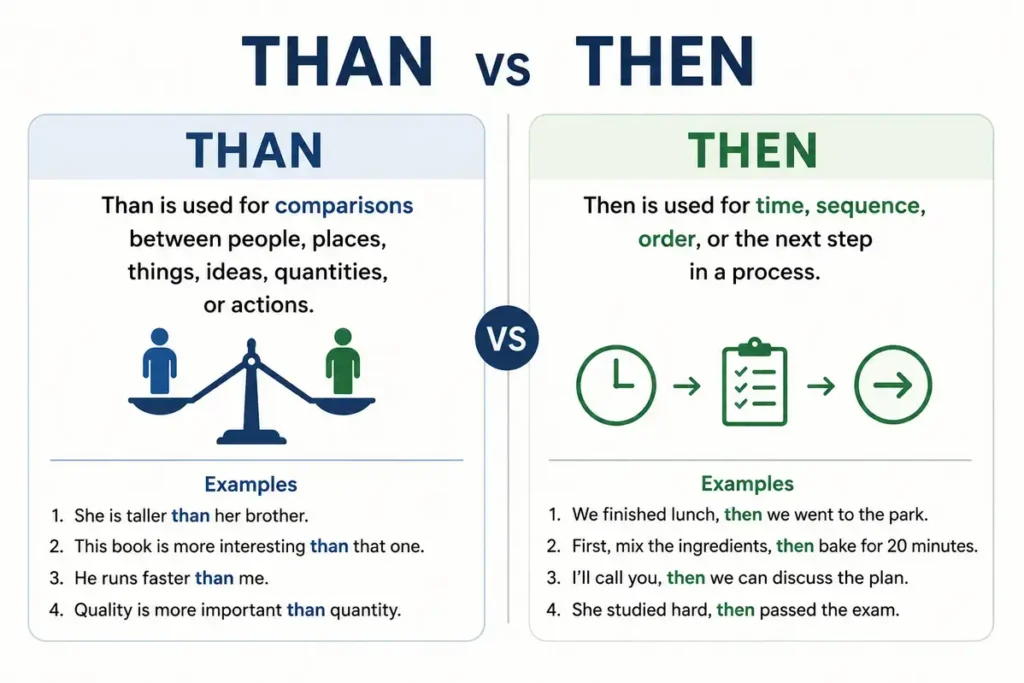
- Than is used for comparisons between people, places, things, ideas, quantities, or actions.
- Then is used for time, sequence, order, or the next step in a process.
- Comparative words such as better, more, less, higher, lower, older, and faster are usually followed by than.
- Instructions, timelines, recipes, and directions often use then because they describe what happens next.
- The phrase back then always refers to a time in the past.
- Expressions like more than, less than, rather than, and other than always use than.
- American English and British English follow the same grammar rules for both words.
- When proofreading, ask yourself one simple question. Am I making a comparison or describing time? The answer will tell you which word to choose.
Conclusion
The distinction between Than vs Then becomes easy once you focus on the purpose of each word instead of how it sounds. Use than whenever your sentence compares two people, objects, ideas, amounts, or actions. Use then whenever you describe time, sequence, instructions, or the next event.
A quick proofreading habit can eliminate nearly every mistake. Look for comparative words like better, more, less, or faster. They almost always require than. If your sentence could be replaced with next, afterward, or at that time, then is the correct choice.
Mastering this small grammar rule makes your writing clearer, more professional, and easier to understand. From school assignments and business emails to blog posts and everyday conversations, choosing the correct word shows attention to detail and strengthens your communication.
With regular practice and the memory tips in this guide, you will quickly recognize the difference and use than and then confidently every time.
Frequently Asked Questions
What is the difference between Than vs Then?
Than is used to compare two or more things. Then refers to time, sequence, or what happens next. If you are comparing, use than. If you are talking about order or time, use then.
Is it better than or better then?
The correct phrase is better than.
Example:
This laptop is better than my old one.
The adjective better creates a comparison, so than is required.
Is it more than or more then?
The correct expression is more than.
Example:
More than one hundred people attended the event.
The phrase compares an amount.
Is it first this then that or first this than that?
The correct wording is first this, then that.
Example:
First wash the vegetables, then chop them.
The sentence describes a sequence of actions.
Can Then ever be used for comparison?
No.
Then does not introduce comparisons. It is used to describe time, order, or a result.
Incorrect:
She is taller then her brother.
Correct:
She is taller than her brother.
Can Than refer to time?
No.
Than is used for comparisons only. It cannot describe time or the order of events.
Why do people confuse Than and Then?
The two words have similar spellings and similar pronunciations in many accents. Typing quickly also causes people to substitute one for the other. Understanding the meaning instead of relying on sound helps prevent mistakes.
Is Than a conjunction?
Yes. Than is commonly classified as a conjunction because it connects two parts of a comparison.
Example:
She is younger than I am.
It can also function as a preposition in many modern grammar references.
Example:
She is younger than me.
Both forms are accepted in modern English, although the first is often preferred in formal writing.
Is Then an adverb?
Yes. Then most commonly functions as an adverb because it tells when something happens.
Example:
We finished work, then went home.
In some contexts, it can also function as an adjective.
Example:
The then chairman announced the decision.
How can I remember the difference between Than and Then?
Remember this simple rule.
Than equals comparison.
Then equals time.
If your sentence compares two things, choose than. If it describes what happens next, choose then.

Confusing Words, Spelling & Word Choice
Claire Whitmore is a U.S.-based English editor who writes about commonly confused words, spelling differences, and word choice. Her work helps readers understand subtle distinctions between similar-looking words through simple definitions, practical examples, and modern usage guidance in both American and British English.