
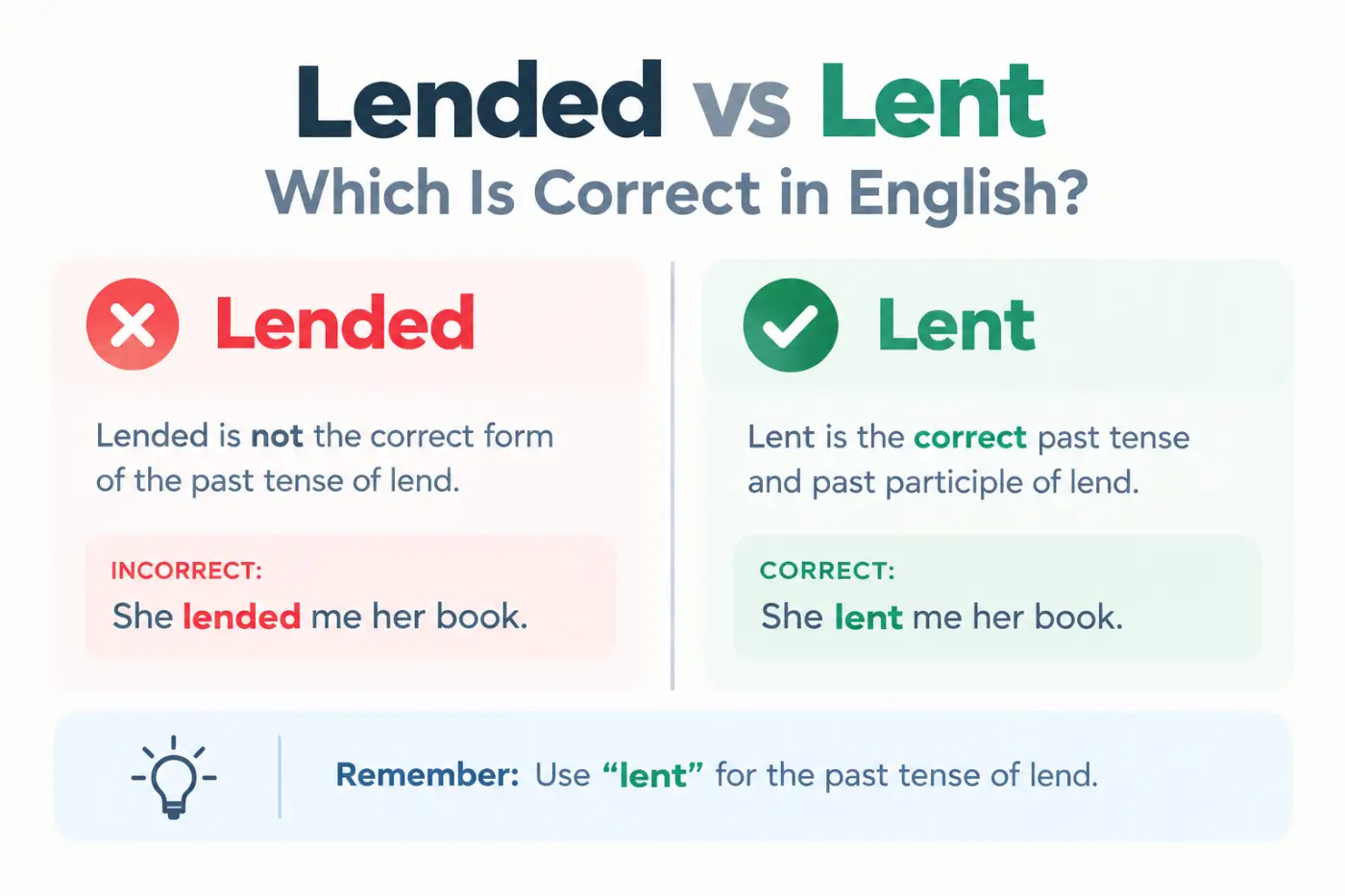
Lended vs lent is a common English grammar question because many regular verbs form their past tense by adding ed. However, lend is an irregular verb, so its standard past form is lent rather than lended. If you want your writing to sound natural and correct in American English, lent is the form to remember.
The verb lend means to give something to another person temporarily, with the expectation that the person will return it. You can lend money to a friend, lend a book to a classmate, or lend someone a hand. In each case, the base verb is lend, and its standard past form is lent.
The good news is that you don’t need to memorize a long list of complicated rules to use this verb correctly. Once you understand its three main forms and see how they work in real sentences, choosing the right word becomes much easier. This guide explains the grammar, common mistakes, practical examples, and differences between lend, lent, and loan so you can use each form with confidence.
Short Answer
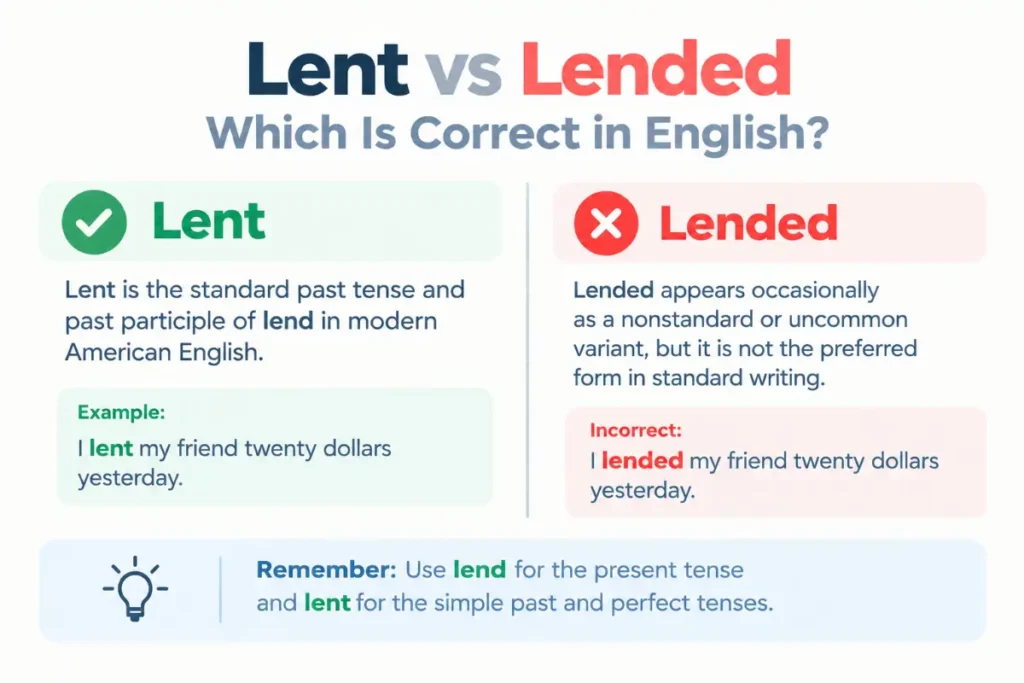
Lent is the standard past tense and past participle of lend in modern American English. For example, you should write I lent my friend twenty dollars yesterday. Lended appears occasionally as a nonstandard or uncommon variant, but it is not the preferred form in standard writing. Use lend for the present tense and lent for the simple past and perfect tenses.
Table of Contents
- The Main Difference Between Lended and Lent.
- What Lent Means.
- What Lended Means.
- The Three Forms of Lend.
- Why Lend Is an Irregular Verb.
- How to Use Lent in a Sentence.
- Lent as a Simple Past Verb.
- Lent as a Past Participle.
- Lend vs Lent vs Loan.
- Common Mistakes to Avoid.
- Real Life Examples.
- American and British English Usage.
- Formal and Informal Writing.
- Memory Tips for Remembering Lent.
- Related Grammar Rules.
- Frequently Asked Questions.
- Key Takeaways.
- Conclusion.
The Main Difference Between Lended and Lent
The main difference comes down to standard verb conjugation. Lent is the accepted form for the simple past tense and past participle of lend. Lended follows the regular pattern of adding ed, but it isn’t the standard choice in modern edited English.
English has both regular and irregular verbs. Regular verbs generally form their simple past tense by adding ed or d, as in walked, played, and saved. Irregular verbs follow different patterns. For example, go becomes went, buy becomes bought, and lend becomes lent.
The table below shows the correct forms and how to use them.
| Word | Grammatical role | Example |
|---|---|---|
| Lend | Base form | I lend books to my friends. |
| Lends | Present tense for he, she, or it | She lends money to her brother. |
| Lent | Simple past tense | He lent me his jacket yesterday. |
| Lent | Past participle | I have lent her my notes. |
| Lended | Uncommon nonstandard variant | Avoid this form in standard writing. |
The examples show that lent works in two grammatical roles. It describes a completed action in the simple past and also works with helping verbs such as have, has, and had.
For example, I lent him my calculator describes a past action. I have lent him my calculator uses the past participle with have to form the present perfect tense.
Remember that the spelling doesn’t change in these two uses. You write lent in both sentences.
What Lent Means
Lent is the simple past tense and past participle of lend. It describes the act of giving something to someone temporarily, usually with the expectation that the item or money will be returned.
Consider this sentence.
I lent Sarah my bicycle last weekend.
This sentence tells us that the speaker gave Sarah temporary use of a bicycle. The action happened in the past, so lent is the correct verb form.
Here is another example.
My uncle has lent me money several times.
In this sentence, lent appears after has. The present perfect tense connects past lending experiences with the present.
Lent can describe many kinds of temporary transfers. You can lend physical objects, money, time, support, or assistance. The exact meaning depends on the context.
For example, a person can lend a neighbor a ladder, lend a colleague a few minutes, or lend support to a local charity. In each case, lend communicates the idea of providing something for another person’s use or benefit.
The verb also appears in common expressions such as lend a hand and lend support. These phrases don’t always describe something that must be physically returned. Instead, they use lend to express help, cooperation, or contribution.
Examples of Lent in Everyday English
- I lent my brother fifty dollars yesterday. The sentence describes money given to a family member with the expectation that it will be returned.
- She lent me her umbrella during the storm. Lent shows that the speaker received temporary use of the umbrella.
- They lent their neighbor some gardening tools. The verb describes a past action involving physical objects.
- Our teacher lent us extra books for the weekend. Lent indicates that students could use the books temporarily.
- He has lent his expertise to several community projects. Here, lent refers to sharing knowledge or skills rather than handing over a physical object.
All five examples use the standard form of the verb. None requires lended.
What Lended Means
Lended is a form created by adding ed to lend. This follows the pattern used with regular English verbs, such as help and helped or clean and cleaned. However, lend is irregular in standard modern English, so its accepted past tense is lent.
You may encounter lended in informal writing, learner writing, online discussions, or older and less common language examples. Its appearance doesn’t make it the preferred form for school assignments, professional documents, published articles, or formal communication.
For example, consider these two sentences.
Incorrect in standard usage: She lended me her notes before the exam.
Correct in standard usage: She lent me her notes before the exam.
The second sentence uses the conventional past form of lend. It communicates the same meaning without departing from standard verb conjugation.
Why People Write Lended
There is a simple reason people sometimes use lended. They apply a familiar grammar pattern to a verb that doesn’t follow it.
English learners often learn that adding ed makes a verb past tense. This rule works for thousands of verbs, including work, worked, open, opened, and borrow, borrowed. When a person encounters lend, it can seem logical to write lended.
Children learning English may also apply this pattern naturally. Linguists call this process overregularization. It happens when speakers extend a regular grammar rule to a word that follows an irregular pattern.
For example, a child might say goed instead of went or buyed instead of bought. The same general pattern explains why someone might say lended instead of lent.
This mistake doesn’t mean the speaker has failed to understand the meaning of the verb. It simply shows that the speaker has applied a regular pattern to an irregular word.
Should You Ever Use Lended?
For standard American English, choose lent. That advice applies to academic writing, business communication, everyday messages, reports, and most other situations.
If you’re studying historical texts or examining unusual forms in a linguistic context, you may encounter lended as a variant. In that case, the surrounding passage and the author’s purpose matter. When editing ordinary modern English, however, lent is the safer and more widely accepted choice.
The Three Forms of Lend
Learning the basic verb forms is the easiest way to prevent mistakes. Lend has a present form, a past form, and a past participle form that you can use in different grammatical structures.
| Verb form | Correct word | Example sentence |
|---|---|---|
| Base form | Lend | I lend my tools to my neighbors. |
| Third person singular | Lends | My neighbor lends me tools. |
| Simple past | Lent | My neighbor lent me a tool yesterday. |
| Past participle | Lent | My neighbor has lent me a tool. |
| Present participle | Lending | My neighbor is lending me a tool. |
| Infinitive | To lend | I agreed to lend him my car. |
The base form lend appears after modal verbs such as can, could, will, and should. For example, you can say I can lend you my notes or I should lend him a hand.
The form lends appears with a singular third person subject in the simple present tense. You write She lends me books, not She lend me books.
Lent serves as both the simple past and past participle. This makes it similar to verbs such as send, which becomes sent, and spend, which becomes spent.
The present participle lending follows a different pattern. You use it in continuous tenses, as in I am lending him my laptop.
Once you learn these forms, you can build accurate sentences without guessing.
Why Lend Is an Irregular Verb
An irregular verb doesn’t follow the usual pattern for forming its past tense or past participle. Most regular English verbs add ed or d, but irregular verbs change in different ways.
Lend belongs to the irregular group because it changes to lent rather than lended in standard usage.
Compare these examples.
| Base verb | Simple past | Past participle |
|---|---|---|
| Help | Helped | Helped |
| Clean | Cleaned | Cleaned |
| Walk | Walked | Walked |
| Send | Sent | Sent |
| Spend | Spent | Spent |
| Build | Built | Built |
| Lend | Lent | Lent |
| Bend | Bent | Bent |
Notice the relationship between lend, bend, send, and spend. These verbs use forms that change their spelling instead of simply adding ed.
However, English irregular verbs don’t all follow one shared rule. Some change a vowel, some change their ending, and others remain the same in the present and past. That’s why it’s useful to learn the common forms of each irregular verb.
The Grammar Rule Behind Lent
The basic rule is straightforward. Use lend for the base form and lent for the simple past and past participle.
For the simple past, use lent when the action happened at a completed time in the past.
Example: We lent our neighbors a ladder last month.
For the present perfect, combine lent with have or has.
Example: We have lent our neighbors several tools.
For the past perfect, combine lent with had.
Example: We had lent them the ladder before they bought their own.
In each sentence, the word lent stays the same. The helping verb and the sentence structure tell readers how the action relates to time.
How to Use Lent in a Sentence
The word lent works in several common sentence patterns. Understanding these patterns helps you choose the correct form and build natural sentences.
Lent With a Direct Object
A direct object is the person or thing that receives the action of the verb. With lend, the direct object often names the item being provided temporarily.
Example: Maya lent her camera to a friend.
The direct object is her camera. It identifies what Maya allowed her friend to use.
Another example is David lent his textbook to Mark. The textbook is the item being lent, and Mark is the person receiving it.
Lent With an Indirect Object
You can place the person receiving the item directly after lent.
Example: Maya lent her friend a camera.
In this sentence, her friend is the indirect object, and a camera is the direct object. The sentence means the same thing as Maya lent a camera to her friend.
Both structures are grammatically correct. Choose the one that sounds most natural in your sentence.
Lent With Money
Lent commonly describes giving money to someone temporarily.
Example: My sister lent me one hundred dollars.
The sentence tells us that the sister provided money that the speaker is expected to repay. The exact repayment terms depend on the situation and any agreement between the people involved.
You can also say My sister lent one hundred dollars to me. The meaning remains the same, though the first version sounds more direct in everyday conversation.
Lent in Figurative Expressions
Lend also appears in expressions that describe support or contribution. In these expressions, the thing provided may not be a physical object.
Example: The volunteers lent a hand during the event.
The phrase lent a hand means the volunteers helped. Nobody needs to return a physical hand.
Another example is Her experience lent credibility to the proposal. Here, lent means contributed to or helped provide credibility.
These expressions show that the verb has a wider range of meanings than simply handing over an object.
Lent as a Simple Past Verb
The simple past tense describes an action that happened and finished in the past. Lent is the correct form when you use lend in this tense.
Consider the following examples.
- I lent my friend a book yesterday. The word yesterday establishes a completed past time.
- She lent her car to her cousin last week. The phrase last week places the lending action in the past.
- We lent money to the organization in 2024. The year identifies when the action happened.
- The librarian lent me a reference book before closing. The sentence describes a completed event in the past.
- He lent his support to the campaign during the election. The verb describes past support for a cause.
The simple past doesn’t require a helping verb. You can write I lent him my notes without adding did or have.
A common mistake is to combine did with the past form. In standard English, write Did you lend him the money? rather than Did you lent him the money?
The helping verb did already marks the question as past tense. Therefore, the main verb returns to its base form, lend.
The same rule applies to negative sentences.
Correct: I did not lend him my car.
Incorrect: I did not lent him my car.
Remember that did and did not take the base form of the main verb. This rule applies to regular and irregular verbs alike.
Lent as a Past Participle
A past participle is a verb form used in perfect tenses and passive constructions. Lent is the past participle of lend, so it appears after helping verbs such as have, has, and had.
The Present Perfect Tense
Use have or has with lent to connect a past action with the present.
Example: I have lent him my notes several times.
This sentence describes past lending experiences that matter to the present conversation. It doesn’t specify one completed time such as yesterday or last Tuesday.
Another example is She has lent her car to three different relatives. The sentence describes experience up to the present.
The Past Perfect Tense
Use had with lent to show that one past action happened before another past event.
Example: I had lent him the money before he received his paycheck.
The lending happened first. The paycheck arrived later.
Another example is They had lent the equipment to the school before the new supplies arrived. The past perfect clarifies the order of the two events.
The Passive Voice
Lent can also appear in passive sentences. In the passive voice, the sentence focuses on the person or thing receiving the action rather than the person performing it.
Example: The books were lent to the students.
The sentence emphasizes the books and their temporary transfer. The person who lent them isn’t identified.
Another example is The money was lent at a low interest rate. The sentence focuses on the terms of the loan rather than the lender.
The past participle remains lent in these structures. You don’t need to change it to lended just because a helping verb appears before it.
Lend vs Lent vs Loan
Lend, lent, and loan are closely related words, but they don’t all perform the same grammatical job. Understanding the differences will help you choose the right word in everyday conversation and professional writing.
| Word | Main use | Example |
|---|---|---|
| Lend | Base form of the verb | Can you lend me your pen? |
| Lent | Past tense and past participle of lend | She lent me her pen. |
| Loan | Noun and sometimes a verb | I applied for a bank loan. |
Lend and Lent
Lend refers to the act of giving something temporarily. Lent describes that action in the past or works as a past participle.
Present: I lend my books to classmates.
Past: I lent my books to classmates yesterday.
Present perfect: I have lent my books to several classmates.
Each sentence uses the same verb at a different stage of its grammatical pattern.
Lend and Loan
Loan is commonly used as a noun for money or property provided temporarily. For example, She applied for a home loan uses loan as a noun.
Loan also functions as a verb, especially in American English. You can say The bank loaned him the money. In this sentence, loaned is the regular past tense of the verb loan.
Lend and loan can overlap in meaning, particularly when talking about money. However, lend is the traditional verb form that learners should know, while loan is especially common as a noun in financial contexts.
Lent and Loaned
Lent is the past tense of lend. Loaned is the past tense of loan.
Correct: The bank lent us the money.
Correct: The bank loaned us the money.
Both sentences are acceptable in modern American English. The difference is the base verb used in each sentence.
Avoid treating lent and loaned as interchangeable verb forms of the same word. They belong to different verbs.
Common Mistakes to Avoid
Even people who speak English fluently can make mistakes when they apply a regular grammar pattern to an irregular verb. These examples show the most common problems and how to correct them.
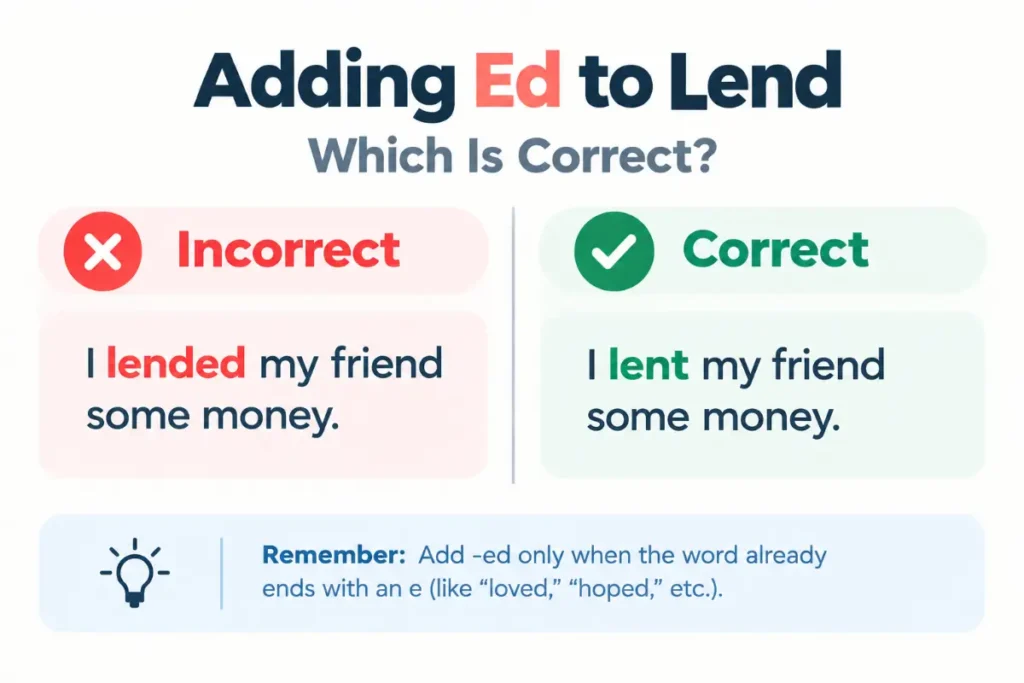
Adding Ed to Lend
Incorrect: I lended my friend some money.
Correct: I lent my friend some money.
The first sentence uses a regular past tense ending, but lend is irregular in standard English. Use lent to describe the completed action.
Using Lent After Did
Incorrect: Did you lent her your book?
Correct: Did you lend her your book?
Did already marks the sentence as a past tense question. The main verb must remain in its base form.
Using Lend After Has
Incorrect: She has lend me her laptop.
Correct: She has lent me her laptop.
The present perfect tense requires a past participle after has. Lent is the correct participle of lend.
Using Lent for a Present Habit
Incorrect: He lent me his notes every week.
Correct: He lends me his notes every week.
The correct choice depends on the intended meaning. If the sentence describes a regular habit that continues in the present, use lends. If it describes a completed past habit, lent may be appropriate with suitable context.
Confusing Lend With Borrow
Incorrect: I borrowed my book to Sarah.
Correct: I lent my book to Sarah.
Lend and borrow describe the same transaction from different perspectives. The person providing the item lends it, while the person receiving it borrows it.
For example, if you give a friend your calculator, you lend the calculator to your friend. Your friend borrows the calculator from you.
Using Lended in Formal Writing
Incorrect: The company lended financial support to the project.
Correct: The company lent financial support to the project.
In formal writing, use the standard irregular form. Lent is the conventional choice in edited American English.
Real Life Examples
The best way to learn a verb is to see it in situations you recognize. The following examples show how lent works in family conversations, school assignments, workplaces, financial discussions, and everyday communication.
Family and Friends
- My brother lent me his headphones for the trip. The sentence describes a temporary transfer of an item between family members.
- Sarah lent her neighbor a cup of sugar. Lent identifies Sarah as the person who provided the sugar.
- I lent my cousin my favorite novel last summer. The sentence uses a past time expression to describe a completed action.
- Dad has lent me his car several times. The present perfect tense describes repeated experiences up to the present.
- My friend lent me a jacket because I was cold. The sentence explains why the lending happened.
School and Education
- The teacher lent the class several dictionaries. Lent describes the teacher providing books for students to use.
- I have lent my notes to two classmates. The present perfect tense emphasizes past lending experiences.
- Our librarian lent me a book about American history. The sentence identifies the item and the person who provided it.
- She had lent him her calculator before the test began. The past perfect tense shows that the lending happened before the test.
- The school lent sports equipment to the students. The sentence uses the verb in a straightforward institutional context.
Work and Business
- My colleague lent me a laptop during the meeting. Lent describes a temporary transfer of work equipment.
- The company lent its conference room to a local group. The verb shows that the group received temporary use of the room.
- Our manager lent support to the new proposal. Here, lent means provided support rather than a physical object.
- The organization has lent its expertise to several projects. The present perfect tense describes contributions made over time.
- The bank lent money to a small business. The sentence describes a financial transaction.
Money and Personal Finance
- I lent my friend two hundred dollars last month. Lent describes money given with an expectation of repayment.
- My parents have lent me money for college expenses. The present perfect tense describes financial help provided before now.
- The lender lent the borrower enough money to repair the house. The sentence identifies both sides of a lending arrangement.
- She had lent him the money before he asked for additional help. The past perfect tense establishes the order of events.
- The bank lent funds to the business at an agreed interest rate. The sentence describes a formal financial arrangement.
Figurative and Creative Uses
- The warm lighting lent the room a peaceful atmosphere. Lent means contributed to the atmosphere.
- Her calm voice lent confidence to the team. The sentence describes an effect on other people’s confidence.
- The evidence lent credibility to his explanation. Lent means helped make the explanation seem believable.
- The music lent a dramatic touch to the scene. The verb describes an artistic contribution.
- His experience lent weight to the recommendation. Lent means added importance or authority to the recommendation.
These examples demonstrate that lent isn’t limited to money or objects. It also works in figurative expressions that describe influence, support, and contribution.
American and British English Usage
The standard past tense of lend is lent in both American and British English. The spelling difference found in some other words between the two varieties doesn’t change this verb’s standard conjugation.
For example, American and British writers both use these forms.
- She lent me her umbrella.
- I have lent him my notes.
- They had lent their support to the project.
All three sentences follow standard grammar in both varieties of English.
You may see lended in informal writing or in unusual examples from different periods or contexts. However, it isn’t the normal standard form in either American or British English.
If you write for a US audience, choose lent in schoolwork, business documents, news articles, emails, and general online content. The same recommendation applies to standard British English.
Formal and Informal Writing
Lent works in almost every register of English. You can use it in a casual text message, a school essay, a business report, or a published article.
In casual conversation, you might say I lent him my charger. In a formal report, you might write The organization lent equipment to the research team.
The tone changes, but the verb form stays the same.
In Academic Writing
Use lent when discussing a past action or a completed lending arrangement.
Example: The university lent laboratory equipment to the research group.
This sentence is direct, grammatical, and appropriate for an academic context.
In Business Writing
Use lent in reports and professional communication.
Example: The company lent its resources to the community initiative.
The sentence is clear and professional. It also uses lent in a figurative sense to describe providing resources or support.
In Emails and Text Messages
You don’t need a special form for casual writing.
Example: I lent you my charger yesterday. Can you bring it tomorrow?
The sentence sounds natural in an everyday conversation and follows the standard grammar rule.
Memory Tips for Remembering Lent
If you often confuse irregular verbs with regular ones, a few simple memory tricks can help you remember the right form.
Connect Lend With Send
Think of the pair lend and lent alongside send and sent.
- I send a message today.
- I sent a message yesterday.
- I lend a book today.
- I lent a book yesterday.
The pairs have a similar pattern. Remembering send and sent can help you recall lend and lent.
Remember the Three Main Forms
Practice this sequence aloud or write it in your notes.
Lend. Lent. Lent.
The first word is the base form. The second is the simple past. The third is the past participle.
Repeat the sequence when you write practice sentences. After a little repetition, it should become easier to recall.
Use a Time Word
Time expressions can help you decide which form belongs in your sentence.
- Every week, I lend books to my friends.
- Yesterday, I lent a book to my friend.
- I have lent books to many friends.
Every week suggests a habit. Yesterday points to a completed past action. Have lent forms the present perfect tense.
The time expression doesn’t replace the grammar rule, but it gives you a useful clue.
Think About the Helping Verb
When you see have, has, or had before the main verb, use lent.
Examples include I have lent, she has lent, and they had lent.
When you use did in a question or negative statement, return to the base form.
Examples include Did you lend it? and I did not lend it.
These patterns help you make the right choice without relying on guesswork.
Related Grammar and Usage Notes
Understanding a few related grammar rules will make it easier to use lend correctly. These rules also help you avoid similar mistakes with other irregular verbs.
Lend vs Borrow
Lend and borrow describe opposite sides of the same transaction.
The lender provides an item temporarily. The borrower receives and uses it.
Example: I lent Emma my book, and Emma borrowed my book from me.
Both clauses describe the same event from different perspectives. The first focuses on the person giving the book, while the second focuses on the person receiving it.
Lent vs Learned
Both are different words with different meanings. Lent is the past tense of lend, while learned is the past tense of learn in standard American English.
Example: I lent him a book, and he learned a lot from it.
The first verb describes giving something temporarily. The second describes gaining knowledge or a skill.
Lent vs Sent
Lent and sent share a similar spelling pattern, but their meanings differ.
Sent is the past tense and past participle of send. Lent is the past tense and past participle of lend.
Example: I lent him my book, and he sent it back the next day.
The sentence uses both verbs correctly. Lent describes the original transfer, and sent describes the return.
Lend vs Give
Lend generally means providing something temporarily with an expectation of return. Give usually means transferring something to another person without expecting it back.
Example: I lent my friend a book.
This suggests that the friend should return the book.
Example: I gave my friend a book.
This usually means the friend now owns the book.
The context can affect the precise meaning, but this distinction is a useful starting point.
The Past Participle Rule
The past participle often appears after a helping verb. With lend, the correct participle is lent.
Correct: She has lent me her notes.
Incorrect: She has lended me her notes.
This pattern also appears in other irregular verbs. For example, write becomes written, take becomes taken, and speak becomes spoken.
Why Irregular Verbs Matter
Irregular verbs are common in everyday English. Learning their standard forms improves grammar, spelling, and sentence structure.
Rather than assuming every verb needs an ed ending, learn the forms of frequently used irregular verbs as complete sets. This method helps you write more accurately and speak more naturally.
Key Takeaways
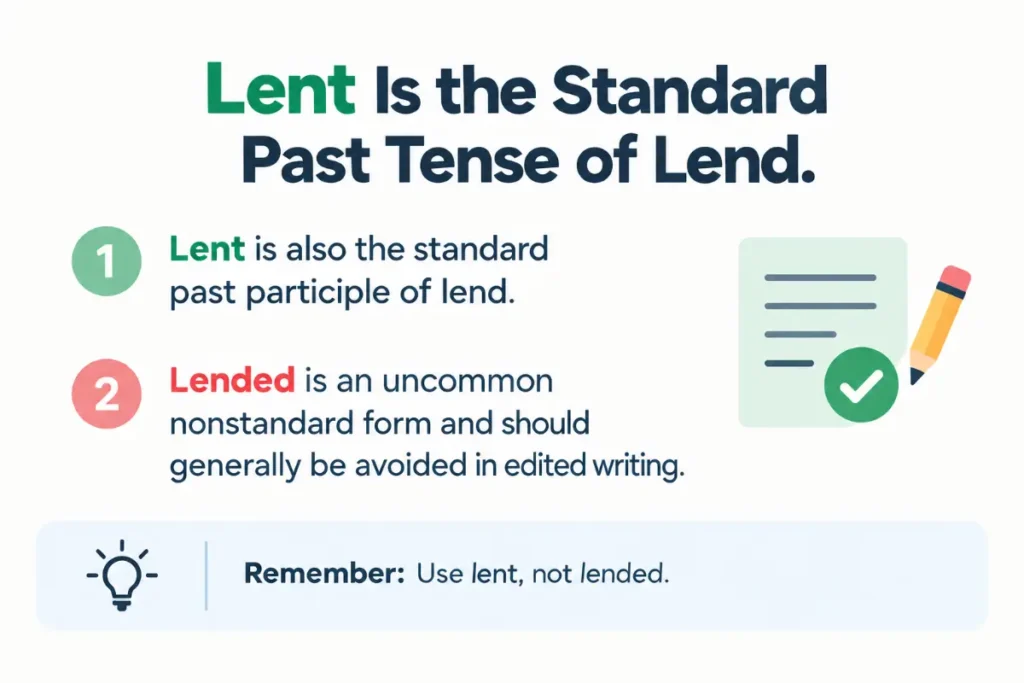
- Lent is the standard past tense of lend.
- Lent is also the standard past participle of lend.
- Lended is an uncommon nonstandard form and should generally be avoided in edited writing.
- Use lend after did, can, could, will, and other helping verbs that require the base form.
- Use lent after have, has, and had when forming perfect tenses.
- Lend describes giving something temporarily, while borrow describes receiving it temporarily.
- Loan is commonly a noun and can also function as a verb.
- Lent is the standard form in both American and British English.
- The easiest memory trick is to connect lend with send and lent with sent.
- When writing for school, work, or publication, choose lent rather than lended.
Conclusion
Lended vs lent comes down to one essential grammar rule. Lent is the standard past tense and past participle of lend in modern English. Although adding ed is a common way to form the past tense, lend is an irregular verb. That’s why the correct sentence is I lent my friend some money rather than I lended my friend some money.
You can use lent to describe a completed action, as in She lent me her book yesterday, or with a helping verb, as in She has lent me her book. The same form works in both cases. You should also remember to use the base form lend after did, as in Did you lend him the money? These patterns cover most everyday situations.
The simplest way to remember the rule is to practice the sequence lend, lent, lent. Connect it with send, sent, sent to make the pattern easier to recall. Once you learn these forms, you’ll be able to use lent confidently in conversations, school assignments, emails, and professional writing.
Frequently Asked Questions
Is lended or lent correct?
Lent is correct in standard modern English. It is the simple past tense and past participle of lend. Lended is an uncommon nonstandard form, so use lent in American English writing.
Is lended a real word?
Lended appears in some informal and uncommon usage, but it isn’t the standard past tense of lend. For ordinary modern writing, lent is the accepted form.
What is the past tense of lend?
The simple past tense of lend is lent. For example, you should write I lent her my notebook yesterday.
What is the past participle of lend?
The past participle is also lent. Use it with helping verbs such as have, has, and had. For example, I have lent him my calculator.
Why do people say lended instead of lent?
People may say lended because they apply the regular rule of adding ed to form the past tense. This process is known as overregularization. However, lend is irregular, and lent is its standard past form.
Is lended vs lent a spelling difference or a grammar difference?
It is mainly a verb conjugation issue. Lended follows a regular spelling pattern, but lent is the standard irregular past tense and past participle of lend.
Can I write I have lended him money?
No. In standard English, write I have lent him money. The present perfect tense requires the past participle of lend, which is lent.
Is lent correct in American and British English?
Yes. Lent is the standard past tense and past participle of lend in both American and British English. You don’t need to change the spelling for either audience.
What is the difference between lent and loaned?
Lent is the past tense of lend, while loaned is the past tense of loan. Both can describe providing money or something else temporarily. For example, The bank lent us money and The bank loaned us money are both acceptable.
How do you use lent in a sentence?
Use lent to describe a past lending action or as a past participle. For example, She lent me her umbrella yesterday uses the simple past, while She has lent me her umbrella uses the present perfect.
Should I use lended in formal writing?
No. Use lent in formal writing, academic assignments, business documents, and professional communication. It is the standard form recognized in modern edited English.
What is the easiest way to remember the correct form?
Remember the sequence lend, lent, lent. You can also connect lend with send and lent with sent. This simple comparison helps you recall the correct forms.

English Grammar & Usage
Nathan Holloway is an American grammar writer and language researcher who specializes in English grammar, sentence structure, verb usage, and common writing mistakes. He enjoys breaking down confusing grammar rules into practical explanations with clear examples, making English easier for students, professionals, and everyday writers.