
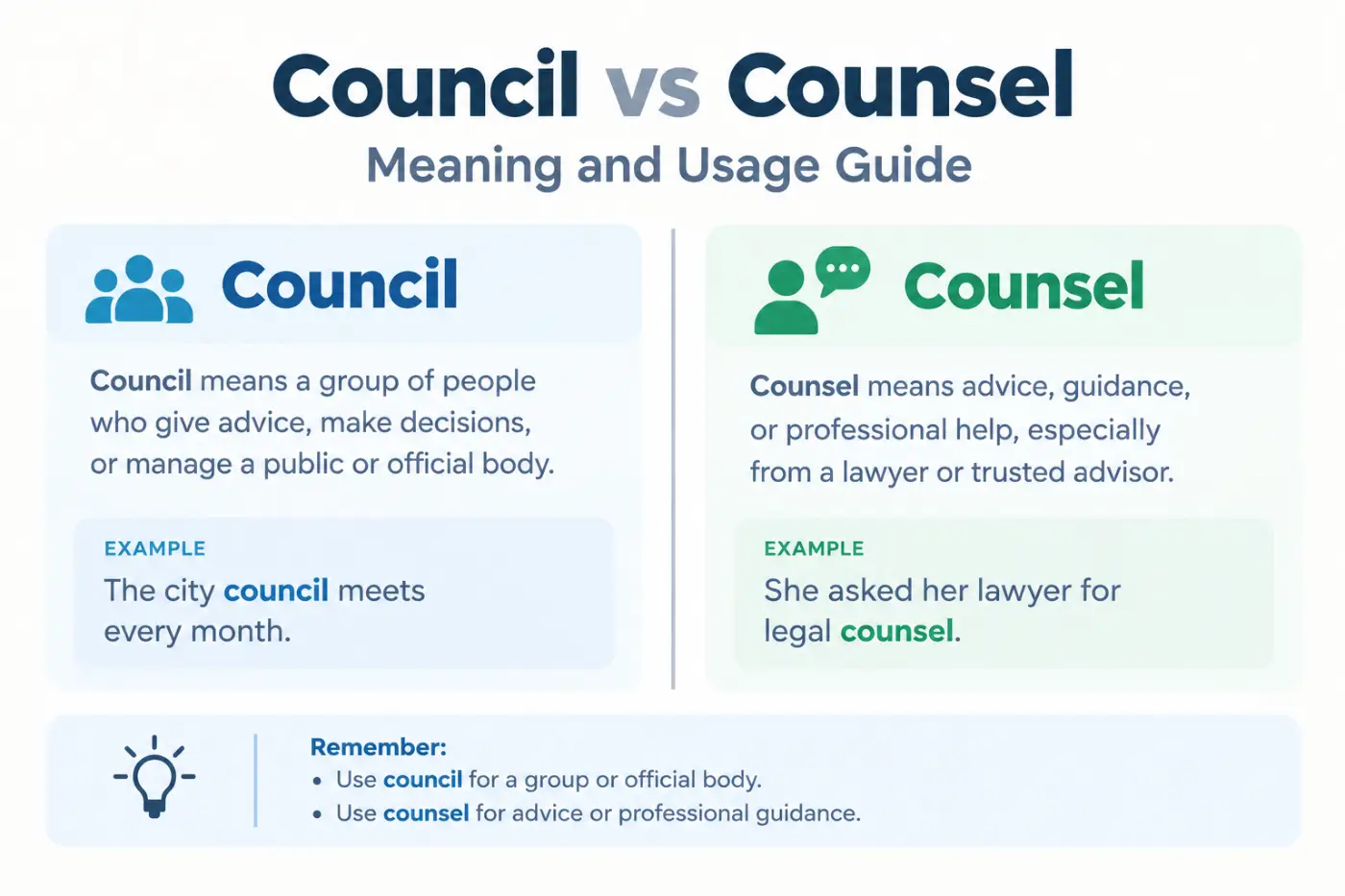
Council vs counsel is a common English word comparison because both words have the same pronunciation but different meanings. The spelling difference is small, yet choosing the wrong word can change the meaning of a sentence. If you write about local government, school administration, legal matters, or personal advice, knowing which word to use will help you communicate clearly.
The easiest way to remember the difference is to connect council with a group and counsel with advice. A city council makes decisions about local services and public policies. A lawyer may provide legal counsel, and a trusted friend may offer helpful counsel when you face a difficult decision. These examples show how each word serves a different purpose.
Both words are correct in American English. Neither is a misspelling of the other. The right choice depends on the meaning you want to express, the role of the person or group involved, and the context of your sentence. Once you learn their meanings and common patterns, you’ll find it much easier to use them correctly in everyday conversations and professional writing.
Short Answer
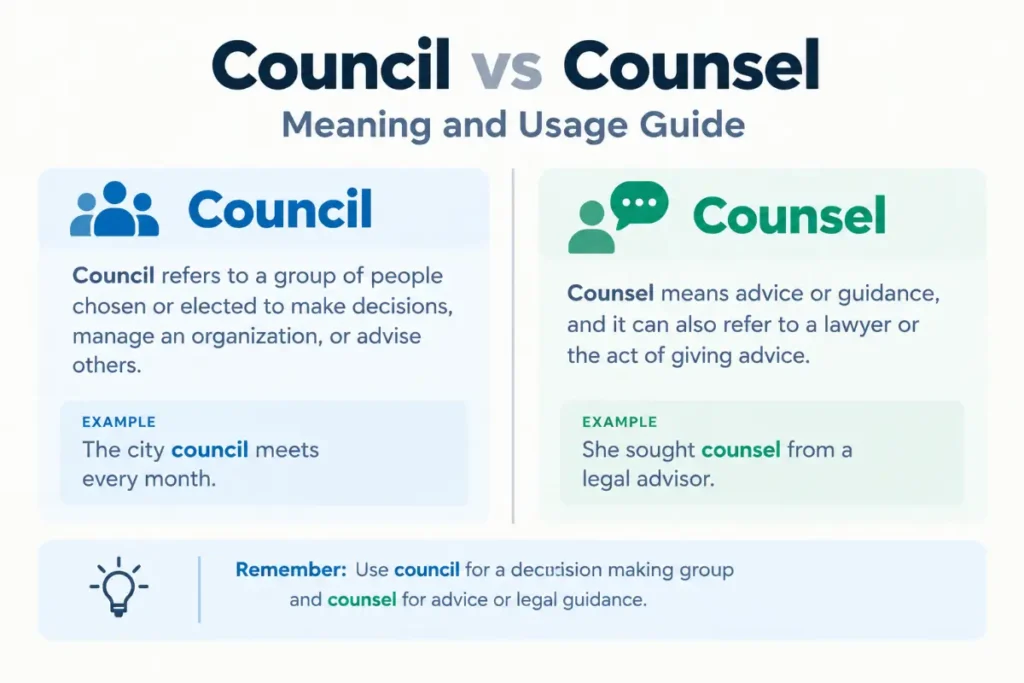
Council refers to a group of people chosen or elected to make decisions, manage an organization, or advise others. Counsel means advice or guidance, and it can also refer to a lawyer or the act of giving advice. Both words sound alike in American English, but their meanings and uses differ. Use council for a decision making group and counsel for advice or legal guidance.
Table of Contents
- What Council Means.
- What Counsel Means.
- The Main Difference Between Council and Counsel.
- Council vs Counsel Comparison Table.
- How to Use Council Correctly.
- How to Use Counsel Correctly.
- Council and Counsel in Legal Writing.
- Pronunciation and Word Origins.
- Real Life Examples.
- Common Mistakes to Avoid.
- Easy Memory Tips.
- Related Words and Expressions.
- American and British English Usage.
- Writing Tips for Students and Professionals.
- Frequently Asked Questions.
- Key Takeaways.
- Conclusion.
What Council Means
A council is a group of people who meet to discuss issues, make decisions, create policies, or provide guidance within an organization or community. Members may be elected by the public, appointed by an authority, or selected by an organization.
You will often see this word in local government, schools, universities, businesses, professional organizations, and community groups. A council usually has a defined purpose and a set of responsibilities.
For example, a city council may approve a budget, discuss road repairs, review zoning proposals, or decide how to spend public money. A student council may organize school events and represent students’ concerns. In both cases, the word refers to a group of people rather than advice itself.
Common meanings of council
The word council can describe several types of groups.
- A local government body. A city council or town council helps govern a local area and makes decisions about community services.
- An advisory group. A council of experts may study a problem and recommend possible solutions.
- An organizational committee. A university council may oversee institutional policies or administrative matters.
- A representative group. A student council may represent students and communicate their ideas to school leaders.
- A professional or official body. A professional council may establish standards, support members, or oversee specific activities.
The exact duties of a council depend on its purpose and the rules that govern it. Not every council has the power to make binding decisions. Some groups mainly provide advice or recommendations.
Council in a sentence
The city council approved the new public park.
This sentence uses council correctly because it refers to a group of local officials who made a decision.
Our student council organized a charity event.
Here, council refers to a group of students who work together to represent their classmates and arrange activities.
The council met to discuss changes to the university’s policies.
In this example, council identifies the group that gathered to review institutional rules.
Is council a noun
Yes. Council is a countable noun. You can use it in singular and plural forms.
- Singular: The council meets every month.
- Plural: Several councils reviewed the proposal.
- With an article: A council was formed to investigate the issue.
- With a possessive: The council’s decision surprised residents.
The plural form is councils. You do not write councils as counsels when you mean multiple decision making groups.
Common phrases with council
Several established expressions use council.
| Expression | Meaning | Example |
|---|---|---|
| City council | A local government body | The city council reviewed the budget. |
| Town council | A local governing group | The town council discussed road safety. |
| Student council | A group representing students | The student council planned a school dance. |
| Advisory council | A group that offers recommendations | The advisory council reviewed the proposal. |
| School council | A group involved in school matters | The school council discussed new activities. |
| Council meeting | A meeting of council members | The council meeting begins at noon. |
| Council member | A person who belongs to a council | A council member introduced the proposal. |
| Council chamber | A room where a council meets | Residents gathered in the council chamber. |
These phrases all refer to a group, its members, its meetings, or its work.
What Counsel Means
Counsel has several related meanings. It can refer to advice, guidance, or a recommendation. It can also mean the act of advising someone. In legal settings, counsel commonly refers to a lawyer or a legal adviser.
Unlike council, counsel doesn’t name a governing group. It focuses on advice, professional guidance, or legal representation.
For example, a parent may give counsel to a child who faces a difficult choice. A financial adviser may offer financial counsel to a client. An attorney may serve as legal counsel during a court case.
Common meanings of counsel
The word counsel works in several ways.
- Advice or guidance. Counsel can mean thoughtful recommendations intended to help someone make a decision.
- The act of advising. A professional may counsel a person who needs guidance or support.
- A lawyer or legal adviser. In legal language, counsel can refer to an attorney representing a client.
- Professional guidance. A counselor or adviser may provide counsel about education, work, finances, or personal decisions.
The surrounding words usually make the intended meaning clear. Phrases such as seek counsel, legal counsel, and follow someone’s counsel commonly refer to advice or legal assistance.
Counsel as advice
When counsel means advice, it is usually an uncountable noun. You can give counsel, seek counsel, offer counsel, or follow counsel.
She sought counsel before accepting the job offer.
This means she asked someone for advice before making her decision.
His father’s counsel helped him avoid a costly mistake.
Here, counsel means guidance or advice that helped him make a better choice.
The manager offered practical counsel to the new employee.
The manager provided useful advice about handling work responsibilities.
You generally don’t use a counsel to mean one piece of ordinary advice. Instead, write a piece of advice, some advice, or a word of counsel when the context supports that expression.
Counsel as a verb
Counsel can also function as a verb. It means to advise, guide, or recommend a course of action.
The teacher counseled the student to speak with the school principal.
The teacher advised the student about a sensible next step.
Her doctor counseled her to discuss the possible side effects before changing her medication.
In this sentence, counseled means advised. The example illustrates the word’s grammatical use rather than replacing professional medical guidance.
The attorney counseled the client about the risks of signing the agreement.
Here, the attorney gave the client legal advice about a decision.
The verb commonly appears in the pattern counsel someone to do something or counsel someone against doing something.
For example, The adviser counseled him against making a rushed decision means the adviser recommended that he avoid acting too quickly.
Counsel as a legal term
In legal contexts, counsel can refer to a lawyer, an attorney, or the legal representation provided by that professional.
The defendant spoke with legal counsel before the hearing.
This means the defendant consulted a lawyer or legal adviser.
Defense counsel questioned the witness.
Here, defense counsel refers to the lawyer or legal team representing the defendant.
The company hired outside counsel to review the contract.
Outside counsel means a lawyer or law firm that works outside the company’s internal legal department.
Legal usage can vary by jurisdiction and context. Counsel may refer to an individual attorney, a group of attorneys, or legal advice as a service. The sentence usually tells you which meaning applies.
Is counsel a noun or a verb
Counsel can be both a noun and a verb.
As a noun, it means advice, guidance, or a lawyer.
- The patient requested professional counsel.
- The company consulted its legal counsel.
As a verb, it means to advise or guide someone.
- The adviser counseled the family.
- The lawyer counseled the client before the trial.
Its grammatical role depends on how you use it in a sentence. If it names advice or a lawyer, it is a noun. If it describes the act of giving advice, it is a verb.
The Main Difference Between Council and Counsel
The key difference is simple. Council refers to a group of people, while counsel refers to advice, guidance, or a lawyer. Although both words sound the same, they don’t serve the same purpose in a sentence.
Think of a council as the people sitting around a table to discuss a problem. Counsel is the guidance someone gives to help solve that problem. A council might invite a lawyer to provide legal counsel before making a decision.
Council refers to a group
Use council when you mean an organized body of people who meet to make decisions, represent others, or discuss a shared concern.
For example, The council voted to improve the public library describes a group making a decision. The word council identifies the people or governing body that took the action.
Other examples include a city council, a student council, and an advisory council. Each expression names a group with a particular purpose.
Counsel refers to advice or a lawyer
Use counsel when you mean advice, professional guidance, or legal representation.
For example, The business owner sought counsel before signing the contract means the owner obtained advice. In a legal setting, The defendant consulted counsel means the defendant spoke with a lawyer or legal representative.
Counsel can also describe the act of advising someone. In The teacher counseled the student, the word describes what the teacher did.
Council vs Counsel Comparison Table
| Feature | Council | Counsel |
|---|---|---|
| Main meaning | A group of people | Advice, guidance, or a lawyer |
| Part of speech | Noun | Noun and verb |
| Typical setting | Government, schools, organizations | Legal work, personal advice, professional guidance |
| Countability | Usually a countable noun | Usually uncountable when it means advice |
| Verb form | Not commonly used as a verb in standard English | Means to advise or guide |
| Plural form | Councils | Counsels can mean different instances of advice or advisers in certain contexts |
| Common phrase | City council | Legal counsel |
| Example | The council approved the plan. | The lawyer provided counsel. |
| Memory clue | Think of a committee | Think of advice |
The most reliable way to choose the correct word is to identify the meaning first. If you are talking about a group that meets or votes, use council. If you are talking about advice, guidance, or a lawyer, use counsel.
Can both words appear in one sentence
Yes. Both words can appear in the same sentence because they refer to different things.
The city council asked its legal counsel to review the proposed agreement.
In this sentence, council refers to the local government body. Counsel refers to the lawyer or legal adviser who will review the agreement.
Here is another example.
The school council sought counsel from an education expert before changing its policy.
The school council is the group making decisions. Counsel is the advice it requested from the expert.
These examples are useful because they show that the words aren’t competing alternatives in every sentence. Sometimes, both are needed to express the intended meaning accurately.
How to Use Council Correctly
Choose council when your sentence refers to a formal group or organized body. The word often appears with verbs such as meets, votes, approves, discusses, appoints, and recommends.
Use council for government and public affairs
Local governments often have councils that discuss public services, budgets, planning, and community concerns.
The city council approved funding for road repairs.
The sentence identifies the governing body that approved the funding.
Residents asked the council to improve street lighting.
Here, council refers to the officials responsible for considering the residents’ request.
The council rejected the proposal after a lengthy discussion.
The word refers to the group that considered and voted on the proposal.
The specific powers of a local council depend on the relevant laws and government structure. The word itself doesn’t guarantee that the group has final decision making authority.
Use council for schools and universities
Educational institutions may have councils that represent students, oversee policies, or advise administrators.
The student council organized a fundraiser for the school library.
Student council refers to the group responsible for arranging the event.
The university council reviewed the proposed changes to academic policies.
The sentence identifies a formal university body that examined the proposed changes.
A council of teachers met to discuss classroom resources.
Here, council refers to a group of teachers gathered for a shared purpose.
Not every school committee is officially called a council. Use the institution’s actual name when writing about a specific organization.
Use council for professional organizations
Professional bodies may establish councils to support members, develop standards, or discuss industry concerns.
The advisory council recommended several improvements to the training program.
The advisory council is a group that provides recommendations.
Members of the council gathered to review the annual report.
This sentence describes a meeting of the organization’s members.
The council appointed a new chairperson.
Council identifies the group that selected the person for the role.
Understand council as a collective noun
Council is a collective noun because it names a group of people as a single unit.
In American English, a singular verb is common when the group acts as one body.
The council has approved the new policy.
The council is treated as one organization, so the singular verb has is appropriate.
The sentence treats the council as a single group holding a meeting.
If you want to emphasize the individual members, you can describe their actions separately.
Council members are discussing their individual recommendations.
Here, the plural subject is members, so the verb are agrees with it.
For American readers, using a singular verb with council when referring to the group as a whole is a reliable standard choice.
How to Use Counsel Correctly
Use counsel when discussing advice, guidance, legal assistance, or the act of advising someone. Pay attention to the sentence’s grammar because counsel can function as either a noun or a verb.
Use counsel when giving or receiving advice
Counsel often appears with verbs such as seek, offer, provide, request, follow, and accept.
She sought counsel from an experienced mentor.
The sentence means she asked the mentor for guidance.
The manager offered counsel to an employee who was struggling with a difficult assignment.
Here, counsel refers to advice intended to help the employee.
He followed his father’s counsel and waited before making a major purchase.
The sentence explains that he acted on his father’s advice.
These examples show that counsel often sounds more formal than advice. It is common in professional, legal, religious, and serious personal contexts.
Use counsel as a verb when advising someone
When counsel functions as a verb, it describes an action. The person giving the advice is the subject, and the person receiving it may appear as the object.
The supervisor counseled the employee about improving communication.
Counseled describes the supervisor’s act of giving guidance.
The lawyer counseled her client against accepting the first settlement offer.
The lawyer advised the client not to accept the offer immediately.
The career adviser counsels graduates on their job searches.
Counsels is the present tense verb because the subject, adviser, is singular.
In American English, the past tense is usually spelled counseled, and the noun or verb forms may also appear as counseling. The related noun for a person who provides guidance is counselor.
Use counsel in legal situations
Counsel is especially common in legal writing and professional discussions about attorneys.
The defendant requested legal counsel.
The defendant asked for legal representation or legal advice.
The company’s counsel reviewed the employment agreement.
The word refers to the lawyer or legal representative who reviewed the document.
Both sides presented their arguments through counsel.
Here, counsel refers to the lawyers representing the parties.
In legal writing, context matters. The phrase legal counsel may refer to advice or to the professional providing it. The phrase defense counsel usually identifies the lawyer or legal team representing the defendant.
Understand counsel as an uncountable noun
When counsel means advice, it generally behaves like an uncountable noun.
You can write:
- She gave me useful counsel.
- He asked for professional counsel.
- They received sound counsel before making the decision.
Avoid writing a counsel when you simply mean one piece of advice. Use a piece of advice instead, or choose another natural expression.
For example, write She gave me a piece of advice rather than She gave me a counsel. If you need a more formal tone, She offered a word of counsel may work in the right context.
Counsel can have countable uses in legal language when it refers to lawyers or legal representatives. The uncountable rule applies most clearly when the word means advice.
Know the difference between counsel and counseling
Counsel and counseling are related, but they don’t have identical grammatical roles.
Counsel can mean advice or the act of advising. Counseling usually refers to the process of providing guidance or support.
The employee requested counsel from the human resources manager.
This describes a request for advice.
The employee attended a counseling session.
This describes a session in which the employee received guidance or support.
The words overlap in meaning, but counseling often refers to a structured process or professional service.
Council and Counsel in Legal Writing
Legal writing is one area where choosing the right word matters a great deal. Council and counsel may appear in the same document, but they refer to different roles.
A council may be a governing body that creates policies or makes organizational decisions. Counsel usually refers to a lawyer, legal advice, or the act of advising someone. The context determines the precise meaning.
Legal counsel and city council
Consider these sentences.
The city council approved the new zoning rules.
The sentence refers to the government body that voted on the rules.
The city hired legal counsel to review the zoning rules.
Here, counsel refers to the lawyer or law firm providing legal assistance.
The council followed its attorney’s counsel before approving the contract.
The first use identifies the governing group. The second use means advice from the attorney.
These distinctions are especially useful when writing reports, contracts, news articles, meeting minutes, and legal summaries.
What does counsel of record mean
In legal proceedings, counsel of record generally refers to an attorney formally listed as representing a party in a case. The exact procedural meaning can depend on the court’s rules and the jurisdiction.
For example, The counsel of record filed a response to the motion means the attorney officially associated with the case filed the response.
The word council would not be appropriate in this expression because the sentence refers to a legal representative rather than a governing group.
What does general counsel mean
A general counsel is the chief lawyer or senior legal adviser for a company or organization. This role often involves reviewing contracts, advising executives, managing legal risks, and coordinating legal matters.
The company’s general counsel reviewed the proposed merger agreement.
General counsel refers to the company’s senior legal adviser. It does not mean a committee or governing council.
Pronunciation and Word Origins
Council and counsel are homophones in standard American English. Homophones are words that sound alike but have different meanings and spellings.
Both words are commonly pronounced /ˈkaʊnsəl/. The first syllable receives the main stress, and the final syllable has a relaxed sound.
Because their pronunciation is the same, listening alone usually won’t tell you which word a writer intended. You must use the sentence’s meaning and spelling.
Why do council and counsel sound alike
The two words developed from related historical sources and came to share the same pronunciation in modern English.
Council entered English through Anglo French and Old French forms connected to the Latin concilium, meaning an assembly or meeting. Its historical development fits its modern meaning of a group gathered to discuss or decide matters.
Counsel also came through Anglo French and Old French, with roots connected to Latin consilium, meaning advice, deliberation, or consultation. Its history fits its modern connection to guidance and advice.
The words have related historical roots, but modern English uses them differently. Their shared sound doesn’t make them interchangeable.
How spelling helps you remember the difference
The spelling gives you a useful memory clue.
- Council contains the letters cil. Connect the word with a council chamber where a group meets.
- Counsel contains the letters sel. Connect it with someone who gives sensible advice.
These are memory aids rather than formal spelling rules. Their main purpose is to help you recall the correct word when writing.
Real Life Examples
Seeing both words in different contexts makes their meanings easier to recognize. The following examples cover common situations in school, work, government, and legal settings.
Examples with council
- The city council met to discuss public transportation. The word council identifies the group responsible for reviewing the issue.
- Our student council raised money for new sports equipment. The sentence describes a student group organizing a fundraising effort.
- The council rejected the proposal after reviewing the budget. Council refers to the body that considered the proposal and decided not to approve it.
- A neighborhood council invited residents to share their concerns. The word names an organized group that represents or serves the community.
- The university council discussed changes to the admissions process. The sentence refers to a formal university body reviewing a policy.
- Each council member received a copy of the report. Council modifies member to identify a person who belongs to the group.
- The council’s decision will take effect next month. The possessive form council’s shows that the decision belongs to or was made by the group.
Examples with counsel
- She asked her mentor for counsel before changing careers. Counsel means advice that could help her make an informed decision.
- The defendant met with legal counsel before the hearing. Counsel refers to the lawyer or legal representative.
- His mother’s counsel helped him think more carefully about the offer. The word means guidance or advice.
- The attorney counseled the client about the possible risks. Counseled is a verb describing the act of giving legal advice.
- The company hired outside counsel to review the contract. Outside counsel refers to an external lawyer or law firm.
- The teacher counseled the student to ask for extra help. The verb means the teacher advised the student.
- The board sought counsel from an independent expert. Counsel refers to advice requested from someone with relevant knowledge.
Both words together
- The city council consulted legal counsel before signing the agreement. Council identifies the local government body, while counsel refers to its legal adviser.
- The school council requested counsel from an experienced educator. Council is the group, and counsel is the guidance it requested.
- The council considered the counsel provided by its attorney. The first word identifies the decision making body, while the second refers to the attorney’s advice.
- The council hired new counsel after reviewing its legal needs. Council is the governing body, and counsel refers to legal representation.
- The advisory council offered counsel to the organization’s leadership. Council identifies the group, while counsel means the advice it provided.
The best way to learn these words is to read the full sentence instead of focusing only on spelling. Meaning determines the correct choice.
Common Mistakes to Avoid
Even experienced writers can mix up words that share the same pronunciation. Most errors happen when someone chooses a spelling based on sound instead of meaning.
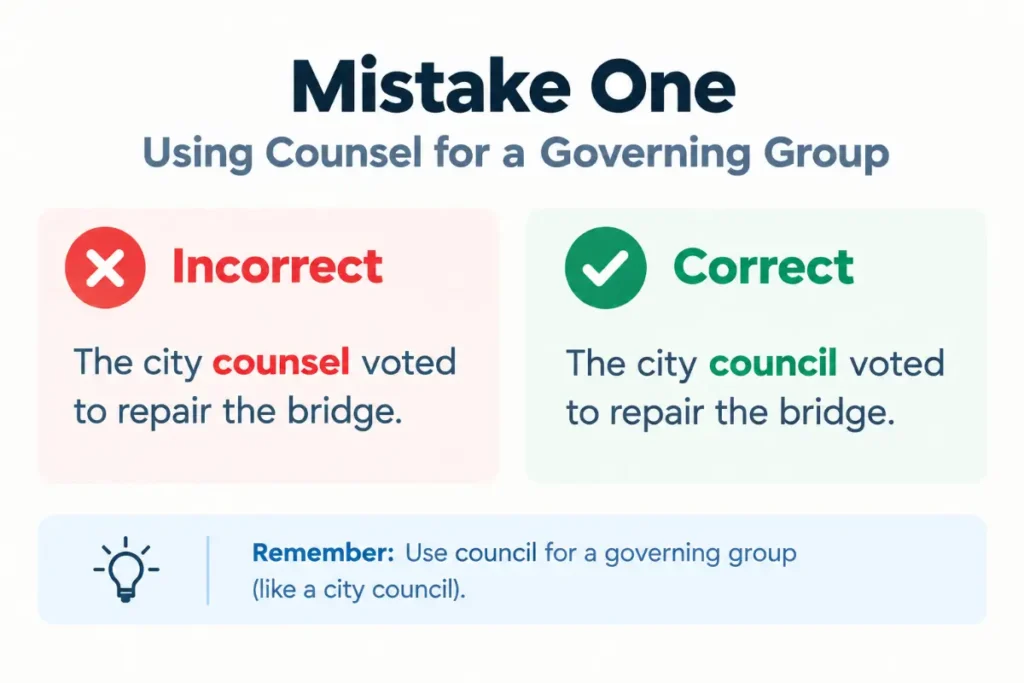
Mistake one using counsel for a governing group
Incorrect: The city counsel voted to repair the bridge.
Correct: The city council voted to repair the bridge.
The sentence refers to a group of local officials making a decision. Council is the correct word because the subject is a governing body.
Mistake two using council for advice
Incorrect: She asked her mentor for council.
Correct: She asked her mentor for counsel.
The intended meaning is advice or guidance. Counsel fits that meaning, while council would suggest a group of people.
Mistake three using council for a lawyer
Incorrect: The defendant spoke with legal council.
Correct: The defendant spoke with legal counsel.
Legal counsel refers to a lawyer or legal adviser. The word council would incorrectly suggest a governing group.
Mistake four treating counsel as a regular countable noun
Incorrect: He gave me a counsel about my career.
Correct: He gave me advice about my career.
Counsel usually acts as an uncountable noun when it means advice. If you want to use counsel, write He offered me counsel about my career.
Mistake five assuming every council gives advice
A council may provide advice, but that doesn’t make the word counsel a suitable replacement for its name.
Incorrect: The school counsel met on Friday.
Correct: The school council met on Friday.
The sentence names a group that held a meeting. Use council even if the group’s responsibilities include advising school leaders.
Mistake six confusing counsel with counselor
Counsel means advice, legal representation, or the act of advising. A counselor is a person who provides guidance or support.
The counselor offered counsel to the student.
Counselor identifies the person. Counsel identifies the advice or guidance.
The difference matters in school writing, workplace communication, and descriptions of professional services.
Easy Memory Tips
You don’t need to memorize complicated grammar rules to distinguish these words. A simple association can help you choose the correct spelling quickly.
Remember council as a group
Think of a council chamber filled with people discussing a proposal. The word council refers to the group gathered to handle a shared responsibility.
For example, The council approved the new rules tells you that a group made a decision.
Remember counsel as advice
Connect counsel with guidance from a trusted adviser or lawyer. If someone offers counsel, that person is offering advice or professional guidance.
For example, The lawyer provided counsel tells you that the lawyer gave legal advice or assistance.
Use the substitution test
When you aren’t sure which word belongs in a sentence, replace it with a simpler word that has the same meaning.
- If you can replace the word with committee or governing group, use council.
- If you can replace it with advice or legal guidance, use counsel.
- If the word describes the act of advising someone, use counsel as a verb.
Consider this sentence: The council requested counsel.
Replace the first word with committee and the second with advice. The sentence still makes sense. That confirms that both spellings are correct in their respective positions.
Related Words and Expressions
Understanding related words can help you avoid additional spelling and usage mistakes.
Council and committee
A council and a committee are both groups of people, but they aren’t always the same type of organization.
A council may have broad responsibilities for governance, representation, or policy. A committee is often a smaller group assigned to handle a particular task or subject.
For example, a city council may establish a transportation committee to review traffic concerns. Both words refer to groups, but each group has a different role.
Counsel and advice
Advice is the more common word in everyday conversation. Counsel often sounds more formal and appears frequently in legal, professional, and serious personal contexts.
My friend gave me helpful advice.
My friend offered me helpful counsel.
Both sentences describe guidance. The second has a somewhat more formal tone.
Counsel and counselor
Counsel can mean advice or a lawyer. Counselor refers to a person who provides guidance, support, or professional advice.
Examples include a school counselor, a career counselor, and a mental health counselor.
The counselor provided counsel to the student.
The two words appear together because they perform different grammatical roles.
Counsel and councilor
A councilor is a member of a council. The spelling councilor is common in American English, particularly for elected local officials. Councillor is a common British spelling.
The councilor presented a proposal to the council.
Councilor refers to the individual member. Council refers to the group.
Counselor, by contrast, refers to someone who provides advice or support. A counselor may offer counsel, but that person isn’t automatically a councilor.
Council and counsel at a glance
| Word | Meaning | Example |
|---|---|---|
| Council | An organized group | The council met on Monday. |
| Counsel | Advice or legal representation | The client requested counsel. |
| Counsel | To advise someone | The lawyer counseled the client. |
| Councilor | A member of a council | The councilor introduced a motion. |
| Counselor | A person who provides guidance | The counselor helped the student. |
| Counseling | The process of providing guidance | She attended a counseling session. |
These words share some letters and related meanings, but their grammatical roles differ. Choose the word that expresses the specific person, group, action, or idea you intend.
American and British English Usage
Council and counsel have the same basic meanings in American and British English. The spelling distinction doesn’t change across these varieties.
In both varieties, a council is a group of people, while counsel means advice, legal representation, or the act of advising someone.
There are some related spelling differences worth knowing.
- Councilor and councillor. Councilor is the usual American spelling for a member of a council. Councillor is the standard British spelling.
- Counselor and counsellor. Counselor is the standard American spelling for someone who provides guidance. Counsellor is common in British English.
- Counseled and counselled. American English generally uses counseled for the past tense of the verb. British English commonly uses counselled.
- Counseling and counselling. American English uses counseling, while British English commonly uses counselling.
These differences involve related words rather than council and counsel themselves. In American writing, keep the standard spellings consistent throughout the document.
Writing Tips for Students and Professionals
Choosing the right word improves clarity in school assignments, business documents, legal writing, and everyday messages. A few practical habits can help you avoid mistakes.
Focus on meaning before spelling
Don’t choose a word simply because it sounds right. Identify the idea you want to express first.
If you are writing about a public meeting, a school group, or an organization, council may be appropriate. If you are discussing legal representation or someone’s advice, counsel is usually the better choice.
Check the words around it
The surrounding words often reveal the intended meaning.
Expressions such as city council, student council, and council member refer to a group or its members.
Expressions such as legal counsel, seek counsel, and offer counsel refer to legal services or advice.
Learning these common word combinations makes correct usage more natural.
Read the complete sentence aloud
Because the words sound alike, reading aloud won’t help you hear the spelling difference. However, it can help you notice an unclear sentence.
After reading the sentence, ask yourself what the word represents. Is it a group, a person, advice, or an action? That question is more useful than listening for a difference that doesn’t exist in standard pronunciation.
Use spelling tools carefully
A spell checker may accept both words because both are correctly spelled English words. It may not recognize that the word doesn’t fit the sentence’s meaning.
For example, a spell checker might accept The city counsel approved the plan even though council is the intended word.
Always review the sentence for meaning and context. Correct spelling alone doesn’t guarantee correct word choice.
Key Takeaways
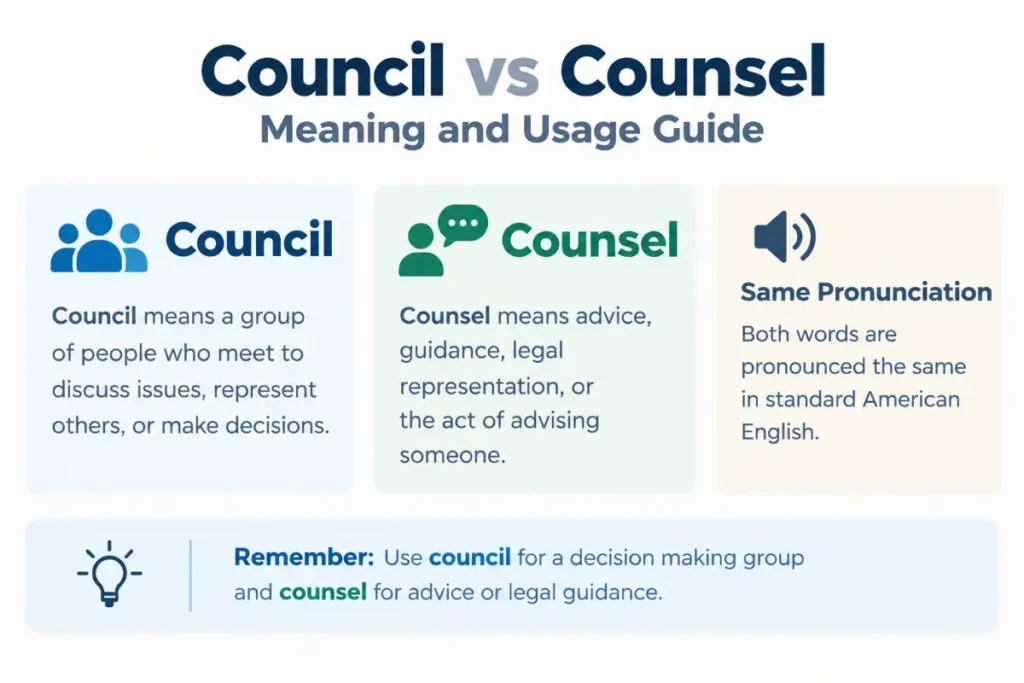
- Council means a group of people who meet to discuss issues, represent others, or make decisions.
- Counsel means advice, guidance, legal representation, or the act of advising someone.
- Both words are pronounced the same in standard American English.
- Council is a noun. Counsel can function as a noun or a verb.
- The plural of council is councils. Counsel is usually uncountable when it means advice.
- Councilor refers to a council member, while counselor refers to someone who provides guidance.
- American English uses counselor, counseled, and counseling. British English commonly uses counsellor, counselled, and counselling.
- A spell checker may accept both words, so always check the meaning of the sentence.
Conclusion
Council vs counsel becomes easy to understand once you connect each word with its main meaning. Council refers to a group of people who meet to make decisions, represent a community, or discuss important issues. Counsel refers to advice, guidance, legal representation, or the act of advising someone. Both words are correct, but they aren’t interchangeable.
Remember the simplest rule. A city council makes decisions, while legal counsel provides advice. You can also use the substitution test. If you mean a committee or governing group, choose council. If you mean advice or a lawyer, choose counsel. These simple checks will help you avoid common spelling mistakes in schoolwork, professional documents, and everyday writing.
With practice, you’ll recognize the difference without stopping to think about it. Pay attention to meaning, learn common expressions such as city council and legal counsel, and check the surrounding words before finalizing your sentence. Once you understand how each word works, you’ll be able to use both confidently and accurately.
Frequently Asked Questions
What is the main difference between council and counsel?
Council refers to a group of people who meet to discuss issues, represent others, or make decisions. Counsel means advice, guidance, or a lawyer. The words sound alike but have different meanings.
Is council or counsel correct?
Both words are correct. Use council when referring to a group, such as a city council. Use counsel when referring to advice, legal representation, or the act of advising someone.
Are council and counsel pronounced the same?
Yes. In standard American English, both are pronounced /ˈkaʊnsəl/. They are homophones, meaning they share the same pronunciation but have different meanings and spellings.
How do you remember council vs counsel?
Remember council as a group of people meeting in a council chamber. Remember counsel as advice from a trusted adviser or lawyer. The substitution test also helps. If committee fits, use council. If advice fits, use counsel.
Is legal council or legal counsel correct?
Legal counsel is correct. It refers to a lawyer, legal representative, or legal advice. Legal council would refer to a group in an unusual context and isn’t the standard expression for an attorney.
What is the plural of council?
The plural of council is councils. For example, Several city councils discussed the proposal. When counsel means advice, it is usually uncountable. In legal contexts, counsel can refer to lawyers or legal representatives.
Can counsel be used as a verb?
Yes. Counsel can mean to advise or guide someone. For example, The lawyer counseled the client before the hearing. The past tense is counseled in American English and counselled in common British usage.
What is the difference between a counselor and a councilor?
A counselor is someone who provides advice, guidance, or support. A councilor is a member of a council. For example, a school counselor helps students, while a city councilor serves on a local governing body.
Should I write city council or city counsel?
Write city council when referring to the local government body. For example, The city council approved the budget. Use counsel when referring to legal advice or an attorney, as in The city consulted legal counsel.
Is counsel always related to law?
No. Counsel can mean advice or guidance in everyday, personal, educational, and professional situations. It also has a common legal meaning that refers to a lawyer or legal representation.

Confusing Words, Spelling & Word Choice
Claire Whitmore is a U.S.-based English editor who writes about commonly confused words, spelling differences, and word choice. Her work helps readers understand subtle distinctions between similar-looking words through simple definitions, practical examples, and modern usage guidance in both American and British English.