
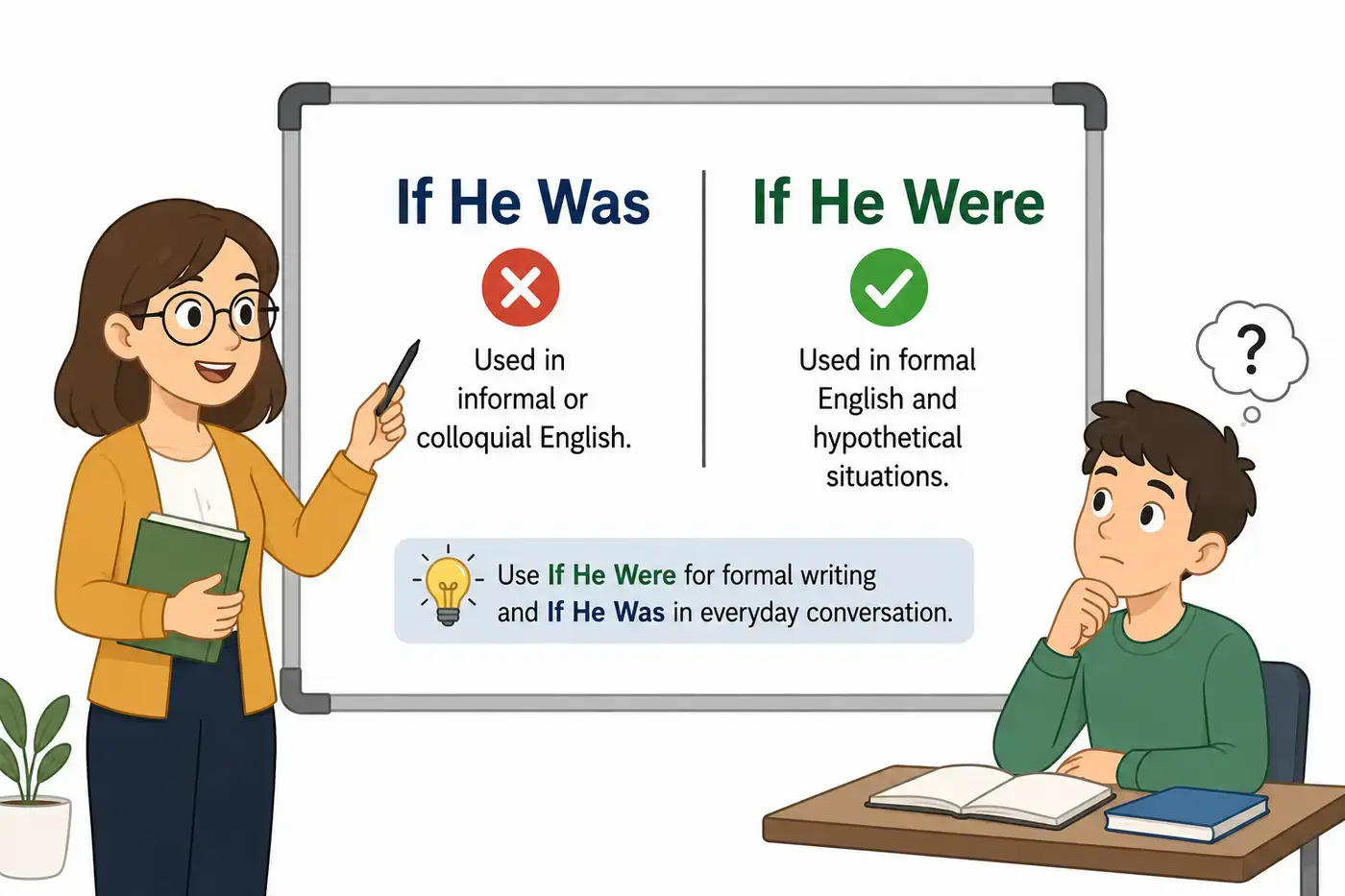
If He Was or If He Were is one of the most common grammar questions in English. Many people see both forms in books movies songs and everyday conversations. That leaves writers wondering which one is correct. The answer is simple once you understand the difference between real situations and imaginary ones.
English uses different verb forms to express facts possibilities and situations that exist only in someone’s imagination. That is why both expressions are correct in different contexts. The trick is knowing when each one fits naturally. This guide explains the grammar in plain English.
You’ll learn the difference between if he was and if he were with easy examples practical writing tips common mistakes and expert editing advice. By the end you’ll know exactly which form to choose in any sentence.
Short Answer
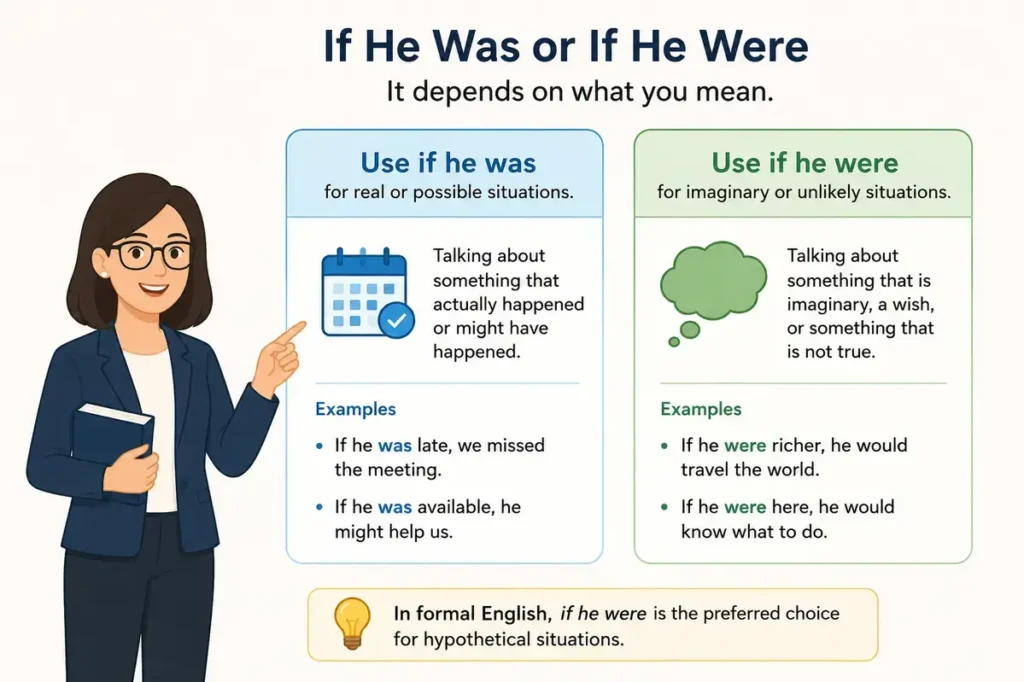
If He Was or If He Were depends on what you mean. Use if he was when talking about something that actually happened or might have happened. Use if he were when talking about an imaginary situation a wish or something that is not true. In formal English if he were is the preferred choice for hypothetical situations.
Table Of Contents
- Short Answer.
- Why People Get Confused.
- If He Was Meaning.
- If He Were Meaning.
- The Main Difference Between If He Was And If He Were.
- Comparison Table.
- Grammar Rule Explained.
- Real World Examples.
- Why Native Speakers Use Both.
- Professional Editing Advice.
Why People Get Confused
English has changed over hundreds of years. Some grammar rules became simpler while others stayed almost the same. The rule behind if he was and if he were belongs to one of the older parts of English grammar. The confusion grows because both forms appear in everyday life. You might hear someone say: If he was here yesterday I missed him.
If that is true about him.
Use if he was when the sentence talks about something that really happened or something that could have happened in the past. The speaker does not assume the event is false. Instead the speaker is uncertain about the facts. Look at these examples. If he was at the meeting he probably heard the announcement. The speaker does not know if he attended the meeting. The attendance remains uncertain. If he was driving too fast the police may have stopped him.
Imagine that he is.
Use if he were when talking about imaginary situations wishes advice or conditions that are not true. This form belongs to the English subjunctive mood. The subjunctive often appears after if when the speaker imagines a different reality.
For example.
If he were taller he could reach the shelf.
He is not taller. The sentence imagines a different reality.
If he were my brother I would help him.
He is not my brother.
If he were here we could start the meeting.
He is not here.
Notice that every example describes something that is contrary to reality.
That is why if he were is the traditional and grammatically preferred choice.
One is used for likely events. The other is used for imagined events.
The easiest way to remember the rule is to ask one simple question. Is the situation real or imagined. If the answer is real uncertain or possible use if he was. If the answer is imaginary impossible or contrary to fact use if he were. This single question solves most grammar problems involving these expressions. Professional editors often rely on this same test because it works in nearly every situation.
Comparison Table
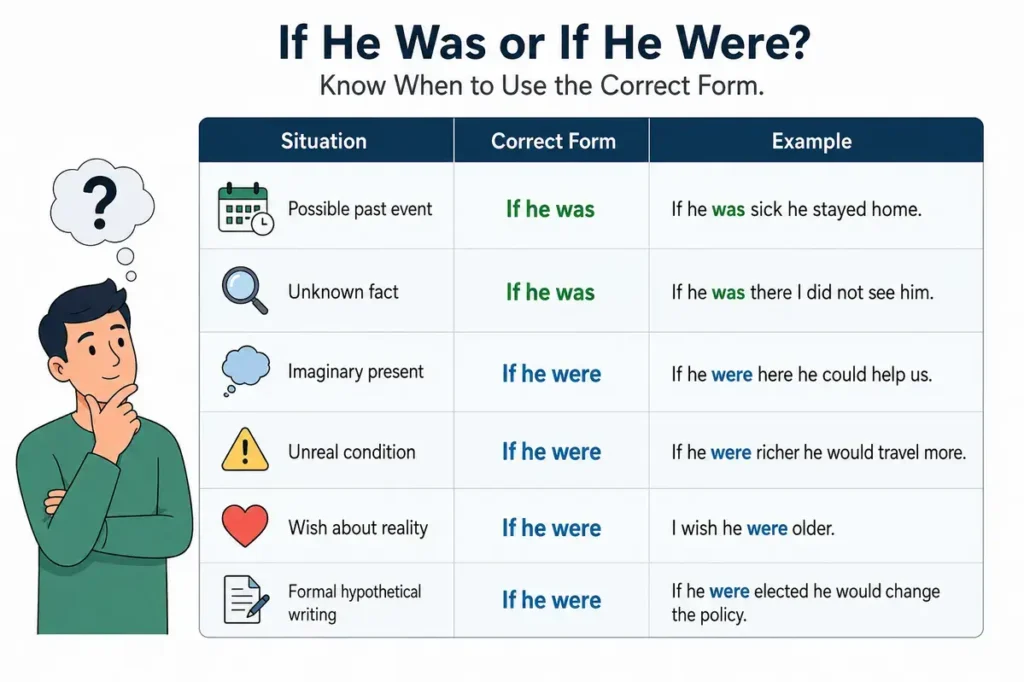
| Situation | Correct Form | Example |
|---|---|---|
| Possible past event | If he was | If he was sick he stayed home. |
| Unknown fact | If he was | If he was there I did not see him. |
| Imaginary present | If he were | If he were here he could help us. |
| Unreal condition | If he were | If he were richer he would travel more. |
| Wish about reality | If he were | I wish he were older. |
| Formal hypothetical writing | If he were | If he were elected he would change the policy. |
The table shows that the choice depends on meaning instead of memorizing isolated grammar rules.
The Grammar Rule Explained
English verbs express more than time. They also express attitude. Sometimes a speaker reports facts. Sometimes the speaker imagines a different reality. These two purposes use different grammatical moods. The first is the indicative mood. The second is the subjunctive mood.
The Indicative Mood
The indicative mood reports facts asks questions and describes real events.
Examples include.
He was late yesterday.
She was happy after the interview.
If he was waiting outside someone probably saw him.
These sentences discuss reality.
The Subjunctive Mood
The subjunctive mood expresses wishes imaginary situations suggestions and conditions that are not true. Examples include. If he were my teacher I would ask more questions. I wish he were here. If he were older he could vote. The subjunctive survives in only a few common English patterns but it remains an important part of formal grammar.
Real World Examples
These pairs show how one small word changes the meaning.
Example One.
If he was in New York he probably visited Central Park.
This sentence suggests the speaker is unsure about his location.
If he were in New York he would visit Central Park.
This sentence imagines a situation that is not true.
Example Two.
If he was responsible someone needs to investigate.
The speaker does not know who caused the problem.
If he were responsible he would admit his mistake.
The speaker assumes he is not responsible and imagines the situation.
Why Native Speakers Use Both
One reason this topic creates so much confusion is that native speakers do not always follow formal grammar in everyday conversation. Many people naturally say. If I was you. Traditional grammar prefers. If I were you. Both expressions appear in movies television interviews and casual conversations.
Professional Editing Advice
Experienced editors rarely correct every instance of if he was. Instead they first ask what the writer means. If the sentence discusses a real possibility they leave if he was unchanged. If the sentence imagines something that is not true they usually replace it with if he were. Good editing always starts with meaning. Grammar exists to make ideas clearer not more complicated. A careful editor pays attention to context before changing a single word.
Does Modern English Still Prefer the Formal Style
No. Modern English is more flexible than many people realize. Traditional grammar recommends if he were for hypothetical situations. At the same time everyday conversation often uses if he was in the same type of sentence. That does not mean the two forms always carry the same weight. In formal writing most editors still prefer if he were because it clearly signals an unreal condition. In casual conversation many native speakers choose the form that sounds most natural to them. That is why you may hear both versions from educated speakers.
Formal Writing Vs Everyday Conversation
The best choice depends on your audience.
| Situation | Preferred Form | Reason |
|---|---|---|
| Academic writing | If he were | Matches traditional grammar. |
| Business writing | If he were | Sounds polished and professional. |
| Books and edited publications | If he were | Most editors prefer it for unreal conditions. |
| Everyday conversation | Both are common | Native speakers often use either form. |
| Casual emails and text messages | Both are common | Natural speech usually matters more than strict grammar. |
Professional writers adjust their grammar to match the situation. That is one reason strong writing feels natural instead of forced.
American English Vs British English
American English and British English follow the same basic grammar rule. Both varieties generally use if he were for hypothetical situations.
For example.
If he were the manager he would change the schedule.
This sentence sounds natural in both countries.
In everyday speech speakers in the United States and the United Kingdom often use if he was instead.
That shift reflects normal language change instead of a separate grammar rule.
Professional editors on both sides of the Atlantic still favor if he were in formal writing.
Why The Subjunctive Still Matters
Some people think the subjunctive disappeared from English. It did not. English simply uses it less often than it did centuries ago. You still see it in common expressions. If I were you. I wish it were true. If he were available I would invite him. If she were here everything would be easier. These expressions remain standard because they describe situations that do not match reality. Learning the subjunctive also makes other grammar patterns easier to understand.
Can You Use Both Forms Interchangeably
No. Sometimes changing the verb changes the meaning. Compare these sentences. If he was at the office he saw the message. This means the speaker is unsure if he was at the office.
Examples In Everyday Situations
At Work
If he was in the meeting he knows the new policy. The speaker does not know if he attended. If he were in the meeting he would ask better questions. The speaker imagines a different situation.
At School
If he was absent yesterday he missed the quiz. The absence is uncertain. If he were the teacher he would explain the lesson again. The speaker imagines him as the teacher.
At Home
If he was sleeping I did not want to wake him. The speaker is unsure. If he were awake he would answer the door. The speaker knows he is not awake. These examples show that context always determines the correct choice.
Common Mistakes
Many writers make the same mistakes again and again.
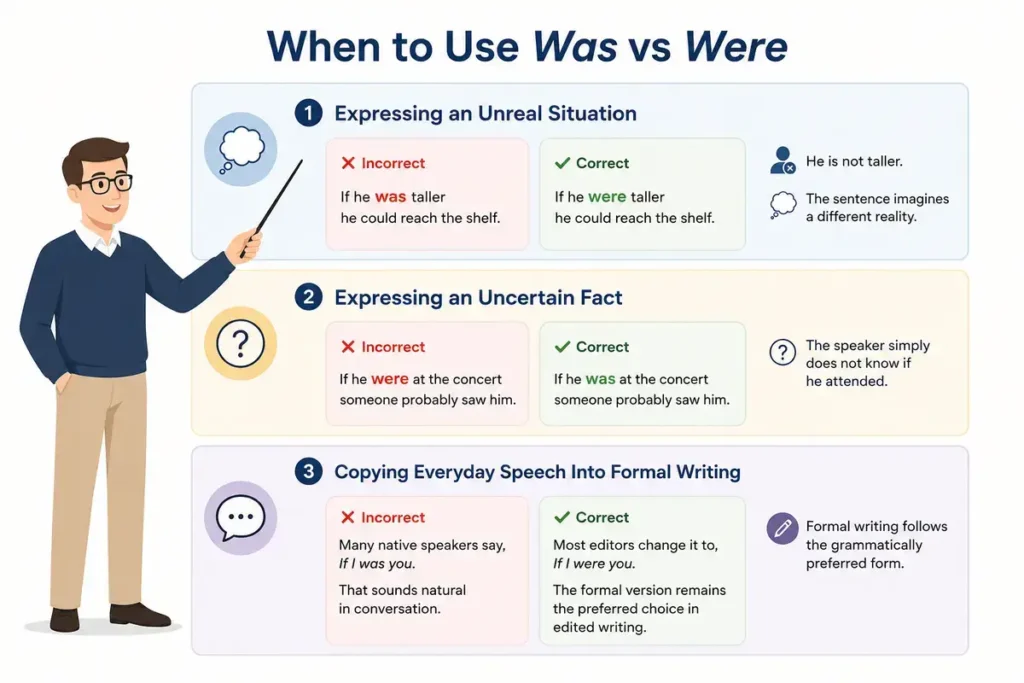
Expressing an Unreal Situation
Incorrect.
If he was taller he could reach the shelf.
Correct.
If he were taller he could reach the shelf.
He is not taller.
The sentence imagines a different reality.
Expressing an Uncertain Fact
Incorrect.
If he were at the concert someone probably saw him.
Correct.
If he was at the concert someone probably saw him.
Copying Everyday Speech Into Formal Writing
Many native speakers say. If I was you. That sounds natural in conversation. Most editors change it to. If I were you. The formal version remains the preferred choice in edited writing.
Easy Memory Trick
Ask yourself one question. Is this sentence talking about reality or imagination. If it talks about reality uncertainty or something that may have happened use if he was. If it imagines something different from reality use if he were. This simple test works in almost every sentence.
Related Grammar Patterns
The same rule appears with other subjects. If I were. If she were. If it were. If they were. The grammar stays the same because the sentence expresses an unreal condition.
Professional Writing Tips
Professional editors follow meaning instead of habit. Before changing a sentence they ask what the writer wants to express. If the sentence presents an uncertain fact they keep if he was. If the sentence imagines something that is not true they choose if he were. This approach creates writing that sounds clear precise and natural.
People Also Ask
Is If He Was Grammatically Correct?
Yes.
It is grammatically correct when the sentence discusses a real event an uncertain fact or something that might have happened.
Is If He Were More Formal?
Yes.
It is the traditional choice for hypothetical situations and remains the preferred form in formal writing.
Why Do Native Speakers Say If He Was?
Everyday speech often simplifies older grammar patterns.
Many native speakers naturally use if he was even in hypothetical situations.
Formal writing usually follows the traditional rule instead.
Which Form Should Students Use?
Students should generally use if he were for imaginary situations because teachers and style guides usually expect the traditional grammar rule.
Which Form Should Business Writers Use?
Business documents reports proposals and professional emails usually sound stronger with if he were when discussing hypothetical situations.
Using the traditional form helps maintain a polished style.
Historical Development
English has changed dramatically over the centuries. Many grammar patterns became simpler, but the subjunctive mood never disappeared completely. Older English used the subjunctive much more often than modern English. Writers used special verb forms to express wishes, commands, suggestions, and imaginary situations. Today, only a small part of that system remains in everyday English.
What Professional Editors Look For
Experienced editors do not change if he was every time they see it. They first identify the meaning. If the sentence discusses a real event or an uncertain fact, they leave if he was alone. If the sentence presents an unreal or imaginary condition, they normally change it to if he were in formal writing. Good editing is about accuracy, not strict rule following. Context always comes first.
Similar Grammar Patterns
The same idea appears in many common English expressions.
| Expression | Purpose |
|---|---|
| If I were you | Giving advice. |
| If she were here | Imaginary present situation. |
| If they were ready | Imaginary condition. |
| I wish he were older | Expressing a wish. |
| As if he were the boss | Comparing with an unreal situation. |
Once you recognize these patterns, choosing the correct verb becomes much easier.
Related Expressions
Several common English expressions follow the same grammar rule. If I were in your shoes. If she were available. If it were possible. If they were honest. As if he were famous. As though she were surprised. Each expression describes something imagined instead of something known to be true.
Memory Tips
Remembering the rule does not have to be difficult.
Think About Reality
Ask yourself one question. Is this happening in real life. If the answer is yes or maybe, use if he was. If the answer is no, use if he were.
Look For Would
Many hypothetical sentences include the word would. For example. If he were here, he would help us. That pattern often signals an unreal condition. It is not a perfect test, but it works in many situations.
Remember The Famous Expression
Almost everyone has heard this advice. If I were you. That expression follows the traditional subjunctive rule. Using it as a memory anchor makes similar sentences easier to recognize.
Quick Practice
Choose the correct form.
Example One
If he _____ at the office yesterday, someone probably saw him.
Answer.
Was.
The speaker is unsure about a past fact.
Example Two
If he _____ taller, he could play professional basketball.
Answer.
Were.
The sentence imagines a different reality.
Example Three
If he _____ responsible for the mistake, he would apologize.
Answer.
Were.
The speaker assumes he is not responsible.
Example Four
If he _____ sick last week, that explains his absence.
Answer.
Was.
The illness is a possible explanation.
These simple exercises reinforce the difference between uncertainty and imagination.
Key Takeaways
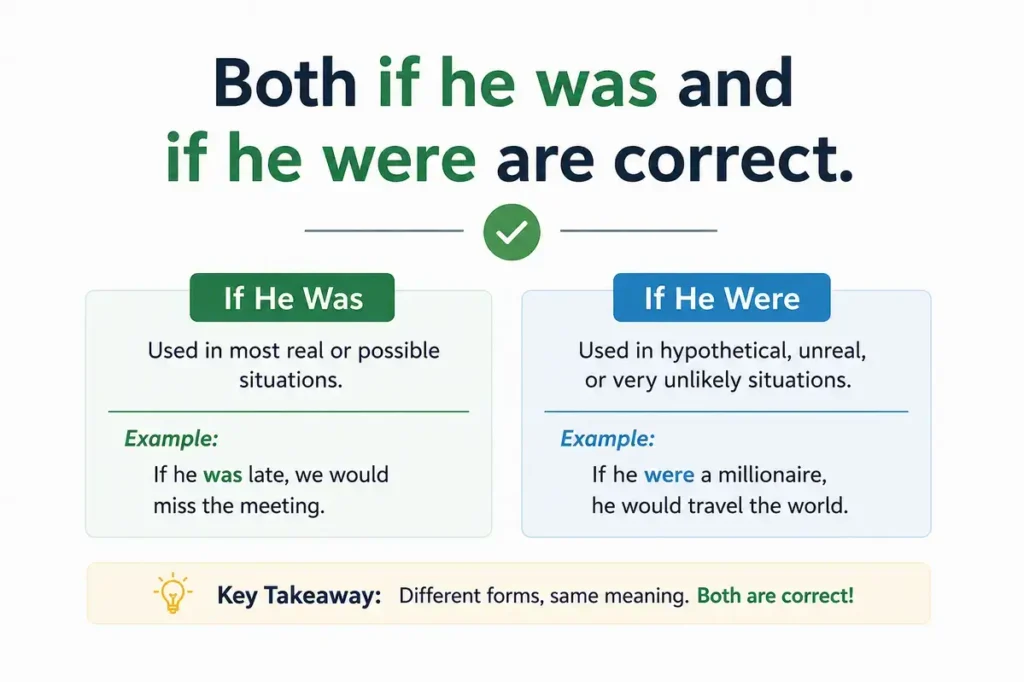
- Both if he was and if he were are correct.
- Use if he was for real situations, uncertain facts, or possible past events.
- Use if he were for imaginary situations, wishes, and conditions that are not true.
- Formal writing usually prefers if he were for hypothetical statements.
- Everyday conversation often uses both forms.
- Always choose the form that matches the meaning of the sentence.
Conclusion
If He Was or If He Were is not a choice between right and wrong. It is a choice between two different meanings. Use if he was when talking about something that happened, might have happened, or remains uncertain.
Use if he were when imagining a situation that is not true, expressing a wish, giving advice, or describing a hypothetical condition.
Understanding that single distinction removes almost all confusion. Instead of memorizing grammar rules, focus on the idea behind the sentence. Once you identify if the situation is real or imagined, the correct verb usually becomes obvious. That simple approach helps you write with more confidence, communicate more clearly, and make choices that fit both everyday conversation and professional writing.
Frequently Asked Questions
Is If He Was Ever Wrong?
Yes. It sounds incorrect in formal writing when the sentence clearly describes an unreal or imaginary condition.
Can I Say If He Was Instead Of If He Were?
In casual conversation many native speakers do. In formal writing, if he were remains the preferred choice for hypothetical situations.
Why Do Grammar Books Prefer If He Were?
Traditional grammar uses the subjunctive mood to show that the condition is not true. Using if he were makes that meaning clear.
Is If He Were Old Fashioned?
No. It is still widely accepted in formal English and appears regularly in books, newspapers, academic writing, and professional communication.
Do Teachers Expect If He Were?
Most teachers do when the sentence describes an imaginary condition. Following that rule is usually the safest choice in school assignments.
Does This Rule Apply To Every Subject?
Yes. The same principle applies to I, she, it, they, and other subjects when expressing unreal situations.
Is If He Was Incorrect In Conversation?
No. Many native speakers use it naturally in everyday speech. Context and audience matter.
Which Form Should I Use In Professional Writing?
Choose if he were for hypothetical situations. Choose if he was when discussing uncertain facts or possible events.
Does American English Ignore This Rule?
No. American English follows the same traditional grammar rule, although casual speech often uses if he was more freely.
How Can I Remember The Difference?
Think about reality. Real or uncertain situation equals if he was. Imaginary situation equals if he were.

English Grammar & Usage
Nathan Holloway is an American grammar writer and language researcher who specializes in English grammar, sentence structure, verb usage, and common writing mistakes. He enjoys breaking down confusing grammar rules into practical explanations with clear examples, making English easier for students, professionals, and everyday writers.