
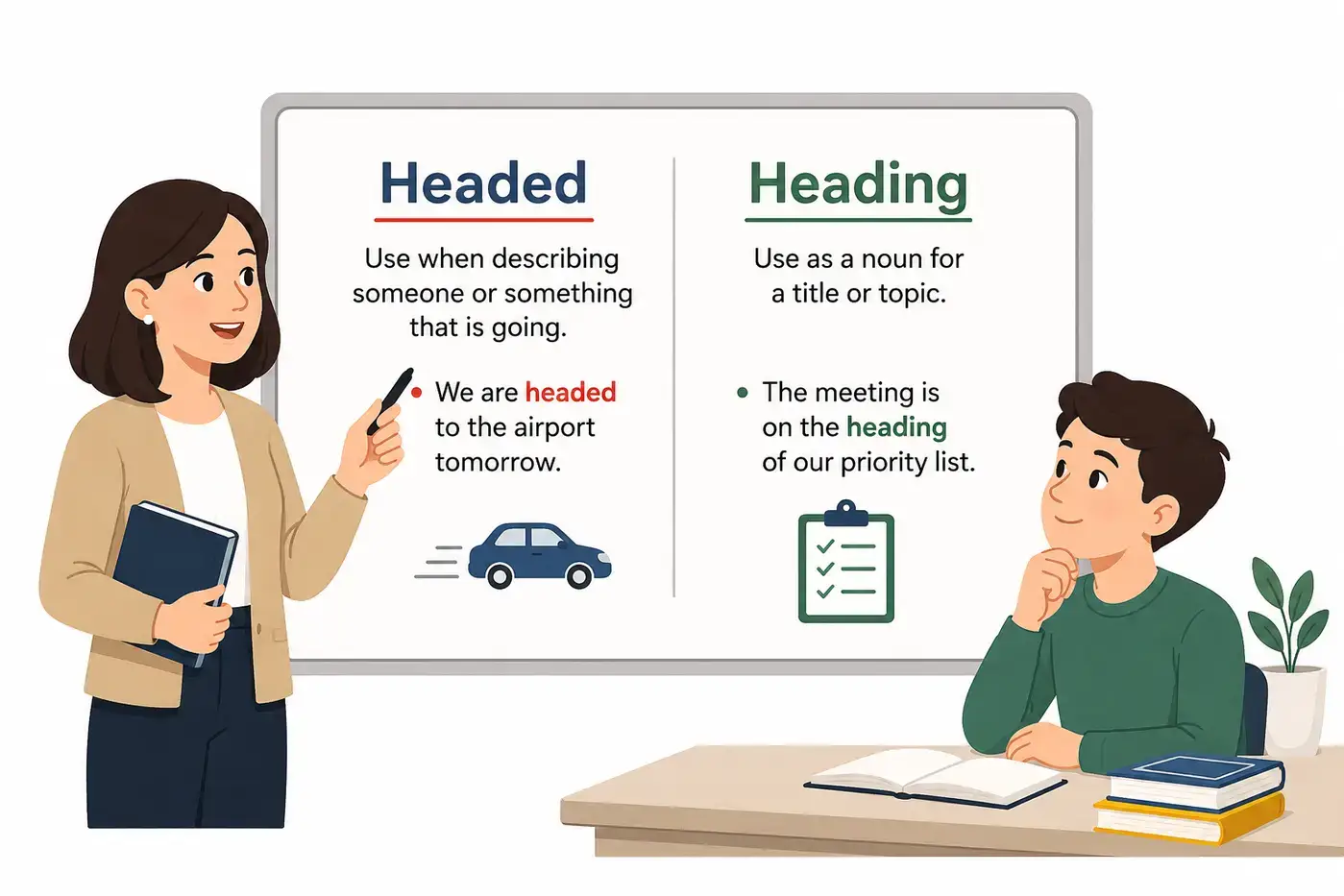
Headed vs Heading is a common grammar question because both words share the same root but perform different jobs in a sentence. They often appear in conversations, emails, travel plans, business writing, and news articles. Since they look similar, many English learners and even native speakers occasionally hesitate before choosing one.
The good news is that the difference is straightforward once you understand verb forms. One word describes an action that has already happened or can describe direction as an adjective. The other describes an action happening now or functions as a noun that means a title or section name.
This guide explains every important detail about Headed vs Heading, including meanings, pronunciation, grammar rules, sentence structure, common mistakes, real life examples, memory tricks, and professional writing tips. By the end, you’ll know exactly which word fits every situation.
Short Answer
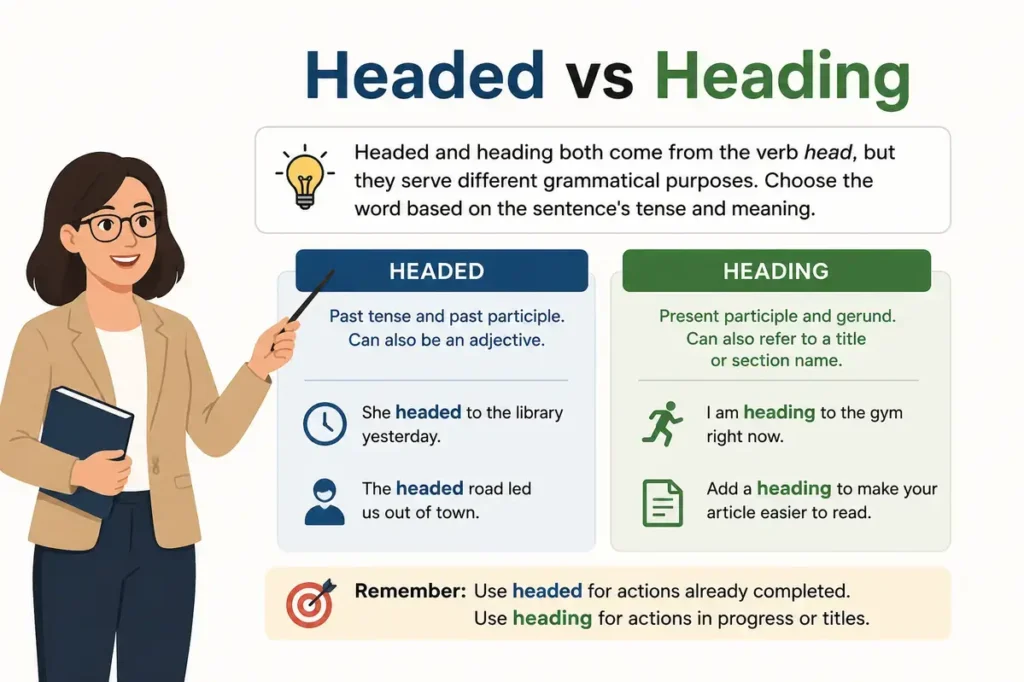
Headed and heading both come from the verb head, but they serve different grammatical purposes. Headed is the past tense and past participle, and it can also function as an adjective. Heading is the present participle and gerund, describing an action in progress or referring to a title or section name. Choose the word based on the sentence’s tense and meaning.
Table of Contents
- What Is the Difference Between Headed and Heading
- Comparison Table
- Meaning of Headed
- Meaning of Heading
- Pronunciation Guide
- Grammar Rules
- Parts of Speech
- Word Origin
- When to Use Headed
- When to Use Heading
- Headed as an Adjective
- Heading as a Noun
- Common Sentence Patterns
- Real Life Examples
- Common Mistakes
- Memory Tips
- Related Grammar Notes
- Frequently Asked Questions
- Key Takeaways
- Conclusion
What Is the Difference Between Headed and Heading
The difference between Headed vs Heading depends on grammar and sentence meaning.
Headed usually describes a completed action or someone’s direction after the helping verb.
Heading describes an action that is happening now or serves as a noun meaning the title of a document, article, or section.
Compare these examples.
We headed home after dinner.
The action happened in the past.
We are heading home now.
The action is happening at this moment.
Add a heading above each paragraph.
Here, heading is a noun rather than a verb.
Comparison Table
| Feature | Headed | Heading |
|---|---|---|
| Verb form | Past tense and past participle | Present participle and gerund |
| Typical meaning | Went toward or directed | Going toward or moving toward |
| Can function as adjective | Yes | Rarely |
| Can function as noun | No | Yes |
| Common tenses | Simple past and perfect tenses | Continuous tenses |
| Example | She headed north. | She is heading north. |
| Document meaning | No | Yes, a title or section name |
| Interchangeable | No | No |
Meaning of Headed
Headed is the past tense and past participle of the verb head. It usually means went toward, moved toward, led, or was directed toward. It can also describe someone’s destination or future direction.
Definition
To move or direct someone or something toward a place, goal, or destination.
Examples
They headed home before sunset.
Explanation: The journey already happened.
She headed straight to the library after class.
Explanation: The movement took place in the past.
The company headed in a new direction last year.
Explanation: The organization changed direction previously.
Headed as an Adjective
One interesting feature of headed is that it often works as an adjective.
Examples include:
Level headed manager
The adjective describes someone calm and sensible.
Blue headed bird
The adjective describes appearance.
Strong headed leader
The adjective describes personality.
Other common adjective combinations include:
- Clear headed.
- Cool headed.
- Warm headed.
- Hard headed.
- Big headed.
- Wrong headed.
In these examples, headed no longer acts like a verb. Instead, it describes a quality.
Meaning of Heading
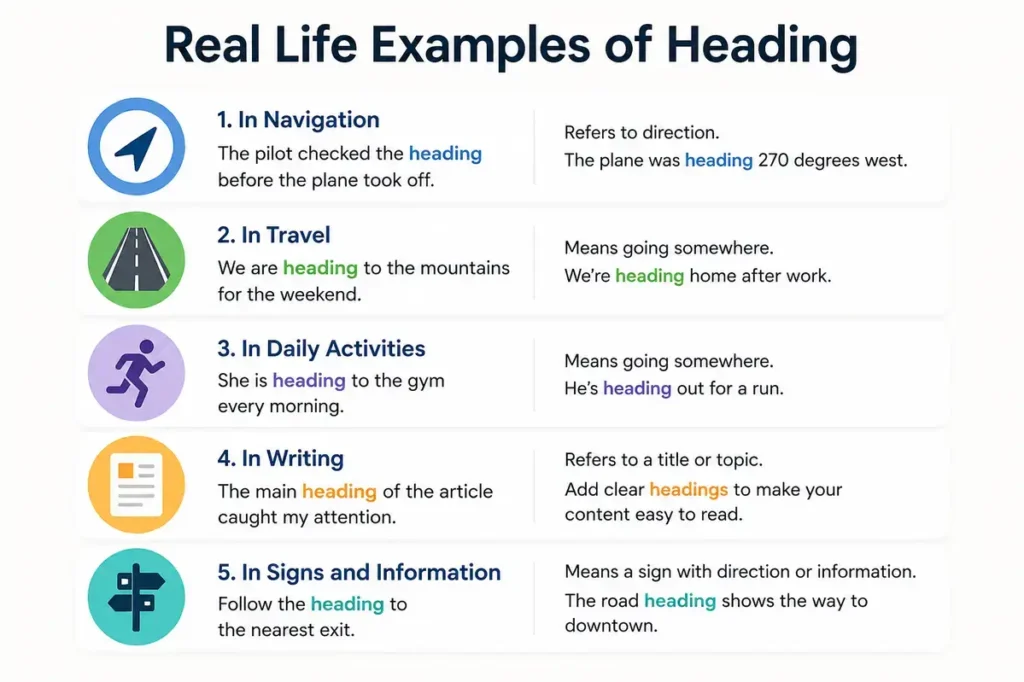
Heading has two major uses. First, it is the present participle of head, describing movement happening now. Second, it is a noun that refers to a title, label, or section name.
Definition as a Verb
Moving toward a place or destination.
Definition as a Noun
A title placed above text, a chapter, or a section.
Examples
We are heading downtown now.
Explanation: The movement is happening at the present time.
The plane is heading east.
Explanation: The direction is current.
Use a clear heading for every section.
Explanation: Here, heading means a title.
Pronunciation Guide
Although the meanings differ, both words share nearly the same pronunciation except for the ending.
| Word | IPA | Simple Pronunciation |
|---|---|---|
| Headed | /ˈhedɪd/ | HED id |
| Heading | /ˈhedɪŋ/ | HED ing |
The first syllable sounds exactly the same. Only the endings change.
Grammar Rules
Understanding verb forms makes choosing the correct word much easier.
Headed
Verb form:
Past tense.
Past participle.
Example:
They headed home early.
Past tense.
They have headed home.
Past participle used with have.
Heading
Verb form:
Present participle.
Gerund.
Example:
They are heading home.
Present continuous tense.
Heading south during winter is common for many birds.
Gerund functioning as a noun.
Parts of Speech
| Word | Part of Speech | Example |
|---|---|---|
| Headed | Verb | We headed west. |
| Headed | Adjective | She is level headed. |
| Heading | Verb | They are heading downtown. |
| Heading | Noun | Read the heading carefully. |
Understanding these grammatical roles helps prevent confusion.
Word Origin
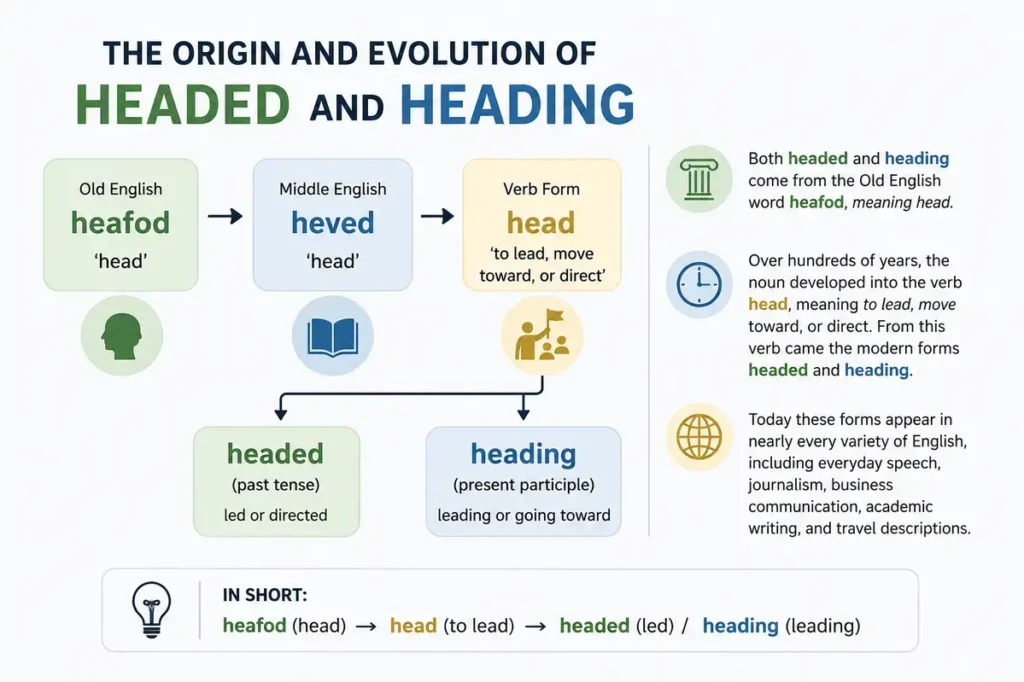
Both headed and heading come from the Old English word heafod, meaning head. Over hundreds of years, the noun developed into the verb head, meaning to lead, move toward, or direct. From this verb came the modern forms headed and heading. Today these forms appear in nearly every variety of English, including everyday speech, journalism, business communication, academic writing, and travel descriptions.
When to Use Headed
Choose headed when talking about a completed movement, a past direction, or something already decided.
Common Situations
- Past travel.
- Previous decisions.
- Historical events.
- Completed journeys.
- Finished actions.
Examples
The family headed to the beach after breakfast.
Explanation: The trip already began in the past.
She headed directly for the exit.
Explanation: The movement has already occurred.
The hikers headed uphill before sunrise.
Explanation: The action happened earlier.
When to Use Heading
Choose heading when the action is happening now or when referring to a title.
Common Situations
- Current travel.
- Live updates.
- Continuous actions.
- Reports.
- Books.
- Websites.
- School assignments.
- Business documents.
Examples
The train is heading north.
Explanation: The train is currently moving.
We are heading to the airport.
Explanation: The action is taking place now.
Every report needs a descriptive heading.
Explanation: Here, the word refers to a section title rather than movement.
Can Headed and Heading Replace Each Other
No.
Although both words come from the same base verb, they perform different grammatical functions.
Correct:
We headed home after the meeting.
Incorrect:
We heading home after the meeting.
The sentence needs the past tense verb headed.
Correct:
We are heading home now.
Incorrect:
We are headed home now.
While We are headed home is also grammatically correct, it has a slightly different meaning. It describes the state or destination rather than emphasizing the ongoing movement. In contrast, We are heading home highlights the action of traveling. This subtle distinction is one reason many learners ask about Headed vs Heading. Understanding the context makes choosing the correct form much easier.
Common Sentence Patterns
Recognizing common sentence patterns makes it much easier to choose between Headed vs Heading.
Pattern 1
Subject + headed + place
Examples:
- We headed home before sunset.
- She headed upstairs to finish her work.
- The visitors headed toward the museum.
Explanation: These sentences describe actions that happened in the past.
Pattern 2
Subject + is or are + heading + place
Examples:
- We are heading home now.
- The bus is heading downtown.
- They are heading to the airport.
Explanation: These sentences describe actions happening at the present time.
Pattern 3
Heading + verb
Examples:
- Heading south during winter helps many birds survive.
- Heading into the meeting with confidence makes a difference.
Explanation: In these examples, heading functions as a gerund.
Pattern 4
Heading + of a document
Examples:
- Read the heading before answering the questions.
- The report has a clear heading.
- Every chapter begins with a descriptive heading.
Explanation: Here, heading is a noun meaning a title or section name.
Real Life Examples of Headed
The following examples show how headed is naturally used in everyday English.
Example 1
The children headed outside after finishing their homework.
Explanation: The action happened after another completed event.
Example 2
She headed directly to her office.
Explanation: The movement occurred in the past.
Example 3
The rescue team headed into the mountains before dawn.
Explanation: The sentence describes a completed journey.
Example 4
We headed home because it started raining.
Explanation: The trip home began after the rain.
Example 5
The company headed in a different direction after hiring a new CEO.
Explanation: The phrase describes a change in strategy.
Example 6
He headed the committee for five years.
Explanation: Here, headed means led rather than traveled.
Example 7
Our grandparents headed west many years ago.
Explanation: The sentence refers to a past relocation.
Example 8
The dog headed toward the open gate.
Explanation: The movement took place in the past.
Real Life Examples of Heading
These examples show the most common uses of heading.
Example 1
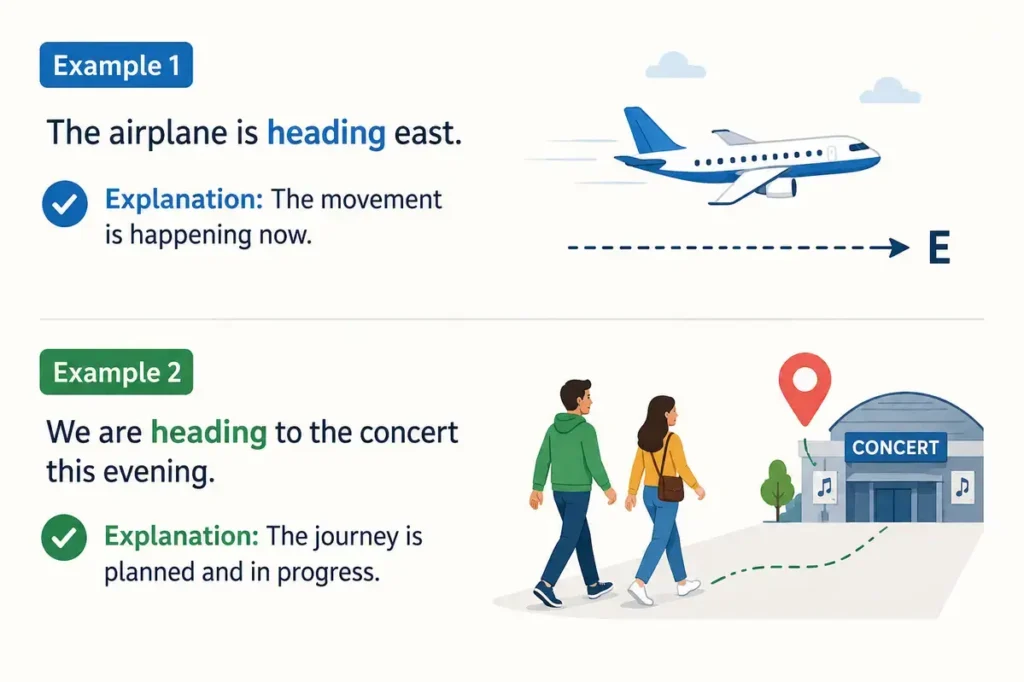
The airplane is heading east.
Explanation: The movement is happening now.
Example 2
We are heading to the concert this evening.
Explanation: The journey is planned and in progress.
Example 3
The students are heading back to class.
Explanation: The action is currently taking place.
Example 4
The storm is heading toward the coast.
Explanation: Weather reports frequently use this structure.
Example 5
Add a heading above every section of your report.
Explanation: Here, heading refers to a title.
Example 6
The article needs a stronger heading to attract readers.
Explanation: The noun describes a headline or title.
Example 7
The hikers are heading uphill.
Explanation: They are currently moving upward.
Example 8
Heading into the interview with confidence can improve your performance.
Explanation: The gerund introduces the action.
Headed Versus Heading in Different Tenses
Understanding verb tense removes most confusion.
| Tense | Correct Form | Example |
|---|---|---|
| Simple present | Head | We head home early every Friday. |
| Present continuous | Heading | We are heading home now. |
| Simple past | Headed | We headed home yesterday. |
| Present perfect | Headed | We have headed home already. |
| Past continuous | Heading | We were heading home when it started raining. |
| Future | Head | We will head home tomorrow. |
Notice that headed appears in past and perfect tenses, while heading appears in continuous tenses.
Headed as an Adjective
One area that often surprises learners is the adjective use of headed.
Examples include:
- Level headed.
- Cool headed.
- Clear headed.
- Hard headed.
- Strong headed.
- Big headed.
- Wrong headed.
These expressions describe personality or characteristics rather than movement.
Examples
She remained level headed during the emergency.
Explanation: She stayed calm and sensible.
He is known for being hard headed.
Explanation: The phrase describes someone stubborn.
The doctor stayed clear headed despite the pressure.
Explanation: It describes mental clarity.
Heading as a Noun
Many people think heading only functions as a verb, but it is also a common noun.
As a noun, it means a title or label above text.
Examples include:
- Newspaper heading.
- Chapter heading.
- Email heading.
- Report heading.
- Section heading.
- Table heading.
- Website heading.
- Form heading.
Examples
The heading summarizes the topic.
Explanation: The title tells readers what the section is about.
Use bold text for every heading.
Explanation: The instruction refers to formatting.
Common Mistakes
Many learners make similar mistakes when comparing Headed vs Heading.
Mistake 1
We headed to school now.
Incorrect.
Correct:
We are heading to school now.
Explanation: The word now requires a present action.
Mistake 2
We are heading home yesterday.
Incorrect.
Correct:
We headed home yesterday.
Explanation: Yesterday signals the simple past tense.
Mistake 3
Using heading instead of a noun title.
Incorrect:
Please read the title.
Correct but more specific:
Please read the heading.
Explanation: In documents, heading is the proper term.
Mistake 4
Confusing headed with heading after helping verbs.
Incorrect:
They have heading home.
Correct:
They have headed home.
Explanation: Perfect tenses require the past participle.
Mistake 5
Thinking headed only means movement.
It can also mean led.
Example:
She headed the research team for three years.
Here, headed means managed or directed.
Memory Tips
Simple memory tricks make Headed vs Heading easy to remember.
Memory Trick 1
Think about time.
Headed equals the past.
Heading equals the present action.
Memory Trick 2
Look at the ending.
Ed often signals a completed action.
Ing usually signals an ongoing action.
Memory Trick 3
Ask yourself a question.
Did it already happen?
Choose headed.
Is it happening now?
Choose heading.
Memory Trick 4
If the word appears above a paragraph or chapter, it is almost certainly heading as a noun.
Related Grammar and Usage Notes
Several related grammar points help reinforce the difference.
Head Toward Versus Headed Toward
Head toward is present tense.
Example:
We head toward the lake every weekend.
Headed toward is past tense.
Example:
We headed toward the lake yesterday.
Heading Toward
Example:
The storm is heading toward the coast.
This describes movement in progress.
Headed For
Example:
She headed for the exit.
The destination is expressed after for.
Heading For
Example:
She is heading for the exit.
The action is happening now.
Professional Writing Tips
Choosing the right form improves clarity and professionalism.
Use headed when:
- Describing completed actions.
- Writing about past travel.
- Explaining previous decisions.
- Referring to leadership in the past.
Use heading when:
- Describing actions in progress.
- Writing live updates.
- Talking about current travel.
- Referring to titles in documents.
- Organizing articles or reports.
Professional writers also keep tense consistent. Switching between headed and heading without a reason can confuse readers. Before choosing one, identify the time frame of the sentence. If the action is complete, use headed. If it is ongoing or you are referring to a section title, use heading.
Key Takeaways
- Headed is the past tense and past participle of head.
- Heading is the present participle and gerund of head.
- Heading is also a noun meaning a title or section name.
- Use headed for completed actions.
- Use heading for actions happening now.
- Headed can function as an adjective in expressions such as level headed and clear headed.
- Perfect tenses require headed.
- Continuous tenses require heading.
- Both words are standard in American and British English.
- Always identify the sentence’s tense and meaning before choosing the correct form.
Conclusion
Understanding Headed vs Heading becomes simple once you recognize the different grammatical roles each word plays. Headed refers to a completed action, serves as the past participle in perfect tenses, and can also function as an adjective in expressions like level headed or hard headed. Heading, on the other hand, describes an action in progress, works as a gerund, and commonly refers to the title of a document or section.
The easiest way to choose the correct word is to look at the time frame of the sentence. If the action already happened, headed is usually the right choice. If the action is happening now or you are referring to a title above text, heading is the correct option. Keeping this simple distinction in mind will help you write with greater accuracy, avoid common grammar mistakes, and use both forms confidently in everyday conversations, professional communication, and academic writing.
Frequently Asked Questions
Is headed or heading correct?
Both are correct, but they are used in different situations. Headed is the past tense and past participle of head, while heading is the present participle, gerund, or a noun meaning a title or section name.
What is the difference between headed and heading?
The main difference is grammatical tense and function.
Headed describes a completed action or can act as an adjective.
Heading describes an action in progress or refers to the title of a document, chapter, or section.
Can headed and heading be used interchangeably?
No. They have different grammatical functions.
Correct:
We headed home after dinner.
Correct:
We are heading home now.
Each sentence expresses a different time frame.
Is heading a noun?
Yes.
Besides being the present participle of head, heading is also a noun that means the title of a document, section, chapter, table, or form.
Example:
The report needs a clearer heading.
Is headed an adjective?
Yes.
Headed often functions as an adjective in compound expressions.
Examples include:
- Level headed.
- Cool headed.
- Clear headed.
- Hard headed.
- Strong headed.
- Big headed.
In these expressions, headed describes a person’s character or appearance rather than movement.
Can I say We are headed home?
Yes.
We are headed home is grammatically correct. It emphasizes your destination or current state. We are heading home emphasizes the ongoing action of traveling. Both are natural English, although the focus is slightly different.
Which form is used after have?
Use headed because perfect tenses require the past participle.
Correct:
They have headed home.
Incorrect:
They have heading home.
Which form is used after is, am, or are?
Use heading to form the present continuous tense.
Examples:
She is heading north.
They are heading to the airport.
Is there a difference between American and British English?
No significant difference exists. Both American English and British English use headed and heading in the same grammatical ways. The meanings and spellings remain the same.
What are some synonyms for headed?
Depending on the context, similar words include:
- Went.
- Moved.
- Traveled.
- Directed.
- Led.
- Proceeded.
- Advanced.
Choose the synonym that best matches the sentence.
What are some synonyms for heading?
When referring to movement, similar words include:
- Moving.
- Traveling.
- Going.
- Proceeding.
- Advancing.
When referring to a document title, similar words include:
- Title.
- Headline.
- Caption.
- Label.
- Section title.

English Grammar & Usage
Nathan Holloway is an American grammar writer and language researcher who specializes in English grammar, sentence structure, verb usage, and common writing mistakes. He enjoys breaking down confusing grammar rules into practical explanations with clear examples, making English easier for students, professionals, and everyday writers.