
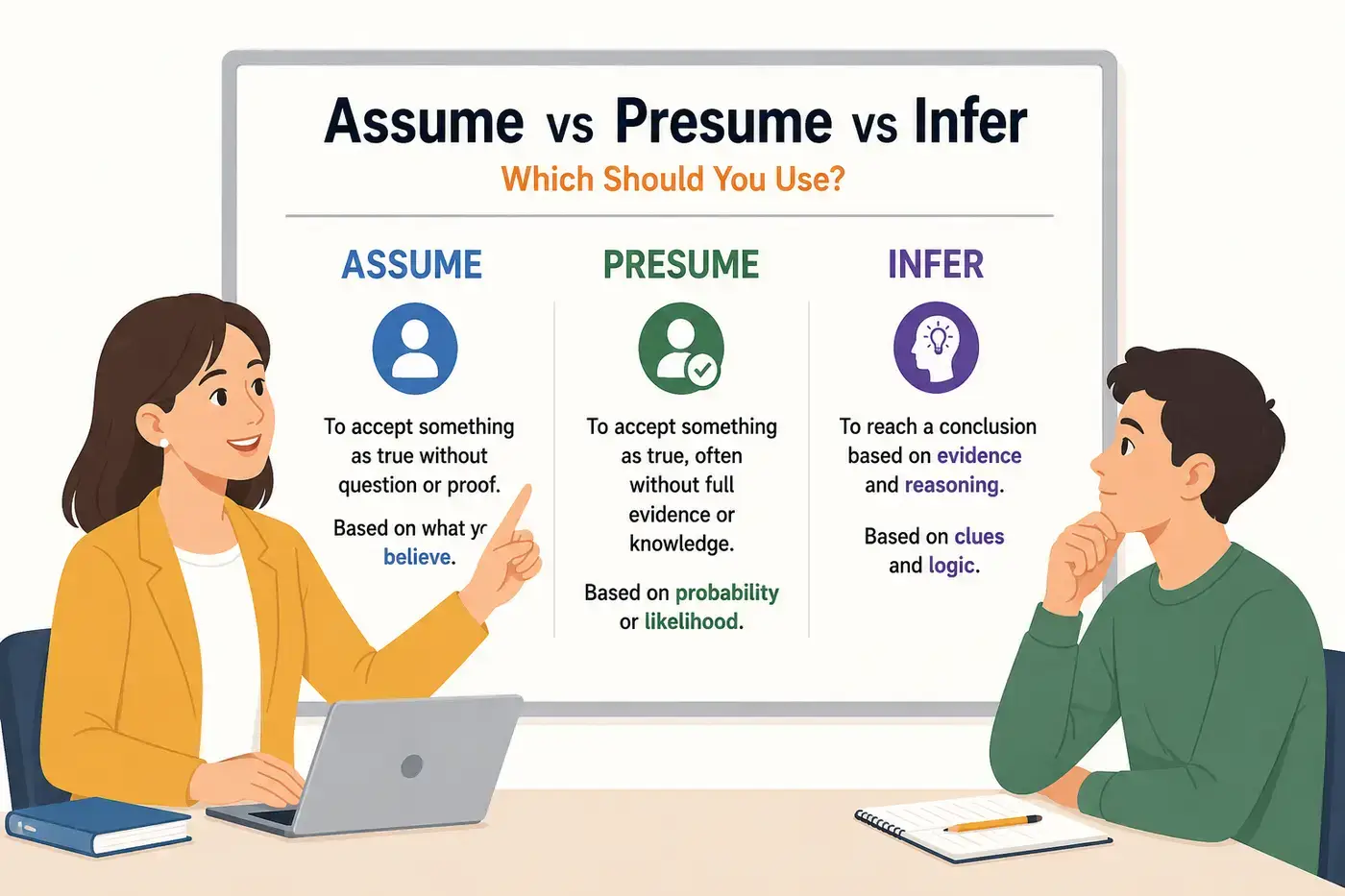
Assume vs Presume vs Infer is one of the most common word comparison topics in English because these verbs all deal with conclusions, beliefs, and reasoning. Although they seem similar, each word describes a different thought process and fits different situations.
Choosing the wrong word can make your writing unclear or even change your intended meaning. For example, assuming something without evidence is very different from inferring something after examining facts. Likewise, presuming often suggests that some evidence or accepted expectation already exists.
This guide explains the meaning, pronunciation, grammar, origins, differences, and correct usage of each word. You will also learn practical examples, common mistakes, professional writing advice, and memory techniques that will help you choose the right word confidently.
Short Answer
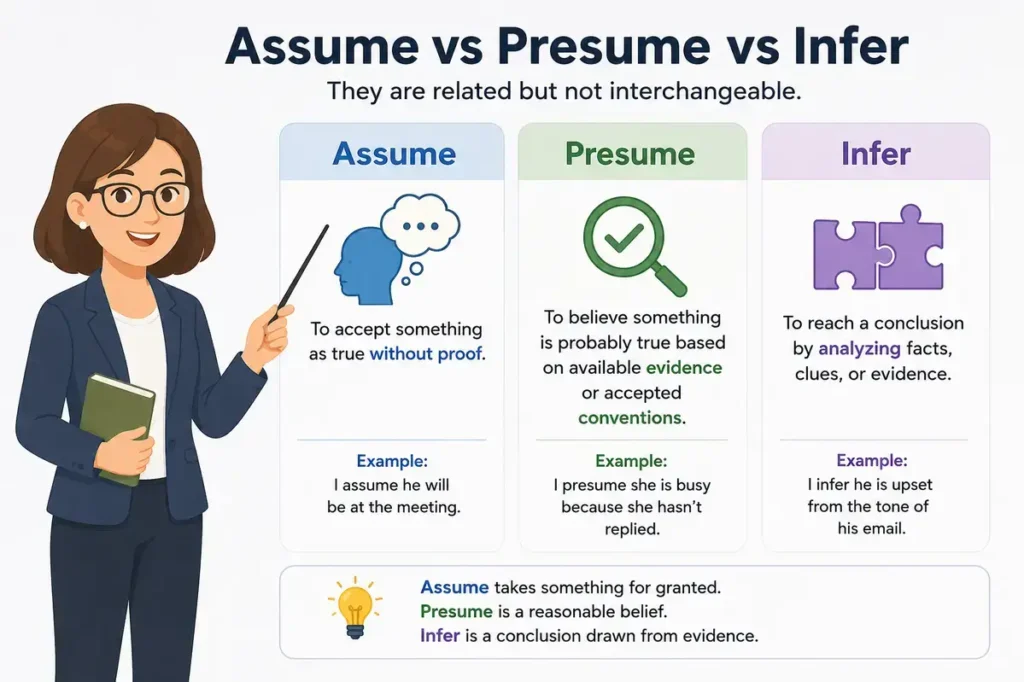
Assume vs Presume vs Infer Explained can be confusing because all three words involve forming ideas without complete certainty. Assume means to accept something as true without proof. Presume means to believe something is probably true based on available evidence or accepted conventions. Infer means to reach a conclusion by analyzing facts, clues, or evidence. They are related but not interchangeable
Table of Contents
- What Is the Difference Between Assume Presume and Infer
- Comparison Table
- What Does Assume Mean
- What Does Presume Mean
- What Does Infer Mean
- Pronunciation Guide
- Parts of Speech
- Word Origins
- When to Use Assume
- When to Use Presume
- When to Use Infer
- Can They Replace Each Other
- Real Life Examples
- Common Mistakes
- Memory Tips
- Related Grammar Notes
- Frequently Asked Questions
- Key Takeaways
- Conclusion
What Is the Difference Between Assume Presume and Infer
The simplest way to understand these three words is to focus on how the conclusion is reached.
Assume means you accept something as true without having enough proof.
Presume means you believe something is probably true because circumstances, experience, or accepted rules support that belief.
Infer means you reach a conclusion after examining evidence or logical clues.
In other words:
- Assume begins with little or no evidence.
- Presume begins with some supporting evidence or a reasonable expectation.
- Infer begins with facts, observations, or evidence that lead to a conclusion.
This distinction is especially important in academic writing, journalism, legal writing, and professional communication.
Comparison Table
| Feature | Assume | Presume | Infer |
|---|---|---|---|
| Basic meaning | Accept as true without proof | Believe based on probability or accepted expectation | Reach a conclusion from evidence |
| Evidence required | Little or none | Some evidence or reasonable expectation | Evidence or logical clues |
| Part of speech | Verb | Verb | Verb |
| Main focus | Belief | Probability | Reasoning |
| Common use | Everyday English | Formal English and legal writing | Academic and analytical writing |
| Opposite idea | Verify | Disprove | Ignore evidence |
| Typical question | What do I think | What is probably true | What does the evidence show |
What Does Assume Mean
Assume means to accept or suppose something is true without confirming it. People often assume because they lack complete information or because making an initial judgment seems practical.
Definition
To believe or accept something as true without proof.
Examples
I assumed the meeting started at nine.
Explanation: The speaker believed the meeting began at nine but had not verified the schedule.
She assumed everyone had received the email.
Explanation: She accepted the idea without checking first.
Do not assume the instructions are the same every year.
Explanation: The sentence warns against accepting something without confirmation.
Common Situations
You commonly use assume when discussing:
- Everyday conversations.
- Initial beliefs.
- Predictions.
- Expectations without confirmation.
- Guessing.
What Does Presume Mean
Presume also means to believe something is true, but it usually suggests there is a reasonable basis for that belief. Sometimes the evidence is indirect. Other times the belief comes from normal expectations or accepted customs.
Definition
To believe something is probably true because circumstances or evidence make it reasonable.
Examples
We presumed the flight was delayed because the departure board showed no gate.
Explanation: The conclusion comes from available information.
The police presumed the building was empty before entering.
Explanation: Their belief likely came from observations or reports.
I presume you received my message yesterday.
Explanation: The speaker expects the message was delivered because that is the normal outcome.
Common Situations
You often see presume in:
- Legal writing.
- Business communication.
- Formal conversations.
- Official reports.
- Professional emails.
What Does Infer Mean
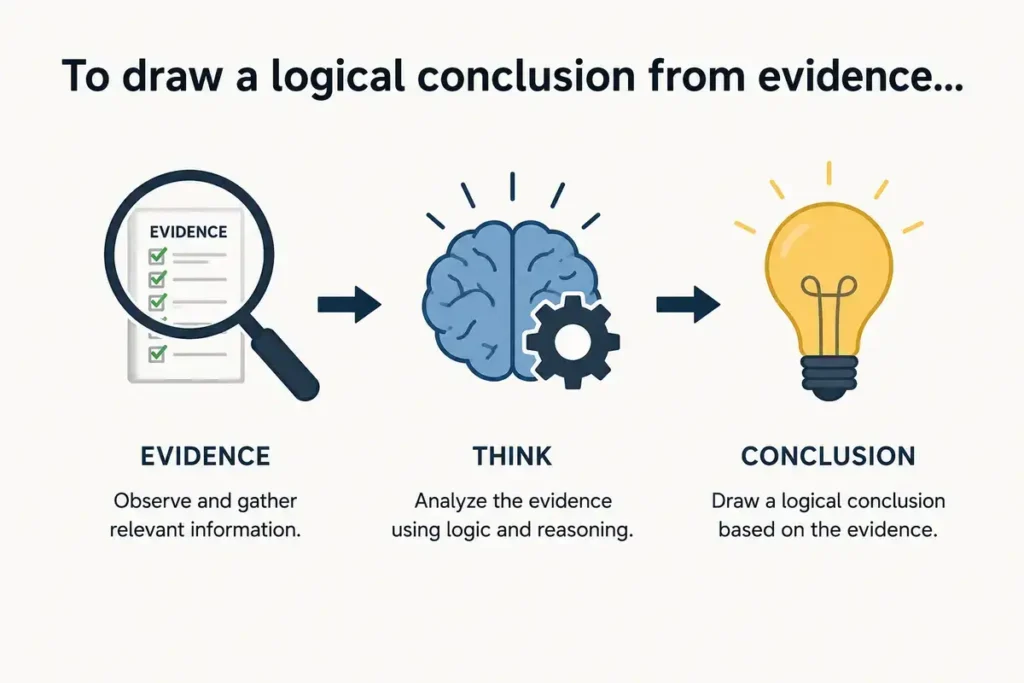
Infer means to reach a conclusion after analyzing facts, evidence, or clues. Unlike assume, infer depends on reasoning instead of guessing.
Definition
To draw a logical conclusion from evidence.
Examples
From the dark clouds, we inferred that rain was coming.
Explanation: The conclusion comes from visible evidence.
The detective inferred that the suspect had entered through the back door.
Explanation: The detective analyzed clues before reaching the conclusion.
Readers can infer the character’s feelings from her actions.
Explanation: The feelings are not directly stated but can be understood from the evidence in the story.
Pronunciation Guide
Correct pronunciation also helps distinguish these words.
| Word | IPA | Simple Pronunciation |
|---|---|---|
| Assume | /əˈsuːm/ | uh SOOM |
| Presume | /prɪˈzuːm/ | prih ZOOM |
| Infer | /ɪnˈfɝː/ | in FUR |
Although assume and presume sound somewhat alike, their meanings differ in subtle but important ways.
Parts of Speech
All three words function as verbs.
| Word | Part of Speech | Example |
|---|---|---|
| Assume | Verb | She assumed the answer was correct. |
| Presume | Verb | We presumed he was at work. |
| Infer | Verb | They inferred the cause from the data. |
Their grammatical behavior is similar, but the reasoning behind each action differs.
Word Origins
Understanding a word’s history often makes its meaning easier to remember.
Origin of Assume
Assume comes from the Latin assumere, meaning “to take up” or “to adopt.” Over time, English speakers began using it to mean accepting an idea without proving it first.
Origin of Presume
Presume comes from the Latin praesumere, meaning “to take beforehand.” The word developed the sense of expecting or believing something before complete confirmation, often because experience or custom supports it.
Origin of Infer
Infer comes from the Latin inferre, meaning “to bring in” or “to conclude.” In English, it evolved into the act of drawing conclusions from evidence or reasoning. The Latin roots reflect the different thought processes behind these verbs. Assume involves accepting, presume involves expecting, and infer involves reasoning.
When to Use Assume
Use assume when you are accepting an idea without checking if it is true. This is the most common of the three words in everyday English.
Appropriate Situations
- Making an initial guess.
- Discussing expectations.
- Giving instructions.
- Explaining misunderstandings.
- Casual conversations.
Examples
Do not assume everyone agrees with your opinion.
Explanation: Agreement has not been confirmed.
I assumed you already knew the answer.
Explanation: The speaker believed something without verifying it.
Many people assume success happens overnight.
Explanation: The sentence refers to a common but unverified belief.
When to Use Presume
Choose presume when your belief is supported by circumstances, experience, or accepted practice.
It sounds slightly more formal than assume.
Appropriate Situations
- Professional communication.
- Legal documents.
- Official statements.
- Academic writing.
- Formal discussions.
Examples
We presumed the office was closed because the lights were off.
Explanation: The conclusion is supported by observations.
Unless informed otherwise, I presume the meeting is still scheduled.
Explanation: The speaker relies on normal expectations.
Doctors presumed the symptoms were related to the infection.
Explanation: The conclusion is based on medical evidence, even if final proof has not yet been established.
When to Use Infer
Use infer when you reach a conclusion after carefully examining evidence, facts, or logical clues.
Unlike assume, infer requires reasoning rather than simple belief.
Appropriate Situations
- Scientific writing.
- Academic research.
- Literary analysis.
- Police investigations.
- Data interpretation.
- Reading comprehension.
- Critical thinking.
- Problem solving.
Examples
Researchers inferred that climate conditions had changed over time.
Explanation: The conclusion comes from collected evidence.
Students inferred the author’s message from the final chapter.
Explanation: The meaning was discovered through analysis instead of being stated directly.
The engineer inferred the cause of the failure after reviewing the test results.
Explanation: The conclusion was based on technical evidence rather than guesswork.
Can Assume Presume and Infer Replace Each Other
Sometimes these verbs appear in similar situations, but they are not true synonyms. Choosing the wrong one can change the meaning of your sentence.
Consider these examples.
Correct: I assumed the store opened at eight.
This means the speaker guessed without checking.
Correct: I presumed the store opened at eight because the parking lot was full.
This means the speaker had a reasonable basis for the belief.
Correct: I inferred the store had already opened because customers were leaving with shopping bags.
This means the speaker reached a conclusion after observing evidence.
Notice how the level of evidence changes from one sentence to the next.
| Word | Level of Evidence | Typical Situation |
|---|---|---|
| Assume | None or very little | Guessing |
| Presume | Some evidence or expectation | Reasonable belief |
| Infer | Strong evidence and logical reasoning | Drawing conclusions |
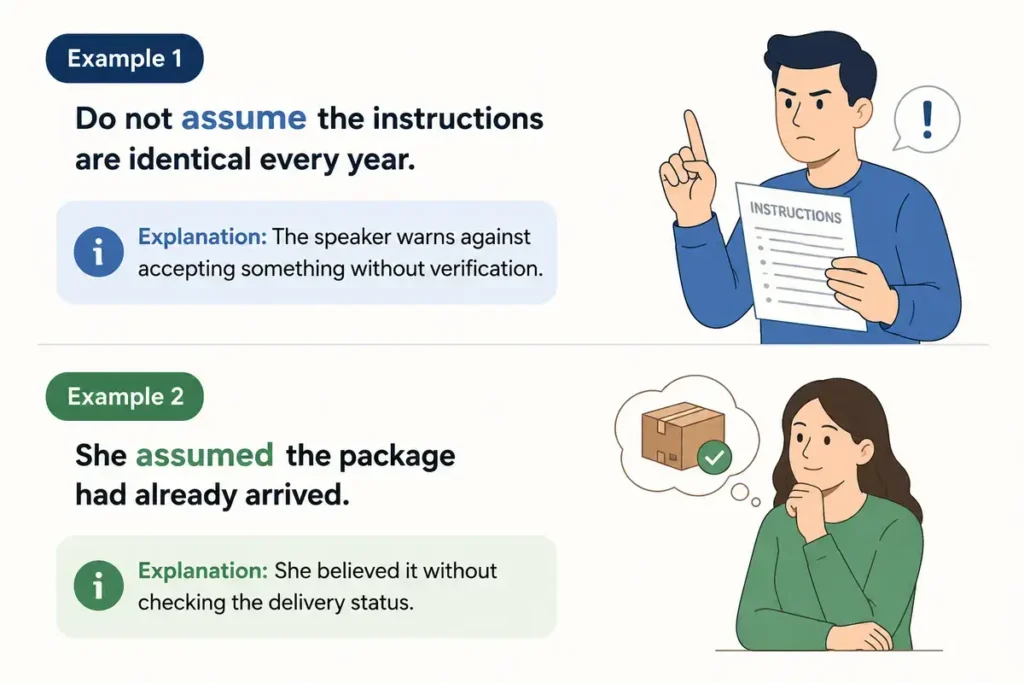
The following examples show how assume is naturally used in everyday English
Example 1
Do not assume the instructions are identical every year.
Explanation: The speaker warns against accepting something without verification.
Example 2
She assumed the package had already arrived.
Explanation: She believed it without checking the delivery status.
Example 3
Many people assume expensive products are always better.
Explanation: This describes a common belief rather than a proven fact.
Example 4
I assumed you had already finished your homework.
Explanation: The speaker made a guess without confirmation.
Example 5
Never assume everyone understands technical language.
Explanation: People may have different levels of knowledge.
Example 6
The manager assumed the report was complete.
Explanation: The manager accepted that idea before reviewing the document.
Example 7
We assumed the restaurant accepted credit cards.
Explanation: The assumption was made without checking first.
Example 8
Students should never assume every online source is accurate.
Explanation: Information should always be verified.
Real Life Examples of Presume
These examples show how presume usually involves some supporting reason.
Example 1
I presume the train is running because no delays have been announced.
Explanation: The conclusion is based on available information.
Example 2
The judge presumed the defendant innocent until proven guilty.
Explanation: This reflects an important legal principle.
Example 3
We presumed the office was closed because every light was off.
Explanation: Visible evidence supports the belief.
Example 4
She presumed he would attend because he accepted the invitation.
Explanation: The acceptance makes attendance seem likely.
Example 5
The neighbors presumed the family had gone on vacation after seeing packed luggage.
Explanation: Their belief comes from observation.
Example 6
Unless you object, I presume everyone agrees.
Explanation: The speaker relies on the normal expectation that silence means agreement.
Example 7
Doctors presumed dehydration was causing the symptoms.
Explanation: The conclusion is based on medical experience before testing confirms it.
Example 8
I presumed your email reached me because the server showed no errors.
Explanation: The belief depends on supporting circumstances.
Real Life Examples of Infer
The following examples demonstrate how infer depends on reasoning.
Example 1
Scientists inferred that the species had migrated thousands of years ago.
Explanation: The conclusion came from research evidence.
Example 2
Readers can infer the character’s fear from her silence.
Explanation: The emotion is understood through clues in the story.
Example 3
The mechanic inferred that the battery had failed after testing the electrical system.
Explanation: The diagnosis followed examination of the evidence.
Example 4
Teachers infer student understanding from classroom participation.
Explanation: Participation provides clues about comprehension.
Example 5
Police inferred that the suspect left before sunrise.
Explanation: The conclusion comes from collected evidence.
Example 6
From the footprints, the hikers inferred that a deer had crossed the trail.
Explanation: The tracks provide logical evidence.
Example 7
Economists inferred that consumer confidence was improving.
Explanation: The conclusion was based on economic data.
Example 8
I inferred from her smile that she enjoyed the surprise.
Explanation: The smile serves as evidence for the conclusion.
Common Mistakes
Many English learners misuse these verbs because they all involve reaching conclusions. Understanding the differences prevents confusing sentences.
Mistake 1
I inferred he was late because I forgot to check the time.
Incorrect because no evidence was analyzed.
Correct: I assumed he was late because I forgot to check the time.
Mistake 2
I assumed the road was closed because several warning signs were posted.
This is understandable but less precise.
Better: I presumed the road was closed because several warning signs were posted.
The signs provide a reasonable basis for the belief.
Mistake 3
The scientist assumed the conclusion after examining the data.
Incorrect.
Better: The scientist inferred the conclusion after examining the data.
Scientific conclusions are normally inferred from evidence.
Mistake 4
Using assume in every situation. Many writers overuse assume because it is familiar. In professional writing, presume and infer often communicate the intended meaning more accurately.
Mistake 5
Confusing infer with imply.
This is one of the most common English mistakes.
Imply means the speaker suggests something.
Infer means the listener concludes something.
Example:
The teacher implied that extra practice would help.
The students inferred that a quiz was coming.
Memory Tips
Simple memory tricks make these words much easier to remember.
Memory Trick 1
Think about the amount of evidence.
Assume = almost no evidence.
Presume = some evidence.
Infer = clear evidence and reasoning.
Memory Trick 2
Remember this progression.
Guess. Reasonable expectation.
Logical conclusion. That sequence matches:
Assume → Presume → Infer
Memory Trick 3
Associate each word with a question.
Assume What do I think?
Presume What is probably true?
Infer What do the facts show?
Memory Trick 4
Picture three detectives.
The first detective guesses immediately.
That is assume.
The second detective notices a few clues.
That is presume.
The third detective studies every piece of evidence before reaching a conclusion.
That is infer.
Related Grammar and Usage Notes
Several closely related words are often confused with these verbs.
Infer Versus Imply
These words describe opposite sides of communication.
A speaker implies.
A listener infers.
Example:
The manager implied that changes were coming.
Employees inferred that new policies would be announced.
Assume Versus Suppose
Both words express belief without proof.
Suppose usually sounds more conversational.
Example:
I suppose he is busy today.
I assume he is busy today.
The meanings are similar, but suppose sounds softer and less certain.
Presume Versus Expect
These words overlap in some situations.
Expect focuses on anticipating an event.
Presume focuses on believing something because it appears reasonable.
Example:
I expect the package tomorrow.
I presume the package has already shipped.
Formal and Informal Usage
Assume
Very common in everyday conversation, business writing, and academic writing.
Presume
Slightly more formal than assume. Frequently used in legal, governmental, and professional contexts.
Infer
Common in education, research, science, journalism, and analytical writing. It emphasizes logical thinking rather than opinion.
American and British English
The meanings of assume, presume, and infer are essentially the same in American and British English. The main difference is style rather than meaning.
American English
Assume appears much more often in everyday speech. Presume tends to sound more formal.
British English
British speakers also use assume frequently, but presume may appear slightly more often in formal conversation and official writing than in American English. Infer carries the same meaning in both varieties of English and is widely used in education, research, law, and professional communication.
Professional Writing Tips
Choosing the right verb improves clarity and precision.
Use presume when there is some evidence supporting a belief, but final proof is still missing.
Use infer when evidence leads logically to a conclusion.
Professional writers avoid treating these verbs as interchangeable because each communicates a different level of certainty and reasoning. Selecting the precise word makes your writing more accurate, persuasive, and easier for readers to understand.
Key Takeaways
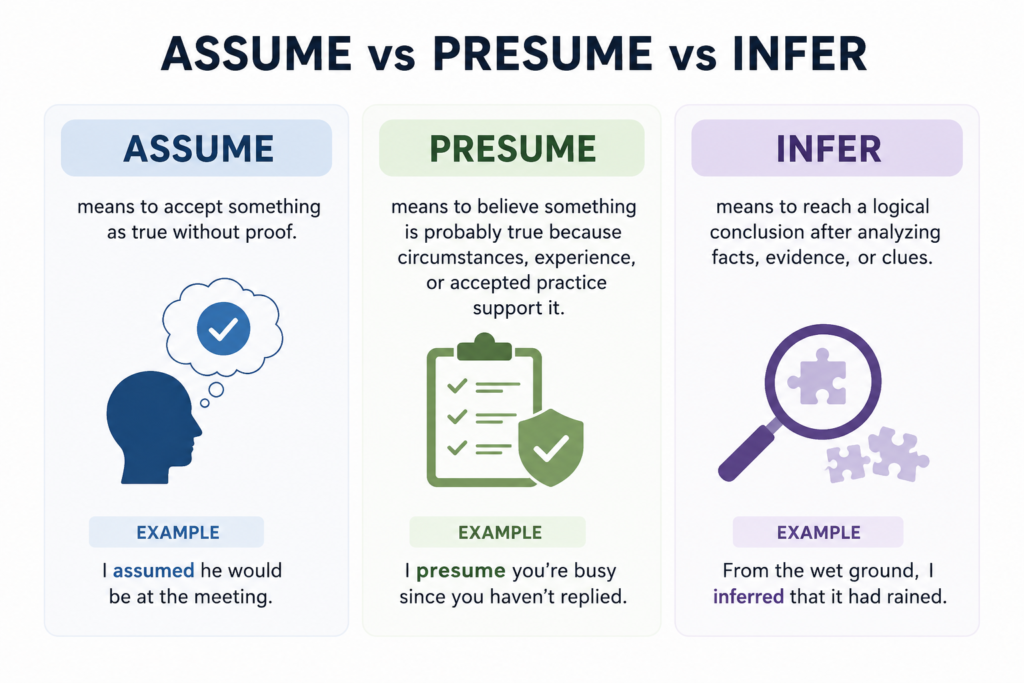
- Assume means to accept something as true without proof.
- Presume means to believe something is probably true because circumstances, experience, or accepted practice support it.
- Infer means to reach a logical conclusion after analyzing facts, evidence, or clues.
- Assume requires little or no evidence.
- Presume requires some supporting evidence or a reasonable expectation.
- Infer requires logical reasoning based on evidence.
- These three verbs are related but are not interchangeable.
- Infer is often confused with imply, but they describe opposite actions.
- Choosing the correct word makes your writing more precise and professional.
- A simple way to remember the difference is guess, reasonable belief, logical conclusion.
FAQs
What is the difference between Assume vs Presume vs Infer?
The main difference is the amount of evidence involved.
Assume means to accept something as true without proof.
Presume means to believe something is probably true because there is some supporting evidence or a reasonable expectation.
Infer means to reach a conclusion after analyzing evidence or facts.
Can assume and presume be used interchangeably?
Sometimes they can, especially in everyday conversation. However, presume usually suggests stronger supporting evidence or an accepted expectation, while assume often refers to a simple belief without verification. In formal writing, choosing the more precise word improves clarity.
Is infer the opposite of imply?
Not exactly, but they describe opposite parts of communication.
A speaker or writer implies something.
A listener or reader infers the meaning from what was said or written.
Example:
The coach implied the team needed more practice.
The players inferred that extra training sessions were coming.
Which word is more formal, assume or presume?
Presume is generally more formal than assume.
It appears more frequently in legal documents, official reports, academic writing, and professional communication.
Is it wrong to use assume instead of infer?
Sometimes.
If your conclusion comes from analyzing evidence, infer is the better choice.
Example:
Correct: Researchers inferred the results from the data.
Less precise: Researchers assumed the results from the data.
The second sentence suggests guessing instead of reasoning.
What is the easiest way to remember Assume vs Presume vs Infer?
Remember this simple sequence.
Assume equals guess.
Presume equals reasonable belief.
Infer equals logical conclusion from evidence.
Thinking about the amount of evidence involved helps you choose the correct word.
Do assume, presume, and infer have the same pronunciation?
No. Although assume and presume sound somewhat similar, they begin with different prefixes. Infer has a completely different pronunciation and stress pattern.
Which word appears most often in everyday English?
Assume is by far the most common in everyday conversation.
Presume appears more often in formal contexts.
Infer is common in education, research, journalism, literature, and analytical writing.
Can infer be used in academic writing?
Yes. In fact, infer is one of the most common verbs used in academic writing because researchers, students, and readers frequently draw conclusions from evidence.
Example: The study inferred a strong relationship between sleep quality and memory performance.
What are common synonyms for assume, presume, and infer?
Some useful alternatives include:
Use assume when you make a guess without enough evidence.
- Suppose.
- Guess.
- Believe.
- Think.
- Accept.
Choose presume when your conclusion is supported by facts instead of guesswork.
- Expect.
- Believe.
- Take for granted.
- Anticipate.
- Trust.
Use infer when you draw a conclusion from the available evidence.
- Conclude.
- Deduce.
- Reason.
- Gather.
- Derive.
Although these words are related, each has its own nuance, so choose the one that best matches your intended meaning.
Conclusion
Understanding Assume vs Presume vs Infer is essential for clear and accurate English. These three verbs all involve forming conclusions, but they represent different levels of certainty and reasoning.
Assume means accepting something as true without proof. Presume means believing something is probably true because circumstances or accepted expectations support that belief. Infer means reaching a logical conclusion by carefully analyzing facts, observations, or evidence.
Selecting the appropriate word improves precision. Assume fits everyday situations involving unverified beliefs. Presume works best when there is a reasonable basis for a belief. Infer is ideal for academic, scientific, and analytical contexts because it indicates that evidence supports the conclusion.
A simple way to remember the distinction is this:
assume without proof, presume with probability, infer from evidence. Keeping that pattern in mind will help you choose the right word confidently in conversations, professional writing, and formal communication.

Confusing Words, Spelling & Word Choice
Claire Whitmore is a U.S.-based English editor who writes about commonly confused words, spelling differences, and word choice. Her work helps readers understand subtle distinctions between similar-looking words through simple definitions, practical examples, and modern usage guidance in both American and British English.