

Principal vs Principle is one of the most commonly confused word pairs in English. Since both words have similar spellings and identical pronunciation, it’s easy to mix them up while writing. Students, professionals, and even experienced writers occasionally pause to decide which spelling is correct.
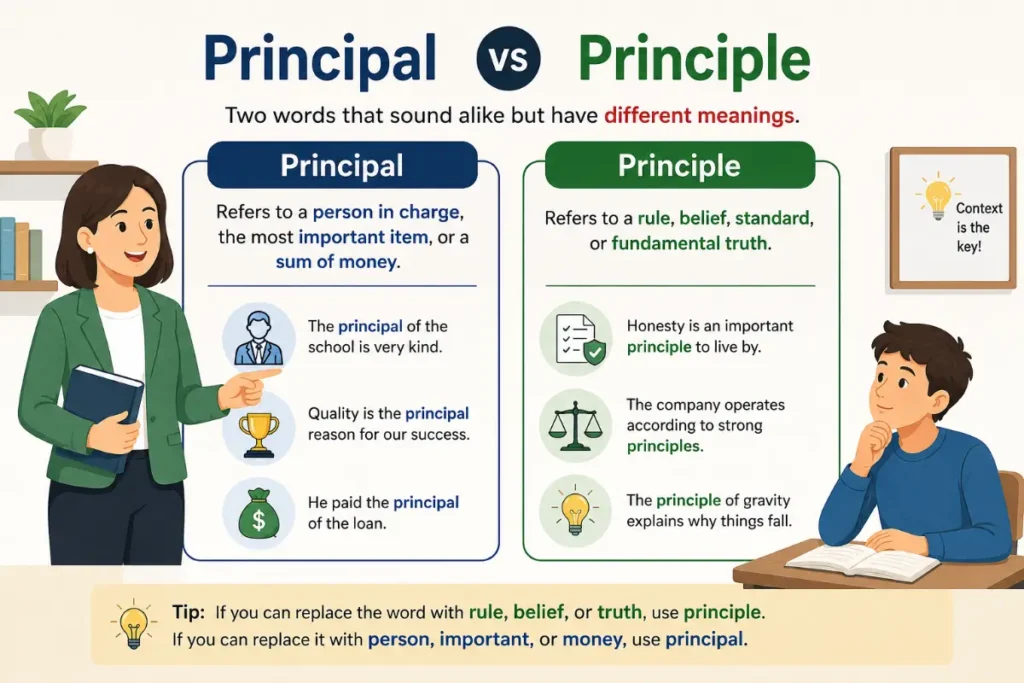
The difference becomes simple once you understand what each word means. Principal usually refers to a person, something of primary importance, or the original amount of money in a loan or investment. Principle, on the other hand, refers to a rule, moral value, belief, or basic truth.
Although the words sound exactly the same, they are never interchangeable because they represent different ideas. Learning this distinction will help you write more accurately and avoid one of the most common spelling mistakes in English.
Short Answer
Principal vs Principle is a common grammar question because the two words sound alike but have different meanings. Principal usually refers to a person in charge, the most important item, or a sum of money, while principle means a rule, belief, standard, or fundamental truth. Choosing the correct word depends entirely on the context.
Table of Contents
- What Do Principal and Principle Mean
- Principal vs Principle Comparison Table
- The Main Difference Between Principal and Principle
- When to Use Principal
- When to Use Principle
- Why People Confuse These Words
- Real Life Examples
- Common Mistakes
- Memory Tricks
- Professional Writing Tips
What Does Principal Mean
Principal has several meanings, but each one relates to the idea of being first, main, or most important.
Depending on the sentence, principal can function as a noun or an adjective.
The most common meanings include:
- The head of a school.
- The most important person or thing.
- The original amount of money borrowed or invested.
- The leading participant in a project or performance.
Examples
- The principal welcomed the new students on the first day of school.
Explanation: Here, principal refers to the head administrator of a school.
- He was the principal speaker at the conference.
Explanation: The word means the leading or main speaker.
What Does Principle Mean
Principle always refers to a rule, belief, law, value, or basic truth. Unlike principal, principle is only used as a noun. People often use it when discussing ethics, science, education, politics, religion, or personal values.
Examples
- Honesty is an important principle.
Explanation: Honesty is a moral value.
- Freedom of speech is a democratic principle.
Explanation: The word refers to a foundational belief.
Principal vs Principle Comparison Table
| Feature | Principal | Principle |
|---|---|---|
| Part of speech | Noun and adjective | Noun |
| Refers to a person | Yes | No |
| Refers to a rule or belief | No | Yes |
| Means most important | Yes | No |
| Used in finance | Yes | No |
| Used in ethics | No | Yes |
| Used in science | Sometimes | Yes |
| Used in education | Yes | Yes, in different meanings |
The Main Difference Between Principal and Principle
The easiest way to distinguish these words is to ask what the sentence is talking about.
Choose principal if the sentence refers to:
- A person in charge.
- The main or most important thing.
- The original amount of money.
- The leading person or participant.
Choose principle if the sentence refers to:
- A rule.
- A belief.
- A moral value.
- A scientific law.
- A basic truth.
Quick Examples
- The principal greeted every student.
- The company follows strong ethical principles.
- Education is the school’s principal goal.
- Fairness is one of our guiding principles.
- The investor withdrew only the principal.
- The machine operates on a simple principle.
Each sentence becomes clear once you identify the type of idea being discussed.
Why People Confuse Principal and Principle
There are several reasons these words are frequently mixed up.
- They are pronounced exactly the same.
- Their spellings differ by only two letters.
- Both appear in educational settings.
- They have related historical origins.
- Spell check may not catch the mistake because both are correctly spelled words.
Because they are homophones, readers depend entirely on context to understand which word is intended.
When to Use Principal
Use principal whenever you’re referring to a person, something primary, or an original amount of money.
Use Principal for School Leaders
Examples
- The principal announced a new attendance policy.
Explanation: The sentence refers to the head of a school.
- Students met with the principal after the assembly.
Explanation: The word identifies the school’s administrator.
Use Principal for Something Most Important
Examples
- Our principal objective is customer satisfaction.
Explanation: The objective is the most important one.
- Water is the principal ingredient in this recipe.
Explanation: Water is the main ingredient.
Use Principal in Finance
Examples
- The borrower reduced the principal before making the next payment.
Explanation: The sentence refers to the original loan amount.
- Interest is calculated on the remaining principal.
Explanation: Banks charge interest based on the unpaid original balance.
Use Principal as an Adjective
Examples
- The principal reason for the delay was bad weather.
Explanation: It means the primary reason.
- The principal office is located in Chicago.
Explanation: The word means the main office.
Common Expressions with Principal
These phrases appear frequently in everyday English.
- School principal.
- Principal office.
- Principal investigator.
- Principal cause.
- Principal objective.
- Principal shareholder.
- Principal amount.
- Principal residence.
- Principal actor.
- Principal source.
Example
The principal investigator led the medical research team.
Explanation: This refers to the lead researcher responsible for the study.
When to Use Principle
Use principle whenever you’re discussing ideas, values, rules, or truths.
Moral Principles
Examples
- Kindness is one of her strongest principles.
Explanation: The sentence refers to personal values.
- He stood by his principles despite public criticism.
Explanation: He remained faithful to his beliefs.
Scientific Principles
Examples
- Newton’s laws are fundamental scientific principles.
Explanation: These are accepted scientific truths.
- The lesson explains the basic principles of electricity.
Explanation: The word refers to foundational concepts.
Business Principles
Examples
- Successful companies rely on sound business principles.
Explanation: The sentence refers to guiding practices.
- Transparency remains one of the organization’s core principles.
Explanation: Transparency is a guiding value.
Legal Principles
Examples
- Every judge must follow constitutional principles.
Explanation: These are legal foundations.
- Justice is an essential legal principle.
Explanation: The sentence refers to a basic legal concept.
Common Expressions with Principle
Many everyday phrases naturally use principle.
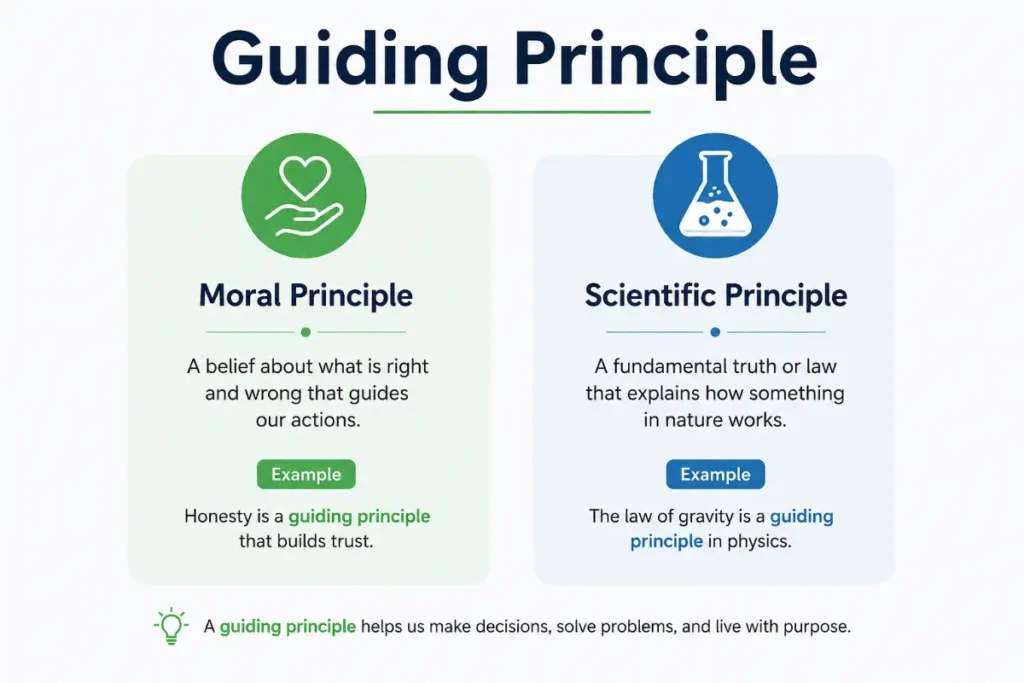
- Guiding principle.
- Moral principle.
- Scientific principle.
- Legal principle.
- Basic principle.
- Fundamental principle.
- General principle.
- Core principle.
- Operating principle.
- Principle of fairness.
Example
The company follows the principle of honesty in every customer interaction.
Explanation: Honesty is treated as a guiding belief rather than a person or object.
Real Life Examples
At School
Correct:
- The principal visited every classroom.
Explanation: A school leader is being described.
Incorrect:
- The principle visited every classroom.
This spelling is incorrect because a belief cannot visit classrooms.
During a Science Lesson
Correct:
- Students learned the principle of gravity.
Explanation: Gravity is a scientific concept.
Incorrect:
- Students learned the principal of gravity.
This is incorrect because gravity is not a person or the main object.
Principal or Principle in Business Writing
Professional writing often uses both words, but in very different contexts.
Use principal for:
- Main offices.
- Primary objectives.
- Loan amounts.
- Lead executives.
- Key investors.
Use principle for:
- Company values.
- Ethical standards.
- Corporate policies.
- Business philosophy.
- Decision making guidelines.
Choosing the correct spelling helps your writing appear polished, professional, and trustworthy.
Principal as a Noun
Most people first encounter principal as the title of a school leader, but the word has several noun meanings.
A School Leader
This is the most familiar use of principal.
Examples
- The principal congratulated the graduating class.
Explanation: The principal is the head administrator of the school.
- Parents scheduled a meeting with the principal.
Explanation: The sentence refers to the person responsible for managing the school.
The Original Amount of Money
In banking and finance, principal means the original amount borrowed or invested before interest is added.
Examples
- She paid off the principal before the loan’s due date.
Explanation: The payment reduced the original loan balance.
- The investment earned interest while the principal remained untouched.
Explanation: The original investment amount is the principal.
The Leading Person
In business, law, medicine, research, and the arts, principal often refers to the leading person in a role.
Examples
- She is the principal architect on the project.
Explanation: She is the lead architect.
- The principal dancer received a standing ovation.
Explanation: The dancer holds the highest performing role.
Principal as an Adjective
As an adjective, principal means main, chief, or most important.
Examples
- Our principal concern is customer safety.
Explanation: Safety is the highest priority.
- The principal highway connects the two cities.
Usage: It is the main highway.
- Sugar is the principal ingredient.
Explanation: Sugar is the primary ingredient.
- Their principal office is located downtown.
Explanation: It is the company’s main office.
Principle as a Noun
Unlike principal, principle has only one grammatical role.
It is always a noun.
Its meaning changes slightly depending on the context, but it always refers to an idea, rule, law, or belief.
Moral Principle
Examples
- Respect is an important principle.
Explanation: Respect is a moral value.
- She refused to abandon her principles.
Explanation: The sentence refers to personal beliefs.
Scientific Principle
Examples
- The experiment demonstrates an important scientific principle.
Explanation: The word refers to a natural law or accepted truth.
- Students studied the principle of conservation of energy.
Explanation: This is a scientific concept.
General Rule
Examples
- This principle applies to every employee.
Explanation: The sentence refers to a general rule.
- Good communication is a basic management principle.
Explanation: Communication is a guiding practice.
Grammar Rule
One simple rule solves almost every mistake.
Use principal when talking about:
- A person.
- Something primary.
- The original amount of money.
Use principle when talking about:
- A belief.
- A rule.
- A value.
- A law.
- A truth.
Ask yourself this question.
Is the sentence talking about a person or something important, or is it talking about an idea or belief?
Your answer will immediately point you to the correct word.
Can Principal and Principle Ever Be Interchangeable
No.
Unlike some confusing word pairs, these two words are never interchangeable.
Compare these examples.
Correct:
- The principal gave a speech.
Incorrect:
- The principle gave a speech.
A belief cannot deliver a speech.
Correct:
- Honesty is an important principle.
Incorrect:
- Honesty is an important principal.
Honesty is a value, not a person.
Because the meanings are completely different, choosing the wrong spelling changes the meaning of the sentence.
Real Life Examples
At School
Correct:
- The principal announced a new dress code.
Explanation:
The sentence refers to the school administrator.
During a Job Interview
Correct:
- The company follows strong ethical principles.
Explanation:
The sentence discusses company values.
At the Bank
Correct:
- The borrower reduced the principal before paying interest.
Explanation:
Principal refers to the original loan amount.
In a Science Class
Correct:
- Students learned the principle of buoyancy.
Explanation:
The word refers to a scientific law.
In Business
Correct:
- Our principal objective is customer satisfaction.
Explanation:
The adjective means the most important objective.
In Everyday Conversation
Correct:
- She always sticks to her principles.
Explanation:
The sentence refers to personal beliefs.
Common Mistakes
Many writers make the same spelling errors because these words sound identical.
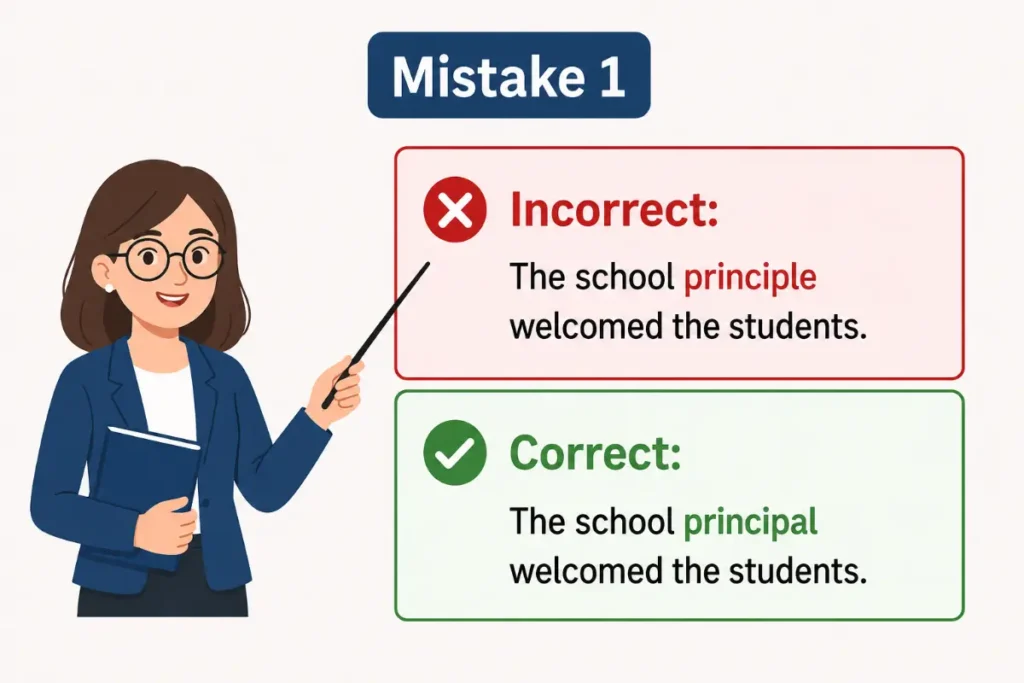
Mistake 1
Incorrect:
- The school principle welcomed the students.
Correct:
- The school principal welcomed the students.
Reason:
A school leader is a principal.
Mistake 2
Incorrect:
- Honesty is an important principal.
Correct:
- Honesty is an important principle.
Reason:
Honesty is a belief or value.
Mistake 3
Incorrect:
- The bank charged interest on the principle.
Correct:
- The bank charged interest on the principal.
Reason:
Loans involve the original amount of money.
Mistake 4
Incorrect:
- Our principal values guide every decision.
Correct:
- Our principles guide every decision.
Reason:
Values are beliefs.
Memory Tricks
These simple tricks make the difference easy to remember.
Trick One
Principal ends with “pal.”
Think:
The principal is your pal.
This classic memory trick reminds you that a principal is a person.
Trick Two
Principle ends with “le.”
Think of law or ethics.
Both are ideas rather than people.
Trick Three
Ask yourself:
Is this talking about a person or an idea?
- Person → Principal.
- Idea → Principle.
Trick Four
If you can replace the word with main, chief, or primary, use principal.
Example:
- The principal reason.
You could also say:
- The main reason.
Trick Five
If you can replace the word with belief, rule, or value, use principle.
Example:
- A guiding principle.
You could also say:
- A guiding belief.
Professional Writing Tips
Professional writers rarely confuse these words because they check the meaning before choosing the spelling.
Keep these habits in mind.
- Think about meaning before spelling.
- Remember that principal can be both a noun and an adjective.
- Remember that principle is always a noun.
- Use principal for schools, finance, leadership, and primary importance.
- Use principle for ethics, science, values, and rules.
- Proofread carefully because spell check may not detect the error.
Following these practices will make your writing clearer and more professional.
Pronunciation
These words are perfect homophones.
| Word | IPA | Pronunciation |
|---|---|---|
| Principal | /ˈprɪn.sə.pəl/ | PRIN suh pul |
| Principle | /ˈprɪn.sə.pəl/ | PRIN suh pul |
Since they sound exactly alike, context is the only way readers know which spelling is correct.
Word Origin
Although these words now have different meanings, they share the same Latin root.
Principal
Principal comes from the Latin word principalis, meaning first, chief, or most important.
That origin explains why the word is associated with leaders, primary importance, and main amounts of money.
Principle
Principle comes from the Latin word principium, meaning beginning, foundation, or basic truth.
Over time, English speakers used it to describe rules, beliefs, and fundamental ideas.
American vs British English
There is almost no difference between American and British English when using these words.
Both varieties follow the same meanings.
Examples used in both countries include:
- School principal.
- Principal amount.
- Moral principles.
- Scientific principles.
- Guiding principles.
The spelling and grammar rules remain the same in American and British English.
Formal vs Informal Usage
These words are used in both formal and informal writing.
Formal examples include:
- Academic research.
- Legal writing.
- Government documents.
- Business reports.
- Financial contracts.
Informal examples include:
- Text messages.
- Emails.
- Everyday conversations.
- School assignments.
No matter the situation, the meanings never change.
Related Grammar Notes
Learning Principal vs Principle becomes easier when you recognize other commonly confused word pairs. These words often have similar spellings or pronunciations but different meanings.
Some examples include:
- Affect vs Effect.
- Advice vs Advise.
- Accept vs Except.
- Then vs Than.
- Complement vs Compliment.
- Stationary vs Stationery.
- Farther vs Further.
- Lay vs Lie.
- Lose vs Loose.
- Who vs Whom.
Understanding these distinctions helps you write with greater accuracy and confidence.
Similar Expressions
Although principal and principle have different meanings, they often appear in similar contexts.
Common Expressions with Principal
- School principal.
- Principal amount.
- Principal investigator.
- Principal office.
- Principal objective.
- Principal source.
- Principal shareholder.
- Principal reason.
- Principal actor.
- Principal engineer.
Common Expressions with Principle
- Guiding principle.
- Moral principle.
- Scientific principle.
- Legal principle.
- Basic principle.
- Core principle.
- General principle.
- Fundamental principle.
- Principle of fairness.
- Principle of equality.
Learning these common phrases helps you recognize which spelling belongs in different situations.
Quick Practice Quiz
Choose the correct word before checking the answer.
1. The ______ welcomed the parents during orientation.
Answer: Principal
Reason: The sentence refers to the head of a school.
2. Honesty is an important ______.
Answer: Principle
Reason: Honesty is a moral value.
3. Our ______ goal is customer satisfaction.
Answer: Principal
Reason: The adjective means “main” or “most important.”
4. The scientist explained an important scientific ______.
Answer: Principle
Reason: The sentence refers to a scientific law.
5. She paid the loan ______ before the interest.
Answer: Principal
Reason: The original borrowed amount is the principal.
6. He refused to compromise his ______.
Answer: Principles
Reason: The sentence refers to personal beliefs.
7. The ______ investigator led the research team.
Answer: Principal
Reason: The lead researcher is the principal investigator.
8. Every successful organization follows clear ethical ______.
Answer: Principles
Reason: Ethics are guiding values.
People Also Ask
Is principal or principle correct?
Both are correct, but they have different meanings. Principal refers to a person in charge, something primary, or the original amount of money. Principle refers to a rule, belief, moral value, or fundamental truth.
How do I remember the difference between principal and principle?
A popular memory trick is “The principal is your pal.” Since pal refers to a person, it reminds you that a principal is often a person. Use principle when talking about ideas, rules, or beliefs.
Is a school leader a principal or a principle?
A school leader is always a principal.
Is honesty a principal or a principle?
Honesty is a principle because it is a moral value or guiding belief.
Can principal be an adjective?
Yes. Principal can describe something that is main, chief, or most important.
Example:
- The principal reason for the delay was heavy rain.
Can principle be an adjective?
No. Principle is always a noun.
What does principal mean in finance?
In finance, principal is the original amount of money borrowed, invested, or deposited before interest is added or earned.
Are principal and principle pronounced differently?
No. They are pronounced exactly the same, making them homophones. The correct spelling depends entirely on the meaning of the sentence.
Do American and British English use these words differently?
No. American and British English use principal and principle in the same way, with the same meanings and spelling rules.
Why do spell checkers sometimes miss this mistake?
Because both principal and principle are correctly spelled English words. Spell check verifies spelling, not meaning, so it cannot determine which word fits the context.
Key Takeaways
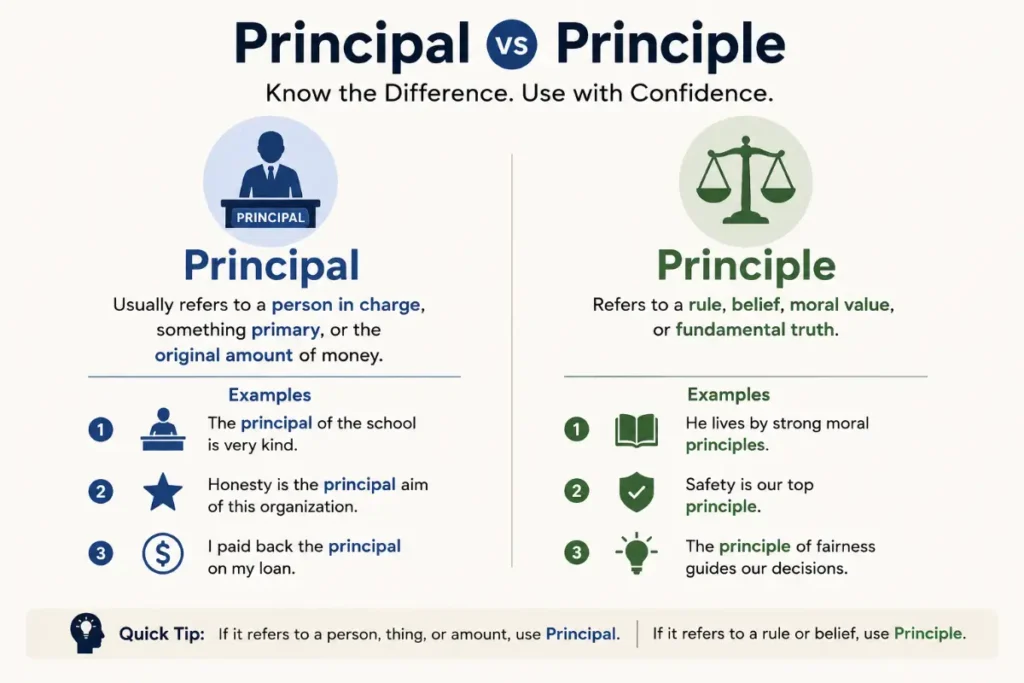
- Principal usually refers to a person in charge, something primary, or the original amount of money.
- Principle refers to a rule, belief, moral value, or fundamental truth.
- Principal can be a noun or an adjective.
- Principle is always a noun.
- The words are perfect homophones but have different meanings.
- They are never interchangeable.
- The memory trick “The principal is your pal” is an easy way to remember the correct spelling.
- Checking the meaning of the sentence is the best way to choose the right word.
Conclusion
Understanding Principal vs Principle is easier once you focus on what the sentence is describing. If you’re referring to a person in charge, something primary, or the original amount of money, principal is the correct choice. If you’re talking about a rule, belief, moral value, or fundamental truth, principle is the word you need.
Although these words sound exactly alike, they are never interchangeable. Using the correct spelling makes your writing clearer, more professional, and easier for readers to understand. When you’re unsure, remember the simple phrase “The principal is your pal.” If the word relates to a person or something main, choose principal. If it refers to an idea, value, or rule, choose principle. That simple habit will help you use both words correctly every time.
Frequently Asked Questions
What is the difference between Principal vs Principle?
The main difference is that principal refers to a person, something primary, or the original amount of money, while principle refers to a rule, belief, moral value, or fundamental truth.
Is principal always a school administrator?
No. Although a school administrator is called a principal, the word can also describe something that is most important or the original amount of a loan or investment.
Can principle refer to a person?
No. Principle never refers to a person. It always describes a rule, belief, law, or guiding idea.
Why are principal and principle so confusing?
They are confusing because they are spelled similarly, pronounced exactly the same, and share a common Latin origin. Their meanings, however, are completely different.
Which word is used in banking?
Principal is used in banking and finance to describe the original amount of money borrowed or invested before interest.
Which word is used in ethics?
Principle is used in ethics because it refers to moral beliefs, values, and standards of behavior.
Can principal be used as an adjective?
Yes. It often means main, chief, or most important, as in the principal reason or the principal office.
Is there a difference between American and British English?
No. Both American and British English follow the same rules for principal and principle.
What is the easiest memory trick?
Remember “The principal is your pal.” The word pal reminds you that a principal is a person. Use principle for beliefs, rules, and values.
Can I use principal and principle interchangeably?
No. They have distinct meanings, so using the wrong word changes the meaning of the sentence.

Confusing Words, Spelling & Word Choice
Claire Whitmore is a U.S.-based English editor who writes about commonly confused words, spelling differences, and word choice. Her work helps readers understand subtle distinctions between similar-looking words through simple definitions, practical examples, and modern usage guidance in both American and British English.