
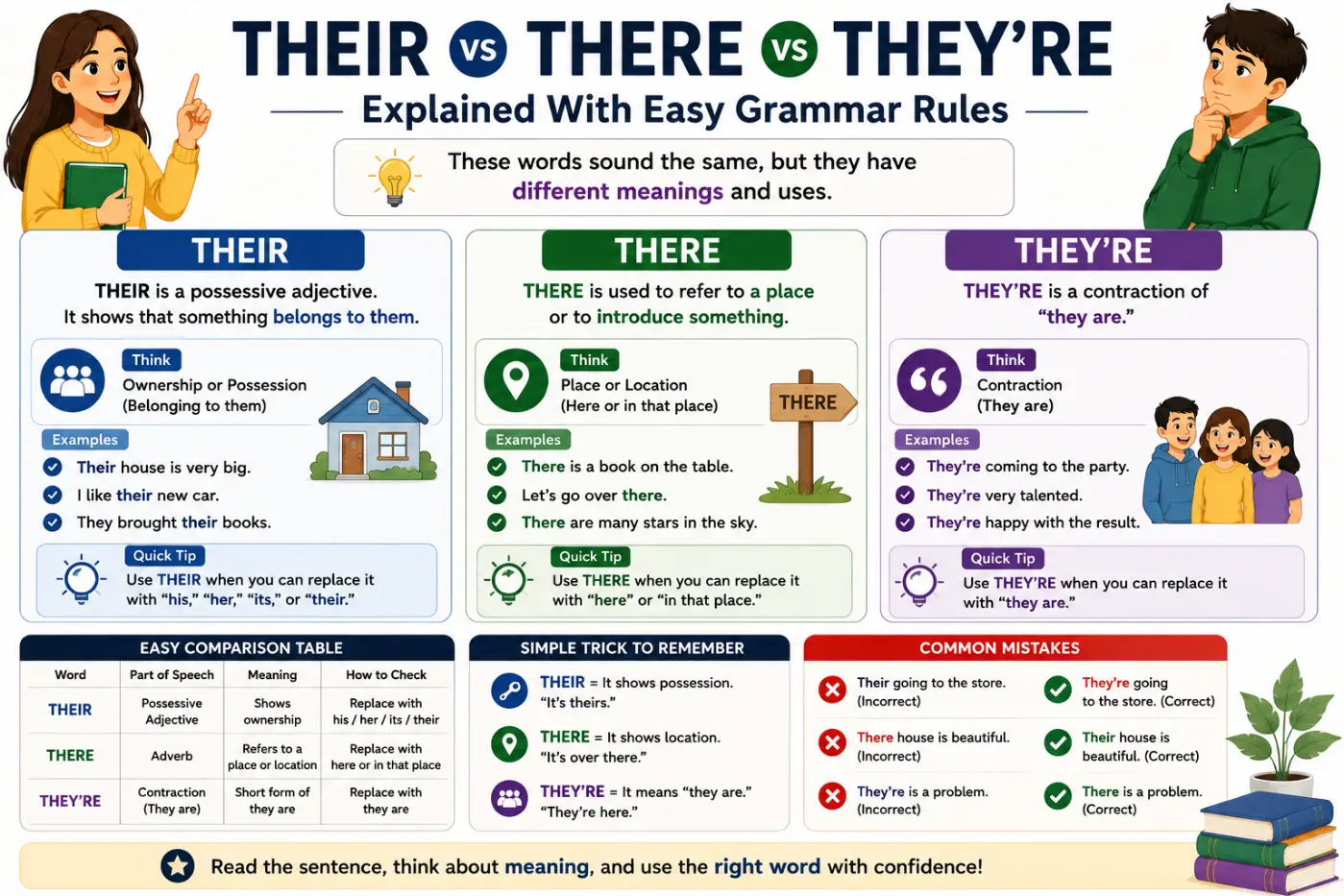
Their vs There vs They’re confuses millions of English learners and even native speakers because the words sound identical but serve completely different purposes. If you’ve ever stopped while writing to decide which spelling is correct, you’re certainly not alone.
The good news is that the difference is easy to remember once you understand what each word does. Their shows possession, there usually refers to a place or introduces a sentence, and they’re simply means they are. Learning these simple grammar rules will help you avoid one of the most common writing mistakes in English.
In this guide, you’ll learn the meaning of each word, how to use them correctly, easy memory tricks, pronunciation, grammar rules, real-life examples, professional writing tips, and the common mistakes to avoid.
Short Answer
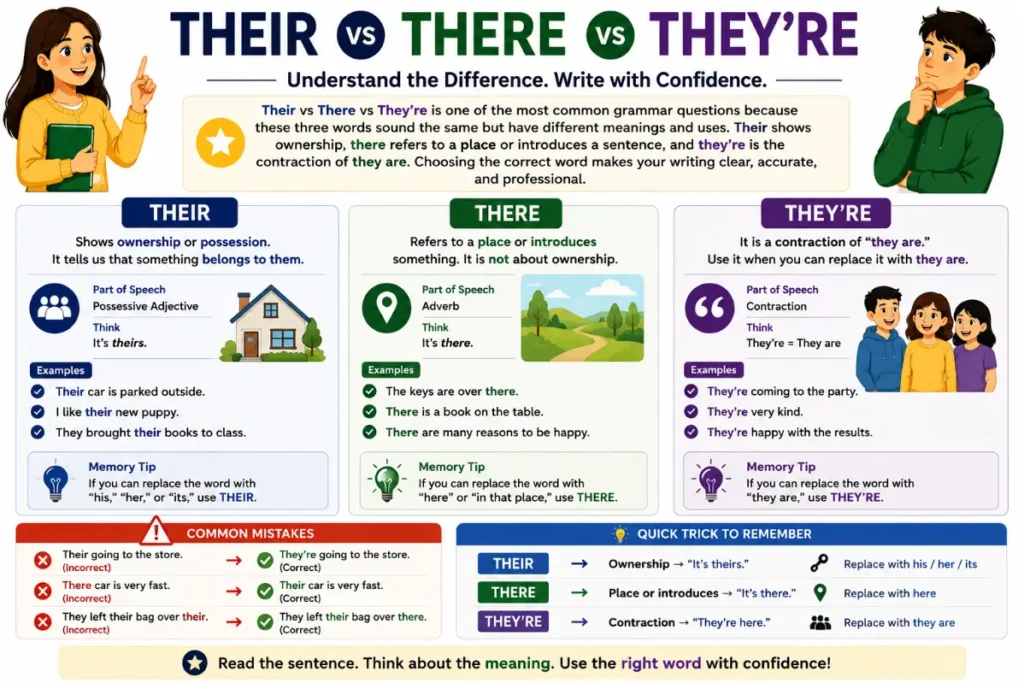
Their vs There vs They’re is one of the most common grammar questions because these three words sound the same but have different meanings and uses. Their shows ownership, there refers to a place or introduces a sentence, and they’re is the contraction of they are. Choosing the correct word makes your writing clear, accurate, and professional.
Table of Contents
- What Do Their There and They’re Mean
- Their vs There vs They’re Comparison Table
- The Main Difference
- When to Use Their
- When to Use There
- When to Use They’re
- Why These Words Are Confused
- Real-Life Examples
- Common Mistakes
- Memory Tricks
- Professional Writing Tips
What Do Their There and They’re Mean
Although these three words sound exactly the same, they belong to different parts of speech and perform different jobs in a sentence.
What Does Their Mean
Their is a possessive determiner. It shows that something belongs to two or more people or to a group.
Ask yourself this question.
- Who owns it?
If the sentence talks about ownership, their is usually the correct choice.
Examples
- Their house is on the corner.
Explanation:
The house belongs to them.
- Their teacher canceled today’s lesson.
Explanation:
The teacher belongs to or is associated with the students.
- Their dog loves playing in the park.
Explanation:
The dog belongs to them.
What Does There Mean
There usually refers to a place, location, or position. It can also introduce a sentence without referring to a specific place.
Ask yourself.
- Is it talking about a location?
- Is it introducing something that exists?
Examples
- The restaurant is over there.
Explanation:
There points to a location.
- There is a new library downtown.
Explanation:
There introduces the existence of the library.
- Please put the box there.
Explanation:
There refers to a place.
What Does They’re Mean
They’re is a contraction.
It simply means:
They are
If you can replace the word with they are, then they’re is correct.
Examples
- They’re watching a movie.
Explanation:
They are watching a movie.
- They’re excited about the trip.
Explanation:
They are excited.
- They’re coming tomorrow.
Explanation:
They are coming tomorrow.
Their vs There vs They’re Comparison Table
| Word | Meaning | Part of Speech | Example |
|---|---|---|---|
| Their | Shows ownership | Possessive determiner | Their books are new. |
| There | Refers to a place or introduces a sentence | Adverb or pronoun | There is my backpack. |
| They’re | Means they are | Contraction | They’re waiting outside. |
The Main Difference
The easiest way to choose the correct word is to ask three simple questions.
- Does something belong to someone?
Use their.
- Is the sentence talking about a place or introducing something?
Use there.
- Can you replace the word with they are?
Choose they’re.
These three questions solve almost every grammar problem involving these homophones.
Why People Confuse These Words
Several factors make these words difficult.
- They have the same pronunciation.
- They are short words.
- They are common in everyday writing.
- Spell check may not catch mistakes because each spelling is a real English word.
- Fast typing often leads to accidental errors.
Because all three words are valid English words, only understanding their meanings helps you choose correctly.
When to Use Their
Use their to show possession or ownership.
Common situations include:
- Family members.
- Friends.
- Teams.
- Companies.
- Animals.
- Groups.
- Organizations.
Examples
- Their children attend the same school.
Explanation:
The children belong to them.
- Their office moved to a new building.
Explanation:
The office belongs to the company.
- Their bicycles are parked outside.
Explanation:
The bicycles belong to them.
- Their vacation starts next week.
Explanation:
The vacation belongs to the family.
- Their ideas improved the project.
Explanation:
The ideas came from them.
- Their uniforms look professional.
Explanation:
The uniforms belong to the team.
- Their decision surprised everyone.
Explanation:
The decision was made by them.
- Their friends arrived early.
Explanation:
The friends are associated with them.
Their With Singular They
Modern English commonly uses their with the singular they.
Example
- Every student should bring their notebook.
Explanation:
Their refers to one person whose gender is unknown or not specified.
This usage is widely accepted in modern English, academic writing, journalism, and professional communication.
When to Use There
Use there when referring to a place or introducing a sentence.
There as a Location
Examples
- The keys are over there.
Explanation:
There points to a location.
- We stopped there for lunch.
Explanation:
There refers to a place.
- She left her phone there.
Explanation:
The phone was left in that location.
- My grandparents live there now.
Explanation:
There identifies where they live.
There to Introduce a Sentence
English often begins sentences with there is, there are, there was, or there were.
Examples
- There is a problem.
Explanation:
The sentence introduces the existence of a problem.
- There are many restaurants nearby.
Explanation:
The sentence introduces multiple restaurants.
- There was heavy traffic.
Explanation:
The sentence introduces the traffic situation.
- There were hundreds of visitors.
Explanation:
The sentence introduces the visitors.
Common Expressions With There
- There you go.
- There you have it.
- Here and there.
- There is no doubt.
- There was once.
- There goes the bus.
- There comes the train.
These fixed expressions always use there.
When to Use They’re
Use they’re whenever you can replace it with they are.
This simple test works almost every time.
Examples
- They’re planning a surprise party.
Replace it.
They are planning a surprise party.
The sentence still makes sense, so they’re is correct.
- They’re ready for the meeting.
Replace it.
They are ready for the meeting.
Correct.
- They’re studying for the exam.
Replace it.
They are studying for the exam.
Correct.
- They’re my neighbors.
Replace it.
They are my neighbors.
Correct.
- They’re working late tonight.
Replace it.
They are working late tonight.
Correct.
Common Contractions Like They’re
Learning similar contractions helps improve grammar.
- I’m = I am.
- You’re = You are.
- We’re = We are.
- He’s = He is.
- She’s = She is.
- It’s = It is.
- That’s = That is.
- Who’s = Who is.
Real-Life Examples
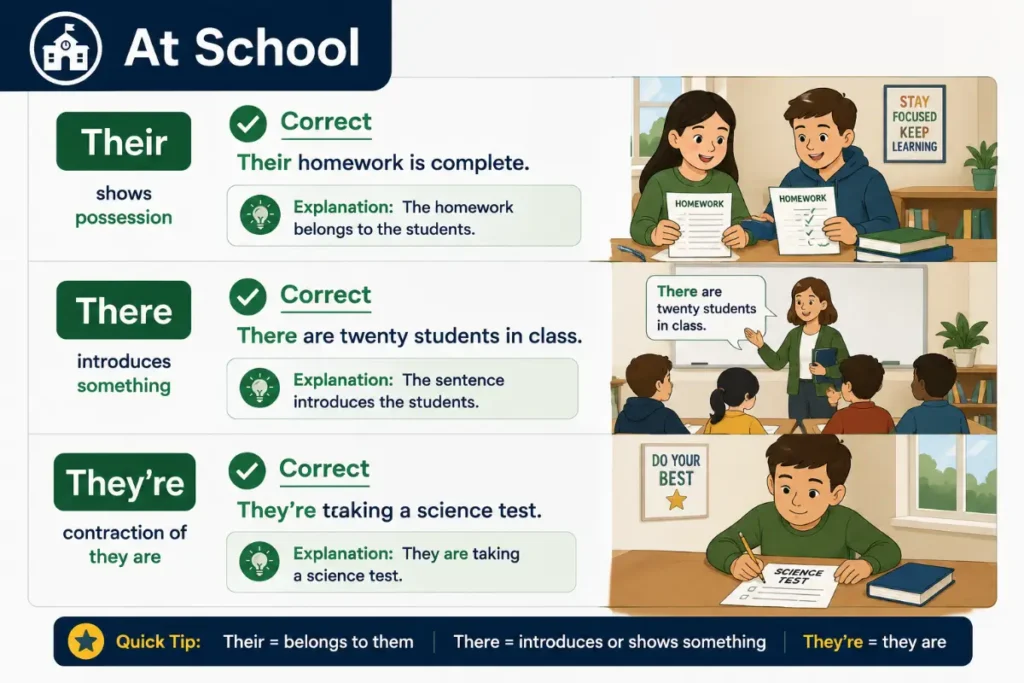
At School
Correct
- Their homework is complete.
Explanation:
The homework belongs to the students.
Correct
- There are twenty students in class.
Explanation:
The sentence introduces the students.
Correct
- They’re taking a science test.
Explanation:
They are taking the test.
At Work
Correct
- Their manager approved the proposal.
Explanation:
The manager belongs to or works with their team.
Correct
- There is a meeting at two o’clock.
Explanation:
The sentence introduces the meeting.
Correct
- They’re presenting the report today.
Explanation:
They are presenting.
At Home
Correct
- Their parents are cooking dinner.
Explanation:
The parents belong to that family.
Correct
- Put your shoes over there.
Explanation:
There identifies a location.
Correct
- They’re watching television.
Explanation:
They are watching television.
Common Mistakes
These errors appear frequently in emails, school assignments, social media posts, and business writing.
Mistake One
Incorrect
- There books are on the table.
Correct
- Their books are on the table.
Reason
Books belong to someone.
Mistake Two
Incorrect
- Their is a problem.
Correct
- There is a problem.
Reason
The sentence introduces something.
Mistake Three
Incorrect
- Their coming tomorrow.
Correct
- They’re coming tomorrow.
Reason
The sentence means they are coming.
Mistake Four
Incorrect
- They’re new office is beautiful.
Correct
- Their new office is beautiful.
Reason
The office belongs to them.
Memory Tricks
Simple memory aids make these words much easier to remember.
Trick One
Look for the word heir inside their.
An heir receives property or ownership.
Think:
Ownership equals their.
Trick Two
Notice that there contains the word here.
Both words relate to places.
Think:
Here and there both describe locations.
Trick Three
The apostrophe in they’re replaces the missing letter in they are.
If you can expand it to they are, they’re is correct.
Professional Writing Tips
Professional editors rely on quick checks before choosing one of these words.
- Use their for ownership.
- Use there for places and introductory sentences.
- Use they’re only when it means they are.
- Read your sentence aloud.
- Replace they’re with they are to test it.
- Ask yourself who owns something before using their.
- Check if the sentence points to a location before using there.
These habits will help you avoid one of the most common grammar mistakes in English and make your writing clearer, more polished, and easier to understand.
Pronunciation
One reason people confuse these words is that they are homophones. A homophone is a group of words that sound the same but have different meanings and spellings.
| Word | IPA | Simple Pronunciation |
|---|---|---|
| Their | /ðer/ | thair |
| There | /ðer/ | thair |
| They’re | /ðer/ | thair |
In both American and British English, these words are pronounced almost exactly the same. Because you cannot hear the spelling, context is the only way to know which word is correct.
Word Origin
Understanding where these words came from makes their meanings easier to remember.
Their
Their comes from Old Norse and has been used for centuries to show possession. It eventually replaced older English forms and became the standard possessive determiner for they.
There
There comes from Old English and originally referred to a place or location. Over time, it also developed another role as a word used to introduce sentences, such as There is and There are.
They’re
They’re is simply the shortened form of they are. Like other contractions, it became popular because it makes speech and informal writing more natural.
Parts of Speech
Although these words sound identical, they belong to different grammar categories.
| Word | Part of Speech | Function |
|---|---|---|
| Their | Possessive determiner | Shows ownership |
| There | Adverb or introductory pronoun | Refers to a place or introduces a sentence |
| They’re | Contraction | Means they are |
Knowing the part of speech often makes the correct choice obvious.
Their vs There vs They’re in American and British English
The meanings of these three words are the same in both American and British English.
You do not need to change your spelling based on the country.
For example:
American English
- Their team won the championship.
- There is plenty of parking.
- They’re arriving tomorrow.
British English
- Their team won the championship.
- There is plenty of parking.
- They’re arriving tomorrow.
The grammar rules remain exactly the same.
Formal vs Informal Usage
Their
Suitable for every type of writing.
Use it in:
- Academic papers.
- Business emails.
- Reports.
- News articles.
- Text messages.
There
Also appropriate in every situation.
Examples include:
- Directions.
- Professional writing.
- Everyday conversation.
- Academic writing.
They’re
Acceptable in most writing, including emails and articles.
In highly formal legal or academic documents, some writers prefer the full form they are, although they’re is still grammatically correct in many contexts.
Real Life Examples
Shopping
- Their shopping cart is full.
Explanation:
The cart belongs to them.
- There is a discount on electronics.
Explanation:
The sentence introduces a discount.
- They’re buying a new laptop.
Explanation:
They are buying it.
Sports
- Their coach encouraged the players.
Explanation:
The coach belongs to the team.
- There are thousands of fans in the stadium.
Explanation:
The sentence introduces the fans.
- They’re celebrating the victory.
Explanation:
They are celebrating.
Travel
- Their flight leaves at noon.
Explanation:
The flight belongs to the travelers.
- There is a hotel across the street.
Explanation:
The sentence introduces the hotel.
- They’re checking into the hotel now.
Explanation:
They are checking in.
Healthcare
- Their appointment begins at ten.
Explanation:
The appointment belongs to the patients.
- There is a pharmacy nearby.
Explanation:
The sentence introduces a location.
- They’re waiting to see the doctor.
Explanation:
They are waiting.
Quick Practice Quiz
Choose the correct word before checking the answer.
1. _____ dog loves playing outside.
Answer:
Their
Reason:
The dog belongs to them.
2. Please leave the package over _____.
Answer:
There
Reason:
The sentence refers to a location.
3. _____ planning a family vacation.
Answer:
They’re
Reason:
The sentence means They are planning.
4. _____ is a beautiful park nearby.
Answer:
There
Reason:
The sentence introduces the park.
5. I borrowed _____ books yesterday.
Answer:
Their
Reason:
The books belong to them.
6. _____ excited about the concert.
Answer:
They’re
Reason:
The sentence means They are excited.
7. We stopped _____ for lunch.
Answer:
There
Reason:
It refers to a place.
8. _____ ideas helped solve the problem.
Answer:
Their
Reason:
The ideas belong to them.
Professional Editing Tips
Editors often use a simple checklist when proofreading.
- Look for ownership.
If something belongs to someone, use their.
- Look for location.
If the sentence refers to a place or introduces something, use there.
- Expand the contraction.
Replace they’re with they are.
If the sentence still makes sense, you’ve chosen the correct spelling.
- Read the sentence aloud.
Although pronunciation will not reveal the spelling, reading slowly often helps you recognize the intended meaning.
- Proofread carefully.
Spell check may not catch these mistakes because every spelling is a valid English word.
Related Grammar Notes
If you often confuse Their vs There vs They’re, you may also benefit from learning these commonly mixed-up words.
- Your vs You’re.
- Its vs It’s.
- To vs Too vs Two.
- Then vs Than.
- Affect vs Effect.
- Who’s vs Whose.
- Accept vs Except.
- Lose vs Loose.
- Than vs Then.
- Lay vs Lie.
Learning these word pairs improves grammar accuracy and writing confidence.
People Also Ask
Why are their, there, and they’re so confusing?
They are homophones, which means they sound the same but have different spellings, meanings, and grammatical functions.
Is there an easy trick to remember the difference?
Yes.
- Their shows ownership.
- There refers to a place or introduces a sentence.
- They’re always means they are.
Can spell check detect these mistakes?
Not always. Since all three spellings are valid English words, many spelling tools cannot identify the wrong choice unless grammar checking is enabled.
Which mistake is most common?
Many writers accidentally type their instead of there or they’re, especially when writing quickly.
Is using “their” with a singular person correct?
Yes. Modern English widely accepts singular they and their when referring to a person whose gender is unknown or when using gender-neutral language.
Example:
- Every employee should submit their report by Friday.
Should I avoid contractions in formal writing?
Not necessarily. Contractions such as they’re are acceptable in most business writing and modern professional communication. In very formal legal or academic documents, some writers prefer the full form they are.
Key Takeaways
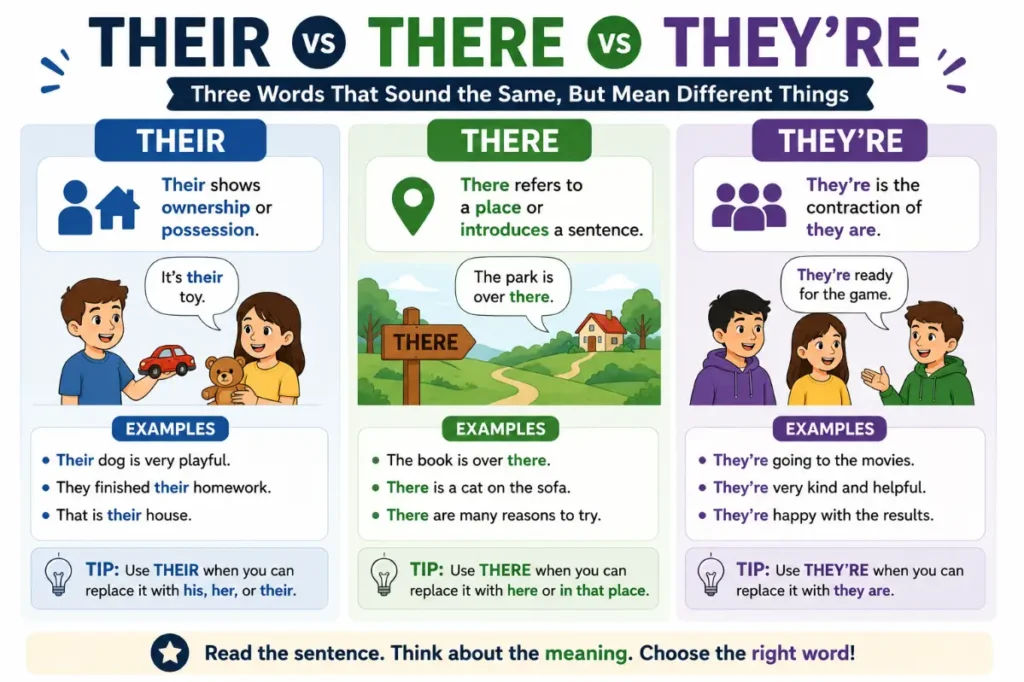
- Their shows ownership or possession.
- There refers to a place or introduces a sentence.
- They’re is the contraction of they are.
- All three words sound the same but have different meanings.
- The apostrophe in they’re replaces the missing letters in they are.
- Their is also commonly used with singular they in modern English.
- Reading your sentence carefully is the best way to catch mistakes.
- Understanding the function of each word makes choosing the correct spelling easy.
Conclusion
Understanding Their vs There vs They’re is easier once you know the job each word performs. Their shows ownership, there points to a place or introduces a sentence, and they’re simply means they are. Although they sound exactly alike, they are never interchangeable because each serves a different grammatical purpose.
The easiest way to avoid mistakes is to pause for a moment before writing. Ask yourself if you’re talking about possession, a location, or the phrase they are. That quick check will help you choose the correct spelling every time. With regular practice, using Their vs There vs They’re correctly will become second nature, making your writing clearer, more accurate, and more professional.
Frequently Asked Questions
What is the difference between Their vs There vs They’re?
Their shows ownership, there refers to a place or introduces a sentence, and they’re is the contraction of they are.
How can I remember which word to use?
Remember three simple rules. Use their for possession, there for places or introductory sentences, and they’re when you can replace it with they are.
Are these words pronounced differently?
No. They are homophones and are pronounced the same in standard American and British English.
Can I use “their” for one person?
Yes. Singular their is widely accepted in modern English when referring to a person whose gender is unknown or when using inclusive language.
Why doesn’t spell check catch these mistakes?
Each spelling is a correctly spelled English word. Grammar checkers may catch some errors, but proofreading is still important.
Which word is most common in everyday writing?
All three appear frequently, but there is especially common because it is used for locations and introductory sentence structures.
Is “they’re” acceptable in formal writing?
Yes. It is appropriate in most professional writing. Some highly formal documents may prefer the full form they are.
What should I do if I’m unsure?
Pause and ask yourself three questions. Does it show ownership? Is it talking about a place? Can it be replaced with they are? The answers will guide you to the correct word.
Is “there” ever possessive?
No. There never shows ownership. Only their functions as a possessive determiner.
Why is Their vs There vs They’re important to learn?
Using the correct word improves clarity, prevents embarrassing grammar mistakes, and makes your writing appear more polished and professional.

Confusing Words, Spelling & Word Choice
Claire Whitmore is a U.S.-based English editor who writes about commonly confused words, spelling differences, and word choice. Her work helps readers understand subtle distinctions between similar-looking words through simple definitions, practical examples, and modern usage guidance in both American and British English.