
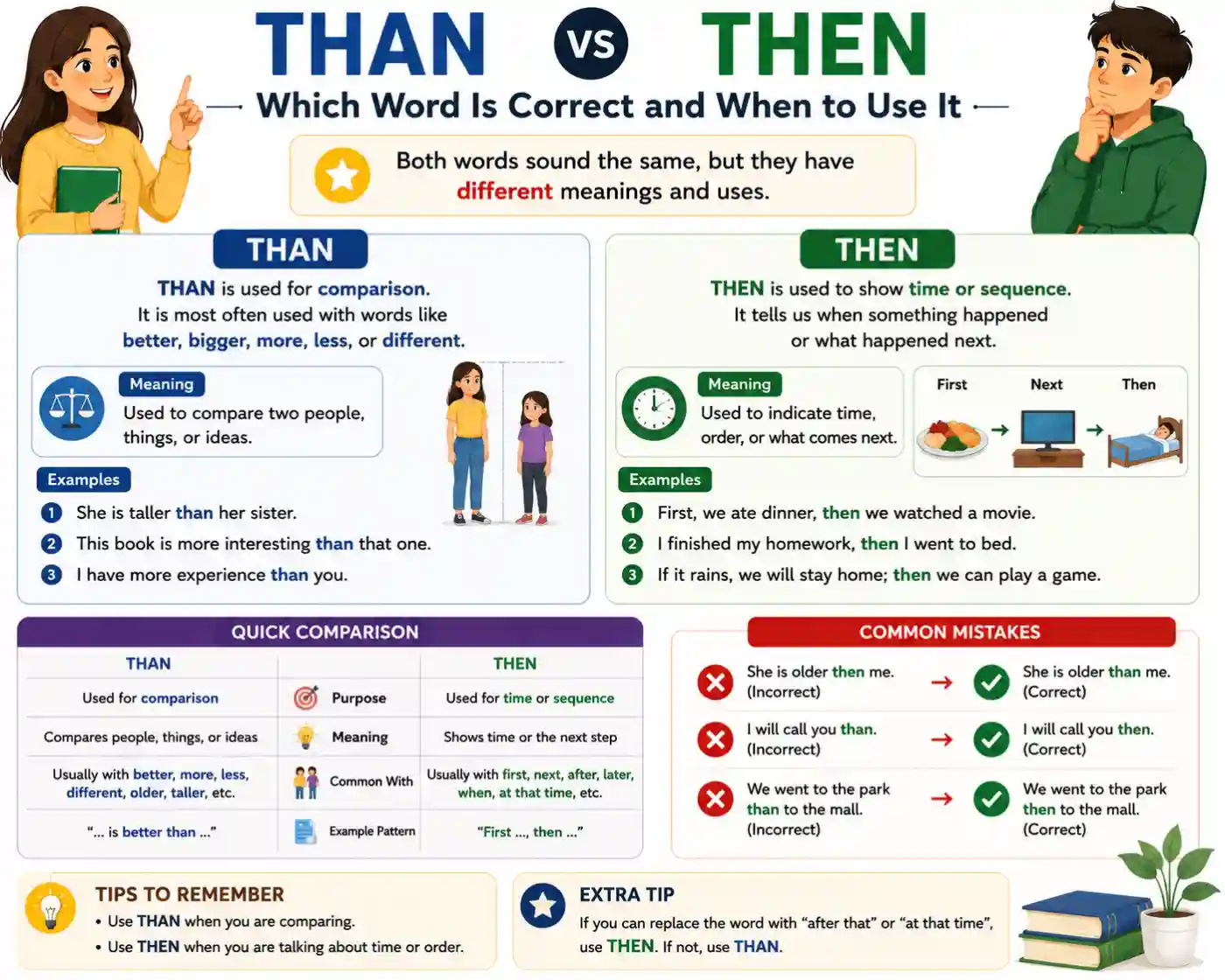
Than vs Then is one of the most frequently confused word pairs in English. Even experienced writers sometimes pause to decide which one belongs in a sentence because the words differ by only one letter and have similar pronunciations. Despite their appearance, they have different meanings and completely different grammatical functions.
The easiest way to remember the difference is this. Than compares two people, things, ideas, or amounts. Then refers to time, order, sequence, or the next step in a process. Once you understand this rule, choosing the correct word becomes much easier.
In this guide, you’ll learn the meanings of both words, grammar rules, pronunciation, comparison charts, real life examples, memory tricks, common mistakes, and practical writing tips. By the end, you’ll know exactly when to use than and when to use then with confidence.
Short Answer
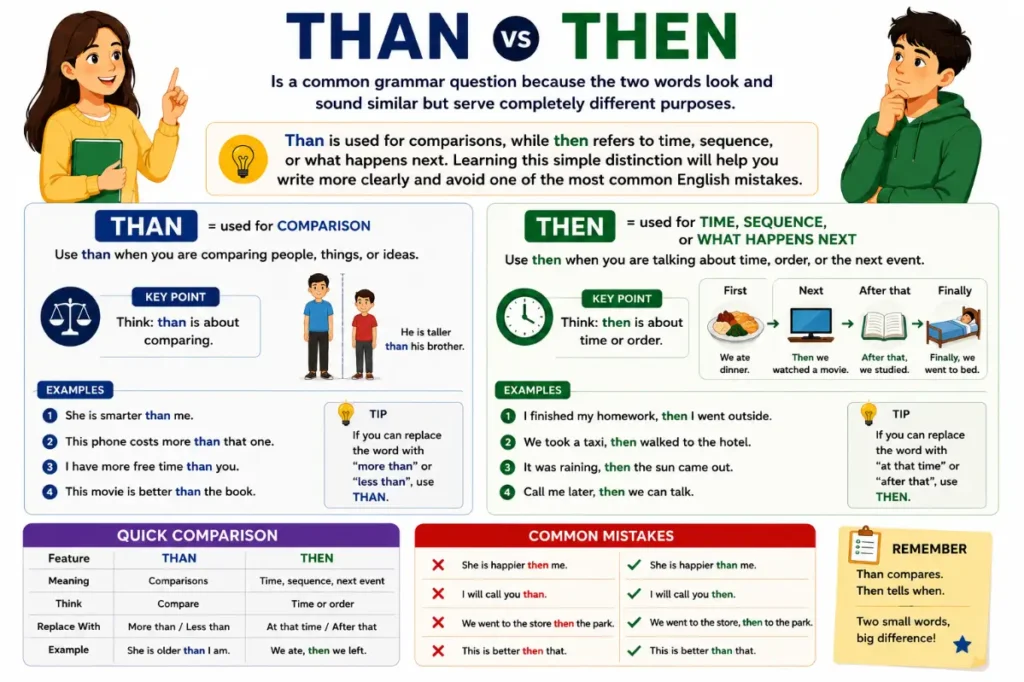
Than vs Then is a common grammar question because the two words look and sound similar but serve completely different purposes. Than is used for comparisons, while then refers to time, sequence, or what happens next. Learning this simple distinction will help you write more clearly and avoid one of the most common English mistakes.
Table of Contents
- What Do Than and Then Mean
- Than vs Then Comparison Table
- The Main Difference Between Than and Then
- When to Use Than
- When to Use Then
- Why These Words Are Confusing
- Real Life Examples
- Common Mistakes
- Memory Tricks
- Professional Writing Tips
What Do Than and Then Mean
Although than and then look alike, they perform different jobs in a sentence.
What Does Than Mean
Than is a conjunction and sometimes a preposition used to compare two or more things.
It answers questions like:
- Which one is better?
- Which one is larger?
- Which one is faster?
- Which one is more expensive?
- Which one is different?
Examples:
- My car is faster than yours.
- She is taller than her brother.
- Coffee costs more than tea.
- This puzzle is harder than the last one.
In every example, than introduces the second part of a comparison.
What Does Then Mean
Then is an adverb, adjective, or noun that refers to time, order, or what happens next.
It answers questions like:
- What happened next?
- When did it happen?
- What is the next step?
Examples:
- Finish your homework, then watch television.
- We ate dinner and then went home.
- Back then, phones had no touchscreens.
- If it rains, then we’ll stay inside.
Each sentence uses then to show time or sequence rather than comparison.
Than vs Then Comparison Table
| Feature | Than | Then |
|---|---|---|
| Primary use | Comparison | Time or sequence |
| Part of speech | Conjunction or preposition | Adverb, adjective, noun |
| Shows differences | Yes | No |
| Shows order | No | Yes |
| Used with comparative adjectives | Yes | No |
| Used with time expressions | No | Yes |
| Example | Bigger than me | Eat, then leave |
The Main Difference Between Than and Then
The simplest way to choose between these words is to ask yourself one question.
Am I comparing something or talking about time?
If you’re making a comparison, use than.
If you’re talking about time, order, or what comes next, use then.
Examples:
- Sarah is older than Jake.
- Finish your meal, then we’ll leave.
- My laptop is lighter than yours.
- We packed our bags and then headed to the airport.
- This movie is better than the first one.
- He smiled, then walked away.
This single rule solves the majority of grammar questions involving these words.
Why People Confuse Than and Then
Several factors make these words easy to mix up.
- They differ by only one letter.
- They have similar pronunciations.
- Both appear frequently in everyday writing.
- Typing quickly often leads to accidental spelling errors.
- Spell check may not catch the mistake because both are correctly spelled words.
Learning their grammatical roles is the best way to avoid confusion.
When to Use Than
Use than anytime you’re comparing two or more people, places, objects, ideas, or quantities.
Common situations include:
- Comparing size.
- Comparing age.
- Comparing price.
- Comparing quality.
- Comparing speed.
- Comparing ability.
- Comparing preferences.
- Comparing quantities.
Examples:
- This chair is more comfortable than that one.
Explanation:
The sentence compares two chairs.
- Emma speaks Spanish better than I do.
Explanation:
The comparison is between two people’s language skills.
- Winter is colder than autumn.
Explanation:
The seasons are being compared.
- Gold is more expensive than silver.
Explanation:
The sentence compares prices.
- My dog is friendlier than yours.
Explanation:
The comparison is between two dogs.
- Running is harder than walking.
Explanation:
Two activities are compared.
- This restaurant serves better pizza than the one downtown.
Explanation:
The comparison is between two restaurants.
Common Expressions Using Than
You’ll often see than in these expressions.
- More than.
- Less than.
- Rather than.
- Other than.
- Better than.
- Worse than.
- Higher than.
- Lower than.
- Bigger than.
- Smaller than.
Examples:
- I have more than twenty books.
- We’d rather stay home than go out.
- No one other than Alex knew the answer.
When to Use Then
Use then whenever you’re referring to time, sequence, or the next event.
Common situations include:
- Giving instructions.
- Describing events.
- Telling stories.
- Explaining steps.
- Referring to the past.
- Referring to the future.
- Showing consequences.
Examples:
- Wash your hands, then eat dinner.
Explanation:
The actions happen in order.
- We visited Paris, then traveled to Rome.
Explanation:
The second event follows the first.
- Back then, people wrote letters instead of emails.
Explanation:
The sentence refers to a past period.
- If you’re ready, then let’s begin.
Explanation:
The sentence introduces the next action.
- She smiled, then answered the question.
Explanation:
One event follows another.
- Complete the form, then submit it online.
Explanation:
The second instruction happens after the first.
Common Expressions Using Then
Some expressions naturally use then.
- Every now and then.
- Back then.
- Since then.
- Until then.
- Then again.
- If then.
- Just then.
- By then.
Examples:
- I’ve been busy ever since then.
- Back then, computers were much larger.
- Finish your work. Until then, stay focused.
Real Life Examples
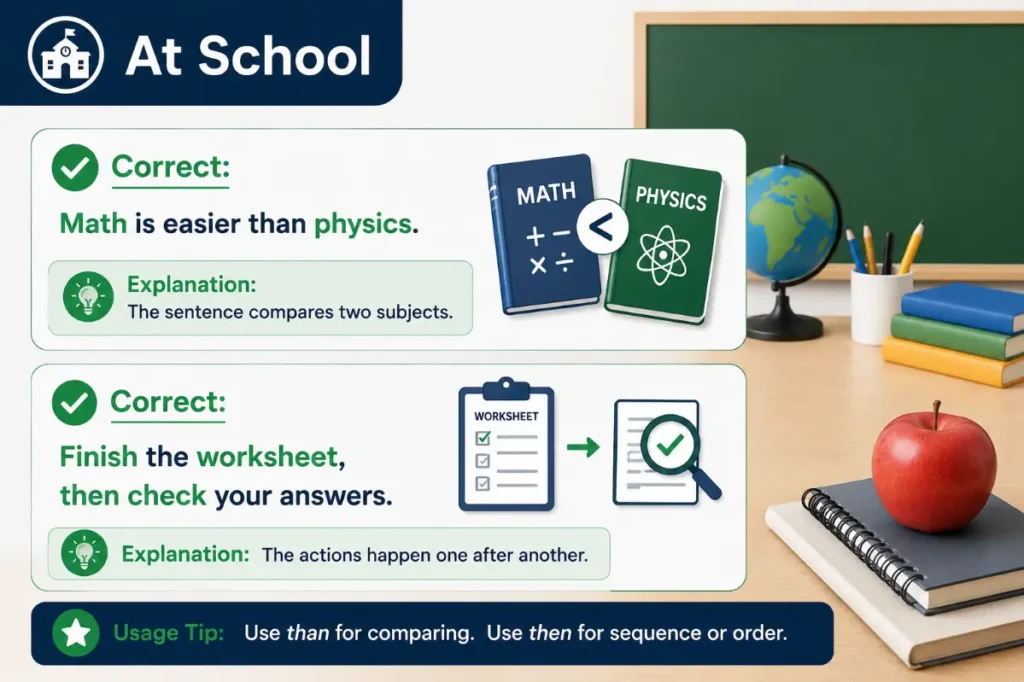
At School
Correct:
- Math is easier than physics.
Explanation:
The sentence compares two subjects.
Correct:
- Finish the worksheet, then check your answers.
Explanation:
The actions happen one after another.
At Work
Correct:
- This project is more challenging than the previous one.
Explanation:
Two projects are compared.
Correct:
- Send the email, then schedule the meeting.
Explanation:
The second task follows the first.
During Travel
Correct:
- The train is faster than the bus.
Explanation:
Two transportation methods are compared.
Correct:
- We checked into the hotel, then explored the city.
Explanation:
The events happen in sequence.
At Home
Correct:
- My bedroom is larger than yours.
Explanation:
Two rooms are compared.
Correct:
- Clean your room, then play outside.
Explanation:
One activity happens after another.
Than in Comparative Grammar
Most comparative adjectives require than.
Examples include:
- Bigger than.
- Smaller than.
- Faster than.
- Slower than.
- Better than.
- Worse than.
- Taller than.
- Shorter than.
- Easier than.
- More interesting than.
Examples:
- Today’s weather is warmer than yesterday’s.
- This exam is easier than the last one.
- Reading is more relaxing than watching television.
Whenever a sentence compares two things, than is usually the correct choice.
Then in Instructions and Processes
Instructional writing relies heavily on then because it describes the order of actions.
Examples:
- Mix the flour, then add the eggs.
- Turn on the computer, then open the application.
- Enter your password, then click Sign In.
- Read the question, then choose the correct answer.
- Lock the door, then leave the building.
Using than in these examples would be grammatically incorrect because no comparison is being made.
Common Mistakes
Many writers confuse these words in similar situations.
Mistake One
Incorrect:
- She is taller then her sister.
Correct:
- She is taller than her sister.
Reason:
The sentence compares two people.
Mistake Two
Incorrect:
- Eat dinner than brush your teeth.
Correct:
- Eat dinner, then brush your teeth.
Reason:
The sentence describes the order of actions.
Mistake Three
Incorrect:
- This phone costs less then mine.
Correct:
- This phone costs less than mine.
Reason:
The sentence compares prices.
Mistake Four
Incorrect:
- We went shopping than returned home.
Correct:
- We went shopping, then returned home.
Reason:
The sentence describes a sequence of events.
Memory Tricks
These simple tricks make the difference easy to remember.
Trick One
Than contains the letter A.
Think of A for Comparison.
Whenever you’re comparing two things, choose than.
Trick Two
Then contains the letter E.
Think of E for Event.
If one event happens after another, use then.
Trick Three
Ask yourself one simple question.
- Am I comparing something?
- Yes → Than
- Am I talking about time or order?
- Yes → Then
Professional Writing Tips
Editors often use these habits to avoid mistakes.
- Use than after comparative adjectives.
- Use than after words like more, less, better, and rather.
- Use then when giving instructions or explaining steps.
- Read your sentence aloud and ask if you’re comparing or sequencing.
- Proofread carefully because spell check may not detect the error.
- Remember that than compares, while then tells what happens next.
Pronunciation
Although than and then look similar, their pronunciations are slightly different.
| Word | IPA | Simple Pronunciation |
|---|---|---|
| Than | /ðæn/ or /ðən/ | than |
| Then | /ðen/ | then |
In fast speech, than is often pronounced as thən, making it sound even more like then. This similarity is one reason these words are frequently confused in writing.
Word Origin
Learning where these words came from makes their meanings easier to remember.
Than
Than comes from Old English þonne, which was originally used to introduce comparisons. Over time, it became the standard conjunction for comparing people, objects, actions, and ideas.
Then
Then also comes from Old English þonne, but it developed a different meaning related to time, sequence, and what happens next.
Although both words share the same historical root, English gradually assigned each one a separate grammatical role.
Than vs Then in American and British English
The grammar rules for than and then are the same in both American and British English.
Both varieties of English use:
- Than for comparisons.
- Then for time and sequence.
Examples:
American English
- My apartment is larger than yours.
- Finish your work, then take a break.
British English
- This route is shorter than the other one.
- We’ll have tea, then we’ll leave.
Unlike some grammar topics, there is no regional difference in their usage.
Formal and Informal Usage
Both words appear in every style of English.
Formal Writing
Use than when making comparisons in:
- Academic papers.
- Business reports.
- Legal documents.
- Research articles.
- Professional emails.
Use then when describing:
- Procedures.
- Timelines.
- Instructions.
- Historical events.
- Logical conclusions.
Informal Writing
The same rules apply in:
- Text messages.
- Social media posts.
- Personal emails.
- Conversations.
- Blogs.
The only difference is that informal writing may include shorter sentences or conversational wording.
Than as a Conjunction and Preposition
Most of the time, than functions as a conjunction because it connects two parts of a comparison.
Examples:
- She is taller than her brother.
- This movie is better than the original.
- Summer is hotter than spring.
In modern English, many grammar experts also recognize than as a preposition in sentences like:
- No one knows the answer better than him.
Both interpretations are widely accepted in contemporary grammar.
Then as an Adverb, Adjective, and Noun
Then as an Adverb
This is the most common use.
Examples:
- We ate lunch, then went shopping.
- Finish your homework, then relax.
- She smiled, then left.
Then as an Adjective
Sometimes then describes a noun.
Examples:
- The then president addressed the nation.
- His then employer supported the project.
Here, then means former or at that time.
Then as a Noun
Less commonly, then refers to a specific point in time.
Examples:
- Life was simpler back then.
- Things were different then.
Common Expressions Using Than
Many everyday expressions naturally include than.
- More than enough.
- Better late than never.
- More than likely.
- Less than perfect.
- Sooner rather than later.
- No sooner than.
- Rather than.
- Other than.
- Nothing more than.
- Easier said than done.
Examples:
- Better late than never.
- We’d rather travel than stay home.
- The job was harder than expected.
Common Expressions Using Then
These familiar expressions always use then.
- Every now and then.
- Back then.
- Since then.
- Until then.
- Just then.
- Then again.
- If then.
- By then.
- From then on.
- Even then.
Examples:
- Every now and then I visit my hometown.
- We’ve been friends ever since then.
- By then, everyone had arrived.
Real Life Examples
Shopping
- This jacket is cheaper than the other one.
Explanation:
The sentence compares prices.
- Choose your size, then proceed to checkout.
Explanation:
The sentence describes the next action.
Cooking
- Sugar is sweeter than salt.
Explanation:
Two ingredients are compared.
- Heat the pan, then add the butter.
Explanation:
The recipe follows a sequence.
Sports
- Alex runs faster than Ben.
Explanation:
The sentence compares speed.
- Stretch first, then begin exercising.
Explanation:
The actions happen in order.
Technology
- This laptop is lighter than my old one.
Explanation:
The sentence compares two devices.
- Install the update, then restart the computer.
Explanation:
The instructions follow a sequence.
Education
- Science is more interesting than history.
Explanation:
The sentence compares school subjects.
- Read the chapter, then answer the questions.
Explanation:
The second task follows the first.
Quick Practice Quiz
Choose the correct word before checking the answer.
1. My sister is younger _____ I am.
Answer:
Than
Reason:
The sentence compares ages.
2. Finish your breakfast, _____ brush your teeth.
Answer:
Then
Reason:
The sentence shows the order of actions.
3. Gold is more valuable _____ silver.
Answer:
Than
Reason:
Two metals are being compared.
4. We watched a movie and _____ went home.
Answer:
Then
Reason:
The sentence describes the next event.
5. This puzzle is harder _____ the last one.
Answer:
Than
Reason:
The sentence compares difficulty.
6. Complete the registration form, _____ submit your application.
Answer:
Then
Reason:
The actions happen in sequence.
7. My office is closer _____ yours.
Answer:
Than
Reason:
The sentence compares locations.
8. Back _____, life was much quieter.
Answer:
Then
Reason:
The sentence refers to a past time.
Related Grammar Notes
Mastering Than vs Then becomes even easier when you learn other commonly confused word pairs.
Examples include:
- Affect vs Effect.
- Farther vs Further.
- Advice vs Advise.
- Accept vs Except.
- Lay vs Lie.
- Lose vs Loose.
- Stationary vs Stationery.
- Who vs Whom.
- Its vs It’s.
- Fewer vs Less.
Understanding these word pairs improves both grammar and writing accuracy.
People Also Ask
Is it “better than” or “better then”?
The correct phrase is better than because than is used for comparisons.
Can then ever replace than?
No. Then refers to time or sequence and cannot replace than in comparisons.
Why do people confuse than and then?
The words differ by only one letter, have similar pronunciations, and appear frequently in everyday writing, making typing mistakes common.
Is this mistake common among native English speakers?
Yes. Even native speakers occasionally type the wrong word, especially when writing quickly.
Does spell check always catch this mistake?
No. Because both than and then are correctly spelled words, many spell checkers will not identify the error.
Key Takeaways
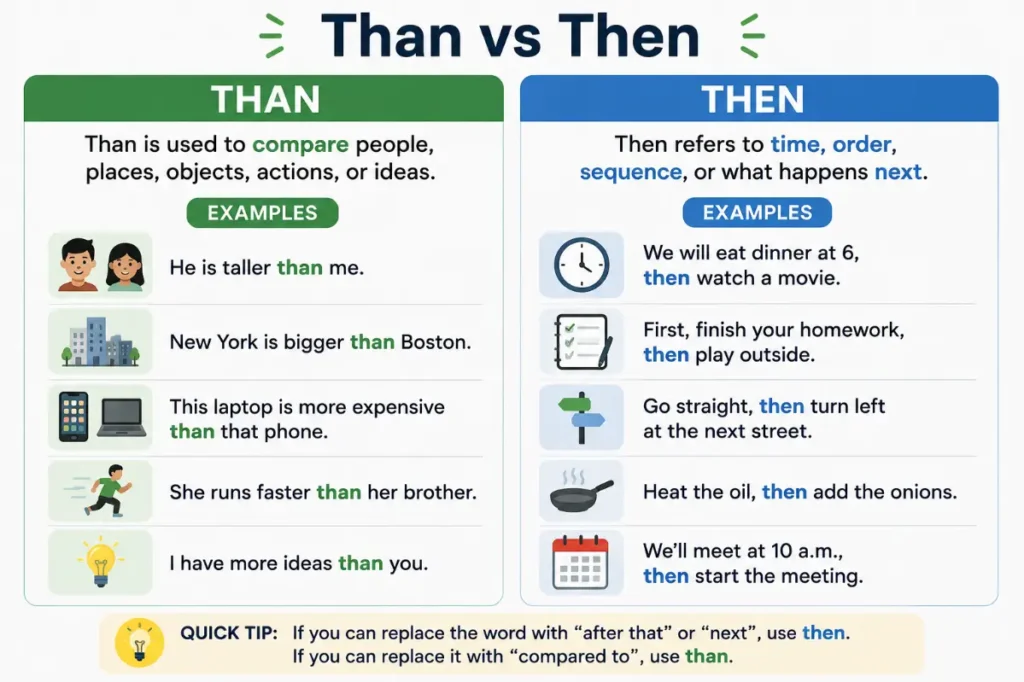
- Than is used to compare people, places, objects, actions, or ideas.
- Then refers to time, order, sequence, or what happens next.
- Than commonly follows comparative adjectives like better, larger, smaller, more, and less.
- Then is frequently used in instructions, timelines, stories, and historical references.
- The grammar rules are the same in American and British English.
- Asking “Am I comparing something or describing time?” is the quickest way to choose the correct word.
- Careful proofreading helps prevent one of the most common English writing mistakes.
Conclusion
Understanding Than vs Then is easier once you remember the different job each word performs. Than introduces comparisons between people, objects, ideas, or quantities, while then refers to time, sequence, or the next event. Although they differ by just one letter, choosing the correct word makes your writing clearer, more accurate, and more professional.
A simple question can help every time you write: Are you comparing something, or are you describing when something happens? If you’re making a comparison, use than. If you’re talking about time or the order of events, use then. With regular practice and careful proofreading, you’ll avoid this common grammar mistake and use both words confidently in every type of writing.
Frequently Asked Questions
What is the difference between Than vs Then?
Than is used to compare two or more things, while then refers to time, sequence, or the next step in a process.
Which word is used for comparisons?
Always use than when comparing people, objects, ideas, quantities, or actions.
Which word is used to show time?
Use then when referring to time, order, or events that happen one after another.
Is “more then” correct?
No. The correct phrase is more than because it introduces a comparison.
Can I use then after comparative adjectives?
No. Comparative adjectives such as better, faster, smaller, and more should be followed by than, not then.
Why doesn’t spell check catch this error?
Both words are spelled correctly. Spell check usually looks for spelling mistakes, not grammar mistakes.
Are the rules different in British English?
No. American and British English follow the same grammar rules for than and then.
How can I remember the difference quickly?
Remember that than is for comparison, while then is for time. If you’re comparing, choose than. If you’re describing what happens next, choose then.
Is “back than” correct?
No. The correct phrase is back then because it refers to a past time.
Which mistake is more common?
The most common mistake is writing then instead of than after comparative adjectives such as better, more, less, or faster.

Confusing Words, Spelling & Word Choice
Claire Whitmore is a U.S.-based English editor who writes about commonly confused words, spelling differences, and word choice. Her work helps readers understand subtle distinctions between similar-looking words through simple definitions, practical examples, and modern usage guidance in both American and British English.