
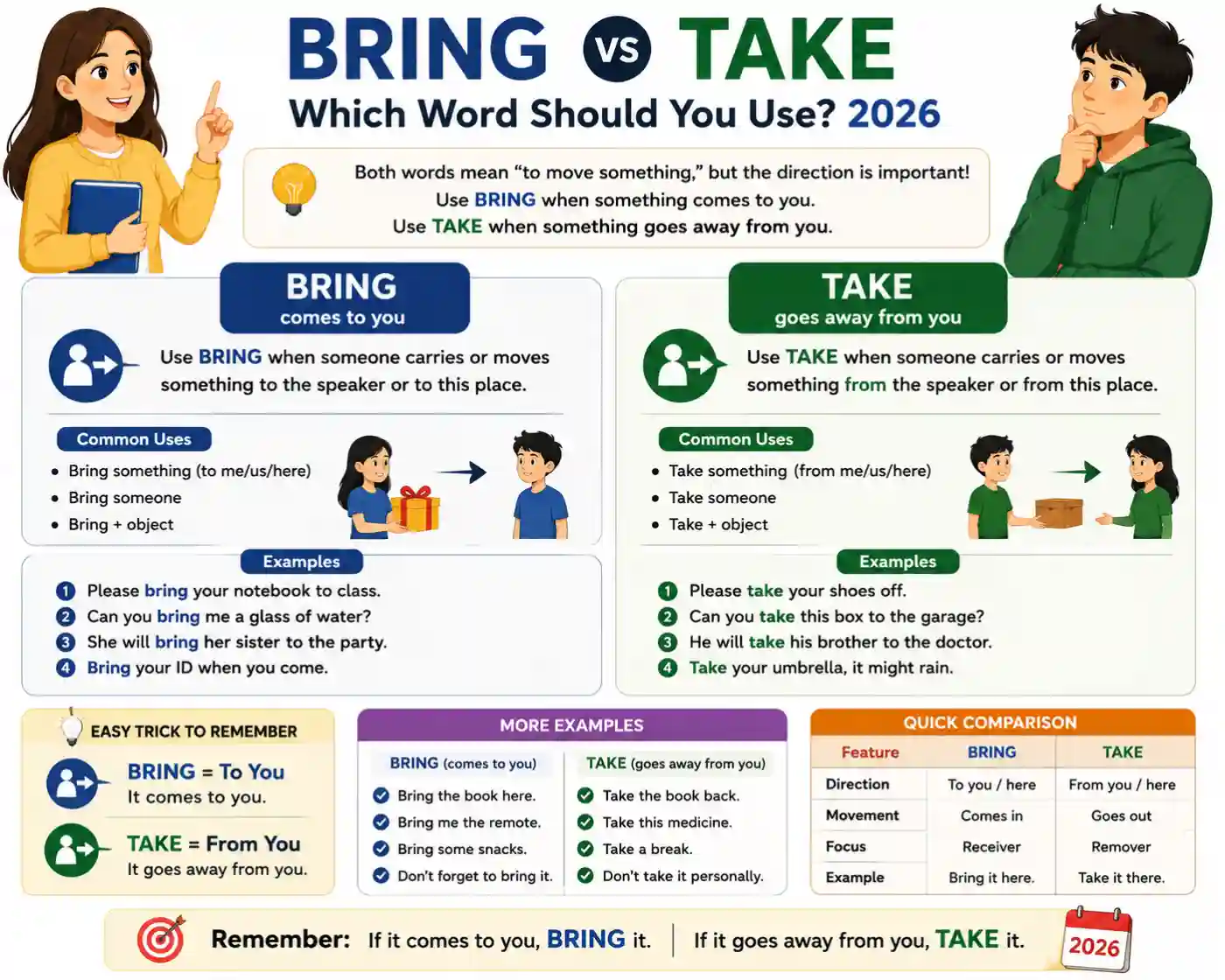
Bring vs Take is one of the most common grammar questions in English. These two verbs seem simple, but many learners and even native speakers occasionally choose the wrong one. The confusion happens because both words describe moving people or objects from one place to another. The real difference lies in the direction of that movement.
Think about where the speaker is now or where the speaker imagines the action happening. If something moves toward that point, bring is the correct choice. If something moves away from that point, take is the right word.
Learning this small grammar rule can make your conversations, emails, presentations, and writing sound much more natural. Once you understand the idea of direction, choosing the correct verb becomes much easier.
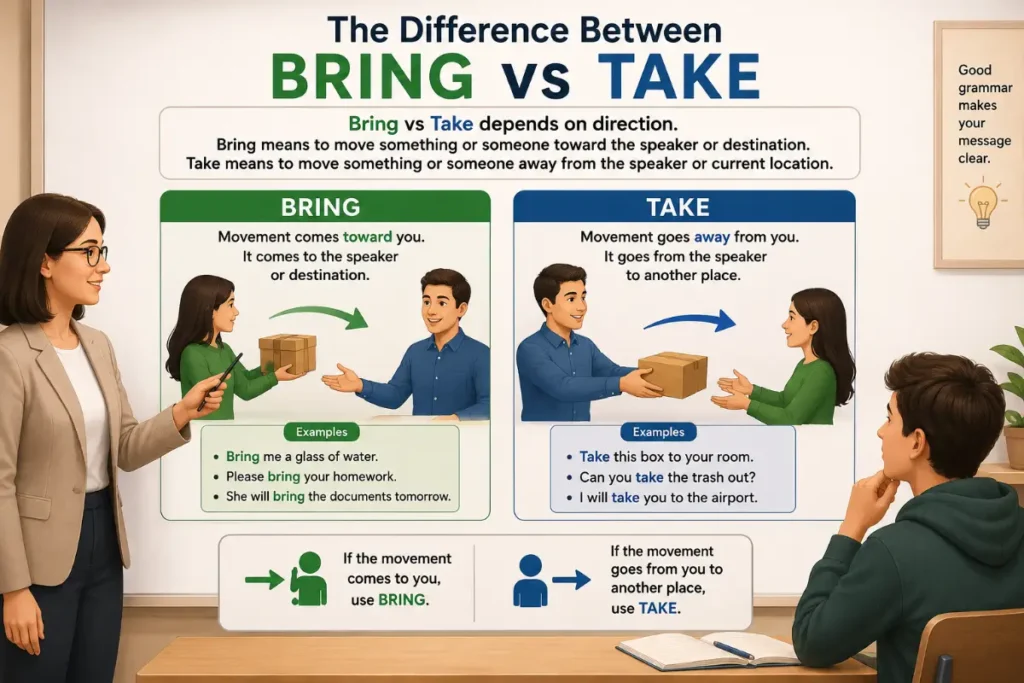
Short Answer
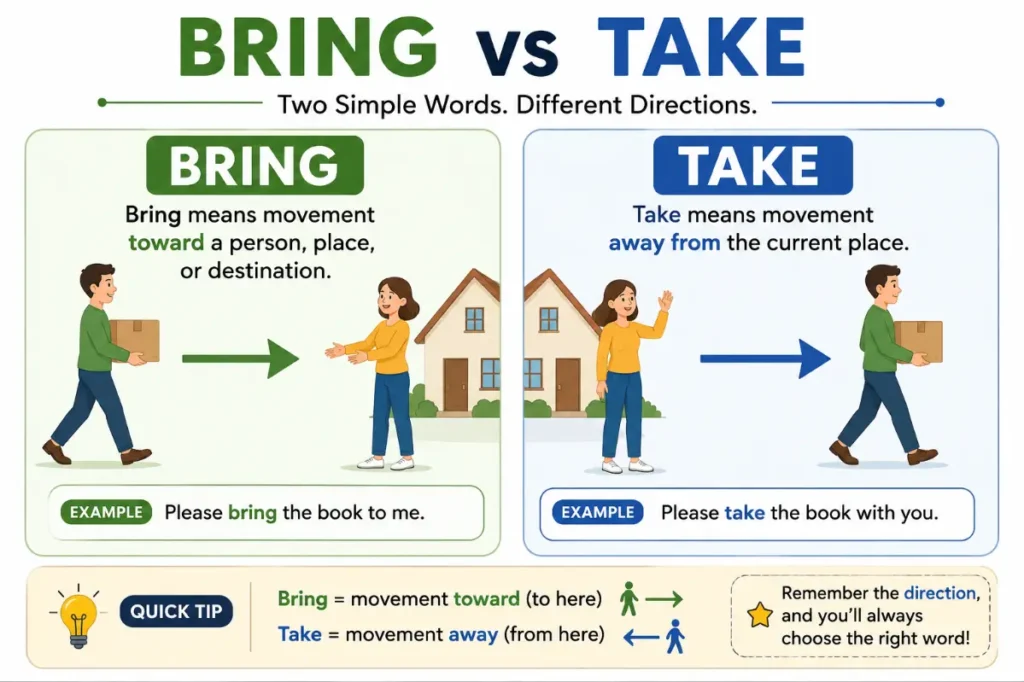
The difference between Bring vs Take depends on direction. Bring means to move something or someone toward the speaker or destination. Take means to move something or someone away from the speaker or current location. If the movement comes to you, use bring. If the movement goes from you to another place, use take.
Table of Contents
- What Does Bring Mean
- What Does Take Mean
- Bring vs Take Main Difference
- Comparison Table
- Grammar Rule You Should Remember
- When to Use Bring
- When to Use Take
- Everyday Examples
- Situations That Cause Confusion
What Does Bring Mean
Bring means to carry, move, or cause someone or something to come toward a place, person, or point of reference. The speaker is usually at the destination, or the destination is the place being discussed.
Examples
- Please bring your notebook to class.
The notebook is moving toward the classroom.
- Can you bring me a glass of water?
The water comes toward the speaker.
- She will bring her family to the wedding.
The family is coming to the wedding location.
- Don’t forget to bring your passport.
The passport comes with the traveler to the destination.
- I’ll bring dessert to the party.
The dessert moves toward the party.
In every example, the movement is directed toward a person, place, or event.
What Does Take Mean
Take means to carry, move, or lead someone or something away from the current place or toward another destination.
The speaker is thinking from the starting point rather than the destination.
Examples
- Please take these books to the library.
The books leave the speaker’s location.
- She will take her son to school.
The child goes away from home to school.
- Can you take this package to the post office?
The package moves away from the speaker.
- He took the documents to his manager.
The documents left one location and went somewhere else.
- I’ll take my laptop to work tomorrow.
The laptop moves away from home.
In every sentence, the movement starts from the speaker’s location and goes elsewhere.
Bring vs Take Main Difference
The easiest way to remember Bring vs Take is to focus on direction.
| Word | Direction | Easy Question |
|---|---|---|
| Bring | Toward the speaker or destination | Is it coming here |
| Take | Away from the speaker or current place | Is it going there |
Another simple way to think about it is this.
If someone is coming to you, use bring.
If someone is leaving you, use take.
Compare These Sentences
Please bring your camera to my house.
The camera comes to my house.
Please take your camera to your friend’s house.
The camera leaves your current location.
She brought flowers to the hospital.
The flowers came to the hospital.
She took flowers from home to the hospital.
The flowers left home.
Notice that the correct verb changes based on the speaker’s point of view.
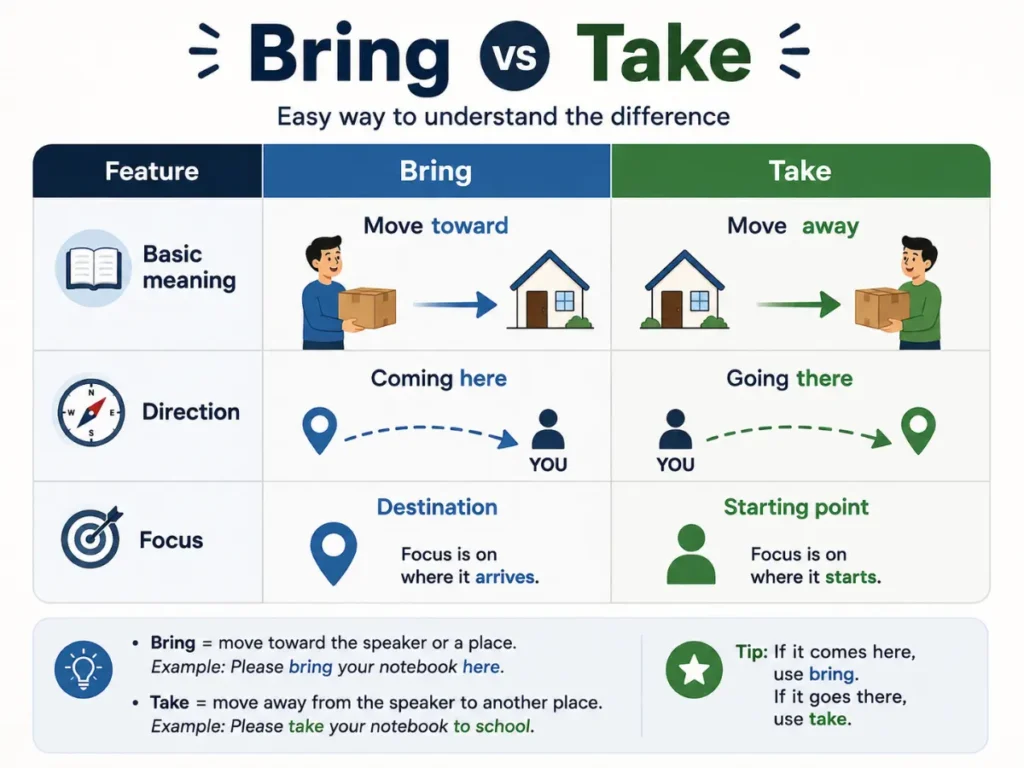
Comparison Table
| Feature | Bring | Take |
|---|---|---|
| Basic meaning | Move toward | Move away |
| Direction | Coming here | Going there |
| Focus | Destination | Starting point |
| Common question | Can you bring it | Can you take it |
| Example | Bring your homework tomorrow | Take your homework home |
| Opposite word | Take | Bring |
The Grammar Rule You Should Always Remember
The key to using these verbs correctly is identifying the reference point.
Ask yourself one simple question.
Where is the speaker mentally standing
If the action moves toward that point, use bring.
If the action moves away from that point, use take.
Example One
I’m going to your office tomorrow.
Should I bring the contract?
Correct.
The contract comes to the office.
Example Two
I’m leaving the office now.
I’ll take the contract home.
Correct.
The contract leaves the office.
Example Three
Please bring your ID to the meeting.
The meeting is the destination.
Example Four
Please take your trash outside.
The trash moves away.
When to Use Bring
Use bring when something comes toward a person, place, or event.
Common situations include the following.
- Bringing food to a gathering.
Please bring a salad to the picnic.
The salad comes to the picnic.
- Bringing documents to work.
Bring your identification tomorrow.
The ID comes to work.
- Bringing children somewhere.
I’ll bring my daughter to the concert.
The child comes to the concert.
- Bringing gifts.
They brought presents to the birthday party.
The gifts came to the party.
- Bringing ideas into a discussion.
She always brings fresh ideas.
The ideas come into the conversation.
When to Use Take
Use take when something leaves one place for another.
Common situations include the following.
- Taking children somewhere.
I’ll take my son to soccer practice.
He leaves home.
- Taking medicine.
Take this medicine after dinner.
The medicine goes into your body.
- Taking luggage.
She took two suitcases to the airport.
The luggage leaves home.
- Taking papers somewhere.
Please take these files upstairs.
The files move away.
- Taking someone home.
Can you take me home after work?
The movement starts here and goes home.
Everyday Examples of Bring and Take
Understanding everyday conversations is the fastest way to master these words.
At Home
Mom says, “Please bring me the TV remote.”
The remote comes to Mom.
Dad says, “Please take these dishes to the kitchen.”
The dishes leave the dining table.
At School
The teacher says, “Bring your homework tomorrow.”
The homework comes to school.
The teacher says, “Take this permission slip home.”
The paper leaves school.
At Work
Please bring your laptop to the meeting.
The laptop comes to the meeting room.
Please take these reports to accounting.
The reports leave your desk.
At the Airport
Bring your passport to the check in counter.
The passport comes with you.
Take your luggage to baggage drop.
The luggage moves from one place to another.
At a Restaurant
Bring us another menu.
The menu comes to the table.
Take these empty plates away.
The plates leave the table.
Common Situations That Cause Confusion
Some situations make Bring vs Take more confusing because the speaker’s perspective changes.
Talking on the Phone
Imagine you’re speaking to your friend.
You say,
“Can you bring your laptop when you visit me?”
Correct because your friend is coming to you.
Now imagine your friend asks,
“Can you take my laptop to the repair shop?”
Correct because the laptop leaves its current place.
Planning for Tomorrow
“I’m coming to your office tomorrow.”
“I’ll bring the signed papers.”
The papers come to the office.
“I’m leaving for the bank.”
“I’ll take the signed papers.”
The papers leave your current location.
Giving Instructions
Bring your passport to the interview.
The passport comes to the interview.
Take your umbrella when you leave.
The umbrella goes with you as you leave.
Shopping
Bring your reusable bags to the store.
The bags come to the store.
Take your groceries home.
The groceries leave the store.
Visiting Friends
Bring your favorite board game tonight.
The game comes to the gathering.
Take your jacket when you go home.
The jacket leaves the gathering.
Advanced Usage Rules for Bring vs Take
The basic rule for Bring vs Take is direction, but real conversations often involve changing perspectives. Once you understand how the speaker’s point of view affects the choice, you’ll make the correct decision almost every time.
Think About the Destination
Use bring when your attention is on the place where something is arriving.
Examples.
- Bring your resume to the interview.
The resume arrives at the interview.
- Bring your children to the museum.
The children arrive at the museum.
- Can you bring your camera to the wedding?
The camera arrives at the wedding.
Think About the Starting Point
Use take when your attention is on where something begins its journey.
Examples.
- Take your laptop home.
The laptop leaves work.
- Take these boxes downstairs.
The boxes leave the current room.
- Take the package to the post office.
The package leaves your hands.
Changing Perspective Changes the Verb
Sometimes both verbs can describe the same action because the speaker’s perspective changes.
Imagine Sarah is at home.
Sarah says,
“I’ll take some cookies to Grandma.”
The cookies leave Sarah’s home.
Now Grandma says,
“Sarah is bringing cookies today.”
The cookies come to Grandma’s house.
Both sentences describe the same event, but each speaker sees it from a different location.
Another example.
Dad says,
“I’ll take the kids to school.”
The children leave home.
The teacher says,
“The parents bring the children to school every morning.”
The children arrive at school.
Neither sentence is more correct than the other. The point of view determines the verb.
Bring vs Take in Everyday Conversations
These verbs appear constantly in daily English.
At Home
Could you bring me my glasses?
The glasses come to the speaker.
Please take these dirty clothes to the laundry room.
The clothes leave the bedroom.
Grandma brought cookies for everyone.
The cookies arrived at the house.
Dad took the recycling outside.
The recycling left the house.
At School
Bring your textbook tomorrow.
The textbook comes to class.
Take your art project home.
The project leaves school.
Our teacher brought extra worksheets.
The worksheets came into the classroom.
The students took their backpacks home.
The backpacks left school.
At Work
Please bring your employee badge.
The badge comes to work.
Take these invoices to the finance department.
The invoices leave your office.
She brought excellent ideas to the meeting.
The ideas entered the discussion.
He took the signed contract to the client.
The contract left the office.
At the Doctor’s Office
Bring your insurance card.
The card comes to the appointment.
Take these medications as directed.
The medicine goes with you for use.
Bring any previous medical records.
The records come to the clinic.
Take this prescription to the pharmacy.
The prescription leaves the clinic.
During Travel
Bring comfortable walking shoes.
The shoes come on the trip.
Take your passport with you.
The passport goes as you leave.
Bring enough cash for emergencies.
The cash comes on the journey.
Take your luggage to the baggage counter.
The luggage moves away from your current position.
Bring vs Take in Phone Conversations
Phone calls often confuse English learners because the speaker and listener are in different places. The speaker usually imagines the destination.
Examples.
“I’m coming to your office.”
“I’ll bring the report.”
The report comes to the office.
“My brother is visiting tomorrow.”
“Can he bring his guitar?”
The guitar comes to the house.
Now consider another situation.
“I’m leaving work.”
“I’ll take the report home.”
The report leaves the office.
“I’m going to the repair shop.”
“I’ll take your laptop.”
The laptop leaves its current location.
A useful question is this.
Where is the speaker imagining the action ending?
That answer usually tells you which verb to choose.
Bring vs Take in Invitations
Invitations frequently use bring because guests move toward the event.
Examples.
Bring your own chair.
Bring your swimsuit.
Each item comes to the event.
However, after the event ends, take becomes the correct choice.
Examples.
Take your belongings before you leave.
Take your umbrella.
The items leave the event.
Bring vs Take in Business English
Professional communication often includes these verbs.
Meetings
Please bring your presentation.
The presentation comes to the meeting.
Take these meeting notes back to your department.
The notes leave the meeting.
Office Communication
Bring your company identification.
The ID comes to work.
Take this document to Human Resources.
The document leaves your office.
Client Visits
Bring samples to the client meeting.
The samples arrive at the meeting.
Take the signed agreement to the legal department.
The agreement leaves the conference room.
Bring vs Take in Academic English
Students use these verbs every day.
Examples.
Bring your calculator to the exam.
The calculator comes to the exam room.
Take your completed assignment to the professor’s office.
The assignment leaves your backpack.
Bring your student ID.
The ID comes to campus.
Take your library books back before Friday.
The books leave your home.
Bring vs Take While Traveling
Travel creates many situations where these verbs appear naturally.
Examples.
Bring a light jacket.
The jacket comes with you.
Take your passport everywhere.
The passport leaves the hotel with you.
Bring a reusable water bottle.
The bottle accompanies you on the trip.
Take your luggage to the taxi.
The luggage leaves the hotel.
Bring snacks for the road.
The snacks come on the journey.
Take souvenirs home.
The souvenirs leave the vacation destination.
Bring vs Take for Abstract Ideas
These verbs are not limited to physical objects. They also describe ideas, emotions, opportunities, and changes.
Bring with Abstract Meanings
Bring usually means to introduce or cause something.
Examples.
She brought happiness to the family.
Her actions created happiness.
The new policy brought positive changes.
The policy caused improvements.
His speech brought hope.
The speech created hope.
Technology has brought new opportunities.
Technology introduced opportunities.
The coach brought confidence to the team.
The coach inspired confidence.
Take with Abstract Meanings
Take often means remove, receive, accept, or require.
Examples.
Take responsibility for your actions.
Accept responsibility.
Please take my advice.
Accept the advice.
The project took six months.
The project required time.
Don’t take criticism personally.
Receive criticism without feeling attacked.
The repair took patience.
The repair required patience.
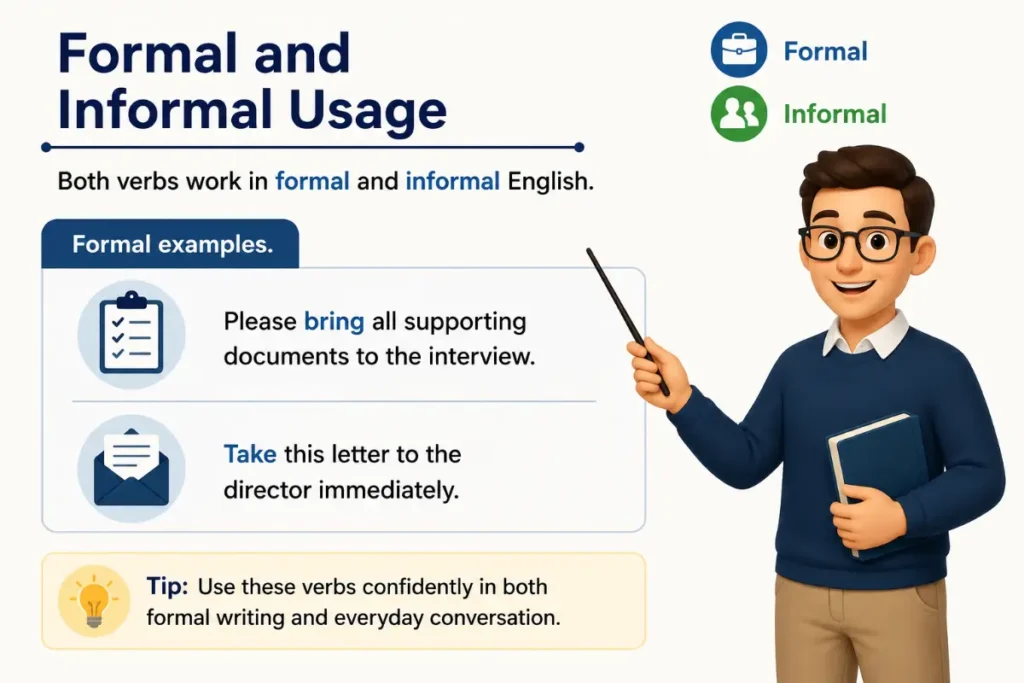
Formal and Informal Usage
Both verbs work in formal and informal English.
Formal examples.
Please bring all supporting documents to the interview.
Take this letter to the director immediately.
Informal examples.
Bring some pizza tonight.
Take your phone with you.
Formal writing simply uses more precise vocabulary around the verbs, but the grammar rule never changes.
American and British English
There is almost no difference between American and British English in the basic use of bring and take.
Speakers in both varieties follow the same direction rule.
American English.
Bring your driver’s license tomorrow.
Take these papers home.
British English.
Bring your driving licence tomorrow.
Take these papers home.
The spelling of nearby words may differ, but the choice between bring and take remains the same.
Pronunciation Guide
| Word | IPA | Simple Pronunciation |
|---|---|---|
| Bring | /brɪŋ/ | Bring |
| Take | /teɪk/ | Tayk |
| Brought | /brɔːt/ | Brawt |
| Took | /tʊk/ | Touk |
| Taken | /ˈteɪkən/ | Tay kun |
Remember that bring is an irregular verb.
Bring, brought, brought.
Take is also irregular.
Take, took, taken.
Examples.
She brought flowers yesterday.
He has brought his laptop.
I took the train this morning.
She has taken the exam.
Word Origin
The word bring comes from Old English bringan, meaning to carry, convey, or cause someone or something to come.
The word take comes from Old Norse taka, meaning to seize, receive, or carry away.
Although both words have existed for centuries, English has consistently used them to express opposite directions of movement.
Common Mistakes
Mistake One
❌ Take your homework to class tomorrow.
This sentence may be correct if the speaker is at home talking before leaving. However, if the teacher is speaking inside the classroom, it should be:
✅ Bring your homework to class tomorrow.
The homework comes to the classroom.
Mistake Two
❌ Bring these boxes to the garage.
If you’re standing in the house sending someone away, the natural choice is:
✅ Take these boxes to the garage.
The boxes leave the current room.
Mistake Three
❌ I’ll take you some coffee when you visit me.
✅ I’ll bring you some coffee when you visit me.
The coffee comes to the visitor.
Mistake Four
❌ Please bring this letter to the post office.
If you’re sending someone from your location to the post office:
✅ Please take this letter to the post office.
The letter leaves your location.
Memory Tips
Learning Bring vs Take becomes much easier if you remember a few simple ideas.
- Think come and go.
Bring works like come.
Take works like go.
- Ask yourself one question.
Is it coming here or going there?
- Imagine an arrow.
Bring points toward you.
Take points away from you.
- Think about deliveries.
The delivery driver brings your package.
You take the package inside.
- Remember one simple phrase.
Bring comes. Take goes.
Related Grammar and Usage Notes
Understanding similar verb pairs helps reinforce the difference between Bring vs Take.
Come vs Go
Come moves toward the speaker. Go moves away from the speaker. Bring and take follow the same directional pattern. Come and bring move toward. Go and take move away.
Borrow vs Lend
Borrow means receive temporarily. Lend means give temporarily. Like bring and take, these verbs describe opposite directions of an action.
Give vs Receive
Give sends something away. Receive accepts something toward you. Thinking about direction makes these pairs much easier to understand and use correctly.
Bring and Take in Professional Writing
Choosing the correct verb makes your writing clearer and more natural. Although readers usually understand your meaning, using bring instead of take, or the other way around, can make a sentence sound awkward. In business writing, emails, reports, and academic papers, always think about the direction of movement before choosing the verb.
Business Email Examples
Correct.
Please bring your identification to the interview.
The identification comes to the interview location.
Correct.
Please take these files to the accounting department.
The files leave the current office.
Correct.
Employees should bring any questions to the meeting.
The questions are presented during the meeting.
Correct.
The manager asked Sarah to take the signed contract to the legal team.
The contract moves away from the manager.
Bring and Take in Phrasal Verbs
Both verbs appear in many common phrasal verbs. Their meanings often extend beyond physical movement.
Phrasal Verbs with Bring
Bring about
Meaning. Cause something to happen.
Example.
The new policy brought about significant improvements.
The policy caused positive changes.
Bring back
Meaning. Return something or make someone remember the past.
Example.
This old photograph brings back happy memories.
The photograph reminds the speaker of earlier experiences.
Bring down
Meaning. Reduce something or make someone unhappy.
Example.
The company hopes to bring down production costs.
The company wants to reduce expenses.
Bring in
Meaning. Introduce or earn something.
Example.
The new product brought in thousands of new customers.
The product attracted additional business.
Bring up
Meaning. Mention a topic or raise a child.
Example.
She brought up an interesting question during the meeting.
She introduced a new topic for discussion.
Phrasal Verbs with Take
Take away
Meaning. Remove something or learn an important lesson.
Example.
The waiter took away the empty plates.
The plates were removed from the table.
Take back
Meaning. Return something or admit something was wrong.
Example.
He took back the jacket because it did not fit.
The jacket was returned to the store.
Take over
Meaning. Gain control of something.
Example.
Lisa will take over the project next week.
She will become responsible for the project.
Take off
Meaning. Remove clothing or leave the ground.
Example.
The airplane took off on time.
The aircraft left the runway.
Take up
Meaning. Begin a hobby or occupy space.
Example.
She recently took up painting.
She started a new hobby.
Idioms That Use Bring
English contains many expressions built around bring.
Bring to Light
Meaning. Reveal something that was hidden.
Example.
The investigation brought to light several important facts.
New information became known.
Bring to Life
Meaning. Make something feel real or exciting.
Example.
The actor brought the character to life.
The performance made the character believable.
Bring Someone to Their Knees
Meaning. Defeat someone completely.
Example.
The economic crisis brought many businesses to their knees.
The businesses struggled to survive.
Bring Home the Bacon
Meaning. Earn money for the family.
Example.
She works hard to bring home the bacon.
She earns the family’s income.
Bring the House Down
Meaning. Receive tremendous applause.
Example.
The comedian brought the house down.
The audience laughed and applauded enthusiastically.
Idioms That Use Take
Many common English idioms also use take.
Take It Easy
Meaning. Relax.
Example.
You have worked all week. Take it easy this weekend.
Take Your Time
Meaning. Do not hurry.
Example.
Take your time choosing a new car.
Take a Chance
Meaning. Try something despite uncertainty.
Example.
He decided to take a chance and start his own business.
Take Control
Meaning. Become responsible.
Example.
The new manager quickly took control of the department.
Take the Lead
Meaning. Become the leader.
Example.
Emma took the lead during the presentation.
Practice Sentences
Choose the correct verb before checking the answer.
Example One
Please _____ your passport to the airport.
Answer.
Bring
The passport comes with you to the airport.
Example Two
Can you _____ these books back to the library
Answer.
Take
The books leave your current location.
Example Three
I’ll _____ dessert to your birthday party.
Answer.
Bring
The dessert comes to the party.
Example Four
Please _____ these documents to the manager.
Answer.
Take
The documents move away from the speaker.
Example Five
Could you _____ me another cup of coffee
Answer.
Bring
The coffee comes toward the speaker.
Example Six
Don’t forget to _____ your umbrella when you leave.
Answer.
Take
The umbrella goes away with you.
Quick Self Check
If you are unsure which word to use, ask yourself these questions.
- Is the person or object coming toward me or the destination?
Use bring.
- Is the person or object leaving this place?
Use take.
These two questions solve almost every Bring vs Take problem.
Key Takeaways
- Bring means movement toward a person, place, or destination.
- Take means movement away from the current place.
- The speaker’s perspective determines which verb is correct.
- Ask yourself, “Is it coming here or going there?” before choosing the verb.
- The same event may use both verbs when different people describe it from different locations.
- Both American and British English follow the same rule.
- Understanding direction is the key to mastering Bring vs Take.
- Regular practice with everyday examples makes the distinction feel natural.
Conclusion
Understanding Bring vs Take becomes much easier once you focus on direction instead of simply thinking about moving an object. Bring is used when someone or something moves toward a person, place, or destination. Take is used when someone or something moves away from the current location toward another place.
Although both verbs describe movement, the speaker’s point of view determines which one is correct. This is why the same situation can sometimes be described with either word. A parent may take a child to school, while the teacher says the parent brings the child to school. Both sentences are correct because each speaker views the action from a different place.
The easiest way to remember the rule is to ask yourself one simple question. Is it coming here or going there? If it is coming, choose bring. If it is going, choose take. With this simple habit and regular practice, you’ll use both verbs naturally and confidently in conversations, emails, school assignments, and professional writing.
Frequently Asked Questions
What is the difference between Bring vs Take?
The difference between Bring vs Take is direction. Bring means moving something toward a person or destination, while take means moving something away from the current place.
Is it bring your homework or take your homework?
Teachers normally say bring your homework because students are bringing it to class. If you are leaving school and talking about carrying it home, you would say take your homework home.
Can both bring and take be correct?
Yes. The same action may use either verb depending on the speaker’s perspective. A parent may say, “I’ll take my daughter to school,” while a teacher says, “Parents bring their children to school.”
Why do English learners confuse Bring vs Take?
Many learners focus on the object instead of the direction. The correct choice depends on where the movement begins and where it ends.
Is Bring vs Take a grammar rule?
Yes. English grammar distinguishes these verbs by direction of movement. This rule is consistent in everyday conversation, professional writing, and formal English.
Are bring and take opposite verbs?
Yes. In many situations they function as opposites. Bring describes movement toward a place or person, while take describes movement away.
Do American and British English use bring and take differently?
No. American and British English follow the same basic grammar rule. Only nearby vocabulary or spelling may differ, not the use of bring and take.
How can I remember Bring vs Take easily?
Remember this simple phrase.
Bring comes. Take goes.
If something comes toward you or the destination, use bring. If it goes away from you, use take.
Is it bring me or take me?
It depends on the direction. Say bring me when someone is coming to your location. Say take me when someone is leading or driving you somewhere else.
Can bring and take describe ideas instead of objects?
Yes. You can bring hope, happiness, or change because these things are introduced. You can take responsibility, advice, or action because these involve accepting, assuming, or performing something.

Confusing Words, Spelling & Word Choice
Claire Whitmore is a U.S.-based English editor who writes about commonly confused words, spelling differences, and word choice. Her work helps readers understand subtle distinctions between similar-looking words through simple definitions, practical examples, and modern usage guidance in both American and British English.