
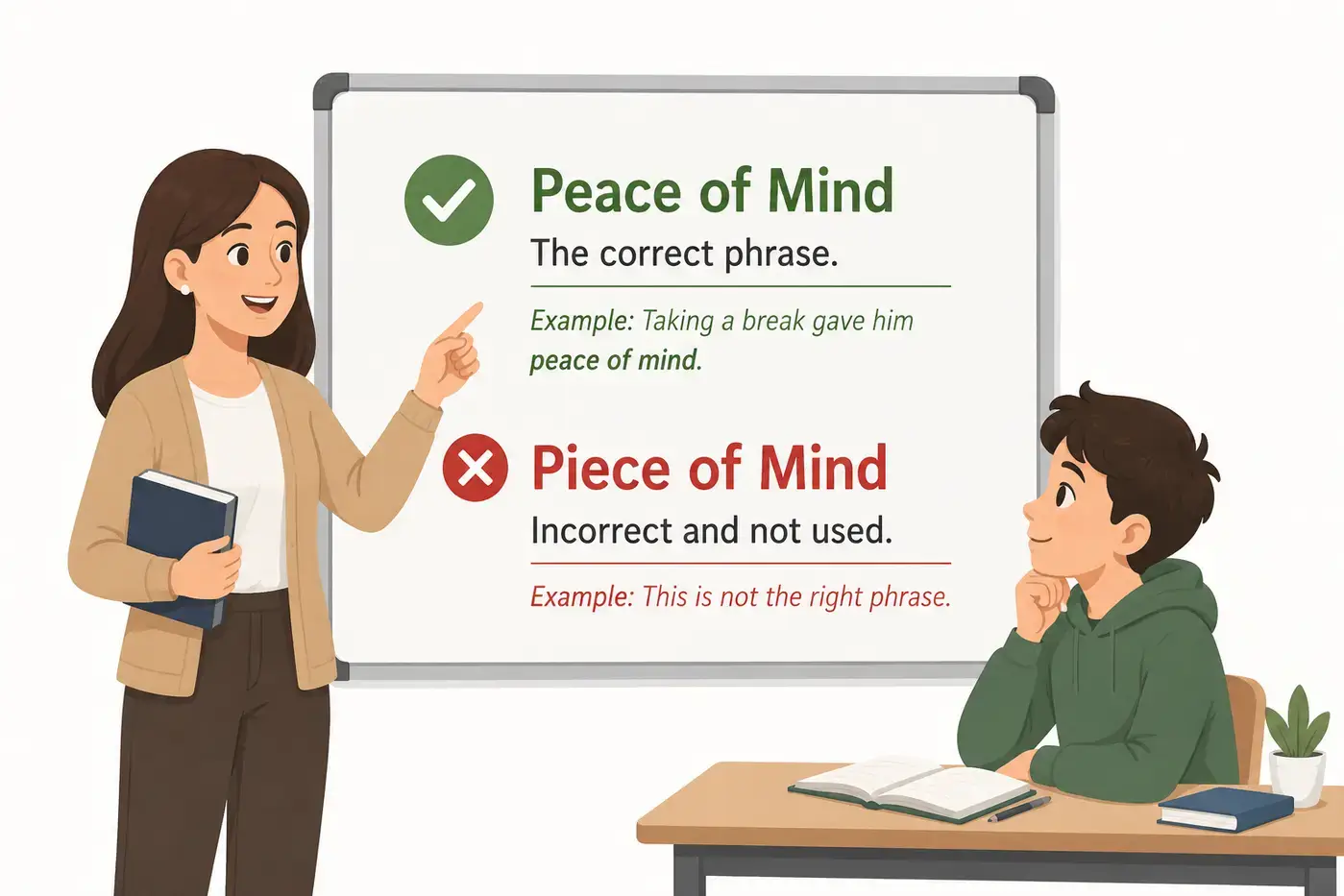
Piece of Mind vs Peace of Mind is a common question because the two words sound exactly alike when spoken. Even experienced English speakers occasionally type the wrong version, especially while writing quickly.
The answer is simple. The correct phrase is peace of mind. It describes a state of mental calm, confidence, or relief after a problem has been solved or a concern has disappeared.
The phrase piece of mind is not a standard English expression. In most situations, it is simply a misspelling caused by confusing two homophones.
Learning the difference helps you write more clearly, avoid embarrassing mistakes, and communicate professionally in emails, business documents, academic writing, and everyday conversations. This guide explains everything you need to know, including meanings, grammar, pronunciation, origins, examples, common mistakes, memory tricks, and expert writing advice.
Short Answer
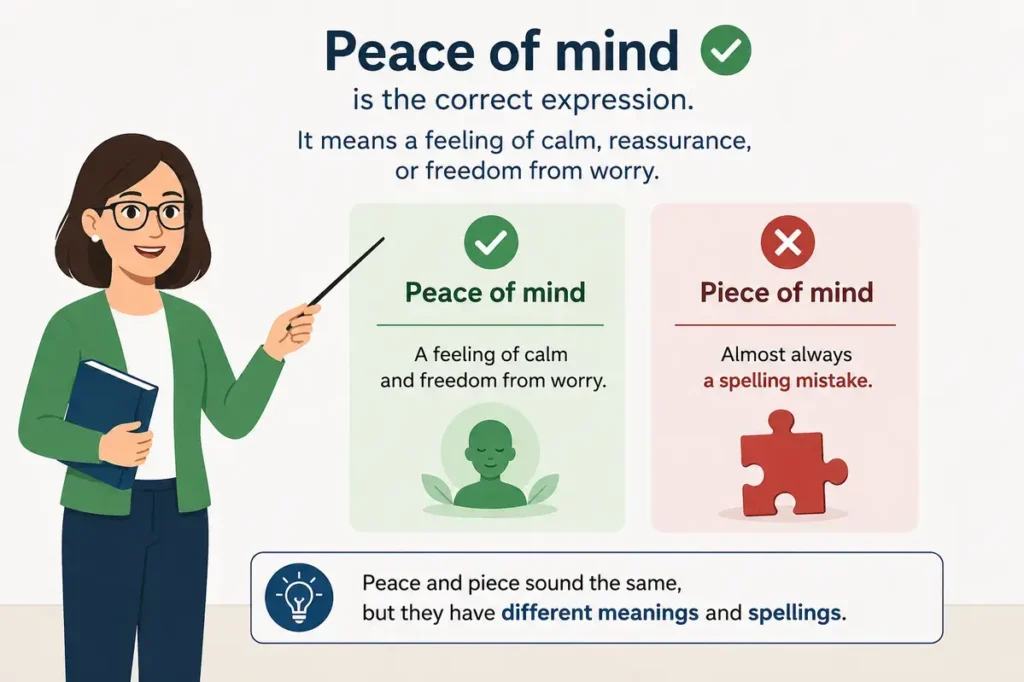
Peace of mind is the correct English expression. It means a feeling of calm, reassurance, or freedom from worry. Piece of mind is almost always a spelling mistake. The confusion happens because peace and piece sound the same, but they have different meanings and spellings.
Table of Contents
- What Does Peace of Mind Mean
- Why People Confuse Piece of Mind and Peace of Mind
- Piece of Mind vs Peace of Mind Comparison Table
- Why Peace of Mind Is Correct
- Is Piece of Mind Ever Correct
- Grammar Rule Behind the Phrase
- How to Use Peace of Mind Correctly
- Example Sentences Explained
- Pronunciation
- Word Origins
What Does Peace of Mind Mean
Peace of mind means feeling mentally calm and free from worry. It describes emotional comfort that comes from knowing everything is under control or that a problem has been resolved. People often use the expression after making a decision that reduces stress.
Examples include buying insurance, checking that the front door is locked, backing up important files, or confirming travel plans before leaving home.
Here are a few examples.
- Buying travel insurance gave us peace of mind before our vacation.
The insurance reduced anxiety about unexpected problems during the trip.
- I checked the oven twice for peace of mind.
Checking again helped the speaker feel calm.
- Her doctor’s explanation gave the family peace of mind.
The information removed uncertainty and worry.
The phrase is common in everyday speech because everyone understands the feeling of relief that comes from certainty.
Why People Confuse Piece of Mind and Peace of Mind
The confusion exists because peace and piece are perfect homophones. They sound identical but have completely different meanings.
| Word | Meaning | Example |
|---|---|---|
| Peace | Calm, harmony, freedom from worry | Peace of mind |
| Piece | A part of something | A piece of cake |
When people hear the expression without seeing it written, they often assume the first word is piece because it is a familiar everyday noun. Autocorrect usually catches the mistake, but not every writing program does.
Search engines also receive thousands of searches every month for the incorrect version because many users type what they hear instead of what they know. This makes it one of the most searched phrase comparisons in English.
Piece of Mind vs Peace of Mind Comparison Table
| Feature | Peace of Mind | Piece of Mind |
|---|---|---|
| Standard English | Yes | No |
| Correct phrase | Yes | No |
| Dictionary recognized expression | Yes | No |
| Meaning | Mental calm and reassurance | No accepted idiomatic meaning |
| Common usage | Extremely common | Usually a spelling mistake |
| Appropriate in professional writing | Yes | No |
| Appears in dictionaries | Yes | No as an idiom |
| Sounds the same | Yes | Yes |
| Recommended spelling | Yes | No |
Why Peace of Mind Is Correct
The expression comes from the ordinary meaning of the noun peace, which refers to calmness, quietness, harmony, or freedom from conflict. When combined with of mind, it literally means a peaceful mental state.
That meaning fits perfectly.
Someone with peace of mind feels relaxed because they are no longer worried.
Examples include the following.
- Keeping an emergency fund gives many people peace of mind.
Having savings reduces financial stress.
- Locking every window before bedtime brings peace of mind.
The speaker feels safer afterward.
- Regular health checkups provide peace of mind.
Knowing your health status reduces uncertainty.
Notice that every example describes emotional comfort instead of a physical object.
That is exactly why peace is the correct word.
Is Piece of Mind Ever Correct
In standard English, piece of mind is almost always considered incorrect.
Since piece means a part of something, the phrase does not naturally express calmness or reassurance.
Occasionally, writers may intentionally use piece of mind in creative works, advertising campaigns, song titles, novels, or artwork as a play on words.
For example, an artist might name a sculpture Piece of Mind because it represents different parts of human thought.
In those situations, the unusual spelling is intentional.
Outside creative contexts, however, readers expect peace of mind.
Using piece of mind in business writing, academic papers, resumes, or professional emails may make your writing appear less polished.
Grammar Rule Behind the Phrase
The expression peace of mind is a noun phrase.
The main noun is peace.
The prepositional phrase of mind explains what kind of peace is being discussed.
Structure:
Peace + of + mind
The phrase functions as a noun.
Examples include the following.
- Peace of mind is priceless.
The complete phrase acts as the subject.
- Good planning gives peace of mind.
The complete phrase acts as the object.
- We all want peace of mind.
Again, the phrase functions as a noun. Because it is an established idiom, the wording does not change. Replacing peace with piece changes the meaning completely and creates a nonstandard expression.
How to Use Peace of Mind Correctly
The expression appears naturally in many situations involving safety, confidence, reassurance, preparation, and emotional comfort.
Personal Life
- Knowing my family arrived safely gave me peace of mind.
The speaker feels relieved after receiving good news.
- I saved copies of every important document for peace of mind.
The extra preparation reduces anxiety.
Business
- Our extended warranty provides customers with peace of mind.
The warranty helps customers feel protected.
- Regular security updates give business owners peace of mind.
They know their systems are better protected.
Healthcare
- The test results gave her peace of mind.
The results removed uncertainty.
- Speaking with a specialist brought the family peace of mind.
Professional advice eased their concerns.
Travel
- Booking refundable tickets gave us peace of mind.
Flexible travel plans reduced stress.
- Travel insurance offers extra peace of mind during international trips.
People feel more secure knowing unexpected expenses are covered.
Education
- Finishing the assignment early gave him peace of mind before the weekend.
Completing the work removed pressure.
- Double checking the calculations gave the student peace of mind before submitting the exam.
The student felt more confident after reviewing the answers.
Example Sentences Explained
Understanding why each sentence works makes the phrase easier to remember.
| Sentence | Why It Is Correct |
|---|---|
| The security system gives us peace of mind. | The system creates reassurance. |
| Paying off the loan brought peace of mind. | Debt relief reduces stress. |
| Backup copies provide peace of mind. | Data protection creates confidence. |
| She wanted peace of mind before signing the contract. | Confidence comes before making an important decision. |
| Calling home gave him peace of mind. | Hearing loved ones were safe removed worry. |
| Installing smoke detectors gave the family peace of mind. | Safety measures create reassurance. |
Every example shares the same idea.
Someone feels calmer after taking an action or receiving reassuring information.
Pronunciation
Both phrases are pronounced exactly the same.
Peace of mind
/piːs əv maɪnd/
Piece of mind
/piːs əv maɪnd/
Because the pronunciation is identical, only the spelling reveals which phrase is correct. This makes the mistake especially common in emails, text messages, social media posts, and online searches.
Word Origins
Understanding the history of each word makes the distinction easier to remember.
Peace
The word peace comes from Old French pais, which traces back to the Latin word pax, meaning harmony, tranquility, agreement, or freedom from conflict.
Over time, English speakers expanded the meaning beyond the absence of war. Today, peace also describes emotional calm and inner tranquility, which explains the expression peace of mind.
Piece
The word piece comes from Old French piece, meaning a part, portion, fragment, or section of something larger. Its meaning has always referred to physical or abstract parts rather than emotional states.
That historical difference explains why piece of mind does not express the intended idea of calmness or reassurance. The meanings of the two words have remained distinct for centuries, even though they sound exactly alike.

Real Life Examples
You will hear peace of mind in conversations about health, money, travel, technology, education, and everyday life. The phrase fits almost any situation where someone feels less anxious after taking a sensible step.
Home Safety
- We installed outdoor cameras for peace of mind.
The cameras help the family feel safer, even if they never record an incident.
- Locking every door before leaving gives me peace of mind.
Checking the locks removes doubt.
Finance
- Having an emergency fund gives many people peace of mind.
Savings reduce worry about unexpected expenses.
- Paying bills on time brings peace of mind.
Financial responsibilities feel more manageable.
Health
- The doctor’s explanation gave her peace of mind.
Understanding the situation eased her fears.
- A second medical opinion brought the family peace of mind.
Extra confirmation reduced uncertainty.
Technology
- Cloud backups provide peace of mind if a computer fails.
Important files remain protected.
- Two factor authentication gives users peace of mind.
Extra security lowers the risk of unauthorized access.
Travel
- Buying travel insurance gave us peace of mind before flying overseas.
The policy helped us feel prepared for unexpected events.
- Confirming the hotel reservation gave everyone peace of mind.
There was no longer any doubt about the accommodation.
Education
- Reviewing my notes one last time gave me peace of mind before the exam.
The final review increased confidence.
- Submitting the project early gave the team peace of mind.
Finishing ahead of the deadline removed pressure.
Common Mistakes
Many writers make small errors because the words sound identical. Knowing the most common mistakes makes them easier to avoid.
| Incorrect | Correct | Why |
|---|---|---|
| Piece of mind | Peace of mind | The expression refers to calmness, not a part of something. |
| I need some piece of mind. | I need some peace of mind. | Peace means mental calm. |
| The warranty gives piece of mind. | The warranty gives peace of mind. | The phrase is a fixed idiom. |
| We bought insurance for piece of mind. | We bought insurance for peace of mind. | Insurance provides reassurance. |
| Peace of mine | Peace of mind | Mind is the correct noun in the expression. |
These mistakes often appear in emails, advertisements, blogs, and social media posts because spell checkers may not recognize that the wrong homophone has been used.
Why Spell Check Sometimes Misses the Error
Spell check looks at individual words.
Both peace and piece are correctly spelled English words.
As a result, many writing tools do not recognize that the phrase is incorrect.
For example:
Incorrect: I finally have piece of mind.
Every word is spelled correctly, so basic spell checking may accept it.
A grammar checker that understands context is much more likely to suggest peace of mind.
This is one reason proofreading remains important, especially in professional writing.
Memory Tips
Simple memory tricks can help you remember the correct phrase every time.
Think About Calm
The word peace means calm.
If you feel calm, you have peace of mind.
Connect It With Quiet
Peace is associated with quiet, relaxation, and harmony.
Since the phrase describes a peaceful feeling, peace is the logical choice.
Picture a Peaceful Mind
Imagine your mind becoming calm after solving a problem.
That mental image naturally connects peace with mind.
Remember What Piece Means
A piece is only one part of something.
You cannot have a “part of your mind” when you are talking about feeling relaxed.
That meaning simply does not fit the expression.
Peace of Mind in American and British English
One advantage of this expression is its consistency.
Both American English and British English use peace of mind.
The spelling does not change between the two varieties of English.
| American English | British English |
|---|---|
| Peace of mind | Peace of mind |
| Correct | Correct |
| Common in speech | Common in speech |
| Common in writing | Common in writing |
Unlike words such as color and colour or organize and organise, this phrase remains exactly the same on both sides of the Atlantic.
Formal and Informal Usage
Peace of mind works well in every level of English.
Formal Writing
Companies often use the phrase in contracts, advertisements, and customer service materials.
Example:
“Our extended warranty provides additional peace of mind.”
Academic Writing
Researchers sometimes use the phrase when discussing mental well being or consumer confidence.
Example:
“The intervention improved participants’ peace of mind.”
Everyday Conversation
Friends and family use the phrase naturally.
Example:
“I called Mom just for peace of mind.”
Because the expression is widely accepted, it sounds appropriate in nearly every context.
Professional Writing Tips
Professional writers use peace of mind because it communicates reassurance in a simple and familiar way. Keep these guidelines in mind.
- Use the exact phrase without changing the wording.
- Avoid replacing peace with piece.
- Use the phrase only when discussing emotional reassurance or reduced anxiety.
- Do not overuse it. Repeating the same expression several times in one paragraph can make your writing sound repetitive.
- Pair it with actions that naturally create confidence.
For example:
“Regular software updates provide peace of mind.”
“Secure payment processing gives customers peace of mind.”
These combinations sound natural because the action clearly leads to reassurance.
Related Expressions
English offers several expressions that share a similar meaning with peace of mind.
| Expression | Meaning |
|---|---|
| Rest easy | Stop worrying. |
| Feel reassured | Become less anxious. |
| Sleep better at night | Feel more secure because a problem has been solved. |
| Put your mind at ease | Remove worry or concern. |
| Breathe easier | Feel relieved after uncertainty ends. |
| Sense of security | Feeling protected or safe. |
| Relief | Freedom from stress or concern. |
| Confidence | Trust that everything will be fine. |
Although these expressions have similar meanings, peace of mind remains the most common and widely recognized.
Similar Words That People Also Confuse
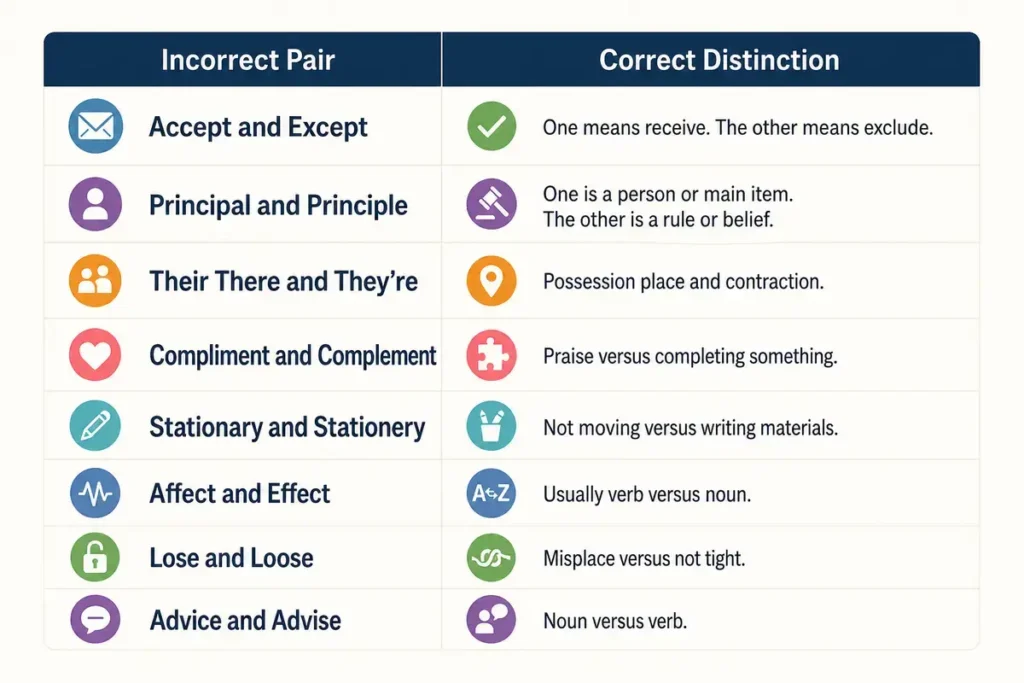
English contains many homophones that cause mistakes similar to this phrase.
| Incorrect Pair | Correct Distinction |
|---|---|
| Accept and Except | One means receive. The other means exclude. |
| Principal and Principle | One is a person or main item. The other is a rule or belief. |
| Their There and They’re | Possession place and contraction. |
| Compliment and Complement | Praise versus completing something. |
| Stationary and Stationery | Not moving versus writing materials. |
| Affect and Effect | Usually verb versus noun. |
| Lose and Loose | Misplace versus not tight. |
| Advice and Advise | Noun versus verb. |
Learning these pairs improves both spelling accuracy and confidence.
Key Takeaways
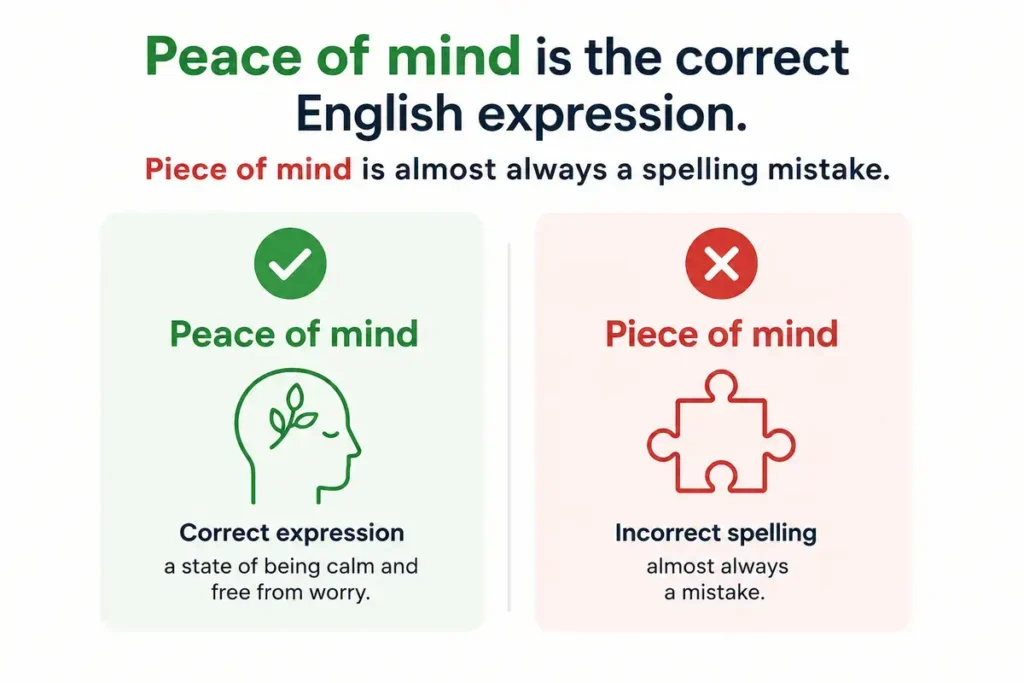
- Peace of mind is the correct English expression.
- Piece of mind is almost always a spelling mistake.
- Peace means calm, reassurance, or freedom from worry.
- Piece means a part of something and does not fit this idiom.
- Both phrases sound exactly the same because peace and piece are homophones.
- The expression is correct in both American English and British English.
- Remember the meaning instead of the sound. If you are talking about feeling calm, choose peace.
Quick Reference Table
| Question | Answer |
|---|---|
| Correct phrase | Peace of mind |
| Incorrect phrase | Piece of mind |
| Meaning | A feeling of calm, reassurance, or freedom from worry |
| Part of speech | Noun phrase |
| Common mistake | Confusing the homophones peace and piece |
| Used in American English | Yes |
| Used in British English | Yes |
| Suitable for formal writing | Yes |
| Suitable for informal conversation | Yes |
Final Thoughts
The debate over Piece of Mind vs Peace of Mind has a clear answer. The correct phrase is peace of mind, and it has been the accepted English expression for generations. It describes the comforting feeling that comes from knowing things are under control, a problem has been solved, or a decision has reduced uncertainty. The incorrect version, piece of mind, appears frequently because peace and piece sound exactly alike. This is a classic homophone error. While both words are valid English words, only peace conveys the idea of calmness and reassurance that the idiom expresses.
If you remember one simple rule, make it this: peace brings calm, while a piece is only a part of something. That meaning makes the correct spelling easy to recognize every time you write. Using peace of mind correctly will make your emails, reports, essays, articles, and everyday communication look more polished and professional. It is a small detail, but choosing the right word shows careful writing and a strong command of English.
Frequently Asked Questions
Is Peace of Mind Always Two Separate Words?
Yes. The standard expression is always written as peace of mind. Each word remains separate.
Can Piece of Mind Ever Be Correct?
Only as intentional wordplay, a creative title, a brand name, or another artistic use. In normal English writing, use peace of mind.
Why Are Peace and Piece So Easy to Confuse?
They are homophones. They have the same pronunciation but different spellings and meanings.
Is Peace of Mind an Idiom?
Yes. It is an established English idiom that means feeling mentally calm or free from worry.
What Is Another Way to Say Peace of Mind?
Depending on the context, you can say reassurance, relief, a sense of security, confidence, mental calm, or feeling at ease.
Can I Use Peace of Mind in Professional Writing?
Yes. It is common in business, legal, financial, healthcare, education, technology, and customer service writing.
Is Peace of Mind Common in Advertising?
Yes. Companies often use the phrase to emphasize security, reliability, protection, and customer confidence. Examples include insurance, cybersecurity, banking, home security systems, warranties, and travel services.
Does Peace of Mind Mean Happiness?
Not exactly. Happiness is a broad emotional state, while peace of mind specifically refers to feeling free from worry, stress, or uncertainty.
Yes. The feeling can be temporary or long lasting.
How Can I Remember the Correct Spelling?
Think about the meaning. If you are talking about calmness or reassurance, choose peace because peace means harmony and tranquility. Piece means a part of something, so it does not fit the expression.

Idioms, Expressions & Figurative Language
Mason Ellsworth is an American language writer with a passion for English expressions, figurative language, and everyday communication. He explains idioms, similes, popular phrases, and commonly misunderstood expressions in a straightforward, engaging style that helps readers improve both their writing and spoken English.